



Abstract
In 2001, a compulsory active surveillance system was started in the European Union to assess the prevalence of bovine spongiform encephalopathy (BSE) in the cattle population. The aim of the current study was to report on the field performances of 3 rapid tests: a Western blot (WB), a chemiluminescence enzymelinked immunosorbent assay (ELISA), and an immunochromatographic assay, routinely used at 3 laboratories of the Istituto Zooprofilattico Sperimentale of Lombardia and Emilia Romagna, over 8 years of BSE monitoring activity. A total of 2,802,866 samples from slaughtered animals and 202,453 samples from fallen stock were tested by 1 of 3 tests. Positive results of the rapid tests were confirmed by histopathological examination, immunohistochemistry, and confirmatory WB. The field performances (i.e., initial reactive and false-positive rates) and practical aspects regarding resources and applicability of the tests to high-throughput routine testing laboratories were evaluated. The 3 tests proved to be reliable tools when applied to slaughtered samples, showing no or very low false-positive rates (<1 per 100,000 negative samples tested) and low retesting frequencies (0.02-0.26%). When samples from fallen stock were analyzed, performances of the immunochromatographic assay, and especially the chemiluminescence ELISA, were negatively affected, resulting in higher false-positive and retesting rates. On the other hand, both tests are less expensive, much easier to use, provide more rapid results, and adapt well to application in routine laboratories as compared with WB. In the authors' experience, the immunochromatographic assay was a good compromise between performance and convenience.
Bovine spongiform encephalopathy (BSE) is a fatal neurologic disease of domestic cattle that was first recognized in Great Britain in 1986. 15 It belongs to the group of disorders known as prion diseases. These diseases are characterized by the accumulation, mainly in the central nervous system, of PrPsc, which is an abnormal, partially protease-resistant isoform of the host-encoded prion protein PrPc. 2 A compulsory active surveillance system for BSE was introduced at the beginning of 2001 in the European Union to determine the scale of the epidemic in the cattle population. At that time, 3 rapid tests, the Enfer a test, the Platelia b test, and the Check WESTERN c test, were approved by the European Commission (EC) as surveillance tools. 10 To date, 9 tests are approved for BSE screening of cattle. 7,8 The aim of the EC approval is to guarantee the efficiency of the BSE diagnostic procedure in all EU member states, using only tests with a high standard of performance (i.e., a high diagnostic specificity and sensitivity), as determined by independent test evaluation.
In Italy, active surveillance is carried out at the Istituti Zooprofilattici Sperimentali (IZS) laboratories, which are located all over the country and authorized by the health administration. The IZS of Lombardia and Emilia Romagna (IZSLER) set up 3 laboratories located in Brescia, Modena, and Milan, all with an accredited quality management system in place. The Brescia and Modena laboratories are high-throughput laboratories organized to test on average 800-1,000 samples per day, while the Milan laboratory is equipped to analyze approximately 150 samples per day. At the beginning of the active surveillance, the IZSLER laboratories used the Check WESTERN c test, based on Western blot (WB) technique, which was replaced in mid-2005 by the Check LIA c test, a chemiluminescence enzyme-linked immunosorbent assay (ELISA). In the spring of 2008, the Check PrioSTRIP c test, an immuno-chromatographic assay (ICA), was adopted. Samples that classified as positive by rapid tests were forwarded to the Italian National Reference Laboratory (CEA), where confirmatory diagnosis was performed by testing all positive samples with 3 World Organization for Animal Health-recommended methods (histopathological examination, immunohistochemistry, and WB). 16
More than 3 million samples were tested within the active monitoring scheme from January 2001 until the end of December 2008. Most samples came from healthy slaughtered cows, approximately 15% from casualty slaughtered animals, and nearly 7% from fallen stock. From September 2001 to March 2005, all cattle older than 24 months that had died naturally or had been slaughtered were subjected to BSE monitoring by rapid tests. In March 2005, the age of healthy slaughtered bovine to be tested was increased to 30 months. The tissue sample submitted to the laboratories was the caudal brainstem, including the medulla and the obex, from which the assay specimen was taken (0.45–0.7 g). Samples coming from the slaughterhouses were stored at 4°C and tested within a few hours, while fallen stock samples were cut longitudinally along the midline into 2 symmetric parts, each containing 1 motor nucleus of the vagus nerve. One-half was stored at −20°C until the rapid test was carried out, and the other was preserved in 10% formol saline for confirmatory purposes. Although most samples tested were collected from freshly slaughtered animals and were in good condition, a proportion, especially from fallen stock, were classified as poor-quality samples (included autolyzed samples from both partially to completely autolyzed tissues and samples in which the submitted tissue did not include the obex). In these cases, the samples were tested, but the result, when negative, was not valid for official purposes and was reported with the caveat that optimal tissues were not available for testing. The aim of the current study was to evaluate field performances (i.e., initial reactive and false-positive rates) and practical aspects regarding resources and applicability of the 3 tests in high-throughput routine laboratories.
The tests were performed and interpreted according to the manufacturers' instructions. In all 3 tests, the brain tissue homogenates were subject to proteolytic treatment with proteinase K (PK), which completely digests PrPc to allow immunological detection of PrPsc, in positive samples. In particular, the WB is based on a PrP-specific monoclonal antibody (6H4) c and an alkaline phosphatase-conjugated antibody combined to a chemiluminescence detection system. 11 The sample is positive when the 3-band pattern of PrP27-30kD is identified. Each sample is tested in duplicate. The minimum time to complete the test is approximately 7-8 hr. The ELISA uses the 6H4 c monoclonal antibody as the capture antibody and a second horseradish peroxidase-conjugated antibody as the tracer. 3 The results of the chemiluminescence measurements are expressed as relative light units and elaborated by a dedicated software that determines a dynamic cutoff value for each plate to distinguish positive from negative results. Test results are obtained within 4 hr. The ICA is based on a lateral flow system, 13 which uses 2 different monoclonal antibodies. The detection antibody is conjugated to blue latex microbeads. The results are interpreted automatically by densitometer analysis with a dedicated scanner and software that converts the blue lines on the strip into digital data, expressed as relative density units. The cutoff value is kit-lot dependent. Results can be obtained in 1 hr and 40 min. In both ELISA and ICA, each sample is tested singularly. Samples scoring above the cutoff value are considered initially reactive and are repeated in duplicate. A sample is considered positive if at least 1 duplicate scores above the cutoff value.
Tables 1 and 2 summarize the activity performed by the IZSLER laboratories on samples collected from slaughtered cattle and fallen stock, respectively. The false-positive rate (i.e., the proportion of all negative samples that were incorrectly identified as positive by the rapid tests but not confirmed by CEA) was estimated. In the current study, the false-positive rates were determined under the assumption that all rapid-test negative results were true negative samples. Under field conditions of the BSE surveillance scheme, false-negative samples remain unrecognized, as confirmation of rapid-test negative results is not part of the active surveillance program. However, in the EU, only rapid tests proven to be highly specific, and hence showing extremely low false-negative results, are used. For all false-positive rate estimations, respective 95% confidence intervals (CIs) were calculated according to the Clopper and Pearson method. 1 The null hypothesis (i.e., no difference between false-positive rate) was rejected when the 95% CIs of the false-positive rate do not overlap.
More than 2.8 million samples from slaughtered animals were tested (Table 1), and 81 positive cases of BSE were identified. Among them, 2 were classified by CEA as a novel phenotype of BSE called bovine amyloidotic spongiform encephalopathy. 5 No false-positive results were scored by WB or by ICA, while the ELISA test scored 9 false-positive samples, resulting in a false-positive rate of 0.94 per 100,000 negative samples tested, significantly higher than the WB. The ELISA false-positive rate is not statistically higher than that of ICA, but it should be noted that the sample size analyzed by ICA was much lower than that of the other 2 tests.
More than 200,000 fallen stock samples were also tested, and 7 BSE cases were identified (Table 2). Western blot did not show any false-positive samples. The absence of false-positive results and the identification of 2 BSE cases in poor-quality samples confirm the excellent performance of WB on samples from fallen stock, as previously reported. 4,6,14 On the other hand, ELISA and ICA exhibited false-positive rates as high as 84.30 and 8.48 per 100,000 negative samples tested, respectively. The ELISA on fallen stock gave an overall false-positive rate statistically higher than both WB and ICA and also about 90 times higher than the rate observed on slaughterhouse samples.
Poor-quality samples accounted for 83% of the false-positive samples detected by ELISA and for the 2 false-positive samples detected by ICA. The quality of the sample seemed to affect the performance of the ELISA more than the performance of the ICA but did not affect the performance of the WB. The high correlation between false-positive results and poor-quality samples suggests that in these samples, the PK may have been partially inhibited, thus preventing the total digestion of the PrPc. Another reason for false-positive samples might be the presence of components in severely autolyzed tissue that interfered with the ELISA, as reported by other authors. 9
The rate of retesting by each of the 3 tests was also evaluated, and respective 95% CIs were calculated as described above. 1 Sample retesting in WB was due to technical problems, caused by the high number of steps involved in the analysis that made the results on the film illegible (Fig. 1). One of the most common reasons the WB results were illegible was the presence on the film of bands corresponding to residual PrPc that was not completely digested by PK. The incomplete digestion of PrPc might also be responsible for some of the initially reactive and/or false-positive results in ELISA and ICA, as shown by the WB analysis of some ELISA false-positive samples, in which the presence of residual undigested PrPc was revealed (data not shown). Each time the films showed a remarkably low signal of the control sample (PrPc), the samples were retested because the complete or partial omission of the 6H4 c monoclonal antibody was determined to be the cause: the faint bands present on the films were due to the nonspecific reaction of the secondary antibody with the control sample and the PK. The ELISA had the highest rate of sample retesting, while the ICA had the lowest, in both slaughtered and fallen stock samples. While WB showed very similar sample-retesting rates in slaughtered and fallen stock samples, ELISA and ICA sample-retesting rates in fallen stock samples were 3.1 and 2.5 times higher, respectively. However, all 3 tests showed low retesting rates when compared with those reported in other studies on field performance of ELISA-based and WB rapid tests for the diagnosis of prion diseases in sheep and goats. 12 During the EC 2003 field trial (Opinion of the Scientific Steering Committee on the field trial evaluation of the 2 new rapid BSE postmortem tests, http://ec.europa.eu/food/fs/sc/ssc/out316_en.pdf. Accessed March 21, 2009), the ELISA was reported with a sample-retesting rate of 0.09%, lower than the value observed in IZSLER (Table 1). A slight increase is likely when the day-to-day activity in routine high-throughput testing laboratories in the field is recorded.
Rapid test performance on slaughtered samples at Istituto Zooprofilattico Sperimentale della Lombardia ed Emilia Romagna evaluated over 8 years of monitoring activity.*
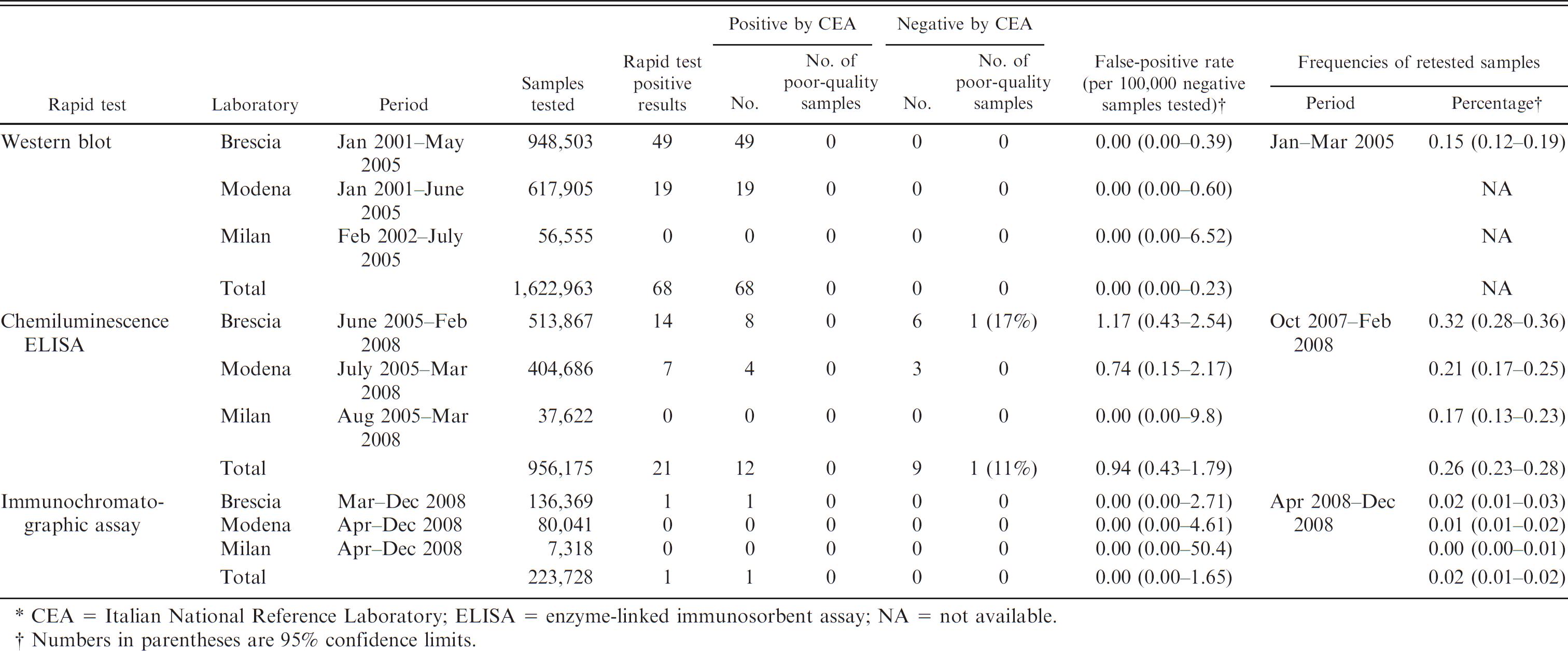
CEA = Italian National Reference Laboratory; ELISA = enzyme-linked immunosorbent assay; NA = not available.
Numbers in parentheses are 95% confidence limits.
Rapid test performance on fallen stock samples at Istituto Zooprofilattico Sperimentale della Lombardia ed Emilia Romagna evaluated over 8 years of monitoring activity.*
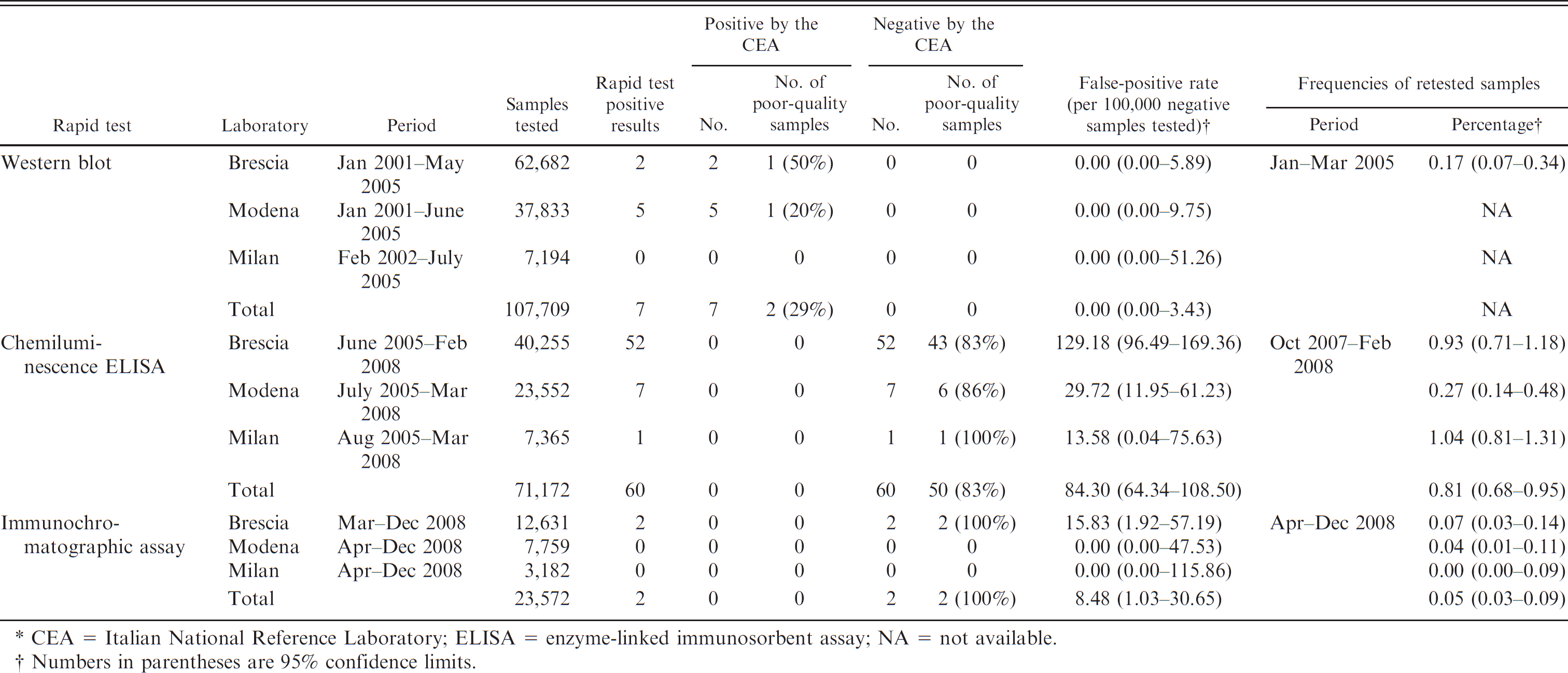
CEA = Italian National Reference Laboratory; ELISA = enzyme-linked immunosorbent assay; NA = not available.
Numbers in parentheses are 95% confidence limits.
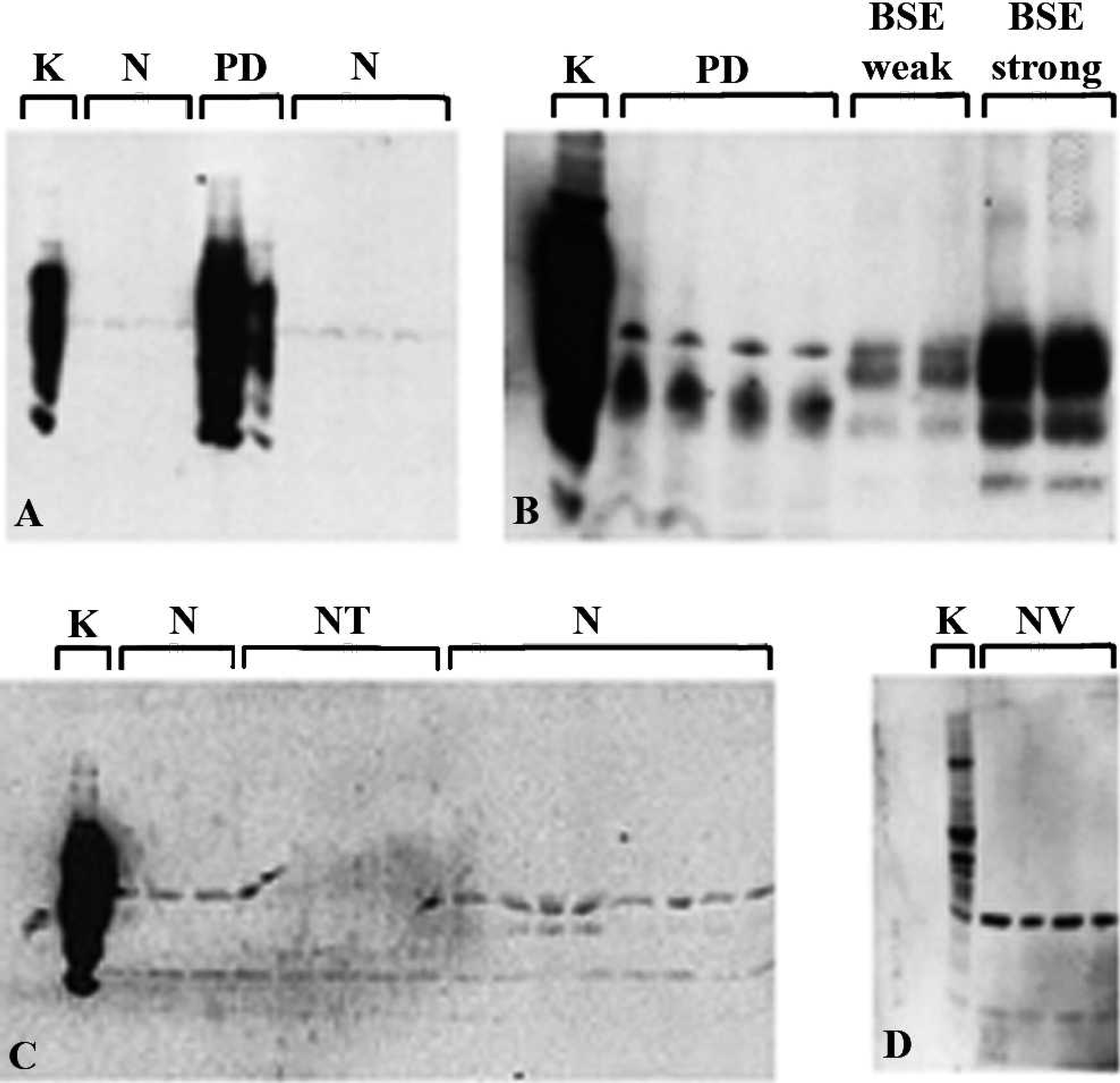
The most frequent technical problems encountered using the Western blot. A, incomplete proteinase K (PK) digestion in the sample in both duplicates (PD): the quantity of residual PrPc makes the result illegible, B, incomplete proteinase K digestion (PD): the quantity of residual PrPc did not prevent the interpretation of the result, C, inefficient transfer of proteins to the membrane due to the presence of air bubbles (NT), D, weak control sample (K) signal due to the omission of the first antibody (6H4), c the result of the samples are not valid (NV). K = control sample (PrPc); N = negative sample; PD = partially digested sample; NT = not transferred sample; NV = not valid sample; BSE = bovine spongiform encephalopathy.
The higher rate of initially reactive and false-positive results scored in samples from fallen stock when compared with slaughtered animals correlated well with the percentage of poor-quality samples analyzed in each of the 2 categories: 0.003% in the case of samples from slaughtered animals and 29.9% in samples from fallen stock (values evaluated in IZSLER laboratories in March-December 2008). Of the 3 tests, the ELISA exhibited the most variable performances among the 3 laboratories, both in slaughtered and fallen stock samples, regarding both false-positive rate and sample-retesting frequencies.
Practical aspects of the use of the 3 rapid tests to analyze 1,000 samples a day in the laboratory.
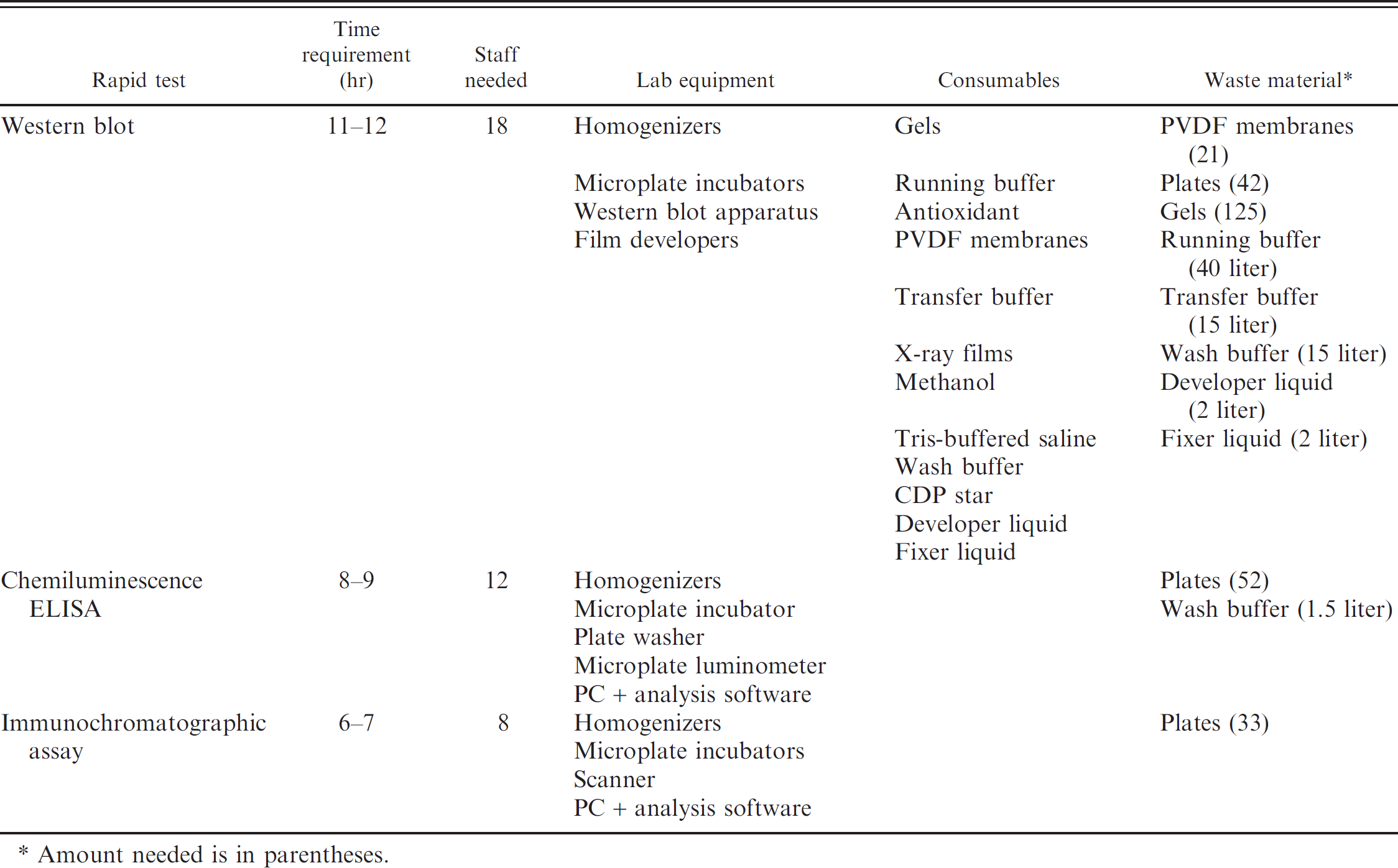
Amount needed is in parentheses.
All 3 tests allow for the analysis of hundreds of samples per day, but they are endowed with significant technical and practical differences (Table 3). During the period of WB and ELISA usage, laboratory staff worked in 2 shifts for a total of 12–13 hr per day. Starting with the use of ICA, only 1 shift was required. Western blot required a specific 1-month training, while 10 days of training were sufficient for ELISA and ICA. Western blot is the only test in which the waste material is a problem, as this test requires the use of hazardous chemicals. Since the commercial price of 1 test is exactly the same for WB, ELISA, and ICA (price on Italian market, March 2009), staff, equipment, and consumables are the features that weigh most on the overall cost of the analysis. In IZSLER's experience, the adoption of ELISA resulted in a reduction of resources (equipments and consumables), of 33% of needed personnel, and of 3 hr to test 1,000 samples per day. Further reductions of resources, of 33% for technicians and of 2 hr, were the consequence of the subsequent adoption of ICA, with significant economic and time savings.
In conclusion, results highlighted the importance of the sample quality on rapid test performance in field conditions. Indeed, while all 3 tests proved to be reliable tools when applied to field conditions using slaughtered samples, when fallen stock samples were analyzed, the performances of ICA, and especially ELISA, were negatively affected, resulting in higher false-positive and retesting rates. On the other hand, ELISA, and especially ICA, is less expensive, much easier to use, provides more rapid results, and adapts well to the application to high-throughput routine laboratories. Consequently, in the experience of IZSLER, ICA was a good compromise between performance and cost.
Acknowledgements. The authors wish to thank the staff at the IZSLER laboratories for their excellent technical assistance.
Footnotes
a.
Enfer Diagnostics Unit T, Naas, Co. Kildare, Ireland.
b.
Bio-Rad Laboratories, Paris, France.
c.
Prionics AG, Schlieren-Zurich, Switzerland.