



Abstract
Toxicosis caused by the ingestion of onion (Allium cepa) by 5 water buffalo (Bubalus bubalis) occurred in the district of Caçador, Santa Catarina, Brazil. The water buffalo died after ingestion of a large quantity of onion that had been left in the pasture. Clinical signs started 8 days postingestion and were characterized by pale mucous membranes, lethargy, and dark urine. At necropsy, pieces of onions were found in the rumen of 1 animal. The carcass smelled strongly of onion, and the kidneys and urine were dark brown. Microscopic renal lesions included tubular degeneration and necrosis with deposits of eosinophilic material in the cytoplasm of renal tubular epithelial cells and tubular lumina. These changes were consistent with hemoglobinuric nephrosis. Centrilobular coagulation necrosis was observed in the liver accompanied by hemorrhage and macrophages containing brown cytoplasmic pigment. A diagnosis of hemolytic anemia caused by onion toxicosis was based on the epidemiological data, clinical signs, macroscopic changes, and histological lesions.
Hemolytic anemia caused by spontaneous ingestion of onion (Allium cepa) has been previously reported in cattle, sheep, dogs, cats, and horses. 1,3,7,8,10,14,15,18,25,27 Moreover, experimental disease also has been reported in sheep, dogs, and cats. 4–6,21,22 The epidemiology of onion toxicosis differs among species. Toxicosis occurs in sheep that gain access where onions are commercially cultivated or in horses grazing in areas where wild onions grow. 1,15 Toxicosis outbreaks in cattle occur mainly where culled cultivated onions are inadvertently fed to livestock or where animals have access to places where onions are stored. 7,10,18,27 Dogs are usually affected by ingestion of homemade food or when onions are used to improve the flavor of diets prepared for ill animals. 3,14 In cats, onion toxicosis can occur after the ingestion of some human baby foods, which are fed to anorexic animals because of higher palatability. 8,21
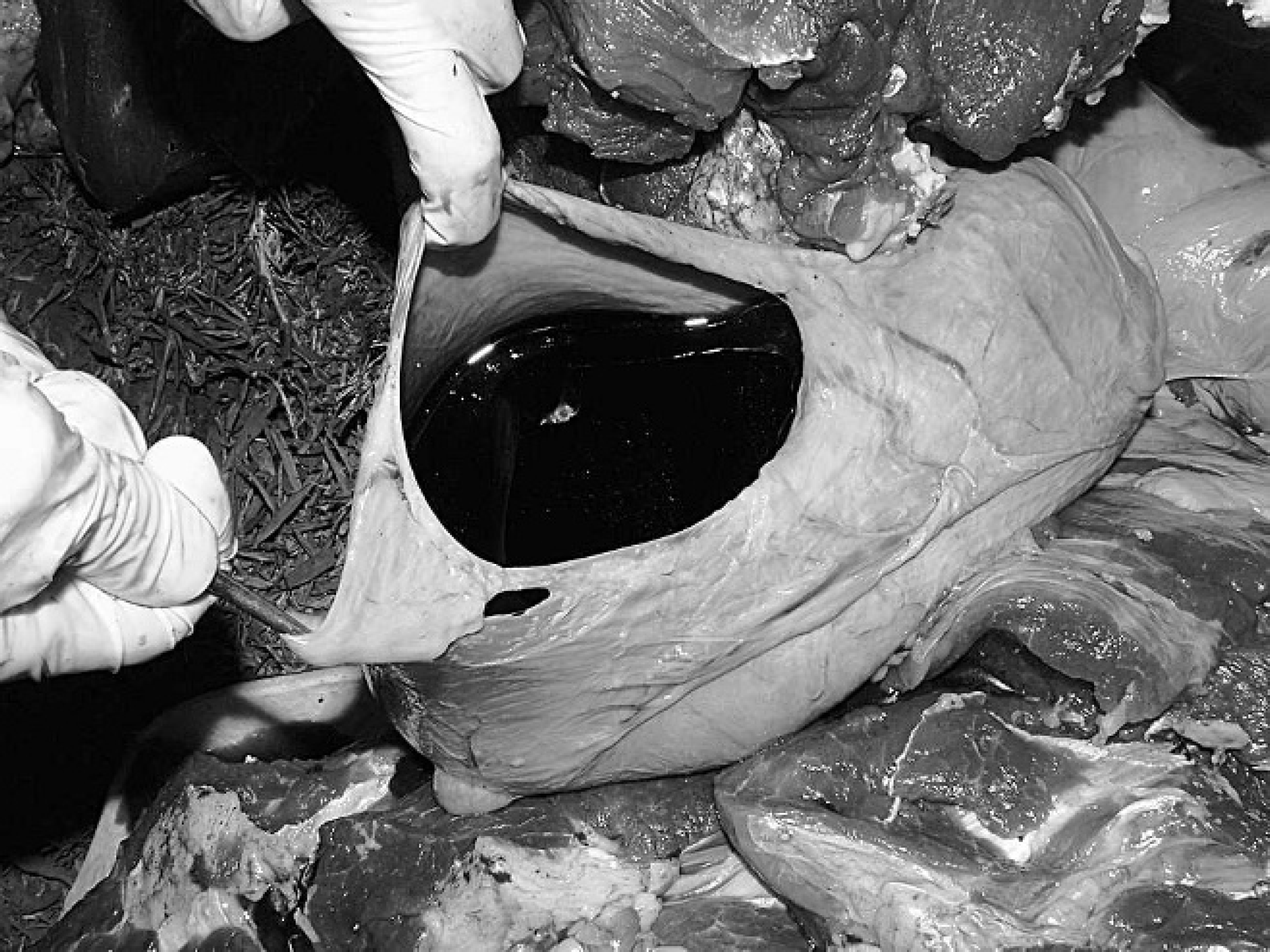
Urinary bladder; water buffalo. Dark brown urine.
Onion toxicosis can be associated with severe methemoglobinemia, leading to cyanosis hemolytic anemia with the formation of Heinz bodies, and death. 1,4,6,8,14,15,18,21,27 The clinical signs observed in cattle with onion toxicosis include inappetence, staggering, abortion, onion odor of the breath and feces, elevated heart and respiratory rates, pale mucous membranes, jaundice, and elimination of brown urine. 7,10,18,27 Common necropsy findings include jaundice or pallor of tissues, dark brown kidneys and urine, tissues with a strong odor of onion, and fragments of onion seen within the rumen. 7,18 Reported histological changes are centrilobular necrosis and vacuolization of hepatocytes in midzonal areas of the liver and hemoglobinuric nephrosis in the kidneys. 7,18
Onion-induced hemolytic anemia has been known for decades, but current studies have shown that more than 1 toxic principle is involved in toxicosis. Onions, garlic, and other plants of the Allium genus contain disulfides, n-propyl disulfate, and S-methyl and S-prop(en)yl cysteine sulphoxides (SMCO) derived from amino acids. 2,6,22,28,29 The SMCO are hydrolyzed in the rumen by anaerobic bacteria to thiosulfonate, which is then further metabolized to dipropyl disulfides and dipropenyl disulfides. 2,13,22 These disulfides are responsible for oxidative damage in erythrocytes. 13,28,29 In affected animals, heme iron is oxidized to the ferric state, producing methemoglobin. Methemoglobin is unable to transport oxygen and, when produced in high concentration, can rapidly lead to death. 4,6,28 Moreover, oxidative damage results in precipitation and aggregation of hemoglobin and its binding to the cytoplasmatic membrane, forming Heinz bodies. 19 Intraerythrocytic Heinz bodies are recognized and phagocytosed by splenic and, to a lesser extent, hepatic macrophages, resulting in extravascular hemolysis. 20 Intravascular hemolysis also may occur because erythrocytes containing Heinz bodies have decreased deformability and can burst when passing through sinusoids or small capillaries. 12,20 Another mechanism of intravascular hemolysis following ingestion of high doses of oxidative agents is direct damage to the erythrocytic plasma membrane, causing cellular lysis. 19 Some species are more resistant to oxidative damage than others. Dogs and cats are most susceptible, followed by cattle, horses, and sheep. 9 Many factors are related to the wide variation to erythrocytic damage among species, including differences in the structure of the hemoglobin and efficiency of protective enzyme systems. 9 The current report describes the clinical, macroscopic, and histologic findings of onion toxicosis in water buffalo (Bubalus bubalis).
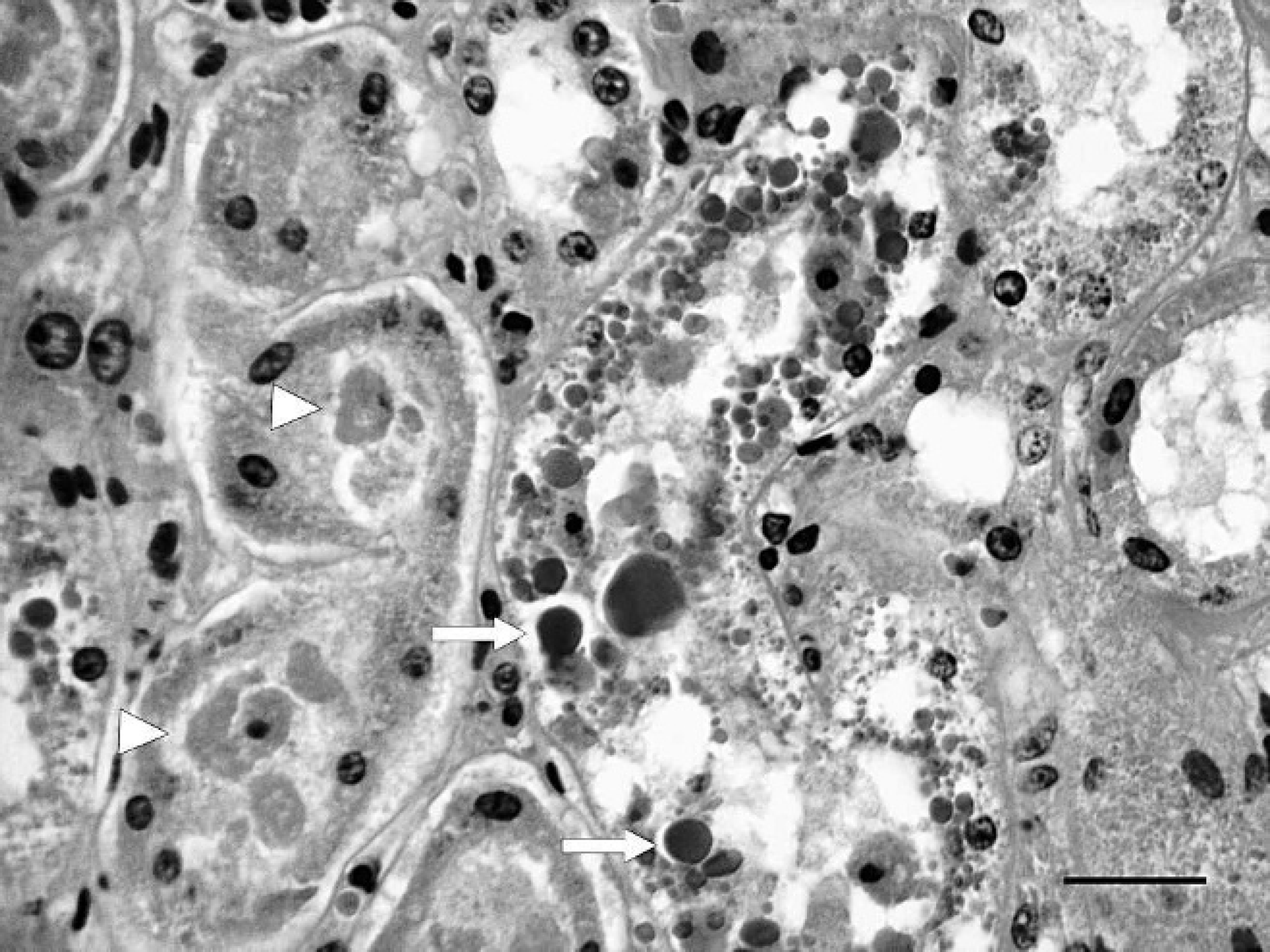
Kidney; water buffalo. Renal tubular degeneration and necrosis with small, cytoplasmic, hyaline droplets (hyaline change) in the renal tubular epithelial cells (arrows) and larger deposits of hyaline material consistent with hemoglobin in the tubular lumina (arrowheads). Hematoxylin and eosin. Bar = 15 μm.
Five water buffalo died after the ingestion of large quantities of onions at a farm located in the district of Caçador, Santa Catarina, Southern Brazil. The epidemiologic data and clinical signs of toxicosis were obtained by the referring veterinarian and by an onsite visit to the property. Onion toxicosis was identified in 6 water buffalo, including 4 cows, 1 sucking calf, and 1 bull. The 5 adult water buffalo died after ingesting onions. The animals were in a paddock containing kikuyu grass (Pennisetum clandestinum) and rye grass (Lolium perenne). Two tons of culled onions had been deposited within the paddock, and the animals were allowed access to them. The owner observed that the buffalo had demonstrated a preference for the onions over the pasture grasses. Eight days after ingestion, the animals had pale mucous membranes, lethargy, constant vocalization, tenesmus, weakness, dyspnea, production of dark urine, and the presence of an onion odor on their breath. The clinical signs progressed rapidly to recumbency, with the subsequent death of 3 adult water buffalo. Nine days after the initial development of clinical signs, the remaining 2 adult water buffalo died, 1 of which was necropsied.
Necropsy lesions included pale mucous membranes, blood with diminished viscosity and decreased coagulation, multi-focal petechiae and ecchymoses of the skin (most obvious on the medial aspect of the inner thigh), dark brown kidneys and urine (Fig. 1), an enlarged gallbladder with clotted bile, and onion fragments within the ruminal contents. Both the ruminal contents and skeletal muscles had a strong odor of onion. Tissue samples were collected, fixed in 10% neutral buffered formalin, processed routinely, sectioned, and stained with hematoxylin and eosin (HE). Renal microscopic lesions included degeneration and necrosis of renal tubular epithelial cells. Small cytoplasmatic hyaline droplets were observed in the renal tubular epithelial cells, and deposits of eosinophilic material consistent with hemoglobin were present in the tubular lumina (Fig. 2). In the liver, a moderate, multifocal, centrilobular, coagulative necrosis was observed along with hemorrhage and macrophages containing brown cytoplasmic pigment.
The observed clinical signs were similar to those described in cattle with onion toxicosis. 7,10,18,27 Jaundice was not observed in the present study, probably because of the rapid onset acute hemolytic anemia, methemoglobinemia, and death. The epidemiologic characteristics are similar to those reported in others studies. 7,18,27 It has been shown that mortality rates may be high if onion consumption continues. The macroscopic and histologic lesions suggested a hemolytic-induced disease similar to that reported in spontaneous onion toxicosis in cattle, sheep, and horses. 1,7,15,18,27 Consumption of onions can cause hemolytic anemia and methemobinemia, 4,6 resulting in secondary ischemic-induced organ damage characterized by hemoglobinuric nephrosis and hepatic centrilobular necrosis as observed in the present study. The differential diagnosis of onion toxicosis includes any disease that causes hemolytic anemia in water buffalo such as babesiosis, postparturient hemoglobinuria, and other causes of hemoglobinuria. 17,24 Hemoglobinuria from Brachiaria radicans toxicosis has not been reported in water buffalo but also was included in the differential diagnosis. Brachiaria radicans is a grass cultivated in some regions of the State of Santa Catarina, and ingestion of this grass can cause intravascular hemolysis. Hemoglobinuria also occurs frequently with Fasciola hepatica infestation in Brazil, and water buffalo are susceptible to fasciolosis, especially when reared in the coastal region of Santa Catarina. 16,23,26 In the current study, the adult animals died following onion consumption, but the sucking calf did not. It is possible that toxins present in onions are not passed in the milk or that concentrations of toxins in the milk are insufficient to cause toxicosis in sucking calves.
Recommended treatment for onion toxicosis includes restriction of access to onions. Blood transfusion may be given to severely affected animals and may promote clinical recovery. 5,10,22,27 Oral antibiotics treatment may be beneficial in reducing ruminal anaerobic bacteria that promote the formation of some oxidative substances. 22 A possible alternative to the unrestricted ingestion of onions by ruminants might be to crush these plants and mix them with the feed at no greater than 25% of the entire diet. This process limits preferential onion consumption because animals cannot choose only the small pieces of onions. 11 The use of onions to feed ruminants also is possible when associated with a protein-rich diet. Dietary proteins are important for the synthesis of enzymes and for the availability of cofactors needed for anti-oxidative reactions. 5