



Abstract
Etiology and methods of immunoprophylaxis against common field cellulitis in commercial turkeys were evaluated. It was determined that intravenous administration (∼10 8 cells/ml) of 1 of 4 isolates of Clostridium septicum from cellulitis lesions rapidly caused the classic lesions of cellulitis followed by death within 36 hr at high doses. When the supernatant alone was injected into turkey poults, signs of depression and ataxia were temporarily observed for up to 20 hr after injection, but no cellulitis lesions were detected. An enzyme-linked immunosorbent assay was developed to measure antibody levels against the isolated C. septicum. This assay was used to predict susceptibility to infection. An experimental formalin-killed bacterin/toxoid was produced from the challenge strain of C. septicum with inactivation timed to allow toxin accumulation and ∼108 cells/ml. This bacterin/toxoid given at day of hatch generated a rapid and persistent antibody response against the homologous C. septicum in the vaccinated birds at 9 weeks (P < 0.001). The ability of this experimental vaccine to protect birds in the field as well as its ability to evaluate unvaccinated flocks to establish the time of seroconversion and the relationship to clinical disease are currently under evaluation.
Keywords
Turkey cellulitis is an acute diffuse infection of the dermis and subcutaneous tissue with edema and moderate diffuse heterophil infiltration of the subcutis. 5,7 Cellulitis in turkeys is associated with substantial economic loss to turkey producers. 3 At present, the etiology and methods of immunoprophylaxis against common field cellulitis in commercial turkeys is being investigated by the authors. The current study reports evidence for Clostridium septicum (CS) as a primary cause of cellulitis in commercial turkeys.
Nine Clostridium sp. isolates from fluid emphysematous lesions of cellulitis in commercial turkeys that died acutely were purified and identified using commercial anaerobic identification panels. a Five isolates were identified as C. perfringens isolates, and 4 isolates were identified as CS isolates. Each isolate was individually grown to high titer in Cooked Meat Medium a (CMM) and evaluated for ability to produce lesions in susceptible 10-week-old breeder hen culls. Turkeys were injected with an intravenous administration of the isolates (∼108 colony-forming units/bird), alone or in mixed cultures. Only 1 of the 4 isolates of CS from cellulitis lesions rapidly caused the classic lesions of cellulitis followed by death within 36 hr.
To evaluate the live versus inactivated CS in day-old commercial poults, 28 poults were divided into 2 groups. Each poult was injected with a subcutaneous (SC) administration of either CMM culture of CS without formaldehyde b (group 1) or CMM culture of CS with 0.25% formaldehyde (group 2). Poults were checked twice a day for 3 days to evaluate clinical signs or mortality. All poults were euthanized by CO2 inhalation and necropsied at 72 hr postinoculation (PI). At 12 hr PI, 11 of the 14 poults died (78.5%) in the group injected with CS grown in CMM and not inactivated with 0.25% formaldehyde. In contrast, the poults that received the inactivated bacteria did not die, nor did they develop clinical signs. Lesions were only associated with birds that died and that displayed serositis in the lungs (pleura), heart (pericardium), and inner lining of the abdomen (peritoneum); generalized vascular congestion; mild ascites; splenic atrophy; and inflamed thymus (enlarged, edematous, and red) with occasional petechial hemorrhages. Injection site lesions were not observed. After 24 hr PI, no additional mortality or clinical signs were observed in any experimental groups (Table 1).
To test the ability of supernatant to induce cellulitis lesions, an overnight CMM broth culture of CS was centrifuged for 10 min at 2,000 X g and filtered through a 0.2-μm filter c to remove bacteria and medium particles. The filtered supernatant was incubated for 1 hr at 22°C with convalescent serum from cellulitis-positive turkeys at the ratios listed below. Forty commercial day-of-hatch poults were divided into 4 groups. Poults from each group were injected SC with 0.2 ml of an equal volume mixture of supernatant only (group 1), supernatant with undiluted convalescent serum (group 2), supernatant diluted with a 1:9 mixture of convalescent serum (group 3), or supernatant diluted with a 1:99 mixture of convalescent serum (group 4). Each poult was neck tagged, placed in a floor pen, and provided with water and feed ad libitum. Subcutaneous injection was performed in the breast area.
Evaluation of the ability of live Clostridium septicum, inactivated C. septicum, supernatant alone, or with serum to cause clinical signs, lesions, and mortality in day-of-hatch poults.*
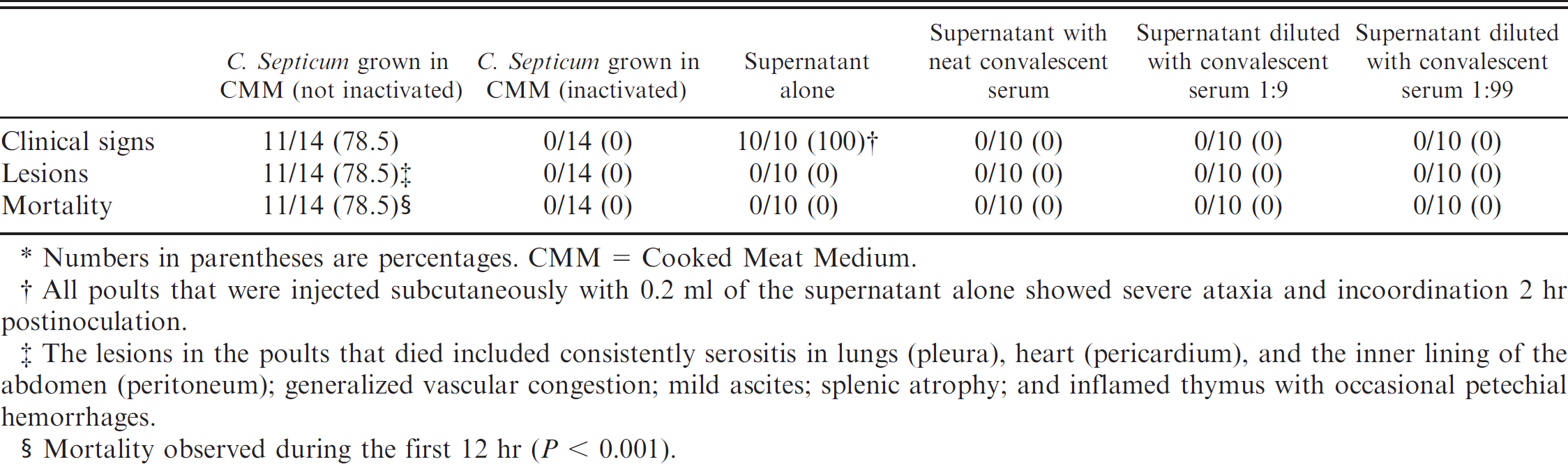
Numbers in parentheses are percentages. CMM = Cooked Meat Medium.
All poults that were injected subcutaneously with 0.2 ml of the supernatant alone showed severe ataxia and incoordination 2 hr postinoculation.
The lesions in the poults that died included consistently serositis in lungs (pleura), heart (pericardium), and the inner lining of the abdomen (peritoneum); generalized vascular congestion; mild ascites; splenic atrophy; and inflamed thymus with occasional petechial hemorrhages.
Mortality observed during the first 12 hr (P < 0.001).
Poults were evaluated for clinical signs and mortality 3 times a day for 72 hr. All poults were euthanized by CO2 inhalation and necropsied at 72 hr PI. All poults that were injected SC with 0.2 ml of the supernatant alone showed severe ataxia and incoordination 2 hr PI. At 4 hr PI, none of the poults in this group was able to walk. Surprisingly, none of the birds in this group died, and by 24 hr, all the poults in this group were clinically normal (Table 1). The poults, which were injected with the mixture of supernatant with either undiluted serum or diluted in a 1:9 or 1:99 concentration of serum, did not show any clinical signs or mortality. All poults were subjected to necropsy at 72 hr PI, and no macroscopic lesions were observed in any of the surviving poults (Table 1).
An indirect enzyme-linked immunosorbent assay (ELISA) was developed for measuring relative antibody levels against the potential CS etiology. This assay was used to predict susceptibility to infection and was also used to show that vaccinated birds had increased levels of antibodies to CS or that birds with higher levels of antibodies were less likely to contract cellulitis. The assay was performed similarly to previously described methods. 1,6,8 Absorbance was read at 450 nm using a commercial microplate reader. d The absorbance obtained for the positive control, negative control, and experimental samples was used to calculate the sample to positive control ratios (S/P ratios). 2,4
An experimental bacterin was produced from the CS isolate that was capable of causing lesions consistent with turkey cellulitis and was recovered from induced lesions, as described. The bacterin was produced from an 18-hr CMM culture of CS, inactivated by the addition of formaldehyde to achieve a final concentration of 0.25%. Inactivation was timed to allow accumulation of toxin and ∼108 cells/ml (24-hr incubation) as verified by quantitative enumeration and hemolysin titration. 6 Aluminum hydroxide suspension e (15%) was added as an adjuvant.
Ten-week-old turkeys were transferred to the University of Arkansas JKS Poultry Health Laboratory (Fayetteville, AR) from a commercial turkey house previously determined to have low levels of antibodies to CS. Serum samples were obtained from a subgroup (n = 11) of turkeys that were not vaccinated (control). A second group was vaccinated (n = 23) SC with 0.2 ml of bacterin/toxoid and then bled 3 weeks after immunization. Antibody levels were then determined using a 1:99 dilution of the serum using the ELISA as described above. In this particular experiment, the turkeys from a commercial turkey house with previously determined low levels of antibodies to CS had a significant increase (P < 0.05) in antibody level 3 weeks after vaccination with 0.2 ml of formaldehyde-treated bacterin/toxoid compared with nonvaccinated controls (Fig. 1).
To test the effectiveness of vaccination in the field, turkeys from a commercial breeder farm with a history of consistent turkey cellulitis were divided into 2 separate houses (each housed 5,000 birds). One group of day-of-hatch turkeys was vaccinated SC with 0.2 ml of bacterin/toxoid. The other house of turkeys was not vaccinated. Nine weeks afeter vaccination, serum samples (n = 10) were obtained from both houses to determine CS antibody levels.
There was a significant increase in antibody level to CS in the vaccinated birds at 9 weeks (P < 0.001) and a shift to the right of the distribution of birds with a higher level of antibodies to CS after vaccination. Vaccinated birds also had an increase in variation of the level of antibodies against CS (Fig. 2). In this particular field trial, vaccinated birds did not develop considerable levels of cellulitis compared with the unvaccinated flock, as reported by the integrator (data not shown).
Bacteria of genus Clostridium are Gram-positive, sporeforming, anaerobic rods normally found in soil and in the gastrointestinal tract of humans and animals. 5,9 Although CS is always present in the environment in turkey houses, not every flock experiences a clinical break of cellulitis. In the present study, it was observed that 1 of 4 isolates of CS from cellulitis lesions rapidly caused classic lesions of cellulitis followed by death within 36 hr at high doses. The broth culture filtrate from the pathogenic CS isolate when injected SC caused morbidity, although neither lesions nor mortality were observed. These results may suggest that the toxin is not responsible for the high mortality that was observed when the CS was grown in CMM and injected without inactivation (Table 1). Turkeys vaccinated with the bacterin/toxoid had a significant immune response to CS (Fig. 1), and when this experimental bacterin/toxoid was administered SC in commercial day-of-hatch poults, the turkeys generated an antibody response against the homologous CS (Fig. 2). The ability of this vaccine to protect birds in the field, the evaluation of unvaccinated flocks to establish the period for seroconversion, and the relationship to clinical disease are currently under evaluation. Nevertheless, the results of the current study suggest that at least some isolates of CS from lesions associated with field cases of turkey cellulitis are capable of reproducing clinical disease similar to field cases after intravenous inoculation of the agent. This organism could be reisolated from lesions induced by intravenous inoculation. Although CS has been frequently isolated from field cases of turkey cellulitis in the authors' laboratory, other clostridial isolates are also occasionally found, sometimes in combination with CS. Clostridium perfringens and Clostridium sordellii are the second and third most frequently isolated clostridia in the authors' laboratory, respectively, with increased frequency in submissions of cellulitis-associated lesions from CS-vaccinated flocks. In some cases, the authors failed to isolate CS from field cases of turkey cellulitis. Thus, it is unfeasible to exclude other clostridial species as possible alternative etiologies of turkey cellulitis. As a result, it is entirely possible that multiple clostridial etiologies may be sometimes causative for turkey cellulitis. While only one of the evaluated clostridial isolates (CS) was capable of causing mortality and lesions in the model used in the current studies, the authors later observed that some turkeys from nonvaccinated commercial flocks had detectable antibody against CS (Fig. 2). New ELISA assays using synthetic toxin fragments from multiple Clostridium species are presently under development. These new assays will potentially allow selection of truly naive turkeys for further evaluation by specific challenge that may provide additional research into the association of these other species with turkey cellulitis.
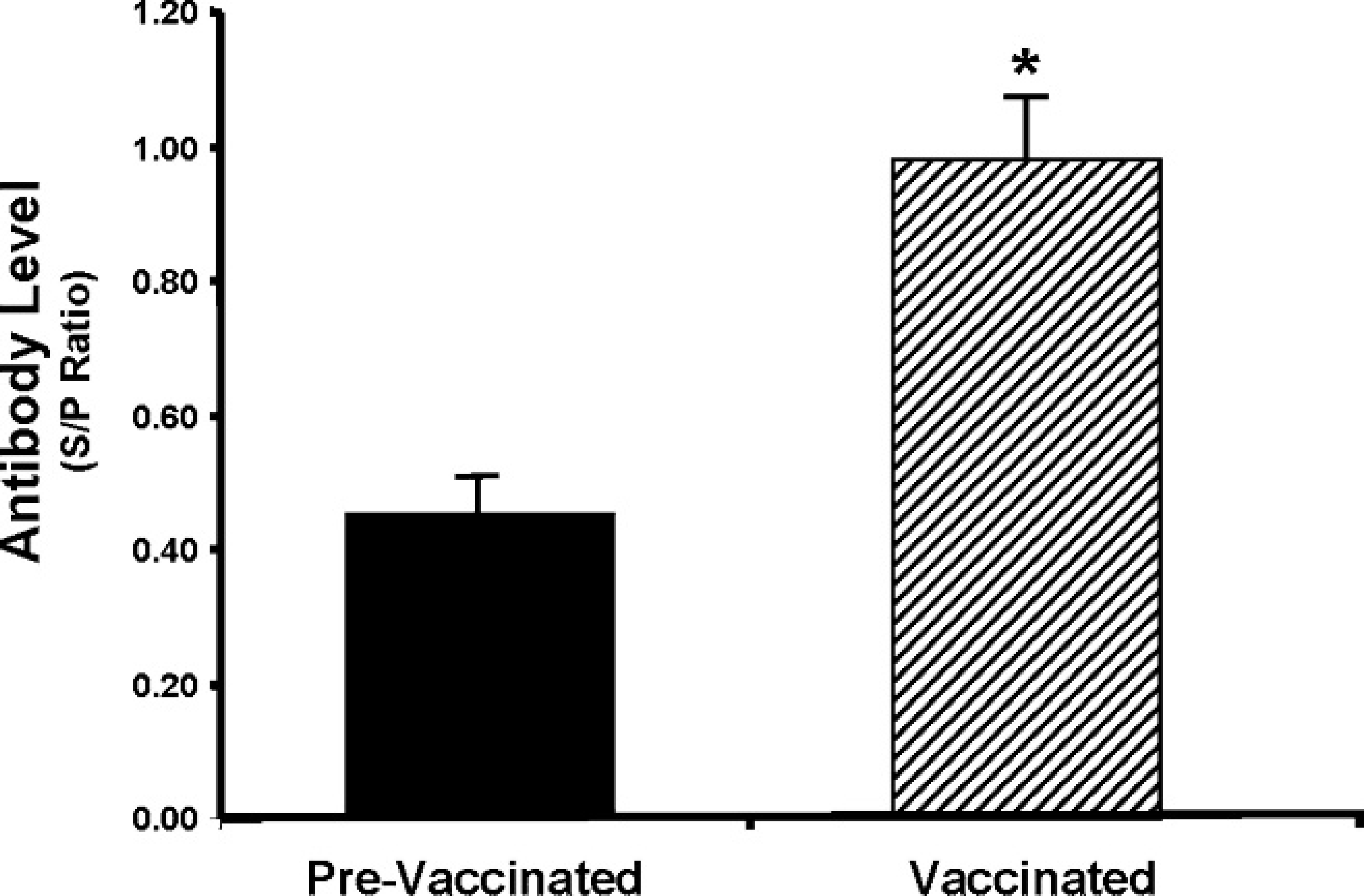
Clostridium septicum antibody levels in turkeys. Enzyme-linked immunosorbent assay antibody levels (sample to positive [S/P] ratio) in 10-week-old turkeys 3 weeks after vaccination with 0.2 ml of formaldehyde-treated bacterin/toxoid versus prevaccinated levels from the same flock. Antibody levels (S/P ratio) are plotted as the average antibody level and standard error of the mean plotted. Statistical significance (*) was determined by analysis of variance with a P < 0.05 significance level (N = 11 for prevaccination controls; N = 23 for vaccinated group).
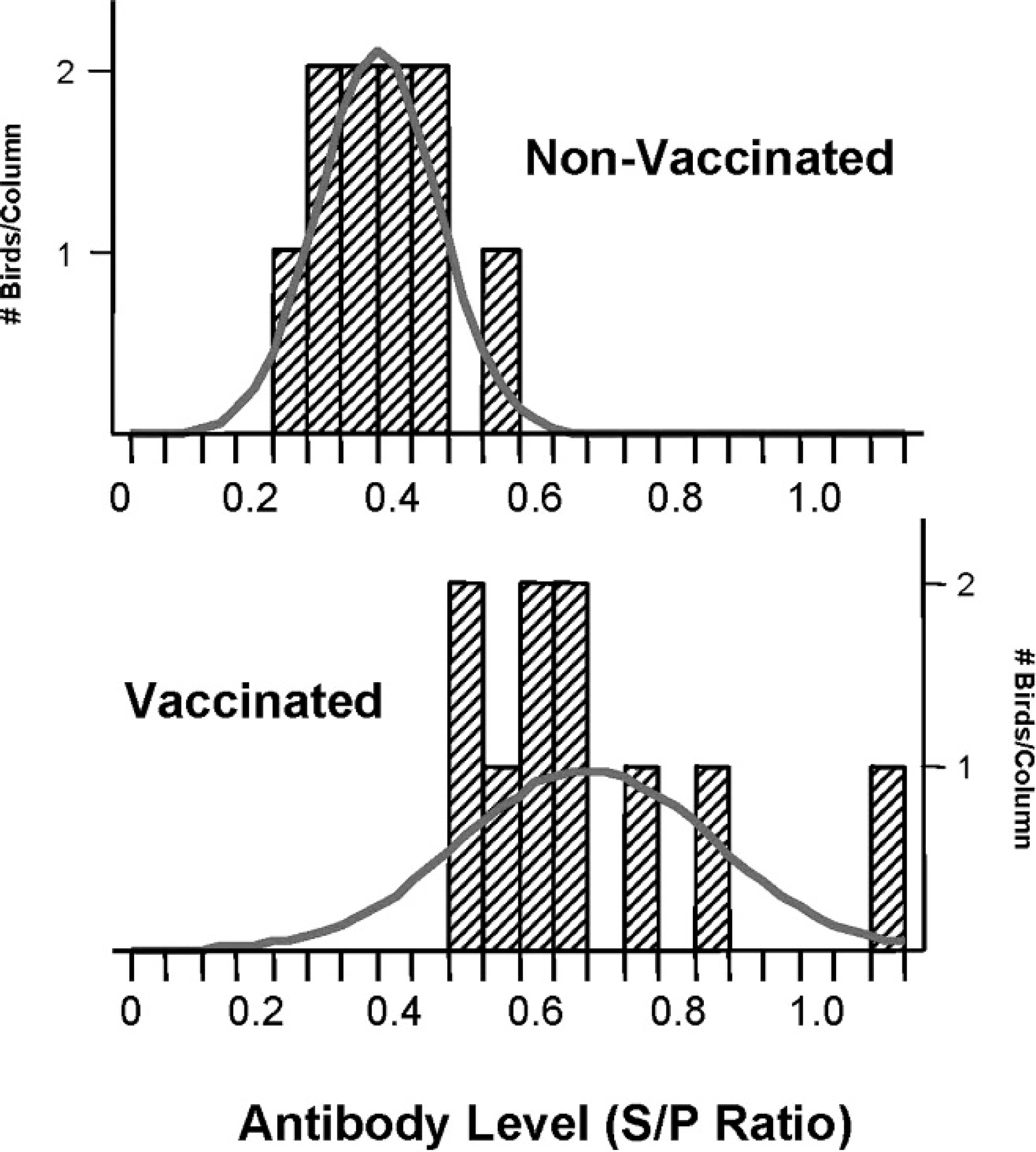
Clostridium septicum antibody levels in commercial turkeys in a farm that consistently experienced outbreaks of cellulitis. Enzyme-linked immunosorbent assay antibody level (sample to positive [S/P] ratio) in turkeys vaccinated day of hatch with 0.2 ml of formaldehyde-treated bacterin/toxoid versus non-vaccinated controls from the same flock separated into 2 houses. One group of day-of-hatch turkeys was vaccinated subcutaneously with 0.2 ml of bacterin/toxoid. The other house was not vaccinated. Nine weeks after vaccination, serum samples (n = 10) were obtained from both houses to determine C. septicum antibody levels. Distribution of the antibody levels with 1 or 2 birds per column. The calculated normal distribution curve is also indicated. Statistical significance of the distribution in the antibody levels was determined by analysis of variance with a P < 0.001 significance level.
Footnotes
a.
RapID ANA II anaerobic identification panels, Remel Inc., Lenexa, KS.
b.
Fisher, Waltham, MA.
c.
Pall Life Science, East Hills, NY.
d.
BioTek MQX200, BioTek Instruments Inc., Winooski, VT.
e.
Rugby Labs, Duluth, GA.