



Abstract
Escherichia coli carrying the F18 fimbriae colonize the small intestine of pigs and cause postweaning diarrhea and edema disease. There are 2 closely related antigenic variants of F18, F18ab, and F18ac. While F18ab-positive strains are known to be associated with edema disease, E. coli–carrying F18ac are known to cause diarrhea. One hundred ninety-eight E. coli isolates obtained from cases of diarrhea and edema disease in pigs isolated from feces or intestine were screened for the presence of the fedA gene encoding for F18 fimbriae. To distinguish between F18ab and F18ac, the fedA gene was sequenced in 69 F18-positive isolates/strains. The translated protein sequences of the fedA gene in the 2 variants differ; F18ac protein carries proline at amino acid residue 121, which is substituted or missing in F18ab. The F18ab- and F18ac-positive E. coli strains were compared for the presence of virulence attributes, serotypes of the isolates, and relatedness between the strains. Contrary to earlier reports that E. coli F18ab-positive strains mostly express Shiga toxin and F18ac-positive strains generally express enterotoxins, the current report shows conclusively for the first time that both variant types may carry genes for Shiga toxins and/or enterotoxins. Monoclonal antibodies produced against F18ab or F18ac fimbriae could not distinguish the strains carrying the 2 variants. Therefore, it was concluded that either of the 2 F18 variants, F18ab or F18ac, may be involved in causing postweaning diarrhea or edema disease in pigs.
Keywords
Pathogenic Escherichia coli–carrying F18 fimbriae colonize porcine small intestine and cause postweaning diarrhea or edema disease. Adherence of the bacteria to microvilli of small intestinal epithelial cells of the piglets is initiated by adhesins that are associated with F18 fimbriae. Colonization depends on the specific binding between adhesive fimbriae and receptors on the enterocytes. The F18 is composed of 2 closely related antigenic variants: F18ab, referred to as F107, and F18ac, also called 2134P and 8813. 2,6,7,16,18,21 The F18ab is often expressed in strains producing Shiga toxins (STEC) and causes edema disease, and many belong to serogroup O139, 16 whereas strains expressing F18ac fimbriae are enterotoxigenic E. coli (ETEC), often belonging to sero-groups O141 and O157, which cause diarrhea by elaborating enterotoxins (STa or STb). 7,16,21 Edema disease predominantly affects pigs 1 to 2 weeks after weaning and is responsible for considerable economic loss worldwide. 3 Postweaning diarrhea, on the other hand, is commonly observed within a week of weaning, but onset of diarrhea has been reported as late as the grower-finisher stage. 1
To develop effective vaccines for STEC and ETEC infections in pigs, it is important to differentiate strains expressing F18ab from those expressing F18ac. The types of toxins and fimbriae produced by the strains are important determinants of the diseases exhibited by infected swine. It was reported that monospecific polyclonal antisera and the monoclonal antibody 6C7/C1, which is specific for F18ac-positive strains, can differentiate between these 2 antigenic variants. 6,7,16,18 Since many strains do not express F18 when cultured in vitro under standard conditions, serologic differentiation is not always possible. 2,12,21
The genetic organization of the fed gene cluster that encodes for F18 has been reported. 14,19 The gene fedA, encoding the major fimbrial subunit of F18, has been sequenced in both F18ab- and F18ac-positive strains. 14 These 2 types can be differentiated by polymerase chain reaction (PCR) restriction fragment length polymorphism analysis that consists of amplification of the fedA gene followed by digestion with restriction enzyme NgoM1. 14,16,18 Single-stranded conformational polymorphism analysis can also differentiate F18ab- and F18ac-positive strains. 4 The proline residue at position 121 of the F18ac protein is substituted or missing in F18ab. The role of F18 in infection is not currently well understood. This report examines the correlation of F18ab and F18ac at the molecular level to other virulence factors that may shed light on the disease for potential intervention.
One hundred ninety-eight E. coli strains from cases of diarrhea and edema disease isolated from pigs that carried F18 fimbriae were selected from the collection of cultures at the E. coli Reference Center (Pennsylvania State University, University Park, PA). Sixty-nine F18-positive strains were randomly selected for fedA gene sequencing. All strains were grown in Luria-Bertani media or in trypticase soy agar. Template DNA from the bacteria and PCR assays for genes encoding for F18, heat-stable toxin (STa and STb), heat-labile toxin (LT), K88 and K99 fimbriae, and Shiga toxin (Stx-2) were conducted based on primers and programs described earlier. 8 The sizes of amplicons for each of the reactions and the positive and negative standards used were as reported. 8 The PCR primers used for the gene encoding for adhesion involved in diffuse adherence (AIDA) were adopted from the published report. 17 Reaction contents for each PCR for AIDA (11 μl total reaction volume) consisted of 3 μl of template DNA (20 ng), 0.5 μmol of primers, a 0.18 mmol each deoxyribonucleotide triphosphate, 3 mmol MgCl2, 0.4 U of Taq DNA polymerase, b 50 mmol Tris (pH 8.3), 250 μg/ ml bovine serum albumin, 2% sucrose, and 0.1 mmol cresol red. The PCR was performed in a commercial rapid cycler c using a rapid-cycle DNA amplification method. 22 It consisted of initial denaturing at 94°C for 30 sec followed by 30 cycles of template denaturation at 94°C (0 sec), primer annealing at 52°C (0 sec), and extension at 72°C for 22 sec. The positive control strain used for AIDA was ECRC#3.3762, and the negative control used was E. coli K12. The amplified products were electrophoresed in 1% agarose gels at 200 V for 1 hr, stained with ethidium bromide, and visualized under ultraviolet light. The positive samples were identified based on the presence of bands of appropriate sizes (585 bp) compared with positive control strain. The amplicon generated for the fedA gene was further sequenced at the Nucleic Acid Facility (Pennsylvania State University, University Park, PA) using a commercial DNA analyzer. d Pulsed-field gel electrophoresis was conducted on all 69 strains carrying F18ab or F18ac according to the procedure described 9 using the enzyme Xba1. Dendrograms based on Dice similarity coefficients were constructed from the resulting profiles according to UPGMA (unweighted pair group method with arithmetic mean). Isolates with ≥94% similar profiles (corresponding approximately with a ≥3-band difference) were considered to represent the same pulsotype or clone. 20
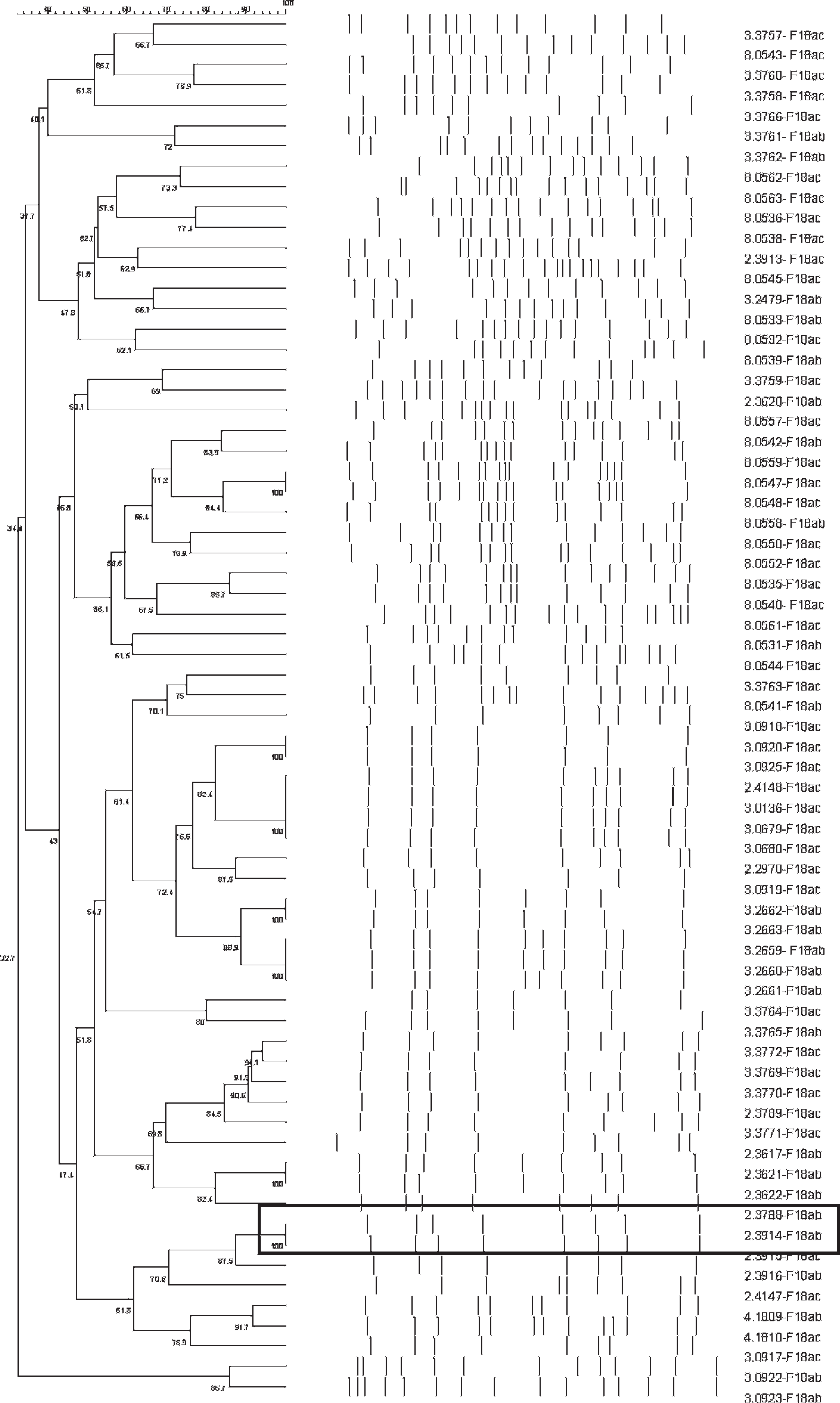
Dendrogram derived from pulsed-field gel electrophoresis (PFGE) analysis of F18ab+ and F18ac+ strains inferred according to the unweighted pair group method with arithmetic mean based on Dice similarity coefficients as calculated from PFGE band positions. Profiles exhibiting ≥94% similarity (boxed) were regarded as representing the same PFGE type.
The strains carrying the fedA gene with ccg nucleotide residues encoding for proline at amino acid residue 121 were considered to be F18ac positive, while strains that exhibited nucleotide residues substituted or missing at this site, and therefore did not encode for proline, were considered as F18ab positive. Forty-three strains (62%) carried the fedA gene encoding for F18ac fimbriae, and 26 strains (37%) carried the fedA gene encoding for F18ab (Table 1). Fifty-four strains were STEC, of which 22 (40%) and 32 (60%) were found to carry F18ab and F18ac fimbriae, respectively. Fifty-five percent of STEC strains belonged to serogroup O147; 13 were F18ab positive, and 17 were F18ac positive. Of 15 ETEC strains belonging to serogroups O138, O141, O147, and O157, 4 carried F18ab and 11 carried F18ac. Many (35%) of the STEC strains and some of the ETEC strains did not belong to any known O serogroup. More than 90% of STEC F18ac-positive and 50% of STEC F18ab-positive strains carried genes for both heat-stable toxins STa and STb. Presence of heat-labile toxin, LT, was not common among the strains tested. More than 80% of F18ab- and F18ac-positive STEC strains carried gene encoding for AIDA, which is known to be prevalent in E. coli isolates from pigs with postweaning diarrhea or edema disease. 10,15 While K99 fimbrial adhesion factor was more prevalent in ETEC strains, K88 was not prevalent in either ETEC or STEC strains. Virulence testing of the isolates reflected that strains carrying F18ab and F18ac can be either STEC or ETEC. Pulsed-field gel electrophoresis analysis was conducted for all strains except 1 ETEC strain (3.0902), which exhibited DNA degradation due to production of excessive nuclease. As shown in Figure 1, E. coli strains carrying F18ab and F18ac did not genetically cluster in groups, and 1 of the F18ab-positive strains was found to be 100% related to a strain carrying F18ac, reflecting that F18 fimbriae may not play a role in overall relatedness among the strains. With the use of the ClustalW software program, relatedness among F18ab and F18ac proteins also did not show any distinct clusters as determined from the analysis of the predicted amino acid sequence of the fedA gene from F18ab- and F18ac-positive strains (data not shown).
Monoclonal antibodies (mAbs) against E. coli strains ECRC 3.2479 carrying F18ab and strain 2134 carrying F18ac were produced by extracting the fimbriae following the procedure previously described. 5,11 After 3 immunizations, mouse serum titers averaged 59,000 with low background, which is sufficiently high for fusion of the spleen cells to produce immune hybridomas. The cell fusion was performed using spleen cells from 2 of the mice, fusing these cells with Sp2/0-Ag14 mouse myeloma cells. The cell mixtures were plated into 96-well plates, giving a total of 1,056 growth wells. Following 12 days of culture, an enzyme-linked immunosorbent assay was used to detect wells containing specific antibodies, and 15 positive wells were identified for F18ab and 15 wells for F18ac. The cells from these wells were transferred to culture plates, allowed to expand and stabilize, and retested. The hybridoma clones against F18ac fimbriae were designated 5I, while those against F18ab were designated 6D (Table 2). To determine the specificity of the mAbs, in particular the ability to differentiate F18ab versus F18ac strains, a bank of the most strongly reacting antibodies was tested with a bank of E. coli strains in a blind study. Eight 6D antibodies (F18ab derived; nos. 1, 2, 3, 4, 5, 7, 15) and four 5I antibodies (F18ac derived; nos. 9, 14, 27, 29) were tested against a bank of 10 bacterial strains (6 F18ac, 4 F18ab) to determine the reactions of the antibodies. Antibody 5I no. 29 was found to react strongly with 8 of the 11 strains carrying both F18ab and F18ac that were tested. In addition, 3 of the other antibodies reacted with at least 1 bacterial strain (F18ab or F18ac positive; Table 2). The mAb 5I no. 29 reacted with both F18ab and F18ac strains, making it difficult to distinguish the 2 antigenic variants. Similar to the current findings, chicken anti-F18ac antibodies were shown to inhibit the attachment of F18ab-positive E. coli bacteria to the pig intestinal mucosa, demonstrating that F18ac antibodies were not specific. 13 It is possible that there is no unique antigenic site for proteins in F18ab and F18ac polypeptide that was involved in antibody production; however, out of 16 hybridomas, none of them were specific for either F18ab or F18ac. Although in this study a limited number of mAbs were obtained that may not have covered all epitopes of the proteins, it is possible that antibodies derived from other strains carrying F18ab or F18ac may produce mAbs specific for the target antigens. It may not always be possible to obtain monoclonals for target antigens easily with limited resources. Therefore, the results depicted here show that F18ab and F18ac proteins share common epitopes, and distinguishing the two on the basis of antibodies may be difficult. The unique epitope that may define the variants may not be involved in the genotypic differences observed in this study.
Virulence profiles of Escherichia coli strains carrying F18ab and F18ac fimbriae.*
Cotinued.
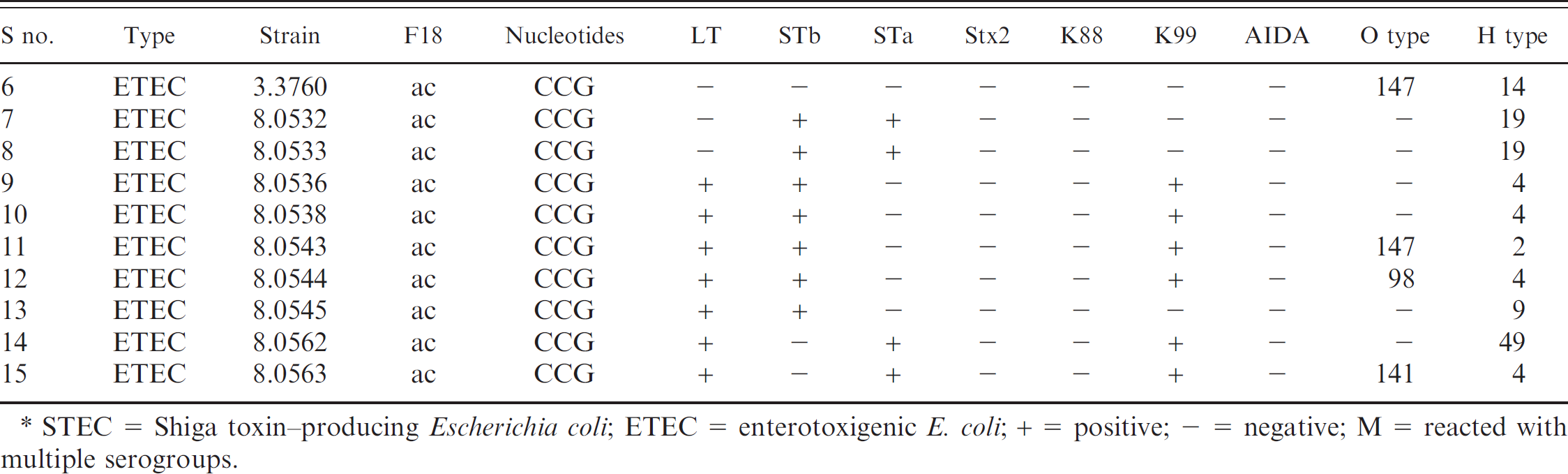
STEC = Shiga toxin-producing Escherichia coli; ETEC = enterotoxigenic E. coli; + = positive; - = negative; M = reacted with multiple serogroups.
Monoclonal antibodies for detecting immunological reactions between Escherichia coli strains carrying F18ab (6D) and F18ac (5I) fimbriae.*
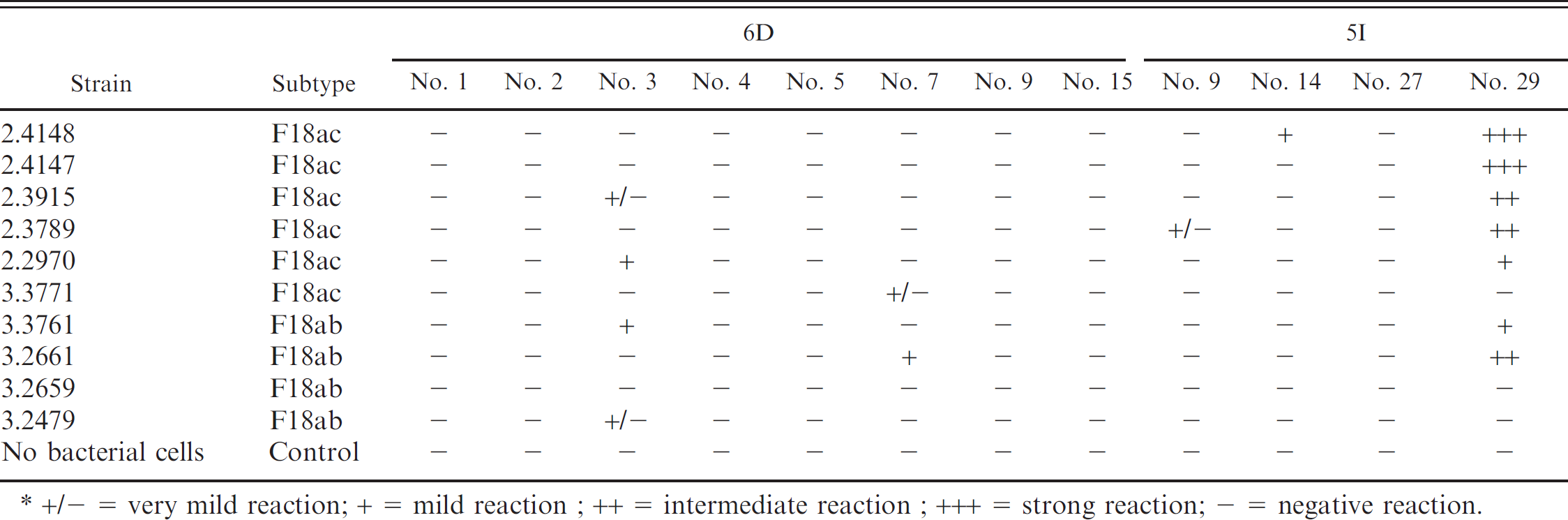
+/- = very mild reaction; + = mild reaction; ++ = intermediate reaction; +++ = strong reaction; - = negative reaction.
Contrary to earlier reports that F18ab and F18ac are distinct, the current study found very little distinction between E. coli strains carrying F18ab or F18ac in terms of serotypes, genes encoding for virulence attributes, relatedness among the strains, and mAb reactions. Therefore, the role of the variants of F18 in causing postweaning diarrhea and edema disease is not clear. As more information emerges on the fimbrial subunit, better strategies can be developed for an intervention to overcome the problem.
Footnotes
a.
Integrated DNA Technologies Inc., Coralville, IA.
b.
PGC Scientific, Gaithersburg, MD.
c.
Idaho Technologies Inc., Salt Lake City, UT.
d.
3730 DNA analyzer, Applied Biosystems, Foster City, CA.