



Abstract
Spinal lymphoma and concurrent pulmonary filariasis are reported in a pet rabbit. The rabbit presented for pelvic limb paralysis resulting from extradural spinal lymphoma, presumably rising from the body of the sixth lumbar vertebra. The neoplasm was subsequently immunophenotyped as a B-cell lymphoma. Pulmonary filariasis was an incidental finding at necropsy.
A 2.5-kg, 6-year-old, neutered, male rabbit (Oryctolagus cuniculus domesticus) with a body condition score of 3.5 out of 5 was presented to the Louisiana State University Veterinary Teaching Hospital and Clinics (LSU VTHC; Baton Rouge, LA) for paraplegia. Before presentation, the rabbit progressed during 3 days from appearing clinically normal to complete paraplegia. The owners reported no change in appetite, water intake, urination, or defecation. The rabbit had been housed outdoors before presentation but was kept in an indoor cage with cedar bedding at the time it was presented to the LSU VTHC. The diet consisted of rabbit pellets, timothy grass hay, and fresh vegetables. No previous medical problems were reported.
On presentation, the patient was bright, alert, and responsive. Physical examination revealed adequate hydration, and all vital parameters were within normal limits. Evaluation of the pelvic limbs revealed bilateral loss of motor control, proprioceptive deficits, and the absence of superficial and deep pain. Neurologic evaluation of the thoracic limbs was unremarkable. Euthanasia was elected because of the poor prognosis for return to normal function and concerns for the rabbit's quality of life.
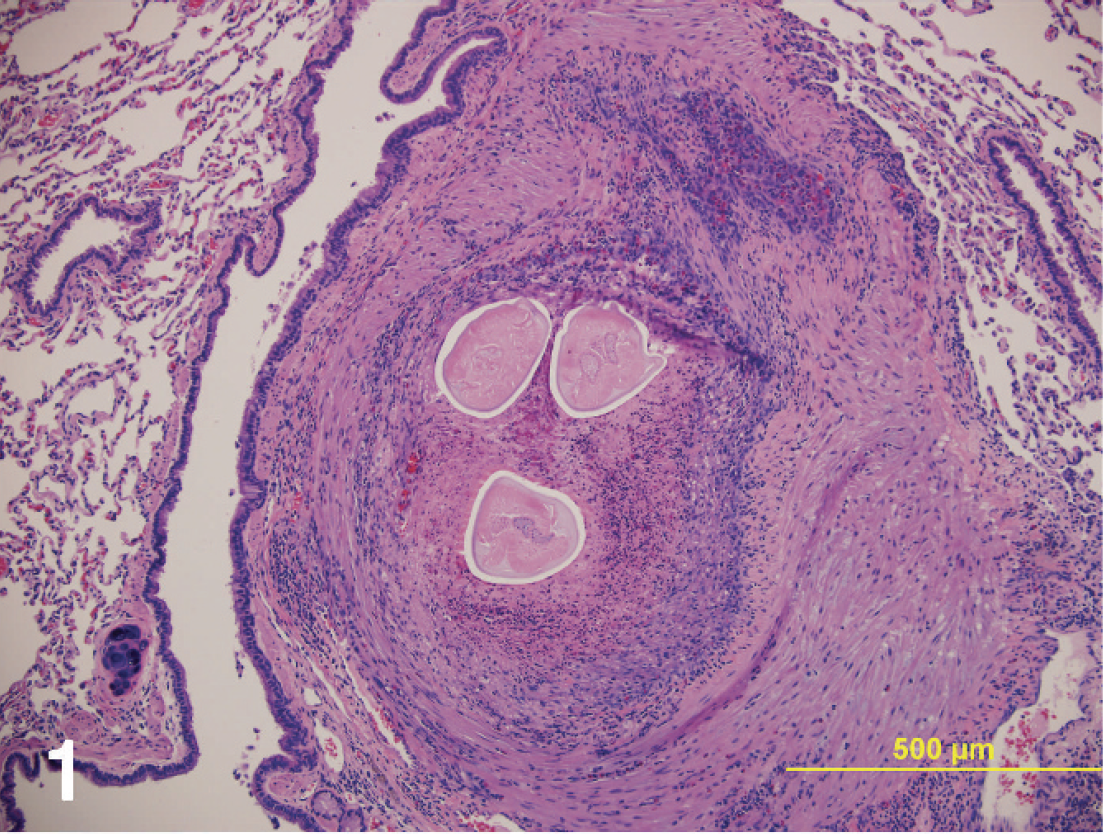
Image from the body of the sixth lumbar vertebrae effaced by neoplastic lymphocytes showing a relatively monomorphic population of plump neoplastic lymphoblasts and numerous mitotic figures. Hematoxylin and eosin stain. 1,000× magnification. Bar = 50 μm.

Image of the 3 sections of Dirofilaria immitis within a markedly thickened pulmonary artery infiltrated by large numbers of eosinophils, histiocytes, and occasional heterophils. Hematoxylin and eosin stain. 100× magnification. Bar = 500 μm.

Immunohistochemistry staining for T lymphocytes showing positive labeling of scattered, small, well-differentiated lymphocytes. Murine monoclonal CD3. 1,000× magnification. Bar = 50 μm.

Immunohistochemistry staining for B lymphocytes showing positive labeling of the population of neoplastic, large, round cells, many of which, are in mitosis. Murine monoclonal CD79a stain. 1,000× magnification. Bar = 50 μm.

Close-up image of a section of Dirofilaria immitis. Characteristic structures are labeled. A thin, smooth cuticle with lateral ridges (C) and prominent lateral cords (LC) dividing prominent, thick, striated coelomyarian muscle (M) into 2 sections; a section of intestine (I), and 2 sections of reproductive tract (U) are characteristic of D. immitis. Trichrome stain. 600× magnification. Bar = 100 μm.
On postmortem examination, the rabbit's ventral vertebral canal had a 1-mm elevation of yellow-white material arising from the body of the sixth lumbar vertebra. When sectioned longitudinally, more than 60% of the vertebral body was effaced by tan, gelatinous material that compressed the spinal cord. The lungs were mottled, purple to red and had prominent arteries on cut section. The lungs were also collapsed and displaced caudodorsally by a large cranial thoracic hematoma that was presumed to be an artifact of euthanasia.
Soft tissues and bone were collected, fixed in 10% neutral buffered formalin solution. Sections of bone were decalcified before processing. All tissues subsequently were processed routinely, embedded in paraffin wax, sectioned, stained with hematoxylin and eosin, cover-slipped, and examined microscopically. The body of the sixth lumbar vertebra had marked expansion and bone destruction by large neoplastic lymphoblasts. These cells centrally effaced most of the dorsal vertebral body (obliterated the bone on the floor of the vertebral canal) and extended into the ventral vertebral canal in the area described grossly as soft tan tissue impinging on the ventral spinal cord (Fig. 1). Neoplastic lymphocytes were round, oval, or reniform, with distinct cell borders and small amounts of basophilic cytoplasm. Cells averaged approximately 2 to 4 times the diameter of a red blood cell. Nuclei were round to oval, with beaded, hyperchromatic chromatin and single to multiple prominent nucleoli. Anisocytosis and anisokaryosis were moderate, and there was an average of 5 mitotic figures per 600× field. The histologic characteristics of this mass were consistent with lymphoma.
To further characterize the lymphoma, immunohisto-chemical staining was performed a using mouse monoclonal antihuman CD3 antibody and mouse monoclonal anti-human CD79a antibody. b The positive control tissue was a section of lymph node from a healthy rabbit. The negative control tissue consisted of the same system without the primary monoclonal antibody. The large neoplastic lymphoblasts were positive for CD79a, a characteristic of B cells (Fig. 2). Also present were fewer small, well-differentiated, CD3-positive T cells that were scattered throughout the section. These latter cells were consistent with normal T cells (Fig. 3). The immunohistochemical findings were consistent with a B-cell lymphoma. 17
Microscopically, arteries throughout the lung had marked mural thickening by myointimal proliferation as well as eosinophilic and histiocytic infiltrations. One pulmonary artery was occluded by a filarid that measured approximately 200 μm in diameter. The filarid was most consistent with an immature, male nematode of Dirofilaria immitis (Fig. 4). Trichrome staining was used to better delineate parasite morphology based on a previous report using azan-type stains for parasite identification. 11 Three transverse sections of the parasite were seen that varied from 170 μmto 220 μm in diameter, had a thin smooth amphophilic outer cuticle, and 2 internal lateral ridges. The filarid also had very prominent, thick, striated, eosinophilic coelomyarian muscle that was divided into 2 segments by lateral cords. Two sections of the parasite had a smaller diameter with a centrally located, degenerating, digestive tube that measured approximately 65 μm in diameter. These sections also had 2 cross-sections of reproductive tract that measured 65–75 μm in diameter and flanked the digestive tube (Fig. 5). Based on these histologic characteristics, the parasite was presumptively identified as an immature, adult, female D. immitis. These characteristics are virtually identical to the 1982 study, 11 except the filarid in the previous report was a male. Numerous reports including histologic images and/or descriptions of D. immitis have been published in the human literature and in cases of surgically infected rabbits since the 1982 study. Although their criteria are less rigorous or included filarids that were more degenerate, all of the descriptions and images match the parasite seen in the rabbit in the current study. 2,4,5,9,16
In an attempt to further substantiate the identification of the parasite as D. immitis, a sample of formalin-fixed, paraffin-embedded lung was submitted to the Pathobiology Service of Auburn University (Alabama) in an attempt to speciate the filarid by polymerase chain reaction (PCR) analysis. The PCR analysis was negative for D. immitis DNA using formalin-fixed, paraffin-embedded tissue (which was the only tissue remaining that contained the parasite), but this type of specimen is not generally recommended for PCR testing. Thus the negative results are equivocal, and a false-negative test result is possible.
Although an incidental finding at necropsy, the pulmonary filariasis in the rabbit in the current report is most consistent with D. immitis based on comparative histomorphology. Experimental infection of rabbits with D. immitis and spontaneous filarid infection found in a laboratory rabbit used in an unrelated study have been described previously. 11,13 However, the spontaneous filarid infection in a laboratory rabbit was reported more than 25 years ago in Japan and, to the authors' knowledge, has not been reported since that time. 11 The morphology of the degenerate heartworm in the current case is consistent with an immature female L5 stage of D. immitis. Histomorphologic characteristics of the filarid infection in the rabbit are almost identical to those of D. immitis described by previously. 11 Several other sources describe identical histomorphologic findings in human and feline pulmonary dirofilariasis. 2,5,9,16 Features differentiating the filarid in the rabbit in the current case from other filarid nematodes include size, the prominent coelomyarian striated muscle, and the 2 prominent lateral cords with cuticular lateral ridges. Based on an excellent review of the diagnostic features of filarids in tissue section, other filarid parasites, including Dirofilaria tenuis, Dirofilaria repens, Dirofilaria ursi, Oncocerca spp., and Brugia spp., could be eliminated from consideration based on clearly identifiable differences from the parasite described herein. 4 Moreover, other cardiovascular parasites, such as the French heartworm, Angiostrongylus vasorum, were eliminated because of size differences (this parasite was approximately 200 nm in diameter, whereas A. vasorum is 270 350 nm in diameter) and/or differences in histomorphologic characteristics (this parasite had very prominent coelomyarian musculature, whereas A. vasorum has thin, much-less-prominent musculature). 1 The identity of this filarid as D. immitis using PCR analysis was unable to be conclusively confirmed, but much of the human and veterinary literature has used less stringent histomorphologic characteristics to diagnose D. immitis. 2,4,5,9,16 Given the geographic location of this rabbit and the endemic prevalence of heartworm disease, the most likely diagnosis of the filarid is D. immitis.
Radiographic alterations, gross necropsy lesions, and histologic changes in rabbits with experimentally transplanted D. immitis are very similar to those in humans with dirofilariasis, and the rabbit has been suggested as an experimental model for the human disease. 13 However, the need to surgically transplant immature worms obtained from heartworm-infected dogs makes this model somewhat cumbersome, and it speaks to the relative resistance of rabbits to natural infection with D. immitis. One can speculate that concurrent lymphoma in the rabbit in the present report may have caused immunosuppression or metabolic alterations favorable to the development of pulmonary dirofilariasis. However, given the prolonged life cycle of D. immitis, the development of spinal lymphoma before patent filarid infection seems less plausible.
The clinical signs of the rabbit in the current case were attributed to spinal lymphoma which, to the authors' knowledge, has not been previously reported in rabbits. Numerous reports of lymphoma in the rabbit have been published, and lymphoma is thought to be the second most common neoplasm in this species. 6 Moreover, the rabbit is occasionally used as a laboratory model of herpes virus induced lymphoma. 3,8 Reported cases of rabbit lymphoma show a predilection for hilar and mediastinal lymph nodes, liver, spleen, and kidney. 6 Most previously published cases were not immunophenotyped, but numerous cases of B-cell lymphoma and a single case of T-cell lymphoma have been reported. 3 Additionally, a single case of multicentric T-cell rich B-cell lymphoma with cutaneous involvement has been reported in the rabbit. 8 Based on immunophenotyping, the case reported herein was a B-cell lymphoma and was thought to only have vertebral involvement. Given the partial effacement of the vertebral marrow cavity with neoplastic lymphocytes, leukemia was considered but not supported by the concurrent complete blood count and blood film examination.
Footnotes
a.
EnVision+ System-HRP Labeled Polymer, Dako North America Inc., Carpinteria, CA.
b.
Dako North America Inc., Carpinteria, CA.