




Abstract
A simple one-step reverse transcription polymerase chain reaction (RT-PCR) method was developed based on T-rich insertions in the viral genome for simultaneous detection and differentiation of wild type and vaccine strains of Classical swine fever virus (CSFV). The CSFV-specific primers were designed to contain the sequences of the T-rich insertion sites that exist uniquely in the 3' nontranslated regions (3′ NTR) of the genome of lapinized CSFV vaccine strains. By using a one-step RT-PCR or a nested PCR followed by an agarose gel electrophoresis or a multicapillary electrophoresis, the wild-type and lapinized vaccine strains of CSFV in clinical samples could be detected and accurately distinguished. These assays can be applied to at least 3 attenuated lapinized vaccine strains, lapinized Philippines Coronel (LPC), hog cholera lapinized virus (HCLV), and Chinese strain (C strain). The detection limit of the wild-type virus was 6.3 TCID50 (50% tissue culture infective dose)/ml for RT-PCR and 0.63 TCID50/ml for nested PCR. In previous studies, notable T-rich insertions of 12–13 nucleotides (nt) were found in the 3′ NTR of the genome of lapinized vaccine strains of CSFV. However, this study discovered that 2 T-rich insertions, 42 and 36 nt in length, are present in the viral genome of lapinized vaccine strains LPC/PRK (primary rabbit kidney) and LPC/TS (Tam-Sui), respectively. These T-rich insertions of 12, 36, and 42 nt length increases the size of PCR fragments, which are favorable genetic markers for rapid detection of and differentiation between wild-type and different lapinized vaccine strains of CSFV.
Keywords
Introduction
Classical swine fever (CSF), previously referred to as hog cholera, is a highly contagious and significant infectious disease of swine and wild boar caused by the Classical swine fever virus (CSFV; family Flaviviridae, genus Pestivirus). 25 The other 2 members within the genus Pestivirus, namely Bovine viral diarrhea virus (BVDV) of cattle and Border disease virus (BDV) of sheep, are also important animal pathogens that can naturally infect pigs. 20 The CSFV isolated around the world was tentatively divided into 3 major genetic groups, each with 3–4 subgroups: 1.1, 1.2, 1.3; 2.1, 2.2, 2.3; 3.1, and 3.2, 3.3, 3.4. 19 Phylogenetic analysis of field isolates of CSFV showed 4 distinct CSFV genotypes, subgroups 2.1a, 2.1b, 2.2, and 3.4, all of which exist in Taiwan. 17
Attenuated vaccine strains of CSFV can persist in tissue or blood of piglets for a period of time after immunization. In piglets inoculated with the Chinese strain (C strain) vaccine virus, the virus can be detected in either tonsils or blood 2 to 16 days after vaccination (DPV). 13 The C strain can be detected in organs 8 DPV in domestic pigs and 9 DPV in wild boars. 6 The PAV-250 vaccine virus, a strain used in South America, persisted in the tonsils of vaccinated pigs until 28 DPV, as detected both by reverse transcription polymerase chain reaction (RT-PCR) and fluorescent antibody test (FAT; Correa GP, Coba-Ayala MA, Salinas LZ, et al.: 2006, Persistence of hog cholera vaccinal virus PAV-250 in tonsils of vaccinated pigs. Proceedings of the 19th International Pig Veterinary Society (IPVS) Conference, Copenhagen, Denmark, vol. 2, p. 117. Available at: www.ivis.org/proceedings/ipvs/2006/VIRAL/P_08–09.pdf?LA=1. Accessed Feb. 28, 2008). In weaning pigs vaccinated intramuscularly with C-strain vaccine virus, the virus genome can be consistently detected in tonsils up to 42 DPV by real-time RT-PCR. 8
Molecular analysis of genetic diversity has enabled differentiation of closely related virus strains. Previously, differentiation of CSFV from BVDV and BDV was achieved by RT-PCR, 4,7,26 RT-PCR followed by restriction endonuclease analysis, 24 RT-PCR followed by a hybridization assay, 1 or real-time RT-PCR. 15,21 Genetic grouping of CSFV was also performed by using RT-PCR followed by restriction fragment length polymorphism of the E2 gene of the viral genome. 18 The use of RT-PCR amplification followed by restriction enzyme digestion to differentiate between wild type and vaccine strains of CSFV was reported. 23,29 Recently, RT-PCR amplification followed by direct sequencing of the amplicons has been the most widely used method for phylogenetic analysis of CSFV and for differentiation of the vaccine strains and the wild-type CSFV. 2,14,17,19 An RT-PCR amplification, combined with TaqMan minor-groove binding (MGB) probes, was reported to distinguish between Korean wild-type and a live attenuated vaccine strain of CSFV (LOM) by single nucleotide difference. 5 A multiplex nested RT-PCR 11 and a multiplex real-time RT-PCR 30 for the detection and differentiation of wild-type viruses from the C-strain vaccine virus was also described.
The attenuated lapinized vaccine strains of CSFV are currently the most widely used in the world for immunizing pigs against CSFV. Different attenuated lapinized vaccine strains, namely lapinized Philippines Coronel (LPC), hog cholera lapinized virus (HCLV), Riems C (Chinese), and Chinese (C) strain, are used in different countries. In sequencing of full-length complementary DNA (cDNA) of 3 vaccine strains (C strain, HCLV, and LPC), notable insertions of 12–13 nucleotides (nt) in length were found in the 3′ nontranslated region (3′ NTR) of the viral genome. 16,27,28 Sequence alignment of the 3′ NTRs of CSFV showed that the 12–14-nt T-rich insertions exist in 4 vaccine strains (Porcivac, Rovac, Russian LK, and the original Chinese vaccine). 3 The unique 12–14-nt T-rich insertions, which are absent from the genome of wild-type CSFV, could be a genetic marker of vaccine strains, and thus a method based on this difference could be developed to enable rapid differentiation between wild-type and lapinized vaccine strains of CSFV by RT-PCR assay. In the current study, a simple, rapid RT-PCR assay was developed, and the usefulness of this method in routine diagnosis of CSFV infection was determined. The assay was not only able to detect CSFV with high sensitivity, but was also able to distinguish wild-type viruses from lapinized vaccine strains.
Materials and methods
Viruses, vaccine strains, and clinical samples
Viruses and vaccine strains used in this study are listed in Table 1. A total of 248 clinical samples from different vaccinated farms were submitted to the Animal Health Research Institute (AHRI; Tamsui, Taiwan) for routine CSF diagnosis by local animal disease control centers between 2004 and 2007. All specimens were prepared as a 10% (w/v) emulsion by homogenizing tonsils and lymph nodes in the Eagle minimum essential medium g and were tested by RT-PCR and virus isolation (VI). The results of the VI were confirmed by FAT staining 2 days after inoculation of the specimen emulsion onto cell cultures.
Primer design
Partial NS5B and 3′ NTR sequences of 72 CSFV, 11 BDV, 15 BVDV-1, and 8 BVDV-2 strains published in GenBank were aligned by using ClustalV of MegAlign 5.03 software. h Two sets of degenerate primers were designed based on the conserved NS5B and 3′ NTR regions in the 72 CSFV sequences. To distinguish between wild-type and attenuated-lapinized vaccine strains of CSFV, the primers were designed to encompass the T-rich insertion site that is unique to the lapinized CSF vaccine strains. Two forward primers, C5 (5′- GTAGCAAGACTGGRAAYAGGTA-3′, Y = C or T, R = A or G; corresponding to Alfort/187 strain 11874 to 11895) and C3 (5′-ACCCTRTTGTARATAACACTA-3′; corresponding to Alfort/187 strain 12106 to 12126), and 1 reverse primer, C6 (5′-AAAGTGCTGTTAAAAATGAGTG-3′; corresponding to Alfort/187 strain 12240 to 12219), therefore, were designed. The primer pair C5/C6 was expected to generate products of 367 and 379 base pairs (bp) in wild type and lapinized vaccine viruses, respectively. The other primer pair C3/C6 was expected to generate shorter products of 135 and 147 bp in wild-type and lapinized vaccine viruses, respectively. In an attempt to increase the sensitivity of the test, the primer pair C3/C6 was also used as an internal primer set in combination with C5/C6 for nested PCR amplification.
RT-PCR and nested-PCR amplification
Viral RNA was extracted directly from 100 μl of the 10% (w/v) emulsion of tissue specimens, diluted vaccines, sera samples, or cell-culture viruses by using TRIzol reagent i according to the manufacturer's instructions. Reverse transcription (RT) and subsequent PCR were performed in 1 tube with a single reaction buffer. The RT-PCR reaction was carried out in a total volume of 50 μl. The reaction mixture contained 1 U of Supertherm DNA polymerase, j 10X buffer supplied by the manufacturer (which contained 1.5 mM of magnesium chloride), 8 U of RNase inhibitor, k 2 U of avian myeloblastosis virus reverse transcriptase, k 10 pmole of each primer, 0.1 mM of each deoxyribonucleotide triphosphate (dNTP), k and 5 μl of RNA sample. The single-step RT-PCR amplification was carried out with the GeneAmp PCR System 9700 l by using the following program: 40 min at 42°C for RT, denaturation for 3 min at 94°C, followed by PCR with 35 cycles of denaturation for 40 sec at 94°C, annealing for 40 sec at 55°C, and extension for 40 sec at 72°C. A final extension step was performed at 72°C for 7 min. When higher sensitivity was required, nested amplifications were performed in a similar manner by using 1 μl of RT-PCR amplicons and nested primers C3/C6 in the second reaction.
Viruses and vaccine strains used in the current study.*
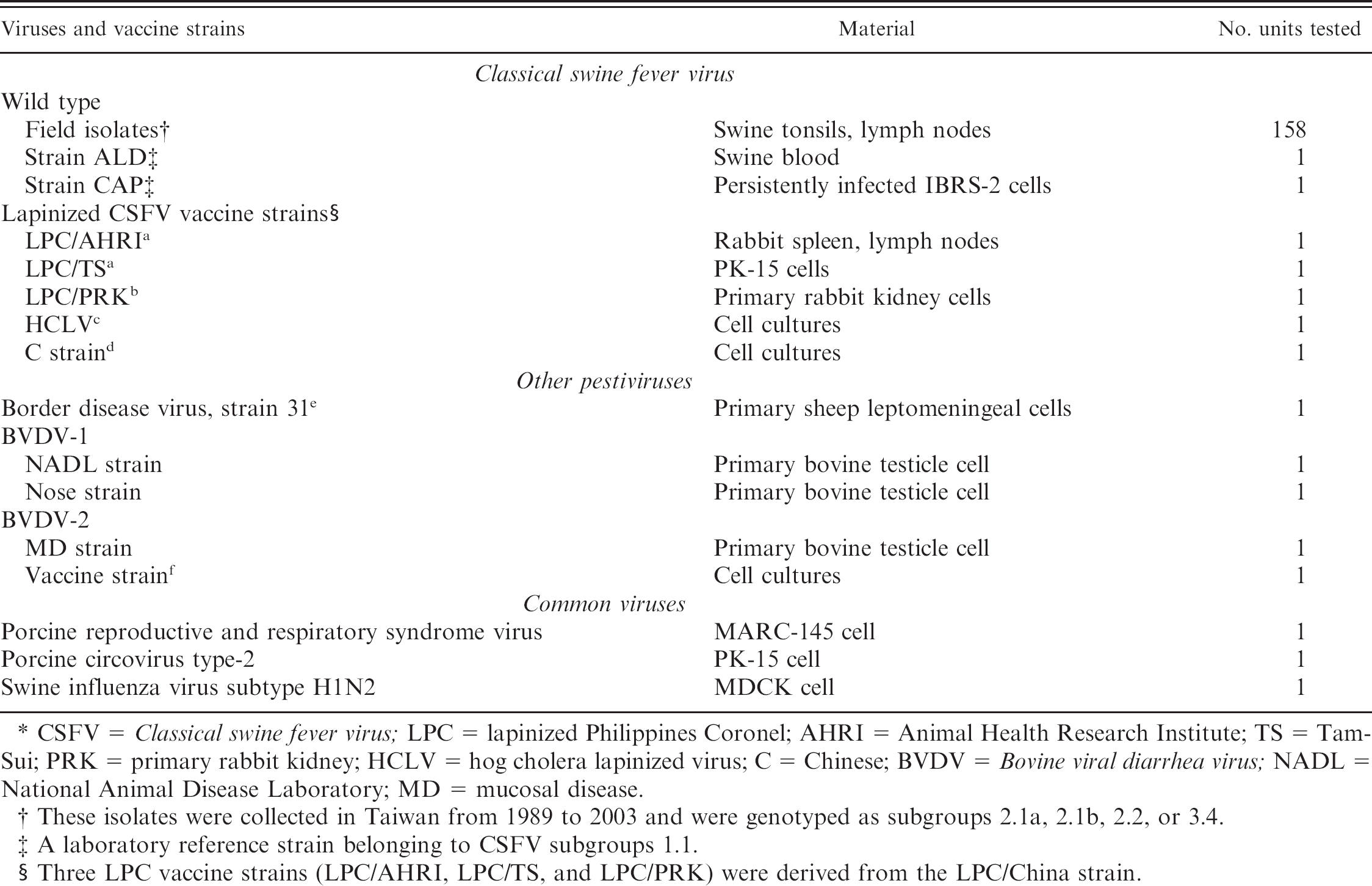
CSFV = Classical swine fever virus; LPC = lapinized Philippines Coronel; AHRI = Animal Health Research Institute; TS = Tam-Sui; PRK = primary rabbit kidney; HCLV = hog cholera lapinized virus; C = Chinese; BVDV = Bovine viral diarrhea virus; NADL = National Animal Disease Laboratory; MD = mucosal disease.
These isolates were collected in Taiwan from 1989 to 2003 and were genotyped as subgroups 2.1a, 2.1b, 2.2, or 3.4.
A laboratory reference strain belonging to CSFV subgroups 1.1.
Three LPC vaccine strains (LPC/AHRI, LPC/TS, and LPC/PRK) were derived from the LPC/China strain.
Detection of CSFV in sera samples from experimental infection of pigs by RT-PCR and nested PCR
Four 8-week-old specific pathogen-free pigs were inoculated intramuscularly with whole blood that contained a wild-type CSFV (92-TC1 strain) with a titer of 105 TCID50 (50% tissue culture infective doses)/ml. Serum samples were collected at 0, 1, 2, 3, 5, 7, 10, and 12 days after inoculation, and the presence of CSFV in these samples was determined by RT-PCR and nested PCR amplification.
Analysis of amplified products by agarose gel and multicapillary electrophoresis
The amplified products were analyzed by electrophoresis through 4% (for primer pair C3/C6) or 2% (for primer pair C5/C6) agarose gels m that contained 0.5 mg/ml SYBR Safe DNA gel stain i in 1 X Tris-acetate-EDTA (ethylenediamine tetra-acetic acid; TAE) solution. The RT-PCR amplification products were analyzed on an eGene HDA-GT12 system with a multicapillary gel cartridge GCK-5000F. n , 12 Ten microliters of the amplicons were mixed with 15-μl Tris-EDTA buffer in the instrument sample tray. The mixture was automatically injected into the capillary channel and was subjected to electrophoresis according to the eGene operation manual. Separations were performed by the AM420 method by using a 10-sec injection time and a 420-sec separation time. The molecular weight and the concentration of the amplicons were determined with reference to a pGEM DNA size marker. n
Sensitivity and specificity assays
To examine the sensitivity of RT-PCR and nested PCR reactions, a cell-culture supernatant fluid of CSFV field isolate strain O1030/CH/05 with an FAT titer of 103.8 TCID50/ml was used in 10-fold serial dilutions in phosphate buffered saline solution (PBS). The total RNA was extracted from each dilution and was used in RT-PCR and nested PCR assays. In the test for specificity of the assay, 2 BVDV-1 strains, 2 BVDV-2 strains, BDV, Porcine reproductive and respiratory syndrome virus (PRRSV), Porcine circovirus-2 (PCV-2), and Swine influenza virus (SIV) were used.
Nucleotide sequence of 3′ NTR of vaccine strains and wild-type CSFV
The RT-PCR products amplified by primer pair C5/C6 were purified by using the QIAQuick Purification Kit o without gel extraction. The DNA sequences of the RT-PCR products were determined by direct sequencing by using the BigDye Terminator Cycle Sequencing Reaction Kit p with the original RT-PCR primers. In the experiment, direct sequencing on a long T-rich fragment was not possible because of the slippage effect (Iowa State University DNA Facility—DNA Sequencing Trouble-shooting Guide. Available at: http://www.dna.iastate.edu/frame_dna_sequencing_tsg.html Accessed Feb. 28, 2008). To overcome this difficulty, 2 RT-PCR products amplified from long T-rich insertions of LPC/PRK and LPC/TS vaccine strains were cloned by using a pBAD/Thio topoisomerase I Taq-amplified Cloning Kit, q according to the manufacturer's instructions. Ten different plasmid clones for each LPC/PRK and LPC/TS strain were chosen for DNA sequencing by using a standard vector primer.
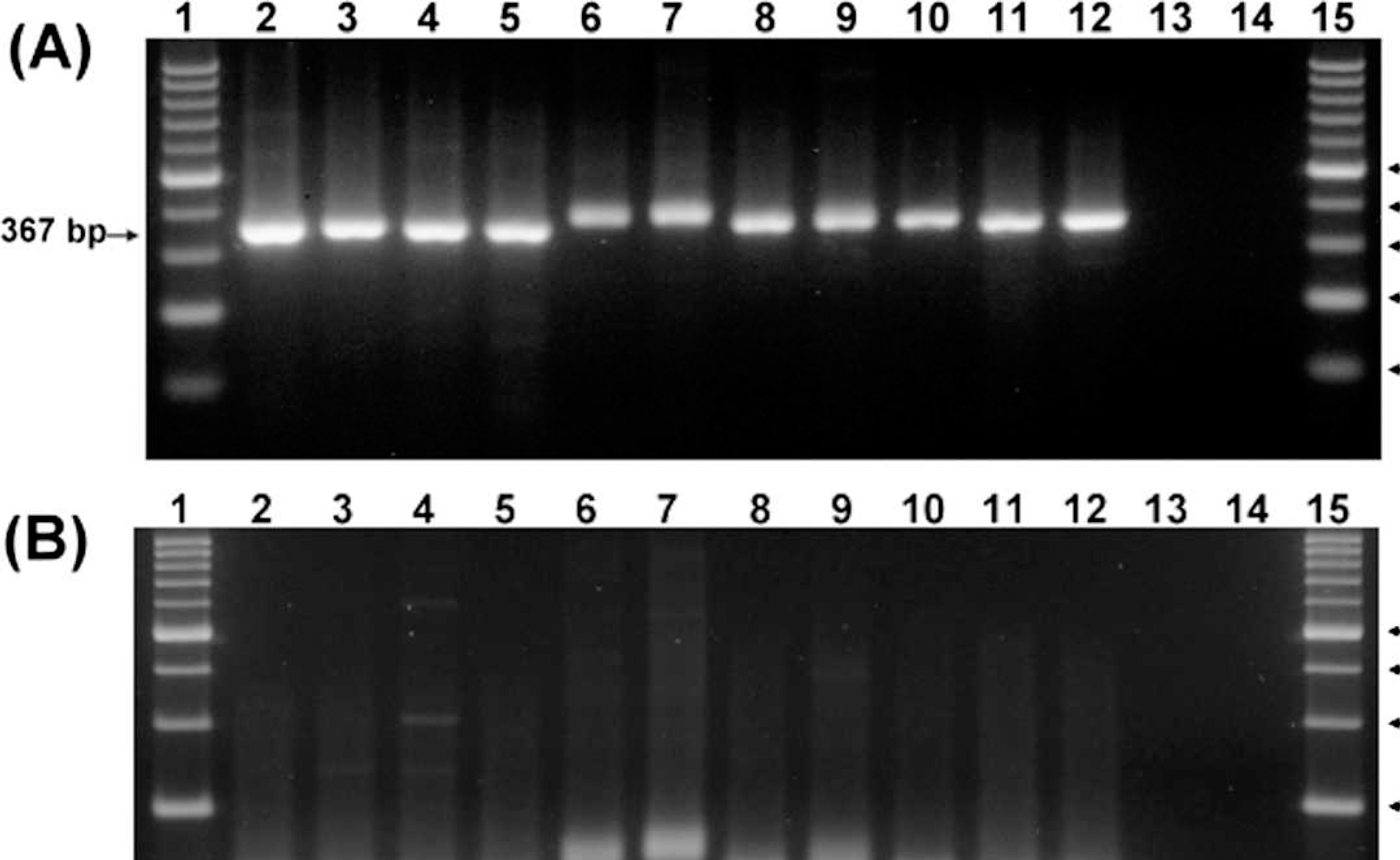
Amplification of different genotypes of Classical swine fever virus (CSFV) and 4 lapinized vaccine strains. The reaction products were analyzed by agarose gel electrophoresis.
Results
Specificity of the RT-PCR and nested PCR
By using the primer pair C5/C6, 158 wild-type CSFV, ALD, and CAP strains, and 5 lapinized vaccine strains (LPC/AHRI, LPC/TS, LPC/PRK, HCLV, and C strain), were successfully amplified by RT-PCR. As expected, the wild-type CSFV had PCR products of 367 base pairs (bp) whereas 3 vaccine viruses (LPC/AHRI, HCLV, and C strain) had PCR products of 379 bp. The slightly larger products of LPC/PRK and LPC/TS strains could be distinguished from those of the wild-type viruses in 2% agarose gels, but the products of 3 vaccine viruses (LPC/AHRI, HCLV, and C strain) could not be distinguished from the wild-type viruses (Fig. 1A). By using the primer pair C3/C6, all the aforementioned wild-type and lapinized vaccine strains were successfully amplified. As expected, 135-bp fragments were generated for the wild-type CSFV. Five vaccine viruses had amplified fragments that ranged from 147–177 bp. The products of vaccine viruses could be easily distinguished from those of the wild-type CSFV in 4% agarose gels (Fig. 1B). In an attempt to increase the sensitivity, a nested PCR assay was also developed. The primer pair C3/C6 was used as an internal primer set for the nested PCR. In the nested PCR, 158 wild-type CSFV, ALD, and CAP strains, and 5 lapinized vaccine strains, generated PCR products of the expected sizes as in the RT-PCR (Fig. 1C). Other pestiviruses, including BVDV/National Animal Disease Laboratory, BVDV/Nose, BVDV-1 vaccine strain, BVDV-2 vaccine strain, and BDV, and other common swine viruses, such as PRRSV, PCV-2, and SIV, were not amplified by these 2 sets of primers (data not shown).
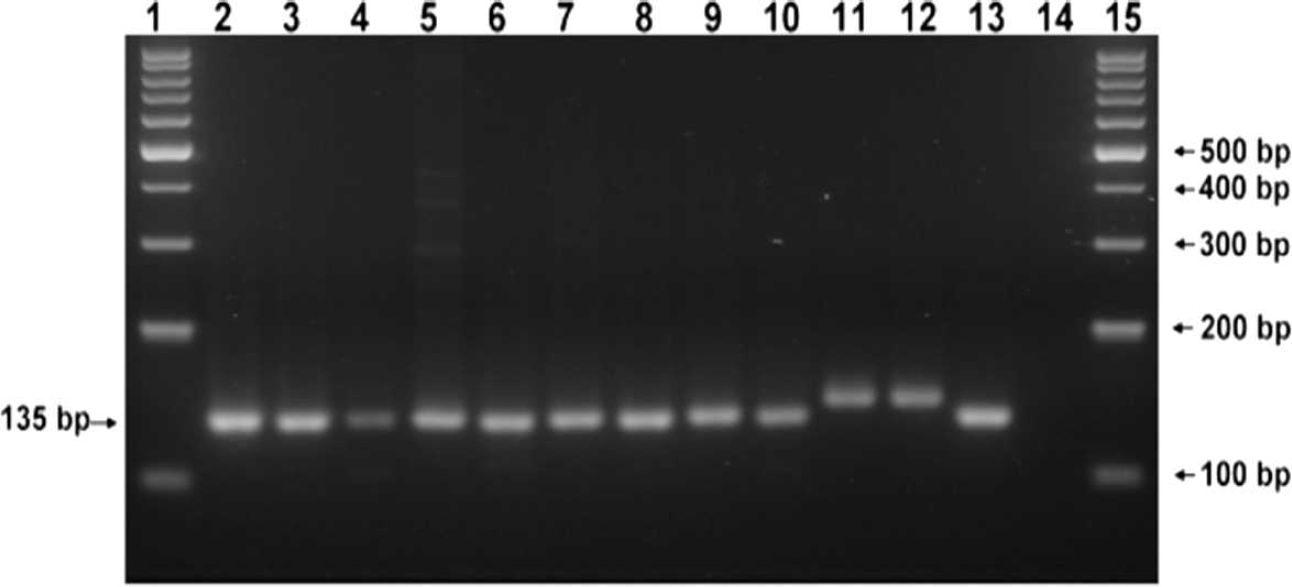
Reverse transcription polymerase chain reaction amplification of clinical samples with the primer pair C3/C6. Lanes 1, 15: 100-base pair (bp) DNA ladder marker; lanes 2–10: 9 wild-type viruses in clinical samples collected from 9 pig farms during 2004 to 2007; lanes 11–12: vaccine-type virus in clinical samples; lane 13: ALD; lane 14: negative control. The detected amplified 135-bp fragment from the wild-type Classical swine fever virus is indicated by an arrow on the left of the gel.
Detection and differentiation of wild-type and attenuated lapinized vaccine strains of clinical samples by RT-PCR
A total of 248 clinical samples were tested in this study. Thirty-five of these samples were positive for CSFV by RT-PCR. Of these 35 samples, 9 were identified as wild-type CSFV (Fig. 2), and 26 were identified as the persistence of lapinized vaccine strains. In VI, only 19 of the 248 clinical samples were positive for CSFV by FAT staining. Of these 19 samples, 9 were wild-type CSFV, and 10 were vaccine viruses. These results showed that the RT-PCR assay was more sensitive than VI.
Multicapillary electrophoresis analysis
By using a multicapillary electrophoresis system, the long RT-PCR products amplified by the primer pair C5/C6 can be easily separated into the wild-type and the vaccine viruses even when the difference is as small as 12 nt. The separation of 4 lapinized vaccine strains (LPC/AHRI, LPC/PRK, LPC/TS, and HCLV) and the wild-type CSFV represented by 5 different viral genotypes in a slab gel view is shown in Figure 3.
Sensitivity of the RT-PCR and nested PCR
In RT-PCR, by using primer pairs C5/C6 and C3/C6, the detection limits for wild-type CSFV were 6.3 TCID50/ml and 63 TCID50/ml, respectively. This shows that RT-PCR, with the primer pair C5/C6, was 10 times more sensitive than with the primer pair C3/C6. In nested PCR, by using the primer pair C3/C6, the detection limit of wild-type CSFV was 0.63 TCID50/ml. Based on these results, nested PCR was 10–100 times more sensitive than RT-PCR.
Nucleotide sequence analysis of 3′ NTR of vaccine viruses and wild-type CSFV
The RT-PCR products of 9 wild- and 8 vaccine-type CSFV obtained from the 248 clinical samples were sequenced by using the C5 and C6 primers. The results of DNA sequencing showed that the 9 wild-type CSFV samples belong to the CSFV subgroup 2.1a, and the 8 vaccine viruses were of the LPC strain that belonged to subgroup 1.1 (data not shown). In addition, 3 vaccine strains of subgroup 1.1 (LPC/AHRI, LPC/PRK, and LPC/TS) and wild-type CSFV of 4 different genotypes (92-TC1 of subgroup 2.1a, 90-YL1 of subgroup 2.1b, 84-KS1 of subgroup 2.2, and 85–12A of subgroup 3.4) were also sequenced. Sequences of these 7 viral strains were submitted to GenBank: 85–12A (EU107748), 84-KS1 (EU107749), 92-TC1 (EU107750), 90-YL1 (EU107751), LPC/AHRI (EU107752), LPC/TS (EU107753), and LPC/PRK (EU107754). The results of direct sequencing of the RT-PCR products showed that the wild-type CSFV lacked T-rich insertions and the vaccine strain LPC/AHRI contained a 12-nt T-rich insertion. The results of sequencing 10 different plasmid clones showed that the LPC/PRK and LPC/TS contained a T-rich insertion of size in the range 32–42 and 27–36 nt, respectively. The 2 clones that contained the longest T-rich insertions of 42 and 36 nt were derived from LPC/PRK and LPC/TS, respectively. They were sequenced by using both forward and reverse primers, and identical results were obtained with both primers. A sequence alignment of T-rich insertions of vaccine strains LPC/AHRI, LPC/PRK, and LPC/TS is shown in Figure 4. The lengths of T-rich insertion of these 3 strains are 12, 36, and 42 nt, respectively.
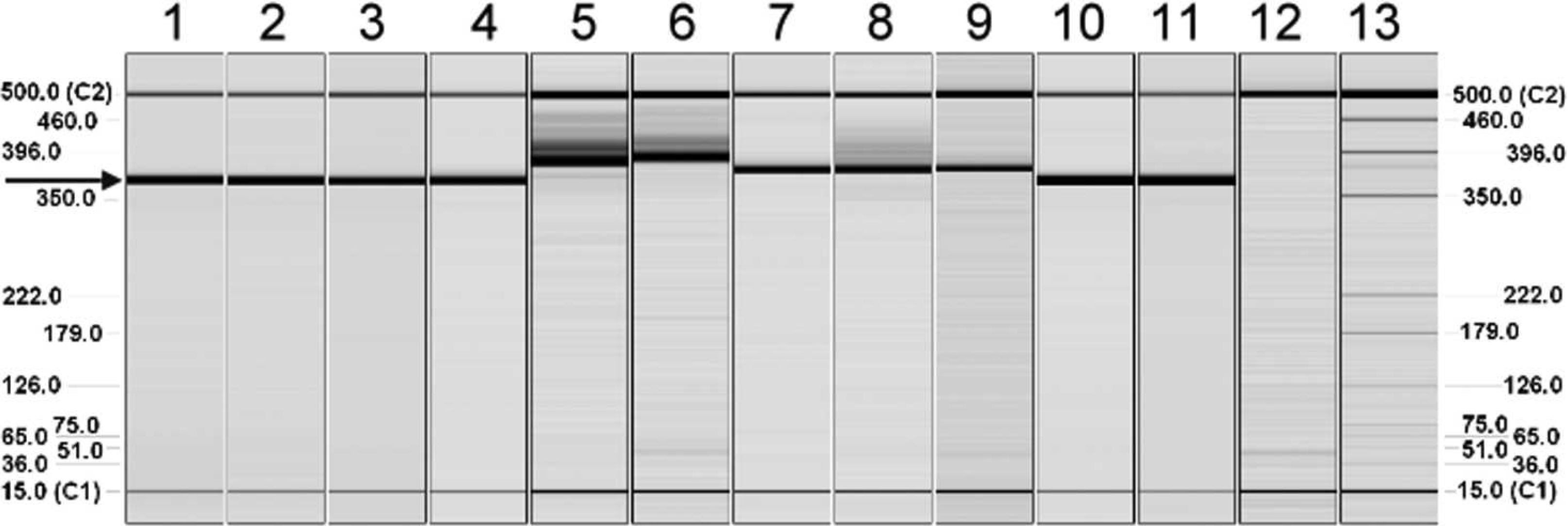
Multicapillary electrophoresis analysis of T-rich insertions in wild-type and lapinized vaccine strains of Classical swine fever virus (CSFV). Separations are aligned by means of bracketing standards C1 (15 bp) and C2 (500 bp) for highly accurate size determination. Lane 1: 85–12A (367 bp); lane 2: 84-KS1 (367 bp); lane 3: 92-TC1 (367 bp); lane 4: 90-YL1 (367 bp); lane 5: LPC (lapinized Philippines Coronel)/TS (Tam-Sui; 403 bp); lane 6: LPC/PRK (primary rabbit kidney; 409 bp); lane 7: LPC/AHRI (Animal Health Research Institute; 379 bp); lane 8: HCLV (hog cholera lapinized virus; 379 bp); lane 9: vaccine-type virus in clinical samples (379 bp); lane 10: wild-type virus in clinical samples (367 bp); lane 11: ALD virulent strain (367 bp); lane 12: negative control; lane 13: pGEM DNA marker. The detected amplified 367-bp fragment from the wild-type CSFV is indicated by an arrow on the left of the gel.
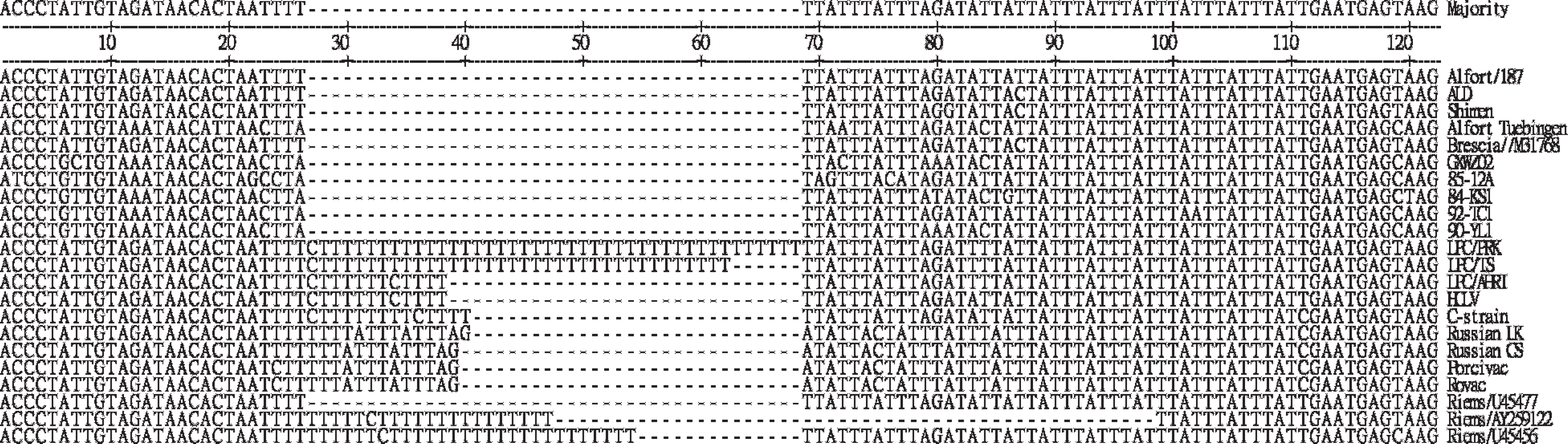
Nucleotide sequence alignment of the T-rich insertion sequences from the 3′ NTR of Classical swine fever virus (bases 12106–12185 from the Alfort/187 sequence). The accession numbers of 22 sequences included in this alignment are as follows: Alfort/187 (X87939), ALD (D49532), Shimen (AF092448), Alfort/Tubingen (J04358), Brescia (M31768), GXWZ02 (AY367767), 85–12A (EU107748), 84-KS1 (EU107749), 92-TC1 (EU107750), 90-YL1 (EU107751), LPC/PRK vaccine strain (EU107754), LPC/TS vaccine strain (EU107753), LPC/AHRI vaccine strain (EU107752), HCLV vaccine strain (AF531433), C-strain vaccine strain (Z46258), Russian LK vaccine strain (AF026718), Russian CS vaccine strain (AF099102), Porcivac vaccine strain (AF026714), Rovac vaccine strain (AF026717), Riems vaccine strain (U45477), Riem vaccine strain (AY259122), and Riems vaccine strain (U45456).
Discussion
Classical swine fever is a highly contagious and an often fatal disease of swine. The attenuated lapinized CSFV strains, such as C strain, LPC, and HCLV, can induce virtually complete protection against the disease (Lin TTC, Lee Robert CT: 1981, An overall report on the development of a highly safe and potent lapinized hog cholera virus strain for hog cholera control in Taiwan. Proceedings of the National Science Council, Republic of China, vol. 5, pp. 1–42. National Science Council, Taipei, Taiwan, Republic of China). 16,22,28 Because the attenuated vaccine viruses can persist in vaccinated pigs for a long period of time, 8,13 they may interfere with the use of laboratory diagnostic tools to detect wild-type CSFV. In Taiwan, the ability to distinguish between wild-type and vaccine strains of CSFV has been of essential importance for laboratory diagnosis of CSF, because extensive vaccination against CSF has been enforced. Previously, RT-PCR followed by sequencing or digestion with restriction enzymes was the main method used in Taiwan to detect CSFV and to exclude the interference of vaccine viruses. 17 To simplify the diagnosis of CSF, a simple one-step, single-tube RT-PCR assay based on the T-rich insertions for simultaneous detection of and differentiation between wild-type and vaccine strains of CSFV was developed in the current study. The RT-PCR products can be analyzed by conventional agarose gel electrophoresis (Figs. 1B, 1C, 2) or automated multicapillary electrophoresis, the latter of which provides high-resolution and short analysis time for rapid differentiation between wild-type and vaccine strains of CSFV (Fig. 3). Results of clinical testing showed that 26 of 248 clinical samples (10.5%) were identified as vaccine viruses by RT-PCR. Similar results were obtained in a previous study in which 18 of 133 field samples (13%) obtained from vaccinated pigs showed the presence of the C-strain vaccine virus by a multiplex nested RT-PCR. 11 Therefore, in countries where live CSF vaccines were used, the possibility of detection of the vaccine viruses should be considered in routine diagnostic procedures for CSF.
In an effort to amplify different genotypes of CSFV without amplifying 2 closely related pestiviruses (BVDV and BDV), 2 sets of degenerate primers were designed based on the conserved regions of the CSFV genome. Five different genotypes of CSFV, comprising 158 wild-type CSFV (subgroups 2.1a, 2.1b, 2.2, and 3.4), ALD and CAP strains (subgroups 1.1), and 5 lapinized vaccine strains (subgroups 1.1) could be amplified, and wild-type and vaccine viruses could be distinguished by using these 2 sets of primers. On the contrary, no amplification was observed from other pestiviruses, such as BVDV-1, BVDV-2, and BDV, or from other common swine viruses, such as PRRSV, PCV-2, and SIV. This demonstrated that the RT-PCR primers were highly specific. In sensitivity tests, the RT-PCR primer pairs C5/C6 and C3/C6 were each able to detect wild-type CSFV individually at a virus titer of 6.3 and 63 TCID50/ml, respectively. Moreover, C3/C6 could be used as a set of nested PCR primers to obtain higher sensitivity. The nested PCR increased the detection limit to 0.63 TCID50/ml. Pigs experimentally infected with wild-type CSFV tested positive for CSFV as early as 3 DPV by RT-PCR and 2 DPV by nested PCR. The results demonstrated that the assay was highly sensitive and could detect the early stages of CSFV infection.
A one-step RT-PCR assay that used TaqMan MGB probes based on single nucleotide difference was developed to distinguish between vaccine- and wild-type CSFV in Korea. 5 The attenuated Korean LOM vaccine strains have a T at nt 223, whereas Korean wild-type viruses, and most of the CSFV have a G in the same position. Therefore, it is possible to distinguish them by means of the MGB probes. 5 However, lapinized CSF vaccine strains, such as LPC, HCLV, C-strain, and Riem C, all contain a G at nt 223. Therefore, the real-time assay described previously 5 does not seem applicable for distinguishing wild-type viruses from lapinized vaccine strains of CSFV. Another study described a multiplex nested RT-PCR for the detection and differentiation of wild-type viruses from the C strain based on 2 nucleotide differences (GT vs. AC) at the 3′ end of a specific primer. 11 However, the LPC strain and the wild-type CSFV have the same AC allele. Therefore, these primers, described previously, 11 do not seem applicable for distinguishing between LPC vaccine strains and wild-type CSFV. A multiplex real-time RT-PCR for quantitative and differential detection of wild-type and C-strain vaccine viruses was also described recently. 30 However, several Taiwanese field strains (P97 and 0406/TWN) show some polymorphism within the probe sequence. Hence, these Taiwanese field strains probably cannot be detected by the assay. 30 There are 7 vaccine strains that contained the 12–14-nt T-rich insertions at the 3′ NTR that were reported, 3,16,27,28 and none of the wild-type CSFV strains were ever reported to contain the insertions. Results showed that the RT-PCR assay developed in this study could be applied to at least 3 attenuated-lapinized vaccine strains, namely LPC, HCLV, and C strain. The Riems C vaccine strain is a cell culture–adapted derivative of the HCLV strain. 28 Three Riems C sequences deposited in GenBank showed differences in the T-rich region. One of the Reim vaccine strains (U45477) lacks the T-rich insertion; another Reim vaccine strain (AY259122) contains a T-rich insertion and a deletion; the third Reim vaccine strain (U45456) contains a 28-bp T-rich insertion (Fig. 4). Therefore, whether the assay can be applied to Riems C vaccine strains is still unknown.
The current study found that the T-rich insertions of the LPC/PRK and LPC/TS strains are longer than those of the strains previously reported. To determine the exact length of the T-rich insertions in the LPC/PRK and LPC/TS strains, plasmid clones prepared from PCR products from these vaccine strains were sequenced. The results showed that the T-rich insertions of the LPC/PRK and LPC/TS strains were 32–42- and 27–36-nt long, respectively. Combined with the results of the multicapillary electrophoresis analysis, it was determined that the longest sequences, 42 nt for the LPC/PRK strain and 36 nt for the LPC/TS strain, were the lengths of the T-rich insertions in their genomes.
Two different lengths of T-rich insertions, 42 and 36 nt, were discovered in the descendant of the LPC/China vaccine virus (Fig. 4) in the current study. Attenuation of the lapinized CSFV strain was originally done in Taiwan in the 1950s. A Rovac strain of the lapinized CSFV that had already undergone about 250 serial passages in rabbits in the Lederle Laboratory was given to Lee by A. B. Coronel and was introduced into Taiwan from the Philippines by Lee in 1952. 9,10 Pigs inoculated with this virus showed severe postvaccination reactions, and some even died of apparent CSF. To obtain a safer vaccine strain, the virus was then further serial-passaged through rabbits. After more than 800 passages, the rabbit-adapted virus had completely lost its virulence and became a safe and effective vaccine virus against CSF for pigs. This vaccine virus was designated as the LPC strain or LPC/China strain, and the seed virus was kept at AHRI for the production of live vaccine (Lin TTC, Lee RCT: 1981, An overall report on the development of a highly safe and potent lapinized hog cholera virus strain). The LPC/TS vaccine strain was derived from the LPC/China vaccine strain by adaptation to the PK-15 (porcine kidney) cell line for 10 passages, followed by cloning twice at a limiting dilution and subsequent growth for 21 passages in the cell line. Why does the original LPC/China strain contain a 12-nt T-rich insertion, whereas its descendant, LPC/TS, contains a 36-nt T-rich insertion? By tracing back the procedure of vaccine development, it was found that the addition of T-rich insertions occurred during the cloning by limiting dilution rather than in the serial passages in tissue culture. The LPC/PRK vaccine strain also obtained a 42-nt T-rich insertion during cloning by limiting dilution (F. Huang, personal communication). Because the LPC/China vaccine virus underwent 1,050 serial passages in rabbits, the vaccine virus was not considered a uniform population. In fact, it contained several different particles that carried T-rich insertions of different lengths. Two tissue culture–adapted lapinized vaccine viruses (LPC/TS and LPC/PRK) that carried 36- and 42-nt T-rich insertions were unexpectedly selected for during vaccine preparation. The LPC/TS strain can be propagated up to 107.3 TCID50/ml in the PK-15 cell line, and the viral titer is higher than the LPC/China strain grown in PK-15 cells (data not shown). It seems that the function of long T-rich insertions could be to increase the virus titer and result in easier selection in the procedure of cloning by limiting dilution. In conclusion, a simple one-step RT-PCR assay presented in the current study could provide a rapid and sensitive diagnostic tool for the specific detection of CSFV, and for distinguishing animals infected with wild-type viruses from those vaccinated with lapinized vaccine strains in the field.
Acknowledgements
The authors thank all those who submitted clinical samples. The authors also thank Dr. Ming Yi Deng (Plum Island Animal Disease Center, USDA) for reviewing the manuscript. This study was financially supported by the Council of Agriculture, Taiwan, Republic of China.
Footnotes
a.
Animal Health Research Institute, Tamsui, Taiwan.
b.
Formosa Biomedical Technology Corp., Taipei, Taiwan.
c.
China Animal Husbandry Industry Co. Ltd., Nanjing, China.
d.
Pestiffa®, Merial SAS, Lyon, France.
e.
VR-996TM, Global Bioresource Center, Manassas, VA.
f.
Bovi-Shield® Gold 4, Pfizer Animal Health, Exton, PA.
g.
Sigma-Aldrich, St. Louis, MO.
h.
DNASTAR Inc., Madison, WI.
i.
Invitrogen Corp., Carlsbad, CA.
j.
JMR Holdings, Kent, UK.
k.
Promega Corp., Madison, WI.
l.
Perkin-Elmer Applied Biosystems Division, Foster City, CA.
m.
SFRTM Biotechnology Grade; AMRESCO, Solon, OH.
n.
eGene Inc., Irvine, CA.
o.
Qiagen Inc., Valencia, CA.
p.
Applied Biosystems, Foster City, CA.
q.
Invitrogen Corp., Carlsbad, CA.