




Abstract
In the present study, the hemagglutinating activity of 9 reference strains (serovars A–I) of Ornithobacterium rhinotracheale was investigated by using fresh erythrocytes from 15 different species: chicken (broiler, rooster, hen), turkey, pigeon, quail, duck, Harris hawk (Parabuteo unicinctus), house finch (Carpodacus mexicanus), cow, sheep, horse, dog, rabbit, pig, human (groups A, B, AB, and O), and rainbow trout (Oncorhynchus mykiss). All 9 strains agglutinated rabbit erythrocytes. None of the strains was able to agglutinate hen, cow, horse, or rainbow trout erythrocytes. The number of positive reactions among the remaining species varied. Results indicate that the use of rabbit erythrocytes is better suited for testing the hemagglutinating activity of O. rhinotracheale.
The bacterium Ornithobacterium rhinotracheale (family Flavobacteriaceae, order Eubacteria, genus Ornithobacterium) has been isolated from both domestic and wild birds. 8 It is associated with respiratory disease, decreased growth, and mortality in chickens and turkeys. Lesions such as pneumonia, pleuritis, and airsacculitis are observed in diseased birds. Economic loss can be considerable when breeders are involved. 1
Identification of infected birds is based on the clinical history and bacteriological isolation of pleomorphic, Gram-negative, oxidase-positive bacteria. Confirmation is determined by routine biochemical or enzymatic tests. However, the Analytical Profile Index (API) 20NE code 0220004 is the most frequently used. 3,4,7,9 At least 18 agar gel precipitin (AGP) serovars have been recognized. 1
To date, the hemagglutinating activity of O. rhinotracheale has been reported in few papers. 2,4,5,7 In the first study, where hemagglutinating activity of O. rhinotracheale was reported, 15 of 25 South African isolates (serovar A) agglutinated with glutaraldehyde-fixed chicken erythrocytes. 2 In Mexico, 10 isolates (unknown serovar) from broiler and laying chickens and 2 (unknown serovar) from turkeys agglutinated glutaraldehyde-fixed chicken erythrocytes. 4,5 In a recent study, the hemagglutinating activity of 40 O. rhinotracheale isolates (serovar A) obtained from 28 chickens and 12 pigeons in Taiwan was tested. Only 22 agglutinated fresh chicken and pigeon erythrocytes, and none of the pigeon isolates agglutinated fresh chicken and pigeon erythrocytes. 7 The hemagglutinating activity of serovar reference strains of O. rhinotracheale is unknown. Hence, the aim of the present study was to investigate the hemagglutinating activity of 9 serovar reference strains of O. rhinotracheale by testing erythrocytes from a number of species.
The reference strains of O. rhinotracheale used were B 3263/91, GGD 1261, ORV K91–201, ORV 94108 nr. 2, O-95029 No. 12229, ORV 94084 K858, O-95029 No. 16279, E-94063 4.2, and BAC 96–0334 #MINN 18 for AGP serovars A to I, respectively. All bacteria were sourced from the culture collection held at the Animal Research Institute (Moorooka, Queensland, Australia). The origin and source of strains used are shown in Table 1. Bacteria were cultivated on 10% sheep blood agar at 37°C and incubated overnight in a candle jar. Brain-heart infusion broth was used for propagation and maintenance of bacterial cultures. For improved growth, this medium was supplemented with 1% (vol/vol) filter-sterilized, heat-inactivated horse serum. 5 All strains included in the study were tested for their ability to agglutinate fresh erythrocytes from different animal species: chicken (broiler, rooster, hen), turkey, pigeon, quail, duck, Harris hawk (Parabuteo unicinctus), house finch (Carpodacus mexicanus), cow, sheep, horse, dog, rabbit, pig, human (groups A, B, AB, and O), and rainbow trout (Oncorhynchus mykiss). Fresh erythrocyte suspensions were prepared as previously reported. 6 Also, chicken glutaraldehyde-fixed erythrocytes were used. 5
Fresh bacterial suspensions of the 9 reference strains of O. rhinotracheale were prepared from overnight cultures on 10% sheep blood agar plates at 37°C that were harvested in 1.5 ml of phosphate buffered saline (PBS; pH 7.0), washed 3 times by centrifugation, and stored at 4°C. 5 The hemagglutinating activity of all strains was investigated as previously reported. 5 In brief, hemagglutinating activity was first determined with 50-μl volumes of reagent and 1% glutaraldehyde-fixed chicken erythrocytes with a diluent of PBS that contained 0.01% thimerosal in a microdilution method. The hemagglutination titer was the reciprocal of the highest dilution of antigen showing complete agglutination of the erythrocytes after incubation for 30 min at room temperature. 5 The hemagglutination titer of all antigens was adjusted to 8 and then tested by using the relevant 1% fresh erythrocyte suspension. Wells containing only the suspension of erythrocytes served as a negative control. To verify reproducibility, hemagglutination assays were repeated 3 times under the same conditions. Hemagglutinating activity was regarded as positive when erythrocyte suspensions were agglutinated in the 3 repetitions.
Hemagglutinating activity of serovar reference strains of Ornithobacterium rhinotracheale included in the present study.*
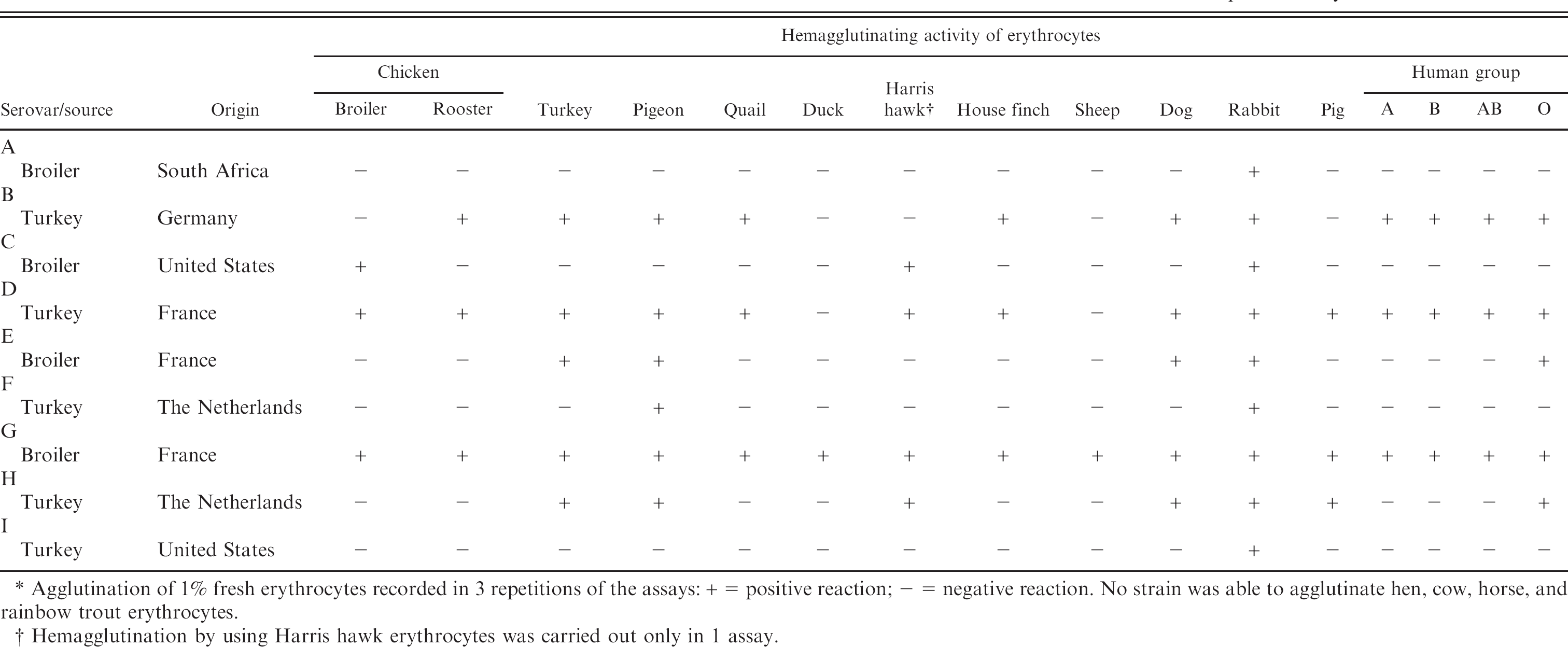
Agglutination of 1% fresh erythrocytes recorded in 3 repetitions of the assays: + = positive reaction; – = negative reaction. No strain was able to agglutinate hen, cow, horse, and rainbow trout erythrocytes.
Hemagglutination by using Harris hawk erythrocytes was carried out only in 1 assay.
With the exception of 2 strains (ORV 94084 K858 ORT and BAC 96–0334 #MINN 18), all bacterial suspensions were adjusted to a hemagglutination titer of 8. Strain ORV 94084 K858 ORT was adjusted to a hemagglutination titer of 2. No hemagglutinating activity of strain BAC 96–0334 #MINN 18 was observed. Bacterial suspension of this strain was adjusted by spectrophotometry to a similar optical density showed by the adjusted (hemagglutination titer of 8) O-95029 No. 16279 strain. The hemagglutination titers of fresh bacterial suspensions with fresh erythrocytes of the different animal species included in the study are shown in Table 1. With the exception of rabbit erythrocytes, strain BAC 96–0334 #MINN 18 did not agglutinate any of the erythrocytes tested. However, all bacterial suspensions agglutinated the rabbit erythrocytes. Erythrocytes from hen, cow, horse, and rainbow trout were not agglutinated by any of the bacterial suspensions.
Results showed that differences exist in the hemagglutinating activity among the reference strains of O. rhinotracheale included in the study. However, it was concluded that hemagglutination tests including fresh rabbit erythrocyte rather than chicken erythrocyte suspensions are better suited for testing the hemagglutinating activity of O. rhinotracheale.
Acknowledgements. This work was supported by Universidad Autónoma del Estado de México, project 1999/2005. Vicente Vega held a scholarship from this project.