



Abstract
An ovine testis cell line (OA3.Ts) was evaluated and compared with primary lamb kidney (LK) cells for its utility in capripoxvirus propagation and titration. A comparison of OA3.Ts cell growth kinetics and morphology at low (<33) and high (34−36) passage levels indicated a difference in both characteristics. However, viral titers determined in low and high passage OA3.Ts cells were comparable with those obtained using LK cells. Capripoxvirus infection of OA3.Ts and LK cells resulted in a similar cytopathic effect, which allowed for the detection of discrete viral plaques following immunostaining with capripoxvirus-specific antiserum.
Introduction
Capripoxviruses comprise 1 of 8 genera within the subfamily Chordopoxvirinae, family Poxviridae. Members of the genus Capripoxvirus are sheeppox, goatpox, and lumpy skin disease viruses that cause disease in sheep, goats, and cattle, respectively. Lumpy skin disease virus (LSDV) is endemic in Africa, whereas goatpox and sheeppox are endemic in Africa, the Middle East, and Asia and are the most economically significant pox diseases of ruminants. 2,11
Capripoxviruses are double-stranded DNA viruses with genomes approximately 150 kbp in size. Goat and sheeppox share at least 147 putative genes. 19 LSDV has an additional 9 genes likely involved in the ability to infect cattle. 18 Currently, there are no serological methods that can differentiate between capripoxvirus isolates. 3,14 In addition, electron microscopy cannot differentiate between different isolates. 13
Diagnosis of capripoxvirus disease is based upon clinical signs with laboratory confirmation by virus isolation, polymerase chain reaction (PCR) and electron microscopy. Although capripoxviruses will grow in a variety of cell types from cattle, goat, and sheep origin, 1 the most commonly used cell systems for virus isolation are primary lamb kidney or primary lamb testis cells. 4 Use of these cells is preferred mainly because of their ability to support the replication of a variety of capripoxvirus isolates 10,20 and the ability to obtain sufficient numbers of cells from the respective organs. However, the reduced availability of lambs, mainly owing to efforts to minimize animal use, has necessitated investigating the suitability of continuous cell lines. A report by Jassim and Keshavamurthy has indicated increased susceptibility of secondary lamb testes cell cultures to a field isolate of sheeppox virus when compared with that exhibited by primary cultures. 9 This has provided the impetus to investigate the suitability of continuous ovine testes cell lines, since secondary cultures still have many of the detrimental, inherent characteristics exhibited by primary cultures, such as cell heterogeneity and the presence of potential contaminating elements such as endogenous viruses. In addition, there is variability in the ability to replicate virus at each passage level and virus susceptibility is still limited to within a few passages. 9,10
The need to use primary or secondary cell cultures, in the absence of a suitable continuous cell line susceptible to primary isolates of capripoxvirus, has inhibited the development, validation, and widespread use of virus isolation and detection methods incorporating immunostaining for disease confirmation. A literature search for continuous ovine testes cell lines that might be suitable for such purposes identified a continuous ovine testis cell line, designated OA3.Ts, that has been documented for its ability to support replication of sheep retroviruses. 15,16 The objective of this study was to evaluate the utility of OA3.Ts cells for capripoxvirus propagation, titration, and serological detection in a comparative manner using primary lamb kidney (LK) cells, since they are currently used widely for capripoxvirus propagation and laboratory diagnosis.
Materials and methods
Cells and virus. African green monkey kidney (Vero) cells a were routinely propagated in Eagle minimal essential medium (MEM) b supplemented with 10% gamma-irradiated (bovine viral diarrhea virus [BVDV]-free) fetal bovine serum (γ-FBS) c and 2 mM L-glutamine. b Ovine testis (OA3.Ts) cells a were routinely propagated in Dulbeccos modified Eagles medium, b supplemented with 10% nonirradiated (BVDV-free) fetal bovine serum b and 4 mM L-glutamine. b The passage level of OA3.Ts cells was carefully monitored, and cells between passages 22 (p22) and 36 (p36) were used. According to the depositor's description, OA3.Ts cells are adherent cells with epithelial morphology and are susceptible to Orf virus, which is in the poxvirus family.
Primary LK cells were isolated using routine cell culture techniques as follows. Kidneys were obtained aseptically from 1-day-old lambs and maintained during transportation in Hanks balanced salt solution b containing 200 μg each of penicillin and streptomycin b /ml and 20 μg nystatin b /ml. Each kidney was dissected to remove the cortex, which was further processed by mincing and incubation with 100 ml 0.25% trypsin b containing 200 μg each of penicillin and streptomycin b /ml and 20 μg nystatin b /ml until such time as the cortex was completely digested. The supernatant from repeated digestions was filtered through sieves, and cells were collected by low speed centrifugation. LK cells were seeded into 150 cm2 cell culture flasks at approximately 100,000 cells/cm2 and propagated in alpha-modified Earles medium b supplemented with 10% non-irradiated (BVDV-free) FBS, c 2 mM L-glutamine, b and 100 ug penicillin/streptomycin b /ml for up to 7 days, after which time the cells were frozen. Upon thawing and seeding, cells were designated as p1.
Capripoxvirus Nigerian isolate was originally isolated from infected sheep in Nigeria d and is virulent in sheep. Other capripoxvirus isolates such as Indian goatpox, d Kenyan sheep and goatpox virus, d Yemen sheep and goatpox virus, d and lumpy skin disease virus (LSDV, Neethling strain) d were obtained from the Institute for Animal Health, Pirbright, UK. Virus stocks were produced in OA3.Ts cells and stored as individual aliquots in order to minimize the effect of freeze-thaw cycles on virus stability. Orf virus NZ a was originally isolated from a sheep in New Zealand and passaged in bovine testes cells. 8 Orf virus stocks were generated by 2 passages in OA3.Ts. Orf virus causes a distinct cytopathic effect (CPE) that differs from CPE induced by capripoxvirus. All virus work was performed in containment level 3 facilities.
OA3.Ts cell growth. To determine growth kinetics, OA3.Ts p25, OA3.Ts p35, and LK p1 cell suspensions were each seeded in 25-cm2 flasks at 1.5 − 104/cm2 (3.75 − 105 cells per flask) under the conditions used for routine propagation. Three flasks were trypsinized at 24-hr time intervals for each cell passage, and the total number of cells from each flask was determined. The average number of cells for each triplicate was plotted, and observations of cell confluency and morphology were made at each time point.
Virus titration. Virus titrations were performed in 96-well plates using LK p1 and OA3.Ts cells p23 to p36. Cell seeding densities were determined in order to achieve 80% to 90% confluency after 24-hr incubation at 37°C in the presence of 5% CO2, at which time media was removed. Based on this determination, LK and OA3.Ts p23 to p33 cells were seeded at 70,000 cells/cm2 and OA3.Ts p34 to p36 cells were seeded at 40,000 cells/cm2. Plates were infected with eight 200 μl-replicates of 10-fold serial dilutions of capripoxvirus (Nigerian isolate) or medium (cell control) and incubated for a further 6 days, with daily examination of the cells for CPE. The virus diluent medium was identical to that used for cell propagation except that it contained only 2% FBS. Cells were observed under light microscopy to identify wells exhibiting CPE. Virus titers (TCID50/50 μl) were calculated using the method of Reed and Muench, 17 where wells displaying 1 or more viral plaques were designated as positive.
Virus growth study. Vero p144, LK p1, and OA3.Ts p26 cells were seeded in 12-well plates at 70,000 cells/cm 2 and infected the following day in triplicate with different multiplicity of infections (MOI) (0.1, 0.01, 0.001, and 0.0001). Plates were frozen at 2, 4, and 6 days postinfection (DPI). Following 2 freeze-thaw cycles, supernatants were titrated, as previously described, using LK and OA3.Ts p26 cells with 2 replicates for each of the samples generated for each time point. Virus titers were determined on DPI 6 and expressed as plaque forming units (PFU).
Virus detection by immunostaining. Six days after capripoxvirus or orf virus infection, medium was removed from OA3.Ts and LK cells by washing twice with phosphate-buffered saline e (PBS) (200 μl/well). The cells were then fixed with 5% neutral-buffered formalin in PBS (200 μl/well) for 1 hr at 37°C. The fixative was removed, and the cells were washed 3 times with PBS (200 μl/well). The PBS was removed and cells were blocked with Sigma blocking buffer e for 1 hr at 37°C. Blocking buffer was removed, and wells were washed 3 times with PBS containing 0.1% Tween 20 e (PBST). The primary antibody for capripoxvirus was obtained from an experimentally infected sheep (Nigerian isolate) at 63 DPI, f was diluted 1:200 in PBST, added to the wells (100 μl/well), and incubated for 1 hr at 37°C. The primary antibody for orf virus was obtained from an experimentally infected sheep (NZ isolate) at 35 DPI, f was diluted 1:200 in PBST, added to the wells (100 μl/well), and incubated for 1 hr at 37°C. The primary antibody was removed and wells were washed 3 times with PBST. One hundred microliters of anti-sheep antibody conjugated to horseradish peroxidase, g diluted 1:2000 in PBST, was added to each well and incubated at 37°C for 1 hr. The conjugate was removed, and the wells were washed 3 times with PBST. Plates were developed with 3-amino-9-ethylcarbazole (AEC). e After development, AEC was removed and the plates were rinsed with water and dried. Plates were assessed for immunostaining by microscopy within 2 days following AEC development. Pre-inoculation (negative) serum was used on capripoxvirus-infected and orf virus–infected cells and positive serum was used on uninfected cells to test for nonspecific reactivity.
Statistical analysis. A Student's t-test (P < 0.05) was used to determine if there were any differences between virus titers obtained in LKs and OA3.Ts.
Results
OAS.Ts and LK cell growth characteristics and morphology. After entering the exponential phase, 24 hours postseeding, LK and OA3.Ts cells demonstrated different growth kinetics and morphology depending on their passage level (data not shown). LK cells exhibited steep exponential growth, resulting in an approximate 9-fold increase in cell number at 72 hours postseeding. By contrast, the growth curve of OA3.Ts cells between p17 and p27 was typified by OA3.Ts p25 cells that exhibited a shallow exponential growth phase until 96 hours postseeding, when an approximate 5-fold increase in cell number was attained. The exponential growth phase of cells between p28 and p36, as exemplified by OA3.Ts p35 cells, was shorter and less productive, resulting in an approximate 2.5-fold increase in cell number at 72 hours postseeding. It is important to note that OA3.Ts cell viability was greater than 97% at all passage levels.
Once maximum cell numbers were achieved, all the cells exhibited an overall decrease, of approximately 35%, in cell number up to 168 hours postseeding, after which time the OA3.Ts cells continued to decrease in cell number, whereas the LK cells demonstrated an apparent sharp increase in cell number at 192 hours postseeding. Observations of LK cell morphology indicated the presence of fibroblast cells (data not shown), which likely overgrew the epithelial cells in the primary cell culture, thus contributing to this phenomenon.
It was interesting to note that OA3.Ts p25 cells appeared more elongated and grew in a more ordered (i.e., swirling pattern) fashion than p35 cells (data not shown). The higher passage level cells exhibited considerable heterogeneity in morphology, generally being larger in size and less elongated, with some cells exhibiting signs of stress, typified by vacuolation and swelling. In contrast to p35 cells, the lower passage cells demonstrated the capacity to form a tightly packed monolayer. These differences were observed as early as 48 hours postseeding and likely accounted for the observation of approximately the same percentage confluency for the high and low passages even though the actual cell numbers were higher for the low passage cells at each time point. LK cells exhibited a less ordered cell monolayer (data not shown) resulting in observations of subconfluency at all time points in the growth curve.
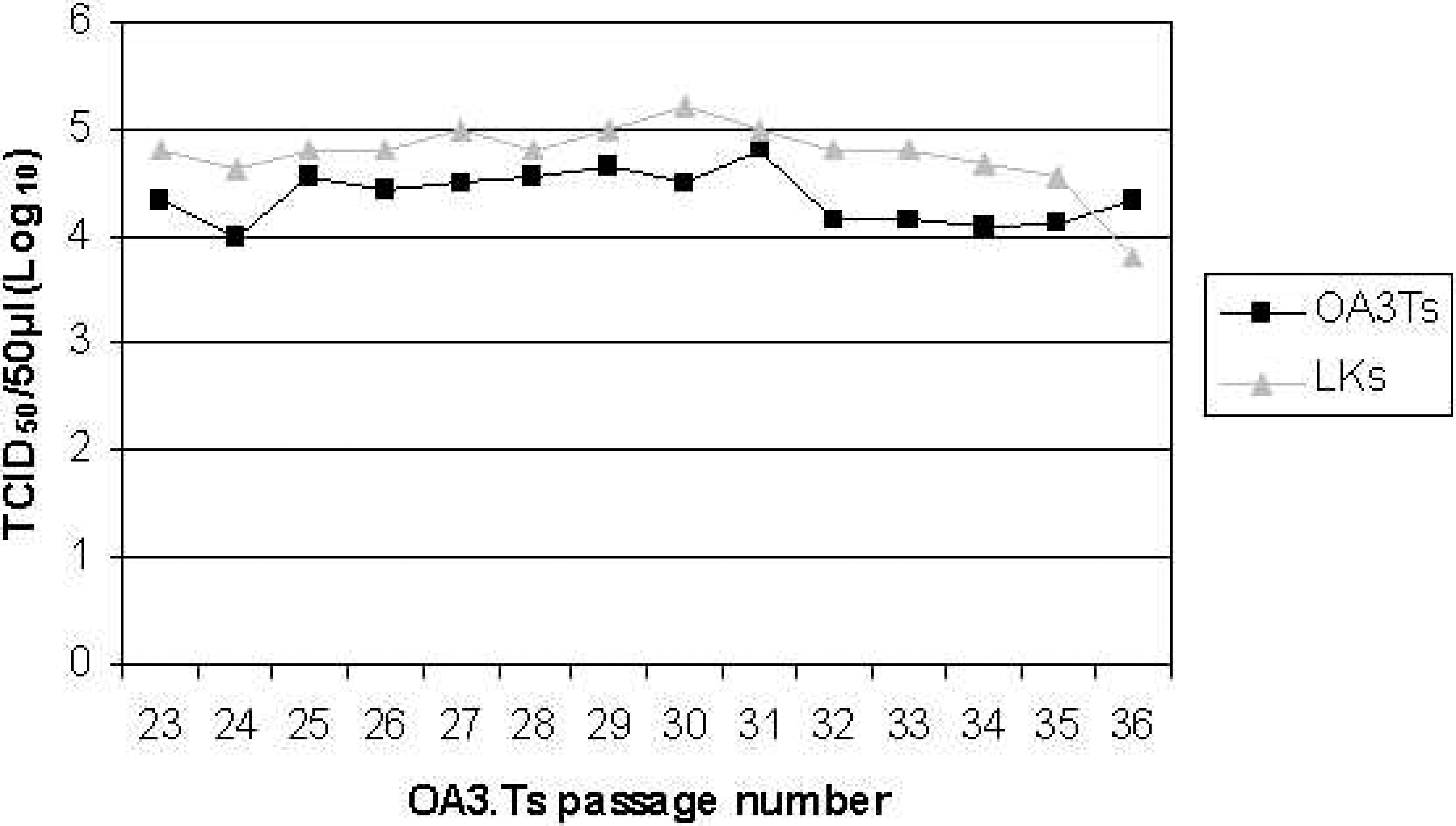
Titer (TCID50) of Nigerian sheeppox virus in OA3.Ts cells ranging from passage numbers 23 to 36 and LK passage 1 cells.
Titration of capripoxviruses in OA3.Ts and LK cells. After infection, cells were examined daily by light microscopy for the presence of CPE, which could be observed as early as DPI 1 with a high MOI and at DPI 4 or 5 with lower MOIs. Based on these observations, DPI 6 was selected as the time point at which virus titers were determined. The CPE was characterized by cells that became refractory and ragged in appearance, with retraction of the cell membranes from surrounding cells. At high concentrations of virus, the monolayer would be completely destroyed with infected cells rounding up and detaching from the surface, whereas at low virus levels, individual viral plaques could be seen. The effect of passage number on virus propagation was determined by titration of capripoxvirus in 96-well plates using OA3.Ts p23 to p36 cells to determine TCID50 values. Virus titrations were simultaneously performed using LK p1 cells. Figure 1 demonstrates no statistical differences (P > 0.05) between the titers achieved in different passage levels of OA3.Ts cells and LK p1 cells.
Propagation of capripoxvirus isolates in OA3.Ts cells. To determine the utility of OA3.Ts cells for propagation of capripoxviruses, an additional 4 isolates were tested, specifically Indian goatpox virus, Kenyan sheep and goatpox virus, Yemen sheep and goatpox virus, and LSDV Neethling strain. These capripoxvirus isolates showed similar cytopathic effects to Nigerian sheeppox virus in OA3.Ts cell monolayers and could not be distinguished from each other by direct visualization of viral plaques (data not shown).
Immunostaining of capripoxvirus- and orf virus-infected cells. To confirm that the CPE was virus specific and to increase the sensitivity of virus enumeration, an immunostaining assay was developed. The results of OA3.Ts cell immunostaining are shown in Fig. 2 with an individual capripox viral plaque in panel B and an individual orf viral plaque in panel C. There was no significant difference in the number of capripox viral plaques enumerated in OA3.Ts and LK cell monolayers (data not shown). In addition, there was no staining in uninfected cell controls (Fig. 2A) or with negative sheep sera (data not shown).
Virus growth study. To confirm that the observed viral plaques were caused by production of capripoxvirus in culture, growth curves were generated for capripoxvirus. Vero, LK, and OA3.Ts p26 cells were infected with several MOI of capripoxvirus (Nigerian isolate) and grown for 2, 4, and 6 days. Figure 3 illustrates that, regardless of the MOI, Vero cells were inferior to LK and OA3.Ts cells with respect to their ability to propagate capripoxvirus. Specifically, virus titers of material produced in Vero cells were an order of magnitude less than those produced in either LK or OA3.Ts. Similar titers were achieved in OA3.Ts and LK, regardless of the cells used to enumerate the virus.
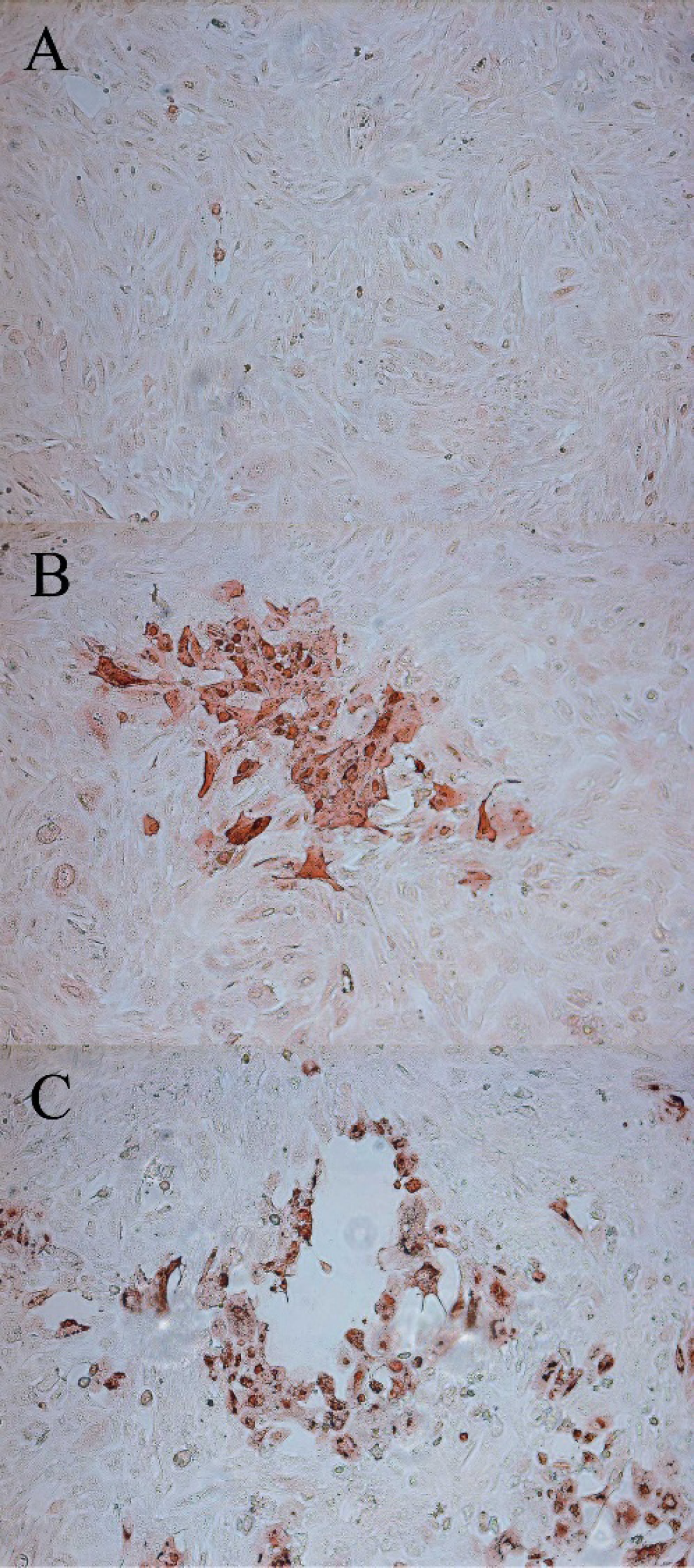
Immunostaining of capripoxvirus- and orf virus–infected OA3.Ts cells. Immunostaining was performed at 6 DPI.
Discussion
Evaluation of OA3.Ts cells for their suitability as a capripoxvirus substrate was based on previous data indicating that primary and secondary ovine testes cells supported virus replication 1,7,9,10,20 and the potential advantages of a continuous cell line. Lamb kidney cells, traditionally used for capripoxvirus propagation, require a fresh stock of cells isolated from animals in a labor-intensive and costly manner. In addition, these cells do not lend themselves to standardization and quality control because of differences in the genetics between animals from which the cells are derived and difficulty in ensuring that the cells are free of adventitious agents such as retroviruses. Although OA3.Ts cells have been used for the propagation of sheep retroviruses, 15,16 information regarding their growth characteristics was not available in the public domain and required preliminary study. Based on a comparison of the growth kinetics for lower passage (p17 to p27) and higher passage (p28 to p36) cells, it was determined that the former may be more suitable due to greater cell numbers and uniform cell morphology even though cell viability at each passage level was determined to be consistently greater than 97%. Restricting the use of OA3.Ts cells to lower passages still allows for up to 10 passages of the cell line, from the starter culture at p17, in order to establish a working seed cell bank. In addition, it has been determined in this study that frozen OA3.Ts cells can be thawed and directly used, without further passaging, in assays and for virus propagation to facilitate a rapid diagnostic response.
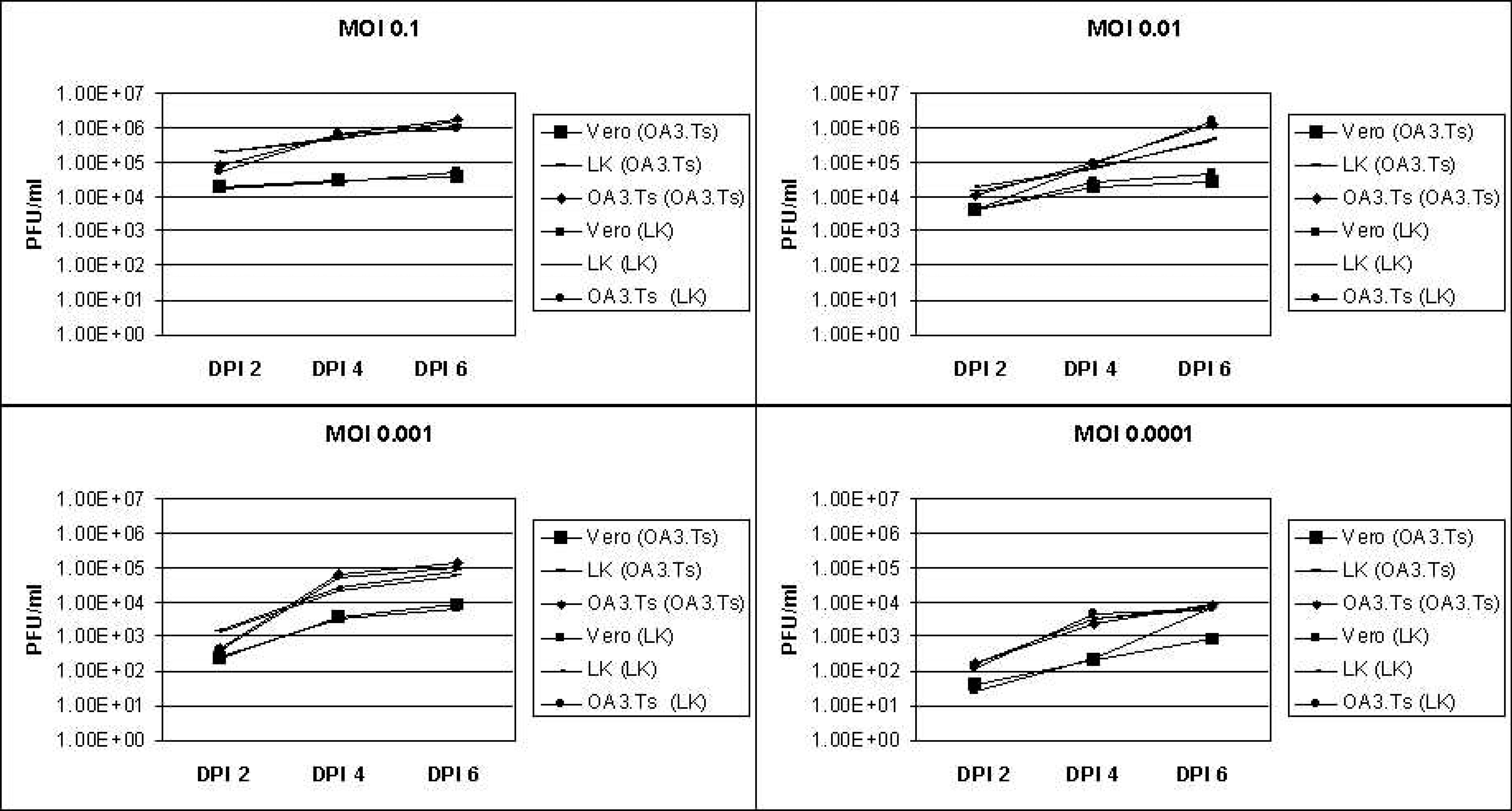
Growth curve of capripoxvirus (Nigerian isolate) in Vero p144, LK p1, and OA3.Ts p26. Each panel indicates infection of these cells at the indicated MOI, and titers were determined on material harvested at DPI 2, 4, and 6 using LK or OA3.Ts cells, as indicated in the adjacent bracket of each label in the legend.
However, despite the different growth kinetics and morphology of passaged OA3.Ts cells, there was no significant difference in their ability to propagate capripoxvirus, which was similar to that observed with LK cells. Infection of both OA3.Ts and LK cells with capripoxviruses resulted in CPE characterized by viral plaque formation at low levels of virus and complete monolayer destruction with high levels of virus. Although there was no significant difference between the titers achieved in OA3.Ts and LK cells, the former remained viable with a uniform monolayer for up to 14 days following plating compared with LK cells, which did not maintain their integrity for longer than 6 days postseeding. In addition, the unevenness of the LK cells in the monolayer made it difficult to determine endpoint titers because of difficulties in distinguishing virus-specific CPE from cell artifacts. This finding was in full agreement with results of other workers who found difficulty in differentiating nonspecific cell degeneration from apparent CPE in primary LT and LK cultures but found that secondary cultures were more suitable since the CPE was more extensive and occurred in a shorter time. 7,10 In contrast, viral plaques produced in OA3.Ts cells could be easily visualized under light microscopy and could be stained using polyclonal anticapripox sera for confirmation of cytopathic effects as being specific for poxvirus.
In summary, OA3.Ts cells are a suitable ovine cell line for the propagation of capripoxviruses (both laboratory strains as well as field isolates), assay development, and possibly vaccine production. Unlike other primary and secondary ovine cells, the OA3.Ts cells provide reproducible virus growth and are susceptible to infection by a variety of capripoxvirus strains, without culture adaptation. The cell line can be propagated according to seed lot principles, 5 wherein a large number of cells can be easily produced and frozen for master and working cell seed stocks, the latter of which can be used directly from frozen stocks since they maintain high viability through cryopreservation. In addition, they can be used for virus titration of capripoxvirus and virus plaque counting using immunostaining. This capripoxvirus immunostaining assay would be useful for comparison with an antigen-trapping enzyme-linked immunosorbent assay (ELISA) for the detection of capripoxvirus in tissue culture supernatant and biopsy samples. 3 Based on the growth studies presented in this report, OA3.Ts cells could also be more suitable than the currently used Vero cells 12 for virus neutralization assays, especially if combined with the immunostaining for confirmation. Such a virus neutralization test would be valuable for sero-surveillance as well as for comparison with indirect recombinant protein-based ELISA assays, using the P32 antigen. 6
Acknowledgements
Funding was provided by the Australian Woolgrowers and the Australian Government through Australian Wool Innovation Limited Project No. EC145 and CFIA Quick-start grants QSW0505, QSW0503, as well as RPS W0309. Capripoxviruses were obtained from the Institute for Animal Health, Pirbright, UK.
Footnotes
a.
American Type Culture Collection, Manassas, VA.
b.
Invitrogen, Carlsbad, CA.
c.
Wisent Inc., Quebec, Canada.
d.
Institute for Animal Health, Pirbright, UK.
e.
Sigma-Aldrich Canada Ltd., Toronto, Canada.
f.
National Centre for Foreign Animal Disease, Manitoba, Canada.
g.
KPL Inc., Gaithersburg, MD.