




Abstract
The Rose Bengal plate agglutination test (RBT) was evaluated for the diagnosis of equine glanders, and its diagnostic efficiency was compared with that of mallein and other serological tests, including indirect hemagglutination test (IHAT), complement fixation test (CFT), and modified counter immunoelectrophoresis test (mCIET). Sera from 70 naturally infected culture-positive, 96 potentially exposed cohorts, and 110 healthy equines were tested. All tests but mCIET showed 100% specificity when testing the sera from glanders-negative equines. The calculated sensitivities of RBT, IHAT, CFT, mCIET, and mallein test when testing culture-positive equines were 90.0, 97.1, 91.4, 81.4, and 75.7%, respectively. The RBT was significantly (P < 0.05) more sensitive than the mallein test and mCIET. The positive and negative predictive values of each test (RBT, IHAT, CFT, mallein test, and mCIET) were as follows: 100 and 94, 100 and 98.2, 100 and 96.7, 100 and 86.6, and 90.5 and 88.6, respectively. On comparing glandered and nonglandered animals, the highest agreement (0.987) was found between RBT and CFT followed by RBT and IHAT (0.940), RBT and mallein test (0.871), and RBT and mCIET (0.852). Because the RBT is simpler and rapid to perform, the inclusion of the test as a supplementary test for the diagnosis of glanders in field conditions is recommended.
Introduction
Glanders is a bacterial disease primarily of equines caused by Burkholderia mallei and is communicable to man and other animal species. The occurrence of the disease must be reported to the World Organization for Animal Health. In the beginning of 20th century, glanders was widespread in Europe, the USA, and Canada. Mass test and slaughter/destruction campaigns have successfully eradicated the disease from these countries. Because B. mallei is of significance as an agent of bioterrorism and biological warfare 16,28 and because glanders is a reemerging disease, 32 different groups of workers are still investigating the pathogenesis, new diagnostic procedures, effective treatments, and the development of protective vaccines. 16,17,34,35 Some recent reports describe occurrence of the disease in Brazil, Turkey, the United Arab Emirates, Iraq, Iran, India, and Pakistan, which are endemic areas. 2,6,7,14,23,30,32,37 Clinical and bacteriological diagnosis of glanders is difficult in the early stages of the disease or if disease is inapparent. Nearly 90% of infections exist as nonclinical or latent. 25 Currently, mallein (allergic hypersensitivity test) and serological tests, including complement fixation test (CFT) indirect hemagglutination test (IHAT), counter immunoelectrophoresis test (CIET), indirect fluorescent antibody test (IFAT), and enzyme-linked immunosorbent assays (ELISAs), are used for the diagnosis of glanders. 8,10,12,13,18,27,38–40,43 Nevertheless, some serological procedures are complex, biological reagent dependent, whereas others require trained personnel and expensive equipment, rendering these unsuitable for field application.
The mallein test is the most commonly used test for the diagnosis of glanders, but its limitations in terms of sensitivity, particularly in clinical and advanced cases of the disease, have been well recognized. 11,21,26 Cross-reactions have also been reported between B. mallei and Streptococcus equi, resulting in false-positive reactions. 1 Moreover, the efficiency and potency of the mallein test respective to its specificity are largely associated with the molecular weight of protein fractions, antigenic range, and virulence of the strains of B. mallei used in the preparation of the mallein. 40 Purified protein derivative (PPD) mallein, available in many countries, is a mixture of both high – and low – molecular weight protein fractions; the low – molecular weight proteins are responsible for the nonspecific reactions. 40 In field conditions, mallein testing is not possible in some fractious equines, thus leaving the animals untested. Furthermore, this procedure requires 48 hours to obtain results. The pitfalls of the mallein test spurred Russian workers to develop a new on-site screening test for glanders vis-à-vis Rose Bengal plate agglutination test (RBT), which has not been fully validated thus far. 5 To date, the sensitivity, specificity, and accuracy of this test have not been evaluated under field conditions. The present paper reports the diagnostic efficiency of RBT vis-à-vis mallein and some other serological tests.
Materials and methods
Equine serum samples
Seventy sera from clinically and bacteriologically positive equines (horses, 49; mules, 13; donkeys 8) were collected from 2 separate outbreaks of equine glanders among Faisalabad Metropolis mounted police, Lahore Polo Club, Lahore (Pakistan) horses and from draught equines working in Faisalabad City. These equines were presented to the Veterinary Medical Teaching Hospital, University of Agriculture, Faisalabad, for the investigation of the disease. Ninety-six serum samples were derived from in-contact animals (potentially exposed cohorts) at Lahore Polo Club, which were clinically normal. One hundred and ten sera collected from Pakistan Army equine breeding establishment (Mona Depot) served as negative control. The equines of this establishment have had no history of glanders infection. In all cases, sera were collected before the mallein test. Sera from the clinically diseased, potentially exposed, but as yet clinically normal and disease-free animals were categorized into groups I, II, and III, respectively.
Bacteriological procedures
Culture and identification of B. mallei was performed as previously described. 2,5,22,24 Briefly, nasal swabs, nodule aspirates, and venous blood samples from clinically positive equines (n = 70) were plated out on brain-heart-infusion agar a with 8% sheep blood. All nasal swabs were incubated for 3 hours at room temperature in saline containing 1,000 units of benzyl penicillin per milliliter before plating. Representative colonies of B. mallei were screened for Gram staining, catalase, indole tests, and colistin resistance. The organism was presumptively identified as B. mallei if it was bipolar, catalase positive, indole negative, and resistant to colistin and if it had an irregularly stained Gram-negative rod. The isolates were further tested on triple sugar iron slants, a motility medium, a and API 20E strips. b Nonmotile, thyroid-stimulating immunoglobulin-negative, arginine-, and gelatin-positive isolates were finally identified as B. mallei.
Preparation of antigens for Rose Bengal plate agglutination test
Antigen for RBT was prepared from 3 different strains of B. mallei: 2 isolates from outbreaks (designated PRL 4 and PRL 7 by the authors) and the China 5 strain. c The antigen was prepared following a modification of the previously described method. 5 Briefly, cultures of the 3 selected strains of B. mallei were checked for purity, resuspended in sterile phosphate-buffered saline (PBS; pH 6.4), and used to seed layers of glycerol-dextrose agar in Roux flasks. Flasks were incubated at 37°C for 1 week. Each flask was checked for purity by Gram staining, and cultures were harvested by adding 100 ml of phenol-saline (0.5% phenol in 0.85% sodium chloride solution) to each flask. The flasks were gently agitated, the suspension decanted, and the organisms killed by overnight heating at 100°C in a water bath. The concentration of bacterial cells was adjusted to 65 × 10 9 per milliliter spectrophotometrically. The suspension was colored with 1 % Rose Bengal dye d and centrifuged at 5,000 g for 20 minutes. The sediment was resuspended in NaOH-lactic acid buffer (50mM; pH 3.5).
Test procedures
For RBT, 1 drop (30 μl) of test serum was added to Rose Bengal antigen on a white porcelain plate and mixed thoroughly with a stick. The plate was rocked slowly for 3 minutes and observed. The test was read and scored as follows: 5 + + + +, agglutination with appearance of large rose-colored flakes with absolute (100%) clarification of the mixture; + + +, less large flakes with incomplete (approximately 75%) clarification of mixture; + +, small flakes, approximately 50 % clarification of mixture; +, small-grained agglutination, insignificant (approximately 25%) clarification of the mixture; and -, no agglutination, the mixture homogenous and stained evenly. The reaction was considered positive in the presence of distinct agglutination with appearance of small or large rose-colored flakes with 50 to 100% clarification of liquid (+ + to + + + +), and it was negative if scored at less than + +.
Both CFT and IHAT were performed by titration methods employing sonicated antigen from the 3 strains. 38,42 A titer of 1:16 or above was considered positive for CFT, whereas for IHAT 1:320 or above was considered to be positive. The mCIET was carried out as previously described. 3 Briefly, 2 ml of 1% melted agarose d in barbiturate buffer (pH 8.6) was dispensed into u-bottomed glass tubes, fixed vertically in a groove, and allowed to solidify. Ten microliters of equine serum (1:10 in PBS) and B. mallei- sonicated antigen were dispensed into anodal (-) and cathodal (+) arms of glass tubing (in duplicate), respectively, and connected with aluminum wire pierced down into the gel about 0.5 cm in both arms of the glass tubing. The ends of aluminum wire were connected with 2 batteries (AA; 1.5 V each), and a constant current was allowed to flow for 20 minutes. Formation of a circular precipitation band was considered positive for B. mallei antibody.
Data analysis
For each test, sensitivity and specificity were calculated using criteria of true negative and true positive responders.
The sensitivity was calculated from the following equation:

and specificity was calculated from the following equation:

T accuracy and predictive value for each test were also calculated and interpreted using standard formulas. 19 Agreement between different tests was estimated using the kappa statistic. e
Results
The results of the 5 diagnostic tests performed on glanders-positive (group I), potentially exposed co- horts (group II), and glanders-free (group III) populations are given in the Table 1. With bacterial culture used as the reference test, sensitivity was calculated as the percentage of culture-positive equines yielding a positive result in each test, and specificity was defined as the percentage of glanders-negative animals identified as negative in the corresponding test. The highest sensitivity was obtained with IHAT (97.1%), followed by CFT (91.4%), RBT (90.0%), mCIET (81.4%), and mallein test (75.7%). The RBT was significantly (P < 0.05) more sensitive than the mallein test or mCIET. No significant differences were noted among RBT, CFT, and IHAT. All tests but mCIET gave 100% specificity. Accuracy was defined as the ability of each test to accurately identify negative and positive cases. The accuracy values of the 5 tests were 98.8, 96.7, 96.1, 90.6, and 89.4% for IHAT, CFT, RBT, mallein test, and mCIET, respectively. Positive predictive values were 100% for IHAT, CFT, RBT, and mallein test and significantly lower (90.5%; P < 0.05) for mCIET. The corresponding negative predictive values were 98.2, 96.7, 94, 86.6, and 88.6%. The reactivity (agglutination score) of sera in the RBT varied from weak (+ +) to strong (+ + + +). Sixty-three of the 70 sera from group I tested positive in RBT; 17 reacted weakly (+ +), 15 reacted moderately (+ + +), and 31 reacted strongly (+ + + +).
The results from samples of group II animals were used to compute apparent sensitivity (defined as the percentage of potentially exposed animals yielding positive results in a given test). The apparent sensitivity values were 17.7, 17.7, 16.6, 16.6, and 11.5% for IHAT, CFT, mallein test, RBT, and mCIET, respectively. The apparent sensitivity of both the IHAT and CFT was identical (17.7%), which was significantly higher (P < 0.05) than that of mCIET (11.5%).
Kappa statistic values of the different diagnostic tests on various combinations of the 3 populations of samples are presented in Tables 2 and 3. The agreement between the tests was good to excellent. When comparing the glanders-positive and glanders-negative animals, RBT and CFT showed the highest agreement (0.987) followed by RBT and IHA (0.940), RBT and culture (0.916), RBT and mallein test (0.871), and RBT and mCIET (0.852). The highest agreement (Kappa = 1) when comparing the potentially exposed and glanders-free animals was found between RBT and mallein tests (Table 3).
Results of the mallein and serological tests when testing sera from glanders-positive (group I; Burkholderia mallei infected) equines, potentially exposed cohorts (group II), and glanders-free (group III) equines

CFT = complement fixation test; IHAT = indirect hemagglutination test; mCIET = modified counter immunoelectrophoresis test; RBT = Rose Bengal plate agglutination test.
Kappa statistics (agreement) between different diagnostic tests from group I (glandered; Burkholderia mallei) and group III (glanders free)
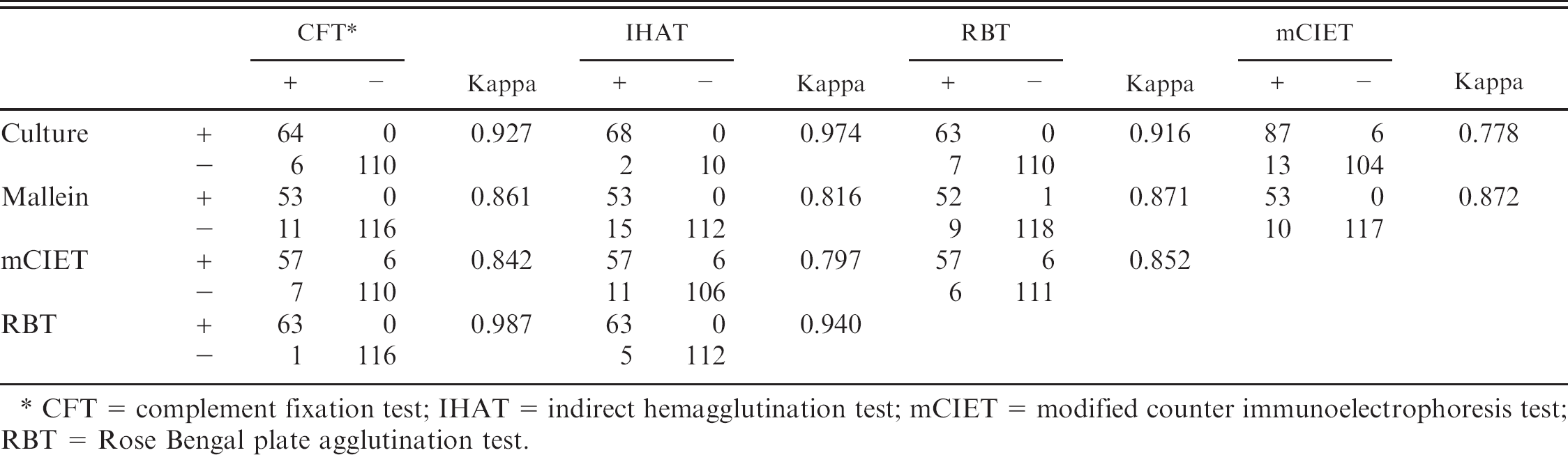
CFT = complement fixation test; IHAT = indirect hemagglutination test; mCIET = modified counter immunoelectrophoresis test; RBT = Rose Bengal plate agglutination test.
Discussion
In B. mallei infection, antibodies appear within a week or so, peak quickly to maximum titers (1:1000 to 2000), and persist for months in a significant proportion of infected animals. 20 Assays based on the detection of specific antibodies (IgG) in serum are promising because strong antibody responses are elicited during infection with B. mallei (about 90% of horses and mules produce serum antibodies). 1,36 An early detection of the disease is imperative not only for the enforcement of “test and slaughter regimes” in areas where glanders is still endemic but also to forestall the spread of the disease through international trade to currently disease-free countries. The usefulness of a diagnostic test depends on its sensitivity, specificity, accuracy, predictive values, 29 and field applicability. The agreement between new and existing tests has been suggested as an evaluation criterion for new tests. 19
In the present study, a composite RBT antigen was prepared from 3 strains (PRL 4, PRL 7, and China 5) originating from different geographical regions. Immunoblotting of 6 B. mallei strains demonstrated variations in immunoreactive components (exopolysacchrides) 4 and evidence of influence of virulence on the potency and sensitivity test antigen. 36,40 Therefore, it is useful to prepare the RBT antigen of wider antigenic range using 3 or more heterogeneous and virulent strains from different geographical regions. Results from 110 glanders-free equines (group III) revealed no false reactions to the mullein test, CFT, IHAT, and RBT but detected false reactions in mCIET. The poor specificity of mCIET observed in this study corroborates the findings of previous workers. 1,12 A larger number of samples than used in this study would be required to estimate the specificity of RBT and mCIET with precision. Because of a strong antigenic relationship between B. mallei and B. pseudomallei 4,8 the RBT may detect antibodies which cross react with B. pseudomallei. Therefore, false-positive reactions are a possibility when equines are tested in melioidosis-endemic regions.
Kappa statistics (agreement) between different diagnostic tests from group II (potentially exposed cohorts) and group III (glanders free)
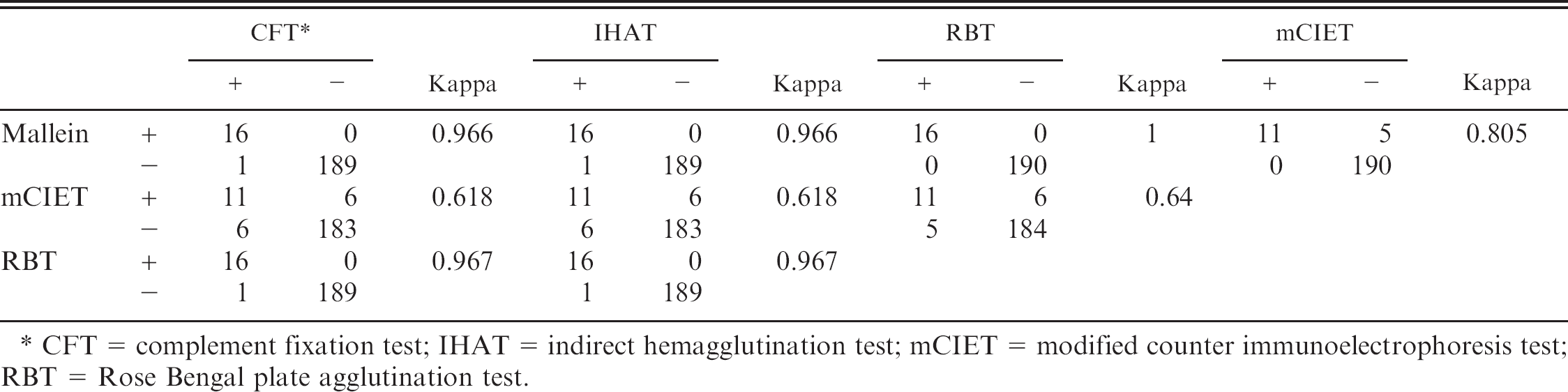
CFT = complement fixation test; IHAT = indirect hemagglutination test; mCIET = modified counter immunoelectrophoresis test; RBT = Rose Bengal plate agglutination test.
Sixty-three (90.0%) of 70 culture-positive equines were detected by the RBT, while the mallein test performed poorly and could correctly detect only 53 (75.5%) animals (Table 1). The weak diagnostic efficiency of the mallein test in clinical and advanced cases concurred with the previous findings of Indian 12 and Pakistani 24 workers, who reported 45 and 46.1% sensitivity of this test, respectively. With the same set of samples, IHAT detected more infected animals (97.1%) than any other test, followed by CFT and mCIET. A higher sensitivity of agglutination test than CFT is concordant with the findings of American workers who described the development of early agglutination titers before the CFT becomes positive. 8 Other workers have reported a low sensitivity for the IHAT. 39 This might be due to the use of nonsonicated mallein as an antigen for IHAT. The CFT is considered to be highly sensitive for the diagnosis of glanders. 38 However, it may fail to detect many confirmed cases. 31,42 This limitation has been attributed to anticomplementary activity of sera of donkeys and mules. 27 Species-related poor performance of CFT on sera from donkeys and mules was also encountered in the present study. The simultaneous use of IHAT has been suggested as a way to improve the accuracy of CFT. 27 The RBT data demonstrated that the test has a range of reactivity (agglutination score; + + to + + + +) on serum samples that seems to be comparable with other agglutination tests. 33,42
The existence of nonclinical (culture-negative) cases of glanders is a relatively frequent finding among clinically infected animals. 2 In the present study, mallein and serological-positive cases among potentially exposed cohorts concurred with this finding, which could be due to cellular and immunological responses as a consequence of contact with B. mallei from infected animals. The higher sensitivity and specificity of the RBT in the present study are consistent with those reported in the immunodiagnosis of brucellosis. 9
The kappa measures the magnitude of agreement between 2 tests and ranges from 0 to 1, where 1 is perfect agreement and 0 is exactly what would be expected by chance. 41 Interpretative values of kappa are as follows: 0.1-0.2 slight agreement; 0.21-0.40, fair agreement; 0.41 0.60 moderate agreement; 0.61 0.80 substantial agreement, and 0.81 0.99 almost perfect agreement. 15 If the kappa value of 2 tests is high, then any of the 2 tests might be selected for a testing program because the results of both tests provide the same information. 19 In the present study, the kappa value of the comparison between RBT and the mullein test (Table 2) suggests that the RBT can be used as an alternative to the latter test.
A quantitative screening test for the field diagnosis of glanders should have a high predictive value for positive results while maintaining high specificity levels. The results of this study indicated that the RBT fulfills these criteria because it had both 100% specificity and positive predictive value.
The RBT could potentially be used in anergic or advanced cases of equine glanders for which the mallein test yields inconclusive results. The test is user friendly, needs no special equipment, and requires little or no specialized training; the result is obtained within 2 minutes, and the test can be performed under field conditions. In view of its simplicity, rapidity, and ease of execution, the RBT has the potential to be used as a supplementary test for the diagnosis of equine glanders under field conditions. However, because crude antigen was used in both the present and the previous studies, there is a need to further evaluate this test using purified defined antigens (capsular or lipopolysaccrides) to minimize the chances of false-positive reactors, as observed in CFT. 26 Further work is warranted on other test formats, such as latex agglutination.
Acknowledgement
The authors are indebted to Dr. David DeShazer, Bacteriology Division, U.S. Army Medical Research Institute of Infectious Diseases (USAMRIID), Fort Detrick, MD, for reviewing the manuscript.
Footnotes
a.
Oxoid Ltd., Basingstoke, Hampshire, UK.
b.
vbioMerieux, S.A. Marcy-I Etoile, France.
c.
Veterinary Research Institute, Lahore, Pakistan.
d.
Sigma Chemicals Co., St. Louis, MO.
e.
Win-Episcope 2.0, Wageningen University, Wageningen, The Netherlands.