




Abstract
The foot-and-mouth disease virus (FMDV) is a member of the picornavirus family, possessing an 8-kb single-stranded RNA genome of positive polarity. It is highly contagious among several livestock species and can lead to severe economic consequences, as evidenced by the UK outbreak in 2001. The usage of real-time polymerase chain reaction has facilitated rapid detection of FMDV. Several real-time PCR instruments are available with various capabilities, such as portability and high sample volume analysis. Primers and a dual-labeled TaqMan probe were optimized to detect a single, highly conserved 88-bp segment of the FMDV 3D (RNA polymerase) gene. To increase the confidence of the RT-PCR result, a positive amplification control was synthesized to detect potential false-positive results due to contamination if a wildtype virus is used as positive control. In addition, a preventative measure against false-negative results was developed in which endogenous beta actin mRNA is coamplified by RT-PCR. Assay performance was compared on the LightCycler1.2 (Roche), the SmartCyclerII (Cepheid), and the SDS 7900HT (ABI). These assays successfully identified the FMDV genome and beta actin mRNA from several sources of infected nasal and oral swabs, as well as probang samples.
Introduction
Foot-and-mouth disease (FMD) is an extremely contagious infection of pigs and cloven-hoofed ruminants caused by the foot-and-mouth disease virus (FMDV), family Picornaviridae. Clinical signs include fever, lameness, and vesicle formation in epithelial tissue of the mouth, feet, and udder, particularly of lactating animals. The capability of this virus to spread among economically important livestock species, its potential to be introduced into several wildlife species, and its effect on trade makes it probably the most significant disease of animals. FMD cannot be clinically distinguished from diseases such as vesicular stomatitis (VS) and swine vesicular disease (SVD). Therefore, rapid and accurate detection is essential for immediate implementation of outbreak control measures. Currently the Office International des Épizooties (OIE) recommends virus isolation and antigen-capture ELISA for FMDV identification. 8 In addition, detection of the FMDV Vp1 (1D) gene by polymerase chain reaction (PCR) methods, followed by sequencing, can be used for strain characterization. 8
The recent development of real-time PCR has facilitated rapid quantitative analysis with a reduced amount of post-PCR processing steps. Monitoring PCR product formation in real time can be achieved through the use of dual-labeled hydrolysis (TaqMan) probes consisting of complementary sequences within the target. Such real-time assays have been developed using FMDV sequence-specific primers and TaqMan probes to conserved regions of the internal ribosomal entry site within the 5′ untranslated region in a 2-step PCR assay, 13,14,17 or a one-step, reverse-transcription (RT) PCR method to conserved regions of the RNA polymerase (3D) gene using TaqMan probes 3 or linear hybridization probes (Roche). 10 TaqMan probes can also be modified with a minor groove binder (MGB) moiety, so that they form stable, higher melting temperature (Tm) interactions with their target sequences. 9 The performance of MGB modified TaqMan probes has not yet been assessed for FMDV RT-PCR detection in any publication.
As in any diagnostic method, extreme care must be taken to control for false positives and false negatives that may arise following RT-PCR amplification. The formation of a PCR product in the sample tube may result from true target amplification or by accidental introduction of product contaminants from preceding reactions. This is a particular problem for diagnostic RT-PCR, where repeated sample manipulations can lead to such false-positive results. Conversely, the lack of a PCR product may arise due to the absence of target or may be falsely negative due to technical errors, degradation of the target nucleic acid, and/or the presence of substances in the sample that inhibit the RT-PCR reaction. 6,7,15 Therefore, positive amplification controls are often included as a component of the RT-PCR assay to confirm optimal reaction conditions. The positive amplification control can be designed containing the same target primer recognition sites while containing unique sequences for differentiation from the true product. 1,6,7 To ensure that negative results are not due to degradation of the target nucleic acid prior to amplification, coamplification of a second target from the same preparation can be employed. This type of control is particularly important to include in diagnostic assays in which the test samples may be collected and stored for extended periods under suboptimal conditions prior to nucleic acid purification. Amplification of host beta actin mRNA can be used to monitor the suitability of the RNA preparation for RT-PCR. A previous publication on real-time FMDV RT-PCR utilized beta actin mRNA as a reference gene for FMDV quantification within diverse porcine tissues to investigate FMDV replication kinetics 12 using human beta actin primers of unknown sequence.
To improve existing real-time RT-PCR tests for FMD diagnosis, FMDV primer and probe set which universally amplifies a highly conserved region of the FMDV 3D gene were developed within a quality-assured, one-step, real-time RT-PCR assay containing amplification controls. In addition, the performance of this assay was examined on 3 different realtime PCR platforms: Sequence Detection System (SDS) model 7900HT, a SmartCycler (version II), b and the LightCycler (version 1.2). c These machines have different performance characteristics such as high sample volume analysis, a which is practical for outbreak situations, or portability b for potential field diagnosis, and are routinely used in several reference laboratories.
Materials and methods
FMDV primers and probe
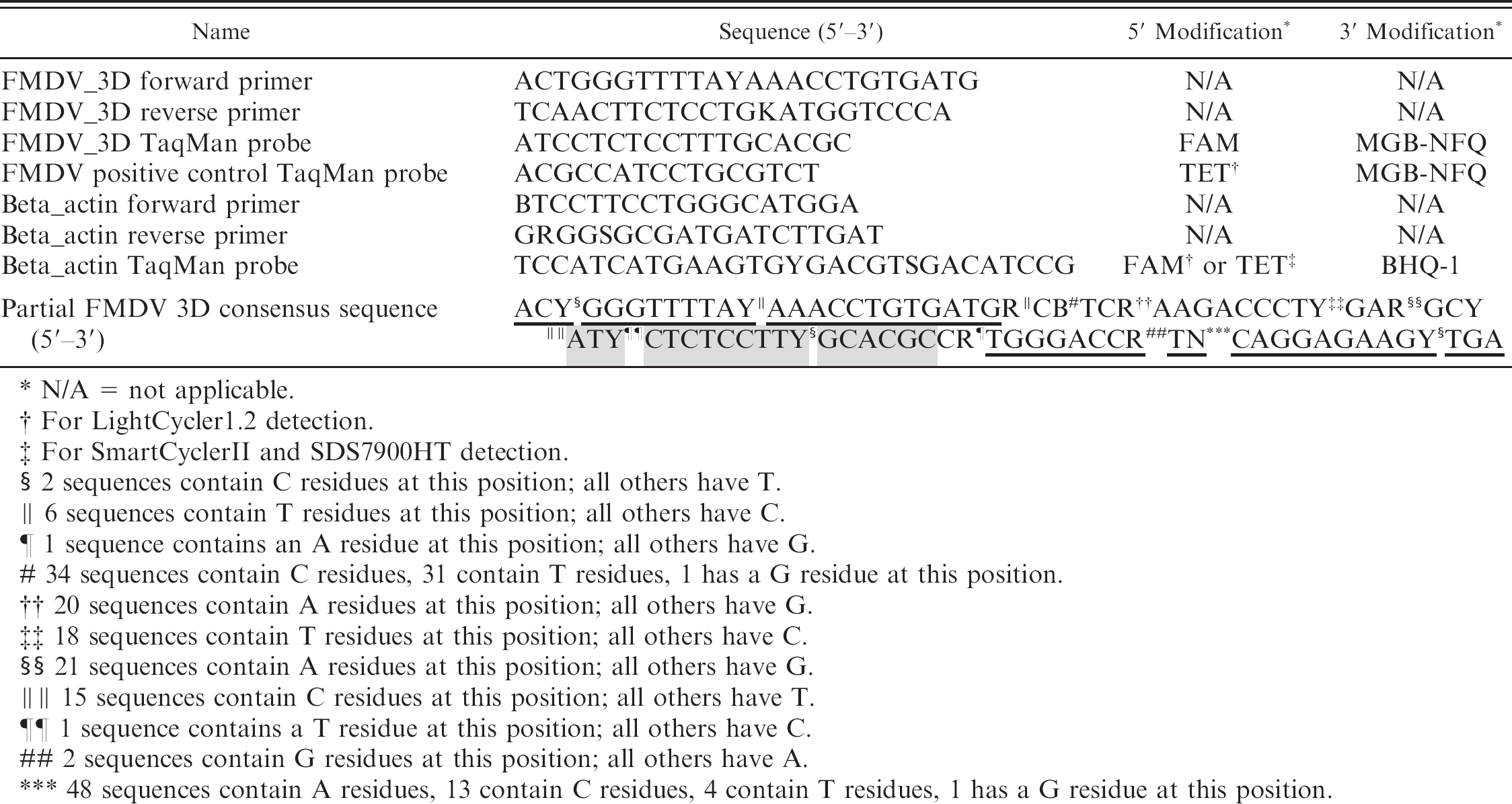
A multiple sequence alignment of 66 FMDV isolates, representing all 7 serotypes, obtained from publicly available databases at the National Center for Biotechnology Information (NCBI, Bethesda, MD) website, was generated using ClustalW 16 (European Molecular Biology Laboratory (EMBL)-European Bioinformatics Institute (EBI), Hinxton, UK) and GeneDoc software 11 (Pittsburgh Supercomputing Center). Primers d and an accompanying Taq-Man probe a were designed to conserved regions within the FMDV 3D gene (Table 1) using Primer Express 2.0.0 a software. The probe was modified with a 5′ 6-carboxy-fluorescein (FAM) dye and a 3′ nonfluorescent quencher with a minor groove binder stabilizer (NFQ/MGB). A BLASTN search of the primer and probe sequences confirmed specificity to FMDV.
Beta actin mRNA primers and probes
Cow, pig, sheep, goat, horse, deer, mouse, rat, dog, guinea pig, zebrafish, llama, musk ox, dolphin, ringed seal, chimpanzee, and human beta actin mRNA from NCBI were aligned using ClustalW and GeneDoc. Exon-intron boundaries were defined using the National Center for Biological Information (NCBI) Spidey program when the mRNA alignment was compared against human and rat beta actin gene sequences. Standard purity primers d were designed to regions of high sequence similarity spanning introns using Primer Express 2.0.0 software (Table 1). A TaqMan probe e was also designed to conserved areas across target species. The probe was modified at the 5′ end with FAM or TET at the 3′ end with black hole quencher-1 (BHQ-1). The primer and probe sequences were checked for beta actin mRNA specificity by a BLASTN search of homologous sequences.
Construction of the positive amplification control
A purified 130-bp oligonucleotide was generated by amplification of a short segment of a highly conserved region of O1 Campos/Br/58, from base position 7871 to 7921 (GenBank gi:18074008). Amplification of a single band resulted using HotStarTaq DNA Polymerase f in 2mM MgCl2 final concentration using the following standard purity primers d : forward primer ACTGGGT-TTTACAAACCTGTGATGGRGTCACCCACACKGT-GATGGCCTCAAA GACCCT; reverse primer TCA-ACTTCTCCTGTATGGTCCCACAGACGCAGGATG-SCGTGCCCACGGCGTGCAAAG. The following cycling conditions were used: activation of the polymerase at 95°C, 15 min; 30 cycles of 95°C, 20 sec; 64°C, 45 sec; 72°C, 30 sec; 72°C, 10 min final extension. The first 24 bases at the 5′ end and the last 23 nucleotides at the 3′ end contain complementary sequences to the FMDV primers, which results in RT-PCR amplification of the 130-bp fragment. This PCR product was subsequently purified, cloned into pGEM-T easy vector, g and reverse transcribed using the T7 promoter (MEGAshortscript kit i ). This RNA preparation was then used as the positive control for FMDV RT-PCR amplification. A TaqMan probe a directed to unique positive control sequences was 5′ modified with 6-tetrachlorofluorescein (TET) and modified at the 3′ end with MGB-NFQ (Table 1).
RNA extraction
Primary lamb kidney (LK) cells, Vero (V-76) cells, or swine testis (ST) cells were individually infected with various FMDV strains, various Swine Vesicular Disease
Virus (SVDV) strains, Vesicular Stomatitis Virus (VSV)-New Jersey, VSV-Indiana 1 Guatemala, VSV-Indiana 2, VSV-Indiana 3, Coxsackie B5 Virus, or Vesicular Exanthema Virus. A total volume of 560 μl medium from each infected cell culture was harvested for RNA isolation using the QIAviral kit f as directed by the manufacturer. As a control, RNA from uninfected primary LK, V-76, or ST cells was isolated as described above. DNase I digestion f was performed on these samples.
Sequences of the FMDV and beta actin primers and TaqMan probes, designed with Primer Express 2.0.0 (ABI). The FMDV primers (underline) and probe (shaded) were designed to the indicated consensus sequence of a conserved FMDV RNA polymerase (3D) gene segment (5′ to 3′), as determined from an alignment of 66 FMDV isolates using ClustalW and GeneDoc. The reverse primer (underlined sequence at the 3′ end) was designed to the complement strand. Degenerate primers were synthesized to residues containing a high degree of polymorphism.
N/A = not applicable.
For LightCycler1.2 detection.
For SmartCyclerII and SDS7900HT detection.
2 sequences contain C residues at this position; all others have T.
6 sequences contain T residues at this position; all others have C.
1 sequence contains an A residue at this position; all others have G.
34 sequences contain C residues, 31 contain T residues, 1 has a G residue at this position.
20 sequences contain A residues at this position; all others have G.
18 sequences contain T residues at this position; all others have C.
21 sequences contain A residues at this position; all others have G.
15 sequences contain C residues at this position; all others have T.
1 sequence contains a T residue at this position; all others have C.
2 sequences contain G residues at this position; all others have A.
48 sequences contain A residues, 13 contain C residues, 4 contain T residues, 1 has a G residue at this position.
A maximum of 30 mg of FMDV-negative tissue was used for RNeasy Fibrous Tissue RNA extraction, f which includes DNase I incubation, as directed by the manufacturer's protocol. Total RNA was extracted from 375 μl of the swab or probang storage media using TriPure Reagent c following instructions of the manufacturer. The RNA in the upper aqueous phase was precipitated with 2 μl GlycoBlue coprecipitant, i washed with 75% ethanol, dried briefly, and resolubilized in 50 μl RNase-free water at 55°C prior to storage at −70°C. DNase I treatment i of the RNA preparation was performed prior to RT-PCR setup.
Real-Time Reverse Transcription PCR
Real-time RT-PCR assays were prepared where directional workflow was maintained throughout the setup. Master mixes were prepared in a laminar flow biological safety cabinet within an isolated, template-free room. Template RNA was then added in another designated biosafety cabinet or sterile workspace within another room and subsequently taken to real-time PCR machines located elsewhere in a dedicated area.
Real-time RT-PCR assays for both FMDV and beta actin were performed using reagents supplied from the QuantiTect Probe RT-PCR kit. f For the LightCycler1.2, a total reaction volume of 20 μl was prepared, of which 2 μl of starting RNA material was included for FMDV RT-PCR, or 5 ml RNA template for beta actin RT-PCR. For the SmartCyclerII and SDS 7900HT runs, a total of 25 μl reaction volume was used, including 2 μl of RNA template for the FMDV RT-PCR (or 5 μl of RNA template for beta actin RT-PCR on the SmartCyclerII and SDS7900HT). A final concentration of 0.5 μM of each forward and reverse primer and 0.2 μM of the TaqMan probe was used in all real-time FMDV RT-PCR for all instruments. For SDS7900HT and SmartCyclerII analysis of FMDV in animal samples, 0.5 μM of the TET/MGB-NFQ labeled FMDV positive control TaqMan probe was included in the reaction. For the beta actin RT-PCR, 1.0 μM of each primer and 0.2 μM of the TaqMan probe were used. A final concentration of 4.0 mM MgCl2 already present in the supplied master mix buffer was used for all reactions. No template controls consisting of nuclease-free water to replace the RNA template were included at a frequency of 1 for every 6 samples (SDS 7900HT) or 1 for every 8 samples tested (LightCycler1.2 and SmartCyclerII), as selected for preparatory convenience.
For FMDV and beta actin RT-PCR amplification in animal samples, identical cycling conditions were used for all 3 instruments: reverse transcription at 50°C for 30 min; enzyme activation at 95°C for 15 min, followed by 50 cycles of 95°C for 10 sec and 60°C for 60 sec. Fluorescence data for all real-time RT-PCR assays were acquired upon completion of the 60°C anneal/extension phase, using the preprogrammed FAM or TET detection channel on the SmartCyclerII and SDS 7900HT. The F1 channel on the LightCycler1.2 was used for FAM dye detection. During assay development, the following FMDV RT-PCR programs were used: for the LightCycler1.2, reverse transcription occurred at 50°C for 30 min; enzyme activation at 95°C for 15 min, followed by 50 cycles of 95°C for 0 sec and 60°C for 45 sec. For the SmartCyclerII FMDV RT-PCR: reverse transcription at 50°C for 30 min; activation at 95°C for 15 min; followed by 50 cycles of 95°C for 1 sec and 60°C for 1 min. For the SDS 7900HT FMDV RT-PCR: reverse transcription at 50°C for 30 min; activation at 95°C for 15 min; followed by 50 cycles of 95°C for 1 seco and 60°C for 20 sec.
LightCycler1.2 RT-PCR data were analyzed using Light-Cycler1.2 version 3.5 software using the second derivative maximum method. In certain cases under this analysis method, a crossing point (Cp), or crossing threshold (Ct), value was observed in samples which clearly did not amplify (fluorescence values < 1.000 units by 50 cycles). In such instances, those samples which had these “nonplausible Cp” values were declared to be negative and were attributed to premature degradation of the dual-labeled probe within the reaction assay, thereby showing a gradual, slight increase in overall fluorescence (personal communication, Roche Technical Services). For the beta actin +/- RT experiments, the Fits Points method was used where the fluorescence baseline was set at 1.000 units for the analysis of all runs. For the SmartCyclerII, the data were analyzed with SmartCyclerII version 2.0b software using run-based auto threshold setting under the second-derivative curve analysis method. For the SDS 7900HT, the baseline and threshold levels were automatically set by the instrument for each individual run.
Successfully amplified targets are expressed in Ct values, or the cycle at which the target amplicon is initially detected above background fluorescence levels as determined by the instrument software. Each sample RT-PCR was performed minimally in duplicate, and the mean Ct value with standard deviation reported. All negative controls must not have shown any detection.
Analytical sensitivity
In order to establish the analytical sensitivity of the assay, 10 serial dilutions (10-fold) of FMDV-O UKG 11/2001 were prepared. The FMDV preparation was diluted from an original titer of 106.7 TCID50/ml using alpha-MEM j as diluent. RNA was isolated from 375 μl of each dilution for RT-PCR analysis using the TriPure c extraction method. As a comparison with the virus isolation method, 200 μl of the same diluted preparation was used to inoculate confluent primary lamb kidney cultures in 24-well tissue culture plates. After 2 passages, any evidence of virus growth at each dilution was recorded.
Sample collection
Nasal and oral cavity swabs were collected from FMDV-infected animals throughout the infection period and stored at −70°C in 1 ml glycerin-buffered vesicular transport media (1.76 mM Na2HPO4, 5.73 mM KH2PO4 pH 7.6 buffer in 50% glycerol, containing phenol red indicator). Nasal and oral swab samples from 107 uninfected bovines were similarly collected at local slaughterhouses and farms and stored at −70°C. Two collections of bovine and ovine esophageal-pharyngeal scrapings (probangs) were obtained using a probang sampling cup as previously described. 17 Uninfected bovine epithelial tissue samples were obtained from a local slaughterhouse and stored at −70°C until commencement of the RNA isolation procedure.
FMDV Experimental Infection
One Holstein calf received 1 ml intradermo-lingual inoculation of FMDV strain SAT2 Sau 1/2000 (106.55 TCID50/ml). Similarly, 1 Suffolk cross sheep was inoculated with 1 ml of FMDV strain A24 Cruzeiro (106.0 TCID50/ml). One Landrace cross pigs was inoculated subdermally via the heel bulb with 1 ml of FMDV strain A24 Cruzeiro (107.01 TCID50/ml). All animals were maintained for 28 days in a disease secure cubicle within a biocontainment level 3 facility at the National Centre for Foreign Animal Disease, Winnipeg, MB, Canada. The animal procedures for this study conformed to guidelines established by the animal care committee and were observed by a veterinarian.
Results
FMDV and beta actin RT-PCR assay development
FMDV and beta actin multiple sequence alignments were examined for regions of high sequence identity for universal primer and probe recognition. Several FMDV primer pairs were designed with accompanying TaqMan probes using Primer Express 2.0.0. Sequences of 1 particular set of FMDV primers and a TaqMan probe fell within highly conserved regions and were evaluated for all subsequent FMDV RT-PCR reactions (Table 1). The associated probe was 5′ labeled with FAM, as this dye was detectable on all 3 platforms and contained a nonfluorescent quencher/minor groove binder on the 3′ end.
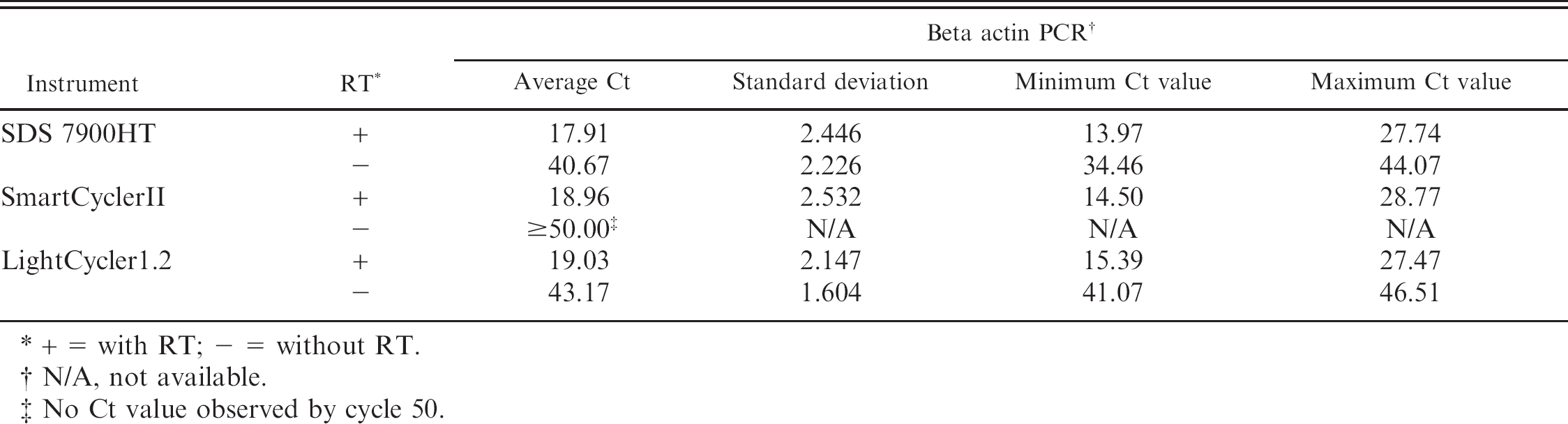
Beta actin primers were designed across predicted exon-intron Junctions to favor mRNA detection and reduce amplification from contaminating genomic beta actin sequences (Table 1). A TaqMan probe labeled with FAM-BHQ1 or TET-BHQ1 was designed within the exon bounded by the primer sites (Table 1). Beta actin detection using these primers was successful in total tissue RNA from cows, pigs, sheep, goat, horse, camel, deer, alpaca, and bison on the LightCycler1.2, SmartCyclerII, and SDS 7900HT (data not shown), which encompass several species susceptible to vesicular diseases. These primers were further tested for mRNA specificity by performing PCR both with and without reverse transcriptase (RT) on 84 RNA preparations from FMDV-negative bovine tissue using the 3 platforms (Table 2). For the SmartCyclerII, in the presence of RT the average Ct value for beta actin amplification was 18.96. Amplification was not detected in these samples in the absence of RT on the SmartCyclerII only. For the LightCycler1.2, the average Ct value of the samples when incubated with RT was 19.03, whereas the average Ct value with no RT was 43.17. For the SDS7900HT, the beta actin average Ct value with RT was 17.91 and without RT was 40.67. The earliest amplification of contaminating genomic beta actin was observed at Ct 34.46 and 41.07 on the SDS7900HT and LightCycler1.2, respectively. Based on these results, arbitrary beta actin positive/negative cutoff values of 34.00 (SDS7900HT), 45.00 (SmartCyclerII), and 40.00 (LightCycler1.2) were established.
Comparison of beta actin amplification of 84 RNA samples, extracted from FMDV-negative bovine tissue with and without reverse transcriptase (RT) incubation on the LightCycler1.2, SmartCyclerII, and SDS7900HT.
+ = with RT; -= without RT.
N/A, not available.
No Ct value observed by cycle 50.
Analytical specificity and sensitivity of the FMDV realtime RT-PCR
The FMDV-specific primers and probe were tested for the ability to detect 23 isolates representing all 7 FMDV serotypes on the LightCycler1.2, SmartCyclerII, and SDS 7900HT real-time PCR machines. The reaction buffers and enzyme mixtures for all reactions were derived from the same commercially available kit and utilized the same primer and probe concentration, the only difference being the final reaction volume used for each platform. The analytical specificity of the primer set was evaluated by testing RNA from several agents causing vesicular diseases, along with total RNA isolated from primary LK, Vero V-76, and ST cells that were used to propagate virus stocks. There was strong detection of only the FMDV template on the LightCycler1.2, SmartCyclerII, and SDS 7900HT by the RT-PCR assay (data not shown). Subsequent agarose gel analysis of these reaction products revealed a single band of the expected size (88 bp) resulting from these reactions (data not shown). Nonspecific amplification of the VSV, SVDV, VE, and cell line RNA by the FMDV primers was not observed.
The detection limit of the real-time FMDV RT-PCR assay was then compared to virus isolation. There was identical sensitivity detection of FMDV-O UKG 11/2001 for both virus isolation and real-time RT-PCR on the SDS 7900HT and LightCycler1.2, where it was able to detect FMDV particles up to the 10−6 dilution of the original virus titer of 106.7 TCID50 (approximately 5 TCID50). The SmartCyclerII was unable to detect beyond the 10−4 dilution of the virus preparation (approximately 501 TCID50).
FMDV positive amplification control
The positive amplification control fragment contains the same primer and probe sequences for FMDV RT-PCR amplification described above, but produces a larger amplicon due to insertion of extraneous sequences during its construction. The transcribed preparation was used as a positive amplification control alongside FMDV RT-PCR runs. The amplification curve of this positive control using the same cycling parameters as the FMDV RT-PCR closely resembles a true FMDV-containing template preparation when amplified on the LightCycler1.2, SmartCyclerII, and SDS 7900HT (data not shown).
The constructed positive control is detectable using the same FMDV RT-PCR (FAM-MGB/NFQ) Taq-Man probe and a unique TaqMan probe (TET-MGB/NFQ) designed to the inserted sequences within the amplicon for identification on an alternate dye channel (Table 1). Addition of this secondary unique positive control probe to the standard components of the FMDV RT-PCR does not interfere with detection of FMDV by the primary FMDV FAM-MGB/NFQ probe on the SmartCyclerII and SDS 7900HT. This could not be performed on the LightCycler1.2, as no other MGB probe modified by another LightCy-cler1.2-detectable dye, aside from FAM, was available at the time of the experiments.
FMDV and beta actin detection in uninfected bovine samples
The performance characteristics of the FMDV and beta actin RT-PCR assay was tested on all 3 real-time platforms, using uninfected and experimentally infected samples which simulate diagnostic specimens for FMDV. The presence of FMDV and beta actin mRNA in these animal samples is represented as Ct units. There is a general correlation between Ct and quantity; specifically, the more target template is present in the reaction, the fewer cycles it requires to reach logarithmic growth and end-point of RT-PCR (i.e., lower Ct values). The resulting Ct values were determined automatically by the software of each instrument with minimal user influence, if any, as preferred for diagnostic samples.
A total of 117 FMD-negative bovine nasal and oral swabs were collected, and total RNA extracted from the storage media. These samples exhibited a Ct value of ≥50.0 on all 3 machines with the FMDV RT-PCR (i.e., no detection). The SDS 7900HT was able to detect beta actin mRNA in 116 nasal (99.1%, mean Ct 22.30) and 103 oral (88.0%, mean Ct 31.11) swab samples. By comparison, the LightCycler1.2 was able to detect the RNA in 115 nasal (98.3%, mean Ct 23.86) and 75 oral (64.1%, mean Ct 28.73) swab samples. The SmartCyclerII could only detect beta actin mRNA from 110 nasal (94.0%, mean Ct 24.58) and 20 oral (17.1%, mean Ct 30.2) swab samples. Similarly, 150 individual normal bovine epithelial tissue samples typically tested for FMDV were also assayed on the SDS 7900HT. All of these samples amplified beta actin mRNA (mean Ct 18.7) but did not detect FMDV. Therefore, any samples that exhibited FMDV amplification (Ct value of less than 50.0) under these conditions were considered to be positive for FMDV.
FMDV detection in experimentally infected animal samples
Nasal and oral swab media from cows, pigs, and sheep, as well as probang samples (cows and sheep only), were obtained from experimentally infected animals of various FMDV strains. Sampling occurred at regular intervals over a course of 14–28 days per animal. Sample cross-contamination by the FMDV-positive control was not observed upon analysis of the SmartCyclerII and SDS7900HT TET detection channel, since the reaction mixture contained the specific TET-labeled positive control TaqMan probe. In general, the LightCycler 1.2 detected the most FMDV- and beta actin-positive samples in infected cow, pig, and sheep samples (Table 3). The SDS7900HT FMDV detection capability closely resembled the LightCycler1.2 performance, while the SmartCyclerII generally detected fewer samples containing FMDV. The LightCycler1.2 was able to detect FMDV minimally from 1–9 dpi in both nasal and oral swabs from Cow237 (infected with lab strain SAT2 Sau 1/2000). However, the same samples were positive starting at 2 dpi, until 9 dpi (nasal) and 7 dpi (oral) on the SDS7900HT, and until 8 dpi (nasal) and 6 dpi (oral) using the SmartCyclerII. Cow237 probang samples exhibited FMDV definitively at 3 and 5 dpi on all 3 instruments, with detection at 7 and 9 dpi on the SDS7900HT and LightCycler1.2. Re-emergence of virus in the probang samples was observed at 28 dpi when amplified on all 3 instruments.
The performances of the real-time PCR instruments were also similar for the experimentally infected sheep (S25 infected with A24 Cruzeiro), where the FMDV detection range in the collected swab samples was greater with the LightCycler1.2 and SDS7900HT as compared to the SmartCyclerII. The presence of FMDV in the sheep probang samples from 3 to 28 dpi was successfully detected by all 3 machines. Though the pig used in this study was infected with a higher dose of A24 Cruzeiro than the sheep, FMDV was weakly detected from 1 to 3 dpi in nasal and 1 and 2 dpi in oral swabs using the LightCycler1.2. Detection was only possible in 1 and 2 dpi nasal swabs and the oral swab 1 dpi sampling on the SDS7900HT. The SmartCyclerII could only detect FMDV at 1 dpi in the nasal and oral swab media.
Beta actin was detected with Ct values between 20 and 33 in all collected probangs and nasal and oral swabs using the LightCycler1.2 (Table 3). Using the established beta actin positive and negative cutoff values, the SDS7900HT and SmartCyclerII were able to detect all except the last 2 collected oral swab samples from C237. Beta actin amplification in these samples had a Ct value of 33.19 and 33.37 on the LightCycler1.2.
Discussion
Rapid and accurate detection of FMDV is of critical importance for FMD-free countries. The use of real time RT-PCR for rapid FMD diagnosis has dramatically increased. The objective of this study was to develop a real-time RT-PCR assay for FMDV diagnosis, with emphasis on quality assurance as a component. In addition, the abilities of the various platforms were assessed for FMDV detection. Amplification of the RNA polymerase (3D) gene from 7 FMDV serotypes was achieved on the LightCycler1.2 (Roche), SmartCyclerII (Cepheid), and Sequence Detection System 7900HT (ABI). This region of the FMDV genome was targeted because it is the most conserved across all 7 serotypes upon examination of the entire multiple-sequence alignment. Pairwise sequence similarity analysis of several recent FMDV strain sequences confirms that the 3D gene sequence displays the highest conservation, with 94%-99% similarity in amino acid sequence and 86%-94% similarity in nucleotide sequence. 5 This FMDV 3D region was also targeted for amplification and detection using a FAM-TAMRA (tetramethylrhodamine) probe on the SmartCycler by Callahan et al. 3 The detector probe used in this study contained a MGB molecule, in addition to a nonfluorescent quencher (NFQ), which increases the Tm of the probe. This shortens the probe sequence and enables it to be designed strictly to invariant regions. Furthermore, the dynamic range of MGB-NFQ probes is larger because of its increased fluorophore quenching efficiency and resulting low fluorescent background compared to FAM-TAMRA probes. 9 The primers and probe in this study were specific to FMDV, as there was no detectable amplification in a panel of RNA samples from pathogens typically tested for differential diagnosis of other vesicular diseases. Amplification of the short 88-bp fragment not only ensures high RT-PCR efficiency, but may reduce some effects of RNA degradation that impact RT-PCR. Adjacent hybridization probe pairs were initially designed to this region (LightCycler1.2 Probe Design Software, Roche), as similarly reported by Moonen et al., 10 but were moderately successful for detection of the FMDV strains on the LightCycler1.2 only. However, detection of the proprietary hybridization probe fluorophores LCRed640 or LCRed705 on the SmartCyclerII and SDS 7900HT was not successful. Because of the limitations on these instruments, this probe chemistry was not pursued further for our diagnostic assay development. The analytical sensitivity of the FMDV RT-PCR was comparable to the virus isolation procedure for the LightCycler1.2 and SDS 7900HT, but less sensitive on the SmartCyclerII for detection of virus in serially diluted inoculum. Furthermore, these assays were simplified such that a single one-step kit was required to detect both FMDV and beta actin on the 3 realtime platforms. Two controls were incorporated in this diagnostic RT-PCR: an FMDV positive amplification control, established to guard against false-positive results, and an internal control to detect endogenous beta actin RNA to ensure that poor quality of the sample does not result in reporting of false negative results.
Summary of FMDV and beta actin RT-PCR detection in nasal and oral swabs from an experimentally infected cow, pig, and sheep, as well as the corresponding probang data (cow and sheep only). *
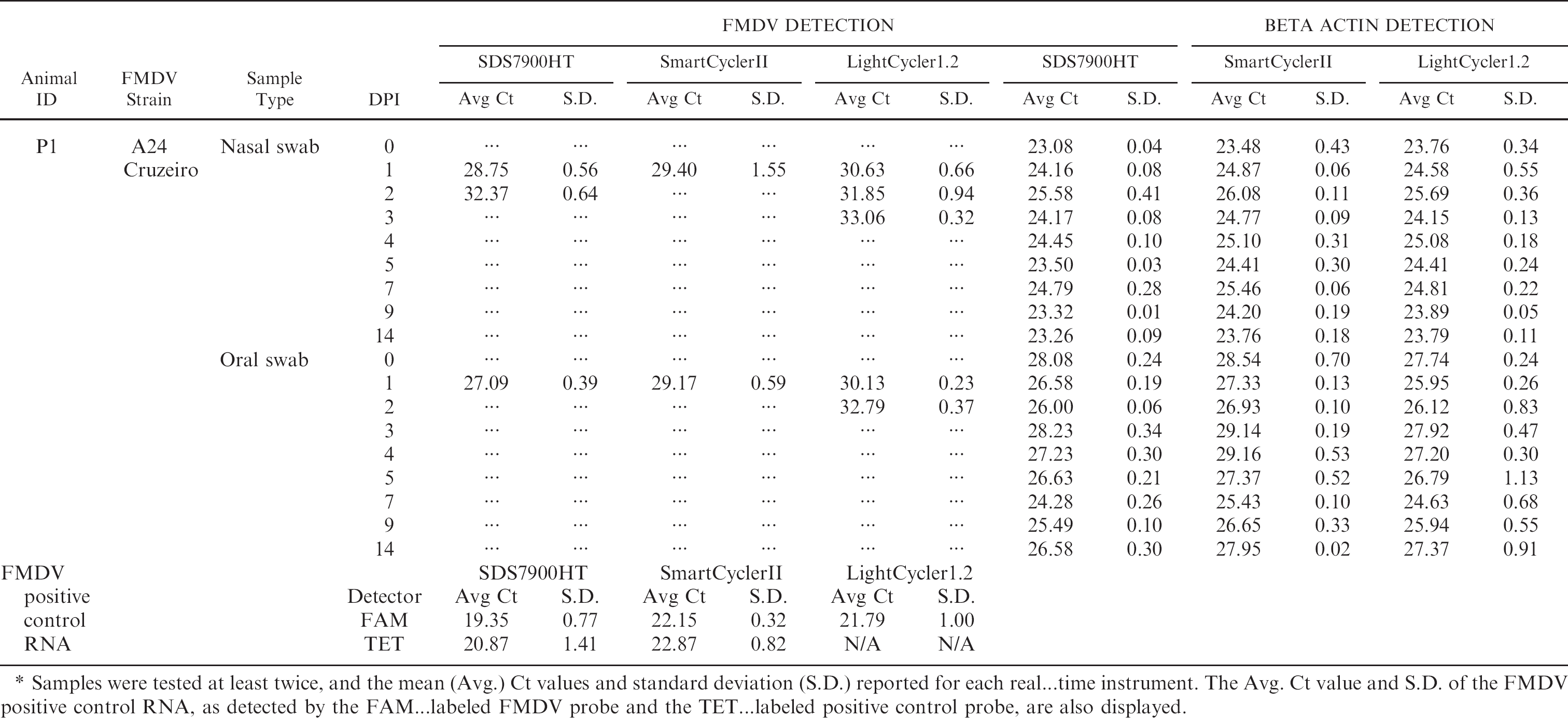
Samples were tested at least twice, and the mean (Avg.) Ct values and standard deviation (S.D.) reported for each real… time instrument. The Avg. Ct value and S.D. of the FMDV positive control RNA, as detected by the FAM…labeled FMDV probe and the TET… labeled positive control probe, are also displayed.
It is important to ensure that RT-PCR positive samples are not the result of carryover contamination from previously handled preparations or reactions. To replace known positive samples as a RT-PCR amplification control, a synthetically generated positive control for FMDV RT-PCR was constructed, inserted into a cloning vector (containing promoter sites for transcription), and linearized. This amplification control permits detection by the FMDV primers and probe, resulting in a larger 130-bp amplicon from the 88-bp FMDV product that can be distinguished by electrophoretic analysis. A differentiating probe labeled with TET and MGB-NFQ has been designed to unique positive control sequences that are not found in the true FMDV amplicon. Inclusion of the TET-labeled positive control probe as a component of the FMDV reaction allows detection of any contaminating positive controls in the sample without performing gel electrophoresis; only analysis of the fluorescence signal from the TET detection channel on the SmartCyclerII and SDS 7900HT is required. The availability of commercially produced TaqMan probes modified with detectable dyes on the LightCycler1.2, other than FAM, is the major limitation with this particular instrument.
Many factors can lead to false-negative results: destruction of RNA in the sample by host RNases, RT-PCR inhibitory substances in the preparation, and technical errors such as pipetting or instrument failure. The successful detection of beta actin mRNA alongside any FMDV RNA isolated from tissues sampled for FMDV isolation is a reliable indicator of the quality of extracted sample. We have demonstrated that beta actin mRNA is sufficiently detected in FMDV samples on all 3 machines. The specificity of the beta actin primers towards mRNA were assessed on the 3 instruments using 84 FMDV-free bovine tissue RNA samples by PCR amplification without RT. The SmartCyclerII detected beta actin amplicons only in reactions containing RT. Beta actin products were detected at an average cycle of 40.67 on the SDS7900HT and cycle 43.17 on the LightCycler1.2 with the omission of RT, suggesting the presence of pseudogenes or contaminating genomic beta actin sequences in the RNA preparation which were not removed by the DNaseI treatment.
Monitoring host beta actin as a control does not rely on the addition of exogenous nucleic acids for coextraction during RNA isolation, such as armored RNA 2,4 as routinely performed for numerous other RT-PCR assays as a processing positive control. 7 Addition of such a process control at the beginning of the RNA extraction procedure in the laboratory gives no information on the RNA degradation state of the sample upon receipt (e.g., during transportation to the lab). In this manner, the beta actin acts as the endogenous “process control” of the sample. Theoretically, detection of FMDV and beta actin can occur simultaneously within the same reaction vessel on the same real-time instrument, if both probes can be labeled with distinguishable fluorophores on these machines. Initial multiplex RT-PCR experiments were successful in detecting only the FMDV amplicon and not beta actin mRNA in FMDV-infected white-tailed deer serum samples (data not shown). This is most likely due to the fact that this serum sample contained FMDV RNA levels that vastly surpassed the amount of beta actin mRNA template in the sample. We have decided to separate these assays so that sensitivity of both FMDV and beta actin detection would not be compromised. Swab and probang RNA extractions generally contain a low abundance of host beta actin mRNA (compared to whole epithelial RNA preparations), which likely derives from superficial scrapings of surface epithelial cells. In particular, oral swabs were generally not as good a sample as nasal swabs, as they generally produced higher Ct values and/or did not amplify well, especially with the SmartCyclerII. Taken overall, it would be more beneficial to amplify beta actin to detectable levels while retaining optimal FMDV detection. If this beta actin RT-PCR is fully optimized to an acceptable amplification efficiency, it could potentially be used as a reference for relative FMDV quantitation studies as described previously for porcine tissues 12 or other FMDV-susceptible species which are detectable by the primers and probe set.
The application of the FMDV RT-PCR assay with the transcribed positive amplification control and the beta actin RT-PCR was tested successfully using simulated diagnostic samples. A survey of RNA isolated from 150 uninfected bovine tissue and 107 cattle nasal and oral swab samples showed no false-positive results. We have determined that detection of FMDV in cattle, pig, and sheep swabs samples was possible as early as 1 dpi and can extend up to 21 dpi. FMDV in cow and sheep probangs was possible by 3 dpi to 28 dpi. The variability of detecting FMDV templates between animals may be attributed to sampling procedure, individual ability of the animal to clear virus, or variable presentation of the different viral strains in these animals. Although the sample number of FMDV-infected animals was low in this study, these results provide an indication of how early and late this real time RT-PCR assay is able to detect virus, showing that this method of detection would be valuable in providing early detection of preclinical animals. The transcribed FMDV positive control RNA can be quantitated and serially diluted for use as absolute quantitation standards. Previously, the positive control was used in the more stable DNA form where serial 10-fold dilutions were amplified alongside test samples with the sole purpose of verifying PCR efficiency for every run occurred within the range of 90%-110%, calculated by efficiency = 10(-1/slope) −1, where −3.10 ≤ slope ≤ −3.60.
The LightCycler1.2 appears to have the greatest FMDV and beta actin detection sensitivity in experimentally infected animal samples compared to the other instruments. It also proved to be the fastest instrument to complete the identical PCR cycling profile, likely due to its rapid air-based heating mechanism as opposed to the slower ramping time of a metal Peltier element heating block in the SDS7900HT, or the I-CORE (Intelligent Cooling/Heating Optical Reaction) in the SmartCyclerII. However, monitoring FMDV positive control cross-contamination events by TaqMan probe detection was not possible on the LightCycler1.2. Positive sample results can only be verified by size using agarose gel electrophoresis, if the contaminating product occurs in amounts where a band can be visualized. There may also be difficulties in a diagnostic environment to declare “nonplausible Cp” occurrences in apparent positive samples. The SDS7900HT demonstrated overall good sensitivity and consistency for FMDV and beta actin detection. Of the 3 platforms compared in this study, the SDS7900HT is the only instrument that uses an argon-ion laser excitation source, which has higher excitation and spectral brightness compared to the light-emitting diode (LED) source used in the Light-Cycler1.2 and SmartCyclerII. The SmartCyclerII also performed adequately, though it was the least sensitive of the instruments. The sensitivity may possibly be improved with the use of another kit and/or readjustment of PCR component concentrations from those which were used in this comparative study. The SmartCyclerII's 100-fold decrease in analytical sensitivity may be compensated by increasing the number of animals to be tested.
We were unable to compare our samples to the virus isolation test, as the storage media contained 50% glycerol and would adversely affect the cell culture-based test. Comparison of FMDV serotype O detection were similar between real-time RT-PCR and virus isolation in epithelial suspensions, 14 as well as experimentally infected cattle, pig, and sheep blood and serum, 13 and saliva and tissue samples. 3 Previous studies have also demonstrated that the sensitivity of the virus isolation test and real-time RT-PCR assay were identical in FMDV-O infected cattle and sheep probangs. 17 Serial dilutions of epithelial suspensions containing several FMDV strains were detected at a comparable or lesser extent by isolation than by real-time RT-PCR of the 3D gene, using hybridization probes on the LightCycler1.2. 10 Although this validated assay appeared to be sensitive and specific for FMDV, 10 this hybridization probe technology is limited in its application on the SmartCyclerII and SDS 7900HT.
The quality assurance of the FMDV diagnostic RT-PCR result can be further improved with the use of automated nucleic acid extractions systems to provide quick and accurate results as compared to the traditional methods of analysis, which potentially can extend 48–96 hours upon receipt of the sample. At present, we still advocate the use of RT-PCR to complement the traditional virus identification tests such as inoculation of tissue culture and antigen detection ELISA for a complete diagnosis of FMD. Isolation provides information on the infectious nature of the replicating virus, and the ELISA is useful for identifying the serotype of the causative virus in the sample. Due to the potential for virus recombination events affecting RT-PCR target areas, amplification of other FMDV genome segments such as the 5′UTR 13,14,17 can further safeguard against false-negative RT-PCR results. Analysis of other segments of the aligned FMDV genome has shown multiple areas of conservation as well as unique serotype-specific polymorphisms. We hope to take advantage of this to extend these protocols by designing additional serotype-specific primers and accompanying probes for rapid typing of FMDV positive samples to further improve the diagnostic assay.
Acknowledgements
The authors gratefully acknowledge the assistance of Dr. Boris Galic, Dr. John Copps, and the Animal Care Unit towards the care and sampling of the animals used in this study. This project was supported in part by the CBRN Research and Technology Initiative (CRTI) and the Canadian Food Inspection Agency.
Footnotes
a.
Applied Biosystems Ltd., Foster City, CA.
b.
Cepheid, Sunnyvale, CA.
c.
Roche Applied Science, Laval, QC, Canada.
d.
Invitrogen Canada, Burlington, ON, Canada.
e.
Integrated DNA Technologies Inc., Coralville, IA.
f.
Qiagen, Mississauga, ON, Canada
g.
Promega, Nepean, ON, Canada.
h.
Beckman, Mississauga, ON, Canada.
i.
Ambion, Austin, TX.
j.
Wisent, St. Bruno, QC, Canada.