



Abstract
“Dalits” are a historically marginalized caste group in India. In this study, we examine the impact that the institution of caste has on career change. Focusing on the shift from science, technology, engineering, and mathematics (STEM) to non-STEM careers, we ask why members of the Dalit communities in India leave their STEM careers. To present a comprehensive understanding of this career change, we also examine the factors that facilitate their retention in STEM careers. Deriving data from in-depth interviews with 42 STEM scholars from the Dalit communities in India, we illustrate their organizational experiences that are based on casteism. Qualitative data analyses were done using the grounded theory method. Results suggest that while caste operates in a unique way to drive away Dalit scholars from their STEM careers, doing gender plays an important role in their retention within the same careers.
Career change studies have long established the importance of familial, organizational, and social relations in intraorganizational and interorganizational career mobility (Feldman & Ng, 2007; O’Mahony & Bechky, 2006). In traditional career change literature, factors like individual aspirations (Feldman & Bolino, 2000; Seibert et al., 2013), self-efficacy (Whiston et al., 2017), person organization fit (van Hoorn, 2017), and organizational incentives (Ng & Butts, 2009) have been highlighted as primary predictors of career change. In recent years, social inequalities based on race (Alegria, 2019), gender (Alegria, 2019), class (Quinn & Ferree, 2019), sexual orientation (Kaplan, 2014), age (Rabl & del Carmen Triana, 2014), and religion (Baker & French, 2018; Duffy et al., 2010) have also been widely explored. While workplace inequalities in terms of wage gap, physical and emotional harassment, and lack of promotional opportunities remain a longstanding focus of the empirical investigations, the scholarship has paid considerably little attention to the lived experiences of marginalized individuals. An understanding of such experiences is called for since those might explain why people often give up their aspired careers to settle for less coveted ones. (Hirschi et al., 2020) This is what we accomplish in this paper by illustrating the career-related experiences of 42 individuals from “lower” caste backgrounds in India.
Historically derived from the concept of “varnas” (color or categories), “caste” in India was a system of social stratification categorizing people into four groups based on their occupations: The “Brahmins” (priests and teachers), the “Kshatriyas” (warriors and administrators), the “Vaishyas” (tradespeople and farmers), and the “Shudras” (laborers) (Fowler, 1997). Excluded from the varna system were the Dalits who performed the “polluted” work like crematorium work, leather work, waste collection, and cleaning public facilities. This engagement in “polluted” work led to their “untouchable” status in society (Coffey et al., 2017; Fowler, 1997). The caste system in modern India was a result of British colonial rule when the rulers used it as a tool to assign important occupational positions primarily to the Christians and members of certain castes (Nehru, 2004). Ranked higher in the caste hierarchy, Brahmins, Kshatriyas, and Vaishyas enjoyed the most social and economic advantages, while Dalits were severely marginalized. Oppression of the Dalits also included restricted access to upward social mobility (Strauss, 2017). To improve their socio-economic status, the government of India took several affirmative action initiatives, such as the Mandal Commission (1990), reserving almost 50% of the seats in public organizations for all marginalized communities (Maheshwari, 1995). Despite affirmative action initiatives, Dalits continue to experience systematic exclusion, especially in the skilled labor market (Haq et al., 2020; Kumar, 2017). To comprehend this exclusion, in this study, we focus on the science, technology, engineering, and mathematics (STEM) teaching and research institutes in India and ask why members of the Dalit communities leave their STEM careers. We conducted in-depth interviews with 23 STEM scholars who had shifted from STEM to non-STEM careers, and 19 STEM scholars who had continued with their STEM careers. Using the grounded theory method (Charmaz, 2001; Corbin & Strauss, 1996), we analyzed the data qualitatively. Our findings suggest that Dalits experience inequality in a unique way within the STEM academia in India that subjects them to a deep sense of isolation. “Interestingly, the ideals of gender socialization facilitate their retention as they cope with invisible casteism pervading the STEM academia in India.”
First, we borrow from the discourse on caste relations in India that delineates how caste reproduces inequalities and aggravates the social and organizational experiences of Dalits. Given that India, with its very large population, reflects an epitome of diversity, studies also focus on the intersecting nature of this inequality to identify the “grammar” of caste relations in the nation (Mosse, 2018). Whereas the role of caste in social and intergenerational occupational mobility is widely studied, the topic remains considerably underexplored in the contexts of organizational careers and career change (Choudhary & Singh, 2018; Mosse, 2018). This paper contributes to this literature by examining the impact of caste on career change in contemporary India.
Second, we use the scholarship on gender socialization in India that underpins the importance of fulfilling gender-related social expectations. Since their childhood, individuals learn gender roles (Schnittker, 2007). This learning process is manifested through an enduring display of behaviors, a process also known as “doing gender” (West & Zimmerman, 1987). In a patriarchal society like India, families lay the foundation of doing gender that is distinct for men and women. While men are required to “do masculinity” by being determined, dominant, and controlling, women are expected to “do femininity” by being tolerant, accepting, patient, and sacrificing (Desai & Temsah, 2014). This literature acknowledges doing gender as a mechanism to meet the normative gender role expectations (Schnittker, 2007). Our study builds upon this literature by showing that it could also be used as a tool to cope with casteism with the STEM academia in India.
The contributions of this paper are threefold. (a) It extends the literature on career change and caste by illustrating the inequalities in high-skilled jobs in India that are both caste-based and invisible in nature. (b) It describes a hidden albeit effective way of restricting the agency of the Dalit scholars in India. It, therefore, contributes to the scholarship on caste relations. And (c) It builds upon the gender socialization studies by explicating the role that doing femininity plays in coping with unequal caste relations.
Dalit and the caste relations in India
Although Dalits make up 16 percent of India's population, they experience multiple forms of oppression like limited access to land, water, higher education, high-paid jobs, and legal support (Dejaeghere & Arur, 2020; Fuchs, 2020; Zene, 2013). Indeed, caste as a social institution operates to distance “upper” from “lower” caste people where Dalits are viewed as “outsiders” and expected to remain at the peripheries of society (Chrispal et al., 2021). Their livelihoods are restricted to a handful of “polluted” work (Ackroyd, 2007; Mahalingam & Rodriguez, 2006), leading to their untouchable status (Coffey et al., 2017; Fowler, 1997), a practice also justified by religious texts (Ghose, 2003). See Chrispal et al. (2021) for further details on caste relations in India.
The affirmative action initiative of the Indian government was a significant attempt to improve the socio-economic status of the Dalits. With regard to careers, this initiative reserved a certain percentage of seats (positions) in politics, government, and educational institutions for them (Gupta & Priyadarshi, 2020; Maheshwari, 1995; Prasad et al., 2020; Saha, 2012). However, many argue that the initiative has deteriorated caste relations by stigmatizing the beneficiaries and limiting their progress (Deshpande, 2013). Studies show that casteism aggravates Dalits’ socio-economic well-being by pushing them towards low-status and low-income jobs (Chrispal et al., 2021; Madheswaran, 2010; Thorat et al., 2021). “For example, according to a 2017–2018 report, 70.56% of the Dalit workers held low- to mid-level jobs. That percentage of the “upper” caste workers was 47.23. However, only 29.43% of Dalits had access to high-skilled occupations, while 52.77% of “upper” caste workers had that privilege (Thorat et al., 2021).” Therefore, a systematic understanding of the underrepresentation of Dalits in high-skilled jobs is needed to gain a deeper insight into casteism in these work settings (Chrispal et al., 2021). In this paper, we accomplish that. Our participants experienced casteism in a unique way within the STEM academia in India. This casteism subjected them to a deep sense of isolation. As a result, 23 of them (out of 42) left their favorite STEM careers. However, at the time of the interviews, 19 individuals persevered with their STEM careers while coping with casteism. Their coping mechanisms were based on the ideologies of doing gender in India. To situate the phenomenon in perspective, next, we present a brief overview of the literature on gender socialization in India.
Gender socialization in India
Gender socialization is a process by which individuals learn the normative expectations associated with their sex, a process called “doing gender” (Schnittker, 2007). It is culturally enabled while families lay the early foundation of doing gender (Chattopadhyay, 2017). That is, children develop and fine-tune gender-based traits as they grow up (Seiter & Nelson, 2011). For example, by “doing femininity,” girls learn to become loving, caring, and obedient and to be patient and compromise with their circumstances by accommodating the needs of others in the family. Similarly, boys “do masculinity” by valuing power and authority (Chattopadhyay, 2017). Although deviation from gender norms is considered unacceptable (Desai & Temsah, 2014), it is important to note that neither gender nor doing gender is binary (Koenig et al., 2011). Sex and development studies show no significant relationship between biology and the cognitive abilities of women and men (Golombak et al., 2008; Halari et al., 2005; Hines et al., 2015). That is, the cognitive performance of individuals is determined primarily by social expectations and socialization (Huston, 1985; Huston et al., 1984). Because socialization is contextual, doing gender is not always sex-specific. Studies show that men often do femininity while caring for their loved ones (Szabo, 2014), meaning depending on contexts, women and men can make conscious decisions about how to do gender (Koenig et al., 2011; Szabo, 2014).
Gender socialization in India is a complex phenomenon (Desai & Temsah, 2014). While many families are matriarchal in nature (Cybil, 2016), women in some communities learn to combat oppression in creative ways (Richards, 2016). Indeed, Indian women are not always the victims of oppression (Desai & Temsah, 2014). However, like any patriarchy, women in India experience multiple oppressions ranging from gender-based wage gap to dowry, domestic violence, and honor killing (Poddar & Mukhopadhyay, 2019; Sen et al., 2020). At the confluence of gender, caste, and class, challenges are more severe for Dalit women than their “upper” caste counterparts (Raman, 2020). For example, a type of prostitution called “Devdasi” is forced mostly on poor Dalit women (Pandey & Mishra, 2021). Yet, Dalit feminism in India is more than a century old, and Dalit women have come a long way. They played an important role in reforms like the abolition of child marriage, enforced widowhood, and untouchability (among others) (Chakraborty, 2023; Sen, 2019). Still, patriarchy and poverty damage the work-life advancements of many women in India (Chattopadhyay, 2017). Their lifestyle choices are limited to marriage and homemaking. This is evident from the percentage of female labor force participation, which was 23.97 in 2022 (World Bank, 2023). They are not expected to question the authority of others, especially men and elders. They learn to accept decisions that others make for them, as obedience is one of the guiding principles of doing femininity in India (Rajagopal & Mathur, 2017). In many families, women sacrifice their happiness for the sake of others and teach the same lesson to their daughters and granddaughters (Chattopadhyay, 2017).
Methodology
Sampling, participants, and data collection
We used personal contacts to reach out to the initial participants and contacted others via snowball technique. When a field is under searched, this technique facilitates systematic investigation via the selection of the best-fit participants, the development of deeper insights, and generating results pertinent to the research context (Emmel, 2013). We conducted semi-structured in-depth interviews ranging from 120 to 190 min. To gauge their work-life experiences, we requested participants to narrate their life stories—both professional and personal. This is because self-narratives during interviews are a reflexive process (Garrison, 2018). This reflection constitutes a rich source of data, particularly when a study is focused on the lived experiences of individuals (Bindl, 2019). We interviewed 42 STEM scholars (38 men and 4 women) who identified themselves as members of different Dalit communities in India. We divided them into two groups: (a) those who left the STEM careers (n = 23, all men, denoted as “PN” in the quotes) and (b) those who continued with their STEM careers (n = 19, four women and 15 men, denoted as “PS” in the quotes). All the participants expressed that STEM was the career they wanted to pursue since their childhood. However, 23 of them had to leave their STEM careers to enter less-desired non-STEM careers. See Table 1 for profile of the participants.
Profile of the participants.
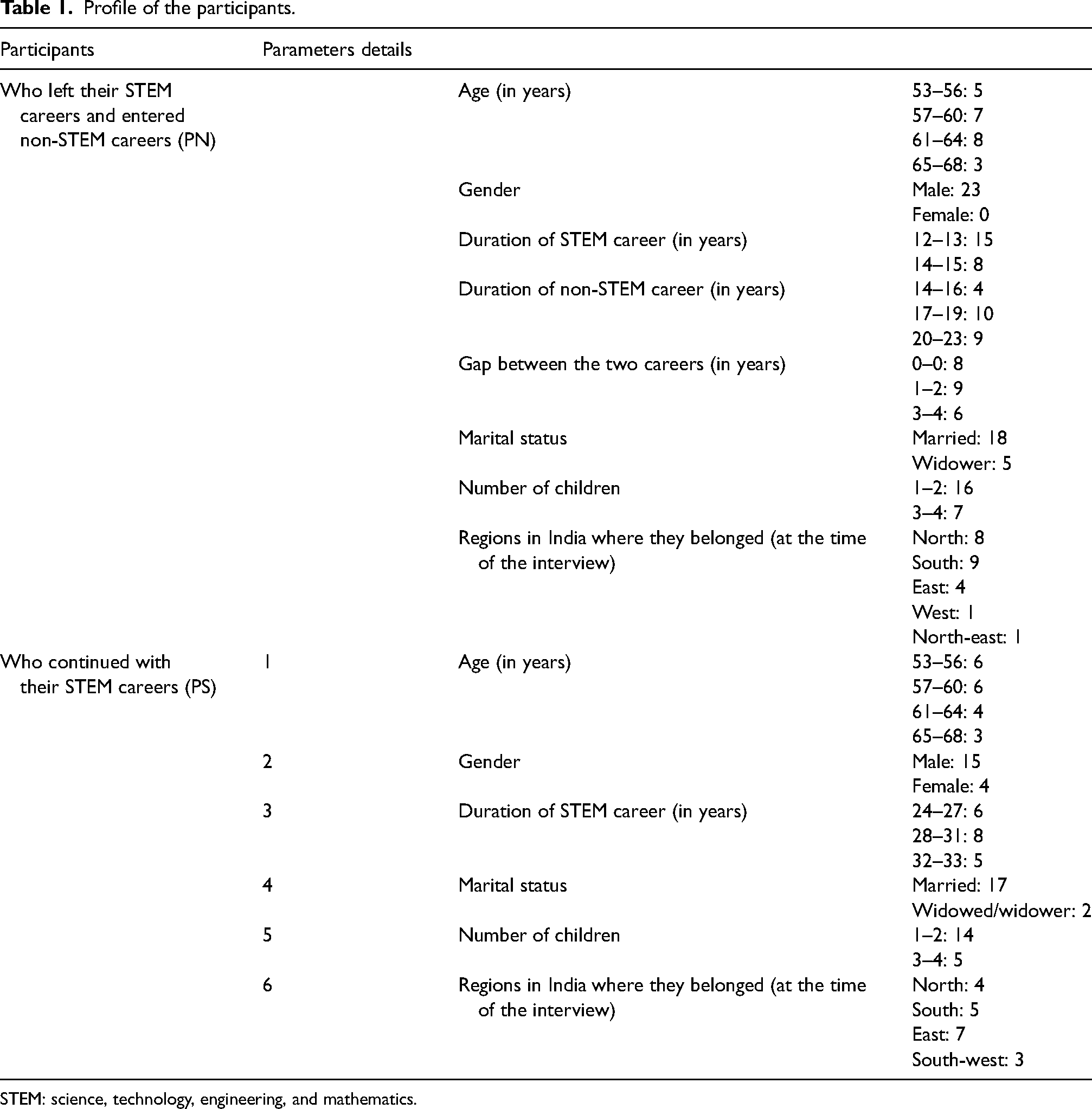
STEM: science, technology, engineering, and mathematics.
Data analysis
We aimed to comprehend the lived experiences of Dalit scholars within the STEM academia in India. Accordingly, we analyzed the data using the grounded theory method. This method aids in assessing complex phenomena by (a) providing direct guidelines for data screening, (b) suggesting distinct stages and strategies of data processing (Glaser & Strauss, 2009), (c) offering definite mechanisms of meaning-making of data vis-à-vis the extant literature, (d) ensuring the trustworthiness of data analyses (Corley & Gioia, 2004), and (e) establishing qualitative research as a scientific inquiry (Glaser & Strauss, 2009). We followed the footsteps of Corley and Gioia (2004), Gibson et al. (2018), and Heyler et al. (2016) to achieve robustness in our data analyses and presentation.
Our data analyses comprised—three overlapping stages that included careful reading of data and their constant evaluation with respect to the literature. In “stage 1,” we read each transcript separately to identify the first-order codes. To stay close to the data, those codes reflected narratives from the transcripts. For example, we paid close attention to the statements depicting caste-based inequality and organized them by means of behaviors, like how colleagues looked, talked, or behaved with Dalit scholars. We met at least three times after reading each transcript to compare codes. Disagreements were resolved via further discussion and consensus. The percentage of inter-coder agreement for every transcript ranged from 0.86 to 0.89, much higher than Cohen's (1960) suggestion of a minimum of 0.70. In “stage 2,” we worked together to condense the first-order codes into second-order codes. For example, the first-order codes about unacceptable ways of looking were categorized into the second-order code called “subtle looks.” Trustworthiness in this stage was established by seeking the help of a research associate who was asked to assign quotes from the raw data to the second-order codes. The overall inter-coder agreement varied from 0.82 to 0.90 in this stage. In “stage 3,” we developed theoretical dimensions, figuring out what the second-order codes represented. For example, the second-order codes, “subtle looks,” “subtle tones,” and “covert treatment” represented the dimension called “invisible casteism within the STEM academia.” In this stage, we actively engaged in member checks (Gioia et al., 2013) when we consistently presented our findings to the participants. All participants were in sync with the version of the findings presented in this paper.
Findings
Invisible casteism within the STEM academia
Being Dalits, inequalities like marginalization and segregation were not new to our participants. Therefore, what astounded them in STEM careers was the “subtle and covert” attitudes of the “upper” caste people. Their academic journeys as STEM students were not easy. “But I thought the situation would be different in the [workplaces] because all are scholars … civilized and educated people.” (PN03, Male). However, casteism reappeared in the “civilized and educated” environment in an unexpected way—“You cannot see it, it is a very refined thing … you can only feel it” (PN05, Male). Thus, we called it “invisible casteism” within the STEM academia because (a) those relations were manifested in a latent way, and (b) only the Dalits experienced them. Three sub-themes emerged from the data (Table 2).
Subtle looks: Because of their Dalit identities, Dalit scholars received derogatory looks from “upper” caste STEM colleagues. Those looks were hidden and fleeting yet very demeaning to the people who received them.“How do you see a rotten object? It is that kind of a glance. [The “upper” caste people] don’t get those looks. You can say that I am a Dalit, so I am over-conscious about such things … but I know what I see. I do not make mistakes in reading people's expressions … it is as if I was nothing … all my hard work, my college and university marks [grades], my research projects – all become meaningless in one second … all that matters is my Dalit identity … I felt so lonely … it became intolerable … I could not live with that anymore.” (PN07, Male) Subtle tones: Dalit scholars did not claim that “upper” caste people openly misbehaved with them. However, condescending conversational tones were a common occurrence.“It happened on the first day of my work … My department head was giving me an orientation…and then he said, “oh yes! I forgot that you are on quota (affirmative action initiative)” … It was not what he said, it was how he said that … as if I got an easy entrance into the job and I did not deserve it. That was so hurtful. … Instantly, I felt alone and distant. Do you think [“upper” caste people] hear that? No, they don’t … That tone haunted me every day. (PN05, Male) Covert treatment: Quite a few “upper” caste colleagues could not accept our participants because of their Dalit backgrounds. Sometimes, that unacceptance was reflected in how Dalit individuals were treated. Interestingly, such treatments were also experienced by the people who did not avail of the reservation program.“When I entered my job, it was long before the [affirmative action initiative]. I thought I was equal … clearly, I was naive. Well, nobody said anything on my face … they never do. But certain incidents bugged me … that no one could see because [“upper” caste people] don’t undergo that. Say … there was a chai (tea) get-together … and my colleagues were talking to each other. When I took my cup and joined them, I realized they were not feeling comfortable, they suddenly used to change the topic of their discussion … it was a feeling as if … I did not exist … My self-worth was crushed. I was depressed every day … one day I said to myself I cannot do that anymore.” (PN09, Male).
A brief summary of themes.
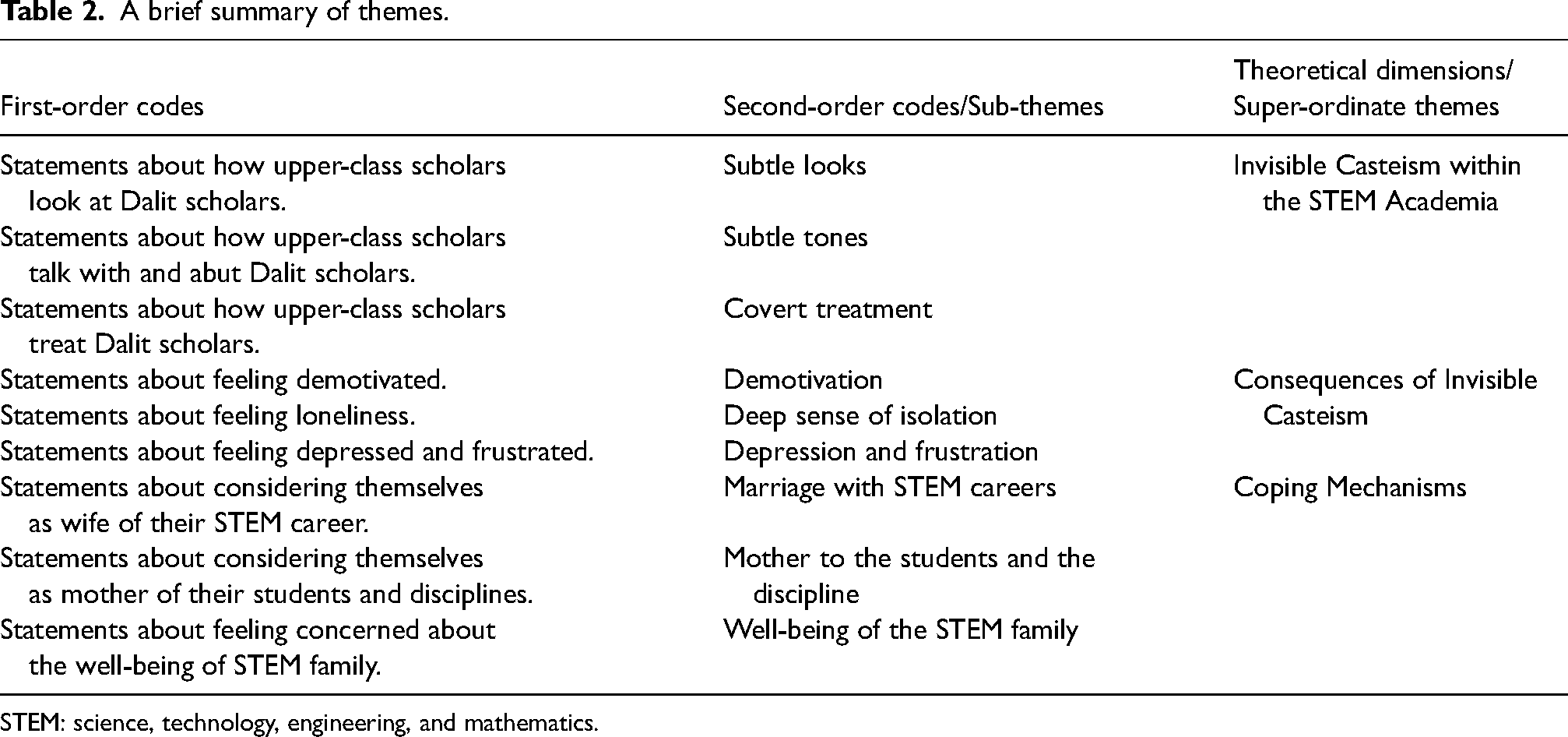
STEM: science, technology, engineering, and mathematics.
Consequences of invisible casteism: some Dalit scholars left STEM careers
The “invisible casteism in the STEM academia” demotivated our participants and drained their confidence and self-esteem. The experiences related to “subtle looks,” “subtle tones,” and “covert treatment” subjected the Dalit scholars to a deep sense of isolation in their STEM workplaces. They remained depressed and frustrated. Eventually, the charm of their “dream careers” was lost, and they decided to switch to non-STEM careers. “Who wants to leave his dream career? But being a Dalit is difficult to survive in those circles” (PN09, Male).
As students, Dalit scholars experienced invisible casteism in the forms of “subtle looks,” “subtle tones,” and “covert treatment” as well. However, what demarcated the experiences as professionals from those as students was the token representation of the Dalits as STEM professionals. “Those insulting looks, and offensive treatments were there in my college and university also. But there I could survive because I had a few Dalit friends. We experienced the same suffering … but we shared it among ourselves and that was a big support. When I took the [STEM] job, I had no one to support me in [the STEM workplace]. I was the only Dalit person there. So, the circumstances were more lonely and unbearable for me … It was because of this and this only I left my [STEM] career” (PN11, Male) “When circumstances make you feel terribly alone, you start thinking deeply. I realized that it was not [the “upper” caste STEM colleagues] fault. They did not know better, they learned it from their parents, from their teachers, from the culture … I knew from the beginning that [caste difference] is in our culture … but … I hoped that when I will get an education, get a job, contribute to society, things will improve. I thought my STEM career would help me do that. But there I realized again that [caste inequality] has gone so much deeper into our culture that even my education or job could not save me. The culture of the country also entered into my [STEM workplace] … if you think about it, it is not my colleagues … but it is the culture that left me alone and cornered. You can fight with people, but I did not know how to fight against culture … even with my education.” (PN15, Male)
Coping mechanisms: a gender-based approach
Our participants who continued with their STEM careers used the ideology of doing femininity to persevere with their STEM careers. This was true for both female and male scholars. They learned to do femininity from the women in their families and also from their life experiences as Dalit individuals. Our data suggested that Dalit scholars did femininity to cope with casteism in the STEM academia in three ways.
Marriage with STEM careers: Even the male participants perceived themselves as wives of their STEM careers. It was their childhood dream to become STEM scholars. To achieve their aspirations, they encountered a lot of social and economic challenges that they overcame with sheer diligence and hard work. Therefore, when they earned their STEM jobs, they embraced it as a life-long relationship.“My wife is my role model. We got married at a very early age. I saw her sacrificing her entire life so that I could have my favourite career … So I wanted to become like her … When I see [casteism] at work, I know I have to cope … because I see it as a marriage … a relation of lifetime where I am the wife. So, I think about my [STEM research] and not me. As a Dalit, I also had my share of oppression from the society … so I also grew up with a certain amount of womanly qualities … like accepting and compromising.” (PS09, Male) Mother to the students and the discipline: STEM scholars saw their students and disciplines as their children. Consequently, they were willing to tolerate casteism for the sake of their “children.”“I see my students as my children and so is my [STEM discipline]. I am like a mother to them, and mothers don’t quit. I am a child of a single mother who tolerated oppression and suffering all through her life. She tolerated serious poverty and a lot of violence. But … she gave everything that she had so that we could live a decent life … I see my [STEM] responsibility in the same manner. I guess this motherly attitude also came to me by being a Dalit … society's injustice teaches us to become more tolerant and patient like a mother … No matter what happens to me, my love for my [STEM discipline] and my students should never decrease.” (PS12, Male). Well-being of the STEM family: Our participants considered their STEM jobs and job-related people as their families, and just like a mother, they bestowed upon themselves the responsibility to enhance the well-being of their “STEM families.”“This is my family, I saw it like that right from the beginning of my job. And I play the role of the mother … I see it like that … so I have a responsibility. When anything went wrong in my family, my mother corrected it with love and affection. It was her responsibility to make every wrong thing right. Here in my [STEM workplace], I see it as the same. If there is anything wrong, it is my responsibility to address it with love and affection. My [“upper” caste] colleagues see me just as a Dalit. I don’t want my [“upper” caste] students to do the same. They need to learn that all people are equal. And I cannot teach that by being angry or offensive … I can teach that only with love and care … like a mother. I want to show my students that their Dalit professor is not only a good scholar, but he is also a model of love and care. My mother maintained the family by being a model of love and care … I want to be the same for my students … If I leave my job … who will do that for the students … and who will do that for the Dalits?” (PS06, Male)
Our data showed that the STEM scholars coped with the casteism in STEM academia by using the ideologies of doing femininity. Feminine attributes of acceptance, compromise, love, and care not only enabled them to continue with STEM careers, but they also hoped to teach the future generation that “all people are equal.” Because doing femininity was a powerful coping mechanism, perhaps it was not a surprise that all women participants in this study endured with their STEM careers.
Discussion
We asked why members of the Dalit communities in India leave their STEM careers. To gain a holistic understanding of career change (following the suggestions of Kiazad et al., 2020, and others), we also explored the factors that facilitated the retention of Dalit scholars in STEM careers. From our data, we obtained three conceptual standpoints. First, caste inequality within the high-skilled STEM academia in India is rather invisible in nature. Dalit scholars reported subtle negative looks, subtle tones, and covert treatments that they experienced as derogatory and hurtful. Second, caste relations in STEM academia erode self-esteem and dignity of Dalit scholars. Due to the lack of social support in workplaces, Dalit scholars suffer from a deep sense of isolation and realize that casteism is a part of India's overall culture that percolates in the academia. Thus, challenging this oppressive system is difficult. With time the individuals’ feeling of hopelessness increases and “being a Dalit [it becomes] difficult to survive in those circles” (PN09). Consequently, they are forced to consider alternate career options (non-STEM).
And third, the fundamentals of feminine gender socialization such as acceptance, compromise, love, care, and sacrificing one's happiness for the sake of others (as illustrated by Chattopadhyay, 2017; Twamley & Sidharth, 2019 and others) promote the retention of Dalit individuals in STEM careers. The women in their families and life-long experience as a Dalit in India, teach individuals to become accepting of their oppressions and compromise with their circumstances. STEM scholars do so by adopting a feminine attitude towards their discipline, research, and students. They view their STEM jobs as marriage, they see themselves as a mother to their STEM disciplines and students, and they consider their STEM workplace as a family where they are the mothers. That is, participants who survive casteism in STEM academia dedicate themselves towards the service of their STEM jobs at the cost of their personal feelings and sufferings. They do so to enhance the well-being of their STEM families. By doing femininity, they also hope to change society by inculcating the values of equality in future generations by means of love and care.
Theoretical implication
This study contributes to the literature in three ways. First, career change literature on caste has long established the impact of caste inequality on the marginalization of the “lower” caste people in various organizational contexts and outcomes. Our study extends this literature not only by illustrating the kind of discrimination that remains invisible but also explains (to a certain extent) the failure of the affirmative action program in one of the high-skilled job settings in India—the STEM academia. Our participants did not experience traditional forms of exclusion like wage gap or denied/delayed promotion. However, they constantly battled casteism that was invisible in nature—neither apparent nor experienced by members of the “upper” caste communities.
Second, the practice of “untouchability” dehumanizes the Dalits in India (Singh, 2014; Thorat, 2009; Zene, 2013). Hence, losing agency by means of damaged self-esteem and dignity is not a new experience for them (Singh, 2014). This study shows how such agency could also be divested by an invisible form of caste-based oppression. Indeed, resistance is more of a challenge when power relations operate underhandedly (McNay, 2020). Our participants feel helpless primarily because the caste inequality in their workplaces is not visible to others. Therefore, this study builds upon the discourse on caste relations in India by drawing attention to a powerful yet invisible way of constraining the agency of Dalits. In the process, we also extend the theory of Inequality Regimes (Acker, 2006). This theory states that in organizations where socially marginalized groups are underrepresented, the forces of inequality (such as gender, race, and class) obstruct every form of their well-being (Acker, 2006). Whereas this theory explains and measures inequality primarily in terms of the visible facets like wage gap, promotional opportunities, employment security and benefits, and networking within workplaces (Acker, 2006), our study highlights the power of invisible casteism operating via subtle looks, subtle tones, and covert treatments.
Additionally, we build upon the subtle racism theory by appending it with the paradigm of racial microaggression. Subtle racism theory proposes that social inequality could be invisible in nature where dominant groups oppress the marginalized groups even without being aware of it (Fiske, 1998, 2002). These oppressions operate in three ways: (a) indirect prejudice, when dominant groups want marginalized groups to remain marginalized (Hewstone et al., 2002), (b) automatic prejudice, when dominant groups continue to harbor negative stereotypes against the marginalized groups (Fiske et al., 2002), and (c) ambiguous prejudice, when dominant groups perceive themselves as superior to the marginalized groups (Dovidio et al., 2002). While this theory remains unclear about the behavioral manifestations of subtle oppressions (Minikel-Lacocque, 2013), this study reveals how invisible inequality is practiced against the Dalit scholars within the STEM academia in India. Moreover, the specific behavioral manifestations like “subtle looks,” “subtle tones,” and “covert treatments,” as revealed by our data reflect the forms of “microinsults,” “microassaults,” and “microinvalidations”—as proposed by the paradigm of racial microaggression (Sue, 2010). This paradigm suggests that when societies formally abolish racism, individual members of a marginalized group are targeted and victimized as opposed to the group as a whole (Sue, 2010). We advance the theory of racial microaggression that focuses primarily on the visible aspects of inequality (Sue, 2010), by describing the invisible facets of microaggression that wane the self-esteem and dignity of Dalit scholars within the STEM academia in India and force many of them to seek different careers.
Finally, this paper contributes to the scholarship on gender socialization in India. In a patriarchy like India, women are expected to be obedient and submissive (Chattopadhyay, 2017; Desai & Temsah, 2014). They conform to their gender roles and do femininity by accepting the oppressions and compromising with them. They also sacrifice their personal desires and happiness for the well-being of others (Chattopadhyay, 2017). While these attributes are socially sanctioned ways in which women are required to meet the social expectations attached to their assigned sex (Schnittker, 2007; Seiter & Nelson, 2011), our study shows that those could also be used as a tool to practice resilience while combating the invisible casteism within the STEM academia in India. Scholarship posits that despite the tradition of patriarchy, women in India often overcome gender-based oppressions to initiate significant familial, organizational, and social changes (Desai & Temsah, 2014; Potthoff, 2019). Perhaps this unique relation between doing femininity and practicing resilience could explain the aforementioned complexity of feminism in India.
Practical implication
In terms of practice, this study has two notable implications. First, caste identity continues to be one of the key determinants of life opportunities in India (Chrispal et al., 2021) where access to high-skilled jobs decreases as one climbs down the caste hierarchy (Mosse, 2018). Caste is an everyday practice that is viewed as natural and is legitimized as sacred (Thorat, 2009). Our study illustrates the nature of this everyday practice within one of the high-skilled occupations in India. Dalit STEM scholars experience inequality that remains largely invisible to the “upper” caste individuals. Latent oppression takes a sinister form as it diminishes the propensity of resistance (Johansson & Lindström Sol, 2022). Therefore, organizations that are increasingly aiming to embrace diversity need to be mindful of these invisible inequalities to protect the self-esteem and dignity of the marginalized sections. That is not to say that visible inequality is easy to resist. In fact, it is easier to perpetuate inequality when it is visible in nature (Mosse, 2018; Thorat, 2009). Yet, a population that is historically marginalized find it more difficult to identify with its organization while battling discrimination time and again (Mosse, 2018; Thorat, 2009). This situation may aggravate when the inequalities are also invisible in nature.
Second, our data suggest that doing femininity facilitates the process of retention of Dalits in high-skilled careers. Feminine attributes like love, care, compromise, and sacrifice allow STEM scholars to view and treat their professions with compassion. While the importance of feminine qualities is being widely acknowledged and appreciated by scholars and practitioners in the contexts of leadership efficiency and better employee relations (Brands et al., 2015), our data show that those qualities could also improve individuals’ relationships with their high-skilled jobs, especially when those individuals are oppressed since their birth and many of whom are probably the first-generation workers in high-status occupations.
Conclusion
Like majority of empirical studies on casteism in India, this research is also a part of the struggle to raise the voices of the oppressed. Minority voices need to be heard and listened to initiate organizational and social changes that would make positive differences in the lives of the marginalized communities in India and the rest of the world. We believe that this approach is effective in highlighting and contextualizing the invisible experiences of oppressed groups so that those experiences do not remain invisible anymore. We hope that research like this will promote awareness and action in a society where caste is a fact of life and eradication of this inequality is fundamental to the development of the nation.
Footnotes
Acknowledgements
First, we thank all the participants for their time and for generously sharing their work-life experiences. Second, we are grateful to Professor Prashant Bordia of the Australian National University for his feedback on the initial versions of this manuscript. Finally, we express our most profound appreciation to the anonymous review panel of this manuscript for all the valuable comments improving the quality of this paper significantly.
Author's contributions
Every author has equal contribution for this manuscript.
Declaration of conflicting interests
The author(s) declared no potential conflicts of interest with respect to the research, authorship, and/or publication of this article.
Funding
The author(s) received no financial support for the research, authorship, and/or publication of this article.
