



Abstract
Student counselors and tutors guide students’ choices of study profiles (subjects) within Dutch secondary education. This study addressed three research questions: (1) According to counselors and tutors, what factors should inform students’ study profile choices? (2) Into what types can the views of counselors and tutors be classified? (3) According to counselors and tutors, which factors should secondary school students consider when choosing their study profiles in a forced-choice situation? Interviews held with 70 tutors and counselors identified students’ interests, abilities, and future-oriented considerations as most important (RQ1). Six types of views were identified in which one, two, or all of the above-mentioned factors were regarded the most important by the participants (RQ2). Responses to the forced-choice situations largely confirmed different perspectives on the factors: the majority of participants perceived students’ interests very important (RQ3).
Career guidance in the Netherlands is provided by counselors and tutors who work at the schools. Research shows that school counselors often do not feel well-prepared to provide adequate career guidance and counseling to students (Morgan et al., 2014). Internationally, there are large differences in the way school counselors are trained and whether they need to adhere to certain career counseling standards. As a result, counselors and tutors may largely differ in the way they provide career guidance and counseling. Foster et al. (2005), for example, reported that school counselors differed in what they found important career guidance activities for students, and revealed that these views also differed from what experts in career guidance and counseling sought important. Examining the different views of counselors and tutors across and within schools is needed to further our understanding of career guidance processes, particularly because several studies have revealed that the effects of career counseling depend upon the counselor (e.g. Fitzenberger et al., 2019). In that study, conducted in German secondary schools, career decisions of students were found dependent on the type of career guidance they had received, which (also) appeared to differ between students in lower versus higher educational tracks.
In the Netherlands, there also exist large differences in the training that school counselors and tutors have received to provide career guidance and counseling. To the best of our knowledge, there are no scientific studies conducted in the Netherlands that have investigated the (presumably different) views of school counselors and tutors on their career guidance practices. In this study, we addressed this topic, by aiming particularly on an important career choice in secondary education, namely, the subject choices of students for upper secondary education. It is not yet known what factors (e.g. grades), according to counselors and tutors, students should consider when making subject choices. We aimed to map these perspectives among a large sample of Dutch counselors and tutors. As these views are expected to represent their career guidance, a comprehensive understanding will provide valuable input for improving career guidance within secondary education and inform educational policy and practice aimed at supporting students’ career decisions.
Study profile choices within Dutch upper secondary education
Dutch secondary schools include three tracks: pre-university, senior general, and prevocational education. The prevocational tracks include theoretical, combined, middle-management, and basic tracks, preparing students for different levels of vocational education. Students choose a study profile (combination of subjects) at the end of Grade 9 (pre-university or senior general secondary education) or at the end of Grade 8 (prevocational secondary education). Study profiles include mandatory subjects for all students (i.e. Dutch and English), a study profile component (a combination of subjects), and optional courses, which may be dropped in some cases. Students take their final exams in all of these subjects. Schools offer at least one of ten profiles available for the combined, middle-management, and basic prevocational tracks: Building, housing and interiors (BUIL); Engineering, fitting out and energy (ENGI); Transport and mobility (TRAN); Media, design and IT (MEDI); Maritime and technology (MARI); Care and welfare (CARE); Business and commerce (BUSI); Catering, baking and leisure (CATE); Animals, plants and land (ANIM); Services and products (SERV). For other tracks, all four available profiles are offered. The theoretical track comprises Care and welfare (CARE); Engineering & technology (ENGI); Agriculture (AGRI); Business (BUSI). The pre-university and senior general tracks offer Science and technology (TECH); Science and health (HEAL); Economics and society (ECON); Culture and society (CULT) (Rijksoverheid, 2022a, 2022b).
Study profile choices may restrict students’ options because some postsecondary studies, especially STEM, have subject or profile requirements, for example, TECH or HEAL is required to pursue most health care fields of study. Also, students in vocational education whose study programs are unrelated to their profiles within secondary education are more likely to drop out than students whose profiles and vocational education are aligned (Vugteveen et al., 2016).
Prior research on teachers’ subject recommendations
In most Dutch secondary schools, the main task of counselors is coordinating a career guidance and counseling program to help students with their career orientation, including study profile choices. Most schools offer classes, activities, written information, and consultations for students and their parents with counselors and tutors (similar to homeroom teachers) (Van Langen & Vierke, 2009). Schools can develop their own policies regarding the admission requirements for profiles and are thus more or less free to decide what career guidance they will provide. Accordingly, counselors and tutors are likely to influence the choices that students make. Indeed, Dutch students enrolled in upper secondary education reported career guidance at school as (somewhat) important for making their educational career choices (Van Langen & Vierke, 2009). Also, in some English reports, views of teachers were found to be an important source of information for students’ subject choices (Cuff, 2017; Jin et al., 2011).
The role of counselors and tutors in guiding students’ choices of study profiles is a largely unexamined topic. Though few countries have comparable systems of profiles within upper secondary education, course selection and guidance provided to assist students in selecting courses has been studied more frequently. Cuff (2017) showed that English secondary school teachers tend to base their subject recommendations on three factors: enjoyableness, usefulness, and subject difficulty. The teachers felt that students who enjoyed learning a subject would be more likely to do well in it. For A-level subjects (determining university admission), teachers also considered students’ needs in relation to their future career ambitions. Subject difficulty was perceived in terms of individual students’ experiences of subjects as being difficult or easy, depending on their strengths. Some teachers felt that each subject was difficult in its own right. Others mostly considered STEM subjects and languages as being the most difficult, and “less traditional” subjects, such as drama, as easier. Teachers’ recommendations thus followed partly from their own perceptions of subjects.
Career (guidance) theories and implications for counselors
A range of literature shows that career guidance leads to increased knowledge and improved attitudes, motivation and aspiration, and there is also some evidence that it contributes to longer term outcomes such as improved attainment and an improved economy (Hanson & Neary, 2020). This suggests that people who have participated in career guidance are more likely to progress to positive learning and work outcomes (Neary et al., 2021).
The conception of a whole school approach to embed a comprehensive career guidance program has been gaining momentum in the United Kingdom (Hearne & Neary, 2021). The Eight Gatsby Benchmarks for good career guidance were based upon international research in best practice (Hanson & Neary, 2020). They are: (1) A stable careers program, (2) Learning from career and labor market information, (3) Addressing the needs of each pupil, (4) Linking curriculum learning to careers, (5) Encounters with employers, (6) Experiences of the workplace, (7) Encounters with further and higher education, and (8) Personal guidance (Hanson & Neary, 2020).
Similar to the whole school approach in the United Kingdom, in Dutch education, a recent theoretical development is a focus on strong career learning environments (Draaisma et al., 2017, 2018). This aims at the development of students’ career competencies and a career identity. In strong career learning environments, dialogues with students including their thoughts and feelings have a central place. It offers students a growing autonomy regarding the choices they make, which differs from traditional learning environments in which information transfer and monologues are central.
The whole school approach and strong learning career environments are the school contexts in which study profile guidance of tutors and school counselors takes place. Several theories could inform their guidance, such as Hollands’ Personality Theory, Super's Life-Span, Life-Space Approach, the Social Cognitive Career Theory, and the Career Construction Theory. These theories not only attempt to explain career choices but they also have practical implications for counselors and tutors. Although this overview of relevant (career) theories is not exhaustive, we consider these theories as most appropriate for understanding the viewpoints of Dutch counselors and tutors, as they represent a broad variety of perspectives on career development and career decisions. Hence, we expect to find views of counselors and tutors to be—at least partly—in line with (aspects of) these career theories.
Holland's personality theory
Holland's personality theory of career choice (1959) posits that individuals are the products of the interactions between their heredity with cultural and personal factors, including peers, parents, and significant adults; social class; culture; and the physical environment. According to their experiences during these interactions, individuals develop a hierarchy of preferred methods of dealing with tasks. When making career choices, they seek situations that satisfy their adjustive orientations. Holland applied his theory by developing a parallel classification system covering six dimensions for major classes of occupational environments and individual personal orientations (Holland, 1959). Individuals can be categorized as one of six personality types: realistic, investigative, artistic, social, enterprising, or conventional (RIASEC). RIASEC types also apply to environments, and individuals seek out environments where they can use their skills and abilities, express their attitudes and values, and take on problems and roles that best suit them (Hartung & Niles, 2004).
Holland developed interest inventories, which were incorporated into the Strong Interest Inventory, one of the most widely applied and empirically supported interest inventories (Spokane, 1996, in Hartung & Niles, 2004). Personality types can be easily applied and matched with a corresponding environment. Counselors use this approach to develop congruence: a primary objective of career counseling sessions (Ireh, 2000). However, Bhatnagar (2018) found inconclusive evidence for the interest-only approach in career interventions, and recommended using multiple traits, such as abilities, values, and interests.
Super's life-span, life-space approach
Super (1990, in Hartung & Niles, 2004) conceptualized career choices and development as an attempt to implement self-concept within educational and occupational decisions. The life stages are growth, exploration, establishment, maintenance, and decline or disengagement. Students feel more satisfied when they can successfully implement their self-concepts within their academic and career pursuits (Hartung & Niles, 2004).
Super and colleagues formulated the career development assessment and counseling model (Gysbers et al., 2014). In the preview, counselors identify the client's or students’ concerns and assess how they perceive the importance of work relative to other life roles. During the depth view, counselors use instruments to measure career stages and concerns and the extent of career choice readiness. In the data assessment step, inventories and tests objectify students’ interests, abilities, and values. In the counseling step, students engage in subjective self-assessments to identify life themes and patterns (Super et al., 1996, in Hartung & Niles, 2004). Super's theory suggests that counselors should learn how to use life stages and tasks to make diagnoses and select intervention strategies (Gysbers et al., 2014; Ireh, 2000).
Social cognitive career theory
Social cognitive career theory (SCCT), developed by Lent and colleagues (1994), differs from the theories of Holland and Super in its focus on self-efficacy, expectations of outcomes, and goal selection. Bandura (1986) described self-efficacy as an individual's sense of personal efficacy, enabling them to exercise some control over events that affect their lives. Goal setting is based on interests, self-efficacy beliefs, and outcome expectancies. This combination induces the selection and performance of activities which leads to experiencing performance attainment, trying out various activities, and feeling successful at them. Thus, according to SCCT, perceptions of self-efficacy and outcome likelihood play an important role in the development of career interests (Gysbers et al., 2014).
Counselors should investigate how students’ learning experiences contribute to shaping self-efficacy relating to career plans and how these experiences may have helped shape outcome expectations and career interests (Gysbers et al., 2014). Counselors should guide students in examining positive and realistic expectations and help them to develop specific goals to meet these expectations. The role of personal attributes, such as gender, race, and social class, in the formation of self-efficacy beliefs should also be examined (Gysbers et al., 2014).
Career construction theory
Career construction theory (Savickas, 2013) and the life design counseling approach (Savickas, 2015) have assumed prominence within contemporary vocational research (Juntunen et al., 2013). Influenced by Super's approach to self-concepts, Savickas conceptualized interests as relational and socially constructed within a dynamic process rather than as stable traits (McMahon, 2014). Savickas emphasized lifelong adaptability and interactions between individuals and a changing society (Juntunen et al., 2013). Individuals acquire adaptability by developing four resources: concern about the future; control through self-discipline, effort, and persistence; curiosity about possibilities; and confidence to pursue goals and aspirations, which can be measured using the Career Adapt-Abilities Scale (Savickas & Porfeli, 2012).
Narrative processes are central to the life-design counseling for career construction approach (Savickas, 2015). In this approach, individuals can make sense of their concerns and construct ways of addressing them through greater adaptability by following the steps of construction, deconstruction, reconstruction, and co-construction. Life themes such as “helping people” feature centrally within career stories.
The current study
The above-discussed approaches reveal multiple factors that counselors and tutors may consider important for use by students in choosing their study profiles. The approaches inform the research questions: all four theories are strongly related to interests, and abilities play a part but are not prominent. Both the SCCT and Savickas’ approach underscore usefulness related to future education and employment. Other relevant factors are attitudes and values (Holland, 1959; Super, 1990, in Hartung & Niles, 2004) as well as self-concepts and life themes (Super, 1990, in Hartung & Niles, 2004). Self-efficacy is decisive in the SCCT, whereas lifelong adaptability and life themes are important in Savickas’ approach.
The present study aimed to map these factors and categories in the Dutch context of profile guidance to advance understanding of the diverse perspectives of counselors and tutors. Research questions:
According to student counselors and tutors, what factors should inform secondary school students’ study profile choices?
Into which types can student counselors and tutors be categorized?
According to counselors and tutors, which factors should secondary school students consider when choosing their study profiles in a forced-choice situation?
Given that interests feature in the aforementioned theories, we expected interests and, to a lesser extent, abilities to be factors perceived as being important. To distil the most important ones, we presented four dilemmas related to students’ interests and abilities in forced-choice situations, as participants could be tempted to state that all factors are equally important in the open questions.
Method
Sample
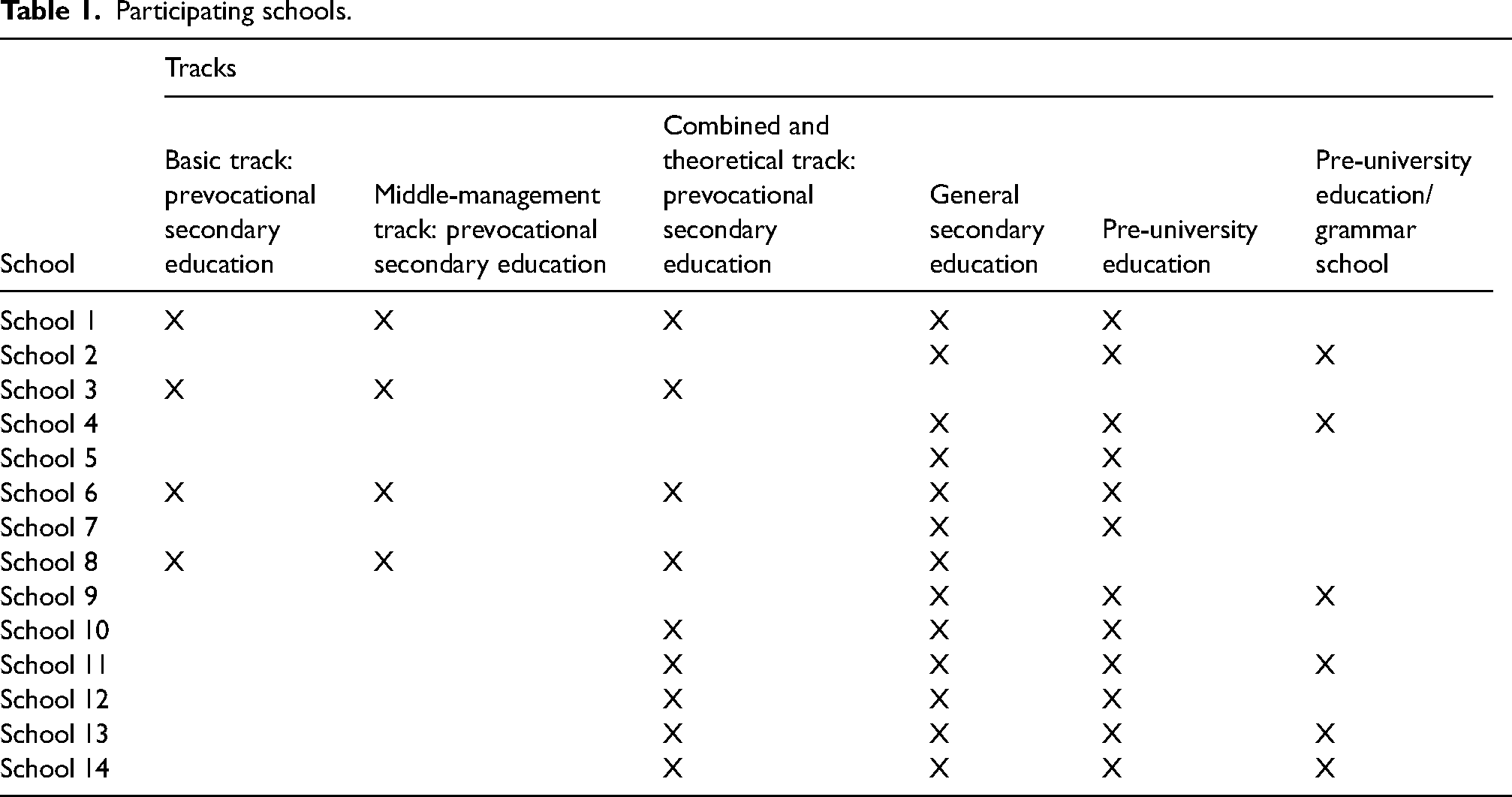
Semi-structured interviews were held with 38 tutors, 29 counselors, a teaching assistant, an educational developer, and a student affairs coordinator from 14 Dutch secondary schools (Table 1). In most schools, all counselors and one tutor in every track participated. In schools 1 and 3, the basic and middle-management tracks were combined into a single track, so there was only one tutor for these tracks. The four dilemmas constructed for the third research question were only presented to the participants if sufficient time was available during the interview. Given time constraints, 45, 41, 46, and 23 participants, respectively, responded to the first, second, third, and fourth dilemmas. The interviewer encouraged the participants to elaborate on their answers. This study was part of the Flow-VO research project (2017–2022) that examines school trajectories and profile choices in Dutch secondary schools. The project was approved by the ethics committee of the Department of Pedagogical and Educational Sciences, University of Groningen.
Participating schools.
Procedure
We collected data between January 2019 and September 2020. All participants signed a consent form and everyone except two also gave permission for audio recording.
The first two research questions were addressed during semi-structured interviews, which were tested by content experts. The participants were asked what they considered to be strong and weak arguments for making a study profile choice. The questions were open-ended to leave room for other factors than those following from the theories. For the third research question, participants were presented with four dilemmas that were partly derived from factors identified by Cuff (2017) and partly from the previously described theories, namely interests and enjoyableness (all theories), usefulness for students’ futures (mainly Savickas, 2013, and the SCCT, (Lent et al., 1994)), and abilities or subject difficulty (all theories but mainly Holland, 1959, and Super, 1990, in Hartung & Niles, 2004). Four dilemmas were presented as part of the interviews. The dilemmas were: (1) Should students choose a profile that they like or one that fits with their academic performance? (2) Is it necessary for students to try to reach their full potential? (3) Would the participants advise students to take some risks, such as choosing a study profile that does not fit with their academic performance? (4) What advice would they give students in cases of low grades or negative teacher advices on subjects that students would like to choose?
Analysis
The interviews were transcribed verbatim, coded in Atlas.Ti, and analyzed using thematic analysis identified by Braun and Clarke (2006), although it was an iterative and reflective process (Nowell et al., 2017). After familiarizing ourselves with the data (phase 1), to answer research questions 1 and 2, codes were created for the factors mentioned as important by the participants (rather than the actual basis for students’ choices), such as interests, money, or usefulness for society (phases 2 and 3). We created an overview of all quotes assigned to the relevant codes per participant. From this, we deduced the most important factors for every participant, ranked by the importance that they placed upon them. As most participants considered all three factors important, the content of the quotes determined whether the factors were coded as being equally important or whether they were ranked. The summaries of factors per participant were categorized into six types of views in which one, two, or all of the above-mentioned factors were regarded the most important (phases 4 and 5). The four dilemmas were assigned their own codes. For example, regarding the first forced-choice situation (whether students should choose a study profile that they liked or one that fitted with their academic performance), important codes were “liking” and “performance.”
Results
Research question 1
The first research question focused on factors that counselors and tutors considered important for use by students in choosing their study profiles. Three factors were considered the most important: students’ interests and the enjoyableness of subjects, students’ abilities, and future-oriented factors. The prioritization of these factors did not imply that other factors were considered unimportant. However, all participants specified that one, two, or all of these aspects were the most important, as discussed below.
Research question 2
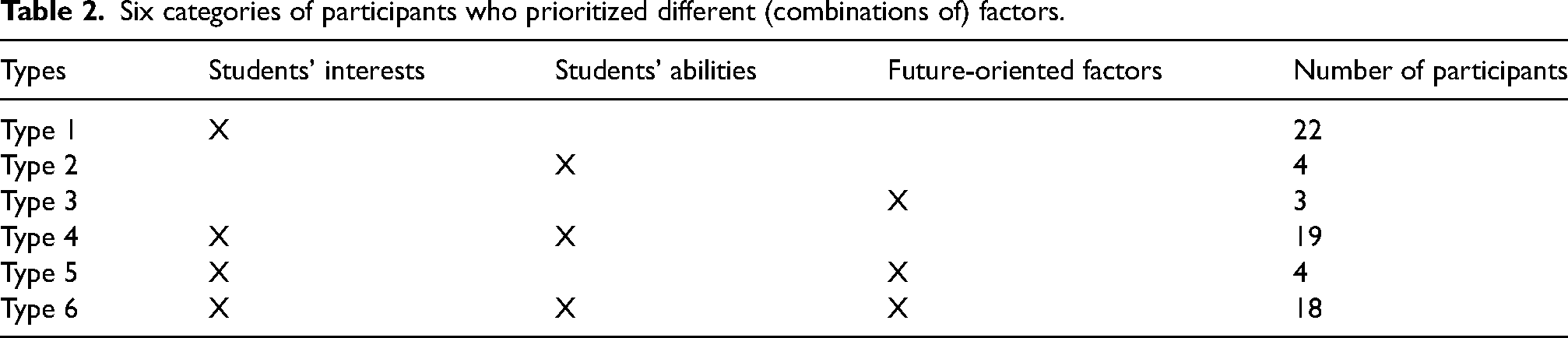
We identified six types of views in which one, two, or all of the above-mentioned factors were regarded the most important by the participants (Table 2). The first category viewed students’ interests as the key factor, whereas those in the second category viewed students’ abilities as critical. Future-oriented factors, a combination of students’ interests and abilities, and a combination of students’ interests and future-oriented choices were prioritized by participants in the third, fourth, and fifth categories, respectively. Those in the sixth type choose all the above factors. These categories are discussed in more detail below.
Six categories of participants who prioritized different (combinations of) factors.
Type 1: Students’ interests are the most important factor
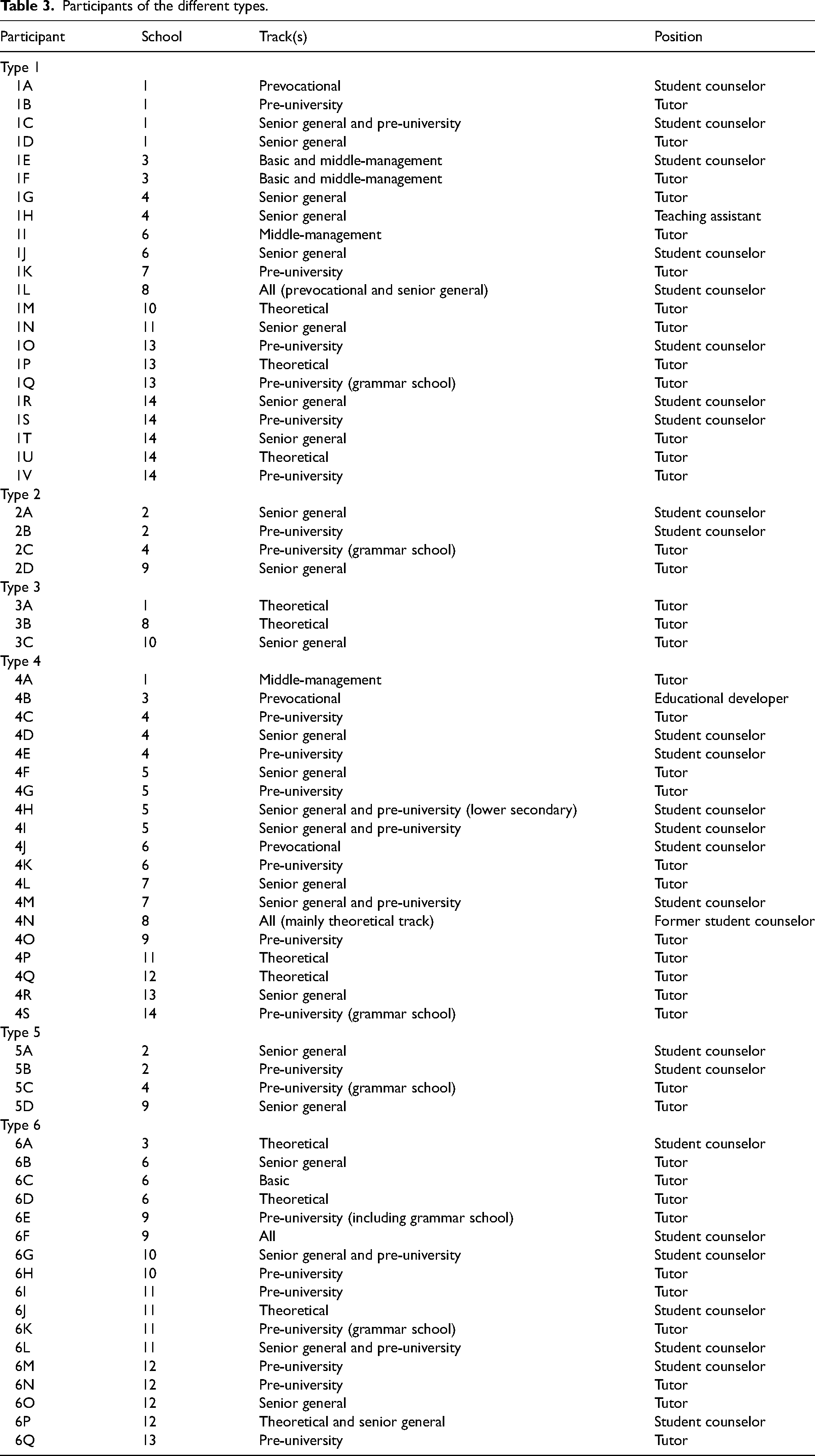
A total of 22 participants identified students’ interests as the most important factor when choosing a study profile (Table 3). Participants with this view comprised a teaching assistant, eight counselors, and 13 tutors, of whom seven were in the prevocational and senior general tracks and six were in the pre-university track. One participant was the counselor for both the senior general and the pre-university tracks, and one worked across all tracks.
Participants of the different types.
Eight participants emphasized that a profile should first of all be enjoyable, and seven felt that students should follow their intuition. A further seven combined several considerations and could not be clearly categorized in any one group. None of the type 1 participants viewed students’ interests as the only important factor. Most also considered students’ abilities, qualities, or the probability that they would succeed as well as future career ambitions as relevant. Views on keeping options open differed. While 1A supported this approach, 1G only recommended keeping options open if this made students happy, and five favored this approach if students did not know what they wanted. Four participants disagreed with keeping options open. Participant 1C stated: “And then I have a school hall filled with parents and students, and I say: ‘choose what you like, don’t choose for tactical reasons.” According to 1N, keeping options open does not apply to prevocational students, as there are hardly any entry requirements for vocational education.
Four type 1 participants held that students should not consider employment because the labor market as well as students’ interests will inevitably change. However, 1D did advise students to choose TECH if they were equally interested in all profiles.
Six participants mentioned choices based on friends as weak arguments. Five felt that students should not choose subjects according to the desires of their parents or families or according to their preferences for particular teachers. Another weak factor identified was future financial prosperity (n = 3).
Type 2: Students’ abilities are the most important factor
Participants holding the second type of view considered students’ abilities as the most significant factor. This group comprised two counselors and two tutors (Table 3).
Participant 2D explained: In the end, the most basic considerations are students’ achievements; their grades, their capabilities. That, whether you like it or not, serves as a starting point.” Three participants noted that students’ interests and career ambitions have to be considered as well. Whereas Participants 2A and 2B recommended keeping options open (ECON with biology and language), 2C disagreed:
There are a number of students who can do that easily. However, there are always students about whom you think: ‘I would specialize in that field and then not do economics.’ But they too want all options (…) You can only recommend not to do that, but it is their choice. In the end you do not talk them out of it that quickly.
Type 3: Future-oriented factors are the most important
For the third type of view, future-oriented factors were central (Table 3). This was the most important factor according to three tutors, as illustrated by 3C: “Often, students say ‘I do not like this subject, but I want to become this.’ And then you think, ‘yes, you will need it, then you have to put fun aside.’” All three felt that having an enjoyable job is essential, although entry requirements and abilities or grades are also relevant.
Type 4: Students’ interests and abilities are equally important
Most participants considered several factors to be equally important. Nineteen regarded both students’ interests and abilities as being equally important (Table 3). Seven counselors, 11 tutors, and one educational developer generally combined students’ intuition about subjects, or subjects they enjoyed or found interesting, with students’ grades, capabilities, the likelihood of obtaining a diploma, or teachers’ recommendations. Participant 4H stated: “It is something you want and something you should be able to do. Both must be right.”
Some participants with a type 4 view also raised other factors. For example, they felt that students could also take the labor market into account (4A and 4B). However, others disagreed, either because they felt that the labor market was going to change anyway (4D) or because if students enjoyed a particular job, they would always find work (4S). Participant 4R took account of the labor market, advising students to consider subjects that may help combat a shortage of occupations. Future career ambitions were mentioned as a less important consideration by seven participants because, as 4J pointed out, most vocational tertiary studies do not have entry requirements.
One participant (4C) did not recommend keeping options open because students could not choose all post-secondary studies anyway. Moreover, 4H mentioned that for most students, this option would induce stress because of greater workloads. Participant 4I observed that students should keep most options open (TECH with economy) only if they had a talent for the subjects. Participant 4L recommended keeping options open if students did not know what to choose. The participants considered some arguments to be weak, such as choosing it for future financial prosperity, to please parents or be with classmates.
Type 5: Students’ interests and future-oriented factors are equally important
The fifth category advocated students’ interests and future-oriented reasons (Table 3). Three counselors and a theoretical track coordinator of student affairs stated that they could not decide between subjects that students found interesting and future education or jobs: “You should enjoy school. You have to think about which subjects you like. And if I like these subjects, what could I do with them later?” (5B).
Type 6: Students’ interests, abilities and future-oriented factors are equally important
Lastly, eight counselors and 10 tutors felt that the above three considerations were equally important (Table 3). Other factors to be considered were students’ hobbies (6C), their inner drive (6P), or the kinds of person students are: a “people person” could choose a society profile (6I and 6J), and a creative person could choose CULT (6N). Participant 6F asked students: “What were the first things you used to play with at home? Was it a cash register or technical Lego, for example?”
Two participants recommended keeping options open for tertiary education (ECON and biology). A tutor (6E) of students in both pre-university tracks at school 9 did not recommend CULT for students who did not know what kind of post-secondary education they wanted to pursue. Participant 6E proposed a science study profile with economy to keep options open for students who were undecided or capable. Two recommended keeping options open only when students were undecided, and another recommended this only for students interested in a broad study profile (both HEAL and TECH). Three participants preferred a selection of enjoyable subjects to keeping options open.
Whereas Participant 6R was not in favor of keeping the senior general track option open for prevocational students, Participant 6G was not disinclined to keep the pre-university track option open for senior general students. Note that in the Netherlands, students can transfer from prevocational to senior general education or from the senior general to the pre-university track during and after secondary education.
According to participants with a type 6 view, weak reasons were future monetary prosperity (n = 3), choosing subjects taught by popular teachers, to be with friends (n = 2), because parents favored these choices (n = 5), or choosing CULT because that would save time for a side job (6E). Other reasons considered weak were negative choices, and choosing a science profile just because it is challenging (6K).
Research question 3
Lastly, counselors and tutors were presented with four dilemmas to elicit their views on factors they thought that students should consider in a forced-choice situation.
Dilemma 1
A total of 45 participants responded to the dilemma on whether students should choose a study profile that they liked or one that fitted with their academic performance. These factors usually went hand in hand according to 26 participants. When they were asked to choose, 24 counselors and tutors said they supported profiles that students enjoyed. “Because then the rest will come naturally.” (1P). Responding to the question of whether this approach would be effective if students worked hard enough, Participant 1F explained:
Yes, in my experience, I always say that there is only one reason to choose something and that is because you like it (…) Of course, that is not entirely true, I say afterwards. But the top reason to choose [an option] is that you like something.
Four participants emphasized good grades over enjoyableness. When asked if they did not match, participant 4H clarified: “(…) The most important thing is obtaining a diploma. And uh you can choose what you want, but if you do not get a diploma anymore, that is why you go to school.” The following excerpt from an interview elucidates this view:
Yes. But suppose a student is good at one thing, and another thing is close to his or her heart.
Then you should not do it.
No?
No. I do not think so. Well, then you have to look [at things] very practically; I am better at that subject; that suits me better, and I will maybe love it later.
Fourteen participants reported that they were unable to choose or that their advice would depend on the situation. For example, Participant 1M stated: “It is not my choice. Ultimately, they have to do what they want and what they think is right. So yes (…) I try to be neutral about that, but I do ask the question to make them think.”
Whereas Participant 4I advised students to take some time to think about their decisions and to discuss them with their parents, Participant 6L advised students to base this decision on the usefulness of the study profile choice for their future careers. Participant 6I advised students to take subjects they enjoyed as elective courses.
Dilemma 2
Seven out of 41 counselors and tutors were in complete agreement that students should try to reach their full potential. Participant 1P stated: “You are going to get the most out of it,” further noting: “I also try that with students. (…) I think, it is more [often] the path of least resistance that they choose. I regret that.”
Participant 1N provided the following explanation: When I see that someone is very good at physics and chemistry, if that is what you mean. [The interviewer affirms this point]. With the example of the girl I just gave, yes, I would have loved to have seen her continue in that, but well, she chose something else, and that is her choice and she stands by that, and I think, I respect that too.
Conversely, some participants explicitly stated that they did not feel that students had to reach their full potential. This view, which was held by Participants 3F and 2D, was related to study profile choices or subjects. However, nine participants linked their responses to school tracks or levels. They stated that they would rather have students select a track that could be combined with hobbies or time off than select the highest possible track. Participant 4R provided the following clarification:
No, I think that is unhealthy (…) No. Why? Seventy percent is more than enough. (…) Yes, because you have to keep your energy supply good (…) In all those happiness books, it is recommended to uh… yes… stress, burnout, it makes no sense, at this age. I do not think we should do that to children. It is better to live a balanced life than to always want to be at the top.
Most participants emphasized that there has to be a balance between students trying to do their best and enjoying what they do (n = 23). If you then say, of course, we want to get the best out of it. But yes, they sometimes have other plans of their own. (…) You also have to be able to be a teenager. Also important. (…) they may also color outside the lines sometimes. (6R) I think it varies from student to student. One is really like ‘yes, I really want that,’ and the other says, ‘well, you know, if I pass my exams, I think it is all fine.’ And I think that in itself, it is a good thing, that you have different students in it. (3C)
Dilemma 3
A total of 46 participants responded to the question of whether they would advise students to take some amount of risk in their choices, for instance by choosing study profiles that did not fit with their academic performance. Seven answered that students should not take risks. For example, Participant 4H stated: “I advise them not to choose unsafe[ly] (…) Because a diploma is the most important thing.” Participant 4S explained: “No, because then they will find themselves in 10th grade (…) And then they have to take another study profile and then they fall behind. That seems to me… no, I am not in favor of that.”
Eleven participants reported that they would recommend that students take risks, without mentioning that this should be a well-founded decision. 1V explained: “I believe that children have the right to make their own mistakes. (…) And education is not an efficiency process or an efficiency battle, no matter how much the minister wants it to be [this].”
Whether or not they felt that students should take risks, most counselors and tutors applied the same reasoning, namely that risks should be well thought-out. Three participants mentioned safety as the key issue. Participant 1N: “[T]hey have to take into account in their choice [the question] ‘are you confident that you will get your diploma?’ (…) and then you can take some risk. As long as you are aware of what you, what that means.”
Fourteen emphasized that students may choose a profile that does not fit their academic abilities as long as they are willing to take the risk or make a plan to make it work. Look, if you want to take a risk because you want something that is worth that risk, so to speak (…) then I think, I actually think you can take that risk. (…) And then I sometimes say, ‘Well, listen, maybe you can choose that subject with it, just to be sure. You can always throw out that risk subject if it does not go so well.’ (1T) As a school, we had always been known for giving children opportunities. Well, we are also punished a bit for that, uh, by the Inspectorate that still, uh [focuses on] the students’ progress and how is the, the, how many children pass, what percentages have dropped out. (…) Where we used to say, well, let him try, now from [the perspective of the] school management, it is faster to say, well, just choose the safe route. (…) And then offering opportunities is nice, but it has to be realistic. Participant 6P further noted: “Of course a student is allowed to take a risk, but uh … I would also consider myself a very bad counselor if I did not ask a student and his parents for a meeting to point out the risks.”
Other participants stated that students should not think about risks, mainly because they should just choose what they enjoy most (n = 6). Others specified that risk taking depends on the type of student and the context (n = 5).
Dilemma 4
Finally, 23 participants were asked what they would advise students to do in case of low grades or negative teacher advices on subjects they want to choose. Most participants were on the same page, though with different nuances. Ten could accept students choosing these subjects, as long as they could justify why and were willing to try their best. Participant 4B: “I say, ‘it is advice. You can put that aside and… I am fine with you proving me wrong.’”
Seven tutors and counselors said they would advise students not to choose subjects if their grades were insufficient or if their teachers’ advice was negative. Not that you can do anything with it, but … you try to minimize that. Also, because it is not nice for a student to get low grades whereas they feel they are doing their best. There is nothing more demotivating than that. (1S)
Participant 6C: “You do not have to be super good in all subjects, but you have to. … You do have to make those children aware that they will eventually have to get a pre-university, senior general, or whatever diploma.”
The opinions of six others were in between those of the others. For example, for Participants 4L and 6M advice would depend on why the grades are insufficient.
Similarities and differences: Tutors and counselors, tracks, and schools
We compared the views of the tutors and school counselors associated with the different tracks and schools (research questions 1, 2, and 3). For the first type, there were more tutors (n = 13) than counselors (n = 8), and they were evenly spread over the tracks. In the second type, there were two counselors and two tutors. One counselor and one tutor worked in the senior general track, and the other two in the pre-university track. Participants of the third type of view comprised a tutor and former counselor in the theoretical track and a tutor in the senior general track.
The fourth type comprised 11 tutors, seven counselors, and an educational developer (n = 19). Five were in the prevocational tracks, four in the senior general track, three in both the senior and pre-university tracks, and six in the pre-university track. The fifth type comprised a student affairs coordinator in the theoretical track and three counselors (two in the theoretical track and one in the senior general track). Participants with type 6 views (10 tutors and eight counselors) considered all three factors to be equally important. Five worked in the prevocational track, 11 in the senior general and/or pre-university, one in the theoretical and senior general tracks, and one at all levels. Thus, there did not seem to be a relationship between the results and the position of the participants.
Furthermore, there did not seem to be a high level of congruence within the schools. Both participants at school 2 belonged to type 2, and participants in school 5 were all type 4, but the results for the other schools were distributed across several categories.
Moreover, most of the responses in the interviews and to the dilemmas seemed to be aligned with each other. For example, many participants attached great importance to students balancing trying their best and taking risks on the one hand, and pursing their interests and pleasure on the other hand.
Discussion and conclusion
We investigated which factors secondary school students should take into account when making their study profile choices according to counselors and tutors. In line with existing theories and the findings of previous research, we identified students’ interests and the enjoyableness of subjects as important factors. Other important factors that we identified were students’ abilities or academic performances and future-oriented factors.
We categorized the views of the participants into six types according to their recommendations of different combinations of factors. For the first and largest group (n = 22), students’ interests were the most important factor. Interests are foregrounded in all four theories discussed earlier in this paper, and are central in Hollands’ Interests Inventories. In Super's career stages, as well as the SCCT, there is a focus on the development of interests. Life-design counselors do not ordinarily use interest inventories. However, they assess clients’ or students’ interests that manifest themselves in magazines, tv shows, or websites, in order to suggest work settings and attractive occupations (Savickas, 2015). Participants of the second type (n = 4) considered students’ abilities as the most important factor. Abilities are also discussed in the above-discussed theories. For example, according to the SCCT, which draws on Bandura's self-efficacy theory, people's beliefs about their abilities play a central role in the career decision-making process: people move toward occupations requiring capabilities they think they either have or can develop, and move away if they think they do not possess or cannot develop required capacities (Niles & Hartung, 2004). Given their prioritization of future-oriented choices, the third category of participants (n = 3) were most closely aligned with Savickas’ career construction theory and the SCCT. The fourth type of views (n = 19), in which participants emphasized interests and abilities equally, were closely aligned with Super's theory, which foregrounds interests, abilities, and values. In the fifth type of views (n = 4), participants regarded students’ interests and future-oriented choices as being equally important; a combination that was not emphasized in any of the theories. Type 6 views (n = 18), whose participants viewed all three factors as being equally important, were most closely aligned with career construction theory, which stresses concern for the future, possibilities, and life themes. No participants viewed abilities and future-oriented choices as being equally important. Thus, although the participants did not mention the theories directly, their perspectives resonated with the theories.
Although it would be reasonable to assume that individuals operating in the same school policy and cultural contexts would share similar viewpoints, a high level of congruence within the schools was not apparent. Future research could explore the degree of congruence in viewpoints and the extent to which they are related to local school policies.
Finally, counselors and tutors were presented with four dilemmas, all of which were to a certain extent related to a choice between subjects that students enjoy or those that fit with their abilities. Similar to the findings of Hingstman and colleagues (2021), who investigated support provided to struggling readers at American and Dutch schools, we found that Dutch participants did not want students to feel overly pressurized, which could be a characteristically Dutch phenomenon.
A direct relation between factors perceived as important and school policy was not apparent for most schools (Table 3). Also, similar to Everitt and colleagues (2008), participants did not refer to theories or research, which is remarkable because many participants reported well-founded choices to be essential. We suggest that educational professionals study and discuss the content of study profile guidance more, for example, within professional learning communities of counselors and tutors. After all, a dialogue between managers and teachers, as well as among teachers, appears to be essential for changes in the learning environment (Draaisma et al., 2018). It is important for students to receive career guidance from tutors and counselors that is based on common grounds and less on subjective viewpoints. This recommendation is supported by the findings of previous meta-analyses that students in cohesive schools achieve better results than students in schools where this cohesiveness in values is absent (Scheerens, 2015). Moreover, well-grounded career guidance may be particularly important for certain groups of students, such as those whose parents have lower education levels, as they may be less familiar with post-secondary education opportunities. Dutch students whose parents’ education levels are lower are less likely to choose science and mathematics than students with better-educated parents (Van Langen et al., 2006), underscoring the importance of suitable career guidance provided by the schools.
Many participants regarded students’ interests as decisive and attached less importance to abilities and future-oriented choices. However, entry requirements and employment may also be critical factors, given that qualifications, socialization, and subjectification have been described as the core functions of education (e.g. Biesta, 2020; Onderwijsraad, 2016). In other words, education also serves society's needs. Furthermore, human capital theory posits that education increases individuals’ productivity, which promotes societal and economic growth (e.g. Becker, 1975). Thus, greater attention to other factors would likely benefit both students and society.
To the best of our knowledge, this is the first study to investigate factors considered important by counselors and tutors for students choosing their profiles. Although its rich data and relatively large sample revealed interesting results, the study had some limitations. Whereas we know which factors were perceived to be important, we do not know the extent to which they were perceived as important. Moreover, lack of references to specific factors by participants did not necessarily mean that that they did not regard them as important. For these reasons, we suggest that future studies include more quantitative measures to cross-validate our findings. We also recommend observational studies to examine how professionals act in relation to real cases. We further recommend investigating how students perceive study profile advice and its (perceived) impacts on their study profile choices. In light of our finding that the participants seemed to lack familiarity with relevant theories and research findings or did not explicitly apply them, we recommend further investigations on their use. Such studies could help to uncover the origins of the counselors’ and tutors’ viewpoints.
To conclude, counselors and tutors report that students’ interests and the enjoyableness of subjects, their abilities or academic performances, and future-oriented factors should inform study profile choices (research question 1). To answer research question 2, we identified six types of views in which one or several factors were perceived the most important factors: students’ interests (n = 22), students’ abilities (n = 4), future-oriented choices (n = 3), interests and abilities (n = 19), interests and future-oriented choices (n = 4), and a combination of these three factors (n = 18). Responses to the forced-choice situations largely confirmed different perspectives on the importance of the factors: the majority of participants perceived students’ interests very important (research question 3).
Footnotes
Declaration of conflicting interests
The authors declared no potential conflicts of interest with respect to the research, authorship, and/or publication of this article.
Funding
The authors disclosed receipt of the following financial support for the research, authorship, and/or publication of this article: This work was supported by the Netherlands Initiative for Education Research (Grant number 405.17.303.2926).
