



Abstract
Accessing high-quality career development to support successful transitions into post-compulsory education and employment can be a challenge for newly arrived students of refugee and migrant backgrounds. In Australia, not-for-profit organisations provide career guidance to students within schools that enrol refugee and migrant families. Through programs, not-for-profit organisations can provide mentoring, support and other career services. This research explores the marketing materials of organisation-provided career guidance programs based in Australian secondary schools. A close textual reading of how the programs engage with the discipline and practices of career guidance reveal a deficit framing of students and their families, with limited focus on promoting agency across programs. In light of the increasing resettlement of refugees and migrants in Australia, these findings highlight a need to balance social justice principles with greater engagement with the discipline of career education when enacting career interventions with vulnerable groups.
Introduction
Since World War II, over 800,000 refugees have migrated and settled in Australia (Phillips, 2017). Settlement programs play a key role for children and families of refugee and new migrant backgrounds as part of Australia's broader migration program. This research understands the notion of ‘migrant’ to apply to people born overseas who reside in Australia (Australian Bureau of Statistics, 2012). Australia has two distinct programs for settlement related to the conditions under which they move to Australia. The first program for voluntary migrants is the Migration Program for skilled migrants and their families. The second program is the Humanitarian Program for forced migrants, such as refugees and those seeking asylum. Phillips (2017, p. 1) defines refugees as ‘a person outside their country of nationality […] and owing to a “well-founded fear of persecution”, is unable or unwilling to return to their home country’ and asylum seekers as ‘people seeking international protection but whose claims for refugee status have not yet been determined’.
Although Australia's Immigration Restriction Act 1901 (i.e. White Australia policy) is no longer in place, Australia's intake of migrants is stable. Since 2010, 13,750 people from overseas can relocate and settle in Australia each year via the two programs, but quotas are set each year by the Australian Government. Yearly quotas vary depending on global events or conflicts that can increase the demand for the settlement of individuals, children and families. For example, in 2012, the quota increased to 20,000 following the war in Syria (Phillips, 2017). In 2022, the withdrawal of United States troops and allies from Afghanistan has led to the exodus of civilians and families, and as a result, 3000 places are allocated within the total Australian quota of humanitarian visas for displaced Afghans (Lowry, 2021). The OECD's analysis of 26 countries found that Australia ranked ninth for the number of permanent migration visas granted and (not including the disruptions caused by the COVID-19 pandemic) the numbers are relatively stable, which is similar to the other top nine countries (OECD, 2023).
It is unclear how many children and young people are settled in Australia, but it is reported that 1636 children are currently on bridging visas and 176 children are waiting for their residence to be determined in Australia (Refugee Council of Australia, 2022). Children who settle in Australia as refugees or asylum seekers can access public schools free of charge, although specific policies relating to access and support vary between each state and territory (Refugee Council, 2023); however, there are major differences in university support between refugees and asylum seekers. Refugees with permanent humanitarian visas can receive help from the Commonwealth to pay for university fees (Department of Education, 2023), but asylum seekers on temporary visas, such as some bridging visas, are considered as international students, requiring them to pay full fees for vocational and university courses (Refugee Council, 2023). These financial barriers to tertiary education may have a strong influence on the settlement experiences and career aspirations of people of asylum seeker status.
Alongside the trauma of involuntarily leaving their homes, children and youth also experience major disruptions to their education and schooling during the migration process. Career guidance during schooling is crucial for students and families of refugee and migrant backgrounds (Abkhezr et al., 2015) who face complex cultural, linguistic and psychological challenges, making navigating educational systems more difficult compared to domestic students (Naidoo et al., 2015). For example, students from refugee backgrounds do not view the ‘cold’ (unfamiliar-formal) institutional support on offer as ‘for them’; instead, they can prefer the ‘warm’ (familiar-informal) support offered via ‘trusted’ people who act as literacy / sociocultural brokers or ‘hot’ (familiar-informal) support of their grapevine of other students (past and present) or experienced community members (Baker et al., 2018).
Not-for-profit organisations have been helping refugees and migrants settle and integrate in Australian society for decades and the voluntary provision of career guidance and employment services has been a part of Australian culture since White settlement (Patton, 2019). We define organisation-provided career programs as a particular form of career guidance that is delivered via not-for-profit organisations, and we focus on those that are delivered in school settings for this research. The purpose of this research is to analyse a suite of programs run by not-for-profit organisations, focusing on how they describe their practice of facilitating transitions to higher education or work for people of refugee and migrant backgrounds, analysing what the programs purport to do against theoretical underpinnings of career guidance.
The central questions guiding this research are: Do organisations providing career support programs for refugees and new migrant young people engage with career guidance practices? And if so, how do they describe their engagement in public marketing materials, such as organisation websites? We are interested in how organisation-provided career support programs frame the role of culture, families, social networks of students and families from refugee and migrant backgrounds and the extent to which they promote social justice and student agency, or self-helpfulness (Peavy, 1992).
Drawing on O’Brien (2001), we define social justice in this research as ‘actions that contribute to the advancement of society and advocate for equal access to resources for the marginalised or less fortunate individuals in society’ (p. 66). As such, the work is motivated by the concern that social justice principles alone should not drive the implementation of career practices for students of refugees or new migrant backgrounds. We acknowledge that many organisation-provided career programs have well-intended purposes; however, we argue that efforts seeking to advance the careers of students from refugee and migrant backgrounds should be underpinned by evidence and should relate to the discipline of career guidance practice.
Context
In Australia, career guidance has traditionally been provided for students in schools, technical colleges and universities (Patton, 2019). Despite this, an international review of career guidance in several countries including Australia (OECD, 2004) revealed limited professionalisation in the field. Since that time, the discipline of career guidance has advanced and professionalised by agreeing to and implementing several foundational practice documents: the Australian Blueprint for Career Development (2010) (the Blueprint) and the development and implementation of Professional Standards for Australian Career Development Practitioners (Career Industry Council of Australia, 2006, 2019).
The Blueprint identifies foundational career development competencies required by people of all ages and can support career guidance practice and the Professional Standards (CICA, 2019) provide ethical guidelines for, and guide the training of career development practitioners (McMahon, 2014). Both these documents are used by professional career practitioners who often have graduate-level qualifications (CICA, 2021), but they are not necessarily applicable to career education programs run outside of school-based delivery. However, the principles (otherwise known as elements) enshrined in the Australian Blueprint for Career Development (2010) are suitable for the delivery of best practice in all programs of career development including outside of schools.
Not-for-profit organisations deliver career guidance in schools, aiming to lift students’ education and employment transition outcomes. While there is some Australian research that evaluates the effectiveness of individual career guidance programs (Block et al., 2014; Broadbent et al., 2012), it is unclear the extent to which career programs align themselves with career guidance principles and practice. What remains largely unexplored is a critical examination of organisation-provided career programs in light of prevailing understandings of career guidance practices in Australia, as enshrined in the Australian Blueprint for Career Development (CICA, 2019). Inspired by a Bourdieusian theoretical framework, our research aims to address this empirical gap.
‘Best practice’ in career guidance
The broad aim of career guidance is to develop effective career management skills and knowledge (McMahon et al., 2003). Keele et al. (2020) argue that the ‘perfect model of delivery or theoretical framework is untenable’ (p. 54) but highlight the benefits in identifying attributes of exemplary practice. Inspired by the work of Whiston et al. (2017), Healy (2017) synthesised some key practices that he argues can be used to inform a model of best practice in the provision of career guidance.
Healy (2017) outlined that repeated interventions carried out by career experts can often be more effective than single interventions or instances of career guidance (Brown & Ryan Krane, 2000; Whiston et al., 2017). Despite this, career guidance does not necessarily need to be delivered one-on-one, as group interventions can also be effective (Brown & Ryan Krane, 2000; Whiston et al., 2003). The nature of group interventions is important, with structured group interventions and workshops identified as more effective than unstructured group interventions, such as group counselling (Whiston et al., 2003). In terms of career activities, interventions that include written exercises, individualised feedback, labour market information, modelling from experts, and support from social networks (Brown & Ryan Krane, 2000). Saliently, career guidance should be targeted to the needs of client groups and where possible, incorporate values clarification that explicate students’ priorities (Hughes et al., 2016).
These practices inform our reading of organisational provision of career guidance for refugees and new migrants; there is little that analyses practices of offering career guidance in school for these populations; however, in the next section, we review extant research for supporting the career development of refugees and new migrants.
The experiences of students from refugee and migrant backgrounds
The experience of navigating admissions processes and enrolling into higher education institutions is marked by unique challenges for students and families of refugee and migrant backgrounds. These challenges can include language difficulties, knowledge on where to find and access relevant information and available supports. For example, de Giola (2017) conducted focus groups with 24 Afghan, Pakistani and Sudanese mothers of primary school students. The participants reported struggling with their own language development and that transitioning their children into secondary school was difficult. Obtaining information about how to begin the schooling process was reported by the research participants as particularly difficult. While schools made some efforts to attend to their needs, Giola (2017) argued that schools often expected refugee families to ‘fit into’ the dominant culture. The experience of enrolling into schools was evidently marked by a sense of disconnection and non-belonging to the new school environment.
The experience of schooling for refugee and migrant students is often marked by contradictions between home and school. For instance, many refugee-background students are expected by their parents to be high educational achievers, in contrast to school cultures characterised by low expectations (Naidoo et al., 2017; Roy & Roxas, 2011). Newly arrived migrant students can see themselves as university-bound, but can encounter school policies and practices which conjure ideas that they are not ‘college material’ (Vang, 2005). Schools can also struggle to integrate and educate students from refugee backgrounds. For instance, Naidoo et al.'s (2015) research on young people from refugee and new migrant backgrounds in New South Wales and the Australian Capital Territory highlight that forced migration, interrupted schooling and significant differences in teaching pedagogy were often reported as barriers to educational achievement. Saliently, the students interviewed reported high aspirations for educational attainment and a strong desire to succeed academically.
From the perspective of schools and their staff, a qualitative study of 10 public schools in the Australian state of New South Wales found that schools are grappling to meet some challenges associated with the increase of enrolments of students from refugee backgrounds (Watkins et al., 2019). In particular, some schools can struggle to deal with issues associated with: teacher workload, professional learning, funding issues, interagency coordination and community liaison. Students often struggled to transition from Intensive English Centres into mainstream schools. In terms of teaching staff, there were also specific sets of individual and school-level challenges. Individual teachers reported that they provided extra support to students and families, but with ‘uneven levels of understanding’ of the nature of refugee students’ experiences (Watkins et al., 2019). While some work is developing at government level to address challenges to do with refugee settlement and schooling, these were not yet implemented across schools (Watkins et al., 2019).
Importantly, successful transitions to tertiary education were inextricably linked to positive interpersonal relationships with peers, teachers, support staff and the wider community. Longitudinal research carried out by King and Owens (2015) with 14 African refugee students, as well a range of school and support staff revealed six key influences that shape their successful education pathways: previous schooling; English language skills; school support; family support, academic achievement; and post-school preparation. These elements will act as focal points that help to frame our programmatic reading of organisation career program websites and materials.
Organisational provision of career guidance for refugees and migrants
In Australia, a range of not-for-profit organisations provide services within schools for refugees and migrants via career programs. The approach of these programs often involves facilitating mentoring, work experience and one-on-one guidance sessions, either with or without parents / guardians. Some of these programs have been evaluated, and some are grounded in international career traditions; however, there are few published studies of organisationally provided programs. For example, Dunwoodie et al. (2020) reflect on a program that draws on Savickas’ (1997) career adaptability theory, but which sits within the field of access and widening participation to higher education and has distinct program aims which are not solely career development related. Broadbent et al. (2012) evaluated a project conducted in 2009 in one secondary college in the western suburbs of Melbourne. The researchers identified that providing young people with the tools to search for information outside school was useful. This research indicates that young people from refugee and migrant backgrounds can demonstrate agency and make career decisions when they are provided with some career guidance within the context of the school, with support from their families.
Evaluations provide some insight into the successful strategies of organisation-provided career guidance programs; however, a literature search reveals no studies in the Australian context which critically examine such programs for refugees and migrants. Guided by a Bourdieusian theoretical framework, this research addresses the gap in the literature by applying a close reading of organisation-provided career programs for new migrant students and families to examine how the career programs engage with professional practice in Australia.
Conceptual framework
Bourdieu's concepts of ‘belonging’ help us to understand how the programs construct notions of culture, agency and social justice. Rather than position in students and families from new migrant backgrounds into deficit frames, our thinking about students, families, schools, culture, careers and belonging is guided by Bourdieu (1966; 1979). For Bourdieu, the ‘cultural capital’ or experiences, dispositions and knowledge of the student is mediated by teacher values, as well as by the values of the school. These values can be expressed in curriculum offerings, streams (or tracks) and subject hierarchies, as well as through schools’ and teachers’ expectations of their students. That is, cultural capital has ‘value’ relative to the fields, or ‘structured social space’ (Bourdieu (2011) in which they are located. This value is mediated by the ‘doxa’ of the field, or the Australian society more broadly, including the policies and practices associated with the settlement and support of refugees.
Cultural socialisation can lead to unconscious dispositions giving rise to an efficiency for success within a particular field, which shapes individuals’ habitus. Schools bestow certain demands on students and families through their practices, processes and values, and these mechanisms exercise power over individuals by including / excluding individuals those who bear / lack certain markers of ‘culture’ (Bourdieu, 1996). Hence, within the field of schooling and career development, there are those who ‘dominate’ such as teachers, leaders, organisations, careers practitioners and those who are ‘dominated’, such as students and their families born outside of Australia.
In contrast to this framing of power and belonging, is the notion of ‘cultural deficit’, which describes attitudes and stereotyping of people based on their background, culture or race. These attitudes play can out in forms of pedagogy, expectations and school practices, which can shape student outcomes within schools and education systems (Solorzano & Yosso, 2001). The role of teacher expectations and perceptions has recently been linked to socioeconomic (SES) background (Gore et al., 2004; Lingard, 2010) in a manner reminiscent of Bourdieu's contention that teacher perceptions of low SES students can impact negatively on their own expectations of their students’ ability to achieve (Polesel et al., 2017). In concert with other researchers such as Naidoo et al. (2015), as mentioned earlier, young people from refugee and migrant backgrounds can be inherently aspirational and a positive framing how these aspirations can be supported within school environments may help to improve career outcomes for young people and their families.
Furthermore, Ball and Bowe (1991) have examined the micro-politics of the individual school, with particular emphasis on the relationship between the school and the myriad of external policy pressures, often legitimised by global educational trends, which constrain its ability to act as an emancipatory agent. Nash (1990) has argued that Bourdieu allows us to ‘reconstruct a theory of family and recover the centrality of family resources to educational differentiation within a radical context which allays the fear of a retreat to cultural deficit theory’ (p. 446). This research posits that while individual agency is important, there are key structural barriers that cannot be overcome by individuals and this necessitates this program review.
Methods
The research question addressed through this investigation is: Do organisations providing career support programs for refugees and new migrant young people engage with career guidance practices? And if so, how do they describe their engagement in public marketing materials, such as organisation websites? The research question warranted a qualitative and reflective approach to explore whether organisations providing career support programs for refugees and new migrant young people engage with career guidance practices, and how they describe their engagement in public marketing materials.
Researchers wished to pay specific attention to the language choices and activate analytical tools to better understand the practices at work in these programs in Australia. We were not seeking more than a critical reading of the programs and were clear they were not evaluating any of the programs but instead looking at them of touchdowns of discursive practice. This explicitly un-judgemental stance facilitates a reading of marketing materials of these programs could open new understandings for practice.
As text-based documents were the focus of the enquiry, unobtrusive research methods were selected with a focus on documentary research (McCulloch, 2004). Information was found through marketing materials and annual reports and was sometimes scarce and so the reading of the programs are neither exhaustive nor definitive but are taken as artefacts of practice. McCulloch (2004) suggests that website listings are just as valid as printed documentation for analysis:
electronic communications revolution of our own time, while transformative in many respects, may well retain and incorporate key elements of the print culture that has developed and spread over the past five hundred years (p. 2).
As the research used purely public sources, and as the programs have been de-identified ethical approval was not required for this research.
In regard to research positionality, one author has assessed school career development programs and has, in previous roles, contributed to settlement career information materials for migrants. One author has familial first-hand experience of migration / refugee narratives and has experience in school transitions for students from ethnic migrants. However, the authors’ professional identities are not bound up in the delivery of any of the career programs in the research and, hence, do not influence the interpretation of the data or marketing materials.
Program selection
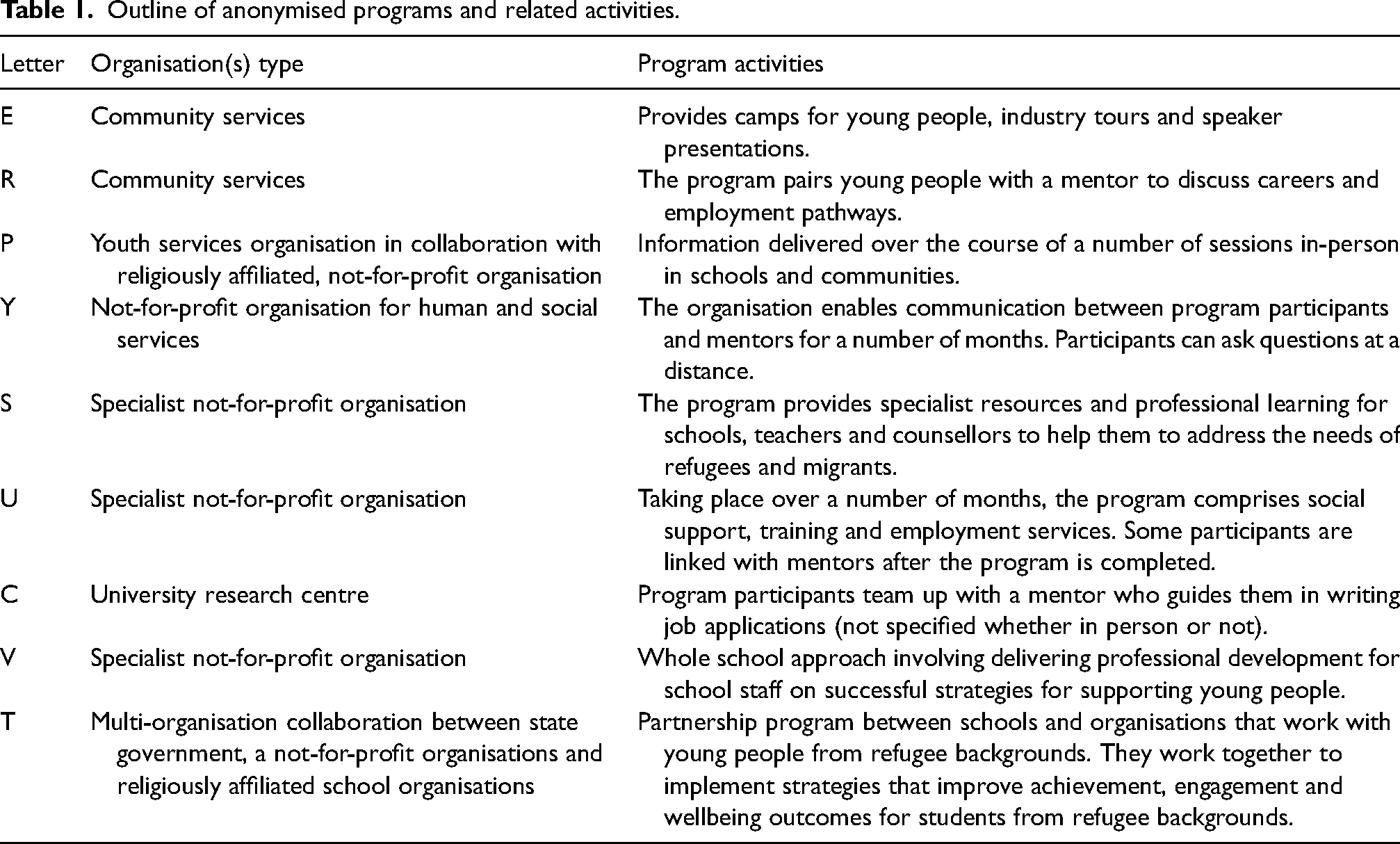
An internet search was conducted to find organisationally provided career programs currently operating to facilitate successful transitions for refugees and new migrants, working with schools, organisations and families. Combinations of key words were searched for such as ‘refugee programs’, ‘new migrants’, ‘organisations’, alongside ‘programs’, ‘schools’ and ‘careers’, ‘career guidance’ and ‘career education’. Programs were included which purported to have career guidance learning as part of the offer, this meant that some were excluded which just had mentoring elements or experiential learning (e.g. work placement orientated) without career education input sessions or visible learning outcomes. Programs were implemented within schools or with school-aged students and were run by not-for-profit or government-supported organisations. A total of nine programs were analysed for this research. The programs are referred to using one letter to maintain their anonymity. The following table provides a brief outline of the organisation type and the career activities that comprise the programs.
Analytical approach
In looking at these programs and thinking about the language they use we seek not to be ungenerous nor criticise trivial misuse of language. Instead by undertaking a ‘close reading’ (MacLure, 2003), we wished to understand more about how career development is presented in these kinds of programs as this contributes to the formation of public understanding about career guidance. We had no access to the curriculum materials of these programs so we cannot say how they delivered their content, nor do we know the outcomes. Nevertheless, there is benefit in the analysis of their presentation to the public by using their marketing materials as a text. This analysis technique has been used to seek and to better understand the purposes of educational offerings, and there is a strong body of literature which has used prospectuses to understand the missions of institutions (Morphew et al., 2018), purposes of education programs (Knight, 2020) and how institutions operate in the educational marketplace (Szekeres, 2010).
In our analysis, we pose several questions to tease out what the language used in the program marketing materials present about the career development basis for the courses. This is to probe and highlight how the use of language which invokes career guidance, and further to seek to understand whether these are shallow uses which do not purport to relate to deeper connections to career development practice. Attention to quality and depth of engagement with career development principles such as those in the Australian Blueprint for Career Development (2010) is important. Questions might also be asked about why these programs, which seem more akin to settlement and social services type programs than career guidance, seek to utilise career guidance language. Hypotheses about why this language is used include a question about whether it is for aspirational purposes, or whether the program managers think career development is more attractive to the intended audiences than settlement-based language.
Findings and analysis
Having located marketing materials of the above programs that were available through public sources, these were downloaded and archived in secure storage. Drawing on the intent of the research, the texts were seen as a corpus containing artefacts of practice in the national context of Australia, rather than individual representations of individual programs. In the first instance, all the programs were subjected to a close reading (MacLure, 2003) which enabled the researchers to share understandings of the language used, and the nomination and argumentation strategies that the researchers noticed. We developed an analytic framework for this work drawing on both language analysis techniques such as Reisigl and Wodak's (2009) discourse historical approach which enables us to dig into the framing of the language:
What are the program aims? Do these support programs interact with the discipline of career education and career guidance practices? How do they frame and position the role of culture, social networks and the agency of students and families from refugee and migrant backgrounds?
Do they refer to previous schooling; English language skills; school support; family support, academic achievement; and post-school preparation?
One researcher recorded data against each of these questions for each artefact in the corpus and the other researcher cross-checked them. Critical insights were then developed from these extracts against the research questions as suggested by an abbreviation of Reisigl and Wodak's (2009) discourse historical approach – as they advise is possible. Differences were resolved collaboratively and instances where this was not possible, the insights from our critical reader who mentored us in this work was obtained to reach the final decision.
Program aims
The program aims were predominantly consistent across programs and the purpose for the majority of the programs was to improve career outcomes for students of refugee and migrant backgrounds. Two programs mentioned building partnerships between organisations, schools and families. The approaches that the programs took to achieve this aim were varied. The first and most common was to team students up with organisational staff in a mentoring model approach. The timeframes for this approach were either specific, where students would work with organisations for a set number of weeks as part of a program of career support, or not referred to explicitly. The second involved working with schools, teachers, career staff, with or without parents to provide resources, support and professional development specifically targeted towards students of refugee and migrant backgrounds.
We analysed how the organisations described students and young people revealing that most programs described the students and young people in broad terms. Three of the nine programs described them as individuals from ‘refugee backgrounds’ and three programs referred directly to ‘refugee or migrants’. Two career programs described refugees as ‘survivors’ or particular events that took place in their home country and hence, provided some context under which they moved to Australia. Lastly, only one program was not directly targeted at students from refugee or migrant backgrounds, but supported ‘parents or carers, education providers and support workers’.
Earlier on in this paper, it was outlined that refugees and migrants can be on different visas, which influence the types of educational supports that they are eligible for. In practice, the programs may provide differentiated supports for the two groups, but we argue that the homogenised description of the two groups does not align with career guidance principles, which emphasises the importance of context.
Interactions between support programs and career guidance discipline and practice
The programmatic reading of the programs highlighted very little engagement with the careers discipline and the professional practice of careers guidance. Only two programs explicitly referred to any formal learning engagements or career education-related learning outcomes. Program Y for instance, referred to the ‘professionality’ of the career counsellors, describing the staff as ‘experienced’ and ‘professional’, but without evidencing any professional qualifications or standards for practice. There was no mention of any professional support for the careers staff and nor was there any little recognition of clientele need within the program presentations.
Instead, there was a focus on transition support and an overall sense of inclusive intentions and advocating for social justice outcomes for young people and their families. For example, career support language is used by Program C, but without making explicit any relevant professional frameworks underpinning the practices: ‘Transition support focused - we give them the tools to build their networks…’ Program C. How this transition support is enacted or the tools by which to develop students’ networks were not outlined.
Descriptions of student and family background, culture and networks
The notion of student or parental agency was largely missing in the descriptions of the programs. One exception was Program P, which has language that frames parental agency as information sharing / access not locating fault in individuals:
Program P aims to help provide up-to-date information about educational pathways that enables parents, carers, education providers and support workers to support young people effectively when they are making career transition decisions during the adolescent years and beyond.
Programme descriptions often framed student or family resources or capital in deficit terms. For instance, the programs where the framing of participants as unempowered individuals as opposed to focusing on structural disadvantage of need for warm connections in local labour markets: ‘The R program aims to empower young adults from refugee and migrant backgrounds to overcome barriers to accessing education’. Further, understanding the role of culture, social networks and the agency of students and families from refugee and migrant backgrounds was not recognised in program presentation of the clientele. One program stated that: ‘Intensive support is provided to assist the achievement of short and long-term aspirations through’ (Program R), but building upon existing high aspirations was not mentioned.
The reading of the programs highlights that family capital is erased from broader depictions of career support, and that students and their families are framed as ‘disadvantaged’ (Program Y) and needing guidance more generally. One program, Program U, offered contingent mentoring as a reward for completing the program, which arguably further decreases agency. The assumption of aspiration building arguably re-instils the sense of deficit of capital in refugees and their families relative to local students as Morley and Lugg (2009) explained when talking about British widening participation programs: understood as a technology of differentiation and stratification rather than a social justice intervention: Initiatives are perceived as a form of meritocratic equalization and/or as a reinforcement of social stratification processes. Those with social capital are often able to decode and access new educational opportunities. Those without it can remain untouched by initiatives to facilitate their entry into the privileges that higher education can offer (p.111).
In light of few connections to the theoretical elements of career support and practice, the deficit framing of refugees and migrants arguably contributes to a dis/empowering discourse rather than promoting social justice and agency, which devalues their experiences relative to domestic students (McWaters & Hawkins, 2018).
Discussion and conclusion
We have considered these not-for-profit organisations that undertake important work such as helping asylum seekers and refugees find homes and integrate into society; these organisations have moved now into providing career guidance programs for student and their families. This movement into career guidance appears logical, since not-for-profit organisations often help refugees and asylum seekers finding employment as part of settlement processes; however, for organisation-provided career programs for students of refugee backgrounds, the analysis highlights little to no overlap between the program aims / success criteria and career guidance principles.
We understand there are different domains of practice involved in the delivery of support within schools and rather than discourage organisations in their work with students and families of refugee backgrounds, we wish in this research to identify potential ameliorations of practice which could be achieved by engaging more deeply with the career guidance discipline and the evidence base. For example, research highlights that refugee families can explicitly demonstrate and communicate a sense of hopefulness about the future to their children (Farah, 2015; Luster et al., 2009; Roy & Roxas, 2011). This sense of optimism translates into high expectations for their children's educational attainment, which can have positive impacts on childrens’ aspirations and school achievement (Naidoo et al., 2015; Rana et al., 2011).
Similarly, many parents communicate to their children the value of schooling to their individual success in life and highlight the links between this and overall family wellbeing (Naidoo et al., 2017; Rana et al., 2011), but the programs do not seem to reference this. Yosso (2005) adds that familial capital is a manifestation of ‘community cultural wealth’, which she defines as ‘an array of knowledge, skills, abilities and contacts possessed and utilised by communities’ (p. 115). Despite this, the findings highlight that family capital is largely missing in program materials, with no references to their prior learning, academic abilities or existing networks, which are important elements to successful transitions for students from refugee backgrounds (King & Owens, 2015). Although Australia's Immigration Restriction Act 1901 (i.e. White Australia policy) is no longer in place, Hage (2012) argues that there is an ongoing colonial legacy in Australia, despite the common image of the ‘multicultural’ society. Through the lack of references to students’ prior experiences, we find that these career support programs bear an undertone of assimilation and integration that may reflect this broader discourse, rather than appear to enact social justice or inclusion.
Students and their families are seen to require guidance and support; however, we argue alongside Bourdieu (1966) that it is not sufficient to simply state the facts of educational inequalities. Rather, we need a ‘description of the objective processes which continually exclude children from the least privileged social classes’ (Bourdieu, 1966, p. 32). For example, Bourdieu argues that parental choice as to the type of school trajectory they wish their sons and daughters to follow is, in most cases, determined by what is realistic or possible, like the ‘interiorisation of the fate objectively allotted (and statistically quantifiable) as a whole to the social category to which they belong’ (Bourdieu, 1966, p. 33). For Bourdieu, it is the student's intuitive and accurate understanding of the actual patterns of transition, which differ for different social groups, or the ‘structure of the objective chances of social mobility and, more precisely, of the chances of a social mobility by means of education’ (1966, p. 34), which conditions their attitudes to school and to its promises.
When we reflect on the principles of career guidance, there is a core notion of social justice and much of the practice strives for emancipatory goals (Sultana, 2015). It must be acknowledged that there has also been critique of traditional forms of career guidance based on a lack of attentiveness to cultural safety and context (Watson, 2006). The central argument of this research is that standards matter and clarity matter, particularly when working with vulnerable cohorts. While traditional and organisational interventions can be of high quality, career guidance has enshrined principles and standards that revere social justice and should be delivered in an ethical and theoretically grounded way.
While this research is limited to how the organisations present themselves, rather than providing any evaluative insights into program effectiveness, it appears that organisations could do more to engagement with the discipline of career guidance. Wilkinson et al. (2017) argue, ‘there is a burgeoning body of research about refugee youth that adopts a deficit approach…. Less research takes an asset approach through an examination of the strengths refugee youth bring to formal schooling’ (p. 210). Similarly, we see greater scope for the inclusion of family and community knowledge, leveraging high aspirations and prior knowledge as one strength-based approach to career support that is underpinned by the social justice principles enshrined in the Blueprint. Future research could focus on data collected from students and families of refugee backgrounds, investigating whether different visa statuses influence the career decisions and trajectories of young people. Drawing on Bourdieu's conceptual tools of habitus clive may be useful as a analytical lens for this research.
Outline of anonymised programs and related activities.
Footnotes
Acknowledgements
We acknowledge the support of our mentoring critical reader and two further anonymous reviewers as well as the editor.
Data availability statement
The data that support the findings of this study are available on request from the corresponding author. The data are not publicly available due to containing information that could compromise the privacy of organisations.
Disclosure statement
No potential competing interest was reported by the authors.
Declaration of conflicting interests
The authors declared no potential conflicts of interest with respect to the research, authorship, and/or publication of this article.
Funding
The authors received no financial support for the research, authorship, and/or publication of this article.
