



Abstract
This study explores the career information-seeking behaviours of young people and career advisers. These are examined through the interrogation of a secondary data set held by Scotland's national skills agency, Skills Development Scotland. Descriptive and frequency analyses of engagement records from career conversations reveal three key characteristics of information seeking in career advisory settings: prompted information seeking; information seeking on young people's behalf and collaborative information seeking. The original contribution of this study lies in two novel research foci: (a) the identification of distinct patterns of career information-seeking behaviours and colloquial language which signifies that information seeking has taken place and (b) the consideration of young people and career advisers’ collaborative information seeking behaviours and their roles and functions within the career information-seeking process. These findings have implications for the improvement of career services and the development of career information, advice and guidance (CIAG) policies.
Keywords
Background
Information occupies a critical role within young people's career decision-making and career advisers’ work practice (e.g. Aley & Levine, 2020; Milosheva et al., 2021). Yet the information-seeking behaviours of young people and career advisers have rarely been elucidated in extant career development research, even though efforts to increase the frequency of young people's career information seeking and advance the sophistication of their information-seeking strategies have been reported in the literature (McHugh et al., 2012). To address this knowledge gap, a study of Scottish secondary school students’ and career advisers’ collaborative information behaviours was undertaken.
In the study reported here, the importance of supportive social networks in young people's information seeking and career decision-making is acknowledged (e.g. Eynon & Malmberg, 2012; Mowbray et al., 2018). The frame of reference is the ‘career conversation’: a semi-structured discussion held between the adviser and the young person (Mittendorff et al., 2010, p. 144; Whiston et al., 2016).
The setting chosen for this study is Scotland's national career service: Skills Development Scotland (SDS). This body supports individuals of all ages into further learning opportunities and employment, and develops their career management, work-based and employability skills. SDS devotes most of its resources to young people's career development, reflected in its curriculum-embedded learning agenda and the integrated support provided by career advisers based within secondary schools. These career services are shaped by the Scottish Government's Youth Employment Strategy (Scottish Government, 2014), which aligns with the recommendations of the Young Person's Guarantee (Scottish Government, 2022). SDS advisers provide expert Career Information, Advice and Guidance (CIAG) to young people, guided by the Government's CIAG strategy (Scottish Government, 2020). As a result, SDS services are focused on young people, and SDS represents a suitable environment to explore the use of career information. In accordance with this, secondary data for the empirical study reported in this article were obtained from SDS in late 2021, and analysed in 2022.
This article begins with a literature review on the topic of career information and career information-seeking behaviours. Next, details are given of the secondary data discovery procedure; the data set chosen for analysis and the thematic content analysis. The findings of the frequency and descriptive analyses follow. The article concludes with a discussion of these findings, and suggestions for future research.
Literature review
Career services play an important role in supporting career management and the achievement of personal goals (Cedefop, 2009, p. 1). Through engagement with career services, clients map vocational and educational pathways towards their chosen careers (e.g. Smith, 2017). Greater participation in career guidance activities is associated with higher degrees of career planning and certainty (Dodd et al., 2022; Klonek et al., 2016; Verbruggen et al., 2017). The provision of timely and comprehensive career guidance through school-based career services is thus particularly beneficial to young people who are in the process of preparing for post-secondary futures (e.g. Borgen & Hiebert, 2006; Draaisma et al., 2018; Schwartz et al., 2018).
However, career decision-making can be challenging for young people (e.g. Slaten & Baskin, 2014), and many seek help with this (Vertsberger & Gati, 2016; Xu, 2021). In addition, career choices are particularly circumscribed by issues relating to socioeconomic class and sociocultural dynamics (Blustein et al., 2015; Fouad & Kantamneni, 2013). Career advisers thus have an important role in supporting diverse groups of young people with their decision-making, by advising and guiding them towards mutually agreed objectives (e.g. Savickas, 2011). In considering the unique circumstances of their clients, they are able to prompt them to engage in forward career planning through explorations of subjective meanings and past experiences of ‘career’ (den Boer & Hoeve, 2017; Chant, 2020; Holland, 2015; Taylor & Savickas, 2016). Such an approach to career guidance is beneficial in ensuring that all young people, regardless of their social background or decision-making agency, can attain positive outcomes (Juntunen et al., 2013, pp. 245–247).
During career counselling sessions, career advisers provide career information to their clients, which helps them make informed career decisions (Osborn et al., 2021). Career information represents everything that people need to know to make career choices and take action (or refrain from action) in relation to their career development activities (Patton & McCrindle, 2001). Students who receive tailored information about careers are more confident in their ability to secure graduate employment compared to students who do not, hence career information is an integral part of career decision-making (Das et al., 2014).
Yet not much is known about young people's collaborative information seeking in the context of their career development. It has been broadly documented that parents often seek information on behalf of their children – especially health-related information and information to facilitate post-secondary transitions – and that young people's dependence on adults can be considerable, since they are still learning how to conduct research (Crowley & High, 2018; El Sherif et al., 2022; Shenton & Hay-Gibson, 2011; Zhang & Liu, 2023). Teachers, friends and family are approached with information queries in everyday life that are not limited only to career development (Agosto & Hughes-Hassell, 2005). In spite of this, it is not currently clear how intermediaries look for career information on behalf of young people, or how career advisers and their clients, in particular, look for information together.
In the small body of literature on the topic of young people and careers’ advisers’ information seeking, it has been found that young people experience institutional, psychological, physical and intellectual barriers to information seeking for career decision-making (Julien, 1999). This appears to be, in part, due to external factors such as the high number of career information sources they need to consult in order to collect high-quality, relevant career information (Herndon, 2012). In their professional capacity, career advisers are able to guide and advise young people on career information matters. Yet, despite the existence of a well-developed literature addressing CIAG policy and the implementation or modernisation of CIAG services (e.g. Booth, 2006; Haynes et al., 2013), the information-related activities performed by career advisers and the information handling demands of their jobs are unclear. In the wider literature, a similar lack of clarity regarding the information-handling demands of jobs and job tasks has been reported, even in occupations known to be particularly information-intensive, such as archival work (Garwood & Poole, 2021). The degree of information seeking performed as part of one's job may be considerable, and yet, to some extent, invisible (Hanell & Ahlryd, 2021; McKenzie & Dalmer, 2020).
Furthermore, the extent to which career advisers conduct career information seeking on behalf of young people or with young people has not been empirically ascertained. The former type of information seeking has been referred to as information seeking and sharing ‘by proxy’, whereby information is sought or shared with individuals who do not have access to the information. This label emerged in Library and Information Science (McKenzie, 2003) and has been applied to explain information seeking in settings such as local democracy (Cruickshank & Hall, 2020). Information seeking and sharing by proxy has the capacity to improve career outcomes for those who experience digital poverty or other barriers to accessing career information, such as those described by Julien (1999). The latter type of information seeking, collaborative information seeking, might also occur during career counselling sessions. Such information seeking may be observed in circumstances where the information sought is too complex for a single individual to manage, or the skills required to access, use, evaluate or share this information are too advanced (Shah, 2010).
The development of insight into collaborative information seeking and information seeking by proxy can have important implications for the career guidance profession and the development of CIAG interventions and products. On the one hand, this might prompt the development of collaborative information-seeking tools or platforms for career guidance. While social networking and online information-sharing applications have been commonplace since the early 2000s, and people often collaborate when seeking information, there are few adequate collaboration tools, and workarounds such as sending information over e-mail are often adopted (Golovchinsky et al., 2008). On the other hand, knowledge of young people and career advisers’ information-seeking behaviours could underpin the development of skills development initiatives to facilitate the development of their digital career literacy skills. Such skills are crucial for information handling and information seeking, particularly in the context of the ubiquity of online career information (Hooley, 2012). Career advisers might need to possess a wide array of skills – such as social and technical skills – depending on the extent of their engagement with career information.
The following research question was addressed in the study reported in this article: What are the characteristics of information-seeking behaviour in career advisory settings?
Method
The empirical work for this study was undertaken between December 2021 and May 2022, and focused on secondary data analysis. It comprised two components: an audit of internal secondary data sources and analysis of a subset of this secondary data. The data was obtained from Scotland's national careers agency, SDS, as it is representative of diverse groups of young people in the population.
The audit was performed to identify digital traces of the information-seeking behaviours of career advisers and young people (secondary school students aged 13–18) who engage with career services. It was conducted in association with service executives, user experience experts and data protection officials. These individuals have access to, and knowledge of, internal notes, documents and communications, service reporting systems, as well as SDS's public-facing careers advice and information website ‘MyWorldofWork’ (MyWoW).
Secondary data analysis was undertaken for two reasons. Firstly, this is one of the first studies of collaborative information use in career counselling settings, and as a result, there is limited empirical evidence upon which the study can be based. Secondary data analysis is appropriate to deploy in this case, as this is well-suited to the exploration of novel phenomena (e.g. Johnston, 2017; Ullah & Ameen, 2018). The data held by career services, in particular, can reveal important insights not reflected in the academic literature. The second reason was practical: direct access to research participants during the COVID-19 pandemic lockdowns was limited, and secondary data analysis was feasible under such circumstances.
The data set chosen for analysis comprised an extract of 200 engagement notes corresponding to a random sample of one-on-one career counselling conversations. These notes were written by, and for, career advisers as part of regular service reporting. They represent summaries of discussion themes, actions taken and outcomes of career conversations. During data extraction, all names were anonymised, duplicate entries removed and brief or incomplete engagement entries (containing fewer than 500 characters in the text field) excluded.
Since the data did not contain transcripts of naturally occurring conversational exchanges, but merely descriptions of such exchanges written by career advisers, it was particularly important that a cautious and reflexive approach to the data analysis was employed. Reflexivity is the act of acknowledging and controlling for bias in the collection, analysis and interpretation of data, for the purposes of increasing the validity and reproducibility of research outputs (Barrett et al., 2020, p. 9). In this regard, it is important to emphasise that the approach taken in this research has some limitations, but also presents some opportunities. On one hand, the analysis of notes produced by career advisers risks giving precedence to their own perceptions and practices, as this represents an account of young people's behaviours as retold and reinterpreted through the practitioner lens. This is an inherent limitation of this kind of research analysis that should be taken heed of. On the other hand, this research employs a novel approach to the exploration of patterns found in rich data that is grounded in practice. It addresses a topic that is not well-understood at the research level through the consultation of data generated at the practice level (which is, in itself, rarely the subject of research enquiry). As such, it represents a valuable first step in understanding the multifaceted nature of collaborative information use.
The data were analysed through thematic content analysis in NVivo 12. The objective of the analysis was to determine linguistic patterns such as word usage and relationships between concepts. Note was taken of verbal exchanges and their impact on the parties involved, following Vaismoradi et al. (2013). First, a frequency analysis of words and sentences related to ‘information’ was performed. Then open coding to develop broad, descriptive codes was adopted, as per Linneberg and Korsgaard (2019, p. 265). In the first cycle of coding, all statements in the data were assigned a code, so that the resulting output resembled a categorised inventory of data set contents. In the second, patterns across first-cycle codes were explored.
Findings
The application of descriptive coding of the engagement notes led to the identification of three types of career information-seeking behaviour in the context of career counselling sessions: prompted information seeking; information seeking on young people's behalf and collaborative information seeking.
Prompted information seeking
In the earlier stages of career planning, young people approach career advisers with requests for assistance, for example, some students ‘requested an appointment to discuss back-up plans’. Once young people have established contact with career advisers, they are prompted by them to complete research tasks to support their decision-making. For instance, they may be asked to ‘do more research, look closely at entry requirements and make a decision about whether to apply for Uni now or next year’. They are also encouraged to obtain career information from others, for example, ‘I encouraged her to call or email the university again’.
Information seeking on young people's behalf
In their work with young clients, career advisers engage in information sharing and information seeking on their behalf. They share relevant career information with them and, in doing so, signpost future employment prospects associated with different career options, for example, ‘I explained that this is an intro course but could lead her onto social sciences or childcare or social care’.
Occasionally, the information provided has a steering function. This may be used to challenge unrealistic career expectations, for example, ‘challenged her on the emotional and physical rigours of this work and we had a discussion as to why this seemed to matter to her’.
Information seeking on young people's behalf is also completed as a means to supplement the careers research carried out by young people, and to facilitate decision-making, for example, ‘told him I would get more information about this course’.
Collaborative information seeking
Information seeking during career counselling sessions is performed collaboratively by young people and career advisers. This comprises information-seeking instruction through demonstration – ‘showed her how to research career sectors and job profiles’ – as well as ‘looking at information’ together.
Information-seeking instruction and collaborative information seeking are interconnected activities: ‘I showed him how to research careers on MyWoW and we looked at computing-related jobs briefly together’. These activities have a ‘scaffolding’ function, developing career information-seeking competence in young people and preparing them for continuing their career research in their own time, for example, ‘I bookmarked the role of a Plasterer to help him start his research’.
Language associated with career information-seeking behaviours
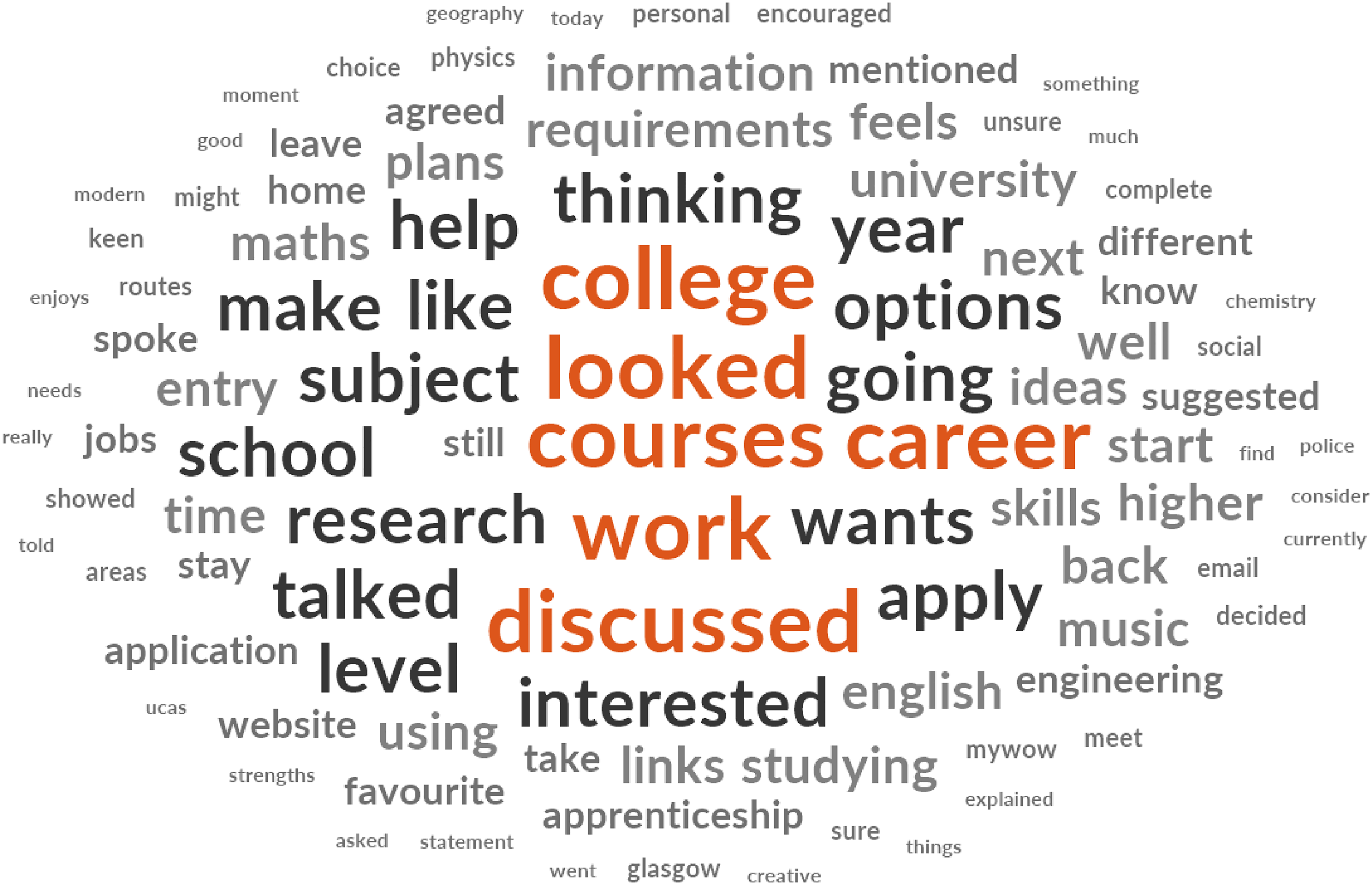
Findings from the frequency analysis suggest that career information seeking is commonly conducted by both young people and career practitioners. However, this is not typically referred to, or experienced as, information seeking per se. Rather, it is described in more colloquial terms. Frequency analyses of linguistic patterns in career advisers’ engagement notes revealed the five most frequently occurring words in sessions as: (a) courses; (b) looked; (c) work; (d) college and (e) discussed (Figure 1).
Word cloud of frequently occurring words.
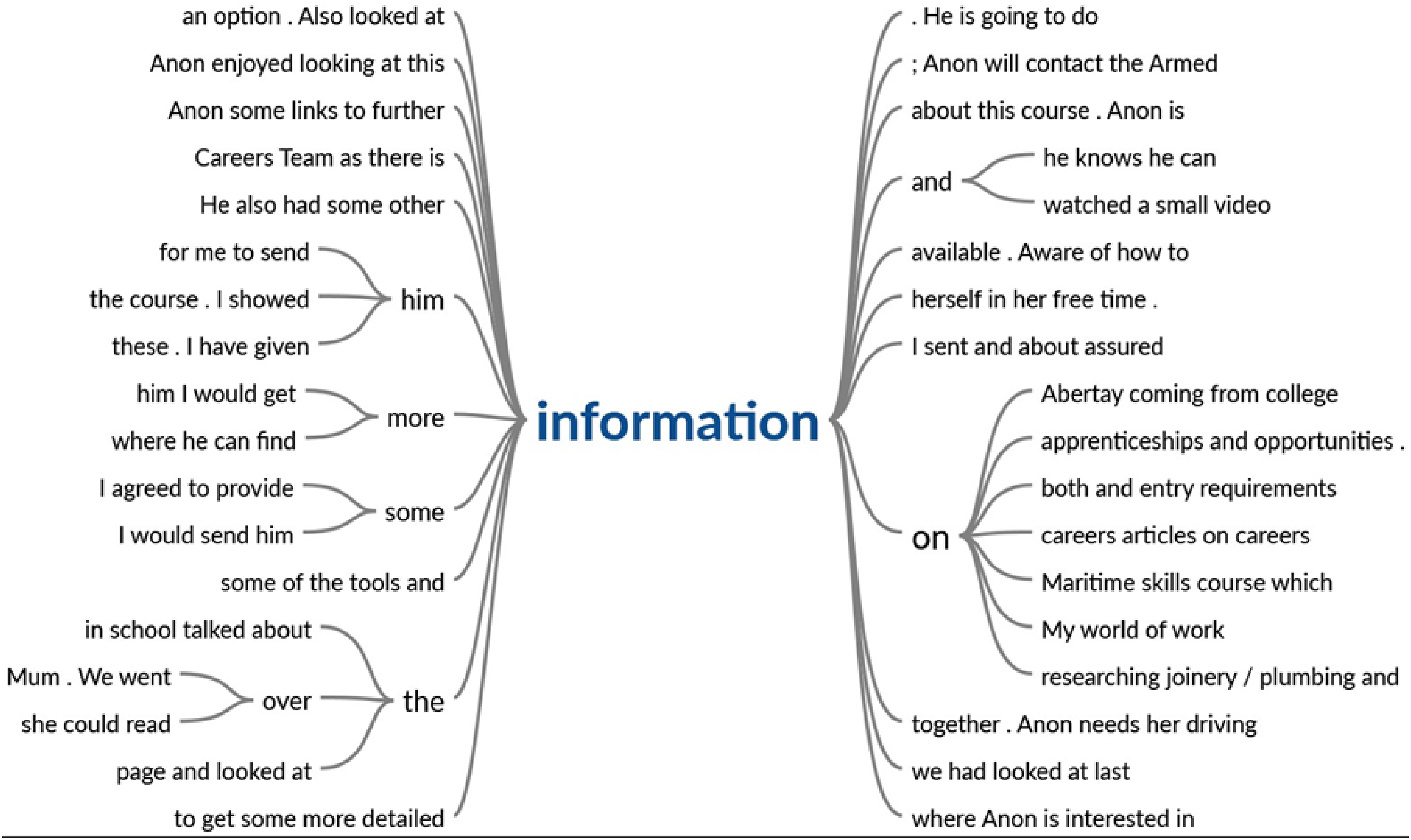
The word ‘information’ (Figure 2) appeared only 36 times in counselling notes. However, words and phrases closely related to information use, such as ‘looking at/looking into’ and ‘researching’, were much more commonly found (N = 179; N = 87 respectively).
‘Information’ word tree.
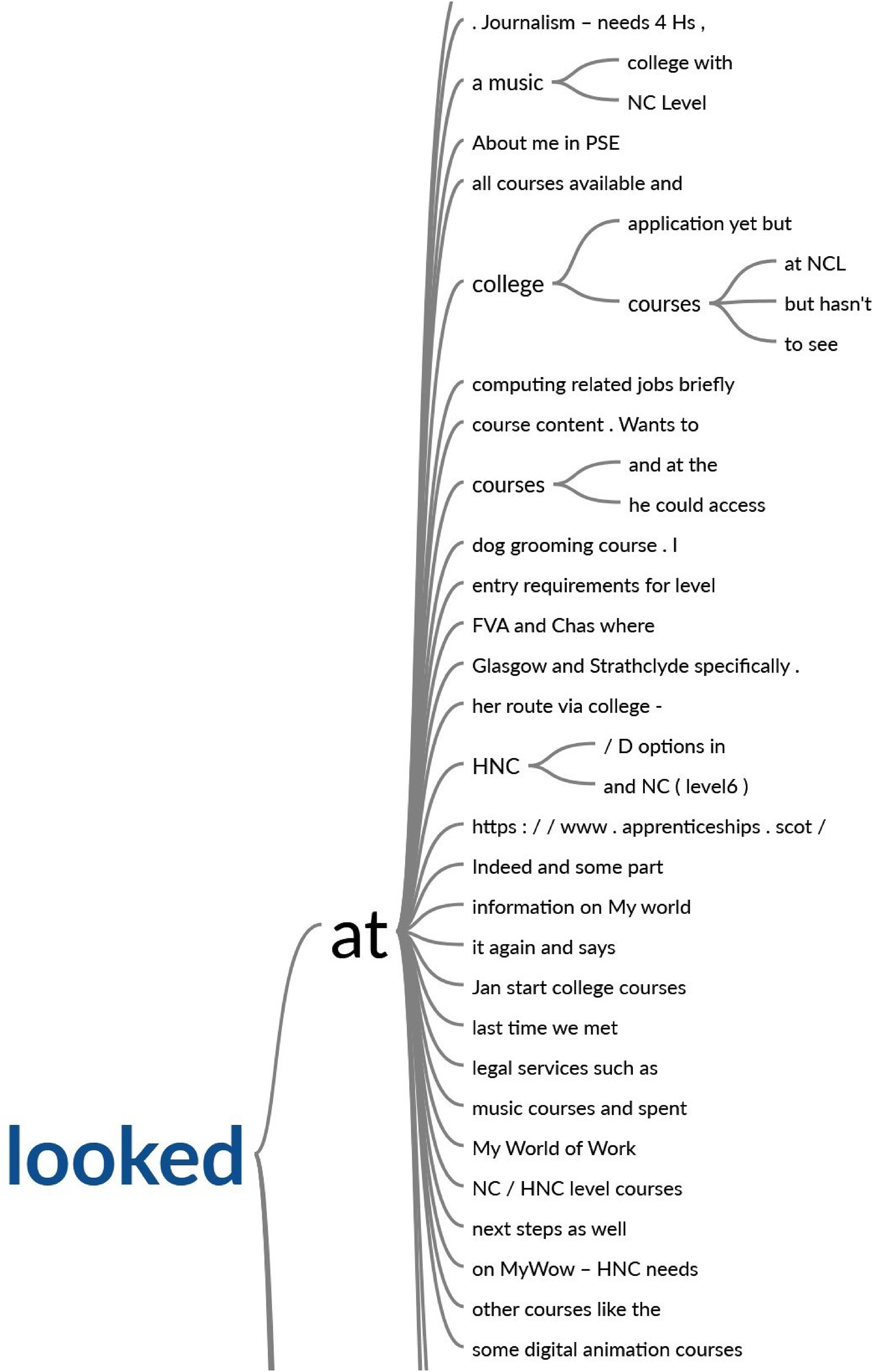
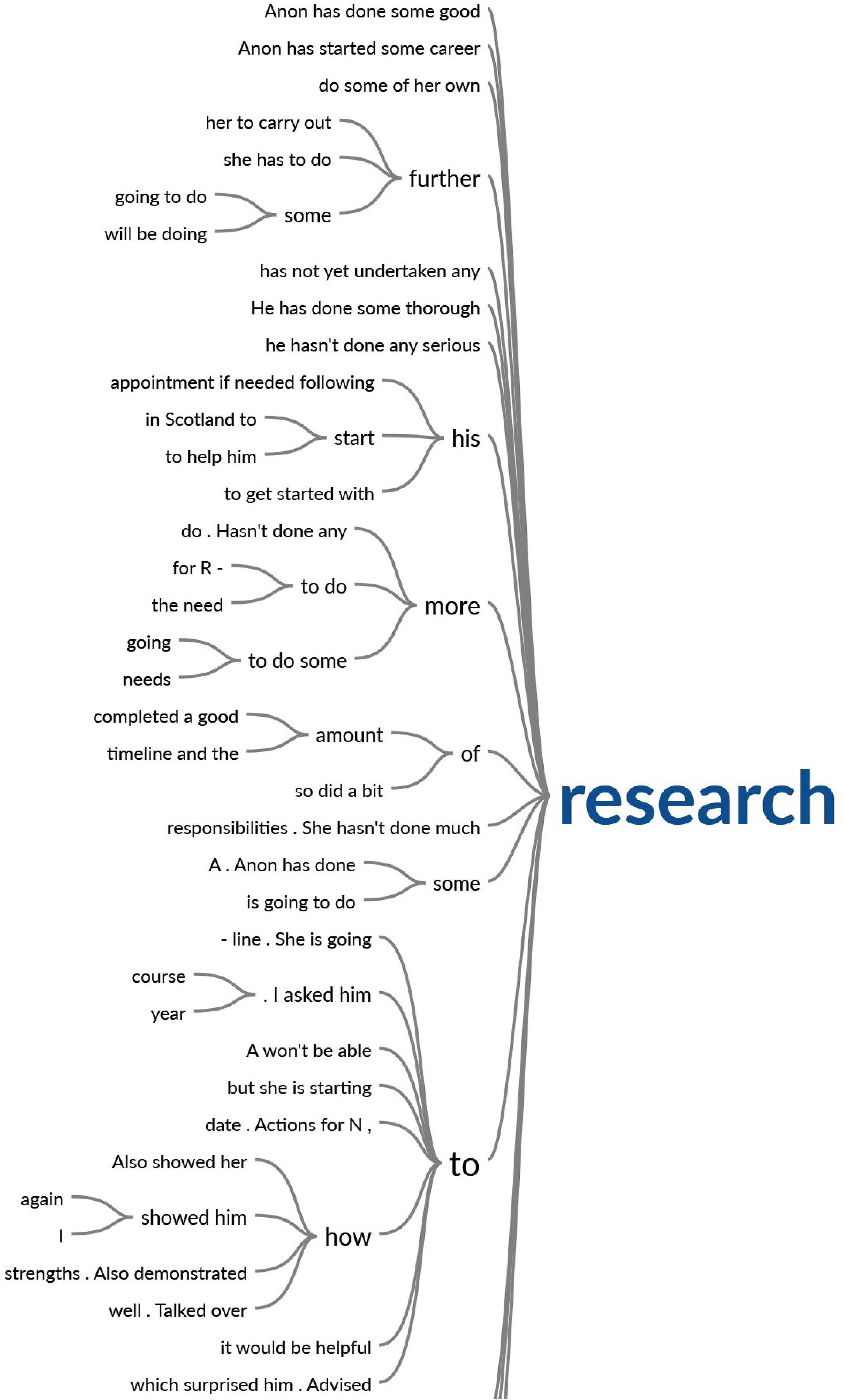
Similar contextual associations were recorded for the phrase ‘looking at/looking into’ and the word ‘researching’. This confirms the interchangeability of these phrases in narratives. Each phrase had one additional facet. ‘Looking at/looking into’ evoked descriptions of specific pieces of information accessed, or that were due to be accessed (Figure 3). ‘Research’ co-occurred with statements of whether or not young people had yet undertaken career research on their own (Figure 4). This is an important indicator of the type and degree of assistance required.
Fragment of ‘looked at’ word tree.
Fragment of ‘research’ word tree.
Discussion
The research question addressed in this study was ‘What are the characteristics of information-seeking behaviour in career advisory settings?’ From the analysis presented here, it can be concluded that there are three key characteristics of career information-seeking behaviour in this setting: prompted information seeking; information seeking on young people's behalf and collaborative information seeking. These information-seeking behaviours all entail an active involvement from career advisers. Young people approach career advisers for information-seeking advice within the early stages of their career decision-making timelines – often before they have begun researching their career options – and benefit from ongoing support with information seeking thereafter.
Overall, it is evident that career information seeking is an integral part of young people's career development learning. This also underpins the counselling practice of career advisers. Through the three characteristics of career information-seeking behaviour described in this article, young people are exposed to sufficient, timely and relevant career information which informs their career choices. However, career information seeking is framed colloquially in everyday exchanges. The frequency analysis revealed that the language used to signify information seeking in career conversations favours verbs such as ‘looking at/looking into’ and ‘researching’ over direct references to ‘information’. This suggests that information use is implicit in discussions and tasks, and may be invisible to both those who undertake it and those who observe it. This is in line with prior work reported by Hanell and Ahlryd (2021) and McKenzie and Dalmer (2020).
The information seeking that young people undertake appears to depend, to a high extent, on the guidance and information-seeking prompts provided by the career adviser. Their information seeking has some bearing on the development of career information literacy skills for the future, yet is more focused on meeting immediate information needs. These findings suggest that young people require guidance in their career-decision making process (as noted, e.g. by Slaten & Baskin, 2014), particularly with regards to career information seeking. Career guidance provision is already being applied towards the advancement of young people's information-seeking proficiencies; further mechanisms to support the development of young people's career information literacy skills can also be developed.
Career advisers seem to require more advanced career information literacy skills. For them, the information seeking associated with career conversations is an activity that supports their primary work objectives, as summarised in the literature review above (e.g. Savickas, 2011). In this study, further elements of the known role of career advisers in young people's career support networks (as noted, e.g. by Holland, 2015) are made evident.
The sequence of events of (a) young people seek assistance with career queries, (b) queries are transformed into specific information-seeking tasks through collaborative information seeking with career advisers and (c) young people seek information on their own (as prompted by career advisers) indicates that career advisers need to possess several information-seeking capabilities. They need to know where to find relevant information; when and how to provide this information to young people; when and how to prompt their client to seek information on their own; recognise when collaborative information seeking might be beneficial and identify when information-seeking instruction might be required.
Career advisers also need to possess information proxy capabilities, so that they can carry out information seeking on behalf of young people. While the study reported here does not uncover career advisers’ motivations for information seeking by proxy, future studies could explore whether or not information seeking by proxy occurs due to technological, skill or other constraints in young people. It is also possible that this behaviour might occur in the absence of any major constraints in accessing and using career information, and is instead intended as a time-saving or benevolent gesture towards the young person.
Since career advisers provide young people with timely input for commencing or continuing information seeking, they may require advanced information literacy instruction, in which their information intermediary and educational responsibilities are emphasised. At present, there is a gap in knowledge with regards to the state of career advisers’ career information literacy skills. Much of the published work on the topic of career and employability-related information literacy regards young people's skills, and not career advisers’ skills, as being in need of development (e.g. Bennett & Robertson, 2015; Hollister, 2005).
The three key characteristics of collaborative career information-seeking behaviours outlined in this article – prompted information seeking, information seeking on young people's behalf and collaborative information seeking – could usefully be explored in future research. It would be helpful to have primary research using direct observations of interactions between practitioners and clients. This could complement knowledge of these modes of information seeking from both young people's and career advisers’ own perspectives, and give insight into the shared meanings constructed through these parties’ joint engagements with information.
In future research on this topic, interviews with both groups can be conducted, and observations of career counselling sessions can be performed. Furthermore, other members of young people's support networks are also candidates for future investigations prompted by this work. As identified earlier in the literature review of this article, collaborative information seeking is anticipated to occur beyond the client–counsellor dyad, for instance, between parents and children or teachers and students. The information-focused interactions of these collaborative groups offer further opportunities for research into young people's ‘careers information ecologies’, in the words of Roberts et al. (2023, p. 300). Of particular interest here are not only the means by which young people approach others for career information, but also the means by which they form shared objectives and pursue information-seeking activities with members of their support networks.
Conclusion
Information-seeking behaviour in career advisory settings can be characterised as comprising both individual and collaborative activities, and requiring young people and career advisers to complete a host of interconnected information tasks. Young people tend to seek general assistance with career research rather than specific career information. Career advisers seek information on young people's behalf, prompt information seeking and provide relevant career information with a steering function. Both parties engage in collaborative information seeking. This includes an element of instruction and involves an apparent transfer of information-seeking proficiency from the careers practitioner to the client. Implied in this finding is the presumption that young people's career information literacy proficiency might be dependent on their career advisers’ information-seeking capabilities. Such a presumption positions career advisers as both key providers of career information, and ad hoc career information literacy educators.
Information-seeking behaviour in the context of career conversations with secondary school students is also primarily experienced, and colloquially referred to, as ‘looking at/looking into’ and ‘researching’ career options. While information seeking is not commonly referred to as such during career counselling sessions, based on the analysis reported in this article, it is evident that a wide range of CIAG services are being provided. Information, advice and guidance discussions are focused on themes of the most immediate importance, such as college courses and the possible career options associated with these courses.
This study represents a contribution to the literature on career information by highlighting the types of tasks that are commonly completed in career advisory settings, and the ways in which the information workload is distributed between career research novices (young people) and experts (career advisers). The value of this research lies in its consideration of collaborative information seeking and its potential to inform career service policy and prompt further career information literacy research, including that of the larger study to which it contributes. In future research projects on this topic, primary data collected from the two populations can develop a more complete picture of career information-seeking behaviour. This can also lead to the development of career information literacy training initiatives. These would be targeted at career advisers or young people or both parties. They would depend on self-reported skills development needs or on community-wide assessments of skills proficiency.
Footnotes
Declaration of conflicting interests
The authors declared no potential conflicts of interest with respect to the research, authorship, and/or publication of this article.
Funding
The authors disclosed receipt of the following financial support for the research, authorship, and/or publication of this article: This work was supported by the Economic and Social Research Council (grant number ES/P000681/1 2277127).
