



Abstract
There is widespread interest in the use of music to help with sleep, although there is little clear understanding of the features that distinguish music for sleep from music for other purposes. We asked if music intended to facilitate sleep is distinct from music more generally considered as relaxing by comparing the features of tracks comprising three types of playlist on the music streaming service Spotify. Ninety playlists to facilitate sleep, relaxation and, for comparison, energy were gathered, based on titles and descriptions. Our analysis found significant differences between many of the features of the tracks in the three playlist categories, and nature sounds were prominent in sleep music playlists. A nonlinear classification model correctly classified music from sleep playlists with an accuracy rate of 72%, with brightness being the strongest predictor in distinguishing music from sleep and relaxing playlists. Music from sleep playlists could generally be described as acoustic, instrumental, slower, quieter, and with less energy compared to the other playlists, conforming with previous work. Our results emphasize the importance of timbral qualities in music for sleep and confirm sleep music to be distinct from music for relaxation. The results can be used to guide the selection of music for sleep, and the transition from relaxation to sleep.
Music continues to attract strong research attention for its potential as a non-pharmacological aid for sleep (Kakar et al., 2021; Wang et al., 2021). To this end, one of the keys to optimizing its use is an understanding of the types and characteristics of music that are most suitable for promoting sleep. Many studies use music with similar characteristics such as slow tempo and little rhythmic or dynamic variation (Jespersen et al., 2015), often referring to recommendations put forward by Gaston (1951, 1968) and Nilsson (2011) for selecting so-called sedative or soothing music. However, researchers have found that survey respondents report using a variety of music for sleep that does not necessarily fit the typical description of sedative music (Dickson & Schubert, 2022; Trahan et al., 2018). For example, Dickson and Schubert (2022) found that 59% of songs chosen by respondents had lyrics, contradicting the typical preference for instrumental music in sleep studies. In an analysis of Spotify playlists, Scarratt et al. (2021) profiled sleep music playlists against the Music Streaming Sessions Dataset (Brost et al., 2020) and found that while sleep music generally fits the assumptions of most researchers (instrumental, acoustic, low in energy), playlists demonstrate considerable variability and a wide range of styles.
There seems to be a close association in the literature between music for relaxation and music to induce sleep, and indeed the notion of relaxation is informally used as a basis for selecting music in sleep studies without this relationship having been explicitly investigated (Huang et al., 2016, 2017; Lai & Good, 2005). Considering that sleep can be seen as a “very relaxed behavioural state” (Kräuchi, 2007, p. 241), linking music for sleep with relaxation seems apt, suggesting that winding down and relaxing may be important contributing factors for music to help with falling asleep.
To investigate this relationship, we examined the overlap and distinctions between music for relaxation and music for sleep as defined commercially and by consumers in Spotify playlists. We asked if there is a difference between music for relaxation and music for sleep, or if music for sleep overlaps to a large degree with music for relaxation, albeit in a more extreme form. To facilitate comparison, we compared playlists for the purposes of relaxing and sleeping with playlists for an opposite purpose, that is, of energizing. The analyses focused on distinctions and overlaps between features of music for these purposes. Understanding the differences between them could help to refine and optimize our understanding of the music associated with sleep induction.
Sleep music: Selections and characteristics
Studies investigating the effects of music on sleep have used stimuli in a variety of genres, including Buddhist music (Huang et al., 2016, 2017); Korean pop music (Lee et al., 2019); classical music (Harmat et al., 2008; Oxtoby et al., 2013; L. P. Tan, 2004); Western (including new age, electric, popular oldies, classical, and slow jazz) and Chinese music (Lai & Good, 2005); Chinese, Czech, and Taiwanese music (Chang et al., 2012); Indian music (Deshmukh et al., 2009); Enya (L. P. Tan, 2004); commercial sleep or meditative music (Cordi et al., 2019; Jespersen & Vuust, 2012; Lazic & Ogilvie, 2007; Picard et al., 2014); and music that is otherwise unspecified but described as soothing, relaxing, or similar (Iwaki et al., 2003; Johnson, 2003; Shum et al., 2014). Some studies have used music composed by the researchers themselves or specifically for the study by another composer (Bloch et al., 2010; Chen et al., 2013), while others have allowed participants to bring their own music or choose from a selection of researcher-chosen music (Chang et al., 2012; Iwaki et al., 2003; Johnson, 2003; Shum et al., 2014).
Music is often selected on the grounds that it has particular features, although detailed accounts of these features tend to be sparse, which makes it hard to present selection criteria systematically. The feature reported most often is tempo, typically within the range of 48 to 85 beats per minute (bpm; Jespersen et al., 2015; L. P. Tan, 2004), with a frequent use of tempi around 60–80 bpm (Chen et al., 2013; Huang et al., 2016, 2017; Shum et al., 2014; Su et al., 2013). A comparison of studies describing relaxing and energizing music, respectively, reported tempi around 60–100 bpm for relaxing music (Elliott et al., 2011; Nilsson, 2011; X. Tan et al., 2012) and around 100–133 bpm for energizing music (Etani et al., 2018; Moelants, 2002, 2003, 2008; van Noorden & Moelants, 1999).
As for dynamics, it is often suggested that music for sleep should have a “stable dynamic structure” (Jespersen et al., 2015, p. 15) and “no dramatic changes” (Chang et al., 2012, p. 923). Dickson and Schubert (2022) compared the features of music that survey respondents reported as having been used successfully and unsuccessfully for sleep, using the MIR Toolbox (Lartillot et al., 2008; Lartillot & Toiviainen, 2007) to calculate dynamic variation measured by the standard deviation from the root mean square (RMS) amplitude. There was no difference between the two categories of music in terms of dynamic variation but the music used successfully for sleep tended to be more legato.
Softness is another suggested feature of music for sleep. Scarratt et al. (2021) reported that sleep music in Spotify playlists tends to be quieter than other music, while Cordi et al. (2019) played music at levels between 45 and 50 dB to participants in their study. Nilsson (2011) suggested that soothing music used therapeutically should be played at a maximum level of 60 dB.
Music for sleep has been reported to have “no strong rhythmic accentuation” (Jespersen et al., 2015, p. 15). Indeed, Timmers et al. (2019) found clear differences between the music in sleep playlists and UK Top 40 songs in terms of event density and pulse clarity, while Dickson and Schubert (2022) found that music used successfully for sleep had low-to-medium rhythmic activity.
Some researchers have investigated the spectral features of sleep music compared to other music. Music in sleep playlists was found to have less bright timbres compared to UK Top 40 songs (Timmers et al., 2019), and Dickson and Schubert (2022) found that music used successfully for sleep had a lower main frequency register. Spectral features are not typically described in studies of sleep music, but these results suggest that they should be. Brightness is linked with intensity and perceived energy (Gomez & Danuser, 2007), and has been shown to affect perceived emotion (Eerola et al., 2012, 2013). Spectral centroid, used as a measure of brightness, has been found to correlate with emotional arousal (McAdams et al., 2017; Sievers et al., 2019).
Finally, the analysis by Timmers et al. (2019) showed that sleep music and UK Top 40 songs differ in terms of mode; while Top 40 songs can be major or minor, sleep music was overwhelmingly in the major mode. This suggests that it is important for sleep music to be positively valenced. This has also been found to be the case with music for relaxation, where relaxation is interpreted as having positive valence and offering release from negative tension, not just low activation as may be inferred from the other features discussed so far (Lee-Harris et al., 2018).
In this brief overview, we have identified parallels between the features of sleep music and the features of music that has been found to elicit emotional responses, particularly arousal (Chuen et al., 2016; Coutinho & Cangelosi, 2011; Kim et al., 2019; van der Zwaag et al., 2011), including its rhythmic, dynamic, spectral, and tonal features. The extent to which music for sleep resembles music intended to promote relaxation is as yet unknown, and our study was designed to fill this gap. Furthermore, while some features of music have been reported relatively often, others have not. Accordingly, we aimed to carry out a systematic analysis of a set of features, including brightness and mode, and compare their occurrence in music for sleeping, relaxing, and—for contrast—energizing.
To do this, we analyzed the features of music in Spotify playlists. With around 286 million monthly active users (Iqbal, 2020), Spotify is one of the most popular online streaming platforms. The Spotify Data Catalog (SDC) contains a wealth of data including features of the music on the platform, which can be accessed through its Web API (Application Program Interface). An API is a software intermediary that some web applications provide as a means of accessing data related to their content. Through the Spotify API, it is possible to extract data on the musical features of all the tracks in the SDC, such as their tempo, energy, or duration. This provides a valuable resource for researchers wishing to analyze music used in different ways (Barone et al., 2017).
Methods
Data collection
Data were collected from the SDC using the Spotify Web API and the Spotipy library in Python. Two of the tools available in the Web API were used to extract musical features: Audio Features, which provides global values for a selection of musical features for each track; and Audio Analysis, which returns additional features for individual tracks according to tatums, 1 beats, bars, segments, and sections. We included part of the timbre object provided by the segments breakdown. This returns a vector with 12 values per segment that represent different aspects of the spectrogram. The first four values correspond to loudness, brightness, flatness, and attack. To include brightness in our analysis, we averaged values across segments to obtain an overall brightness value for each track. Table 1 presents the full list of features included in our analysis, and their descriptions. 2
List and descriptions of Spotify features extracted for this study.
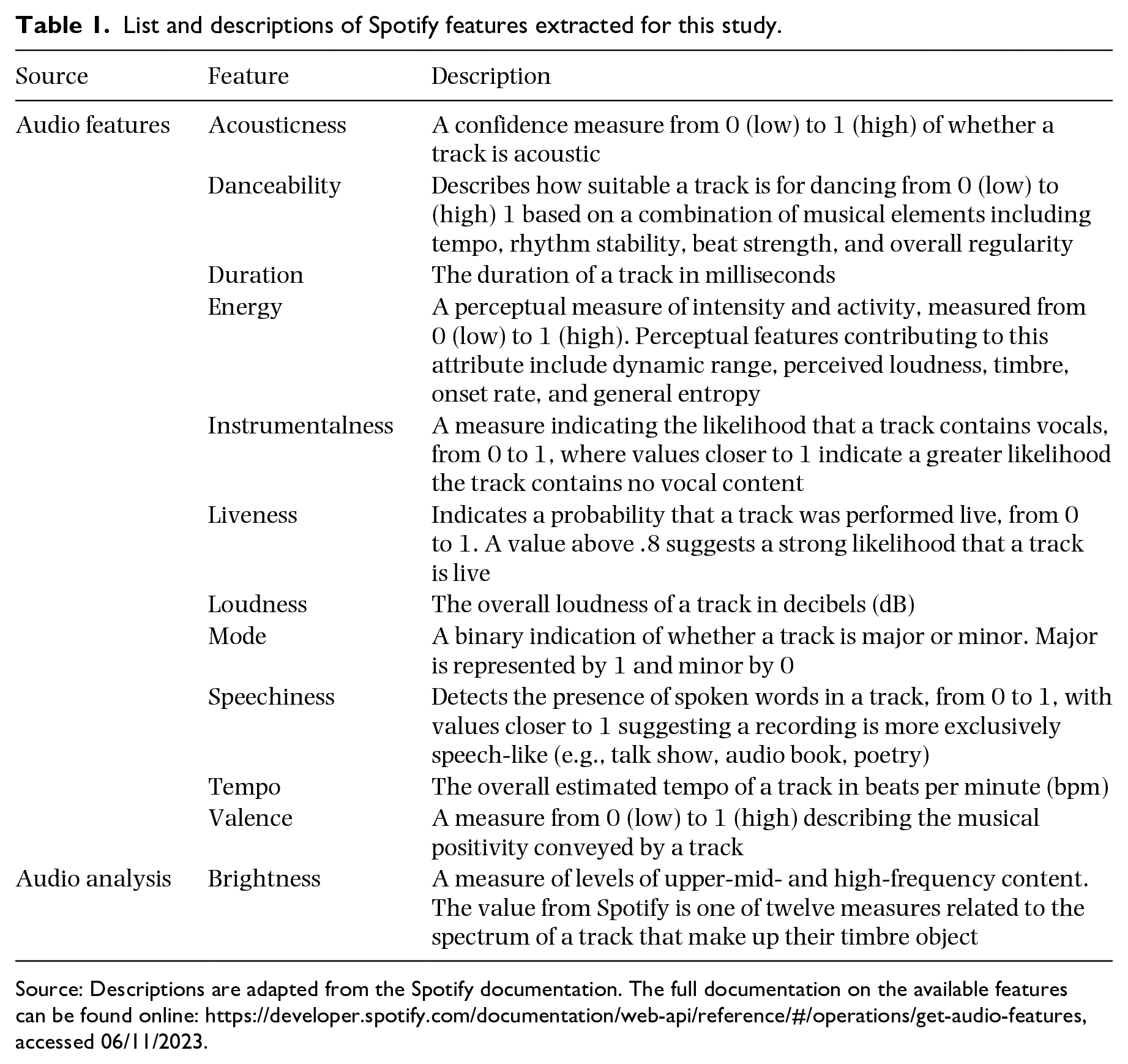
Source: Descriptions are adapted from the Spotify documentation. The full documentation on the available features can be found online: https://developer.spotify.com/documentation/web-api/reference/#/operations/get-audio-features, accessed 06/11/2023.
A list of Spotify playlists and their corresponding IDs were gathered using the search function in the Spotify web player. 3 Playlists for sleeping and relaxing were gathered using the search terms sleep* and relax*, respectively. Playlists for energizing were gathered using the search terms energi* (to accommodate different spellings and variations, e.g., energise/energize, energizing, etc.), dance, and workout. The latter were included as energi* proved to be a relatively limited search term. Other search terms were considered but these three were deemed sufficient to capture the energizing theme. Playlist names, creators, and IDs were logged for input into the Spotipy script.
In order to balance the selection, 30 playlists of at least 50 tracks each were collected in each category (hereafter referred to as Sleep, Relaxing, and Energizing playlists), by order of search appearance. This resulted in a set of 90 playlists consisting of a total of 17,274 tracks (see Appendix 1 for a complete list of the playlists included). Titles of playlists indicated themes such as Jazz for Sleep and Relaxing Guitar Music and the number of tracks in each playlist varied considerably, from 50 to 1,159 tracks in a single playlist. To reduce potential bias from this imbalance, we took a random sample of 50 tracks from each playlist. This resulted in a total of 4,500 tracks (1,500 in each category) for the analysis.
Analysis
The analysis consisted of three phases. First, we compared the values of the Spotify features (see Table 1) in each track across the three categories of playlist (Sleep, Relaxing, and Energizing). Next, we used principal component analysis (PCA) to investigate linear relationships between features and groups of features according to their shared components. Finally, we used nonlinear data-driven modeling to test the ability of features to predict the category of playlist in which the tracks could be found accurately and assess the extent to which each feature contributed to this prediction. We conducted nonlinear modeling using the Statistics and Machine Learning Toolbox in MATLAB. We performed all other statistical analyses in SPSS. We used Laerd Statistics (https://statistics.laerd.com/) for guidance on procedure and reporting. We normalized all continuous data to values between 0 and 1 prior to analysis.
Results
Univariate tests
The violin plots in Figure 1 show the distribution of the values for the Spotify features of the tracks in each playlist category. The medians and distributions of these values suggest a trend typically decreasing from Energizing to Relaxing to Sleep. For example, tracks in these three playlist categories became progressively slower, quieter, and less bright. Other features such as the Acousticness and Energy of the tracks in the Sleep and Relaxing playlists had similar values, which were distinct from the tracks in the Energizing playlists. Tracks in the three playlists had similar values for Duration, Liveness, and Speechiness, as they were all mostly less than 4 min long, recorded in studios rather than live, and rarely included spoken words.
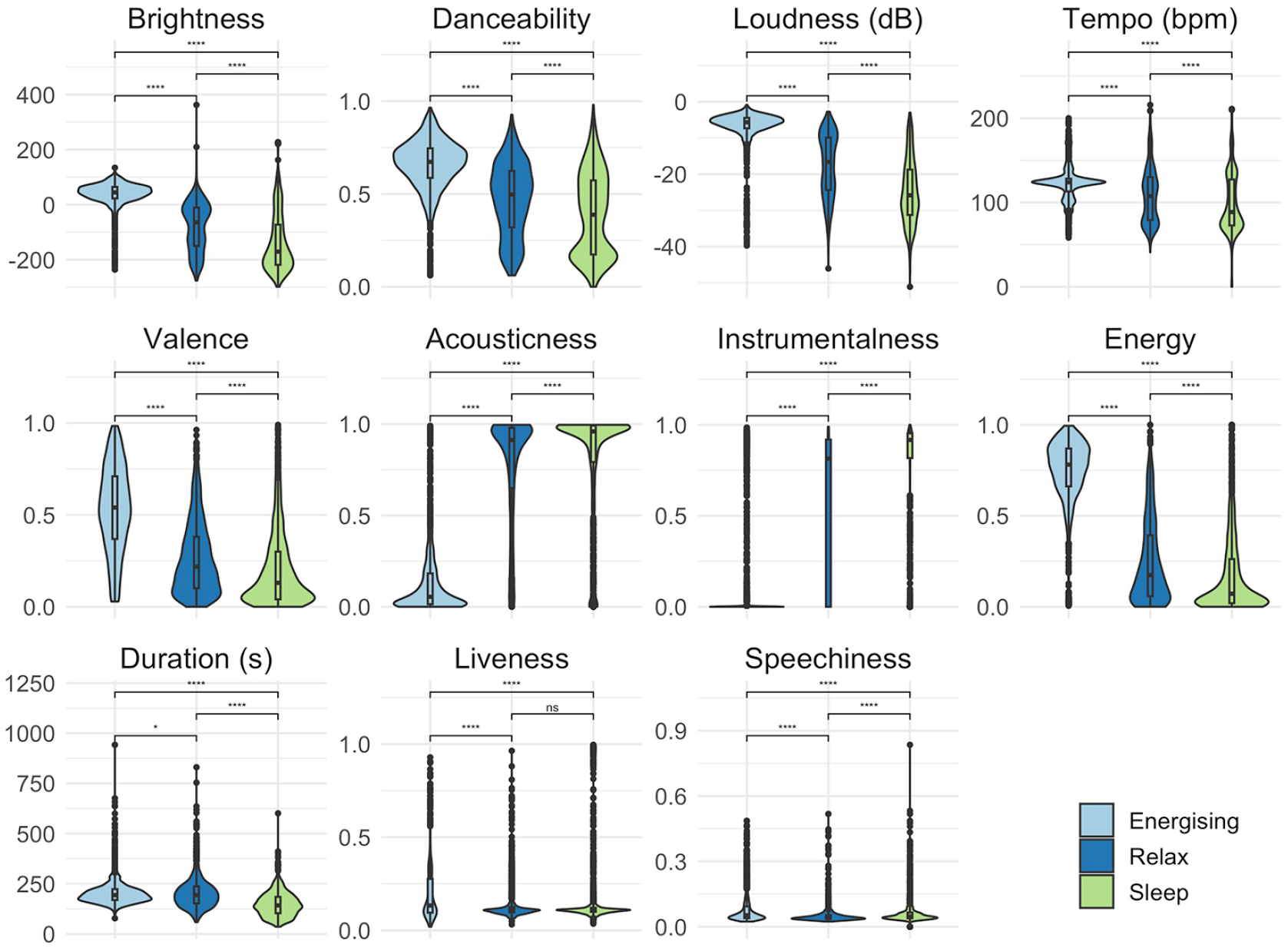
Violin plots of features by playlist category, original values (duration converted to seconds).
Many of the features failed to meet the assumptions of normality of distribution, as assessed by visual inspection of histograms and confirmed by z-score calculations of skewness and kurtosis. We therefore used non-parametric tests to compare the features of the tracks in each playlist category.
Because Mode is a dichotomous dependent variable, we used a chi-squared test of homogeneity, and post hoc pairwise comparisons using the z-test of two proportions with a Bonferroni correction, to identify potential differences between the proportions of tracks in the minor mode in the three playlist categories. The chi-squared test was statistically significant (p = .001), as were all pairwise comparisons: 47.7% (716) of the tracks in the Energizing playlists were in the minor mode, compared to 32.9% (494) in the Relaxing playlists and 26.1% (391) in the Sleep playlists.
We used Kruskal–Wallis H tests, and pairwise comparisons using Dunn’s (1964) procedure with a Bonferroni correction, to compare the values for all the other Spotify features of the tracks in each playlist category. With one exception (Liveness in the Sleep and Relaxing playlists, as shown in Figure 1), the pairwise comparisons were all statistically significant. The tracks in the Sleep playlists tended to be acoustic and instrumental, with lower values for all the other features in the tracks in the Relaxing and Energizing playlists, particularly Brightness, Danceability, Energy, Loudness, Tempo, and Valence.
We then went on to conduct a PCA to provide insight into how groups of features, rather than individual features, may contribute to the differentiation between playlist categories.
Principal component analysis
Musical features serving similar functions are more likely to vary together than independently. PCA enables a set of variables (in this case musical features) to be reduced to its main components, and can reveal patterns in the data. We omitted Mode from this analysis because, as a dichotomous variable, it was not suitable for inclusion. We assessed the suitability of all other features to be included in the PCA by calculating correlations between them and inspecting the matrix of correlations illustrated in Figure 2.
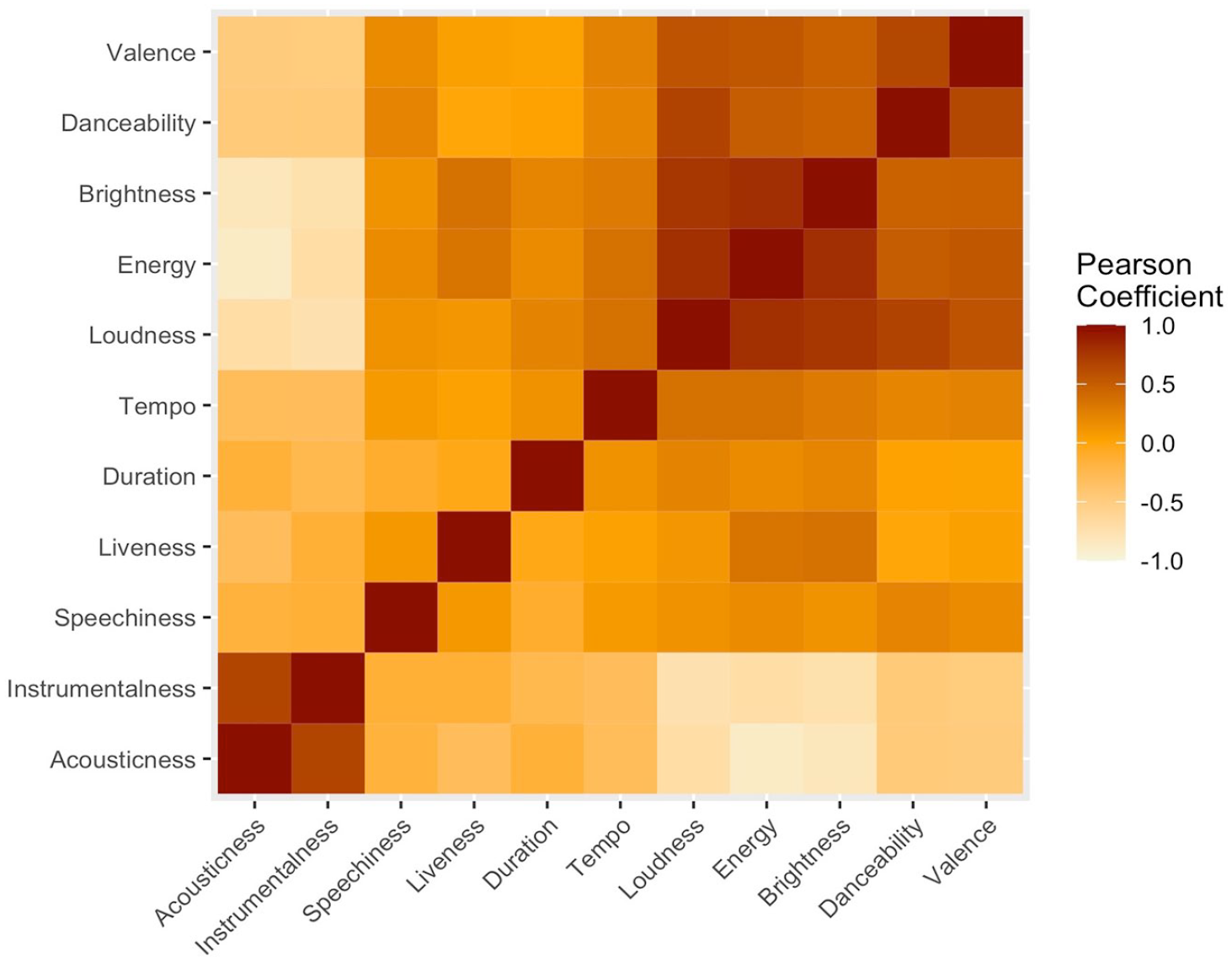
Heatmap of correlations between features, clustered hierarchically.
We omitted Duration and Speechiness from the PCA because their correlations with all other features were less than r = .3. The overall Kaiser–Meyer–Olkin (KMO) measure for the PCA was .846, or meritorious, according to Kaiser’s (1974) classification. All individual KMO measures were greater than .7 except for Liveness (.572). Bartlett’s Test of Sphericity was statistically significant (p < .0005), indicating that the data were likely to be factorizable.
PCA revealed two components with Eigenvalues greater than 1, explaining 70.1% of the variance. The Varimax rotation revealed a complex structure, with several of the features loading on both components (see Table 2). The features with the highest values loading on to Component 1 were Loudness, Danceability, and Valence. The strongest contributor to Component 2 was Liveness, which was the only feature that did not load on Component 1.
PCA matrix, rotated solution.
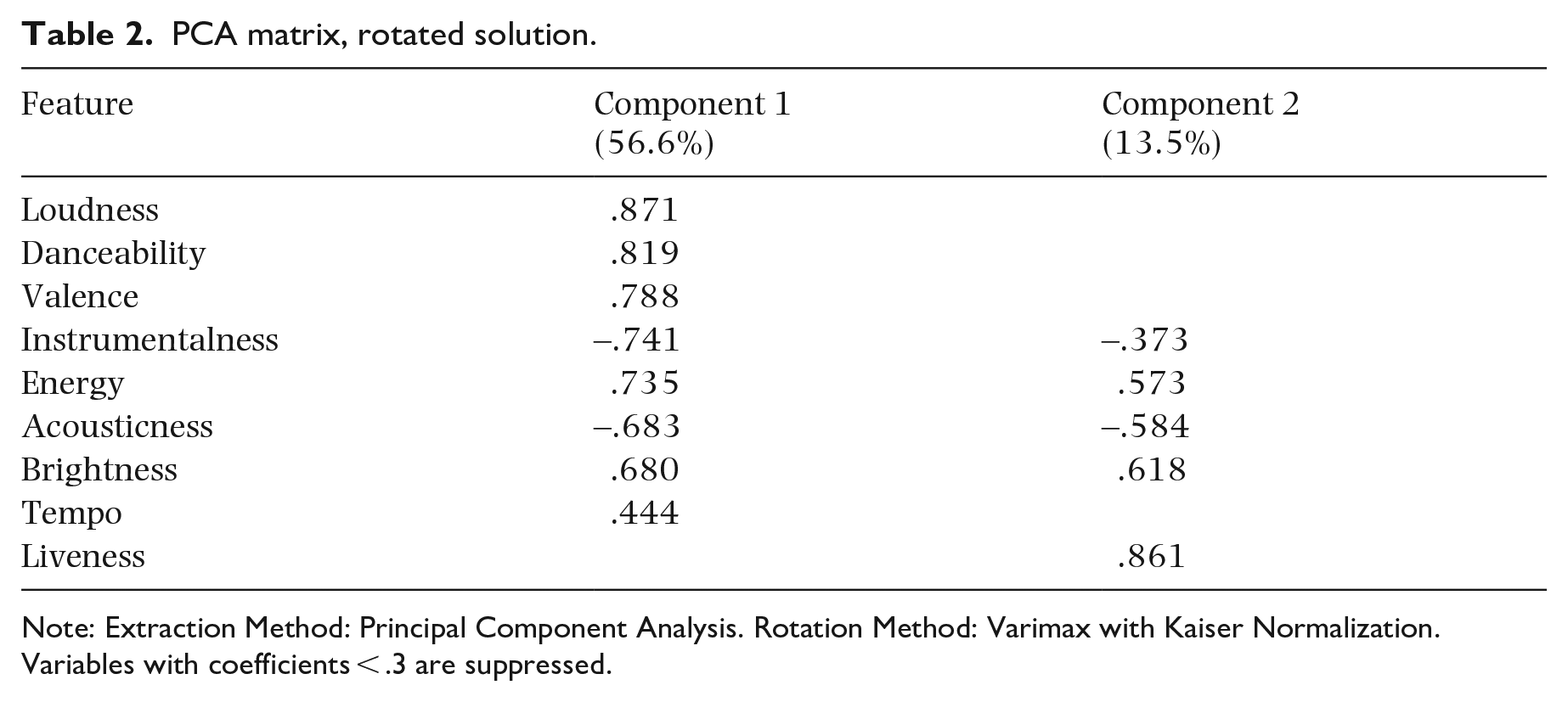
Note: Extraction Method: Principal Component Analysis. Rotation Method: Varimax with Kaiser Normalization.
Variables with coefficients < .3 are suppressed.
We used SPSS to calculate component scores for each track with regression weightings based on the retained two-component solution. Figure 3 represents a visualization of these scores. This shows the distribution of scores across the three playlist categories to be both separate and overlapping, such that the scores for the components of the Sleep tracks are more extreme than those of the Energizing and Relaxing tracks. The Sleep tracks have a long tail, particularly on Component 2, distinguishing them from the tracks in the other playlists. This is because many of these Sleep tracks consisted of sounds of nature such as rain or waves, which scored high for Liveness. We assume that the audio analysis methods used by Spotify mistook nature sounds for those of an audience, producing the binomial distribution illustrated in Figure 3.
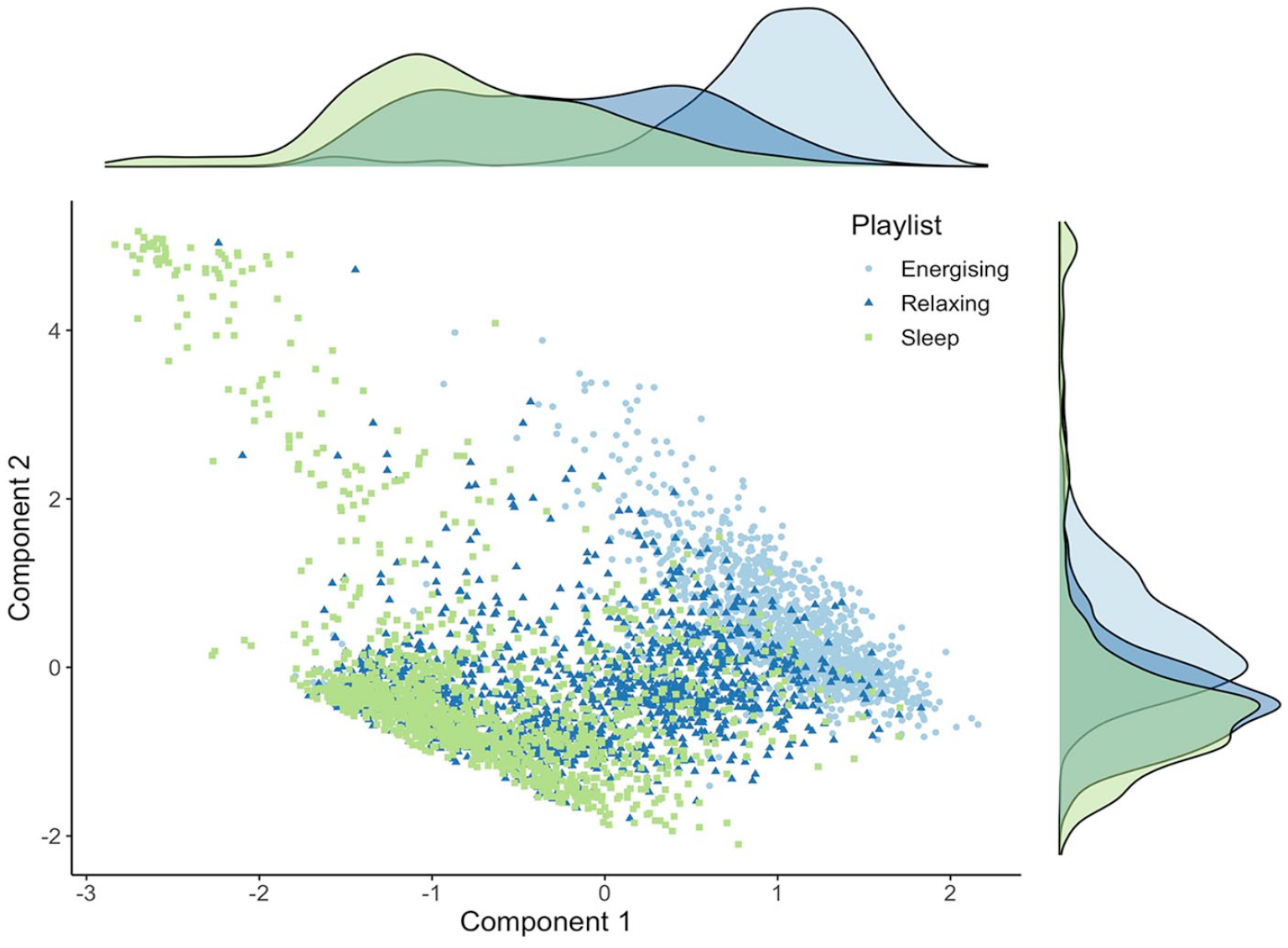
Scatter plot of the PCA component scores for each track by playlist category with density plots along each axis showing the distribution of component scores.
We therefore conducted the PCA again having identified and removed 150 tracks in two playlists consisting entirely, and one playlist consisting predominantly, of nature sounds; 4 as before, we excluded Duration and Speechiness. The resulting KMO was .877, an improvement on the first model, while all individual KMOs were above .8, including Liveness (.947). Bartlett’s Test of Sphericity was again statistically significant (p < .0005). This solution produced a single component with an Eigenvalue greater than 1, which explained 59.7% of the variance. The resulting solution showed very similar loadings as Component 1 in our original analysis, with only the addition of Liveness, which returned the lowest value. A forced two-component extraction increased the overall explained variance to 69.8%, with Liveness once again prominent in Component 2 (Eigenvalue = .910).
Nonlinear models
Finally, we used classification models to assess how well the Spotify features of each track predicted the category of playlist in which it could be found. Classification models attempt to discern how well a given set of classes (in this case, playlist categories) can be identified from a given set of predictors (in this case, the features). We used the same features as in the PCA (i.e., omitting Duration and Speechiness) and reintroduced Mode. We used classification decision trees, which can accommodate both continuous and categorical variables (James et al., 2013). A bag ensemble tree was fit using 10-fold cross validation, 5 which returned an overall validation accuracy of 75.8%. Performance varied for each category (see Figure 4), with the model performing best for the Energizing playlists (90.4% overall prediction rate) and worst for the Relaxing playlists (65.1%). Tracks from the Sleep playlists were correctly classified in 72.0% of cases.
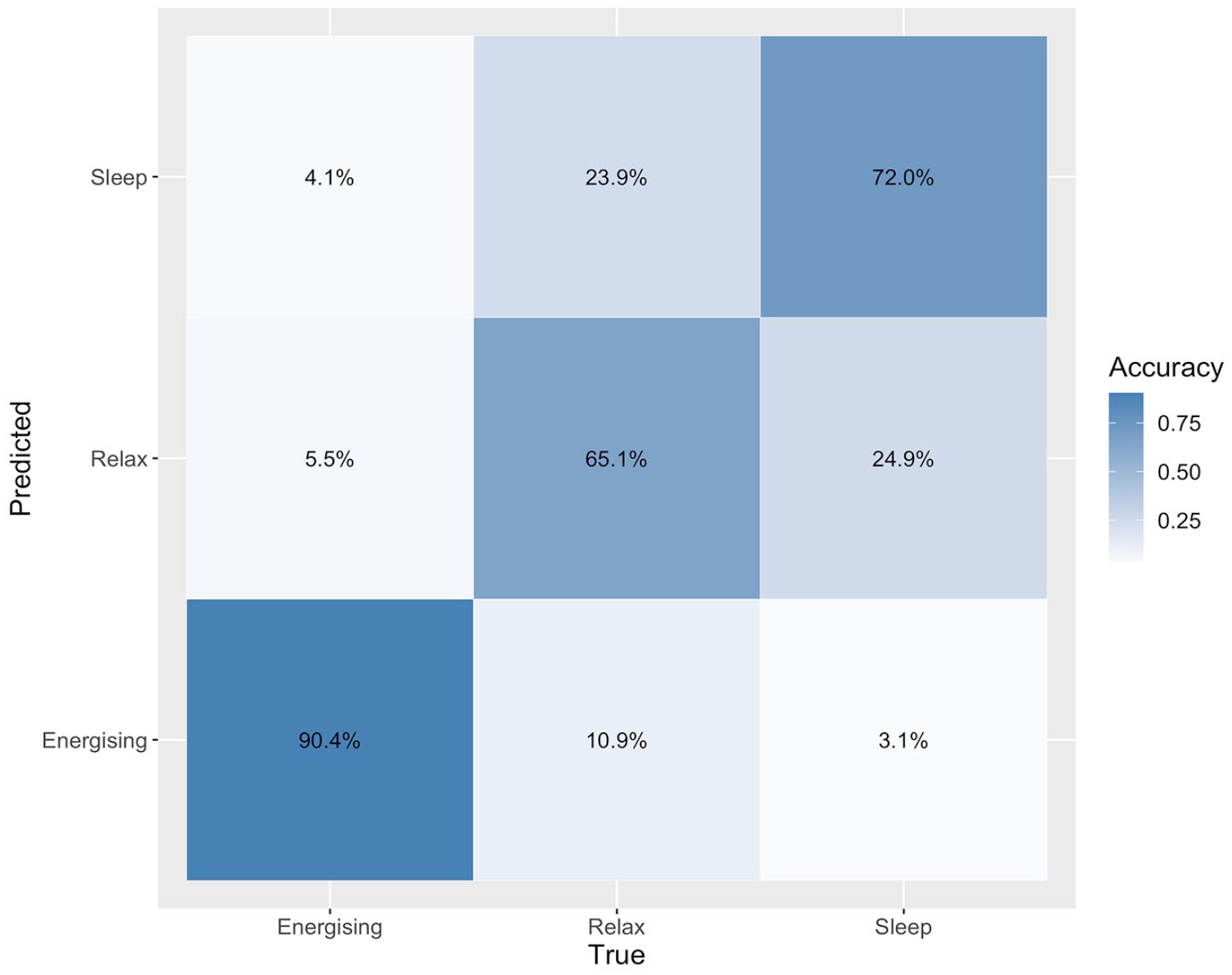
Confusion matrix showing the distribution of predictions for each track in each playlist category.
Identifying the weightings of individual predictors in a model can tell us more about the distinctions between each class and the relevance of the predictors. Predictor weight was investigated using the MATLAB predictorImportance function for decision trees and calculated for each fold of the model before being averaged. Energy was the strongest predictor, followed by Loudness, Brightness, and Acousticness. The model was likely to have been strongly influenced by several distinguishing features of the tracks in the Energizing playlists, such as Energy and Acousticness (see Figure 1). We therefore conducted the analysis again excluding the Energizing playlists to produce a Sleep/Relaxing model enabling us to differentiate between these two types of playlist. With the influence of Energy much reduced, Brightness was the strongest predictor, followed by Loudness, Instrumentalness, and Valence (see Figure 5). The validation accuracy of this model increased to 74.7% for the Sleep and 72.9% for the Relaxing playlists, respectively.
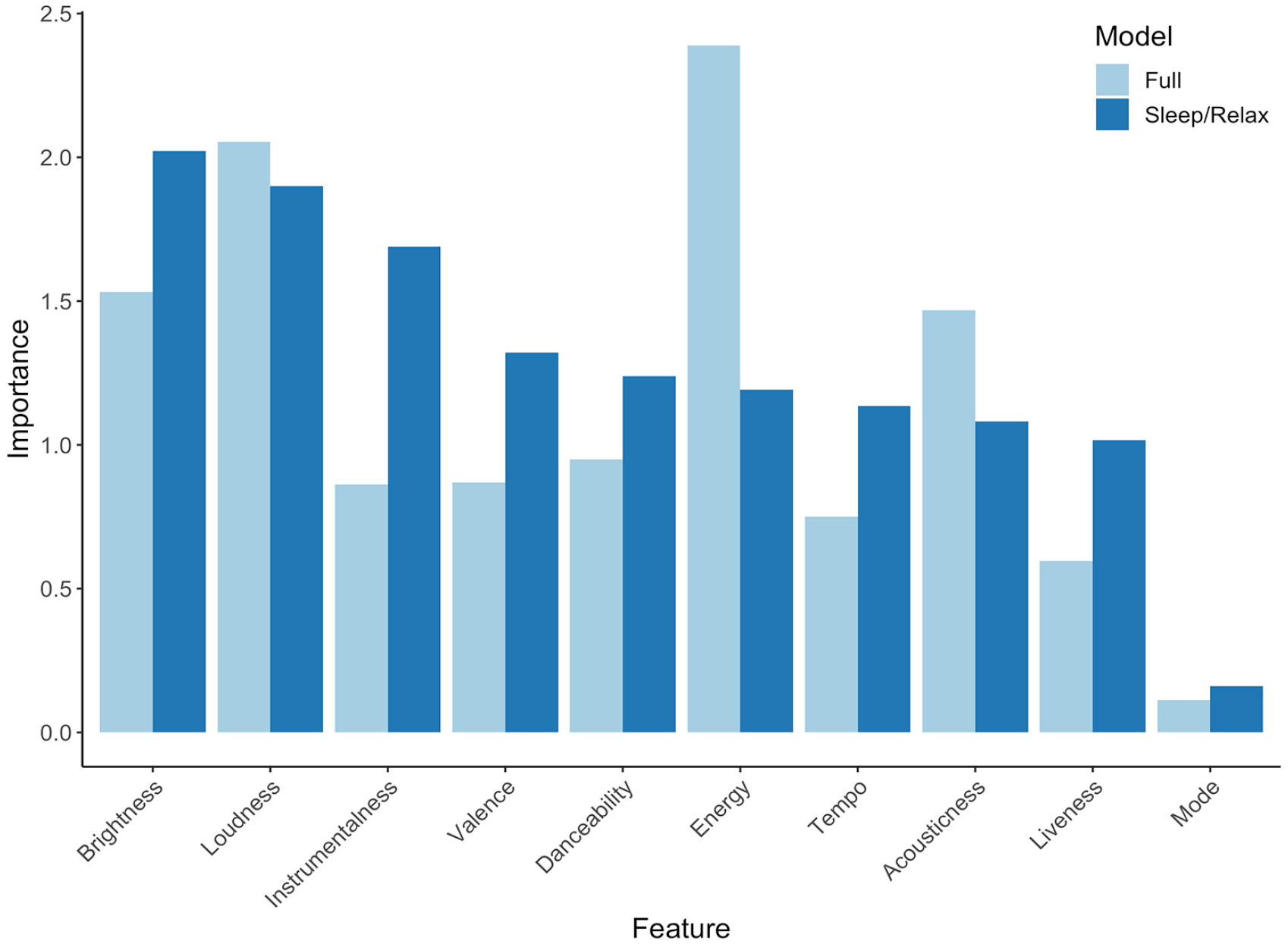
Weight or importance of each predictor presented for the model trained on the full dataset and the model trained on the sleep and relaxing playlists only. Predictors are sorted by importance in the sleep/relaxing model.
Removing the tracks consisting entirely or predominantly of nature sounds from the dataset altered the results only slightly. The overall validation accuracy of the full model was reduced by 0.9% to 74.9%, with a greater reduction for the Sleep playlists (69.4%), while the validation accuracy of the Sleep/Relaxing model was reduced to 69.3%. Brightness was a stronger predictor than Loudness, and therefore the second strongest predictor, in the full model, and remained the strongest predictor in the Sleep/Relaxing model. Finally, the importance of Valence decreased in both models.
Discussion
In this study, we aimed to increase our understanding of music for sleep by investigating how it may be distinguished from music for other purposes, especially relaxation, using the features of tracks on playlists available in, and as defined by, Spotify.
The importance of brightness
Our finding that sleep music is low in Brightness is in line with previous work (Dickson & Schubert, 2022; Timmers et al., 2019). As the strongest predictor for distinguishing sleep music from relaxing music more generally, our analysis emphasizes the importance of this sonic feature that is typically less reported in the sleep music literature. The relevance of Brightness could relate to its effect on emotional arousal (Bannister, 2020; Eerola et al., 2013; McAdams et al., 2017) as one mechanism by which music aids sleep (Jespersen & Vuust, 2012).
Brightness could be a reflection of other facets, such as instrumentation, recording quality, and pitch. Sleep music in these types of playlist tended to be acoustic and instrumental, and while there were many ambient and electronic music playlists, around half consisted of solo piano music or piano with ambient drones. Of the remaining Sleep playlists, several contained lo-fi music, which is characterized by having little high-frequency information. Some Sleep playlists contained tracks of white or brown noise, and it was these that exhibited the lowest Brightness values. Other low Brightness tracks included ambient pieces such as Crystal Glass by Uffe Jörgensen, Dromen by Bedtijd (Dutch for bedtime; the song title means dreams or dreaming), and Wanderstar by Amel Scott, and solo piano music such as Morning Ditty by Tiffany Royce and Afternoon with Auntie by Jenna Schwartz. Most of the Energizing playlists, on the contrary were dominated by pop and dance tunes, with a heavy emphasis on electric or synthesized instruments. These included tracks such as Freed from Desire by Gala and Venus by Bananarama, which had some of the highest Brightness values. Relaxing playlists were more varied, with some consisting of acoustic folk/rock/pop music (e.g., I See Fire by Ed Sheeran and I Guess I Just Feel Like by John Mayer) and others including more ambient instrumental music. Interestingly, the tracks with the highest Brightness values were also found in Sleep playlists in the form of nature sounds, specifically forest sounds including the chirping of birds. These were contained in one of the playlists omitted in the reanalysis without the nature sounds, perhaps explaining the improved KMO values in the resultant PCA and the improvement of Brightness as a predictor in our classification models.
Loudness was correlated with Brightness. The combination of Loudness and Brightness could be related to equal-loudness contours, or the Fletcher Munson Curve (Fletcher & Munson, 1933), which describes how listeners perceive different frequencies at different volumes and predicts that lower Brightness or centroid (pitch center of the spectrogram) is perceived as softer. In turn, music producers may take this into consideration when mixing audio and may reduce high frequencies when they want to achieve a softer, calmer sound. Correlations between Loudness and spectral centroid have been observed in music production, although whether this is deliberate or an unconscious product of the phenomenon is unclear (Deruty et al., 2014). Loudness was the second most important predictor in our classification model distinguishing Sleep from Relaxing playlists.
Explicitly manipulating the Brightness of a piece of music in future research may be a way to investigate whether intensity or timbre is the more important contributor to Brightness (Bannister, 2020).
Nature sounds
Timmers et al. (2019) found that sleep music playlists regularly include music containing a large proportion of non-musical acoustic sounds such as nature sounds, and we too have found these extensively in Spotify Sleep playlists. Other than the three playlists specifically identified in our PCA analysis as consisting exclusively or predominantly of nature sounds, nature was notably present in other playlists in the Sleep category. For example, the playlist Relaxing Spa Music—Perfect Bliss, Water Sounds Massage contains music dominated by sounds of waves and rippling water with an overlay of ambient drones. The Sleep Lullabies playlist consists of piano renditions of classic lullabies accompanied by ocean sounds, and several other playlists include compositions including elements of nature sounds.
The relevance of these nature sounds to music for sleep is unknown. In an experimental study, Jespersen and Vuust (2012) used music including natural sounds such as waves and birdsong but did not explicitly test the effect of these sounds on sleep. They may encourage psychological and physiological relaxation (Alvarsson et al., 2010; Annerstedt et al., 2013; Ghezeljeh et al., 2017; Jo et al., 2019), however, and applications of this suggestion can be found in the incorporation and manipulation of nature sounds in biofeedback relaxation protocols (Yu et al., 2017, 2018). Participants who listened to the sound of rippling water in a study of the effectiveness of music for stress reduction (Thoma et al., 2013) had lower cortisol levels than those who listened to music, liked it as much, and found it equally relaxing.
Tempo and mode
Sleep music is typically described as slow in tempo. It is harder to measure tempo using automated feature extraction methods than some other features, because beats can be extracted at more than one level, particularly when the music has no clear pulse (e.g., 60 bpm is reported as 120 bpm). For this reason, alternative methods have been developed (Egermann et al., 2015). The tempo values we report are probably unreliable as they vary from 0 to 211 bpm. The tempo distributions illustrated in Figure 1 show two peaks in both the Sleep and, albeit to a lesser degree, the Relaxing playlists, which may indicate a doubling error in the calculation.
The literature on the role of mode in sleep music presents a mixed picture. Music in the minor mode was used in some studies (Chang et al., 2012; Huang et al., 2016, 2017; Su et al., 2013). However, in their investigation of YouTube, Spotify, and Apple sleep playlists, Timmers et al. (2019) found a clear preference for music in the major mode, perhaps highlighting a difference between the features that are prescribed by researchers and those preferred by users. Positive mood is conducive of sleep (Jespersen & Vuust, 2012) and the major mode may be thought of as promoting positive mood. In our study, we found striking differences between the three types of playlist in terms of the balance of tracks in major and minor modes, with a clear trend; the proportions were approximately equal in the Energizing playlists but majorities of major-mode tracks in the Relaxing (67.1%) and Sleep (73.9%) playlists. This is an important avenue for further investigation as few studies of mode in sleep music or positive mood as a mediator of the effect of music on sleep have been reported.
Limitations of Spotify features
As a large repository of data, the Spotify Data Catalog is an extremely useful resource for researchers. Spotify’s feature extraction methods are not accessible to them, however, because of their proprietary nature, and its documentation does not provide full details of calculations. Our results are, therefore, not as reliable as we would like, particularly those relating to values for Liveness and Tempo. Unreliability may explain why they were two of the weakest features in our analysis rather than suggesting, for example, that Tempo is not an important factor in music used for sleep.
Another questionable Spotify feature is Valence, a complex measure worth exploring because it is a core component of affective responses (Kuppens et al., 2013). Although Valence was only of medium importance in our classification model, it was nevertheless useful for distinguishing between the types of playlist. Sleep and Relaxing playlist tracks are more negatively valenced than those in the Energizing playlists, with Sleep music more negatively valenced than Relaxing music. This would appear to contradict the predominance of major-mode tracks in all three types of playlists and even the suggestion that music for sleep should promote positive emotions (Jespersen & Vuust, 2012), although pleasure can still be derived from music with apparently negative emotional content (Sachs et al., 2015). This finding may be linked to the way Spotify determines the presence of positive or negative Valence, typically associating the former with high values for energy and brightness. Since Sleep playlist tracks have low values for both, they can also be expected to have low values for Valence. To explore the role of Valence in slow and soft music more effectively, it may require a more sophisticated definition.
Examination of features other than those provided by Spotify could provide further relevant insights into music for sleep. These could be obtained from more detailed sonic analyses (McAdams et al., 2017) and qualitative assessments (Dickson & Schubert, 2022) of the Spotify dataset, although these would not have been feasible within the scope of this study given their computational demands and the constraints of time. It would be possible to carry out such analyses using the 30-s preview clips of tracks available in the form of MP3 files from the Spotify API, although these might be too short to provide a reliable representation of the whole track.
A wider issue with using the global features of entire tracks as data is that they are represented by single values. Music is inherently variable, involving structural, tonal, dynamic, and other changes that may be integral to the affective qualities of music (Coutinho & Cangelosi, 2011). It is possible to carry out a more refined evaluation of specific time-segments of a track using the Audio Analysis tool available from the Spotify API (see Data collection, above), but its features are limited, such that many of those we included in our analysis using the Audio Features tool are not present.
Limitations of Spotify playlists
While we studied playlists labeled as serving particular purposes, their suitability for those purposes was determined by their creators and not on the basis of empirical evidence. In choosing 30 playlists in each of three categories of playlists, we aimed to identify a sample representing a variety of creators’ perceptions and opinions, and this was reflected in the variability of our results. Of the 90 selected playlists, a total of 37 (41%) are credited to Spotify itself (11 Energizing, 12 Relaxing, 14 Sleep) but we have no way of knowing if the tracks in these playlists actually serve the purpose, respectively, of energizing or relaxing listeners, or helping them sleep.
Listeners’ perspectives
The variability of our results, in terms of Spotify feature values, reflects the diversity of sleep music as reported in other studies (Dickson & Schubert, 2022; Scarratt et al., 2021; Trahan et al., 2018). Some consider tracks chosen by their participants which, like Spotify and other publicly available playlists, reflect individual preferences. Music for sleep may differ from music for other purposes only partly because of characteristics such as those represented by Spotify features; it may also differ from music for other purposes because of the way it is used by listeners. It is typically assumed that they listen to it while they are falling asleep in bed, the protocol most commonly used in empirical studies of sleep music. Participants in a study by Oxtoby et al. (2013) who listened to researcher-provided music for sleep for at least 20 min after 6 pm during their “normal night time activities” (p. 9), however, experienced positive impacts (although not on their measured sleep quality). People who find music conducive for sleep in the real world may listen to it as they wind down toward bedtime, as they fall asleep, or throughout the night. Rather than seeking psychological effects, they may use it to mask a noisy environment (Dickson & Schubert, 2020). Music may help people sleep because they like it, although preferences can change over time (Lee-Harris et al., 2018), or simply because listening to music is habitual. In short, many factors underlie individuals’ choice of music for sleep and how they use it.
Conclusion
We analyzed 30 Spotify playlists in each of three categories (Sleep, Relaxing, and Energizing), comprising 4,500 tracks in all. We extracted the values for 12 Spotify features of each track and compared the types of playlist using statistical methods. While sleep and relaxing music are similar in many ways, the features of sleep music are more extreme, and the two categories can be distinguished using nonlinear classification models. Specifically, sleep and relaxing music are distinguished, above all, by their brightness, thus highlighting the relevance of timbral qualities not often discussed in the sleep music literature. Also, music for sleep is likely to be in the major mode and/or incorporate nature sounds. Otherwise, its characteristics conform to those already described in literature (Jespersen et al., 2015; Scarratt et al., 2021): acoustic; instrumental; and low in energy, loudness, and tempo.
While our analysis of a dataset drawn from playlists available on a commercial streaming platform provides valuable insights into the characteristics of music that is considered suitable for helping people to sleep, they do not necessarily do so. Nevertheless, our results can inform the selection of music to be used in future research and suggest avenues for further study. Finally, they are helpful for identifying the orthogonal dimensions of a sleep-music feature space, namely energy and the liveness or naturalness of sounds.
Footnotes
Appendix
Full list of playlists and their description (where provided), creator, ID, and number of likes and tracks. Playlists titles, creator names, and content are liable to change.

| Playlist | Description | Creator | ID | Likes | Tracks |
|---|---|---|---|---|---|
| Energizing | |||||
| Energizing music | — | louisep! | 76YdW0YY1aEYUwAUQPv2kr | 840 | 249 |
| Gym Playlist Energie | — | Energie Fitness | 4qJhnePHLlfgWqnvEAGnVH | 7,051 | 220 |
| Energizing Study Music—No Lyrics | — | smd82408 | 4axJH5T0SzA0G91NeszOws | 1,608 | 118 |
| Enfoque con Energia | Trap y electrónica instrumental para enfoque (en: Trap and instrumental electronics for focus) | Spotify | 37i9dQZF1DX5EY8JFBuaLS | 41,459 | 122 |
| Energizing Music | — | chaj1 | 7yKgnCJZQDlqOLFSr2HC56 | 1,510 | 231 |
| Energiser | — | nutatiahh | 2BIu9x9P6wXjrtsQtGepfg | 197 | 69 |
| Pura Energía | El subidón musical que necesitas (en: The musical high you need) | Spotify | 37i9dQZF1DWYp5sAHdz27Y | 249,228 | 100 |
| Energia positiva | — | salamander_05 | 1xyGdY1GuPHaQyvikZglmB | 3,994 | 298 |
| Alta Vibración 432 Hz & Energía Positiva | Música de alta frecuencia vibracional y aumento de energía positiva (en: High vibrational frequency music and increase of positive energy) | Jordi Sanz | 1Upphcq8Euc3IpsIhuCnkw | 24,877 | 126 |
| Energia 97FM 2021 | Energia 97 FM 2021 Radio Energia 97 FM Top 40—Brasil Hits—Best Radio Brasil—a melhor música 2021—Best Brasil Music | hotvibesnetwork | 4ttPvH5KXUbAKpR6ucYD6R | 1,638 | 113 |
| Dance Hits | All the big ones with deadmau5 & Kaskade | Spotify | 37i9dQZF1DX0BcQWzuB7ZO | 3,362,538 | 100 |
| DANCE 2021 Party Summer Electro Pop Só Tracks Hits Beach Tropical House Electrônicas Dua Lipa | cover: @mahdi_chf by Unsplash—Dua Lipa, Sunset Hits Beach Party Ibiza Night Club Dance Music Hot Pop Beats Good Vibes Chill Deep House Progressive New Eletro Hits Novas Eletrônicas Músicas Lançamentos | Victor Oliveira | 0tLyGnQZ5T8wlu0tydvQU3 | 60,005 | 131 |
| Dance Anthems 2021 | Dance music now. Club hits + remixes from Sigala (Wish You Well), Joel Corry (Sorry, I Wish), ATB (Your Love 9PM), Topic (Breaking Me). Playlist updated regularly—FOLLOW () for updates! Get the IBIZA 2022 album here! Double J Music [2022 description] | Double J Music | 0qiyp96nNBGdRLApUAmMtG | 32,563 | 112 |
| Dancehall 2021 [new] | New Dancehall music trending in 2022. Follow now! Independently selected by DJ Fabi Benz. Cover: Mehkadon | DJ Fabi Benz | 1AKuDAKQOUSbQ8KKJkrlMi | 36,150 | 200 |
| Massive Dance Classics | Floorfillers galore from the 90s and 00s. | Spotify | 37i9dQZF1DWYtg7TV07mgz | 1,009,545 | 50 |
| Dance Party! Best Dance Hits | The best dance party songs of all time. Party hard with our selection of guaranteed floorfillers that will get everyone on the dancefloor! We can’t guarantee your dance moves will be great. . .but surely, the music will be!—Picture © Free | Lost Records | 5oKz4DsTP8zbL97UIPbqp4 | 171,329 | 435 |
| Dance Workout | Dive into the biggest Dance and Electronic throwback summer hits. Songs for sunny days, happy mornings, afternoon sunsets, UK summer, Bank Holiday Bangers, Heatwaves, Barbecue, Pool party, BBQ tunes. Cover: Calvin Harris | Filtr UK | 7wBpRbIoatquCDVcxybHEk | 397,867 | 74 |
| Dance Pop | Hit the dance floor with your favorite bops! | Spotify | 37i9dQZF1DWZQaaqNMbbXa | 228,814 | 150 |
| Dance Nation—Ministry of Sound | It’s going off! Expect the biggest club anthems and floor fillers to get you on the dancefloor. Featuring hits from Regard, Sigala, Majestic, Oden & Fatzo, Joel Corry and many more. . . | Ministry of Sound | 7FUhHHA0zXAPVsJdDrNxNs | 259,416 | 60 |
| DANCE MUSIC 2021 Best Dance 2021 & EDM Hits 2021 | Best dance music right now! Discover the latest dance and EDM hits & 2022 top Dance Music. | Filtr Éxitos | 6g40a9GjWBkX8ewR0vF9 C2 | 242,718 | 198 |
| Workout Music 2021, Gym Music, Treino, Cardio Music, Training Music, Fitness Motivation, Bass Music | Workout Music 2022, Workout Playlist 2022, Gym Music, Treino, Cardio Music, Training Music, Fitness Motivation, Bass Music Mix. Trening, Formazione, Formacion | BLACK DOT | 190wZ2oVo7MTrBvNlPiub2 | 570,992 | 100 |
| Workout | Pop hits to keep your workout fresh. | Spotify | 37i9dQZF1DX70RN3TfWWJh | 4,497,825 | 100 |
| Adrenaline Workout | If your workout doubles as an outlet for your aggression, this is the playlist for you. | Spotify | 37i9dQZF1DXe6bgV3TmZOL | 1,309,302 | 120 |
| The Rock Workout | For when only raw rock will do . . . | Spotify | 37i9dQZF1DX6hvx9KDaW4s | 458,038 | 50 |
| Workout Beats | Need to break a sweat? Turn these jams up and stay motivated! | Spotify | 37i9dQZF1DWUSyphfcc6aL | 1,004,616 | 70 |
| Workout Motivation 2021 | These songs will get you motivated! The best playlist on Spotify for your Workouts (at home). Follow and get motivated | Slagelhag Workout | 2237sMNMlXS4wWLgdQ1UuV | 578,369 | 275 |
| Workout Playlist 2021 | My favorite Workout bangers 2021. Mostly Rap, mixed with some edm tracks:) | metr | 7AiuMp1D8Hli18nyTbriZ9 | 253,131 | 91 |
| Workout Bhangra | Get ready for a full-body workout | Spotify | 37i9dQZF1DX8To1hlfhp7U | 16,529 | 74 |
| Workout Beats 2021 | Get fit with the best workout & gym beats out there. Workout Music 2021, Workout Songs, Gym Music, Fitness Motivation, Home Workout, Training Music, Dance Workout, Bass Music, Cardio Music, Treino, Crossfit Beats, Fitness Motivation, Workout Motivation, Running Songs | Selected | 4XIEV4NaByrujFUjFoG32v | 183,777 | 98 |
| 80s Workout | Grab your leg warmers and spandex: let’s get physical! | Spotify | 37i9dQZF1DWZY6U3N4Hq7n | 273,024 | 80 |
| Relaxing | |||||
| Relax & Unwind | Let your worries and cares slip away . . . | Spotify | 37i9dQZF1DWU0ScTcjJBdj | 3,669,078 | 114 |
| Relaxing Massage | Soothing drones, ambient piano and new age music | Spotify | 37i9dQZF1DXebxttQCq0zA | 537,966 | 206 |
| Relaxing Music 2020 | Relaxing Songs 2020—Relaxing Music 2020—Meditation Music—Relax—Chill Music—Calm Songs—Calm Music | Lofi Infini | 0Ie5X3JS6BrLSWKrRm310 H | 47,509 | 85 |
| Ambient Relaxation | Relax and unwind with chill, ambient music | Spotify | 37i9dQZF1DX3Ogo9pFvBkY | 1,113,286 | 298 |
| Pop Relax | La musica giusta per la massima spensieratezza (en: The right music for carefree/light-heartedness) | Spotify | 37i9dQZF1DX3SQwW1JbaFt | 137,327 | 60 |
| Relaxing Classical | Relax, unwind and chill to the world’s greatest composers. Perfect background music for sleep and study | Filtr UK | 1ZJpJahEFst7u8njXeGFyv | 322,721 | 80 |
| Relaxing Piano | Beautiful solo classical songs. Ludovico Einaudi (Una Mattina), Yann Tiersen, Max Richter, Erik Satie, Yiruma and more. Follow New Music Friday Classical Double J Music | Double J Music | 0OOZzfr4olaGarfeaydGZf | 75,646 | 400 |
| Relaxing Piano: soft & calming piano music for relaxation | The sounds of soothing piano music to make you feel cozy and relaxed. Come for updates to the playlist and enjoy—by @dream.relaxation | Dream Relaxation | 2ODMZHnO9zcajVJ54Rlhz7 | 503,440 | 157 |
| lofi hip hop music—beats to relax/study to | A daily selection of chill beats—perfect to help you relax & study | ChilledCow | 0vvXsWCC9xrXsKd4FyS8kM | 5,818,585 | 300 |
| Jazz Relax | Relax to vocal and instrumental jazz | Spotify | 37i9dQZF1DXbOVU4mpMJjh | 696,372 | 50 |
| Relaxing Guitar Music | Soothing modern classical guitar music, perfect to unwind and enjoy calm and quiet moments. Enjoy and please follow the playlist if you like it | Florecilla Records | 6wFWKXnsBFQxWQjSug7ory | 12,531 | 392 |
| Relaxing Jazz Background Music | — | jazz_jazz_jazz75 | 71tQFRd9OWYWWSQdxLQccn | 19,221 | 818 |
| Hanging Out and Relaxing | The perfect playlist to just sit back and chill out with | Spotify | 37i9dQZF1DXci7j0DJQgGp | 1,789,929 | 145 |
| Relax in the Bath | Release the tension and soak up this playlist of super relaxing songs | Matt Johnson | 5sMfgeII8qGOwcgxfqqDaM | 26,056 | 130 |
| Relaxing Songs | — | lyssastreiner | 4D3hxAbOjVu5jaC5Bnlmky | 72,516 | 100 |
| Soothing Relaxation | — | Soothing Relaxation | 4AyG5SW1hu3toT9kd9PSXR | 94,253 | 135 |
| Relaxing Reading | Gentle instrumental music to help you relax while you read | Spotify | 37i9dQZF1DX3DZBe6wPMXo | 90,184 | 50 |
| Relaxing acoustic | — | samkeane-gb | 4rdl06oulIdgDNjJts2rmp | 1,908 | 99 |
| Relaxing Pop | — | Mindy Moss Shaffer | 3LNyeJ7KMVZvNp9zClWCW3 | 9,512 | 171 |
| Relaxing Spanish Guitar | The beautiful sound of the Spanish guitar to help you wind down | Spotify | 37i9dQZF1DX6BbeVFYBeZs | 67,534 | 84 |
| Relaxing Spa Music—Perfect Bliss, Water Sounds Massage | Zen Meditation Planet offers Perfect Bliss in music playlist . . . | zenmeditationplanet | 0pUKEVfbKICpYx35RozAk7 | 3,826 | 200 |
| Deep House Relax | Forget it and disappear with chill house | Spotify | 37i9dQZF1DX2TRYkJECvfC | 2,271,019 | 200 |
| Relaxing Playlist | — | Pie | 0B1cW8x7Mopg6Du5BJ4spM | 2,066 | 134 |
| Piano Relaxation | The perfect selection of relaxing, calm piano music to help you relax, sleep or focus. Classical piano pieces inspired by the old masters | Piano Relaxation | 04Bx6c3eZmYdWZRkQrLB7l | 73,787 | 153 |
| Bach Relax | Let the daily stresses of the world melt away with this peaceful playlist, filled with the warm, comforting melodies of JS Bach | Spotify | 37i9dQZF1DWU1JctQodQRj | 49,978 | 73 |
| Relaxing & Chill House 2021 The Good Life Radio | My favorite songs from the genres: Chill House, Deep House, Tropical House, Chillout, Lounge, Ambient 2022 and basically anything that you want to listen to when you are relaxing in a lounge or at the beach:)—Relax, Relaxing House Music | Sensual Musique | 75XrS5HXOmVYMgdXlaQTwO | 181,269 | 323 |
| Relax Tayo | Sit back and relax to our favorite local indie and R&B sounds | Spotify | 37i9dQZF1DWU96w4Gh7vJe | 490,976 | 50 |
| Meditação e Relaxamento | Respira, inspira. . . Uma seleção musical ideal para você relaxar. (en: Breathe, inspire. . . An ideal musical selection for you to relax) | Spotify | 37i9dQZF1DXaKgOqDv3HpW | 715,406 | 119 |
| Mindfulness—Focus/Relax | Peaceful instrumental music for meditation and relaxation | 1165 Recordings | 2ozb9cgwMcl2SDWK4SLRp8 | 78,561 | 346 |
| Relaxing Music | Relaxing ambient music to calm down to. Hit play and unwind with these chill songs | Pryve | 1r4hnyOWexSvylLokn2hUa | 96,662 | 228 |
| Sleep | |||||
| Sleep | Gentle ambient piano to help you fall asleep | Spotify | 37i9dQZF1DWZd79rJ6a7lp | 4,272,769 | 163 |
| Deep Sleep | Soothing, minimalist ambient for deep sleep | Spotify | 37i9dQZF1DWYcDQ1hSjOpY | 1,421,084 | 214 |
| Sleep Piano Music | Relaxing piano music to help you fall asleep. Calming piano music for background listening and sleeping | Pryve | 7xhcF9ddiyF8Skbd1tenro | 109,579 | 347 |
| Baby Sleep | Soothing instrumental music for sleepy babies | Spotify | 37i9dQZF1DX0DxcHtn4Hwo | 499,645 | 292 |
| Songs For Sleeping | A series of soothing sounds to softly send you to sweet, sweet slumber | Spotify | 37i9dQZF1DWStLt4f1zJ6I | 466,696 | 99 |
| Sleep, Baby Sleep | Soft music for sleepy babies | Spotify | 37i9dQZF1DXdJ5OFSzWeCS | 171,083 | 336 |
| Sleepy Piano | Calm piano music for sleeping | Spotify | 37i9dQZF1DX03b46zi3S82 | 227,909 | 187 |
| Jazz for Sleep | Let these jazz tracks lull you to sleep | Spotify | 37i9dQZF1DXa1rZf8gLhyz | 899,517 | 105 |
| Sleep Piano | Bedtime. Relax and indulge with some profoundly beautiful piano pieces—Background Piano—Classical Piano—Easy Piano—Peaceful—Sleep—Sleepy—Study—Flight—Airplane—Nightmode—Night—Night Shift | Ron Adelaar | 1Ty8JKNLTI5C7DKE65jvb9 | 82,802 | 355 |
| LoFi Sleep | LoFi Sleep Rain | HOURLY—Updated Hourly—Last Update was on 13 May 2022 at 7:01 a.m. in New York.—Instagram and Twitter: @lofipandajams—LoFiPandaJams.com | James Gilsdorf | 3DP5Khm13rl3I9mQkgX6fx | 11,250 | 375 |
| Sleep Tight | Music to reduce insomnia and help you relax | Spotify | 37i9dQZF1DWSUFOo47GEsI | 570,733 | 190 |
| Classical Sleep | Drift off to these peaceful classical melodies | Spotify | 37i9dQZF1DX8Sz1gsYZdwj | 397,436 | 54 |
| Sleep Sounds | Bedtime ASMR sounds, relaxing soundscapes, calming thunderstorms and ambient vibes. Ease in to a night of sound sleep and sweet dreams | Filtr | 6k6C04ObdWs3RjsabtRUQa | 124,240 | 1,159 |
| Sleep Lullabies | — | gkyla | 30oR4iBzmouadY8aawVODx | 1,988 | 187 |
| Sleep: Into the Ocean | Drift off with these peaceful ocean sounds | Spotify | 37i9dQZF1DXabJG3i5q2yk | 1,445 | 59 |
| Soothing Strings For Sleeping Babies | Soothing strings for our sleepy little ones | Spotify | 37i9dQZF1DX2C8CFEPyYmg | 111,828 | 205 |
| Lo-Fi Beats | Let yourself be sunkissed with beats to chill, relax, study, code, focus, skate, and roll . . . | Spotify | 37i9dQZF1DWWQRwui0ExPn | 4,263,935 | 650 |
| SLEEPY TIME | The perfect playlist to sleep through your alarm to lol | macyleeeeedavis22 | 68JXTKfqFZEWO1DQRdVndh | 82,874 | 192 |
| Sleeping Songs | — | megan21 | 5OajoGDWc6pK101SCqH1R7 | 52,014 | 180 |
| Sleepy Music | Sleep music | Sleepy Times | 1u9NkEi4uwvlKu1Nlhx5 T7 | 6,955 | 348 |
| Baby Sleep Aid: White Noise | White noise to help babies fall asleep | Spotify | 37i9dQZF1DXby8tlLbzqaH | 205,908 | 168 |
| Lullabies for Sleep | Sleep baby, sleep. A relaxing playlist of peaceful piano songs and nursery rhymes, for babies and adults alike. Browse all playlists here doublejmusic.com or at Double J Music | Double J Music | 25wThb57sSId0kPwhgSgaO | 64,078 | 144 |
| Lofi Fruits Music lofi hip hop music to chill, relax, study, sleep to—lofi beats, chillhop | Lofi Fruits Music Try Jazz Fruits, Rain Fruits & Piano Fruits Strange Fruits | Strange Fruits | 3LFIBdP7eZXJKqf3guepZ1 | 7,392,030 | 347 |
| Relaxing Rain Sleep Sounds | Stressful times? Breathe in, breathe out. Take a nap, wind down or fall asleep to soothing, rainy thunder storms for calming mindfulness | Filtr Sweden | 7f24KaDrATReBg45esAgX8 | 11,348 | 1,027 |
| Sleep Noise | Colored noise to help you sleep | Spotify | 37i9dQZF1DWSW4ppn40bal | 48,645 | 134 |
| 432 Hz Sleep Music | 432hz healing frequency for sleep meditation, anxiety relief, DNA repair, and inner peace. Helps resist insomnia and to balance body and mind | Miracle Tones | 4wavvfiVFxWmGgjkR5w0Fh | 34,171 | 260 |
| Calming Sleep Music | Music to help you fall asleep, and relax, sleep well! ❤ | gery07 | 6X7wz4cCUBR6p68mzM7mZ4 | 37,851 | 458 |
| Sleeping Music | Listen to this as you fall asleep and you will have amazing dreams | TheGoodVibe | 7mVeHiaEmixl8tKak7UwQT | 57,945 | 109 |
| Sleep Music | Ambient Sleep Music, Musica para dormir, Music to sleep, Piano, Ambient, Orchestral, Sweet dreams, Relax, Meditation, Sov Gott, Calming music, New Music Every Friday | LoudKult | 21wbvqMl5HNxhfi2cNqsdZ | 213,568 | 301 |
| lofi sleep, lofi rain | Weekly selection of the best peaceful & quiet lo-fi beats for a perfect sleepy night | Colors in the dark | 35xI4hSJ8MdO1xkXwsd56a | 189,033 | 100 |
Acknowledgements
We would like to thank the reviewers and Professor Jane Ginsborg for their helpful comments and feedback on the article.
Funding
The author(s) disclosed receipt of the following financial support for the research, authorship, and/or publication of this article: This research was supported by a Doctoral Training Partnership Scholarship from the UK Engineering and Physical Sciences Research Council (EPSRC).
