



Abstract
Musicians, both professional and amateur creators of music, faced economic, social, and psychological hardship during the pandemic. In this article, we use identity process theory from social psychology to interpret the potential impact of the COVID-19 pandemic on identity processes among musicians, including the significance of identity resilience and identity threat to their experience, and the strategies that may be employed in response to possible threats to identity. First, we provide a brief overview of empirical research into identity and well-being among musicians during the pandemic, which has shown the potential for identity threat and the multitude of coping strategies deployed by musicians during this period, most notably the move to virtual settings. We exemplify the theoretical observations made regarding identity processes and coping through three case studies focusing on quite different strategies musicians used to deal with identity threat during the 2020–2021 COVID-19 lockdowns. Awareness of the risks of identity threat and the variety of coping strategies that they can deploy against it could be valuable to musicians and others in the creative industries facing future societal upheavals. In crises, musicians can use music to create coping strategies both for themselves and to support others.
COVID-19 was first observed in Wuhan, China, in December 2019 and subsequently spread to all seven continents, resulting in its designation as a global pandemic. Nations across the world attempted to contain the virus by imposing measures such as social distancing policies, local and national lockdowns, and, since the beginning of 2021, mass vaccination programs. Both the pandemic and the social distancing and lockdown measures used to control it had adverse effects on social, economic, and psychological well-being in the general population (Serafini et al., 2020). The creative arts and culture sector was particularly affected by the pandemic. Musicians, both professional and amateur creators of music, and consequently the music industry as a whole—consisting of producers, promoters, consumers, and others—faced much hardship during the pandemic. Many live musical performances were abruptly postponed or canceled following changes in government legislation and, due to lost income, many musical artists felt compelled to withdraw from the music industry amid the great uncertainty they faced (Crosby & McKenzie, 2021).
Music making is a broad concept, encompassing playing and composing music, using many different media, vocal and instrumental, individually and in concert with others. There is now much evidence about the social, economic, and, indeed, psychological benefits of music consumption, creating music and having a thriving music scene in one’s community (Croom, 2015; van der Hoeven & Hitters, 2019). However, there has been limited research into identity processes among musicians themselves (e.g., Beech et al., 2016; O’Neill, 2002), especially during the tumultuous time of the COVID-19 pandemic where aspects of their identities may have been subject to threat from curtailment of their music activities.
In this article, we use identity process theory (IPT) from social psychology to explore the potential impact of the COVID-19 pandemic on identity processes among musicians, including the significance of identity resilience and identity threat to their experience, and the strategies that may be employed in response to possible threats to identity. We explore not only the potential effects of the pandemic on individual identities among musicians but also what these psychological effects may mean for the industry as a whole as the pandemic continues and preparations are made for waves of new variants of the coronavirus.
Some recommendations are provided for predicting identity threat and coping among musicians against the backdrop of the COVID-19 pandemic. We exemplify the theoretical observations made in this article through three empirical case studies focusing on quite different sorts of experiences encountered by musicians during the 2020–2021 outbreak of COVID-19. The empirical and theoretical insights they provide are developed into several practical recommendations for enhancing coping in musicians facing, or at risk of, identity threat. However, we acknowledge that coping tactics employed to protect identity will need to change as manifestations of the disease itself change (e.g., as in the case of the Omicron variant toward greater transmissibility and lower severity) and the attempts made to manage it change (e.g., as in the shift from complete lockdowns to greater reliance on booster vaccinations).
Some psychological aspects of music making during the pandemic
When many of the world’s nations imposed lockdown in early 2020, the constraints on our movements, ability to congregate in groups, and even leaving our homes had a dramatic effect on the music industry. Making music individually and collectively is a core aspect of musicality (Small, 1998). The psychological benefits of making music are multitudinous (Perkins et al., 2020; Yap et al., 2017). For instance, focusing on the Japanese city of Sapporo, Letson (2021) notes that the eclectic mix of both national and international influences on the punk music scene in Japan has meant that this has provided enthusiasts with a sense of inclusivity and community. Furthermore, the punk music subculture has enabled adherents to derive a sense of individuality and distinctiveness in a culture that is traditionally construed as requiring conformity and collectivism. Perhaps it is because association with the punk community has provided its members with a means of asserting a positive distinctiveness for themselves that they have striven to maintain their affiliation to it even as the pandemic limited in-person contact and mandated social distancing among citizens.
Even individual music making, although possible in the context of social distancing, did not occur under the same conditions as live audiences in the same physical space were missing. This resulted not only in a dramatic financial burden on many professional musicians who were reliant on live performance to earn a living but also in feelings of uncertainty and anxiety among musicians, professional, and amateur alike (Fram et al., 2021). The implications for psychological well-being cannot be overstated. Spiro et al. (2021) examined survey data from 385 performing arts professionals in the United Kingdom and found a substantial reduction in work and income in this population. First, over half (53%) of respondents reported financial hardship, 85% reported anxious symptomatology, and 63% reported feelings of loneliness. Second, they found that financial hardship was associated with decreased well-being and increased loneliness and depression. They conducted a thematic analysis of qualitative descriptions of performing arts professionals’ experiences, which revealed feelings of loss and vulnerability, such as decreased social connectedness, grief, and concern for others, during COVID-19 lockdowns. Recent research into the social neuroscience of music (e.g., Greenberg et al., 2021) suggests that the brain networks involved in music production, as opposed to music listening, overlap with those implicated in the social processes of mentalization, empathy, and synchrony. From an evolutionary perspective, it is thought that these processes evolved to facilitate feelings of social affiliation and connectedness between people. It is possible that participating in (even virtual) music making will militate against some of the negative psychological effects of social distancing and self-isolation.
However, attempts to move musical performances to virtual settings met with variable success. In their study of 234 musicians, the vast majority of whom resided in either Belgium or the Netherlands, Onderdijk et al. (2021) found a decrease of 79% of live music making in public contexts during lockdowns, but a 264% increase in online music making. Those musicians for whom music making constituted their main source of income were more likely to make the transition to online music making than those who had alternative employment. Some musicians who made the online shift exhibited much creativity. For instance, there was a 93% increase in the use of complementary music-making processes, such as pre-recording and playing some parts separately to reduce latency issues in online contexts.
Musical groups employed creativity in different ways. Draper and Dingle (2021) conducted a cross-sectional survey of 257 participants in singing, instrumental, and dance groups. They found that the groups differed in the extent to which they adapted to the shift from face-to-face to virtual activity, with members of the instrumental group being the least adaptable of the three. Across all three groups, both group identification and the satisfaction of key psychological needs, including self-esteem (i.e., the subjective evaluation of one’s own worth or value) and self-efficacy (i.e., the subjective appraisal of one’s own ability to deal effectively with difficulties), were lower following the transition to virtual settings compared to face-to-face. While scores of self-esteem and self-efficacy in virtual settings were lower, they were still quite high in absolute terms. This indicated that continuing to engage with fellow musicians in virtual settings may, while facilitating a continued sense of group identification, also to some extent satisfy individuals’ desire for self-esteem and self-efficacy. Levstek et al. (2021) also found that participation in virtual music groups had positive psychological effects on schoolchildren during the lockdowns and that it was associated with greater self-expression and emotion management, while restoring lost musical identities and restoring musical self-efficacy. They found that music making in virtual settings facilitated both a sense of connection with others and belongingness during a time when social distancing militated against the satisfaction of these important psychological needs.
Music continued to play an important role in people’s lives during the pandemic. Carlson et al. (2021) studied musical consumption in a convenience sample of 432 people in an international sample, mostly from Finland, the United States, and Canada. Over half reported that they had made music themselves, 86% reported singing at least once during the two weeks preceding the study, and 78% reported having played an instrument. Carlson et al.’s analyses of qualitative data indicated that musical engagement engendered a sense of nostalgia, potentially supporting a sense of identity continuity through remembrance and reconnection with the past. Indeed, Gibbs and Egermann (2021) found that nostalgic music listening (i.e., listening to music that evokes positive reminders of past life experiences, people, or places) has a positive effect on psychological well-being, possibly because it can enable individuals to regulate negative emotions induced by adverse events, such as the COVID-19 crisis.
The social-psychological aspects of the pandemic for musicians
The key social-psychological components
Our object in this article is to understand how some musicians coped with the threats to their identity that arose during the pandemic. To do so it is not sufficient to focus exclusively on intrapsychic processes, such as thoughts and feelings. We employ a generic framework for the social-psychological analysis of musicians’ responses during the COVID-19 pandemic. In this section, we outline its core features.
Breakwell (1994, 2014) presented a generic framework for social-psychological analysis that can be applied fruitfully to the issue of identity management among musicians during the COVID-19 pandemic. The framework postulates that effective social-psychological theory must incorporate several distinct levels of analysis, operating from the physiological, through the intrapsychic, into the interpersonal, and then on to the intragroup and intergroup, and beyond to the institutional and societal. It specifies 10 elements that are especially important in the formation of multilevel social-psychological models of action (Figure 1). A brief overview of each of these elements is provided to highlight how social-psychological research should seek to provide a holistic account of identity resilience, threat, and coping among musicians during the pandemic. Figure 1 presents the basic framework. Figure 2 illustrates how this may apply to musicians during the pandemic. Figure 2 includes arrows that suggest the flows of influence of the various determinants upon action choices. Each of the determinants are described more fully below. The boxes with thicker outlines determine action most immediately. There are some potential feedback loops between these determinants that Figure 2 does not include. The actual flows of influence between determinants will change. The task of the social-psychological analyst is to use the framework as a way of conceptualizing the minimum that should be considered when trying to explain action.
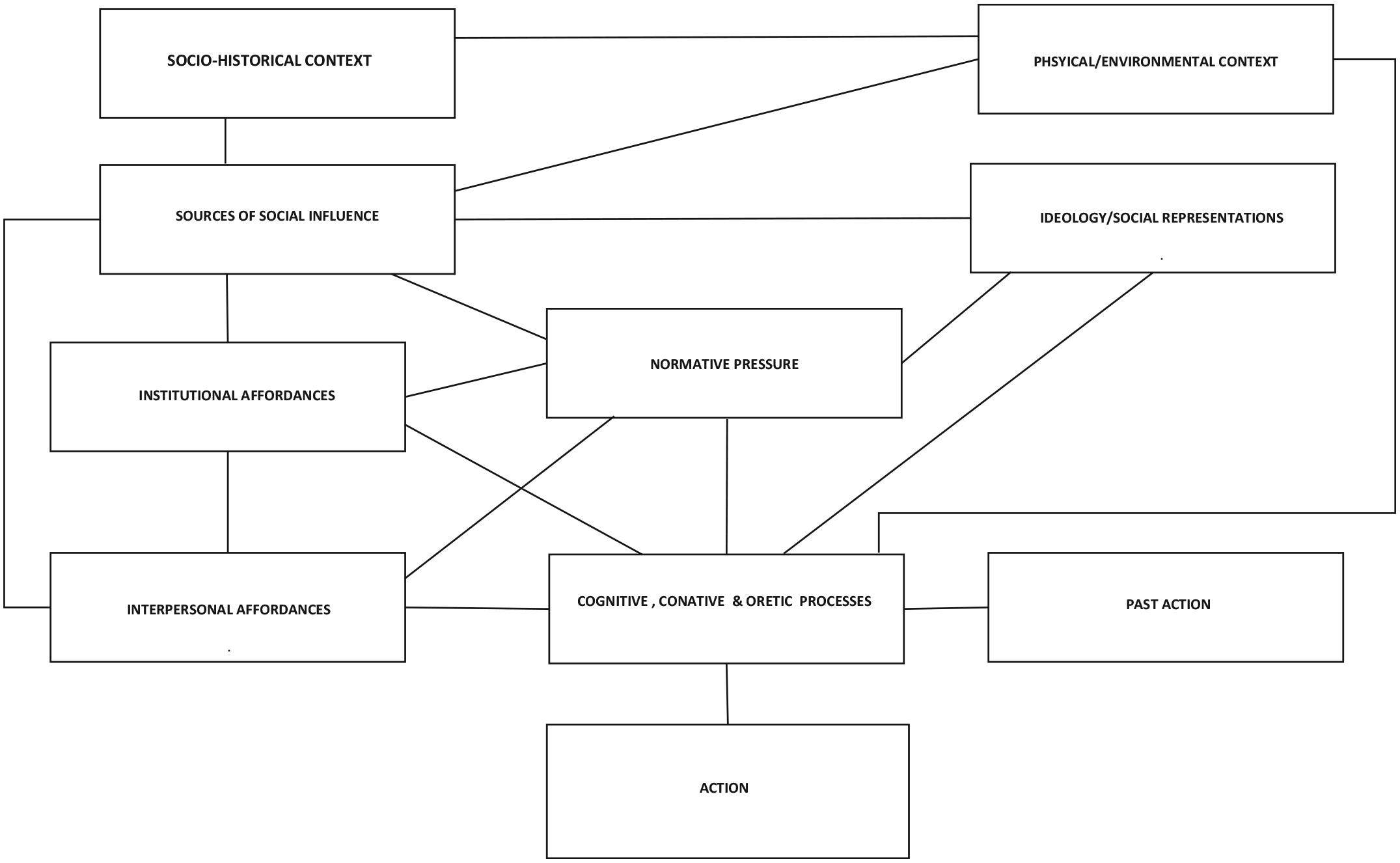
A generic framework for social-psychological analysis.
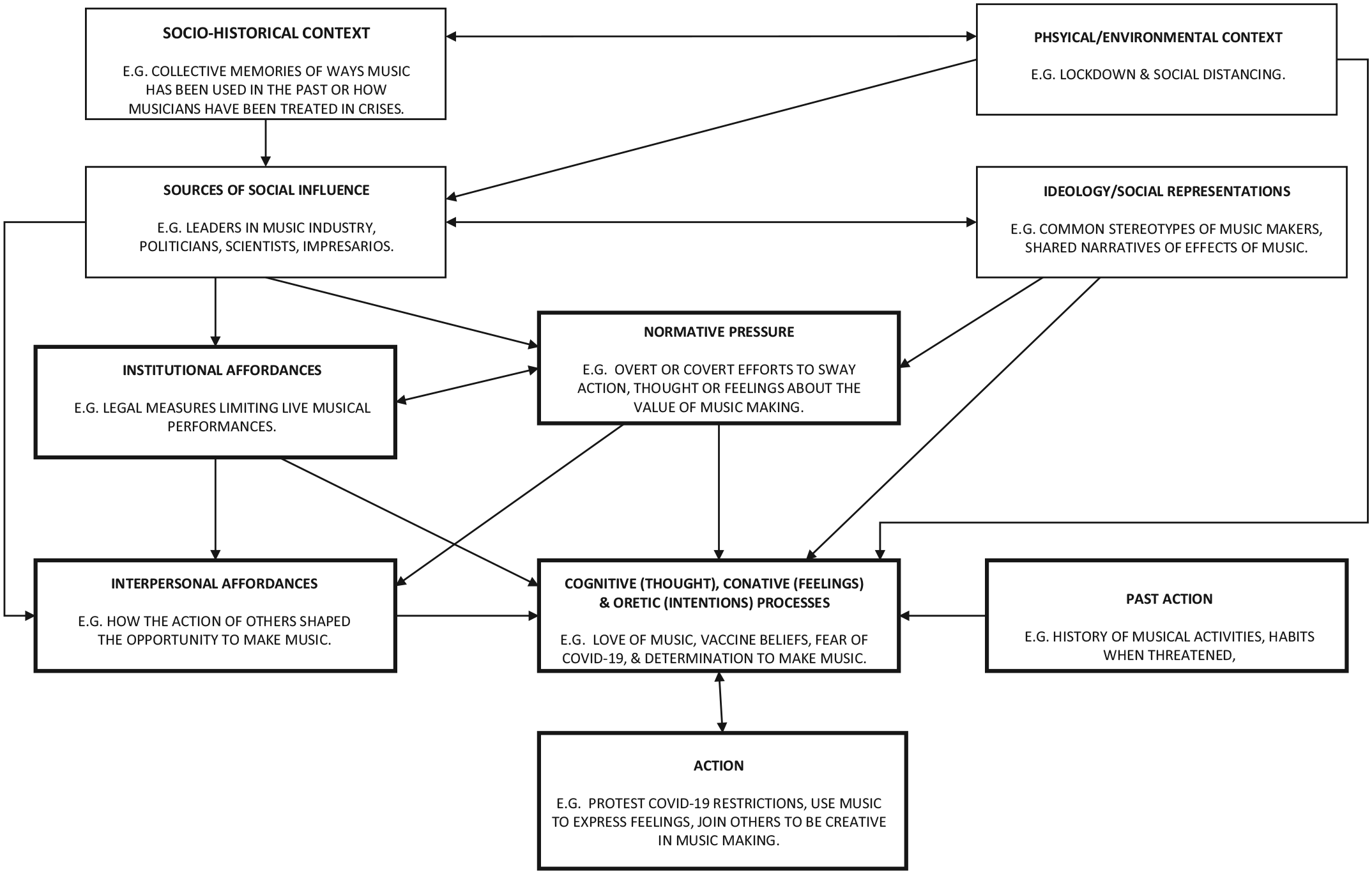
Outline framework for social-psychological analysis of determinants of action of musicians during the COVID-19 pandemic.
The sociohistorical context captures social memory, that is, how people collectively recall, think, and talk about the past. The shared memories of the past provide a lens through which present circumstances can be viewed and future outcomes can be predicted. The COVID-19 pandemic is often contextualized in relation to another pandemic, Spanish influenza, which occurred more than a century ago (Páez & Pérez, 2020). Historically music, and especially music making, has been used to make sense of challenging situations and to cope with them. For instance, during World War 1, many war songs emerged that provided a mechanism for self-expression, solidarity, and hope (Perlsweig, 2021). Collective memories of the value of music in previous troubled times trigger its use in new crises. The balcony singing that was widely reported during the COVID-19 lockdown in Italy is evocative of musicians’ reactions to the Black Death in the 7th century. In short, the sociohistorical context of music making in relation to adversity shows how it can be mobilized as a means of dealing with present-day adversity.
The physical/environmental context reflects what is happening in the material universe. The line linking it to sources of influence and thence to ideology and social representations is meant to indicate that this physical reality takes on meaning through social construal and action. Lockdown and social distancing happened and transformed the COVID-19 pandemic into an economic, social, and psychological hazard to many musicians.
Sources of social influence are those individuals, groups, and institutions that influence the course of events. During the pandemic, politicians, scientists, policy makers, community leaders, media celebrities, social media pundits, and many others could plausibly be regarded as sources of social influence. It is noteworthy that these sources of social influence rarely operate in isolation but rather that the social attitudes, beliefs, and understandings that they disseminate interact with those disseminated by others. They are thus transformed and acquire different levels of traction. The situation for musicians and musical performance during the pandemic relied on the actions and rhetoric of many different sources of influence. Our case studies, described later, show how these influences in some cases enabled music making and in others effectively prevented it.
Ideology/social representations refers to systems of widespread or shared beliefs, and values used to interpret the meaning of what happens. For musicians during the COVID-19 pandemic, others’ beliefs about the economic value of the music industry and the morale-boosting potential of music were among the factors that shaped the amount of support they received.
Normative pressure refers to the processes and acts of communication that allow social influence to have impact. Normative pressure works mostly to ensure that individuals conform to what their peers and others who are important to them would wish them to do. At various times during the pandemic, music makers, whether professional or amateur, would have come under competing normative pressures. On one hand, such pressures came from other musicians expecting them to find some way to perform at all costs, and on the other from political and health authorities instructing them to remain isolated. Such conflicts of normative pressure are prime sources of threat to identity. They put in stark relief the disagreements between different pillars of influence upon which identity evaluation relies. Maintaining identity positivity in such situations is enormously difficult. It can entail big decisions about revaluing the importance of the pillars themselves.
Institutional affordances reflect the constraints and opportunities created by the institutions that are able to curtail individual freedom of action (e.g., through legal, economic, or religious barriers). In the complex context of the COVID-19 pandemic, there were many institutions at work. The political decisions that eased lockdown and social distancing freed musicians to engage in proactive action The policy requiring individuals to self-isolate if traced and found to have been in contact with someone with COVID-19 introduced ongoing uncertainty about whether performances would be canceled at short notice due to members of the orchestra or cast being “pinged.”
The term interpersonal affordances refers to the influence of other individuals upon action decisions, or how they choose to act. Virtually, all actions are affected by what others do, whether in the past, present, or anticipated future. Like everyone else during the pandemic, musicians decided what they would do in the context of what others were doing. Obviously, the actions of certain others are more important, and those who contribute to the way an individual achieves a positive and resilient identity are most influential in shaping that person’s choice of action.
Past action reflects the individual’s own past behavior in relation to the object of analysis. Musicians who have habitually given live performances are likely to find the online alternative less acceptable. This is particularly so if they use live performance, with audience feedback, to reinforce their sense of personal worth and competence.
Cognitive, conative, and oretic processes refer to processes at the intrapsychic level that result in the thoughts, feelings, and intentions of the individual. In practice, this requires careful analysis of emotional states as they relate to decision making and intention. These processes are not necessarily rational or conscious. Responses to the challenges of the COVID-19 pandemic have often been determined by emotions (e.g., fear, anxiety, anger). In building a model of how the identities of musicians responded to COVID-19, emotions, like all the other factors in this generic framework for social-psychological analyses, need to be taken into account.
Action in the framework simply refers to the outcome of the system of processes identified above. Obviously, any action that is taken may well feed back on and change the processes that resulted in its occurrence. The feedback loop is important to remember because coping with threats to identity can depend upon it. For instance, the actions taken by some individuals in the music industry changed the opportunities that were made available to many other musicians during the pandemic.
A focus on identity processes
This article focuses upon examples of how musicians have reacted to the challenges that the COVID-19 pandemic created for them. It centers around the types of coping tactics they deploy to deflect or remove threats that the pandemic represents to the aspects of their identities that rely on music making. IPT (Breakwell, 2014, 2015, 2021b; Jaspal & Breakwell, 2014) is an integrative model that focuses on how people construct their sense of identity, how their identity develops over time and space, and, crucially, how people retain a stable sense of identity in the face of events and situations which can challenge it. IPT abandons the rigid distinction between personal identity and social identity that is made in the social identity approach (see Brown, 2020), instead acknowledging that identity consists of a constellation of elements, which will include individual characteristics (e.g., personality traits) and group memberships (e.g., being a member of a choir). Actually, being a musician has been understood in both ways. For instance, being a musician can be construed primarily as an individual trait (e.g., “I have always been musical”) or as a membership of a group (e.g., “I feel that I belong to a community of musicians”).
IPT postulates that the person’s identity is a product of two processes:
Assimilation-accommodation refers to the absorption of novel elements into the identity structure and their subsequent accommodation within it. Assimilation-accommodation is a continuous process. This has been most apparent during the pandemic when musicians have been forced by the physical/environmental context, sources of social influence, and emerging social representations to reassess their identity (Cohen & Ginsborg, 2021). For instance, as musicians have struggled to find work during the pandemic, some have had to take on alternative employment. This calls for the assimilation of a novel identity element, derived from the new employment. Previous identity elements are reconfigured in order to accommodate the new. Essentially, failing to find work as a musician can challenge self-definition as a musician and finding it necessary to take other work introduces an alternative component for self-definition. IPT does not suggest that assimilation and accommodation will inevitably result as a consequence of changed life circumstances. People may resist changing their self-definition. For instance, some musicians would not treat inability to work in their industry as a blow to the role of musician in their self-definition. IPT is interested in explaining why and how some people will resist changes in self-definition;
Evaluation refers to the process of attributing significance and value to both existing and novel identity elements. Like assimilation-accommodation, the evaluation process entails continuous adjustments. Both processes are dynamic. The value of identity elements changes over time and contexts and is shaped by changes in social representations, normative pressures, and institutional or interpersonal affordances. For instance, musicians may append positive meaning to their musician identity element because it tends to provide feelings of self-esteem, positive distinctiveness, and self-efficacy (Abrams, 2009; English & Davidson, 2020; Hendricks, 2016; Kruse, 2012). However, the COVID-19 pandemic introduced a new frame of reference for identity evaluation for many professions. For instance, some workers in the National Health Service (NHS) found that the identity elements associated with their occupation were evaluated by society more positively. Some musicians, amateur and professional, who engaged with efforts to support other people during the pandemic by music making may also have experienced public approbation that raised the significance of being a musician in their self-definition.
Assimilation-accommodation and evaluation processes involve personal agency. The changes they initiate in the identity configuration (referred to above as the self-definition) are not simply determined by influences outside the individual’s control. The individual is motivated to build an identity that satisfies certain principles. To do this, the individual will deploy many different coping strategies at various levels to ameliorate or divert the effects of changing circumstances on self-definition. A common coping strategy is denial (i.e., refusing to accept that something has actually changed). A coping strategy, possibly more adaptive in the long term, focuses upon efforts to minimize the substantive implications of the change. In the case of musicians during lockdown, the shift to online performances or music sharing may have operated as such a coping strategy.
Identity principles
The identity principles that the individual is motivated to satisfy in coping with change include the following:
Self-esteem refers to the extent to which one values oneself and believes oneself to be valued by others. Among performing musicians, personal interest in music, self-perception of music abilities, and support and recognition from others have been found collectively to contribute to self-esteem (Kruse, 2012). Moreover, authentic self-expression in music, when it is possible in other spheres of one’s life, can facilitate feelings of self-esteem (Swart, 2016).
Self-efficacy refers to feelings of personal control and competence. This has been found to be a significant predictor of musical achievement in both amateur and professional musicians; in particular, self-efficacy can promote enactive mastery experience, vicarious experience, verbal/social persuasion, and positive physiological and affective states (Hendricks, 2016). This identity principle can motivate the development of musical skills and qualities, as well as optimizing performance (Ritchie & Williamon, 2007). More generally, music making itself can facilitate feelings of success and accomplishment in individuals who, in other spheres of their identity, experience decreased confidence, autonomy, and control (Fancourt et al., 2019).
Continuity refers to the perception that one’s past, present, and future are connected in a meaningful way. Music often facilitates a sense of continuity through its connection with nostalgia and evoking, through playing or listening to music, positive memories of the past, relating to the self, or valued group memberships, in the present (English & Davidson, 2020). Furthermore, musicians themselves may establish feelings of continuity by reproducing particular musical styles that are evocative of their nationhood, ethnicity, culture, favorite football team, family, and other valued identity elements (e.g., Bogt et al., 2011; Lum, 2017). This too may serve to satisfy the motive for identity continuity.
Distinctiveness refers to feelings of positive differentiation of oneself from others. Musical preferences can contribute to achieving an optimal sense of distinctiveness from others. In fact, people tend to invest greater resources in, and show greater commitment to, music that is neither unique nor very mainstream (Abrams, 2009). Creating music can also facilitate a sense of positive differentiation from others. Guion Peoples (2017) makes this point in her analysis of Prince’s musical career, which relied on a tension between elements of his identity derived from being African American and musical, respectively, and which, in turn, produced feelings of positive differentiation in relation to both social groups. It has been argued that, in some cultures, roles in music groups can also bestow distinctiveness upon an individual (see Vignoles et al., 2000). In collective music-making settings, such as that of a band, occupancy of particular roles (e.g., being the guitarist, keyboard player, and vocalist) also confirms the unique contribution that each individual makes to the overall success of the musical project.
Each of the identity principles has been thoroughly investigated across many populations, times, and places. There is some evidence that personality traits (e.g., neuroticism) or ideological beliefs (e.g., political orientation) influence the importance of each principle to an individual. Responses to changes in circumstances will vary according to the importance of each principle so that, for instance, those who place greater importance on continuity may find change, especially abrupt and unanticipated change, more threatening to their identity (Bardi et al., 2014). Empirical research has shown the identity principles to be cross-culturally relevant although they may be manifested in different ways across cultures. For instance, in individualistic societies, distinctiveness may be derived primarily from individual achievements and contributions, while in collectivistic societies, this principle may be satisfied by occupying a role or roles in a particular group (Vignoles et al., 2000). Of course, these two routes to distinctiveness can coexist. Being a musician, especially one who performs with others, can confer distinctiveness on the individual through both individual and collective routes. Similarly, the building of self-esteem may be attributable both to the individual’s own musical accomplishment (e.g., learning to play the piano during lockdown) and the group’s collective musical achievements (e.g., singing in a choir).
A unique contribution of IPT to the already rich literature on the four identity principles is its focus on individuals’ responses to events and situations that challenge these principles. IPT argues that, when identity processes are unable to comply with the four motivational principles, the individual experiences identity threat. This may be harmful for psychological well-being. It can be argued that musicians occupied a threatening position (e.g., a position in which their identity was susceptible to threat but not necessarily threatened) due to the pandemic and the constraints upon social and economic life that it generated. Certainly, the curtailment of live musical performances during the COVID-19 pandemic created a series of conditions likely to challenge one or more of these identity principles and thus threaten musicians’ identities. Some musicians may have perceived the pandemic as inducing financial insecurity for them as individuals, while others may have perceived it as threatening the music sector as a whole. Some musicians would have felt it threatening in both respects. Both, although involving different identity elements, have the capacity to undermine feelings of self-esteem, self-efficacy, continuity, and positive distinctiveness.
Coping strategies
The consequences of identity threat are dependent on many factors. Individuals may adopt a coping strategy consisting of a series of planned coping activities or a single stratagem (a coping tactic). The coping strategies or tactics that an individual uses will usually influence the consequences of identity threat. IPT argues that attempts at coping take myriad forms but that they cluster into three types. These types can be used in concert or sequenced over time. The choice of type will depend primarily on the source of the threat and the resources (psychological, social, and material) of the individual concerned. The three clusters entail intrapsychic, interpersonal, and intergroup coping strategies.
Intrapsychic coping strategies
These operate at an individual psychological level and include modifying cognitions in order to reduce or eradicate the threat to identity. A common feature of intrapsychic coping is the constructive reinterpretation of the sources of threat and of their implications. For instance, some musicians may have chosen to interpret lockdown as likely to be short-lived and as a brief disturbance that could be ignored or even treated as a short opportunity (e.g., extra time to spend with the family or composing). This interpretation was erroneous but, while maintained, it may have prevented the need to examine the implications of the COVID-19 pandemic for being a musician.
Another sort of intrapsychic coping strategy relies more upon accepting the change for what it is but trying to think of ways to take advantage of it. Some musicians understood very early in the pandemic that virtual performance would need to be substituted for live performance. They anticipated that becoming online performers could be one way of retaining some of the identity benefits of being a musician. As a result, their identity configuration will have changed; they will have assimilated and accommodated new ideas about themselves as musicians and as a person. Some transient change in the relative priorities of the identity principles may have taken place (e.g., perhaps continuity gave way a little to distinctiveness and self-efficacy in achieving identity benefit) to make this advantageous.
Using music to manage personal reactions to the COVID-19 pandemic also falls into the category of intrapsychic coping. Songwriters and composers who faced the risks and the trauma of living through the pandemic had another coping strategy at their disposal. They could express their thoughts and feelings in their compositions. The mere act of creating their music may have been a means of identity protection or of catharsis. For instance, the ability to speak of sadness or fear can help assuage them. It is also a potent example of how sharing the meaning of COVID-19 with others, through new music, can not only be a coping strategy for the creator but also offer coping routes for other people, acting as a voice for their emotional tumult.
Interpersonal coping strategies
These rely on modifying the nature and patterns of relationships with other people to reduce or eradicate threats to identity. Typically, this entails seeking out support from others. In the context of the COVID-19 pandemic, we have found repeatedly that those who have strong support networks suffer less serious negative effects (Jaspal & Breakwell, 2022; Jaspal et al., 2020). It has been notable during the pandemic that informal interpersonal networks were energized and developed by musicians through social media (Cohen & Ginsborg, 2021). These networks are not exclusive to musicians. However, they were a strong basis for providing practical and emotional support for musicians who found in them an alternative way to gather affirmation of their self-esteem, self-efficacy, distinctiveness, and continuity. In this, musicians are not unique. It would be a mistake to think that the identity threats and coping strategies of musicians are fundamentally different to those of other people. Case Study 1, which describes how members of a choir dealt with COVID-19 constraints, illustrates how interpersonal coping strategies within a single group can morph into action that affects many other people.
Intergroup coping strategies
These rely on the modification of actual or perceived relationships between groups. For musicians in the context of the COVID-19 pandemic, this sort of strategy may appear to be an unlikely option. The intergroup relationship that would need to be changed in order to help the music industry would be that between it and the policy makers instituting lockdowns. In fact, there is an example of an attempt to change this intergroup dynamic in Case Study 2. Andrew Lloyd Webber, the composer and theater owner, tried very hard to change the social distancing and self-isolation rulings applied to theater performances. Such direct action to change intergroup relationships is rare. More usually, individuals try to modify the perceived relationship between groups by promulgating representations of the outgroup that raises the value of the ingroup, and thus its value for the identities of its members. Some of this strategy was exhibited by musicians in the COVID-19 outbreak, where claims were made for the unique value of the music industry to the community and its economic vibrancy. Such claims were typically associated with the request that musicians be given some respite from COVID-19 restrictions. It is interesting to note this reflects a technique often used in the protection of identities against threat: to protect oneself, one claims to be offering protection to others. Of course, sometimes the claim is actually justifiable.
There are many factors that determine the choice of coping strategy and its effectiveness, including the elements of the generic social-psychological framework outlined in Figure 2. One significant determinant of coping is identity resilience, which is discussed next.
Identity resilience
In recent research using IPT, Breakwell and colleagues (Breakwell, 2021a, 2021b; Breakwell et al., 2022; Breakwell & Jaspal, 2021a, 2021b) have introduced the concept of identity resilience. This refers to the perception that one’s identity configuration is characterized by personally satisfactory levels of self-esteem, self-efficacy, continuity, and positive distinctiveness. Identity resilience reflects the personal perception that one’s ability to understand and overcome challenges and to retain a sense of self-worth and value safeguard a consistent sense of who one is, and to that one remains positively distinctive from others. Higher self-ratings of these four characteristics represent a greater overall sense of identity resilience.
Previous empirical research has indicated that having greater baseline identity resilience is associated with lower levels of identity change in the face of stressors with the capacity to threaten identity (Breakwell & Jaspal, 2021a, 2021b). This can be attributed to the stability of the identity structure that in turn may be better positioned to withstand potential threats. In the original statement of IPT, Breakwell (1986) distinguishes between occupancy of a threatening position and the actual subjective experience of threat. This reminds us that not everyone who is exposed to a hazard or risk to identity will actually experience identity threat. Moreover, among those who do experience it, the extent of identity threat will differ. It could therefore be hypothesized that those musicians who have higher baseline levels of identity resilience will exhibit less negative affect, such as fears and worries about the future. They may therefore be less susceptible to identity change when exposed to the stressors associated with the pandemic, such as lockdown curtailing live musical performance.
It has been found that people with higher baseline identity resilience are more likely to adopt adaptive coping strategies (i.e., those strategies with higher levels of long-term effectiveness) than those with lower identity resilience (Jaspal, Assi and Maatouk 2022). Accordingly, those musicians with higher baseline levels of identity resilience should be more likely to engage in adaptive strategies. For instance, they may be more inclined to adopt pragmatic, future-oriented strategies, such as the transition to virtual settings for musical creation.
Case studies
Using a case study approach (Jaspal, Assi and Maatouk 2022), we outline three case studies showing how the identities of musicians have been threatened by the COVID-19 pandemic and how they may be coping with the stressors associated with it. The case studies were chosen specifically to illustrate how different coping strategies or tactics have been used by musicians during the pandemic. These cases indicate how coping strategies at all three levels (intrapsychic, interpersonal, and intergroup) are used, sometimes in tandem, always dynamically. The case studies involve a male-voice choir, well-known songwriters, and a composer and theater impresario. The descriptions of these cases are based on publicly available sources in the form of media reports and websites that are cited in the case descriptions.
Case Study 1: The Featherstone Male Voice Choir
The Featherstone Male Voice Choir, formed in 1963, is, as its name indicates, for males only and has around 45 members ranging in age from 40 to 89 years (Featherstone Male Voice Choir, 2022). Prior to the COVID-19 UK lockdowns of 2020–2021, it met twice weekly in the small former mining town of Featherstone in West Yorkshire. Before the pandemic, the choir performed in venues across the Wakefield district, with a wide-ranging repertoire from the classics to almost modern popular music besides traditional choral and Christmas music, often to raise money in support of charities and good causes.
When their in-person rehearsals were made impossible in March 2020 due to COVID-19 restrictions on mobility and social gatherings, they tried hard to continue. They used video teleconferencing to continue their rehearsal sessions. This was not a very satisfying experience. Members varied in familiarity with the technology. Sometimes, time lapses in transmissions left singers out of synchrony with the rest and needing to silence their individual contributions. Yet they persisted, maintaining the camaraderie that characterized the group, and looked forward to the easement of lockdown.
Their hopes that by May 2021 the choir would be able to sing, socially distanced, in the Featherstone Methodist Church were dashed. On the day that they were due to start there, the legislation was changed, banning indoor gatherings. The local newspaper, the Yorkshire Post, reported one of the members responding to this news as follows:
All of a sudden we were in the lurch, there was nowhere for us to go. Choirs like ours are rooted in mining communities. This has felt an existential threat. We couldn’t help but wonder how this will all work in a post-COVID world? (Kitchen, 2021)
The Chief Executive of Featherstone Rovers Rugby Club, on hearing of their plight, offered the club’s stands for rehearsals. This provided for up to 30 members of the choir to rehearse together, with a three-seat space between singers in alternate rows. One member of the club said at the time, “Choirs throughout the land, throughout the world, have struggled to connect. We have tried everything as a choir to keep interest going . . . At least now we can hear each other’s voices” (personal communication, 3 June 2021). Particularly for those in poorer health, being together for the first time in 14 months, in a COVID-secure environment, was felt by members to have made a difference.
Subsequently, the choir was able to sing to supporters in the stands at a match. The media reported the gesture from Featherstone Rovers allowing the use of its stands as a “wonderful gift” to the former mining community of Featherstone (Kitchen, 2021).
Relevance to identity processes
Whether in the Welsh valleys or the Yorkshire Dales, mining communities have traditionally bred splendid male-voice choirs that have offered their communities a focal point for engagement and opportunities for friendly rivalries. For their singers, the choir is a social organization that offers support, a valued position in the local community, and regular contact with other men who share an interest in music and in performing. Membership can be long lived and offer predictability and routine, as well as the excitement of entertaining others.
In identity terms, the choir allows members:
Various forms of positive distinctiveness: within the choir by virtue of the differentiation between types of contributions they make (e.g., soloists, music coordinators, website manager) and beyond the choir because the contribution it makes to charities and social events earn members’ recognition;
Continuity: the choir normally represents a constant aspect of the member’s identity; it is not usually transient, and it ties the individual to the past and into a prospective future that, together, offer continuity in self-schema;
Self-esteem: successes of the choir and successes of the individual’s performances in the choir offer the substance for evaluation of self-worth and social acceptance;
Self-efficacy: the choir provides the basis for making a difference in the local community; it is an axis for change through actively helping those who are in need, if only through raising the spirits of those in care homes with a round of Christmas carols.
These effects will manifest themselves for different individuals and groups in different ways and to differing extents. For instance, the Featherstone Male Voice Choir consists, of course, of men only, and it is possible that these effects would manifest themselves differently for members of female choirs (see Breakwell, 1979). An examination of other female-only or mixed-sex choirs would be valuable in future research. The general point is that being part of this sort of choir involves more than the process of making music. It also involves the process of developing identity.
With COVID-19, the processes that normally contributed positively to identity were disrupted. The inability to meet and perform challenged the capacity of the choir to function as a support for identity. The social cohesion usually offered by involvement in the choir was challenged.
The coping strategies deployed initially sought to resurrect the connectedness of the members virtually. It was recognized how inadequate this was. But the effort was made. The choir did not go into abeyance during lockdown. Hope for the future revival of activity was maintained. When their expectations of singing together again were dashed initially, they gave voice to their disappointment, and they received a remarkable gift. The use of the Featherstone Rovers Rugby Club stands for rehearsals provided a route to their renewed togetherness and then actual performances. The rugby club, considered locally as a key institution in the community, provided the solution. This support reflects how the symbols of the identity of a community that has such a rich heritage may come together when under threat. Alliances that are mutually beneficial for identity processes are important forms of coping strategy. When these allies are significant for the sense of community identity, their success in dealing with threat can have positive ripple effects for the wider community (Puddifoot, 2003).
With regard to resilience, interpersonal and intergroup support is particularly important. People differ in the level of resilience they have at any one time and in any particular challenging situation. However, the individual’s resilience and its expression can be significantly affected by the activities of people around them during any threat, especially those people who are important to them. In the case of the choir, the resilience of the members as a whole acted as a support for each individual. In addition, the practical support for the choir from the rugby club had ripple effects on other people locally. It enhanced the broader community’s sense of efficacy. It showed that something could be done to mitigate the negative effects of the COVID-19 pandemic. In times of fear and sadness, it is possible to ignite hope and foster resilience through lateral thinking and generosity.
The Featherstone Male Voice Choir is by no means unique in its attempts to cope with the implications of the COVID-19 pandemic; male, female, and mixed-sex amateur choirs and bands across the United Kingdom have gone to remarkable lengths to continue to make music and to entertain others. The wider public has often become aware of their efforts because they have been reported in local media. The roles of local media within their communities have been significant in telling the stories of these musicians. The media can promulgate images of these choirs and bands as local exemplars of determination in the face of the COVID-19 threat. Incidentally, examining media representations of choirs during the pandemic would further contribute to our understanding of identity processes.
Responses to the COVID-19 pandemic have been massively influenced both by the effects of personal resilience and by the effects of the resilience of groups, communities, and institutions. The interaction between the individual and the shared sense of resilience permeates all reactions to the pandemic. A shared capacity for resilience, and for coping based on resilience, is often activated by a spokesperson, typically someone who can identify the main features of the problem that has to be faced and who can articulate what should be done and by whom. The next case study, which comes from musical theater, exemplifies the influence of so-called champions on the effects of COVID-19 threats to identity and coping strategies.
Case Study 2: Professional musicians and live performances—Andrew Lloyd Webber
The restrictions introduced to control the spread of COVID-19 not only interrupted the lives and work of musicians during total lockdown periods but also subsequently. This was particularly evident during the initial easing of lockdowns in the way performance venues were either prevented from opening or allowed to open only if social distancing for audiences could be maintained. Changes in the rules during the summer of 2021 were introduced incrementally, and uncertainties about the timing of relaxation of the rules made planning for public performances very difficult. Even when governmental restrictions allowed performances, audiences for live shows were reduced as people avoided crowded spaces.
Professional musicians, like many other workers, found that their industry was facing major financial difficulties (UK Music, 2022). Some faced the closure of shows or cancellation of concerts in which they were scheduled to perform. Since the music industry is fundamentally international, there were also significant challenges in navigating the complexities of different regulations in force across countries. Obviously, not all professional musicians depend largely on live performances for their income, but many do.
The COVID-19 pandemic had substantial effects on musicians reliant upon live performance to large audiences. These were financial, in both the short and longer terms—particularly if venues had to be permanently closed after debts had accumulated during lockdown—and related to psychological well-being. For a professional performer, the inability to perform can be a significant identity threat as their work is an important element in the configuration of their identity. Not only is musician their occupational descriptor but also the way they construe themselves. It is a way in which they achieve self-esteem and a sense of self-efficacy. The performance reinforces this when they are acclaimed, applauded, recognized, and rewarded for their skills and their creativity. The COVID-19 pandemic disrupted this system of identity reinforcement. Performances were reduced to virtual engagements where audience feedback is minimal. Mutual support or competition from other musicians was removed or shifted into the once-removed virtual dimension. The self-isolation component of the response to the pandemic was particularly problematic for people who typically rely upon opportunities for structured social exchanges to gain support for their identity.
Many business sectors raised concerns about the effects of COVID-19 restrictions upon their industries, notably tourism, restaurants, and nightclubs. The live music industry also broadcast its difficulties, typically through the Live Music Trade Association, LIVE. By October 2021, UK Music, a trade body for the music industry, had reported that a third of musicians had lost their jobs during the pandemic and that live music revenues had shrunk by about 90% (BBC News, 2021). In the midst of the crisis, it was challenging to explain the particular problems of the music industry so as to improve the situation. Throughout the period May–July 2021, Andrew Lloyd Webber, the renowned composer, philanthropist, theater owner, and musical impresario, had repeatedly challenged the UK government about its handling of the COVID-19 pandemic and its treatment of the arts sector during that time. In May, explaining that most musicals could not play to 50% capacity because the shows were too costly, Lloyd Webber called for government to stick to its commitment to scrap all coronavirus restrictions for theaters in June 2021 (Robertson, 2021). When the government, concerned as to the possible effects of the new Delta variant of COVID-19, was considering pushing back the date for removal of restrictions, Lloyd Webber told newspapers he would go ahead as planned with reopening a theater where his new show Cinderella was to be performed, even if he was arrested for doing so (Webber, 2021). It is unclear how these actions by Lloyd Webber and others in the sector were heard or interpreted by either the public or policy makers. In future, it will be important to examine the multidimensional impacts on diverse audiences of engaging in such group-based strategems for coping with threat. In this case, it soon became clear that the government would not lift restrictions until July, but Lloyd Webber decided to open his show in late June with a house at 50% capacity, despite the financial cost, in the interests of his cast and crew. However, self-isolation rules for anyone who had been in contact with someone with COVID-19 meant that cast members could find themselves having to withdraw from a show without notice and for several days. In early July, Lloyd Webber announced that Cinderella could not open as planned due to self-isolation rules; eventually, it opened at the end of August (White, 2021).1
Irrespective of the actual extent to which Lloyd Webber influenced government policy on COVID-19 restrictions, he was in a unique position to make the public aware of the difficulties musicians were experiencing. His ability to enable people to appreciate both the obvious and hidden costs of theater closure and cancellation may have provided a basis for individual musicians to explain their own difficulties and develop their coping strategies. Examinations of the ways people cope with threats to identity sometimes focus too closely on what the individual thinks, feels, and does. Coping with identity threat is also based upon what influential individuals can do to provide, through their own actions and rhetoric, a framework within which individuals can understand and chart a course away from the threat. In the case of musicians dependent upon live shows to support themselves financially and affirm their identity evaluation, having an advocate who was willing to challenge the rules and restrictions, even at personal cost, may have represented an important lifeline, offering them an alternative social representation (e.g., explanation, someone to blame, a time frame for rescue) of their personal situation. Andrew Lloyd Webber voiced the concerns of his industry to government, but he was also reported to a broader audience who could benefit from his willingness to speak out.
Case Study 3: Coping through creating
This case study is less about a single musician or group of musicians but rather about a route for coping that music creators have, which most people do not have. Composers and songwriters, irrespective of genre, have the opportunity to create new music. They can use this to comment on their personal and shared experiences of the COVID-19 pandemic. Many did (e.g., CBS News, 2020). The Rolling Stones had not released an original song in 8 years, until “Living in a Ghost Town.” The lyrics (source: Musixmatch, writers Michael Phillip Jagger and Keith Richards) are simple and yet capture many nuances of COVID-19 experiences: the loss of visibility, recognition, capacity to have an impact (“like a ghost”), the absence of social contact and activity (“the ghost town”), and nostalgia for other, better times (“life was so beautiful”).
You can look for me
But I can’t be found
You can search for me
I had to go underground
Life was so beautiful
Then we all got locked down
Feel a like ghost
Living in a ghost town, yeah
The song goes on to refer to being “shut up all alone,” begs “please let this be over,” and admits “always had the feelin’ it will all come tumblin’ down.” The song paints a vivid picture of life in COVID-19 lockdown. We cannot say what creating it meant for the writers, but many will empathize with the images they create and the sense of loss those images connote. Such songs represent the thoughts and feelings of many people. They contribute to social representations of lockdown and life during the pandemic more generally. Songwriters can express for others what they would like to be able to say about themselves. The song becomes a double-edged coping strategy. It can allow the writers to externalize the feelings they have, and perhaps reduce the threat to their own identities, but it also allows listeners to understand that they are not alone in feeling as they do. Simply sharing the images can help others cope better with the implications of the COVID-19 pandemic for their identities. For the songwriter, of course, this process may have other positive effects for identity through enabling them to reengage and reunite with their audiences. In terms of the typology of coping strategies described earlier, this one cuts across all three. It requires a mixture of intrapsychic, interpersonal, and intergroup activity.
Recommendations for future research
The specific coping strategies that musicians have used when facing the threats of COVID-19 are linked closely to the particular interpersonal and institutional affordances available to them. However, the way their coping strategies operate at intrapsychic, interpersonal, and intergroup levels is not unique to them.
This article does not consider how musicians differ from others in the way they respond to situations liable to undermine aspects of their identity. In fact, it suggests that their repertoires for self-defense are similar structurally to those available to other people. Our work has not empirically examined whether musicians differ from other people in their levels of identity resilience or success in coping with threat. Since musicians comprise an enormously diverse category of people, such a task would be well-nigh impossible. It is, however, worth examining in future research whether specific types of musicians adopt different coping strategies. Even the same substantive threat (for instance, the requirement for lockdown during the pandemic) can have different implications for different types of musician. For instance, lockdown would have differential financial or career implications for professional and amateur musicians. This is likely to initiate very different coping responses. It would also be valuable to examine identity processes with a greater focus on the effects of policy interventions, such as the impact of the financial support offered by government institutions to the arts sector specifically. Moreover, addressing the extent to which musicians’ lobbying efforts were actually heard and attended to by government institutions would shed light on how institutional affordances and physical contextual factors limit or enhance identity coping strategems. This approach would be consistent with the multilevel model for social-psychological analyses presented in this article.
Future research could usefully focus upon detailed differences between the processes involved. This would allow a more fine-grained analysis of the changes in identity content and evaluation (particularly self-esteem, self-efficacy, continuity, and positive distinctiveness) consequent upon the use of specific coping strategies. This work would support the development of IPT. It may also provide an evidence base for tactical advice for musicians coping with disruption to their music making. To be valuable in theory development, it would be advisable to integrate methodological approaches ranging from the qualitative nonintrusive, as reported in this article, to the quantitative and/or experimental. Identity processes and coping strategies can best be understood through investigations that lay bare the multiple layers of what is actually happening.
The specific role of musical creativity as a coping strategy when faced with identity threat also needs further research. The way it can challenge the negative interpretations of threat is little understood. An area that might be examined profitably is how collaboration in new music creation influences responses in the context of shared threats. During lockdown, Jon Bon Jovi brought his fans, including young children, into his COVID-19 song-writing process (Blistein, 2020). The contributions they made said a lot about their own experiences. We would predict that this process resulted in some identity change for those involved. It would be valuable to conduct systematic experimental and longitudinal studies of identity change through musical creativity during crises.
Conclusion
The COVID-19 pandemic created many challenges for music makers. Some of these, particularly lockdown and social distancing, potentially represented significant threats to their identities, specifically those elements of their identities dependent upon live musical performances not just for maintaining financial solvency but also for self-esteem, self-efficacy, positive distinctiveness, and continuity. Musicians used a wide range of coping strategies to manage the effects of threat, including intrapsychic, interpersonal, and intergroup strategies, as illustrated here in our case studies. In deploying these strategies, musicians were sometimes indirectly supporting others in their own communities and the public at large to deal with or develop a narrative to interpret the effects of the pandemic.
The capacity of individuals to be effective in handling the impact of COVID-19 on themselves was possibly dependent upon their existing identity resilience besides their physical assets. We did not assess the identity resilience of the actors described in the case studies. However, we do see in the case studies how some individuals’ positive attempts to cope not only paid off for themselves but also offered support for others. Our case studies point to three key conclusions: musicians acting together, arousing support in their local community, can maintain their viability; musicians using their public platforms can explain the nature of the threat their musical community is facing and seek redress; and musicians can use their musical creativity to describe and disseminate what many people are thinking and feeling when they are under threat. The case studies illustrate the variety of coping strategies deployed in the COVID-19 pandemic. It is not an exhaustive list and, more importantly, it cannot be. Coronavirus, in one variant or another, is here to stay and the threats it generates will morph into others and require new responses.
