




Abstract
Professional musicians with strong identities in music may also have a high degree of music in their identities. Accordingly, a rigid identification with work may be problematic for musicians, particularly when forces beyond their control change their work circumstances. In this study, we conducted semi-structured interviews with 10 singing teachers, representing a subset of professional musicians, and used interpretative phenomenological analysis (IPA) to explore the ways in which they enacted music in their identities. The framework of musical identities in action was used to interpret the findings, revealing the dynamic, embodied, and situated complexity of music in participants’ identities. Music had existential salience in the accounts of nine participants. Its salience resulted from the dynamic and situated presence of music across the lifespan, the literal embodiment of the singing voice, and the metaphorical embodiment of the presence of music in participants’ experiences. While a strong sense of music in people’s identities can promote lifelong engagement with music, if the emphasis on music is existential, the identity of a professional musician may be at risk when they are faced with an external threat to their livelihood. This is important knowledge for music educators and professional musicians’ career thinking.
Keywords
Today’s professional musicians face unprecedented challenges to the value and even the continuation of their work. For example, the global pandemic, rapid technological advances such as generative artificial intelligence, the gig economy, precarity, and cost of living all pose a threat to musicians’ livelihoods and wellbeing. Professional musicians must negotiate these challenges in new ways if they are to sustain their careers (Canham, 2022, 2023). One strategy is to focus on their identity as professional musicians. In this article, we report an exploration of the experiences of singing teachers, representing a subset of professional musicians, suggesting that an awareness of the role of music in identity may help professional musicians navigate the vicissitudes of their careers in music in the 21st century.
The literature on musical identities has consistently distinguished between identity in music, which refers to a distinct role such as a singing teacher, and music in identity, which refers to the extent to which music plays a role in an individual’s broad sense of self (Hargreaves et al., 2017; Hargreaves & Lamont, 2017; MacDonald et al., 2002; MacDonald & Saarikallio, 2022). The literature has focused on the construction of specific roles and identities in music rather than professional musicians’ sense of music in identity. For example, studies have considered the identities of school music teachers (e.g., Ballantyne & Grootenboer, 2012; Ballantyne et al., 2012; Pellegrino, 2009, 2015, 2019; Welch, Purves, et al., 2010), instrumental music teachers (e.g., Huovinen & Frostenson Lööv, 2021; Natale-Abramo, 2014; Triantafyllaki, 2010), performer/teachers (Fernández González, 2018), and singers (e.g., Hughes, 2013; Lemon-McMahon, 2019; Oakland et al., 2012, 2013, 2014; Schei, 2005; Welch, 2017).
Less is known about how these roles and identities relate to a sense of music in identity, although this relationship is of particular importance for professional musicians. Identities in music are often a key aspect of professional musicians’ self-concept (Hargreaves et al., 2017). Drawing on Tajfel’s (1978) theory of role identity salience, Oakland et al. (2013) connect professional identity in music with music in identity and conclude that “for a professional musician, an occupational identity is likely to have a high degree of salience when determining a self-concept” (p. 261). An identity in music that is work-dependent with a strong sense of music in identity can be fragile, and susceptible to external threats such as redundancy (Oakland et al., 2017) or a global pandemic (Maxfield, 2021). It has been argued that these complex interactions between different kinds of identity must be understood in terms of musicians’ personal and situational liminality, as the modern-day professional musician is in a constant state of “discontinuity and disjuncture” (Beech, 2022, p. 800) with increasing precarity, uncertainty, and vulnerability (see also Canham, 2022). It is thus important to understand the role of music in identity for professional musicians because it has implications for their career resilience, and their health and wellbeing (see Gross & Musgrave, 2020; Musgrave, 2023; Musgrave et al., 2023).
Musical identities in action
The theoretical concepts of identities in music and music in identities are helpful for unpacking the multifaceted ways in which music enacts a sense of self identity (MacDonald & Saarikallio, 2022). There is a dynamic relationship between identities in music and music in identities (Goopy, 2020, 2022, 2023; Hargreaves et al., 2017; MacDonald et al., 2002; MacDonald & Saarikallio, 2022). It is acknowledged that music in identity interacts with other components of the self-concept (Goopy, 2022; Hargreaves & Lamont, 2017) and aspects of our personality (MacDonald & Saarikallio, 2022). This occurs across the lifespan, playing an important role in motivation and lifelong engagement with music (Spychiger, 2021). While the term self-concept is used in psychology, in this article we adopt the broader term identity in keeping with the literature on musical identities. Identity is used in many disciplines, including philosophy and the arts, and evokes an expansive framing of the whole self that is “fluid, evolving, [and] adaptive” (Spychiger, 2017, p. 267). Breakwell (2023) presents identity as a story we tell ourselves about ourselves which we share selectively with others; it is also the story others tell about us. Understanding the multifaceted nature of these self-stories is important because “identity motivates thought, feeling and action” (Breakwell, 2023, p. 2).
The concepts of identity in music and music in identity have been developed further as the result of recent advances in the cognitive sciences resulting in the latest theoretical contribution to the field, the musical identities in action framework (MacDonald & Saarikallio, 2022). The framework incorporates concepts from 4E cognition—in which cognition is viewed as multidimensional rather than purely representational—into the field of musical identities. Within 4E cognition, cognition is embodied (the embodied brain), embedded (the embodied brain-environment), enactive (the embodied brain-action), and extended (interaction of the embodied brain with other objects in the environment including technology) (Menary, 2010; Rowlands, 2010; Shapiro, 2019). Framing musical identities within 4E cognition allows for a more nuanced understanding of musical identities in action with the world around us. Thus, musical identities in action are framed as dynamic (dialogical and performative), embodied (acknowledging the physical expression and experience of music), and situated (arising from social interactions, the use of technology, and the cultures within which we live) (MacDonald & Saarikallio, 2022). The theoretical constructs of identity in music, music in identities, and musical identities in action can help illuminate the dynamic, embodied, and situated nature of music in identity, and the degree to which it is essential for singing teachers’ identity in music.
Identity threat, identity resilience, and music career thinking
The role of singing teacher is a prominent professional identity in music. For example, the most prominent US-based professional organization for singing teachers reports membership of over 7,000 from 35 countries (National Association of Teachers of Singing, 2023). Many professional musicians’ livelihoods and wellbeing were adversely affected by the COVID-19 pandemic lockdowns (Canham, 2023; Crosby & McKenzie, 2022; Spiro et al., 2021). Singing teachers were no exception. Anecdotal reports from this time reveal that the threat of the pandemic to singing teachers’ ongoing professional practice “was nothing short of an existential crisis [emphasis added]” (Maxfield, 2021, p. 109). The message for singing teachers to stop working “was akin to being told to change our identity, or stop being” (Maxfield, 2021, p. 109). These examples speak to a clear and present identity threat for singing teachers during lockdown (see Breakwell, 2023 on coping with identity threat during public crises). Faced with identity threat, understanding the degree to which professional musicians experience music in identity can inform the development of identity resilience. This is the perception of an individual’s ability to cope with and overcome threats and uncertainty while retaining self-worth, and without having a permanent and negative impact on identity (Breakwell, 2023; see also Breakwell & Jaspal, 2022).
The relationship between specific identities in music, music in identity, career thinking, and resilience in the face of identity threats has been considered in previous research. In a series of articles, Oakland reported investigations of the impact of redundancy on opera chorus singers, demonstrating that the embodiment of the singing voice plays a key role in singers’ sense of self, which, in turn, has implications for how they manage career transition (Oakland et al., 2012, 2013, 2014). López-Íñiguez et al. (2022) explored postgraduate classical music performance students’ motivation to engage in music and their career-related meaning-making. These students identified closely with music, which influenced their career thinking; they were called to a music career as a fulfilling activity and were emotionally attached to music, due in part to their early formative experiences of music. López-Íñiguez et al. (2022) suggest that, if external factors intervene to make a career in music challenging or impossible, a strong identification with music may pose a risk to career sustainability. The authors encourage educators to engage in broad-ranging conversations with students about careers to explore the full range of options available beyond an exclusive focus on music performance.
Along similar lines, Breakwell and Jaspal (2022) offer a range of coping strategies, illustrated by case studies, for musicians to employ to build resilience in the face of identity threat. These strategies are intrapsychic, interpersonal, and intergroup, and are useful not only for musicians to maintain financial security “but also for self-esteem, self-efficacy, positive distinctiveness, and continuity” (Breakwell & Jaspal, 2022, p. 795). Musicians with a higher baseline of identity resilience should be more able to adapt to changing external circumstances (Breakwell & Jaspal, 2022; López-Íñiguez et al., 2022; for a more wide-ranging discussion of identity resilience and coping strategies, see Breakwell, 2023). These strategies echo the findings of Oakland and MacDonald (2022), who make the link between the importance of identity work to performer wellbeing and the ability to adapt the self to a rapidly changing work environment.
In the current study we explored these issues with a subset of professional musicians, singing teachers, who are under-represented in the literature. The research questions guiding the study were (1) What is the experience of music in identity for singing teachers and what does music in identity mean for them? (2) What are the implications of this meaning for singing teachers’ identity resilience and career thinking?
Method
Research design
The interpretative phenomenological analysis (IPA) of interviews was used to investigate singing teachers’ experiences of music in identity and the meaning it holds for them. Participants recruited to IPA studies are typically few in number, relatively homogenous, and selected for the purpose of gaining insight into the experiences of a particular group of people (Smith et al., 2022). In IPA studies, the use of a small sample allows for the in-depth, detailed examination of data obtained from each participant. However, as Nizza et al. (2021) explain, “IPA does not eschew generalization. Rather it insists on that generalization being built iteratively and inductively from the careful reading of each of the analysed cases” (p. 383). IPA can, therefore, be used to identify both convergent and divergent accounts, which can be used, in turn, to answer research questions (Smith et al., 2022).
Recruitment
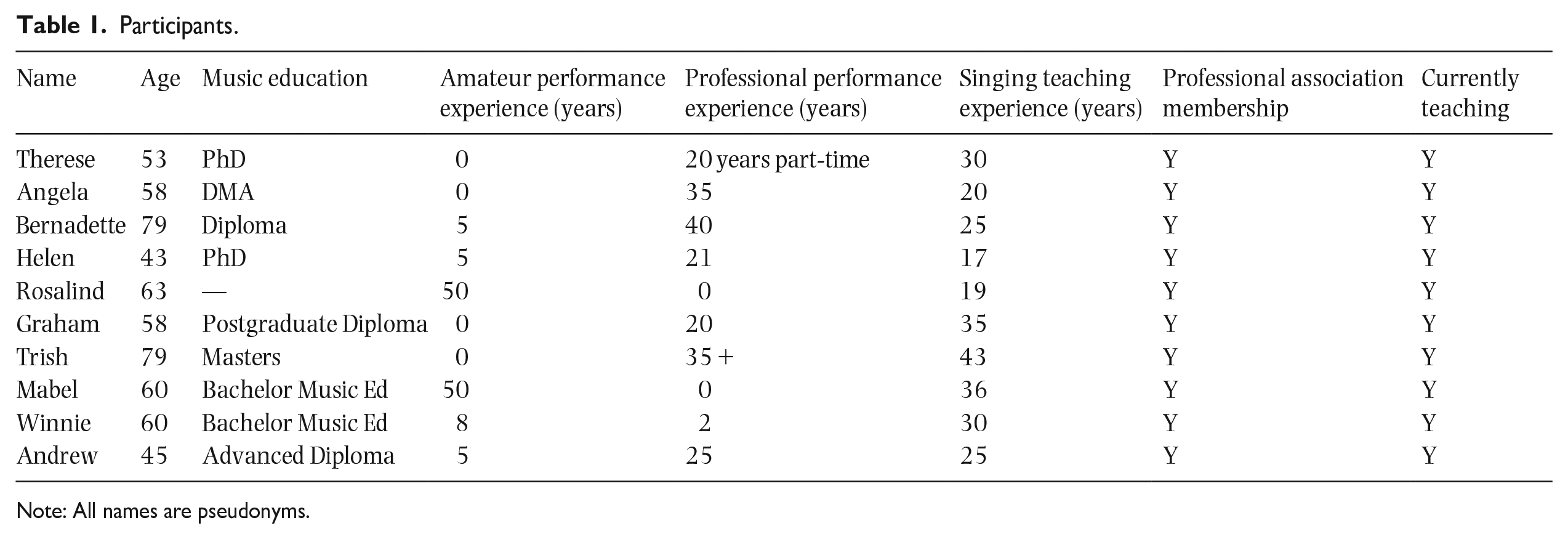
The present study was part of a wider study investigating the socio-cultural factors that influence musical identities. The Australian professional association for singing teachers was included in the call for participants, distributed via email. From the individuals who responded, 10 were selected because of their professional identification as singing teachers (see Table 1). They thus formed a homogenous group, providing an ideal opportunity for us to examine their experiences in relation to issues of musical identity.
Participants.
Note: All names are pseudonyms.
Participants
Participants’ ages ranged from 43 to 79 years, with a mean of 59.8 years. Their experience as singing teachers ranged from 17 to 43 years, with a mean of 28. Seven participants had several decades of professional performing experience. Nine had qualifications in music and/or education. All were engaged in teaching singing at the time of the study and were members of a professional association for singing teachers. Approval to conduct the study was sought and obtained from the Human Research Ethics Committees at the home institutions of the first and third authors.
Data collection
One-to-one interviews were conducted and recorded via Zoom with each participant using a semi-structured interview protocol (see Appendix 1). Where participants were personally known to the first author (a singing teacher and member of the same professional association), interviews were carried out by another member of the research team. Drawing on Hallam’s (2017) conceptualization of the various influences on musical identity, the interviewer asked participants to reflect on their experiences of various social and cultural factors as they related to music, and the role it plays in their lives (e.g., family, cultural environment, educational environment, self-belief, friends, love of music, opportunities, and musical preferences). Questions and prompts were open and broad, for example, “Tell me about the role of your music in your family growing up.”
Data analysis
Interviews were professionally transcribed verbatim and then analyzed by the first author. Throughout the process of analysis, the first author discussed the developing focus of the analysis with the second and third authors. It is important in IPA research for the analyst to acknowledge the implicit knowledge they bring to the analysis (Motta & Larkin, 2023; Smith et al., 2022). The first author is a singing teacher who, at the time of the study, had been involved in the singing voice pedagogy community for nearly 20 years. She used her knowledge and experience to interpret participants’ experiences (Motta & Larkin, 2023), with an eye to hidden meanings and to achieve a depth of interpretation that would not otherwise have been possible.
The process of analysis in IPA research is not prescriptive but flexible, provided the focus of the analysis always remains on participants’ attempts to make sense of their own experiences (Smith et al., 2022). Analysis moves from the case to shared meaning across cases, and from the descriptive to the interpretative (Smith et al., 2022). The following steps were taken to complete the analysis: (1) data immersion by reading through all the transcripts and listening to the recordings of the interviews, making exploratory notes on a separate document for each case; (2) line-by-line analysis of each transcript, making more detailed exploratory descriptive and interpretative notes; (3) the construction of personal experiential statements for each case by grouping these detailed notes together; (4) the formation of personal experiential themes for each case by clustering the meanings of statements; (5) cross-case analysis to form group experiential themes by finding connections between personal experiential themes; and (6) the development of an overall interpretative narrative account, attending to nuance, and convergence and divergence, to interpret and understand participants’ meanings in this context.
Quality indicators for IPA research include the construction of a compelling, unfolding narrative; the development of a vigorous experiential and/or existential account; close analytic reading of participants’ words; and attention to convergence and divergence (Nizza et al., 2021). The analytic process was guided by the literature on quality criteria for IPA (Nizza et al., 2021; Smith, 2011); also consulted was the literature on conducting interpretative phenomenology underpinned and informed by ontological philosophy, especially that of Heidegger (e.g., Conroy, 2003; Frechette et al., 2020; Horrigan-Kelly et al., 2016).
In the remainder of this article, we present a narrative account of one group experiential theme reflecting participants’ experiences of music, the role of music in identity, and the meaning this has for them. We then consider the implications of these findings for the identity resilience and career thinking of singing teachers, and professional musicians in general. We formed other themes related to the nature and strength of various sociocultural influences on the construction of singing teacher identity in music but do not report them in this article.
Findings
With the group experiential theme Musicking Identity, we sought to capture (1) the dynamic ways in which the embodied enacting of music in identity was experienced as bringing forth the authentic self and (2) the salience of music in identity for participants. Thus interpreted, music had primordial, ontological importance in the lives of participants; it was fundamental to participants’ being-in-the-world and afforded experiences of utmost consequence and meaning. The group experiential theme comprised two subthemes, foregrounding music and embodying singing.
Subtheme 1: Foregrounding music
To capture the prioritizing of music throughout life for these participants, the subtheme was named foregrounding. Because the participants’ mean age was nearly 60 years, music could be traced as a long-term and dynamic life presence. This was apparent in nine of their accounts. In Andrew’s words, “there was always music.” Angela, Andrew, and Graham recalled pivotal moments in their formative years that planted the seed of music in the very fiber of their being. Graham had enjoyed a lengthy singing-teaching career of 35 years, with 20 years as a professional singer. He recalled being “moved to tears by music” in church as a child which formed a love in him for oratorio and sacred music. It is this music that had continued to speak “the most deeply” to him. Because of this formative experience, Graham had “always seen” himself, during his 58 years, through the lenses of music performance and education. When Graham said he was “moved” he described a deeply emotional experience metaphorically in terms of a physical experience—the music enacted an existential repositioning into a new world in which music was foregrounded as intrinsic to identity.
Andrew recalled his “visceral response,” as a young child, to hearing Rachmaninoff’s Prelude in C sharp minor on the car radio: I remember it vividly . . . like something I had never heard before but was representative of the entire human experience all wrapped up in six minutes . . . that was what really made me want to be a classical musician. (Andrew) I remember distinctly hearing for the first time the beginning of the Beethoven Violin Concerto . . . I was deeply, deeply, deeply affected on an emotional level. I remember looking around at other people that listened to it and thinking, and their faces were bland, and thinking, don’t you hear it? Isn’t that—I just could not talk of it, it would make me cry and it deeply, deeply affected me emotionally . . . I carry that with me. (Angela)
It is clear from this passage that the experience described shaped Angela’s way of being in the world. Angela experienced herself and her reaction to the music as distinctive from those around her (“their faces were bland” and “don’t you hear it?”). At this moment, Angela was called to music because it set her apart from others—it spoke to her in a way that others do not experience. Both Angela and Andrew went on to build careers in classical singing, with 35 and 25 years of performance experience, respectively.
Trish’s account differed from these in terms of how music was foregrounded and entered her being, but the result was the same; at the age of 79, Trish’s identity had been at one with music for her entire life. Trish was adopted and told that her biological mother was very musical. This embedded within Trish a deep sense of her own “innate musicality.” As a result, Trish dedicated her life to developing her musicality; she described her musical and vocal abilities as having become “friends that have accompanied me through life.” Trish’s personification of her musical and vocal skills as lifelong friends revealed a deep relationality between herself and her musical abilities; like lifelong friends, they were dependable, and a source of solace because they made her feel “[c]omfortable. Never anxious.” They were an intrinsic part of her being and fundamentally shaped the way she was in the world. Sixty-year-old Mabel’s experience was like Trish’s, in that from a very early age, Mabel was identified by others as being able to sing well, sowing the seed for lifelong engagement in singing and music. Again, indicating music’s presence in her life over time, Therese (aged 53 years at the time of the study) stated that music had given “a lot of meaning to my life.” These experiences—whether being moved by hearing music or being identified by others as musical—led participants to have music and or singing as “the main focus” (Bernadette) in their lives.
Helen, Trish, Therese, and Rosalind shared the sense that music is for life, a “language of the spirit” (Trish) that brings forth the ability to live authentically and meaningfully. Both Helen (at 43 years, the youngest participant) and Therese spoke of the spiritual or metaphysical nature of the determined musical path, which is not a path with any destination, but one that enables deep exploration of the self; it is “this endless quest for doing the thing that you do as well as you can . . . spiritual practice is quite like that too” (Therese). Similarly, Helen spoke of her musical development as an “ongoing experience.” It was not a case of “tick box, done . . . I would never feel that way about my singing and I think I would never feel that way about my singing identity as well, that I had somehow finished, and the box was closed.” As Helen said, “there’s a certain spiritual or like metaphysical journey that we go through as well as a musician.” The constant companionship of music in participants’ lives was reflected in their commitment to lifelong learning and to understanding music’s nooks and crannies in depth and in detail; Andrew felt that he had been “doing that forever.” Winnie (aged 60 years) described this thirst for knowledge and understanding as a compulsion: “I remember saying to [my mother], I can’t stop. You know, what do you mean, stop?!” Rosalind too said, “I couldn’t stop, because it was what fed my spirit.”
Absence, silence, or loss can be particularly revealing in terms of the meaning we ascribe to experience (Frechette et al., 2020). For example, Rosalind noted the omnipresence of music, even in its absence: “There might be slabs of the day when there’s no music on, but there could be music in my head . . . The wonderful thing about music is that actually, you’ll never run out.” Four participants raised the issue of loss in relation to music, and three discussed, in particular, the impacts of the COVID-19 pandemic on singers and singing teachers. Andrew recalled how the pandemic wrought destruction on the profession: “COVID has decimated our industry and our identity really . . . in a post-COVID world, we are being devalued.” Andrew linked this to issues of identity and the embodied voice (discussed further below): “I don’t pack this [the voice] away. This doesn’t go into a case and gets slid under the bed. This is everything, who I am, essentially, as a musician.” These passages from Andrew’s interview were perhaps some of the most telling of all the interviews, in terms of the complex links between the embodiment of singing, musical identity, and the consequent risky nature of singing practice when uncontrollable external forces intervene. For Andrew, how could it be otherwise when singing was “everything, who I am?” Helen expressed similar sentiments to Andrew regarding the impact of COVID’s impact but more matter of factly: “when there is no work . . . your identity is severely challenged.” For Winnie, “with COVID hitting, my workload has diminished enormously.” Mabel lost her career in school music education, resulting in her feeling as though “something died in me in that respect, by losing all of that music I was involved in.” Each of these experiences of the loss of music—be it temporarily as for Winnie, or permanently, as for Mabel—was expressed in terms of death, diminishment, struggle, questioning, hopelessness, and lack of agency. The disappearance of music from the foreground was experienced as a loss of self. That is, music was experienced existentially.
In summary, the sub-theme foregrounding music reveals how participants engaged with music over the long term and experienced it as an internalized omnipresence. Music was experienced ontologically as a way of being in the world and for four participants, its loss was experienced as a loss of self. This sense of music as a constant, internalized presence was interpreted by the analyst as an active and situated foregrounding of music.
Subtheme 2: Embodying singing
The second subtheme, embodying singing, supported the group experiential theme of Musicking Identity, with which we sought to capture the existential salience of music in identity for participants. Five participants spoke of the fusion of body, singing, and music, with two further divergent yet nevertheless relevant accounts.
For Helen, music was so natural to her that it was inseparable from the physical self; her sense of music in her identity was almost biological: [Music is] beyond an obsession, it’s beyond an identity . . . It’s like saying I love and enjoy my blood, and my blood is such a huge part of who I am and I need it and I appreciate it and I value it, but I don’t think about it. It’s the same with music.
She described music using the simile of blood, a physiological state or entity, something that is taken for granted as always being there in her body. She spoke of this union of self and music in metaphysical terms: “it’s gone to a godly state of—it’s ethereal now.” The reason for the union of subject (Helen) and object (music) apparent in this account was, in Helen’s words, because “your body is your instrument.” Four other participants explicitly linked the embodied voice and singing to notions of identity and self-expression. It was the embodied nature of singing that initially attracted Angela to becoming a professional singer: “I wanted all that physical expression of the voice and of a performer using your whole body as an instrument.” Rosalind too noticed how “singing lives in your body, and there is no external instrument.” Note that Rosalind does not say “the voice lives in the body”; it was (the more active) “singing” that was given life in physical form for Rosalind. For Therese, the embodiment of singing, and its unity with the self, made singing “a really complex thing to teach and to learn . . . all these sort[s] of embodied understandings and attitudes to yourself and to your identity.” As discussed previously, Andrew said he did not pack his voice away like one might an instrument; his voice was him.
Winnie’s experience of embodiment diverged from the previous accounts, in that she described her accompanying or leading a choir (rather than singing in or with it) as “innate” and “a part of me.” One possible explanation for this divergent expression of embodiment may stem from the fact that Winnie reported having had the least performance experience in singing. The five participants who did speak of the embodiment of singing (Helen, Angela, Rosalind, Therese, and Andrew) had had extensive singing performance experience as professionals or, in Rosalind’s case, an amateur performer for 50 years. While Winnie did not refer explicitly to singing as an embodied experience, she described her practice (as a singing teacher and music educator) using the broader term “music” as “a part of who I am.”
There was one other divergent account of note in relation to the notion of embodiment. Despite Angela’s early experience of listening to music, which was deeply affecting, and her desire to use her whole body to perform music, Angela was the only participant for whom music did not appear to have existential meaning. Angela identified “more as a person than [an] opera singer.” She had a sense of occupying the roles of singing teacher and voice teacher, but her overall sense of self was stated unequivocally: “I identify myself as Angela, more than anything else by now.” Angela described a gradual distancing of herself from vocal music because of her professional singing practice; while she retained an abiding connection to instrumental music, she “cannot say the same anymore with vocal music. It either engages me too much and it’s work, and I cannot step back from it.” For Angela, vocal music is “too close to the bone” and she no longer has “the luxury of [enjoying] performance . . . I’m just too much involved.” In contrast to other participants, it seemed as if Angela had almost excised vocal music from her DNA. Paradoxically, however, Angela’s choice of the metaphor “close to the bone” nonetheless spoke to the embodied act of singing.
In summary, the subtheme embodying singing reveals the physical and ontological salience of singing and music to self and identity for six participants. This was conveyed literally through the biological fact of the embodied voice, and metaphorically through the descriptions of musical experience and singing as embodied (e.g., “close to the bone”; “spine-tingling”; “a part of me”; “like saying I love my blood”). Angela’s divergent experience—the low salience ascribed to music in her identity relative to that of other participants (“I am Angela”)—is a reminder that IPA findings are not generalizable and transferable but are designed to draw out, ideographically, the nature of the experience of a particular phenomenon.
Discussion
This study sought to answer two research questions: (1) What is the experience of music in identity for singing teachers and what does music in identity mean for them? (2) What are the implications of this meaning for singing teachers’ identity resilience and career thinking? In answer to the first question, we found that music was existentially salient in singing teachers’ identity; music was an active, dynamic, situated, and embodied way of being-in-the-world. This notion of music as existentially salient was brought into stark relief through its absence, as described by five participants who had experienced the devastating effects of losing their place in music due to job loss or the COVID-19 pandemic. With the group experiential theme Musicking Identity, we, therefore, sought to capture the existential salience of music in participants’ identities. This salience was a product of the dynamic, situated, and long-term presence of music in their lives captured by the subtheme foregrounding music, the literal embodiment of the singing voice, and the metaphorical embodiment of singing and the presence of music captured by the subtheme embodying singing. In answer to the second research question, the high salience of music in the identity for participant singing teachers has important implications for identity resilience and career thinking for singing teachers and professional musicians more broadly.
Before turning to these implications, it is useful to examine the findings through the lens of musical identities in action, in which musical identities are conceptualized as dynamic, embodied, and situated (MacDonald & Saarikallio, 2022). Foregrounding music shows that participants experienced the dynamic nature of music in identity as always evolving, dialogical, and actively performed. This was particularly apparent during childhood, when participants recalled experiencing deep connections with music in their everyday life (see also López-Íñiguez et al., 2022). These critical formative events cast music as unique in the pantheon of experience and caused four participants (Angela, Andrew, Geoff, and Trish) to feel as though they had been called to music in a way that set them apart from others. These experiences also set participants on a path of lifelong professional and/or amateur engagement with singing and music through performance and teaching.
The situatedness of musicking identities was evident in five participants’ sense of loss of music resulting from social upheavals such as the pandemic and losing one’s job. They spoke of self-diminishment, grief, and metaphorical death (see also Spiro et al., 2021). These experiences of grief point toward a psychological death of the self, or, as Maxfield (2021) expressed, an “existential crisis” (p. 109). Andrew poignantly described the diminishment of the literal value of his work and his identity as a professional musician during the pandemic. Because of the nature of singing, which involves sustained exhalations, and the transmission of COVID-19 through aerosol droplets, it was unfortunately yet necessarily the target of much concern during lockdowns. The pandemic thus caused both financial and psychological losses, which were felt acutely by singers and singing teachers.
Participants also referred to the literally embodied nature of singing and/or the voice as a way of being-in-the-world; for them, music was expressed and experienced physically, unmediated by an external instrument (embodying singing). Such experiences echo much of the literature on singing, the self, and identity, in which the embodied singing self is undifferentiated from the self per se (see Oakland, 2014, on the impact of physical disability and vocal disembodiment on a professional opera singer). The embodied experience of music and singing was also highlighted in participants’ metaphors and similes. Such language used by professional musicians can be a rich source of information about experience and can reveal the cognitively embodied dimension of musical performance (e.g., Forbes & Cantrell, 2023; Holmes & Holmes, 2013). This was illustrated in the current study by phrases such as “close to the bone” and “like saying I love my blood”. For one participant, Winnie, engaging with piano and choral conducting meant that music was “innate,” which we interpreted as an example of extended cognition in which the embodied brain interacts with other objects in the environment (piano and choir as instruments), also revealing an embodied sense of music in identity.
It may well be that posing interview questions in terms of music and/or singing influenced participants’ framing of their responses (see Appendix 1). Participants tended to use the terms singing and music interchangeably throughout their interviews. This tendency may also reveal a complex inter-relationship between the activities of musicking and singing, and the roles of musician and singer. For example, despite having had a professional opera career, Andrew did not recall that he wanted to be a singer; he wanted to be a classical musician. Helen referred to singing and music, interchangeably, in relation to her ongoing development. This tendency for participants to use the terms as synonyms may indicate that they saw themselves as musicians who perform and teach singing, with their voice as the instrument (see Mills, 2004). The infrequent occurrence of either the noun teacher or the verb teaching in the interviews was notable. Perhaps this was because seven of the participants were performers, and singing was the most prominent aspect of music in their identities; it may illustrate their view that teaching is a way of being a performing musician. We did not explore these nuances in the interviews with participants, however.
This was a small-scale IPA study focusing on the experiences of a broadly homogenous cohort of singing teachers; the findings are limited to the first author’s interpretations of the interview data. As is typical in IPA research, we offer these interpretations cautiously but credibly and transparently (see Oakland et al., 2013, 2014). IPA is concerned with the phenomenon being studied as it appears to the individual; the researcher then engages the logos—reason and judgment—to “make sense of that appearing” (Smith et al., 2022, p. 20). While Breakwell and Jaspal (2022), for example, contend that an exclusive focus on intra-psychic processes such as thoughts and feelings are insufficient to fully explore identity threat and coping, we argue that doing so in the case of singing teachers is an important first step in researching this important yet under-represented subset of professional musicians. We also acknowledge that music is but one component of and ever-changing and complex process of identity formation throughout a person’s life (Breakwell, 2023), and that other facets of identity were not explored during interviews because we were focusing in the study on music and identity. It may well be that other aspects of identity such as gender and parenthood are also existentially salient for participants, but we would argue that the salience of one aspect of identity does not necessarily cancel out the salience of others. The complexity of these identity entanglements could be a fruitful avenue for future research.
Recommendations and conclusion
Viewing singing teachers’ identity experiences through the lens of musical identities in action revealed a nuanced and complex understanding of music in identity that could inform other professional musicians’ reflections on their own relationships with and to music. The existential salience of music in identity for participants connects directly to career and identity resilience for professional musicians. The literature and our findings suggest that the existential salience of music in identity for nine of our 10 participants may render them vulnerable to identity threat if and/or when faced with challenges to their ability to engage in music making. This threat had in fact crystallized for five participants when they discussed the impacts of the pandemic and (in one case) job loss.
This raises important questions regarding one of the stated goals of music education, that is, to promote positive musical identities (Elliot & Silverman, 2017; Hargreaves et al., 2018; MacDonald & Saarikallio, 2022). The ways in which these identities can be developed to encourage life-long engagement in music have been reported in the literature (e.g., Goopy, 2020, 2022; Krause et al., 2020; Lamont, 2011, 2017; Welch, 2017; Welch, Himonides, et al., 2010); recent research suggests that these identities do not always encourage beneficial engagement, however (e.g., Goopy, 2023). The findings of the present study suggest that identity risks and costs are associated with a high salience of music in identity. Canham (2022) argues that musicians must be change-ready in a post-portfolio, precarious work environment, able to adapt their identities in response to external factors. We agree with this, and with Oakland and MacDonald (2022) who emphasize that music performers must learn the skills to adapt or modify their sense of self in response to external events that may have an impact on their continuing participation in music making (see also Oakland et al., 2014).
As Musgrave (2023) argues, normative prescriptions drawing on evidence of the benefits associated with music participation are not necessarily relevant to many professional musicians. Professional musicians should therefore develop strategies for building identity balance, flexibility, and adaptability. Maxfield (2021) provides practical advice for singing teachers aiming to achieve a better balance between their professional and personal identities; this includes making time to do other things and build new networks outside of their professional practice. Such advice is relevant to other types of professional musician. We further suggest that developing a stronger sense of connection, in domains beyond that of music, between the self, others, and the world around us, can help de-emphasize the individual as the sole source of identity, moving toward an intraconnected sense of identity, self, and belonging (Siegel, 2022). Given the situational and personal liminality of musicians (Beech, 2022), and the precarity of their careers (Canham, 2022), important skills to include in music education and music career thinking are the development of identity resilience, balance, and a broad sense of an intraconnected self (see also López-Íñiguez et al., 2022).
When music becomes existentially salient for a singing teacher, or indeed for any professional musician, their identity and wellbeing may be at risk. Breakwell and Jaspal (2022) emphasize the importance of raising awareness of the many risks to identity threat for musicians. They also acknowledge that music itself can be one of the most effective coping strategies for dealing with societal upheavals. In light of our findings, we commend the adaptive strategies offered by these authors to singers and singing teachers, and those who teach them, to achieve more balance within their identities, and to build identity resilience. Further research is needed to inform curriculum development in both school and higher education contexts so that music can still be an important part of the lives of singing teachers, singers, and other professional musicians, but those lives can be more balanced.
Footnotes
Appendix 1
Acknowledgements
The authors thank Xanthe Lowe-Brown for assisting with interviews and the participants in this study.
Author contributions
A.E.K. and M.F. collaboratively developed the study, gained ethical approval, and conducted participant recruitment. M.F. and A.E.K. oversaw data collection and M.F. conducted the qualitative data analysis; M.F., A.E.K., and J.G. collaborated on interpretation of findings. All authors collaborated to draft the manuscript and approved the final version of the manuscript.
Funding
The authors received no financial support for the research, authorship, and/or publication of this article.
Ethical approval
Ethical approval for this project was granted on the basis that participants would be asked to provide their explicit consent if the researchers wanted to use their data in future for a comparative study. Approval was not sought for future sharing of the data.
