



Abstract
Since the establishment of a classical music canon in the 19th century, classical music culture has historically been focused on a stable set of masterpieces by genius composers predominantly from the classical and romantic periods. A small number of composers continue to dominate programming to this day. Many classical music organisations are keen to programme music beyond this narrow repertoire and to showcase new or unfamiliar works. The need to sell tickets, however, is often an obstacle, with organisations far more confident in the ability of big hits to attract large crowds. This article explores the experiences and opinions of classical music concertgoers in relation to familiar and unfamiliar music, providing a number of reasons as to why audiences may choose to hear well-known pieces rather than new works. This paper reports on one strand of a qualitative study with 42 individuals who booked tickets for one of two concert series consisting of core and populist repertoire, respectively. Semi-structured interviews were carried out to explore the reasons for their choices and their experiences of attending live concerts. These interviews showed that most participants did indeed have a clear preference for hearing music that was familiar to them, and only frequent attenders relished the challenge of unknown music. Participants felt that listening to familiar music was usually a more enjoyable experience than hearing something new. They rarely spoke of becoming bored with over-familiar music, perhaps because the live concert experience brings a sense of freshness to even the most familiar work.
Since the establishment of a classical music canon in the 19th century, classical music culture has historically been focused on a stable set of masterpieces by genius composers predominantly from the classical and romantic periods (Weber, 2001). A small number of composers continue to dominate programming to this day; Marín’s (2018) analysis of 4,761 performances on the concert listing website Bachtrack (https://bachtrack.com) showed that 10 composers accounted for around a quarter of the works performed in a five-year period (Marín, 2018, p. 118). This has led to a music industry that rewards conservative programming: canonical works tend to result in the availability of cheaper musical scores and reduction in rehearsal time, since musicians are familiar with the music (Tamburri et al., 2015). Not wishing to stagnate, many classical music organisations are keen to programme music beyond this narrow repertoire and to showcase new or unfamiliar works. However, my experience of collaborating with arts organisations suggests that the need to sell tickets presents an obstacle: organisations are far more confident in the ability of big hits such as Beethoven’s Fifth Symphony or the Tchaikovsky Violin Concerto to attract large crowds.
In this article I explore the preference of audiences for classical music for familiar works, and consider why it may be difficult for symphony orchestras to sell tickets for programmes of unfamiliar works. I draw on research with the City of Birmingham Symphony Orchestra (Price, 2017) in which I carried out semi-structured interviews with members of the audience for their core concert programme and the Friday Night Classics series of what I have called in this article populist classical music (see Methodology for definitions of these terms and further information on the two types of concert). First, I provide evidence that most participants did indeed have a clear preference for hearing music that was familiar to them, and only the most frequent attenders relished the challenge of listening to unknown music. Second, I suggest that while the avoidance of unfamiliar music may be framed as risk aversion, it can also be seen as a way of prioritising the use of limited resources (time, money, energy) for music that more strongly guarantees enjoyment. Finally, I propose that the continued appeal of well-known music may be explained best by the sense of freshness produced by live performance, which provides audiences with a sense of the new even when hearing the works that are most familiar to them.
Familiarity and Audience Engagement
Defining familiarity with music (musical familiarity) in the context of audience engagement can be challenging, since each member of the audience possesses a unique mixture of knowledge and understanding of music. As such, familiarity may be best understood by reference to two scales: popularity and individual familiarity. The popularity of music can be viewed on a spectrum, from works that are well-known to the general public, through core canonical works that would be familiar to regular concertgoers and rarely-played works from the common practice era, to premières of new music. Meanwhile, the individual concertgoer’s familiarity with specific pieces of music varies greatly. Attenders could know a piece well through playing, singing or studying, or at the other extreme, be totally unfamiliar with the work, composer or style. It is also possible for a work to be new to the listener but in a familiar style; to use Huron’s (2006) terms, the listener could have no veridical familiarity with a work, and yet still be able to predict the course of the music because of its schematic predictability, through its adherence to stylistic norms. The two scales, popularity and individual familiarity, are related but not equivalent to each other, since even the most popular and apparently well-known works can be entirely new to some members of the audience. Understanding how familiarity influences audience engagement therefore demands that both the assumed popularity of the works in the programme, and the level of audience members’ knowledge of and familiarity with them, should be scrutinised.
This study draws on a growing body of research into audience members’ engagement with live classical music (for some recent examples see Garrido & Macritchie, 2018; Gosling et al., 2016; Toelle & Sloboda, 2019). The process underlying the decision to attend concerts has been investigated extensively in both academic and industry research, particularly for the purposes of carrying out more effective marketing (Baker, 2000/2007) and addressing the social exclusivity and apparent ageing of concert audiences (Dobson, 2010). As Baker has shown, studies have consistently found that, for virtually all concerts, the most influential factor in an individual’s decision to attend is the programme of music to be played, over and above the soloist, conductor, ensemble, price and venue.
Perception of risk has been shown to be a strong influence on the decision to attend. Brown (2004) claims that it is familiarity with the programme, artists, genre, venue and organisation in particular that drive attendance. While factors such as lack of time or money are commonly given as reasons not to attend (Baker, 2000/2007; National Endowment for the Arts, 2015), these practical barriers often mask lack of interest in the art form or lack of confidence that it will be worth prioritising resources such as time, energy or money to experience a concert (Wiggins, 2004). More expensive tickets can often make audiences more selective, prioritising only those concerts offering a high chance of enjoyment (Pitts, 2014; 2016; Radbourne et al., 2009), and Brown (2004) has found that audiences “will pay almost anything to guarantee a home run” (p. 2); in other words, audiences will pay large amounts of money for an event that they are confident they will enjoy. These findings suggest that familiar music will provide a stronger motivation for attendance than unfamiliar music as it is less risky.
A small number of studies have considered the roles of familiarity and enjoyment in choosing to attend concerts. Roose’s (2008) study of audiences for symphonic and chamber music in Belgium found a negative relationship between frequency of attendance and desire for familiarity; infrequent attenders showed a much stronger preference for familiar music than those who attended regularly. Pitts’s studies (Pitts, 2005; Pitts & Spencer, 2008) studies with audiences for chamber music in the UK using questionnaires, interviews and, in the case of the 2005 study, diaries, found that the trust of concertgoers in the ensemble’s programming made them at times “cautiously open-minded” (2005, p. 263), while at other times they reported feeling guilty when they avoided newer or unfamiliar works (2008, p. 10). Dobson (2013) investigated the effect of musical familiarity by taking a group of people to their first concerts of classical music and asking them to comment, in surveys and interviews, on their experience. Dobson found that giving half the participants recordings of the works to listen to in advance did, on the whole, increase enjoyment, although not for longer and more complex works. By contrast, Thompson’s (2006, 2007) studies of audience experience found no significant relationship between enjoyment and familiarity for concert attenders. Finally, while there is substantial evidence for audiences rejecting contemporary classical music (Baker, 2000/2007; Gray, 2010; Needham, 2012; Pitts & Price, forthcoming; Ross, 2010), the way in which familiarity is taken into account in concert selection and how the influence of musical familiarity on enjoyment has been explored extensively in laboratory-based studies. The relationship between musical familiarity and enjoyment has typically been depicted as an inverted U (Berlyne, 1970, 1971), in which enjoyment increases with familiarity, until the listener has grown tired of hearing it and rapidly begins to dislike it (see Greasley & Lamont, 2013; Greasley et al., 2013; Hargreaves, 1984; King & Prior, 2013; Russell, 1987). While this theory has gone in and out of favour in recent years, a systematic review by Chmiel and Schubert (2017) of studies employing the inverted-U model suggests that the model does still have validity, in relation to listening to music, and should not be entirely dismissed. Theories as to why familiarity is associated with enjoyment centre on the idea that during the course of repeated hearings, listeners develop schemata or mental representations of the structure of the music, which allow them to orientate themselves while it is being played, and anticipate what is to come (Deliège et al., 1996; Huron, 2006; Ockelford, 2004; Pollard-Gott, 1983; Prior, 2013).
In their review, Chmiel and Schubert (2017) note that pieces of classical music have often been used as stimuli in experiments on musical familiarity. Classical music occupies an interesting role in research testing the inverted-U model, since the complexity of works has been shown to interact with familiarity and enjoyment. North and Hargreaves (1995) found evidence to support their hypothesis that there is an optimum level of subjective (i.e., perceived) complexity and found that the relationship between familiarity with and the perceived complexity of the excerpts could be described as U shaped. In Dobson’s (2013) study, responses to the symphonic works were influenced to a lesser degree by a brief period of pre-concert listening, supporting the idea that familiarity with longer and more complex works is more difficult to develop than familiarity with shorter, simpler pieces, but perhaps necessary for enjoyment. It is worth noting that the inverted-U model maps onto ideas of music appreciation, in which classical music is believed to yield greater enjoyment for the listener if time is spent becoming familiar with the work (Hund, 2014). However, the emphasis in music appreciation classes on familiarity has been shown to lead audiences to believe they need extensive knowledge to be able to engage with classical music properly (Kolb, 2000; Dobson, 2010); familiar music may therefore provide a sense of security for less confident listeners.
While the inverted-U model has been tested in laboratory studies and surveys, it has not been explored to date in the context of natural, live concert settings (as noted by Hield & Price, 2018). Familiarisation can take place in the concert hall at a pre-concert talk or via the reading of programme notes that could be thought of as providing a structure for listening and therefore a shortcut to familiarity. The influence of contextual information on listening appears to vary; it has been shown both to inhibit (Bennett & Ginsborg, 2018; Margulis, 2010) and increase enjoyment (Bradley, 1972; see also Chmiel and Schubert, 2019). Margulis et al. (2015) suggest that the extent to which programme notes enhance listeners’ enjoyment is mediated by their prior musical experience. I would also argue that concertgoers’ agency needs to be taken into account: not all members of an audience choose to read programme notes and some may prefer to listen to music without doing so.
Furthermore, listening to live performances offers an experience radically different from that of listening to recordings. Audiences have been shown to value live performances for their novelty and uniqueness; the chance to experience the thrill of witnessing a performer make a mistake; the feeling that a warts-and-all performance is more honest than a recorded performance; the physical experience of live sound; the excitement of sharing the same space as the artists; the opportunity to be involved in or contribute to a performance; the communal act of consumption; social interactions; a sense of occasion; visual spectacle; and the state of open-minded focus often experienced in the concert hall (see Auslander, 2008; Baker, 2000/2007; Brown & Knox, 2016; Earl, 2001; Price, 2017; Radbourne et al., 2014). How do these different aspects of the live concert experience influence both the process of familiarisation with the works to be heard, and the audience’s experience of listening to and familiar and unfamiliar music?
Listening to music in the concert hall is very different, too, from hearing it in the context of participation in an experiment on music and familiarity; typically, research participants in such experiments have no choice as to the music stimulus to which they are exposed, while audiences have chosen to listen to specific pieces of music to be played in a particular programme. For each individual concertgoer, this choice involves an evaluation of the extent to which they think they will enjoy each of the works to be played, weighing up their familiarity and considering the risks associated with hearing potentially less-enjoyable works on the same programme.
Finally, Greasley et al. (2013) have demonstrated that listeners are aware of the degradation of their enjoyment, and will, as Greasley and Lamont (2013) describe it, deliberately put away music for a time when they grow tired of hearing it, but to date no research has been carried out to find out if audiences go through a similar process when choosing whether or not to attend a concert, and if so what this process might entail. Research drawing on the literature both on audiences and on musical familiarity, such as that previously reported (Price, 2017), can provide new insights into the experiences of concert audiences and the decision-making process behind concert selection.
In this article I report a case study of audiences for a regional orchestra in the UK that was designed to investigate the experience of listening to familiar and unfamiliar music. It was prompted by the following questions: (1) How does musical familiarity influence classical music audiences’ choice of concert to attend? (2) What is the influence of musical familiarity on the audience’s experience of listening to live music?
Methodology
This article presents one strand of analysis from a research project funded by an AHRC-funded Collaborative Doctoral Award with the City of Birmingham Symphony Orchestra (CBSO). The CBSO is a professional symphony orchestra that performs approximately 130 concerts per year, largely in the purpose-built Symphony Hall in Birmingham, UK. Alongside traditional core programme of canonical symphonic works from the common repertory period, the CBSO also puts on a range of other types of concert, such as lunchtime chamber music concerts and Notelets events for children.
This project investigated audiences for two types of CBSO concert: core classical concerts and Friday Night Classics, the latter being populist concerts with programmes such as orchestral pop, big band, film soundtracks, famous classical excerpts, all hosted on a Friday night. I have adopted the term populist for these programmes to reflect the criticism that such programmes have received both historically and more recently, this term describing the desire for accessibility and popularity at the risk of sacrificing integrity (see Price, 2017). This term also bears a similarity to the related terms pops orchestras and popera, the populist operatic programming which has more commonly been established as a term (McCormick, 2004; Mitchell, 2014). I have adopted the term core for traditional, classical programmes of symphonic music delivered to a still and silent audience, because such concerts are the mainstay of symphony orchestras across the UK. I use these value-laden terms deliberately, as the two kinds of programmes offered by arts organisations in the UK and further afield provided the opportunity to undertake a case study exploring ideas about audience development and cultural hierarchy (Levine, 1988) in the context of classical music today.
Design and Interview Topics
Using semi-structured interviews, I sought to shed light on audiences’ experiences and opinions of core and populist concerts, particularly in relation to classical music as art and entertainment. Since populist programmes such as the CBSO’s Ultimate Playlist are based on well-known music, familiarity emerged from the interview data as a strong influence on participants’ choice of concerts. These data on musical familiarity are the focus of this article.
The approach to research was primarily qualitative, intended to complement the collection of primarily quantitative data by UK state-funded arts organisations using platforms such as Audience Finder (https://audiencefinder.org/). Semi-structured interviews were used as a means of eliciting the experiences and views of participants, enabling them to reflect on their engagement with classical music and reveal how they decided whether or not to attend particular concerts, and which concerts they attended, in ways that would not have been possible using survey methods. The semi-structured format ensured that the same broad topics were covered in each interview while giving participants the flexibility to discuss what was most important to them. The topics included participants’ routes into concert-going, how they decided which concerts to attend, the perceived value of the live concert experience, ways of listening, and their views on art and entertainment in classical music (see Appendix 1 for complete interview schedule). Several questions elicited comments about familiar and unfamiliar music; notably, “How do you choose which concerts to attend?” In addition, participants were prompted to discuss specific programmes and artists.
Participants
Forty-two individuals who had attended one of CBSO’s core or populist concerts took part in interviews. A post-concert evaluation survey, including an invitation to volunteer to take part in an interview, was sent via email to prospective participants, who were subsequently contacted via telephone. The majority of interviews were conducted face-to-face, although three participants who were unable to attend an interview in person responded to questions via email. The pragmatic decision was taken to carry out seven interviews with couples; these produced some of the most interesting interviews in the dataset (for the merits of joint interviews, see Bjornholt and Farstad, 2012).
Participants were recruited to represent a mixture of concertgoers who attended core and populist concerts frequently and infrequently. The most difficult to recruit were those who attended populist concerts, and those who attended concerts infrequently, as they were less likely to volunteer to take part in interviews. Forty (95%) described themselves as White British and 37 (88%) were more than 55 years old. This sample is representative of the current classical music audience in the UK (Department for Culture, Media and Sport, 2016). Sixteen participants (38%) attended predominantly core concerts while 11 participants (26%) attended predominantly populist concerts; the remaining 15 (36%) attended a mix of different types of concerts (see Appendix 2).
Participants were not asked to provide detailed accounts of their musical background, for example through a tool such as the Goldsmiths Musical Sophistication Index (Müllensiefen et al., 2014), but many of them did so in the course of describing their routes into classical music (see Appendix 2). They reported a variety of musical backgrounds. A total of 11 (26%) had received lessons on a musical instrument when they were children but had stopped playing while nine (21%) were still making music, in five cases (12%) by singing in choirs. Two participants were current or former music teachers. Among the ten participants (24%) who said that they had never taken part in music-making, some were keen to emphasise that they did not read music as though to qualify their opinions, or demonstrate that not everyone in the audience was a lapsed musician (cf. Pitts, 2013).
The study was reviewed and approved by The University of Sheffield Research Ethics Committee. Participants gave their informed consent to take part, in the knowledge that findings, but not full transcripts, would be shared with the CBSO and that participants’ comments would remain anonymous in all reports and publications (pseudonyms are used throughout). Interviews were recorded using a portable audio recording device and then transcribed by the researcher. Care was taken to record participants’ patterns of speech, hesitations, emphasis and mistakes, and non-verbal behaviour where relevant.
Data Analysis
Data analysis was approached in two ways: first, Interpretative Phenomenological Analysis (Smith et al., 2009) was used to investigate how participants interpreted and found meaning in their previous musical experiences and how this informed their decisions to attend particular concerts. Pen portraits and lengthy quotations from individual participants can be found in Price (2017), and both serve to maintain the integrity of participants’ accounts. Participants were also categorised in terms of their frequency of attendance (number of concerts booked since 2009), their attendance at core or populist programmes, their attitude to familiar music and their musical training, where possible (see Table in Appendix 2). Second, thematic analysis (Braun & Clarke, 2006) was used to find common themes amongst the dataset as a whole. In this article the results of the thematic analysis are reported, in relation to musical familiarity only. The following codes were derived from the data: (1) decision to attend – programme; (2) contemporary, (3) core programming (4) populist programming, (5) evaluation of previous concert – programme, (6) concert homework (i.e., listening to pieces in advance or afterwards, reading programme notes), (7) listening experience; and (8) ethical language (i.e., guilt for not engaging in a particular way). Data were coded by the author and sampled for reliability by an independent coder. The data contributing to each of these themes were compared with participants’ concert-going activity (Appendix 2) to identify any potential relationships between their concert-going, musical training and views on unfamiliar music. In the analysis that follows, I first discuss the role of familiarity in the decision to attend (amalgamating codes 1–4, 8), followed by the effect of familiarity on the live listening experience (5–7).
Results and Discussion
The Role of Familiarity in the Decision to Attend
Like the participants in previous studies (e.g., Baker, 2000/2007; Brown, 2004), the participants in the present study prioritised the musical programme above factors such as soloists, conductors and venues, although routines and opportunities to socialise would seem to have had a much stronger influence than has been previously acknowledged (Price, 2017). When prompted to consider whether they were drawn to pieces that they already knew, or if they sought out unfamiliar pieces, participants described how, given that classical music concerts typically contain several works, they were often forced to hear works that were unknown to them. They therefore had to consider their familiarity with some works in the context of hearing several others that might be less familiar when making their decision to attend.
There’s a concert of Spanish music coming up, and they play [Manuel de Falla’s] Nights in the Gardens of Spain, music I have always loved, ever since I first heard it. But whether I should come just for that piece, which is short, no more than 25 minutes, 20 minutes, perhaps. (Ken)
The 42 participants revealed five distinct attitudes to unfamiliar music, and were categorised accordingly from A to E (see Appendix 2), with example quotations as shown in Table 1. Only two participants, a married couple I refer to as Mark and Sandra, explicitly rejected the idea of hearing unfamiliar music (A) although a third participant, Jill (categorised as B), also lamented the fact that the CBSO did not play more popular works. For the majority, a total of 26 participants (62%), the main motivation for attendance was familiar music, but they were either open to or actively welcomed hearing new works as part of the programme (B and C). Of the 12 participants who actively sought out unfamiliar music (D), ten often attended core concerts; the remaining two, Ben and Alison (E), were new to classical music, describing themselves as “brave” in attending only populist concerts. Indeed, while those who attended Friday Night Classics might be perceived as seeking out the familiar, participants expressed a desire to hear programmes that varied from one year to the next.
Summary of Participants’ Attitudes to Familiar Music.
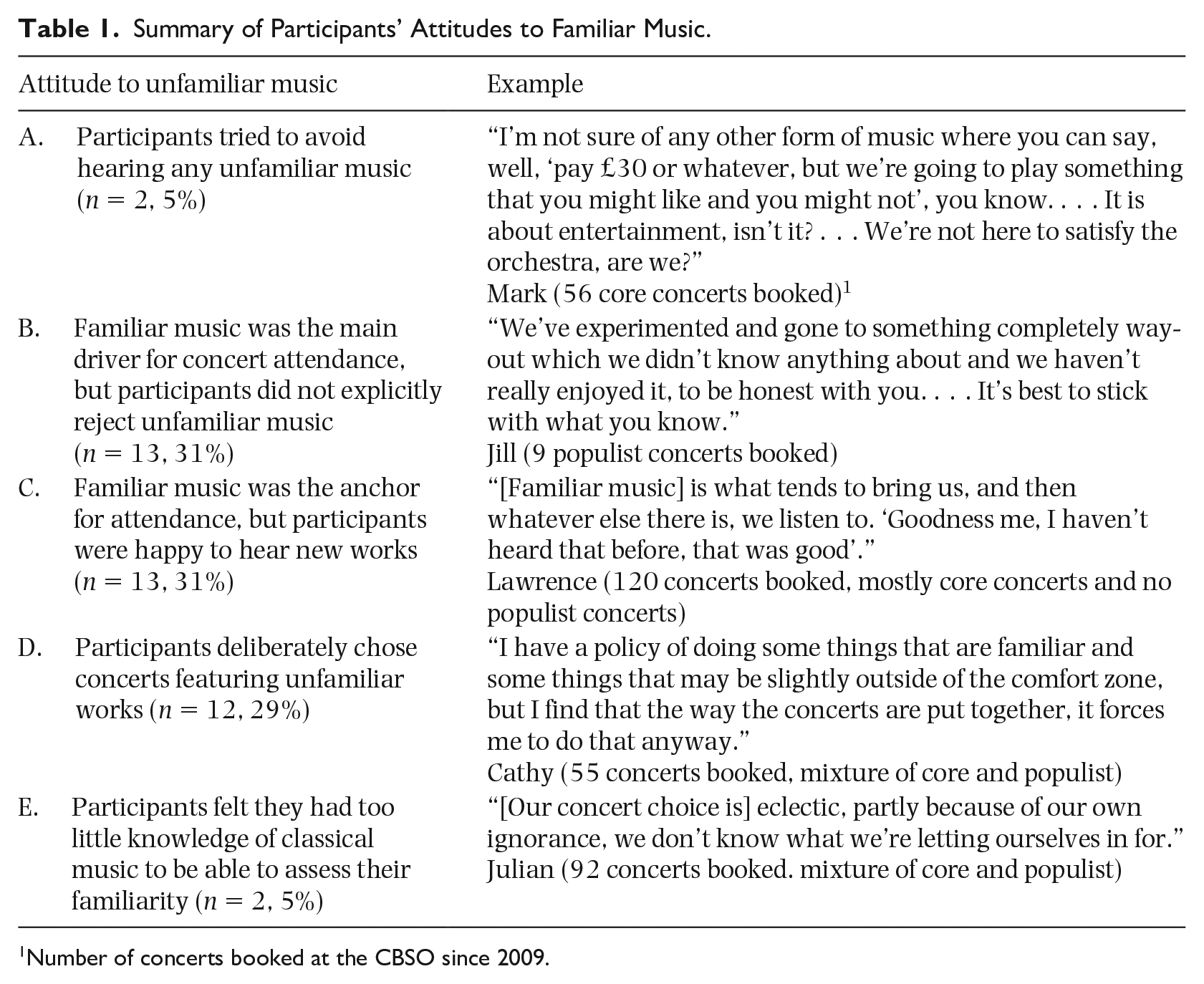
Number of concerts booked at the CBSO since 2009.
Participants’ attitudes towards unfamiliar music were therefore strongly influenced by how often they went to concerts; as found by Roose (2008), attenders who had booked fewer concerts since 2009 were generally less receptive to unfamiliar works. It is unclear whether this openness to the unknown is a cause or effect of frequent attendance. On the one hand, recent research involving the participation of audiences for contemporary arts has shown that frequent attenders are more tolerant of less enjoyable events because they are balanced out by other experiences that they regard as valuable (Pitts & Price, forthcoming). They are therefore open to the unknown because they attend concerts frequently. On the other hand, they may attend concerts more often because they are open to the unknown, given that a finite number of classical concerts is presented in the city each season and those that include unfamiliar music are no less attractive than others. Interestingly, there is little correspondence between participants’ formal musical education and their attitudes to familiarity (see Appendix 2).
When asked about their preferences with regards to musical programme, some participants displayed an aversion to risk. They often mentioned the limited resources at their disposal, and Anthony, for one, said that the cost of attendance made him “selective.” Those who spent more per concert, buying the best seats in the house, and “making a night of it” with dinner beforehand and drinks afterwards (categorised as B and C in Table 1 and Appendix 2) tended to prioritise the guarantee of familiar music, by contrast with the frequent attenders (D), who got the best deal on cheap seats and ate a sandwich on their journey to the concert hall. There appeared to be a relationship between frequency of attendance and resources such that those who went to fewer concerts invested more time, money and energy in those they did attend; these participants tended to be more conservative in their tastes.
Participants reported that they would rather have a stronger guarantee of enjoyment from a well-known work than take a risk on something that might not be enjoyable, illustrated in Table 1 by Jill who said it was “best to stick to what you know.” One bad experience of a piece of music could make participants avoid anything they feared might be similar, as though they were experiencing a musical allergy; as Paul said, “There’s, like, this style of composers that come out with the. . . there’s this one sound and it takes me back to, like, royal times and I despise it and I can’t listen to classical music that’s like that. I don’t enjoy it.”
Risk avoidance was particularly apparent when participants shared their views on contemporary music; very few participants said they would actively choose to hear contemporary music in a concert. As with Paul’s “royal” music, their previous experience of contemporary music was so bad that they actively avoided any exposure to new music, even though they recognised that there were probably some pieces that they would enjoy. According to Jackie, “[Contemporary music] could be, you know, something that I would find a cacophony of noise, or it could be something that’s really quite soothing”; Veronica said, “I don’t like discordant music that could be termed modern these days. This certainly puts me off modern classical music.”
Some participants expressed a sense of guilt about their avoidance of new music and reprimanded themselves for not trying harder: “We’re awfully conservative . . . one’s forgotten who the most modern composers are in classical music, we’re not very good at it . . . we ought to have tried harder” (Georgina). Highly critical and emotive terms were used by participants, such as Ken describing himself as “lazy” and Joanne describing her avoidance as “prejudice.” The difficulty of engaging with unfamiliar music is evident in these quotations, which are couched in the language of work and effort, and were not restricted to audiences for core classical concerts; those who attended populist concerts also described their engagement as “playing it safe” (Anthony) and “not terribly experimental” (Denise).
While these self-deprecating comments may be the result of participants’ self-consciousness during in the interview – Hennion (2001, p. 5) describes some interviewees as “over-sociologised” – the comments still shed light on what participants believe to be the ‘right’ way to engage with classical music. Some implied that they ought to be working harder at listening by choosing more challenging types of music, particularly in order to support new composers and ultimately the future of classical music. Furthermore, the way in which some participants described their decision deliberately to listen to unfamiliar music was full of ethical language: Cathy had a “policy” of trying new things, David reminisced about years of being “conscientious” in “sitting through” minimalist music, and Yvonne, likewise, felt that having spent years listening to unfamiliar music played by the Hallé Orchestra meant that she had been “brought up in a good way.” This use of language implies that exposure to unfamiliar music is viewed as the correct way to engage with classical music, but harder work than listening to familiar works.
The role of familiarity in the experience of listening to live music
Participants who engaged with music to greater and lesser extents remarked that it was often more enjoyable to listen to familiar music than unfamiliar pieces. “If you go to see a piece that you know really well, there’s very much an anticipation of what’s to come. . . . There’s the anticipation of waiting for a big theme, or something like that, that’s coming” (Trevor). “It’s nice to be able to. . . not sing along but, sort of, you know, recognise it and to know what’s coming next because you’re familiar with the piece” (Mark).
These accounts of listening to familiar music focus on the enjoyment of anticipating the next part of a piece. The way in which they navigate their way through familiar pieces echoes schema theory in music listening as described by Prior (2013), and their ability to anticipate what is to come appears to enhance their enjoyment of the work (cf. Huron, 2006). Participants’ emphasis on familiarity raises questions around repetition and over-exposure to pieces of music. The inverted-U model suggests that while enjoyment increases with familiarity, it decreases when the music becomes too familiar and the listener tires of hearing it (King & Prior, 2013). Greasley and Lamont (2013) have shown that listeners take care to regulate their exposure to recordings so as to avoid boredom, but little was previously known as to how people do this in the context of attending live concerts.
Only four of the participants in the present study mentioned that they did not want to hear the same works played over and over again. Having heard the same themes (for example film music) repeated in several seasons of populist concerts, Gordon, Julie and William said they wanted greater variety, and Trevor had grown tired of two particularly popular classical works, Beethoven’s Pastoral Symphony and Ravel’s orchestration of Mussorgsky’s Pictures at an Exhibition. Generally, however, participants were happy to hear the same pieces played regularly at CBSO concerts and some stated explicitly that their enjoyment was not dulled by repetition. As Michael said, “Even if I saw a piece like the Eroica [Symphony] a couple of years ago or even last year, I’d come back and see it this year!” And Ken commented, “I would always come to hear [Bruckner’s Seventh Symphony]. Even if they played it every year, I would still come.”
Part of the continued appeal of well-known works in concert programmes is, perhaps, that the live performance gives a sense of freshness to even the most familiar work. In much the same way as the listener was reported by Greasley and Lamont (2013) to have regained enjoyment in hearing an over-familiar song by “putting it away” for a while (pp. 21–22), the live-ness of a concert performance appears to mitigate potential saturation, giving the listener a renewed sense of the unexpected even if they are familiar with recordings or a particular recording. Participants described finding freshness in the concert hall in three ways, by hearing new interpretations, live orchestral sound and by listening in a different way.
Participants described performances of familiar works that differed from the recordings they knew well in terms of tempo, instrumental balance or musical expression as new interpretations. Their praise for the CBSO’s Beethoven Week festival frequently centred on the way in which the musicians, particularly the conductor Andris Nelsons, could bring something new to pieces that were so familiar to them. For example, Ruth commented, “You think ‘oh, well, I know [Beethoven’s First Symphony]’ and then when [Nelsons conducts] it, ‘well actually, I don’t know it!’ You always hear something new and fresh.” For Ruth, this freshness emerged from an implicit comparison with their prior knowledge of the work, perhaps as they remembered hearing it played in a particular recording or on previous occasions. It is important to note that, and how much, knowledge of a work is needed as a basis for perceiving a particular performance as a new interpretation. As the perception of freshness is dependent on familiarity, this perception was not available to those who were new to concert going and did not already have a thorough knowledge of the works to be performed.
Nevertheless, new and less knowledgeable concertgoers still reported hearing freshness in the live orchestral sound; their experiences of listening were quite different from those of hearing recordings of classical music. Three participants spontaneously and independently described a live performance bring an entirely new and fresh dimension to the same familiar piece, Ravel’s Bolero.
1
One of the most phenomenal things that stood out for us, we came when they did Ravel’s Bolero and I never really appreciated until I watched an orchestra like the CBSO doing it, how it builds up to that wonderful crescendo at the end. . . . It was just stunning, wasn’t it? To watch all the little bits build up. . . . When I hear it now, I just visualise that CBSO build-up. That’s what I can see now. I don’t see Torvill and Dean now! I see the CBSO!! (Alison)
Despite having very little knowledge of classical music, all three participants noted differences between listening to the recorded and live performances. For example, John and Yvonne pointed out that they heard a different balance of instruments when they sat in different parts of the hall, such as hearing more of the percussion and brass from the choir seats behind the stage. Thus even a standard interpretation of a familiar work can be perceived as fresh because it sounds raw, not having been mixed or compressed, and being heard, as it were, in three dimensions.
Finally, participants listened to the music being played in the concert hall quite differently from the way they heard recordings at home. Robert said that being able to watch the orchestra for visual cues “almost magnified” the sound, while Sandra said it helped her attend to aspects of the instrumental parts or lines in the music that she had not noticed before: “you just accept the sound if you’re listening to [a recording], and it makes you a lot more aware, when you are seeing the orchestra, where that sound’s coming from” (Sandra). In addition, participants were able to listen in a more focused way, undistracted by “reading, sudoku, crossword” (Robert) or “mak[ing] yourself a cup of tea” (Anita). This enabled them to hear the music as though for the first time. Taken together, these experiences meant that live performances of familiar works were heard as fresh, as new interpretations, and in detail.
Conclusion
The data gathered in these interviews provide support for the belief, based on anecdotal evidence, that audiences for classical music are primarily attracted to works that are familiar to them; unknown works were primarily sought out by only the most frequent concertgoers, and even they tried to strike a balance between hearing familiar and unfamiliar works in all the concerts they attended. In part, this preference for the familiar can be attributed to risk aversion, and many participants reported feeling guilty when asked themselves if their choices of concert were conservative. More research should be done to understand the origin of these ethical beliefs in relation to classical music, and how the idea of the perfect listener or the correct way to behave may shaping or inhibit concert attendance.
Participants reported finding it more enjoyable to hear familiar music in the concert hall, with live performance enabling the most jaded participants to hear it as though it were fresh. Only the most frequent and knowledgeable concertgoers referred to the interpretation of works, so promoters might do better to advertise the impact of hearing live orchestral sound or having the opportunity to engage in active listening in the concert hall rather than highlighting artistic matters such as the conductor’s style or interpretative intentions, which may be lost on those who are new to concert going.
While this study involved a modestly sized sample of participants, they provided in-depth reflections on their engagement with classical music. This topic could be explored further in two ways. Analysis of ticket sales using data such as those collected using Audience Finder would enable an assessment to be made of the extent to which programmes of popular music attract larger audiences or less frequent attenders than programmes that include unfamiliar music. The analysis could include data on programmers’ views on the appeal of different types of works and projected ticket sales. That said, such research relies on a definition of popular music that is different from the present study’s focus on familiarity, in particular that of individual concertgoers with particular works. Further research should also be undertaken, therefore, with different kinds of audiences in other regions of the UK and further afield, to confirm their preference for familiar music and the freshness afforded by live performances.
In this article I have shown why audiences for classical music concerts prefer familiar music. If arts organisations are to encourage audiences to come to concerts that include unfamiliar works, and concerts of new music, they must support them to do so, particularly for the first time. They can do this by providing opportunities for listeners to build familiarity with the works to be played in advance, putting on concerts with added social and atmospheric value, and framing attendance as a form of philanthropic support for the orchestra (cf. Pitts & Price, forthcoming). It must be acknowledged, however, that the classical music sector tends to look down on radio stations playing popular classics such as Classic FM and the hugely successful concerts produced by promoters such as Raymond Gubbay. Yet research in the field of music psychology shows that people typically enjoy listening to music that is familiar more than to music that is unfamiliar. Given the costs of concert attendance in terms of time, money, and energy, it is unsurprising that so many concert-goers choose to spend their evenings hearing fresh versions of works they know and love.
Footnotes
Appendix 1
Appendix 2
Summary of the Musical Background and Concert Attendance of Participants.
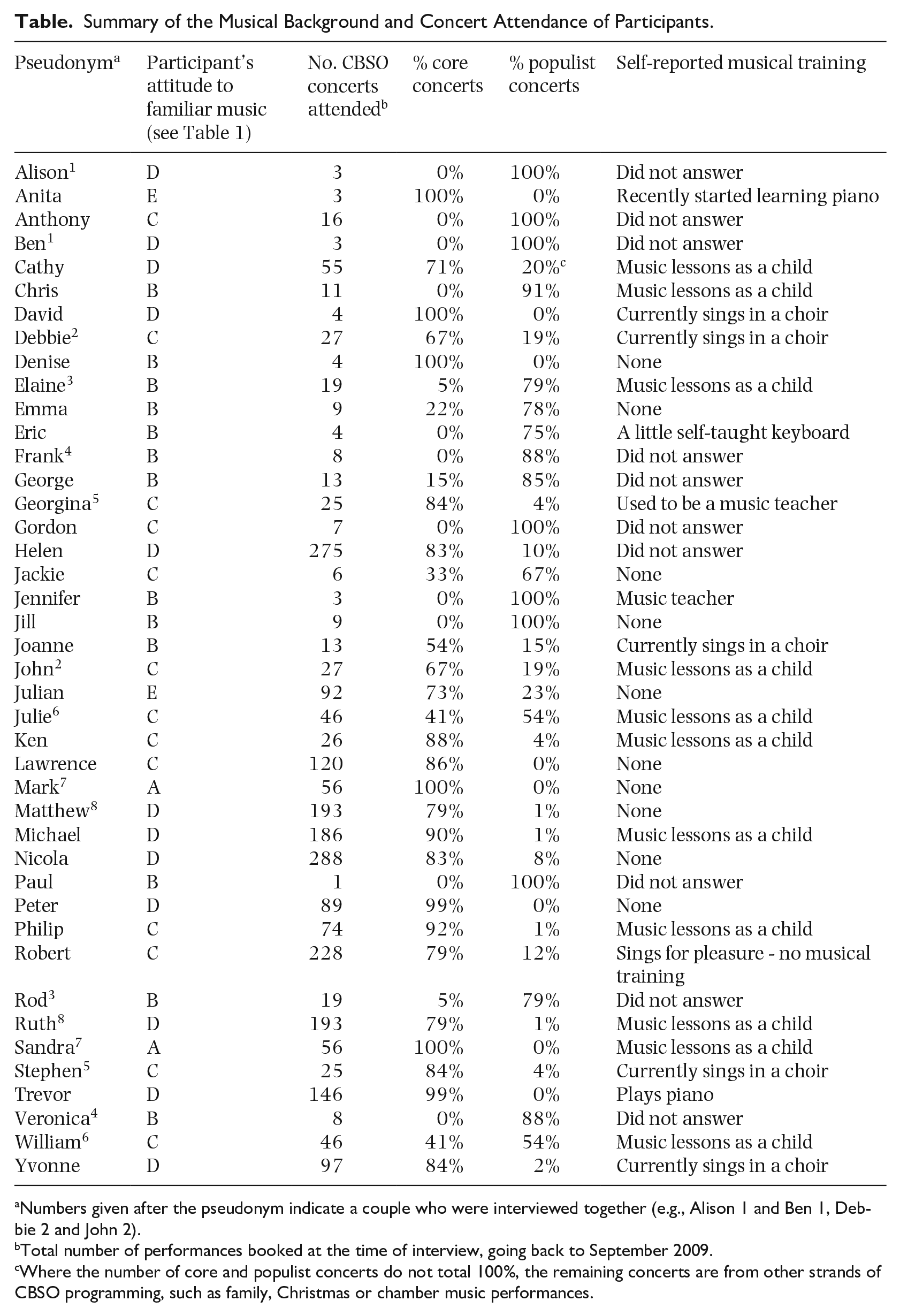
| Pseudonym a | Participant’s attitude to familiar music (see Table 1) | No. CBSO concerts attended b | % core concerts | % populist concerts | Self-reported musical training |
|---|---|---|---|---|---|
| Alison1 | D | 3 | 0% | 100% | Did not answer |
| Anita | E | 3 | 100% | 0% | Recently started learning piano |
| Anthony | C | 16 | 0% | 100% | Did not answer |
| Ben1 | D | 3 | 0% | 100% | Did not answer |
| Cathy | D | 55 | 71% | 20% c | Music lessons as a child |
| Chris | B | 11 | 0% | 91% | Music lessons as a child |
| David | D | 4 | 100% | 0% | Currently sings in a choir |
| Debbie2 | C | 27 | 67% | 19% | Currently sings in a choir |
| Denise | B | 4 | 100% | 0% | None |
| Elaine3 | B | 19 | 5% | 79% | Music lessons as a child |
| Emma | B | 9 | 22% | 78% | None |
| Eric | B | 4 | 0% | 75% | A little self-taught keyboard |
| Frank4 | B | 8 | 0% | 88% | Did not answer |
| George | B | 13 | 15% | 85% | Did not answer |
| Georgina5 | C | 25 | 84% | 4% | Used to be a music teacher |
| Gordon | C | 7 | 0% | 100% | Did not answer |
| Helen | D | 275 | 83% | 10% | Did not answer |
| Jackie | C | 6 | 33% | 67% | None |
| Jennifer | B | 3 | 0% | 100% | Music teacher |
| Jill | B | 9 | 0% | 100% | None |
| Joanne | B | 13 | 54% | 15% | Currently sings in a choir |
| John2 | C | 27 | 67% | 19% | Music lessons as a child |
| Julian | E | 92 | 73% | 23% | None |
| Julie6 | C | 46 | 41% | 54% | Music lessons as a child |
| Ken | C | 26 | 88% | 4% | Music lessons as a child |
| Lawrence | C | 120 | 86% | 0% | None |
| Mark7 | A | 56 | 100% | 0% | None |
| Matthew8 | D | 193 | 79% | 1% | None |
| Michael | D | 186 | 90% | 1% | Music lessons as a child |
| Nicola | D | 288 | 83% | 8% | None |
| Paul | B | 1 | 0% | 100% | Did not answer |
| Peter | D | 89 | 99% | 0% | None |
| Philip | C | 74 | 92% | 1% | Music lessons as a child |
| Robert | C | 228 | 79% | 12% | Sings for pleasure - no musical training |
| Rod3 | B | 19 | 5% | 79% | Did not answer |
| Ruth8 | D | 193 | 79% | 1% | Music lessons as a child |
| Sandra7 | A | 56 | 100% | 0% | Music lessons as a child |
| Stephen5 | C | 25 | 84% | 4% | Currently sings in a choir |
| Trevor | D | 146 | 99% | 0% | Plays piano |
| Veronica4 | B | 8 | 0% | 88% | Did not answer |
| William6 | C | 46 | 41% | 54% | Music lessons as a child |
| Yvonne | D | 97 | 84% | 2% | Currently sings in a choir |
Numbers given after the pseudonym indicate a couple who were interviewed together (e.g., Alison 1 and Ben 1, Debbie 2 and John 2).
Total number of performances booked at the time of interview, going back to September 2009.
Where the number of core and populist concerts do not total 100%, the remaining concerts are from other strands of CBSO programming, such as family, Christmas or chamber music performances.
Declaration of Conflicting Interests
The author declares that there is no conflict of interest.
Funding
The author(s) disclosed receipt of the following financial support for the research, authorship, and/or publication of this article: this research was funded by AHRC Collaborative Doctoral Award No. 1374595 with The University of Sheffield and the City of Birmingham Symphony Orchestra.
