




Abstract
The de-risking strategy rolled out by the European Union (EU) in 2023 was a major historical event for EU-China relations in higher education. In this study, 40 international education professionals from both China and the EU were interviewed to glean an understanding of what potential impact the policy may have on EU-China relations in higher education. Using knowledge diplomacy as a theoretical lens, this study aims to examine whether the higher education sector is able to balance national security and knowledge diplomacy in their international activities in the “de-risking” context. Despite some important concerns perceived, close to half of international educators from both sides are optimistic about the higher education sector's ability to transcend geopolitical tensions and continue collaboration. The confidence in the future prospect shows that de-risking presents challenges to collaborations, but the challenges do not necessarily eliminate the possibility of knowledge diplomacy.
Introduction
Higher education collaboration between the EU and China grew fast in the first two decades of the twenty-first century. However, the trade war between the US and China increased the US and its Western allies’ suspicion of China's technological theft from the West through research collaboration and researcher mobility. The Ukraine War also made the EU reevaluate its trade relations with China. Realizing that it was not possible, nor desirable, to cut off its extensive trade ties and thus “decouple” from China, the EU's new approach to China relations adopted in 2023 was “de-risking”. How do the higher education sectors from both sides perceive this new geopolitical environment of EU-China relationship? There has been much scholarly discussion about the impact of the de-risking policy on higher education collaboration, but there is no empirical study yet with first-hand data on the issue. This study aims to fill this void by inviting frontline university administrators in international education from both China and the EU to share their perceptions and experiences with the de-risking policy. To provide a larger context for this study, this paper will first review the historical tensions between China and the West due to colonial, ideological and economic reasons. It will also unpack the de-risking policy adopted by the EU and how it aims to differentiate from the decoupling approach in the US. Finally, the concept of knowledge diplomacy, a new goal of higher education internationalization espoused by the international education community, is reviewed as a theoretical framework in this project to examine the EU-China relationship in higher education in the de-risking environment.
The Thucydides Trap
As part of the Cold War, the strife between China and the key democratic countries in the West started in 1949 when the Communist Party of China (CPC) won the civil war and became the ruling party of China. The People's Republic of China was diplomatically isolated and economically blocked by the West, and the CPC government was not recognized as the legitimate government of China for over two decades. However, the tension between China and the West today extends beyond ideological differences. In 1970, still under Chairman Mao's leadership, China's GDP was only 2.7% of the world GDP, compared to the US's 31.4% (Mathisen, 2022). From the 1980s, China abandoned the previous Soviet model of Socialism and started its “Reform and Open-up” initiative, internally introducing market economy and externally opening up to trade with the rest of the world. The initiative unleashed China's economic growth, doubling its GDP every 7–8 years over the past 40 years and lifting an estimated 800 million Chinese people out of poverty (World Bank, 2023). China was projected by many economists before the Pandemic to surpass the US and become the world's largest economy in the first half of the twenty-first century. The narrowing economic gap under the leadership of two very different governments has increased rivalry between China and the US. China was seen more and more as the US's strategic competitor in the new century.
The political rivalry between the US and China, intensifying in the new century, has been described as a historical “Thucydides Trap”. The Thucydides Trap refers to the theory that when a rising power threatens a ruling power, the result is often war (Allison, 2017). The ruling power of the world since the end of WWII has been the U.S., and the rising power is of course China. Strong signs of the two countries falling into the Thucydides Trap include a trade war starting in 2018 after US President Donald Trump imposed tariffs on almost half of China's exports to the US. The trade war was followed by a technology war which was further intensified when US president Joe Biden banned exports to China of semiconductor chips and other high-tech equipment in 2022. In addition to the ideological and economic tensions, the Chinese have a more distant memory of its colonial past, known to the Chinese as the Century of Humiliation from the two Opium Wars (1839–1842/1856–1862) to the end of Japanese invasion during WWII (1937–1945). In the 100 years, in Chinese memory, the country was invaded and taken advantage of by all major imperialist Western powers, from the UK, France, Germany, Russia to the US and Japan. The trade war and the tech war today have been often perceived in China as the US's efforts to stop China's rise in the world (e.g., Chan et al., 2023). The Thucydides Trap is avoidable, but it will take much political and diplomatic wisdom (Allison, 2017). Can universities in both worlds help in this regard?
From Decoupling to de-Risking
Shortages of N 95 masks and other key medical equipment at the beginning of the COVID-19 crisis in early 2020 showed to the US and the EU how dependent the West had become on production in China. From then on, the rhetoric of decoupling from China has shown a sharp increase in the US, citing the risk of continued dependence on imported Chinese goods. China has also been accused of stealing technologies from the West to create an unfair advantage for its trade relations with the West. There was also fear of military espionage from the European side over the possibility of collaborative research projects feeding into military or dual-use applications.The Ukraine War from 2020 further exposed the danger of EU countries’ over-reliance on energy imports from Russia. The concern extends to the EU's supply chain dependence on China for numerous key manufacturing goods. To address such concerns, the EU rolled out the “de-risking” policy in 2023, aiming to reduce risks associated with collaborations with China (Nikkei Asia, 2023). The de-risking strategy, to distinguish from decoupling, is intended to reduce critical dependencies and vulnerabilities, but not to cut off economic ties or to engage in a trade war. Aligning with this approach of the European Commission, Germany's China strategy (released on July 14, 2023), for example, seeks to “de-risk” links with China while maintaining engagement (Ziady, 2023). Specifically, Germany intended to limit federal support for research projects that could lead to a “knowledge drain” to China.
The dual objectives of bolstering collaboration with China and securing national security create a paradox for European universities. As a newly adopted EU-wide security policy, neither the scope of knowledge to be protected nor the specific ways to de-risk are specified, leaving much uncertainty among EU stakeholders in China relations in the higher education sector. One common reaction of EU universities in Sweden, Denmark, the Netherlands and Germany has been to suspend co-funding agreements with China Scholarship Council and to stop hosting Chinese government sponsored PhD students in high-tech dual-use areas (Sharma, 2023). Some scholars feel that such a blanket measure is no guarantee for safety, as espionage is not tied to a particular nationality or a particular scholarship program (Fischer & Gohli, 2023). Instead, it may strengthen the Chinese nationalist narrative that the West is trying to suppress China and that human rights are just empty phrases (Fischer & Gohli, 2023). Others worry that mis-perceived and over-perceived concerns with security issues may result in lost opportunities in collaboration (Cai, 2023), and disrupting the pipeline of Chinese graduate students in STEM areas (also sensitive areas) into Europe will risk the decline of the quality and quantity of future research outputs in Europe (Mitchell, 2023). In addition, the de-risking policy is creating “a worrying shift in public discourse towards a moralizing puritanism” (Schubert & Alpermann, 2022, p. 96) in which a normative postulate of critiquing Chinese authoritarianism reduces public interests in research-led production of knowledge about China.
Knowledge Diplomacy
Universities around the world can serve multiple goals in their international activities (e.g., Stier, 2004). At the national level, international education can be used as a means to help countries secure their national interests in relation to other countries. At the global level, international education can be adopted as a way to contribute to equitable, sustainable and peaceful development of the world. For example, after WWII, international education was taken as an important foreign policy asset in the U.S. to improve intercultural understanding and to promote world peace, with the rollout of the Fulbright Program in 1945 and the National Defense Education Act in 1959 (Rilokekar, 2022). From the 1990s, however, international education began to be seen more as an export business and a global talent acquisition strategy for most Anglo countries (Rilokekar, 2022). Higher education has been taken as a private good, not a public responsibility anymore (Altbach & Knight, 2007). Global higher education has been used more as an instrument to obtain resources around the world and to ensure a country's economic competitiveness (Liu, 2023a). Traditional values such as exchange and cooperation, peace and mutual understanding, human capital development, and solidarity have been pushed to the side for the purpose of competition, revenue, and reputation/branding (de Wit, 2020). After 9/11, international education in the U.S. was also considered a risk factor for national security, with the establishment of the Department of Homeland Security and the Student and Exchange Visitors Information System (Rilokekar, 2022). From 2018, the national security discourse was much more stressed in the U.S. and among its Western allies, and it was widely used as a justification for trade war, tech war and restrictions on scholar mobility from China.
In the EU, higher education collaboration with China saw fast development in the first two decades of the twenty-first century in many areas, from individual student/faculty mobility to collaborative degree programs, and to deep research collaboration through co-funding projects (Cai, 2019). There were strong political wills to strengthen the bilateral relationship, with both sides considering each other as important innovation partners and both sides committing to effective student mobility and research collaboration. The EU opened its research and technology development framework program to China, allowing the participation of Chinese institutions; China opened its National High Technology Research and Development Program (863 Program) and the National Key Basic Research Program (973 Program) to EU researchers and institutions (Cai, 2019). There were seven joint PhD programs between Chinese and European universities as of 2018 (Zheng & Cai, 2024). However, things began to change at the beginning of the 2020s. Similar to the US, national security has become an important concern in the EU's higher education collaborations with China. The de-risking policy implies risks for European universities’ collaboration with China, and the implication inevitably creates mistrust between both sides for collaboration. From the perspective of knowledge diplomacy, this is an unfortunate development, as it is happening at a time when the common global challenges, such as global warming, global pandemic, global refugee crisis, are counting on universities worldwide to engage in more collaboration to seek solutions.
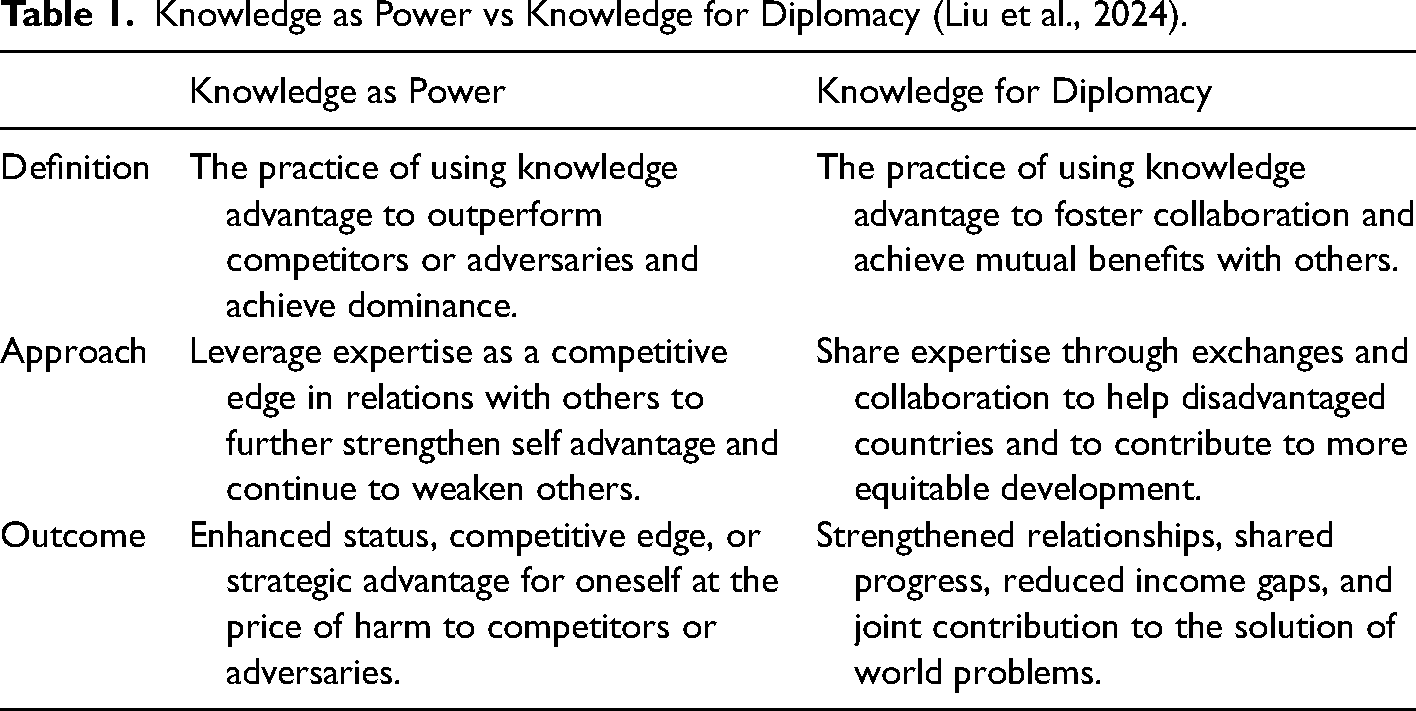
Starting from the COVID-19 pandemic, many critical internationalization scholars have advocated the concept of knowledge diplomacy as “a new approach to understanding the role of international higher education in strengthening relations among countries and addressing common global challenges” (Knight, 2020, p. 38). The concept of knowledge diplomacy has been around for over two decades. It was first used in the context of protecting a country's intellectual property (i.e., knowledge) through trade agreements (i.e., diplomacy) (Ryan, 1998). When applied to higher education, knowledge diplomacy has often been seen as universities’ role to advance a country's soft power by securing national self-interest through attraction and persuasion (Ogunnubi & Shawa, 2017). However, when advocated as a new critical goal for higher education internationalization, knowledge diplomacy is no long considered a national competitive construct, like soft power, but a global collaborative goal, a responsible goal for international higher education, aiming to narrow the world's gap between rich and poor and to achieve more sustainable development (Knight, 2019, 2020). Liu et al. (2024) has distinguished the concept of “knowledge diplomacy” from “knowledge power” in definition, approach and outcome (Table 1). From the lens of knowledge diplomacy, we hope to answer the following questions in this study: Is knowledge diplomacy still a viable goal for international higher education in the de-risking and de-coupling geopolitical contexts? Are universities in the EU and China able to transcend the geopolitical challenges and continue collaboration in order to contribute to knowledge diplomacy?
Knowledge as Power vs Knowledge for Diplomacy (Liu et al., 2024).
Methodology
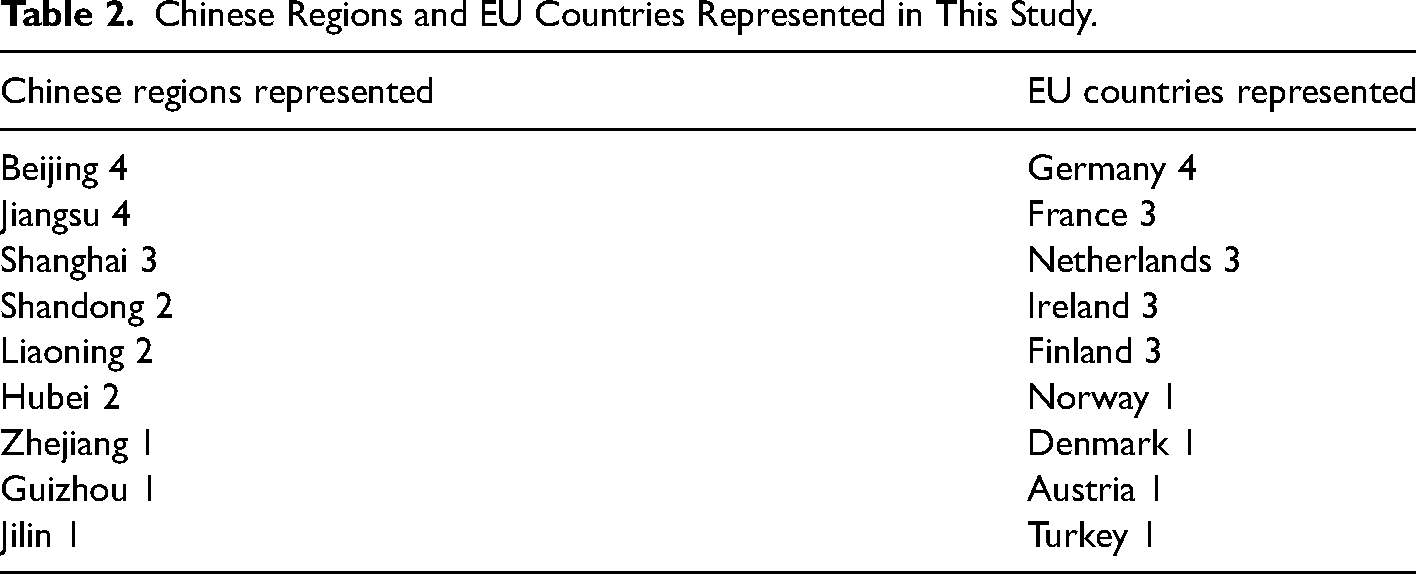
A comparison of perceptions on the EU's de-risking policy among international educators in both China and the EU is important in providing insights into the future of higher education internationalization in the two regions. In this study, 20 international education professionals from different Chinese universities and another 20 international education professionals from different EU countries were interviewed to glean an understanding of what de-risking means to them and what potential impact it may have on the EU-China relations in the higher education sector. Table 2 shows the Chinese provinces and the EU countries represented by the 40 participants. The 40 participants of this study were invited through snowball sampling, starting with international educators known to the authors of this study on both sides. As a result, not all Chinese provinces and EU countries are represented. This is one limitation of this study. The 40 participants vary across a range of ages and professional positions, from Managers of international programs to Associate Vice Presidents (International). Some are scholar administrators, combining both academic and administrative responsibilities. All 40 participants were given a written interview with the same open-ended question in both languages: “As international educators working in China/EU, how do you perceive the impact of the EU's de-risking policy on higher education collaboration between China and EU countries?” There was no requirement in terms of how long their response should be. With a qualitative design from an emic perspective (Creswell, 2006), this study aims to learn how international educators from both China and the EU construct the meanings and implications of the de-risking policy adopted by the EU on China relations.
Chinese Regions and EU Countries Represented in This Study.
In the thematic analysis (Braun & Clarke, 2019) of qualitative data obtained in this study, we analyzed the China data and EU data as two separate groups with the aim of finding some patterns within each group as themes. In qualitative studies, themes are taken as the structure of people's lived experiences (van Manen, 1990). When determining themes, we focused on the salience of ideas, but the frequency of their mention by 20 participants in each group was also recorded and reported in this study (see Liu, 2023b). The focus of this study is to determine the similarities and differences between the two groups. Intercoder reliability checks among authors were conducted to ensure systematicity, communicability, transparency and trustworthiness of the findings (O’Connor & Joffe, 2020). The 20 participants from each side are considered members of a culture-sharing group in the Ethnographic tradition (Creswell, 2006). So the second limitation of this study we need to acknowledge is that the regional differences in the case of China and the national differences in the case of the EU are not considered. Given the limitations, this study aims to provide insights on the research question, but does not claim to be conclusive on this issue.
Findings
In this section, we will present themes gleaned from both groups as findings to show similarities and differences in the perceptions of Chinese and EU international educators with regard to the de-risking policy and its impact on Sino-European collaboration in higher education.
I understand that the EU's “de-risking” policy with China is essentially “de-coupling” in order to cater to the United States. The highest level of de-risking is de-coupling. (n11) Europe has been deeply penetrated by the United States. The entire Europe has become a vassal of the United States and cannot independently make decisions that are beneficial to Europe. (n12)
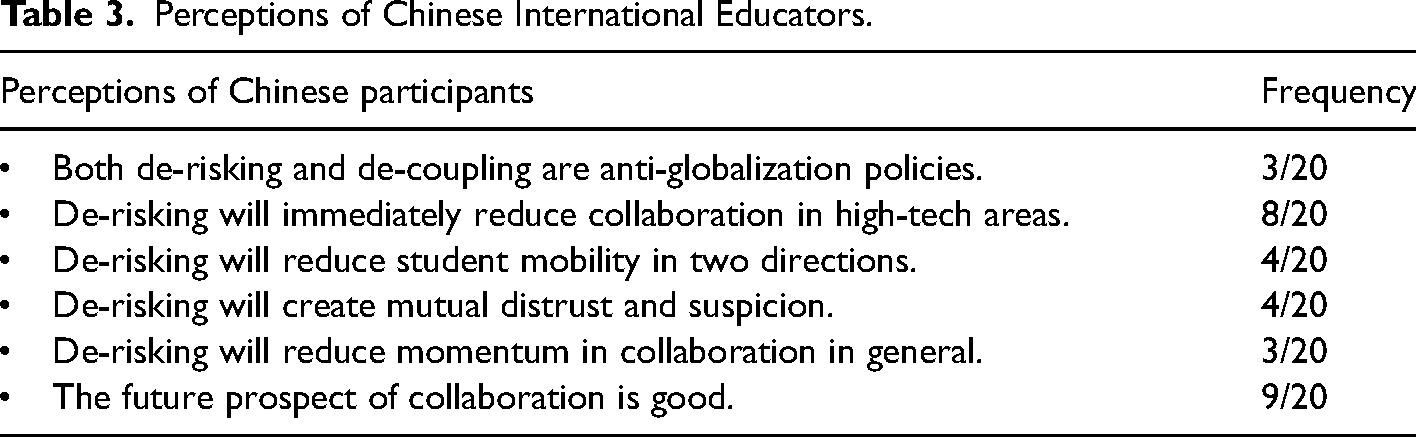
The Chinese international educators in this study do not seem to see the difference between the EU's de-risking and the US's decoupling (4 mentions), believing that de-risking in Europe is following the US’ decoupling in a lockstep way:
Both de-coupling and de-risking are believed to be anti-globalization policies (3 mentions), for example: Whether it is de-risking or de-coupling, they are both essentially counter-globalization moves, which will have a serious negative impact on both economic development and international exchanges. (n12) This kind of deglobalization trend has really made us working in international education feel a chill. (n17)
Naturally, the most important impact of the de-risking policy on EU-China higher education collaboration is felt in research collaboration and talent training in the sensitive high-tech areas (8 mentions). One participant believes that the de-risking policy is the reason for a couple of European universities’ decisions to stop hosting graduate students sponsored by China Scholarship Council (n1): The high-level scientific collaboration will necessarily suffer. […] I know a Computing Science professor of Chinese origin working in a Dutch university. He has experienced much pressure in accepting PhD students from China. (n3) There will be negative impacts both in terms of the breadth and the depth of collaboration. The scale of personnel exchanges will be reduced. The possibility of in-depth cooperation will be reduced or non-existent. (n14) Due to the “de-coupling” policy adopted by the US, many Chinese students have chosen to study in Europe in the past while, thus making Europe the beneficiary. Chinese parents perceive European countries, such as the UK and France, as being more tolerant and liberal. But now the EU has followed the US's suit. (n 6) It will also be more difficult to recruit international students there (Europe) to China, even exchange students. (n 20) From our daily work experiences, we have already felt that the resistance is getting bigger and bigger. One indication is that communication is not as smooth as before. (n10) We will persist in continued cooperation with the EU, but as the difficulties accumulate, we may not be able to pursue every detail of our work with persistence and enthusiasm (n17) In response to external pressure, China seems to have become more cautious toward malicious foreign forces too. Personally as a frontline practitioner, I used to focus on developing programs, not worrying about the external environment. Now I pay more attention to diplomatic events and become more careful about what I do. (n2) As we continue on our relations with Western Europe, I feel that the education sector is starting to strengthen cooperation with Russia. (n 17) I just got back from France talking to some partner universities. I feel the old collaborative programs will continue, but it is challenging to start new ones. The China fear seems to be prevalent in Europe, and this will definitely exert pressure on EU-China relations in higher education. (n2) Personally, I have noticed some changes over time already. European universities are less willing to leave things on paper when they cooperate with us. Professors are still willing to cooperate, but they are worried about the risks and potential investigations that an agreement may bring to themselves. (n18) I believe we are running the risk of broken ties, as both sides approach the relationship with suspicion and negativity. (n2) Some political changes are not enough to shake the underlying logic of cultural exchanges. The two-way flow of young students should still be the general trend. (n13) When there is political tension, the governments might rely more on people to people connections to maintain diplomatic ties. In this sense, educational collaboration and mobility of students are champions of diplomatic relations. (n4) After all, isolation will only create greater barriers, and only communication can bridge and overcome these barriers. (n15) 2.
There is some confusion among the 20 EU colleagues in this study as to how to implement the de-risking policy at the institutional level (3 mentions), for example, We (at the university) don't have any specific de-risking measures related to China. So I don’t really know what de-risking means for China relations. (n5)
Perceptions of Chinese International Educators.
One accusation is that German institutions are financially dependent on China. However, there is a lack of evidence to show that German universities are significantly dependent on financial resources from China. Another accusation is that China scholars in Germany only work on uncritical topics without a critical stance on China. But a quick look at German scholars’ publications shows that their research is not uncritical about China. (n16) Accusations of propaganda or espionage against Chinese partners in many cases came without any concrete evidence. A report for the German parliament on the Confucius Institutes could give not one example of propaganda or problematic behavior. (n18) […] at least from my university, our China relations have decreased in number and in scope. And it gets harder each year to apply for funding for China-related projects. For example, this year, we had two funding applications in relation to China, and before we submitted them, we had long discussions with our legal team on whether this poses a risk or not and what we should do. (n3) German scientists need to be more aware of the problems inherent in academic collaborations (keyword here: China's civil-military fusion strategy). However, I don’t think this warrants a “securitization” of all academic contacts and scientific exchanges. For instance, Chinese students coming to Germany do not, in general, pose any security problems. This includes those on CSC scholarships. (n11) Science develops network-wise and depends on serendipity and spontaneity for progress. It needs mass and open exchange that is threatened by derisking politics. […] Unraveling the education cooperation with China will translate into shrinking research and development in the EU. (n12) You cannot have an international strategy without China. It is 1/5 of the world population, the biggest source of international students in the world. We cannot ignore the market, the same is true for India, sub-Sahara. (n6) […] a complete ban on research collaboration with China would be disastrous. The lack of knowledge about China as a result of disengagement with China will be a bigger risk for Germany. (n16) De-risking is mutual. China is also trying to protect their own research, limiting access to their key labs and data. (n14) China is important to us. We try to grow student enrollment in China to reduce the reliance on the India market. Our strategy is to grow the number of partners, increase student recruitment in China, and run the existing Confucius institute. (n4) […] we are establishing stronger links with Hong Kong universities now, as a potential bridge to mainland China. For instance we can have a joint degree program with a university in Hong Kong and other Chinese students will be able to take part in it. (n8) The fear of collaborative research with China might cause the opposite of de-risking. More engagement (instead of less) with China and having a deeper understanding of China is the best approach to de-risk. (n1) One major problem I see right now is a lack of enthusiasm to take Chinese Studies (including the language) among young Germans. […] But the fact of the matter is that we need more people with China-related competencies, not less! As it is, we will be facing a severe bottleneck. (n11) I'm leaning toward an optimistic outlook. While there are risks associated with increased collaboration, there are also several potential benefits for both countries, such as increased cultural exchange and economic growth. (n10) Most European researchers care about their research, and don’t care about politics. They are happy to collaborate (with Chinese colleagues). They have much academic freedom. (n14) There is an overall hesitation to collaborate with China, partly due to the influence of (negative) media coverage of China, such as lack of academic freedom and ethnic minority issues. The strong links between Russia and China will also turn some Germans away. (n13) The CSC (PhD training agreement) closures, in my observation, are both due to security concerns and due to the low CSC funding levels. Students are not able to afford basic living expenses in the EU with CSC funding. (n14) The Xinjiang issue could cause some tension. There are Chinese students, mostly from Xinjiang, studying in Turkey. Being an Islamic country, Turkey is sympathetic with the Muslim population in Xinjiang. China may see this as a threat to China's ethnic unity. (n17)
Discussion
The activities that universities can undertake for knowledge diplomacy include international joint universities, student/scholar exchanges, research networks and joint degree programs (Knight, 2022). The de-risking environment will definitely pose challenges to these activities between the EU and China. Participants from both the Chinese and European sides believe that de-risking will immediately reduce collaborations in the high-tech areas. Both sides also believe that de-risking may reduce student/scholar mobility between China and the EU. Despite the challenges, close to half of the Chinese participants (9/20) expressed optimism about the future prospect of the EU-China relations in higher education. Two-way communication, mobility and collaboration are believed to be highly desirable for students and scholars on both sides, and educational collaboration and mobility of students are seen as safeguards and champions of normal diplomatic relations between China and the EU in the long run. Similar to the Chinese side, many EU colleagues (8/20) are also confident about the future of EU-China cooperation in higher education. They believe that EU universities have academic freedom and institutional autonomy, and if they see the benefits of working with China, they will continue their collaboration with China, while considering and managing risks. The confidence in the future prospects shows that knowledge diplomacy is still a viable goal for international higher education in the de-risking context, as universities in the EU and China show willingness to transcend the geopolitical challenges and continue collaboration.
Perceptions of EU International Educators.
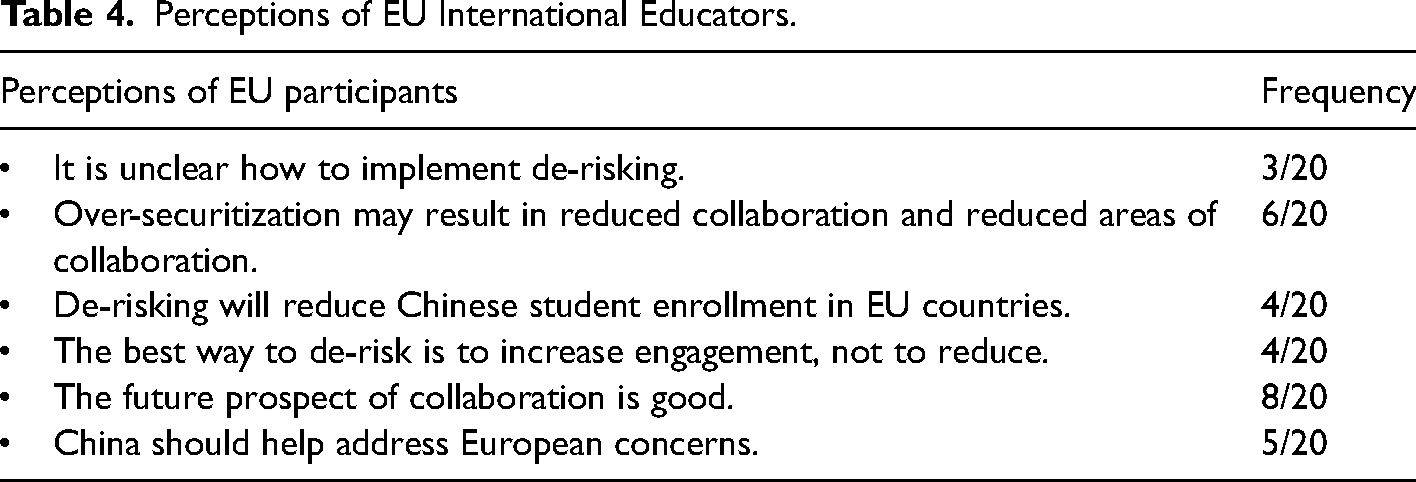
The study has also revealed some misalignments in perceptions between the two sides. The 20 Chinese international educators fail to see the difference between Europe's de-risking and the US's decoupling, either in policy or in implementation. Instead, they perceive this European policy as part of the Western hostility toward China and efforts to contain China's development, under the US leadership. Both decoupling and de-risking are considered to be anti-globalization policies. Most EU participants in this study agree with the rationale of the de-risking policy to protect EU research, though they have expressed confusion in terms of how to implement the policy, particularly at the institutional level. What they are most concerned about is the tendency of some European universities and individual scholars over-securitizing and self-censoring in collaborations with China. Reduced collaboration, and the lost opportunities as a result, are believed to be the risk of de-risking. They believe that the best approach to de-risking is not to reduce engagement, but to increase understanding. Furthermore, some European colleagues believe that the Chinese side should play a role in addressing the EU's concern about higher education collaboration with China, particularly by protecting the Chinese institutions’ autonomy and Chinese scholars’ academic freedom, while the Chinese colleagues in this study do not seem to feel an obligation in this regard, as they see the de-risking policy as an EU policy imposed on China and China is thus the victim.
Policy Implications
To achieve knowledge dimplacy in the de-risking context, both sides need to seek a balance between the global public good and national economic interests, a balance between solving global problems and securing national security, and a balance between academic freedom and government oversight. One important consensus that emerged in this study is that the best way to de-risk is not to reduce collaboration, but to increase understanding. Capacities for mutual understanding and cooperative problem solving should be increased, not reduced during geopolitical tensions (Cai, 2023). Self-censorship and reduced academic autonomy, as a result of top-down policy pressure from the government, are the immediate risks in the de-risking policy environment. To avoid such risks, European governments are advised to require transparency of university research collaborations, but refrain from directly interfering with such collaborations with China or restricting European scholars from working with Chinese scholars (Habich-Sobiegalla & Steinhardt, 2023). The collaborative modes that contribute to knowledge diplomacy, as suggested by Knight (2022), include negotiation, communication, compromise, mediation, trust building and dialogue. As EU universities are actively considering best ways to de-risk while continuing to collaborate, the Chinese government and universities need to be also making an effort to help address the risks perceived.
To ease the European concern over risks in research collaborations with China, the Chinese government should also aim to demonstrate transparency in policy, and better respect the Chinese universities’ autonomy in running the academy and better protect researchers’ freedom in academic expression. Founded in 1949, the P.R. China built a state-controlled system of higher education with high levels of centralized planning. China began to gradually change its management of higher education from a state-planned system to a state-regulated system from the 1980s. Today, the Chinese institutions are in a state of semi-independence, after a centralized process of decentralization in the past four decades, and institutional autonomy is still lacking in many areas for Chinese universities (Liu & Yan, 2019). The Chinese national outline for medium and long term educational reform and development (2010–2020) has expressed the desire to build “a modern university system that is characterized by rule by law, self-governance, democratic supervision, and community engagement” (Gu, 2010). Within China, institutional autonomy and academic freedom are widely considered the hallmarks of a modern university system conducive to the healthy development of the knowledge creation enterprise (Liu & Yan, 2019). It is our hope that the de-risking environment will serve as an external motivation for the Chinese government to deepen reforms in university governance and allow Chinese universities more autonomy to operate. More academic freedom given to Chinese institutions will help ease the concerns of European collaborators.
Conclusion
With qualitative data from Chinese and EU frontline international educators, this study has set out to evaluate the impact of the de-risking policy on Sino-EU collaborations in higher education. The de-risking policy presumes risks for European universities’ collaboration with China, and such presumption naturally creates mistrust between both sides. In addition to increased mistrust and reduced mobility, over-securitization due to unclear boundaries in implementation is another negative impact. From the perspective of knowledge diplomacy, the best way to de-risk is not to reduce engagement, but to increase understanding. To avoid the risk of the Thucydides Trap that endangers world peace, both Chinese and the EU universities are obligated to continue collaboration and contribute to knowledge diplomacy. Thus knowledge diplomacy is still a viable goal for international higher education in the de-risking context. Universities need to fulfill both the national security goals and the global sustainable and peaceful development goals in their internationalization endeavors.
Footnotes
Declaration of Conflicting Interests
The author(s) declared no potential conflicts of interest with respect to the research, authorship, and/or publication of this article.
Funding
The author(s) received no financial support for the research, authorship, and/or publication of this article.
