




Abstract
As the European Union (EU) navigates its intricate relationship with China amidst escalating geopolitical tensions and diverging interests, the concept of ‘knowledge and research security’ emerges as a pivotal concern, especially within the realm of higher education cooperation. This paper delves into the EU's evolving stance towards China, marked by a shift, which categorizes China as simultaneously a partner, competitor, and rival. Amidst this repositioning, the surge in Sino-European academic partnerships has spotlighted the challenges of knowledge and research security, underscoring the need for caution in collaborations with a country whose values diverge from those of the EU. Despite a consensus at the EU level on the necessity of managing ‘knowledge and research security’, the implementation of academic cooperation with China largely rests with individual Member States. This non-centralized approach enables countries to customize their engagement based on national interests and priorities, leading to a varied landscape of academic cooperation with China. This study focuses on three Member States – Hungary, Italy, and the Netherlands- each representing different European sub-regions and stances towards China. By examining their approaches to balancing academic collaboration with China against the backdrop of potential security risks, this paper seeks to uncover the degree of convergence or divergence with the EU's overarching position on knowledge and research security with China.
Keywords
Introduction
The EU's relationship with China has become increasingly complex, navigating a fine line between economic cooperation and the protection of strategic interests. In the backdrop of escalating geopolitical tensions related to a more assertive China's stance at international level, an exacerbated US-China rivalry, China's retaliation against EU human rights sanctions with economic coercion and trade practices endangering the single market, the COVID pandemic and lastly China's position on the war in Ukraine, the EU has repositioned itself in the relation with China. The downward spiral in EU-China relations, which started already in 2017 (Pinna, 2025), has been formalized in 2019 in the European Commission (EC) “Strategic Outlook” (European Commission, 2019) that defines China as a partner, competitor and rival simultaneously. A recent report from the EU Parliament (2024a, 2024b), that aimed at informing the EU's future strategy towards China, focuses mainly on derisking and decoupling issues, underscoring an even bigger emphasis on securitization of the EU-China partnership.
Over recent years, concerns surrounding knowledge and research security have intensified within the context of academic, techno-scientific, and research cooperation across Europe and Western countries (D’Hooghe & Lammertink, 2022). This focus reflects broader US and European security strategies aimed at countering hybrid threats, including covert operations by countries like Russia and China to undermine intellectual property and influence scientific communities. These concerns push for stringent measures to control knowledge and research exchanges (Ibid.; Snetselaar, 2023).
Higher education institutions (HEIs) are at the forefront of these discussions, as they play a pivotal role in advancing scientific knowledge and innovation. The significance of HEIs has become particularly pronounced with the increase in Sino-European research partnerships, spurred by China's growing techno-scientific influence globally. Since the 1980s, China has transformed its education system into the world's most extensive state-managed system, elevating Chinese universities to top global rankings and making them attractive partners for European institutions and popular study destinations for European students (Pinna, 2012; University Ranking, 2024; Wen & Hu, 2019).
Historically, Sino-European academic cooperation has been mutually beneficial, contributing positively to the educational and socio-economic development of both regions (Cai, 2019). However, in recent years, the perception of these partnerships, especially in advanced technologies, has become increasingly cautious with growing debates over potential risks like unwanted knowledge transfer, intellectual property theft, and ethical compromises in scientific research (Cai, 2024; Snetselaar, 2023).
While an outright prohibition of such collaborations is seen as neither realistic nor desirable, there's a growing call for increased vigilance at individual, institutional, and national levels to safeguard knowledge and research security. The role of universities, as centres for the production and sharing of knowledge and research, and the internationalization process, that has characterized the higher education sector in the last decades, are under question and scrutiny (European Council, 2023).
At the EU level, a certain consensus has been reached on the need to better manage knowledge and research security (as analysed in section 3.1 of this article). However, academic cooperation predominantly operates at the level of individual Member States, due to the nature of educational policy within the EU. The non-centralized approach – based on the EU's subsidiarity principle, i.e., Member States’ sovereignty especially in areas such education and culture (Stalenhoef et al., 2022) – allows countries to tailor their engagement based on national interests, academic strengths, and strategic priorities. Through bilateral agreements, academic exchanges, and research collaborations, Member States have established a diverse and multifaceted landscape of educational cooperation with China which is not always aligned with each other neither with the main position of the EC (Andersson & Lindberg, 2024; Luijten-Lub et al., 2005; Stalenhoef et al., 2022).
Despite the increasing concern over knowledge and research security, academic literature on the subject remains limited and underdeveloped (Snetselaar, 2023). Current studies predominantly focus on policy-level discussions and frameworks (Andersson & Lindberg, 2024; Czekanski et al., 2024; D’Hooghe & Lammertink, 2022; Safeguarding-Science, 2024). Building on these studies, this article contributes to fill this research gap focusing on understanding how knowledge and research security policies are implemented and experienced at the Member States’ level, including variations in capacity and regulatory environments. This gap becomes more pronounced given the evolving nature of knowledge security risks, which require localized and context-specific insights that are currently lacking in the scholarly discourse. Against this backdrop, this paper investigates “How is the ‘narrative’, or ‘normative principle’, of knowledge and research security, associated with collaboration with Chinese counterparts, framed by the EU? And how does this narrative emerge, influence, or fail to materialize at the national level among EU Member States? Focus of the investigation is to understand if and how the EU narrative surrounding academic cooperation with China converges (or not) with individual countries’ positions and what are the implications for shaping a cohesive EU approach. Three Member States, Hungary, Italy, and the Netherlands, have been selected to understand how Member States approach the balance between benefiting from research collaborations with China and safeguarding their academic sectors from potential security risks.
Knowledge and Research Security: An Analytical Framework
The concept of ‘knowledge and research security’ in the context of academic cooperation between the EU and China is explored through a comprehensive analytical framework that integrates theories from international relations, science and technology (S&T) studies, and higher education governance. This multifaceted approach allows for an in-depth analysis of how security concerns are framed, governed, and operationalized within international academic engagements, while also providing the necessary concepts and relationships to answer the research question.
The core concepts within this framework include securitization, dual-use technology, and governance mechanisms for knowledge and research security in HEIs. These concepts are interrelated in a structure where the EU functions as the securitizing actor, framing academic cooperation with China as a security risk. This framing process is analysed through the lens of securitization theory, which, as outlined by the Copenhagen School of international relations (Buzan et al., 1998; Stritzel, 2014; Waever, 2011), posits that issues are transformed into security concerns when actors convince relevant audiences—here, EU Member States and HEIs—of the need for extraordinary (governance) measures (Ibid). The analysis tracks how these security narratives are constructed at the EU level and then disseminated to member states and HEIs, investigating how these actors adopt, adapt, or resist these narratives in practice. According to the theory, successful securitization requires the acceptance of the audience, which in this case consists of EU Member States and HEIs (Ibid.).
Building on this and drawing from S&T studies, the concept of dual-use technologies—those applicable for both civilian and military purposes—is considered relevant as it illustrates the complexities of managing academic collaborations that may involve sensitive technologies. The proliferation of dual-use knowledge, especially in areas like AI, has raised significant ethical and security concerns, necessitating stringent governance mechanisms to safeguard against exploitation. Applying the dual-use concept to HEIs implies considering how scientific knowledge is ‘governed’ within international collaborations, the practices and policies that institutions and countries adopt to safeguard sensitive research while promoting academic freedom and cooperation. This includes mechanisms for vetting international partnerships, protecting against intellectual property theft, and ensuring that collaborations align with national security interests and ethical standards. (Bellanova et al. 2020; Snetselaar, 2023) As such., the article will explore how the EU's framing of academic cooperation as a security issue influences governance practices within EU Member States and HEIs. This includes analysing the implementation of specific governance mechanisms, such as national regulations on research collaboration and HEI policies, and assessing whether these mechanisms align with the EU's security narratives or reflect national or institutional resistance to them.
Based on these concepts, the framework is operationalized through a two-step approach. First, the analysis focuses on the normative security narratives at the EU level, exploring how knowledge and research security is framed as a matter of concern. This includes investigating how the EU articulates these risks and the mechanisms it proposes to address them. The second step involves examining how these narratives influence, or fail to influence, governance practices at the Member States level. Specifically, the study will analyse national regulations governing research collaboration and compare them with each other and with the guidelines recommended by the EC. The study will explore whether EU-level securitization narratives are reflected in these practices or whether there are significant deviations at the national and institutional levels. The study will compare and contrast how these security narratives manifest across different EU Member States, offering insights into the interplay between regional policies and national implementations. In doing so, it will shed light on the broader implications of EU security strategies for international academic collaboration, particularly in the context of the EU-China relationship.
From Policy Analysis to Selected Case Studies as Methodological Framework
The securitization framework highlights three key methodological dimensions—performativity, audience, and context—that shape how issues are framed as security concerns. Performativity examines the role of speech acts in constructing social reality, raising questions about whether actors and audiences pre-exist or are constituted by these acts (Farber, 2018). The audience dimension complicates the identification of who validates securitization, as actors may simultaneously co-produce and respond to security narratives. Context underscores how sociopolitical and historical factors influence the resonance and acceptance of securitizing moves. Applying these concepts to the EU's securitization of ‘’knowledge and research security’, the study examines how iterative narratives construct this domain as a security concern, treating Member States as both audiences and co-producers of the EU's framing. By incorporating performativity, audience engagement, and contextual factors, the analysis provides a nuanced understanding of how the EU's securitization agenda evolves and interacts with the distinct responses of Hungary, Italy, and the Netherlands, illuminating the dynamic and reciprocal nature of this process (Ibid.). The case-study methodology is employed to delve into the positions of the three selected Member States—Hungary, Italy, and the Netherlands. The qualitative approach is instrumental in providing a deep examination of these countries’ contemporary real-world engagements with China, thereby applying theoretical concepts to unveil the dynamics of their relationships within actual contexts (Yin, 1994). This methodological approach facilitates a nuanced comprehension of how individual states’ policies and engagements with China contribute or contrast the EU's position.
Within this framework, the focus is on two directions: first, to determine the changes that have occurred over time within the EU's narrative and normative aspects; secondly, to assess if and how these changes are reflected within the three Member States in terms of both narrative and normative features as well as governance mechanisms (Collier, 2011).
Hungary, Italy, and the Netherlands have been chosen as case studies because they represent a spectrum of approaches to the EU's discourse on knowledge and research security, particularly in relation to their academic and scientific collaborations with China. Hungary stands out for its strong ties with China, often aligning more closely with Chinese interests and prioritizing economic and academic partnerships that sometimes put it at odds with EU security concerns. Italy, meanwhile, occupies a middle ground: as a significant European economy, it has initially engaged actively with China's Belt and Road Initiative but has also shown signs of caution more recently and stronger alignment with EU-wide security narratives. The Netherlands, in contrast, represents a more security-conscious and strategically cautious approach, being a key player in promoting stricter measures for safeguarding sensitive research and technology. Together, these countries provide a diverse landscape for examining how EU Member States interpret, negotiate, and implement the securitization of research and knowledge in the face of China's growing influence.
The research methodology incorporates a qualitative data collection strategy, focusing on the past decade and more specifically the last 5 years, to capture the developments of how the concept of ‘knowledge and research security’ has emerged, developed and integrated into practice at the EU's and at the Member States’ level. The study employs the analysis of official documents and data of both the EU and Member States, the review of secondary literature as well as targeted media analysis. Being a newly emerged issue, the literature is still developing especially to what concerns the Member States. To enrich the analysis, target elite semi-structured interviews with key officials in the EU-China academic collaboration have been carried out.
This data has been used to construct a snapshot of Hungary's, Italy's, and the Netherlands’ stances towards China, to share light on the ways they are influenced by the EU's position or, vice versa, they influence it. Ultimately the analysis evaluates the convergences and divergences among these three countries and the EU's position in their relations with China. The main argument is that, while a certain degree of alignment is shaping at the EU level on the need for ‘knowledge and research security’, positions among Member States are diversified and the political dynamics between the EU and its Member States operate in a mutual interrelation rather than in a one-way directionality.
Research Findings
This section presents a detailed analysis of the evolution and impact of the concept of knowledge and research security within the EU and how the three selected Member States position themselves in relation to China. Section 4.1 traces the development of knowledge and research security as a significant area of concern at the EU level, mapping out the key events, policies, and narratives that have shaped this concept in response to the geopolitical rise of China and the associated risks to sensitive knowledge and technological sovereignty. Section 4.2 then provides a comparative assessment of how Hungary, Italy, and the Netherlands have responded to this evolving security discourse. By assessing and comparing their policies, strategic priorities, and academic cooperation frameworks, this analysis highlights the diverse ways in which EU countries balance their own national interests with broader EU security directives, offering insights into the complexities and tensions that characterize Europe's collective approach to research and knowledge security in the context of relations with China.
Tracing the Emergence of the Concept of Knowledge and Research Security at the EU
Over the past decade, the European Union has undergone a significant shift in its approach to the internationalization of HEIs, particularly concerning academic cooperation with China. In 2013 the EC identified the internationalization of European HEIs as crucial to achieving the Europe 2020 strategy's objectives, aiming to enhance the international appeal of European institutions and attract students from non-EU countries (EC, 2013). However, the perspective began to evolve markedly post-2019 and after the COVID-19 outbreak, leading to heightened concerns around ‘knowledge and research security’ in EU policy. This concept, though not fully defined, generally involves the process of preventing the unauthorized transfer of knowledge and technology. Knowledge security addresses the targets of threats, the variety of threats, their sources, and strategies for mitigating these threats. Research security, on the other hand, specifically concentrates on protecting research activities. It includes measures to prevent covert influence by state actors on higher education and research, which can undermine the freedom of scientific inquiry either directly or through induced self-censorship (European Council, 2023; OECD, 2022; Safeguarding-Science, 2024).
Key EU documents over the years, such as the EU Security Union Strategy (July 2020) and subsequent directives, have emphasized a comprehensive range of security issues, including cybersecurity, hybrid threats, and foreign interference, and have underscored the need for secure international research and innovation cooperation. Notably, in 2021, the European Council advocated a balanced approach to academic cooperation and internationalization, promoting a stance that is “as open as possible, as closed as necessary” to ensure fair and reciprocal exchanges (European Council, 2021). By 2023, discussions on knowledge security and responsible internationalisation were actively integrated into the policy debates at the Competitiveness Council.
The focus on safeguarding research integrity has also been incorporated into broader EU security strategies, such as the ‘Defence of Democracy’ initiative and the Strategic Compass, which introduce measures to mitigate covert foreign interference and enhance transparency in financial disclosures related to research (Safeguarding-Science, 2024).
While these documents do not exclusively target China, the growing concerns about China's role in potentially undermining European research integrity have been explicitly addressed by EU leaders. For instance, President Ursula von der Leyen, in her 2023 address at the Mercator Institute for China Studies, highlighted the risks of enhancing the military and intelligence capabilities of systemic rivals like China through unchecked academic cooperation. This sentiment was echoed in the European Parliament's report on the security and defence implications of China's influence on critical infrastructure within the EU (EU Parliament, 2023).
In response, the European Commission, in January 2024, put forth a Proposal for a Council Recommendation On Enhancing Research Security and a White Paper On Options For Enhancing Support For Research And Development Involving Technologies With Dual-Use Potential. These documents propose strategies to protect critical technologies and maintain academic freedom while fostering responsible internationalization. The EC calls for coherent policy actions from Member States, the development of national action plans, and the establishment of Research Security Advisory Hubs (EC, 2024a, 2024b). Basically, the EC is advocating for vigilance against meddling in domestic research from strategic adversaries, particularly concerning the quest for key technologies.
Overall, these developments mark a pivotal phase in the EU's strategy to navigate the complexities of its academic cooperation with China. The adoption of the above mentioned documents can be viewed as a securitization process of the academic cooperation with China where the EU's narrative differs significantly from a decade ago. This resulted in a call for the establishment of governance mechanisms at Member States level, as underlined by the two documents issued in 2024, to balance the need for openness with the imperative of safeguarding the EU's research and innovation sector against security risks and unethical practices. The need of safeguard and closure, was also underlined by an EU official during its reflection on EU-China cooperation moving forward: “the EU is open by default; thus, closure is a necessary step”. 1 This can be seen as an alignment within the EU at both the normative and practice level Tables 1 and 2.
Timeline of Key European Documents Regarding Knowledge Security (not an Exhaustive List).
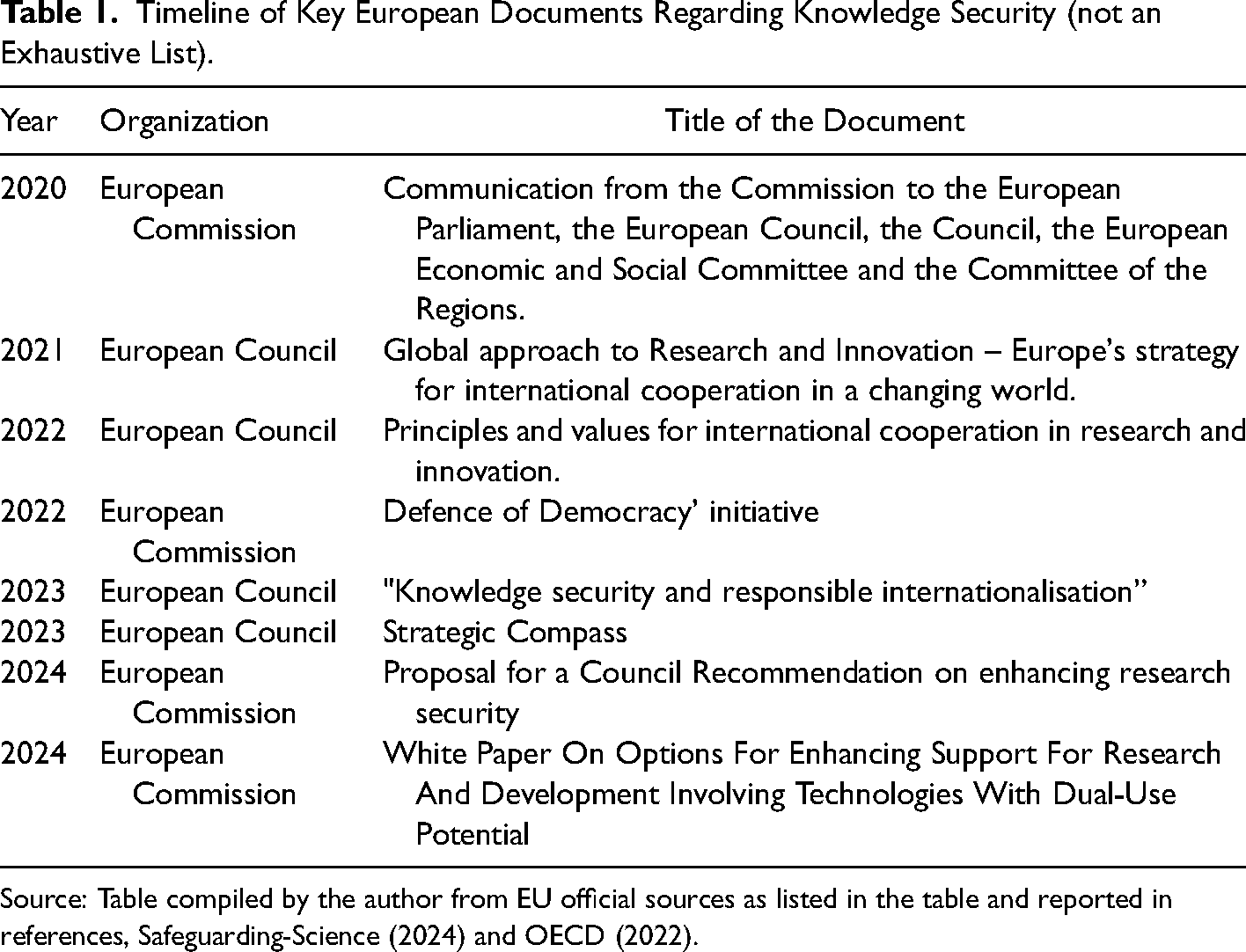
Source: Table compiled by the author from EU official sources as listed in the table and reported in references, Safeguarding-Science (2024) and OECD (2022).
Timeline of Key Supporting Initiatives Regarding Knowledge Security (Not an Exhaustive List).
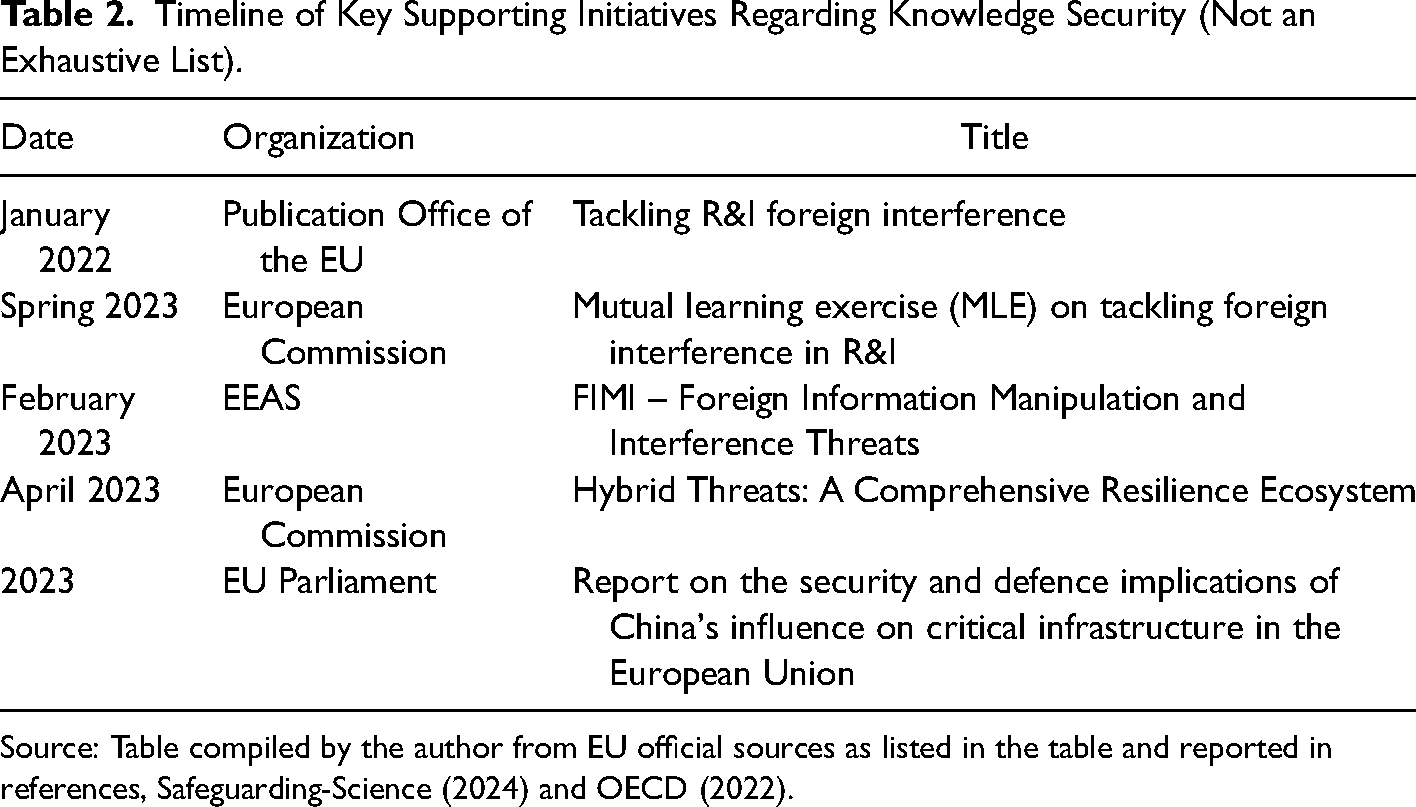
Source: Table compiled by the author from EU official sources as listed in the table and reported in references, Safeguarding-Science (2024) and OECD (2022).
EU Member States’ Position Towards China: a Comparative Assessment
This section will delve into the analysis of the three selected Member States and their academic cooperation with China. To set the stage for the three countries case-study and comparison, two key indicators will be provided for each of those countries and China., The two indicators, namely university rankings and broader innovation metrics, serve distinct yet complementary purposes in this analysis. The first looks at institutional performance and the second at the overall environment at national level in terms of research and innovation infrastructures.
The first table (Table 3) provides a list of the top 10 universities across these countries. With their limitations, such rankings provide insight into the academic prestige and global reputation of these institutions, which are critical factors in attracting international students and faculty, as well as securing research funding.
Top 10 Universities in Hungary, Italy, the Netherlands and China (2024).
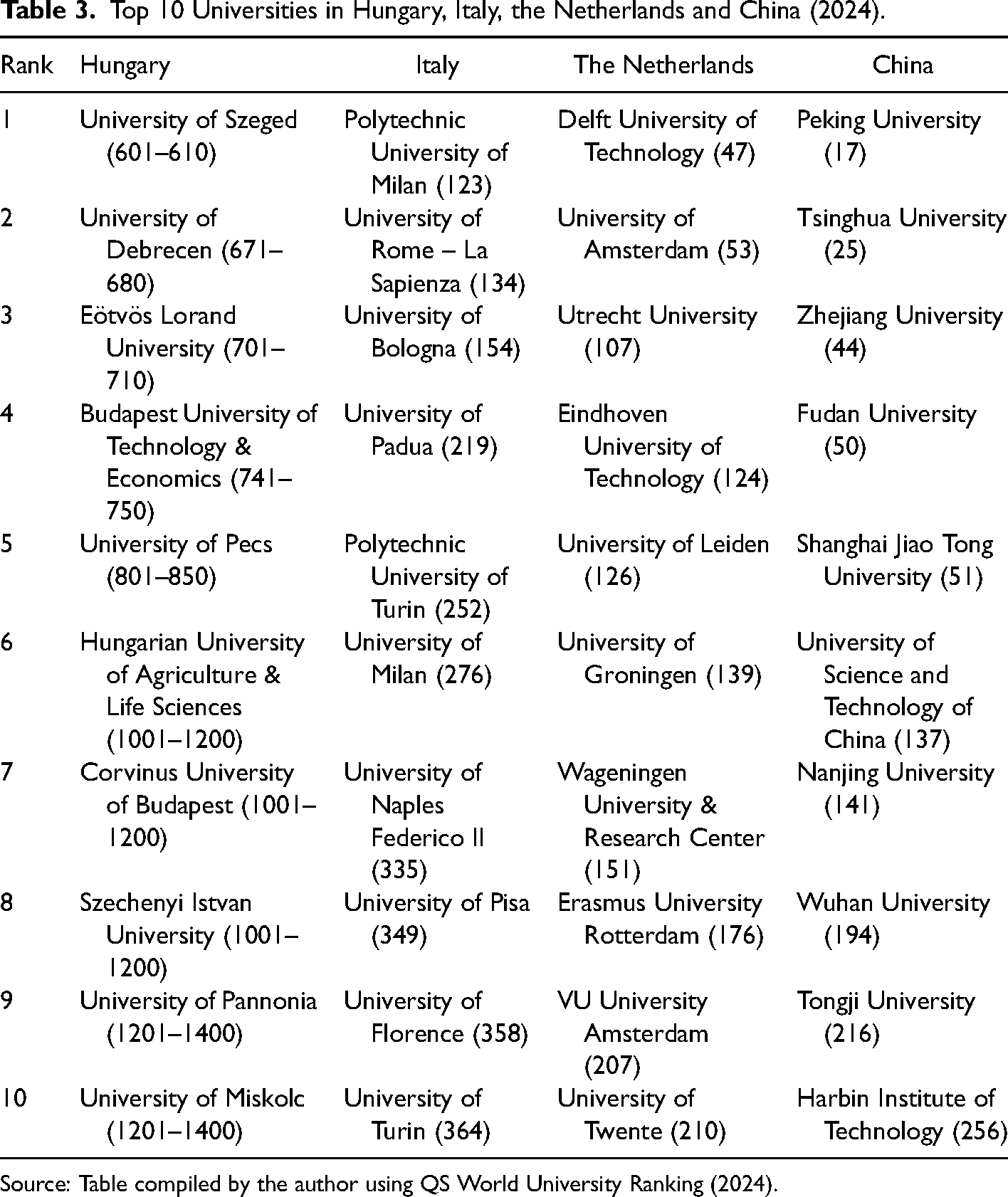
Source: Table compiled by the author using QS World University Ranking (2024).
Hungary's universities predominantly rank within the 601–1400 range, indicating an important regional presence but lesser visibility on the global stage compared to institutions in the other listed countries. The highest-ranked university, the University of Szeged, is positioned between 601–610. Italian universities show a broader spread in the rankings, with the Polytechnic University of Milan leading at rank 123, indicating a robust global recognition. Other institutions like the University of Rome – La Sapienza and the University of Bologna also display strong international standings within the top 200. The universities from the Netherlands are consistently high-ranked. Delft University of Technology and the University of Amsterdam, ranked 47 and 53 respectively, showcase the country's cutting-edge educational infrastructure and its appeal in the global academic landscape. China's universities are highly competitive globally, with Peking University and Tsinghua University ranking 17 and 25 respectively. This reflects China's massive strides in higher education and research, positioning its institutions as global leaders in various academic fields.
The second table (Table 4), focusing on the Global Innovation Index, extends the analysis to a national level across various dimensions of innovation, such as institutions, human capital, infrastructure, market sophistication, and more, which collectively indicate a country's innovation capabilities and environment.
Global Innovation Index and Categories for Hungary, Italy, the Netherlands and China (2024).
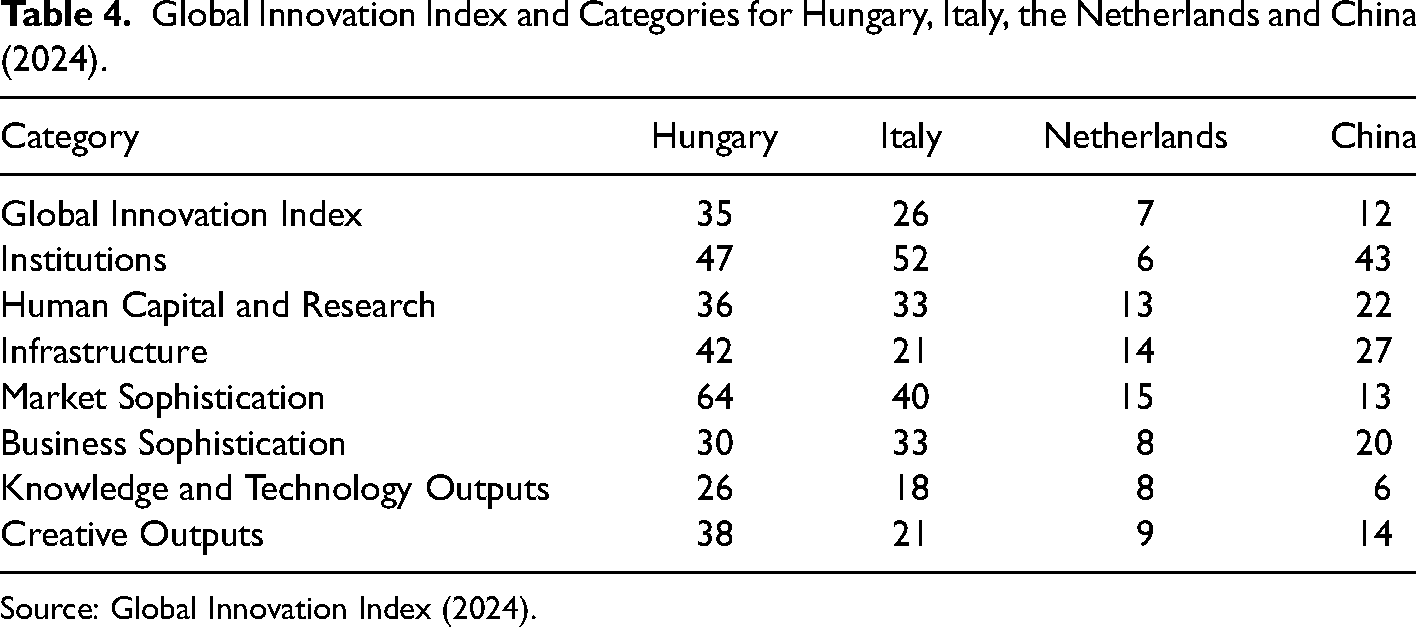
Source: Global Innovation Index (2024).
This data illustrates that the Netherlands is a leader in almost all categories, reflecting its holistic and robust innovation ecosystem. China also shows strong performance across the board, aligning with its recent pushes in technology and innovation. Italy and Hungary, while trailing behind the Netherlands and China, display strong areas in certain categories like infrastructure and business sophistication, signalling their ongoing development towards becoming competitive innovation-driven economies.
These two tables together allow for a nuanced understanding of where Hungary, Italy, and the Netherlands stand in relation to China in terms of academic excellence and innovation capability. Each country's unique position shapes their respective approaches to academic collaboration with China and it serves this analysis as a base to understand opportunities and risks of their engagement, key factors in embracing (or not) the knowledge and research securitization process.
The following section delves into the three case study and analyses: 1) each country's national interest and political alignment with China; 2) how academic cooperation has evolved in the last decade, especially after COVID-19; 3) if and how “knowledge and research security” governance practises/mechanism have emerged.
Hungary and China Cooperation: China as An Opportunity Rather than a Risk
Hungary, a key player in Central Eastern Europe (CEE), faces intricate challenges within the EU, particularly regarding democratic policies and the rule of law, which have also impacted its HEIs (Révész, 2024). Over the last decade, significant reforms in Hungary's higher education system, led by Prime Minister Viktor Orbán, have centralized control over universities and academies. By 2021, the governance of 34 institutions, including 21 universities, was transferred to public trust foundations managed by individuals closely affiliated with Orbán and his political party (Krull & Brunotte, 2021). This centralization raised concerns about the rule of law, prompting the EU, already in 2018, to trigger Article 7, a disciplinary procedure against Hungary for undermining democratic rules and being “a clear risk of a serious breach of the values referred to in Article 2 of the Treaty on the European Union.” (van der Wende, 2021) Following this, in January 2023, the EU suspended Horizon Europe and Erasmus funding to these institutions due to rule of law breaches. The EU also restricted Hungary's access to cohesion funds and the Recovery and Resilience Facility to counteract what it perceived as authoritarian shifts in governance within Hungary's education sector. In response, the Hungarian government contended that the Commission's decisions “unfairly target public interest trusts and the universities they manage”, (Brent, 2023) maintaining that it had fulfilled all its commitments and opposing the exclusion of its universities from participating directly in EU tenders. An official supported this view arguing that “the reforms were necessary for Hungarian universities and that the funding cuts forced them to seek support outside the EU, despite the potential dependency risks involved”. 2
Hungary's engagement with China, influenced by Orbán's Eastern Orientation Policy from the 2010s, illustrates a strategic shift aimed at strengthening Hungary's global connectivity and infrastructure development. As a pioneer within the EU in endorsing China's Belt and Road Initiative (BRI) and a leader in the former 16 + 1 group, Hungary has positioned itself at the forefront of CEE-China relations ().
In higher education, this relationship is marked by substantial agreements to enhance academic and technological exchanges. Notably, a 2019–2022 framework agreement, signed by Hungary's Minister for Innovation and Technology, László Palkovics, and China's Vice Minister of Education, Zheng Fuzhi, included 230 scholarships alongside short-term research positions (About Hungary, 2019). This is complemented by numerous institutional collaborations across various disciplines, such as the recent partnership with Miskolc University, which underscores the depth of Hungary-China academic cooperation (University of Miskolc, 2023).
The cultural aspect of this partnership is highlighted by the establishment of five Confucius Institutes in Hungary, which is not a small number considering that Hungary has a population of less than 10 million inhabitants. Those facilitate cultural and educational exchanges, particularly targeting the significant Hungarian Chinese community and those closely involved with Chinese affairs (Matura, 2022).
Controversies, such as the debated establishment of Fudan University's campus in Budapest (Révész, 2024), mainly led by the opposite party and supported by the Budapest's mayor, were clear sign of discontent reflecting underlying tensions within Hungary concerning Chinese influence in higher education. This was paralleled by domestic discontent following the closure in 2019 of the Central European University (CEU) – established in 1991 by Hungarian-born financier George Soros – as it was forced to meet new regulations targeting foreign-funded universities (BBC, 2021; Green, 2020).
Despite these challenges, Hungary's commitment to deepening ties with China continues, as evidenced by the signing of five BRI agreements at the third Belt and Road Forum in October 2023, focusing on enhancing scientific and technological cooperation (Global Times, 2023). This ongoing partnership demonstrates Hungary's strategic embrace of Chinese investments in education and science, aligning with broader economic and strategic goals.
Regarding knowledge security, no specific statements from Hungarian representatives were found during the search. Conversely, at the Eurasia Forum—held in Budapest in November 2023 and organized by the Hungarian Central Bank in collaboration with five Chinese partners out of 18—György H Matolcsy, the Governor of the Magyar Nemzeti Bank, emphasized in his opening speech the importance of “joint thinking” and international cooperation”, “inclusivity and knowledge sharing” for the new generation of talent, subsequently citing a Chinese proverb. His speech was followed by the opening speech of Wu Hongbo, the Special Representative on European Affairs of the Chinese Government (Eurasia Forum, 2024).
The timeline and content of the 2019–2022 framework agreement, the BRI commitments and the narrative surrounding the partnership with China underline how the measures proposed by the EU are not really taken up. The absence of concerns on ‘knowledge and research security’ might be the result of the dominant narrative shaped by the Orban's government surrounding academic cooperation with China. However, two considerations are important. First, internally, domestic political power struggle between the Orbán government and the Europhile, left-liberal opposition is intertwined with foreign policy orientations. As a response, the left-liberal opposition parties, supported by their Euro-Atlantic political and intellectual counterparts, can use the anti-Chinese stance as a political tool. Consequently, the domestic situation should be monitored as it influences the country's foreign policy orientation towards China. (Marac, 2023). Secondly, it is reasonable to suppose that Hungary, within the broader EU framework as indicated by the EC's recommendation on enhancing research security in January 2024, approaches such cooperation with a consideration of both the opportunities and security challenges posed by international academic partnerships, involving a higher level of scrutiny, particularly in areas of strategic importance. However, the suspension of EU funds to major Hungarian academic and cultural institutions, if on one side it is a necessary step in light of the country's breach of the rule of law, on the other it can function as a further obstacle for the Hungarian alignment with EU's stance. More recently, the EC has chosen to boycott Hungary's six-month EU Council presidency due to Viktor Orbán's contentious visits to Moscow and Beijing, which are largely viewed as undermining the bloc's political unity (Liboreiro, 2024).
Italy and China Cooperation: An Ambivalent Partnership
Italy, standing as a pivotal nation within Southern Europe and a foundational member of the EU, boasts the EU's third-largest economy. Its unique position as the only G7 country to formally engage with China's BRI marks a significant moment within EU-China relations and far beyond within the NATO alliance, leading to a reconsideration of such agreement under the leadership of Giorgia Meloni's government in late 2023 (Pinna, 2025).
To what concerns academic cooperation with China, a noteworthy point is that Italy was among the earliest Western nations to sign an intergovernmental agreement with China in 1978, coinciding with China's opening-up reform. This agreement fostered cooperation in science and technology, opening Italian universities to Chinese scholars and students. (Marinelli & Andornino, 2014).
In response to China's expansion in higher education, Italy has proactively engaged with Chinese educational institutions to boost its own academic and research capabilities globally, marking a key component of its broader internationalization strategy. This engagement is driven by mutual interests in academic exchange and collaboration, which serve as catalysts for enhancing Italy's educational and research outputs (Casarini, 2021). As a result, Italian universities have entered academic partnerships with various Chinese counterparts spanning a wide array of disciplines, as exemplified by the number of academic agreement signed. Up to date, there are 1042 research agreements between Italian and Chinese universities (CINECA, 2024). Among the various institutional partnerships, it's worth noting that back in 2012, Florence agreed to become home to the first Chinese university campus established outside of China, with the set up, in 2014, of a Overseas Campus of the Tongji University in the University of Florence. Additionally, in 2016, the two universities agreed to set up in Shanghai the “Shanghai International College of Intellectual Property”. (Firenze Today, 2012; University of Florence, 2016)
In terms of mobility, Italy has developed two specific mobility programs, “Progetto Turandot” and “Progetto Marco Polo” . They are both agreements between the Italian and the Chinese Government to facilitate young Chinese students to study at Italian universities. The first focused on the study of arts, music and design and the second on all other disciplines (Universitaly, 2024).
China has also made substantial investments to facilitate cooperation and cultural exchanges with Italian academic institutions, including the establishment of numerous Confucius Institutes (12) and Confucius Classrooms (3) (Geopolitical Insights, 2022). Italian universities have experienced an influx of sponsorships from Chinese companies, notably in the information and communication technology (ICT) sector, such as ZTE and Huawei. (Casarini, 2021). The signing of the BRI Memorandum of Understanding (MoU) in March 2019 further underscored the significance of higher education, academic, cultural, and S&T collaboration. (Italian Government, 2019).
While this has enriched Italy's research capabilities, already in 2019 concerns have arisen regarding potential self-censorship and undue influence from Chinese interests, prompting questions about Italy's security interests and its alignment with Western allies (Scarpari, 2019).
Italy's relationship with China in higher education has been characterized by ambivalence. Despite the initial enthusiasm, subsequent developments, including the government's withdrawal from the BRI MoU, reflect growing concerns over knowledge and research security in the cooperation with China and a stronger alignment with the EU's position.
Nonetheless, academic cooperation with China is considered essential for Italian universities as underlined by a government official, especially to tackle global challenges. 3 During the China-Italy Intergovernmental Committee meeting in Beijing on September 4, 2023, both nations reasserted their commitment to reinvigorating their bilateral dialogue under the Global Strategic Partnership. The meeting highlighted the importance of their longstanding scientific and technological cooperation program, which has been actively supported by both the Italian Ministry of University and Research and the Chinese Ministry of Science and Technology for the past 13 years (MUR, 2024).
However, cooperation has shifted in its approach. There is not the same openness and cooperation needs to be justified although it remains unclear where responsibility should rely on. In this environment, misunderstandings are growing, sometimes caused by lack of cultural sensitivity. On the other hand, Chinese scholars are facing enormous pressure to deliver on the promise of national technological supremacy and independence, while the space for creativity especially in certain sectors is still missing or even narrowing. This doesn’t help the building of trust neither the flourish of cooperation. 4 While governance mechanisms of screening are not yet in place, also due to the novelty of the EC's recommendation on research security, nonetheless an increasing awareness regarding derisking from China is documented in the economic sector and to some extent in the academic sector too to what concerns dual-use technologies (Assonime, 2024). Nonetheless, the push seems to be top-down driven signifying how the Italian government is following the steps of the EU and aligning with the bloc's position. However, on the ground, efforts by the Italian government to de-risk from China are facing significant resistance from key sectors, including business, local authorities, and also academia, all of which continue to deepen ties with Beijing despite official policies to reduce dependency (Casarini, 2023).
The Netherlands and China Cooperation: Beyond Business as Usual
The Netherlands, acting as a representative of the Central-Northern European position, maintains a more cautious stance with China. It is a founding EU member and a significant trading partner with China. The Dutch government's approach to China has evolved in the last decade from a primarily business-oriented stance in 2013 to a more cautious perspective in 2019, as outlined in “The Netherlands and China: A New Balance."(Government of the Netherlands, 2019; Pinna, 2025). This shift, aligning with the EU's strategic outlook, reflects concerns over strategic dependencies on China and the need for reciprocal relations. Issues like China's human rights record, with reference to the treatment of Uighur Muslims and the erosion of freedoms in Hong Kong, as well as attempts to influence Dutch domestic affairs, have prompted the Netherlands to recalibrate its strategy towards China, focusing on national interests and values alongside economic benefits. These measures have included initiatives to enhance transparency in investment and scrutinize sensitive sectors, such as technology and critical infrastructure.(Martin, 2022) This change was prompted by various significant events that acted as wake-up calls, including debates surrounding 5G technology, the global consequences of the coronavirus pandemic, and the export of ASML's extreme ultraviolet (EUV) machine. (Martin, 2022; Pinna, 2025).
A domain where cooperation between China and the Netherlands has introduced geopolitical dimensions is in the realm of higher education cooperation and knowledge security, which has gained significant prominence in recent years. It's noteworthy to recall that the term ‘knowledge security’ has actually been coined by the Dutch Government already in 2020 (Tweedekamer, 2020), before it appears in EU documents. In 2021, the Dutch General Intelligence and Security Service's (AIVD) annual report highlighted China as the most significant threat to knowledge security, cautioning Dutch universities about their collaborations with China (Hoger Onderwijs Persbureau, 2022). This position has been reiterated each year since then.
At institutional level, it's interesting to recall that concerns over academic cooperation with China were already raised before. For instance, in 2017, the University of Groningen planned to open a campus in Yantai, but the project failed due to both economic and academic values considerations (Lijst Calimero, 2017). Collaborating with Chinese academic institutions is increasingly viewed in the Netherlands, as either a potential security risk or ethically questionable, particularly in the context of advanced technology sectors that are at the forefront of global strategic competition. The apprehensions associated with partnerships with Chinese universities encompass a range of issues, including unwanted knowledge transfers, theft of intellectual property, covert attempts to influence individuals, breaches of ethical norms or scientific integrity, and the exploitation of technology with both civilian and military applications. (Snetselaar, 2023). Within academic circles, increasing voices have been mounting over higher education cooperation with China. “We were naive – China and Russia want our knowledge” titled a column of the University of Groningen Journal, signed by the Dean of the Faculty of Science Engineering (Boomsma, 2023).
The “China threat” is perceived also regarding the role of Confucius Institutes. Presently, the Netherlands is home to only two Confucius Institutes, located in Groningen and Maastricht, established in 2011 and 2016, respectively. The Confucius Institute at Leiden University terminated its partnership in 2019, citing a misalignment between the institute's activities and the university's evolving China strategy. The Confucius Institute in Groningen is under strict scrutiny. (Fabrizi, 2022).
In 2023, the Dutch government increased scrutiny on international students, particularly those sponsored by the Chinese Scholarship Council (CSC), due to national security concerns. This follows Dutch universities’ decisions to exclude Chinese postgraduates from advanced technology degrees, in response to CSC requirements that students pledge allegiance to the Communist Party and report to the Chinese embassy. Amidst growing EU concerns over Beijing's influence, the Netherlands is exploring restrictions on CSC students and is preparing a Knowledge Security Screening law to mitigate risks associated with sensitive technologies. This initiative is part of a broader strategy to counteract foreign interference in research and innovation (Government of the Netherlands, 2022) and includes plans to establish a new centre to safeguard European research. (Bounds, 2023) Reflecting a cautious approach, Dutch universities are starting to limit admissions of CSC-funded students to protect intellectual property and sensitive technologies. A recent comprehensive study showed that in 2023, there were about 2,197 CSC PhD students in the Netherlands, with nearly half engaged in strategically important research. However, the dependence of Dutch academic institutions on these students for strategic research remains minimal, although the importance of diversifying funding sources to balance security concerns remains key (d’Hooghe & Martin, 2024).
The Dutch case highlights the most sophisticated measures taken so far to ensure ‘knowledge and research security’ while navigating a complex relationship with China towards a more sustainable balance. It's important to note how the definition of the Dutch position converges in terms of timeline and contents with the EU's (see Table 1); to some extent, it anticipates the definition of its concerns, such in the case of the term ‘knowledge security’.
Assessing Member States’ Convergences and Divergencies
The securitization of knowledge and research within the EU operates on two distinct levels: the EU normative level and the Member State level. At the EU normative level, there is a noticeable degree of alignment in terms of policy frameworks and overarching principles. The EU has established common guidelines and regulatory measures to address the growing concerns around research security, particularly in areas like dual-use technologies, foreign interference, and intellectual property protection. Initiatives such as the 2024 EC's recommendation on knowledge security and the publication of critical technology lists reflect a coordinated approach to addressing the securitization of research at the supranational level. These frameworks aim to standardize responses across Member States while preserving the EU's commitment to open and collaborative scientific research.
However, at the Member State level, the pace and depth of implementation vary significantly, especially to what concerns the establishment of governance mechanisms. While some countries, such as the Netherlands, have taken proactive steps in creating national research security guidelines and updating their regulations in response to the geopolitical changes, others lag behind (Hungary) or have adopted more cautious approaches (Italy). This divergence is influenced by different national priorities, historical contexts, and the extent of perceived security risks associated with research activities. As a result, there is an uneven landscape across the EU in terms of how Member States implement and enforce these security measures within their own scientific communities. A comparison of the approaches of Hungary, Italy, and the Netherlands ‘can share light on these dynamics.
Hungary's enthusiastic embrace of China, exemplified by its active participation in the BRI and plans for hosting a Chinese university campus, underscores a strategic political alignment, driven by President Orban's policy, with China's global ambitions. This approach, however, appears to sideline discussions on ‘knowledge and research security’, potentially placing Hungary at odds with the EU's securitization discourse on academic and scientific cooperation with China. Hungary's academic policies reflect a strong inclination towards engaging with Chinese institutions to enhance its international academic stature and access advanced research resources. The country, with universities generally ranked lower on global scales, sees cooperation with China as an opportunity to boost its academic and technological capabilities, which can spur domestic innovation and development. Although there are concerns about potential over-dependence on Chinese resources and political pressures, the EU's suspension of Horizon Europe and Erasmus could enhances the vulnerability of Hungarian HEIs further widening the distance with the EU's stance.
Italy presents an ambivalent political posture vis a vis China; initial engagement under the BRI MoU has cooled, particularly in the wake of the pandemic and growing recognition of China's strategic objectives. Italy's withdrawal from the BRI MoU under the Meloni government signifies a recalibration of its relationship with China, reflecting a more cautious approach that aligns with the EU. Italy's academic relationship with China is characterized by a balanced willingness to engage, leveraging Chinese advancements in technology and research to complement its strengths. Italy, with a mix of middle and high-tier universities, considers cooperation with China as essential to enhance its global competitiveness. However, there is an increasing awareness of the EU's securitization process of ‘knowledge and research security’ and the need to align with that. Nonetheless, the Italian approach reflects a nuanced strategy of cautious engagement, balancing historical ties, national interest and the need to adhere to EU guidelines on ‘knowledge and research security’.
The Netherlands represents the archetype of alignment with the EU's approach towards managing relations with China, particularly in the realm of higher education and research. Dutch universities are consistently high-ranked and the Netherlands ranks exceptionally high globally at 7, indicating a strong national innovation system. Thus, cooperation with China is important for the Netherlands but its position of strength makes the difference. The Dutch strategy is informed by a proactive stance on safeguarding intellectual property and a rigorous scrutiny of academic collaborations with China. The introduction of stringent screening policies exemplifies the Netherlands’ commitment to protecting its educational and research sectors from potential foreign interference and undesirable knowledge transfer. This alignment with EU policies is driven by both security concerns and ethical considerations, reflecting a broader European apprehension about China's influence in critical research areas and strategic sectors. It's noteworthy that the Dutch approach not only aligns with but to some extent anticipates EU initiatives. This is evident also from the fact that the Netherlands is the only country of the three that has already set up some of forms of governance mechanism to screen and protect academic and scientific cooperation with China.
Conclusion: Towards a Cohesive EU Stance
The article provides a thorough examination of the broader implications for the EU's cohesive stance towards academic collaborations with China, to what concerns ‘knowledge and research security’, focusing on the diverse approaches of Hungary, Italy, and the Netherlands.
These Member Sates each adopt distinct strategies towards academic cooperation with China, reflecting a spectrum of engagement within the EU. Hungary's independent approach may pose challenges to EU cohesion, particularly concerning ‘knowledge and research security’. Italy navigates a delicate balance between the government push for de-risking from China and on the ground resistance to continue strengthening ties with Beijing. The Netherlands aligns closely with EU strategies that emphasize the protection of academic freedom and integrity. Nevertheless, while Hungary's stance could complicate EU efforts, Italy's shifting policies and the Netherlands’ cautious approach might support the EU's tendency towards a more prudent engagement with China.
These varied approaches underscore the difficulty in crafting a unified EU policy towards China. The EU's capability to forge a cohesive and strategic approach towards China, especially in academic cooperation, depends on reconciling the different positions of its Member States and requires a nuanced strategy that respects the diverse concerns and priorities of its Member States. The position of each country is different as well as their academic and innovation strength that have a direct influence on their political alignment and leverage in the academic relations with China. Thus, reducing inequalities within the EU is seen as a necessary first step towards the strengthening of the EU's cohesive stance. Secondly, to effectively manage these complexities, the EU could capitalize on the EU's collective negotiation strengths with China while ensuring that academic partnerships do not undermine the Union's strategic interests or its values. Such a strategy would be essential for maintaining the EU's economic competitiveness and effectively addressing global challenges, underlining the importance of a balanced and strategic engagement with China.
This study makes both empirical and theoretical contributions to the limited body of research on knowledge and research security in the context of EU-China relations. Empirically, it provides new insights by tracing the evolution of the EU's securitization of academic and research cooperation with China, offering a comprehensive assessment of how this concept has become embedded in European policy frameworks. Through a comparative analysis of Hungary, Italy, and the Netherlands, the research illuminates the nuanced ways in which individual EU Member States interpret and implement these security concerns, contributing case-specific evidence that enhances our understanding of the diversity of national responses. Theoretically, the study builds on and extends the application of securitization theory by examining how knowledge and research domains are framed as security issues within a geopolitical context. It also integrates perspectives from science and technology studies, focusing on dual-use knowledge, to analyse how securitization influences the governance of international academic collaborations. By bridging these theoretical frameworks, the study enriches scholarly debates on the intersection of security, international relations, and academic cooperation, offering a multidimensional perspective on the challenges posed by China's scientific rise.
In conclusion, a key limitation of this study is a precise definition for ‘knowledge and research security’, which remains ambiguous across different contexts. The lack of clarity around these terms makes it difficult to consistently assess and compare securitization efforts across nations and institutions. As the concept encompasses a range of concerns—from intellectual property protection to preventing dual-use technology transfers and safeguarding against foreign interference—it is challenging to establish uniform guidelines. Looking ahead, the study could be significantly enriched by broadening the scope of case studies to include a wider array of countries and institutions. By incorporating nations at different stages of implementing knowledge and research security measures, future research could offer a more comprehensive understanding of the evolving challenges and best practices across diverse geopolitical and institutional contexts, leading to more generalizable and impactful insights.
Footnotes
Declaration of Conflicting Interests
The authors declared no potential conflicts of interest with respect to the research, authorship, and/or publication of this article.
Funding
The author disclosed receipt of the following financial support for the research, authorship, and/or publication of this article: This research has received funding from the European Union’s Horizon 2020 research and innovation programme under the Marie Sklodowska-Curie grant agreement No 101032504.
