




Abstract
This study examines the evolution of Science, Technology, and Innovation (STI) policies within the context of the European Union (EU) and China scientific cooperation. Applying a historical institutionalism perspective, this study identifies three phases in EU-China scientific cooperation since 2006: dependent innovation, innovation with a global vision, and a transition to passive independent innovation. The study reveals that EU-China scientific cooperation has been significantly shaped by the trajectory of China's STI policies. The reciprocal relationship between the EU and China, particularly in terms of economic implications, has undergone dynamic changes. With the evolving role of the government in STI domains, EU-China cooperation has diversified in fields and approaches. This study provides a Chinese perspective on uncovering the internal logic of Chinese STI policies, highlighting the dynamics between the national and the international dimensions. Finally, the paper offers prospects for EU-China scientific cooperation in an era characterized by competition and interdependence in scientific advancements.
Introduction
The contemporary era has been characterized by significant transformations in the domains of STI, which constitute the foundation of national strength competition among countries. Since 2006, China has formally implemented its STI policies. The State Council introduced the “Outline of the National Program for Long- and Medium-Term Science and Technology Development (2006–2020),” delineating the guiding principles for science and technology (S&T) as “indigenous innovation, key breakthroughs, support for development, and leading the future (自主创新、重点跨越、支撑发展、引领未来).” This plan established the ambitious objective of transforming China into “an innovative country” by 2020. In 2012, the 18th National Congress of the Communist Party of China (CPC) announced the implementation of an “innovation-driven development strategy (创新驱动发展战略),” thereby elevating innovation to the status of a national strategy.
China's STI policies, like those of many other countries, have played a significant role in shaping China into a global innovation powerhouse. Notably, in the past two decades, China's STI policies have been highly outward-looking, facilitating the flourishing of Chinese higher education and S&T through collaboration among various agents at global, regional, national, and local levels (Marginson, 2018). For example, the EU and China have mutually benefited from exchanges and cooperation in STI. By 2023, the stock of two-way investment between China and the EU have exceeded 250 billion US dollars (People’s Daily, 2024).
Given the close relationship between STI and international scientific relations, it is essential to comprehend the evolution of China's STI policies, especially the interactions and dynamics at global, regional, national, and local levels. This multifaceted approach not only elucidates the evolving nature of EU-China partnerships over the past two decades but also provides insights for forecasting future trends in EU-China S&T cooperation.
China's STI strategies are centrally positioned within its economic development narrative. These strategies are deemed crucial for addressing pressing economic and social challenges that China confronts, including social stability, environmental degradation, and energy security, as well as underscoring China's ambition to reassert its position as a preeminent global economic power (Bräuner, 2011; Freeman, 2021; Sautenet, 2008, p. 4). Existing literature on EU-China scientific collaboration within the framework of STI policies can be encapsulated across four dimensions: First, an asymmetry in the economic reciprocity inherent to STI cooperation between the EU and China was perceived. In 2023, approximately one-third of the EU's imports of high-tech products were sourced from China, accounting for 32% of the total imports in this category and amounting to a value of €155 billion (Eurostat, 2024). As a result, there is a call within the EU for enhanced reciprocity in cooperative endeavors, as well as a pursuit of greater balance in EU-China higher education partnerships (Van Der Wende, 2020).
Another concern is over the state intervention and authoritarian governance in China's STI. European scholars believe that the political repercussions could extend into scientific endeavors and will impede Sino-EU scientific collaboration. They contend that the CPC's initiatives to adopt cutting-edge technologies for military modernization and to fortify its authoritarian rule will introduce new risks and raise concerns regarding the EU-China scientific cooperation initiatives (Arcesati et al., 2021). Such concerns include potential threats to national security and the compatibility with European values.
Furthermore, European scholars have expressed concerns regarding the absence of a robust and reliable framework to safeguard research security and ethics in EU-China STI cooperation. They identify potential risks and a perceived deficiency in the management of data security, intellectual property protection, research integrity, and adherence to ethical standards. Van Deursen and Kummeling (2020, p. 221) note that while both Chinese civil and criminal law address the use of personal data, the legislation still lacks clarity on the mechanisms and principles that should underpin this protection.
Last but not least, recent research has increasingly demonstrated that universities are at the forefront of STI, driving social innovation and contributing to regional and national economic growth (Acs et al., 2016; Datta et al., 2019; Valero & Van Reenen, 2018; Wen et al., 2023). Universities, particularly research-intensive ones, serve as pillars of national innovation systems by advancing basic research, fostering an innovative culture, training talent, facilitating technology transfer, and promoting regional innovation clusters (Cai, 2022; Wen, 2024).
The majority of existing English literature exhibits a critical stance toward China's STI policies, yet a nuanced analysis from a Chinese viewpoint is notably absent. With this in mind, this paper seeks to enrich the global discourse on EU-China collaboration in STI by offering insights from a Chinese standpoint. It endeavors to address a pair of pivotal research inquiries: What has been the trajectory of China's STI policy development since the inception of its initial STI policy in 2006? And to what extent have these policies shaped the scientific interactions between the EU and China?
Theoretical Perspective and Analytical Approach
Historical institutionalism is adopted to analyze the trajectory of STI policy development in China. Historical institutionalism does not only recognize the time-sensitive nature of political development but also emphasizes the institutional factors behind these temporal processes (Pierson, 2000). The common analytical approaches of this theoretical cluster include critical junctures, path dependency, gradual transformation, etc., and most of them pay special attention to the timing, sequence, and interaction of ongoing political actions (Thelen, 1999). This approach is particularly well-suited to analyzing the trajectory of China's STI policy given the country's centralized governance system, where policies often have coercive power and drive institutional change.
Historical institutionalism divides institutional change into “normal periods” and “critical junctures”. “Critical junctures” are points where structural constraints during the path-dependence phase are relaxed and the contingency is substantially enhanced (Capoccia & Kelemen, 2007). A thorough analysis of these critical junctures enables us to trace the starting point of institutional change and to unravel the historical event chains that lead to and away from these inflection points (Mahoney, 2001).
Existing research tends to dissect critical junctures into three main aspects—the past, the present, and the future. Slater and Simmons (2010) propose that factors or conditions preceding a critical juncture can produce the outcome of interest when in combination with the causal forces. Those preceding factors and conditions are referred to as
This study adopts a critical juncture approach to examine the development of China's STI policy. The critical junctures will be identified and contextualized with their respective critical antecedents, permissive conditions, and productive conditions. In each phase, this study will summarize the main characteristics of STI policy and elaborate on its consequential impact on EU-China scientific cooperation. Notably, this is not to say that China's STI policy evolution shows no sign of path dependency. We draw on the analytical approach of critical juncture because it provides an analytical tool to understand why and how China's STI policy changes.
Methods and Data
STI policies are a social and historical process, where powers and politics are deeply embedded in its development. Thus, a policy-focused analysis benefits “…a better understanding of the dynamics of policy change, and a more accurate mapping of interests, strategies, and influence” (Hacker & Pierson, 2014, p. 643). Given that “globalized discourses and agenda-setting and policy pressures now emerge from beyond the nation” (Rizvi & Lingard, 2010, pp. 14–15), China's STI policies, though born domestically, reflect and determine the stances, values, and strategies towards its STI development in the international area.
This study drew upon key STI policy documents released by central government bodies, such as the State Council, the Ministry of Science and Technology (MoST), the Ministry of Education (MoE), the Ministry of Commerce (MoC), etc. A chronological policy review was conducted and three phases were identified. Then it explored the context, content, and consequences in each phase (Taylor et al., 1997). Specifically, the context in this study involves the social, cultural, historical, and political backdrop against which STI policies are formulated, especially given that China's political environment has gone through significant changes both domestically and internationally. Content refers to policy texts, including their objectives, intentions, and prescribed actions. Through a content analysis of key STI policies, we aim to uncover the nuances and dynamics within China's STI policies. Consequences mean the actual effects of policy implementation, including both intended and unintended outcomes. The paper encompassed analyses of how STI policies are interpreted and executed in practice, especially in the international realm.
The Evolutionary Phases of China's STI Policies and Their Impacts on EU-China Scientific Cooperation
Phase 1: Dependent Innovation (2006–2011)
The introduction of the innovation strategy in 2006 marks a critical juncture in China's STI policies in the twenty-first century. The critical antecedent to this development was China's entry into the World Trade Organization (WTO). While it brought unprecedented foreign investments, it also facilitated the absorption of foreign technologies, which became a major approach to enhancing China's innovation capacity.
Within this critical juncture, at least three permissive conditions can be identified. First, the opening of the domestic market led to an increasing demand for advanced technology. Second, the diminishing benefits from cheap labor and the escalating environmental challenges necessitated a paradigm shift in China's industrialization and economic development. Third, the pivotal role of science and technology in global competition prompted China to adopt a more proactive strategy for innovation and reconsider its long-standing reliance on foreign technologies. Collectively, these conditions propelled China to deviate from its previous development path and search for opportunities for productive conditions.
The decisive point came at the National Conference on Science and Technology in 2006, when the “Outline of the National Program for Long- and Medium-Term Science and Technology Development (2006–2020)” was issued. “Indigenous innovation”, officially defined as “strengthening original innovation, integrated innovation, and re-innovation based on the assimilation of foreign technologies” (加强原始创新、集成创新和引进消化吸收再创新), was first proposed as a guiding principle for S&T development in China (State Council, 2006). Although “indigenous innovation” was proposed in the policy document, the focus seems to be more on “innovation” rather than “indigenous”. The previous strategy of “trading market share for foreign technology” (市场换技术) was not abandoned; rather, the importation of foreign technologies became a main approach for innovation in some sectors, such as the automotive industry. Consequently, China's innovation at this stage remained largely dependent on foreign support.
This period witnessed a significant increase in EU-China STI cooperation. From 2006 to 2011, the EU was the largest source of China's technology imports. In 2006, China signed 2,597 technology import contracts with the EU, valued at 8.66 billion US dollars; this accounted for 39.3% of the total value of technology import contracts, with Japan and the US ranking second and third (MoC, 2007). During this period, China was an active participant in leveraging the global scientific system. Before 2013, the EU classified China as a middle- and low-income country, ranking relatively high in the EU Framework Program's budget for non-EU countries (see Table 1). Policy documents such as the EU-China Strategy in 2001 and “A Mature Partnership: Common Interests and Challenges in EU-China Relations” in 2003, along with the establishment of the China-EU summit meetings mechanism, marked the apex of bilateral relations, often described as a “honeymoon period.” In terms of STI, this trend was particularly evident in the EU's active support for China's participation in the EU Framework Research Program, with funding for China in the EU's Sixth Framework Program (2002–2006) quadrupling that of the Fifth Framework Program (1998–2002), and maintaining the same heightened level in the Seventh Framework Program (2007–2013) (see Figure 1).
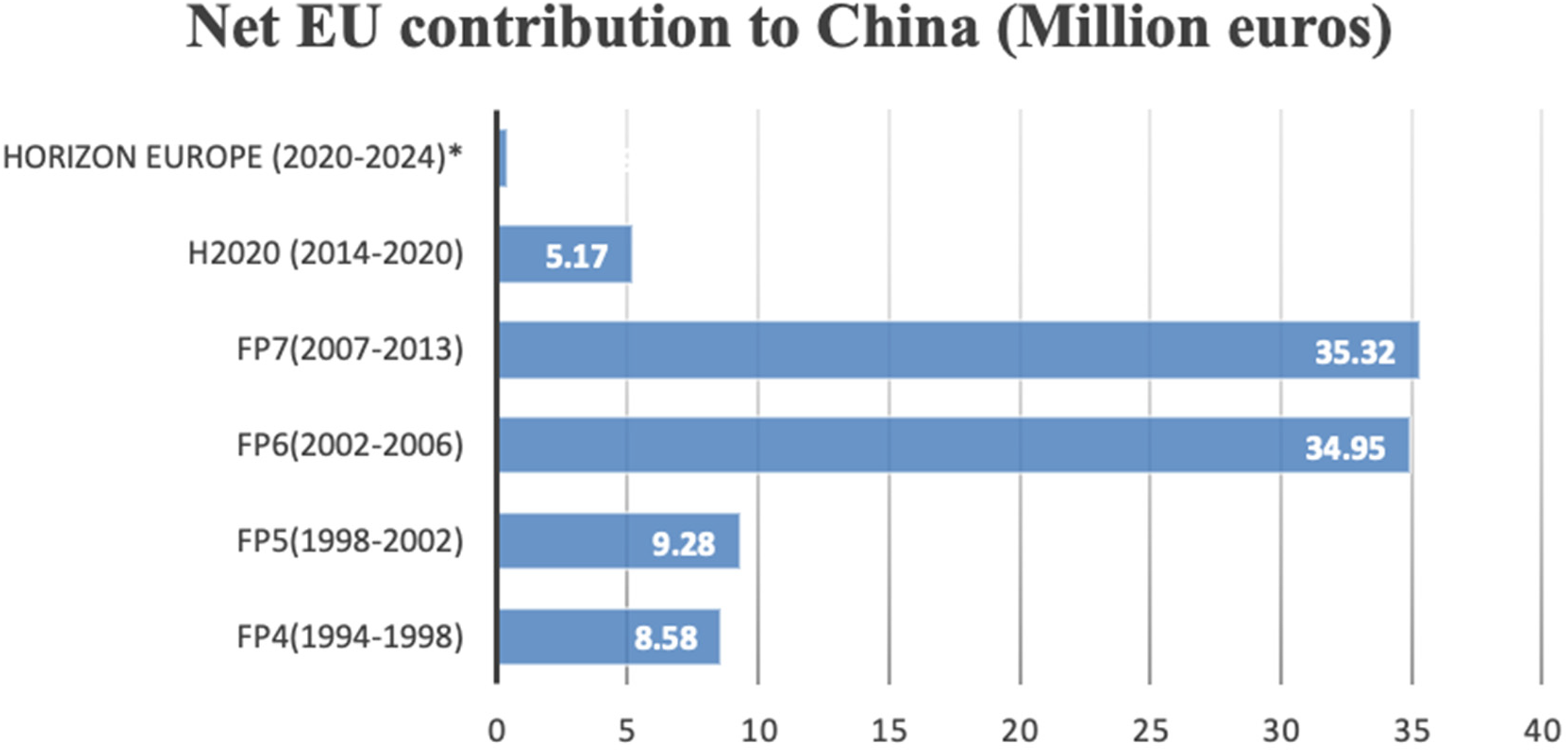
Eu's net contribution to China through framework program.
China's Budget Share Ranking in the EU Framework Program.
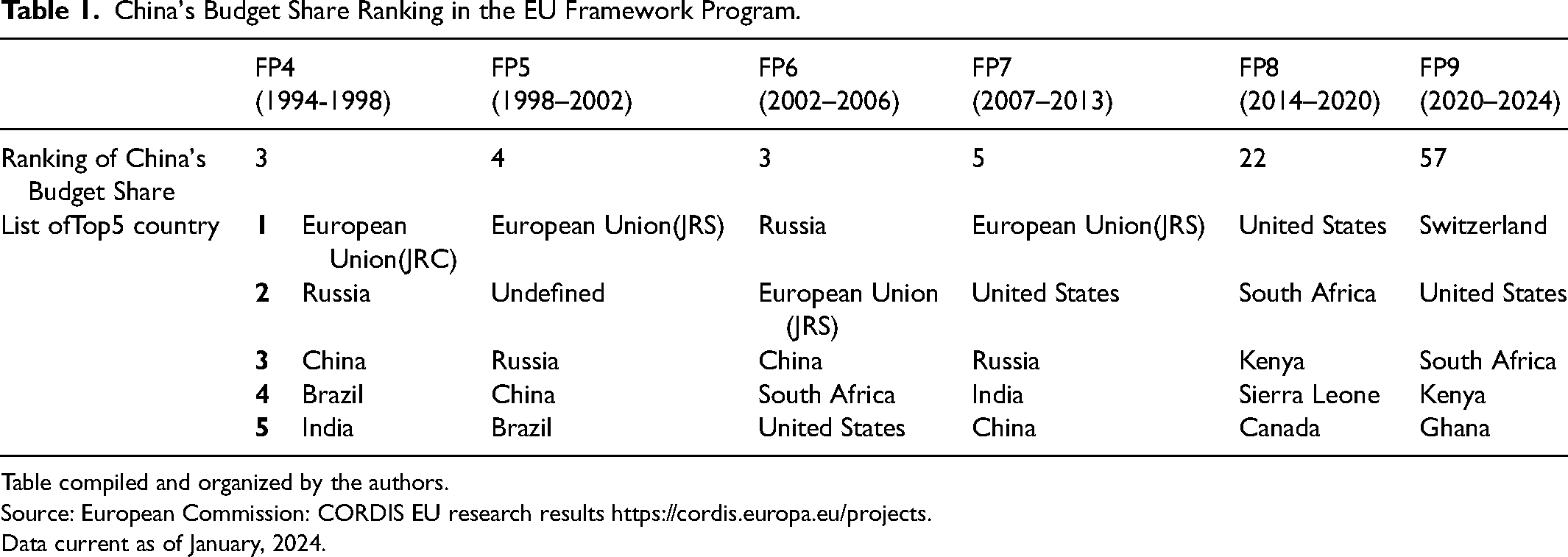
Table compiled and organized by the authors.
Source: European Commission: CORDIS EU research results https://cordis.europa.eu/projects.
Data current as of January, 2024.
Efforts were also made to attract overseas talents, such as the establishment of “disciplinary innovation and talent attraction bases” in 2006 and the implementation of the notable “Thousand Talents Plan” (千人计划) in 2008. These initiatives exemplified China's efforts to accumulate the human capital scattered worldwide.
Meanwhile, the government strengthened its role in creating a favorable environment for technology importation and selectively allocating resources. For example, in 2010, the State Council identified a few “strategic emerging industries” fields to enjoy the priority of foreign investment, including information technology, biotechnology, advanced manufacturing, and renewable energy. Consequently, EU-China S&T cooperation began to flourish in these fields. In 2010, China and the EU signed a joint statement on energy research, encouraging cooperation between small and medium-sized enterprises (SMEs) from both sides. To this end, China established a special fund of 100 million RMB for SMEs, known as the “China-EU SME Energy Conservation and Emission Reduction Special Fund,” to support technological cooperation in energy systems and renewable energy between SMEs from both parties.
Phase 2: Innovation with a Global Vision (2012–2019)
In 2012, the 18th CPC National Congress officially announced the “innovation-driven development strategy” (创新驱动发展战略), marking the second critical juncture in China's STI policies. This comprehensive strategy builds upon years of efforts to construct regional innovation demonstration areas such as Beijing, Hebei, Tianjin, Shanghai, Guangdong, Anhui, Sichuan, Wuhan, Xi’an, and Shenyang city. Within these regions, high-tech industries and international collaborations were vigorously promoted and generously subsidized.
The permissive conditions at this phase are twofold. Firstly, China's economy has been rapidly developing, with a shift from the heavy reliance on traditional factors of production such as labor, land, and resources, towards technological innovation factors. Secondly, the global financial crisis in 2008 prompted major countries to adopt trade protectionist policies, thus hindering China's ability to import foreign technologies and compelling the nation to comprehensively upgrade its position within the global supply chain.
Notably, the national strategy of “innovation-driven development strategy” also emphasized the importance of a global vision and international exchange, signaling China's proactive stance in integrating into the global innovation network. To enhance its innovative capacity, China placed great importance on global innovation resources, aiming to lead in several strategic areas and contribute to formulating international rules (State Council, 2016). In 2016, the MoST unveiled the action plan for STI cooperation in Belt and Road Initiative (BRI) regions. This plan indicated a strategic shift in China's S&T focus, transitioning from a phase of “importing” knowledge to one of “exporting” innovation, with innovation emerging as a pivotal element of China's international engagement (MoST, 2016). Since then, China has engaged in various forms of STI cooperation under the BRI umbrella, including bolstering fundamental scientific research, establishing joint research platforms, creating technology transfer centers and overseas education hubs, and developing high-tech parks (He et al., 2023).
China's STI policy outcomes at this stage reflect a more proactive stance in EU-China S&T cooperation. The China-EU 2020 Strategic Agenda for Cooperation, released in 2013, underscores the pivotal role of innovation in fostering “national competitiveness” and “sustainable development” for both parties. Beyond national boundaries, the agenda also advocated for “the shared responsibility of the EU and China in promoting global development.” This advocacy signifies China's intent to shape international S&T cooperation in line with its image as a responsible and significant power. In 2015, the EU and China collaborated to establish the “China-EU Research and Innovation Joint Funding Mechanism (CFM),” with the MoST committing an annual investment of 26 million euros to support Chinese institutions participating in EU framework programs (EEAS, 2022).
Under the Belt and Road Science and Technology Innovation Action Plan in 2016, the vast potential of the Chinese market and its burgeoning scientific research capabilities have attracted the cooperation interests of many individual EU member states. From 2013 to 2017, 17 countries engaged in bilateral scientific cooperation with China, including Hungary, Poland, France, Germany, Greece, and Italy, among others.
Furthermore, the establishment of the “pilot zone for comprehensive innovation and reform” has been a strategic move to minimize government intervention. This initiative aims to stimulate a more dynamic and market-driven approach to innovation, positioning Chinese firms at the forefront of enhancing collaborative efforts with European partners. By the end of 2023, Chinese companies had established 17,000 overseas enterprises in countries participating in the BRI, with direct investment stock exceeding 330 billion US dollars (Xinhua News, 2023a). By the end of September 2023, the China-Europe Railway Express had reached 217 cities in 25 European countries, with a total of over 78,000 trains operated and more than 7.4 million TEUs (twenty-foot equivalent units) of cargo transported (China News, 2023).
Phase 3: Transiting to Passive Independent Innovation (2020 - Present)
Amid escalating geopolitical tensions and stagnant international exchanges, recent years have seen a resurgence of scientific nationalism, prompting nations (Lee & Haupt, 2021; Sá & Sabzalieva, 2018), including China, to reorient their policy focus inward. Against this backdrop, a third critical juncture in China's STI policies unfolded during the fifth plenary session of the 19th CPC Central Committee in 2020, where “scientific self-reliance and self-strengthening” (科技自立自强) was officially articulated as the strategic cornerstone for national development. Specifically, “self-reliance” (自立) underscores the autonomy and security of China's STI evolution, while “self-strengthening"(自强) accentuates the pivotal role of S&T in forging new national competitive edges (Zhang & Chen, 2021). Preceding this, the “dual circulation"(双循环) development paradigm was introduced, prioritizing domestic growth and fostering a symbiotic relationship between internal demand and international trade (State Council, 2020). This shift underscores China's commitment to achieving self-reliance and enhancing STI capabilities to overcome technological bottlenecks, thereby providing a critical antecedent for China's new STI policy in the contemporary era.
The permissive conditions during this process include the outbreak of the COVID-19 pandemic, deteriorating relations between the US and China due to the trade war and the China Initiative, as well as the subtle shift in the EU's positioning of China—from a partner to a competitor and rival. These events signaled a major transition in the global environment and brought national security to the forefront of each country's agenda. Meanwhile, the fourth plenary session of the 19th CPC Central Committee in 2019 proposed a new nationwide institution to overcome bottlenecks in developing critical technologies, thus providing a concrete path to achieving “scientific self-reliance.” To some extent, China's inward-looking STI policies at this stage appear more like a forced move rather than a proactive choice. With international scientific cooperation being hampered, the importance of “scientific self-reliance and self-strengthening” is becoming increasingly prominent.
In alignment with this principle, China restructured its national key laboratory system in 2021 and introduced the “university-initiated organized research (高校有组织科研)” policy in 2022, marking a comprehensive adjustment in strategic S&T efforts to highlight a demand-oriented approach focused on national security and socio-economic development. Concurrently, a new development concept of “new productive forces (新质生产力)” was introduced in 2023, reiterating the crucial role of strategic emerging industries in generating new momentum and creating new market opportunities amidst fierce competition in traditional manufacturing (Xinhua News Agency, 2023b). Under these policy protocols, China has secured a vital position in the global high-tech supply chain, significantly influencing EU-China trade and technology competition. According to the EU's “China 2.0” report in 2023, the EU's value chain is heavily dependent on the import of raw materials and critical resources, with 30% of the world's raw material production and 40% to 50% of processed materials concentrated in China (Alves et al., 2022).
Therefore, the EU has adopted a strategic stance towards scientific cooperation with China due to the substantial risks posed by changing geopolitics and decreasing reciprocity. The EU's 2016 policy document on China, “Elements for a New EU Strategy on China,” states, “the rise of China has happened with unprecedented scale and speed…and the EU needs its strategy, one which puts its interests at the forefront in the new relationship.” It further emphasizes that EU-China engagement should promote “reciprocity, a level playing field, and fair competition across all areas of cooperation” (European Commission, 2016).
Crisis awareness is not only embodied in the emphasis on equality rather than foreign assistance but is also deeply reflected in the narrowed selections for cooperation. As detailed in the EU's 2016 document, EU-China S&T cooperation has shifted from a model of comprehensive openness to selective engagement, concomitant with the EU's pursuit of “strategic autonomy.” This evolution is reflected in the Horizon 2020 Framework Programme (2014–2020) (H2020), where there is a discernible pivot away from funding natural sciences and engineering towards boosting social sciences. Additionally, the thematic orientation of EU-China S&T cooperation has realigned since H2020, with a growing emphasis on global challenges such as climate change, environmental governance, water resources, biology, and sustainable development, while sidelining fields like automation, engineering, and aerospace manufacturing (CORDIS, 2024).
In response to the EU's changing attitude, China has proactively adjusted its STI international cooperation strategies. China is paying more attention to the technological layout of “strategic emerging industries,” such as the digital economy, intelligent manufacturing, and biotechnology. This directly influences China's priority in selecting cooperation areas with the EU. Moreover, the emphasis on advanced technologies and related scientific research has elevated the importance of universities in international cooperation. Universities have a loosely coupled organizational structure, inherent international characteristics in knowledge production, and a self-organized networking nature. To address emerging global issues like climate change and clean energy, the newly launched “university-initiated organized research” policy has triggered new public-private partnerships within universities, such as innovation consortia, university-enterprise joint institutions, university alliances, and international joint laboratories. This indicates that in the practice of EU-China cooperation, research universities and individual scientists have greater agency to reshape the pattern of EU-China scientific cooperation. Thus, the criticism that China's S&T cooperation with Europe is completely dominated by an authoritarian system might oversimplify the situation because it overlooks the power and influence that universities and individual scientists wield within their local context.
Discussion
This paper reviews the evolution of China's STI policies and their influences on EU-China scientific relations. The first phase of “Dependent Innovation” (2006–2011) was marked by the EU leading STI cooperation through initiating international scientific projects and high-tech trading. During this period, China's international cooperation in STI mainly relied on direct state planning and foreign support. In the second phase of “innovation with a global vision” (2012–2019), China was proactive in extending its global outreach and attempted to sustain long-term international cooperation despite geopolitical tensions. The Chinese government devolved power to the market mechanism, helping domestic firms acquire innovation capabilities through innovation pilot zones and the BRI framework. The third phase of “transitioning to passive independent innovation” (2020-present) saw a shift of policy focus from utilizing global resources to self-reliance and self-strengthening. However, this inward orientation does not necessarily refer to China's withdrawal from international technology sourcing. Instead, policies like “organized university-initiated research” and university-enterprise partnerships signal continued engagement in EU-China cooperation. Actions to improve data protection and refine research ethics indicate China's determination to clear obstacles hindering STI cooperation.
The evolution of China's STI policies across three phases encapsulates both critical changes and enduring elements. Understanding what has changed and what remains constant in China's STI policies is crucial for comprehending EU-China cooperation in S&T and higher education.
There has been a notable transformation in the government's role and the modalities of state intervention within the sphere of scientific activities. In contrast to the past, which was marked by a highly interventionist and surveillance-oriented state, exerting strong and direct control over scientific endeavors to align with the national will (as discussed by Arcesati et al., 2021; Benner et al., 2018; Chen & Yang, 2024), the current Chinese administration has adopted a more nuanced and multifaceted approach to engagement in scientific affairs. The transition from a government-led model to a collaborative framework involving both the government and the market underscores the increasing influence of market dynamics in driving technological innovation. The “new state system” (新型举国体制) introduced in 2021 is designed to harness the dynamism of an active government and an efficient market to bolster national strategic technological capabilities. This initiative aims to establish a tripartite synergy among government, market, and society in addressing key core technologies. Under this policy framework, the latest STI policies emphasize the integration of organized administrative power with the autonomous exploration of research universities and scientists, thus empowering universities and enterprises to take on significant roles in technological innovation and international cooperation. This shift suggests that these institutions will be instrumental in shaping future EU-China collaborations (Amaro de Matos et al., 2022; Cai, 2022).
Moreover, the trajectory of China's STI policies has evolved from being solely focused on science and technology to encompassing a broader spectrum of policies, including finance, taxation, education, and talent development. This evolution signifies a more profound integration of STI with societal needs and reflects the government's commitment to building an innovative nation, as well as its proactive role in mobilizing and coordinating societal resources.
Nevertheless, amidst these pivotal shifts, one constant feature remains: the development of China's STI has consistently relied on the synergy between national efforts and global engagement (Marginson, 2018). Influenced by geopolitical dynamics, China's emphasis on the national market and global cooperation has fluctuated across different phases (Chen & Yang, 2024; Gao & Liu, 2023). During periods of geopolitical détente and the honeymoon phase of EU-China relations, scientific cooperation has been mutually advantageous, with China offering market access in exchange for technology and the EU expanding its high-tech trading market. However, during the current stage, concerns and worries from the EU regarding the potential imbalance in cooperation with China (van der Wende, 2020) stem from a perception of China's tendency to withdraw from the global science system. But the fact is that China's outreach to international innovation cooperation always stays promising and proactive. Currently, China's approaches towards EU-China STI cooperation are becoming more diverse, with more agency given to enterprises, higher education institutions and scientists both at home and abroad to build a vigorous and innovative tie with the EU.
Concluding Remarks
Amidst the ascendancy of scientific nationalism and anti-globalization sentiments (De Wit & Altbach, 2020; Lee & Haupt, 2020), international S&T collaboration has become increasingly intertwined with “high politics” and “national strategy.” As a global common good, the generation and dissemination of S&T knowledge not only impacts the core interests of nations but also offers indispensable value in tackling the grand challenges that the world faces. The EU and China have historically been each other's most significant S&T collaborators. However, current misunderstandings between these two entities have negatively affected their cooperation, undermining the trust and capacity essential for sustaining future partnerships (Cai, 2023).
The trajectory of China's STI policies indicates that, despite the vicissitudes brought about by global economic and political upheavals, China's STI development has consistently engaged with the global scientific community. Even during periods that appeared to be more introspective, like under the “scientific self-reliance and self-strengthening” policy, a commitment to international exchanges and collaboration has remained a constant thread. It is true that the nationwide system approach can engender path-dependent dynamics in the evolution of China's STI policy. However, this does not suggest that the role of the government and its intervention strategies are immutable. In fact, under the influence of Confucianism, the state-society space in China exhibits a “nested” characteristic, where the state, government, society, family, and individual overlap in a highly integrated fashion (Marginson & Yang, 2021, p. 164). This allows for a coexistence of multiple stakeholders—individuals, higher education institutions, and the state—within the same domain of practice, where state intervention acts as a catalyst for STI development.
In light of the escalating tensions between the EU and China, there is an urgent need to intensify efforts aimed at fostering mutual understanding and facilitating cooperation.
Footnotes
Declaration of Conflicting Interests
The authors declared no potential conflicts of interest with respect to the research, authorship, and/or publication of this article.
Funding
The authors disclosed receipt of the following financial support for the research, authorship, and/or publication of this article: This work was supported by the Beijing Municipal Social Science Foundation, Key Program of the National Social Science Fund of China, (grant number 24JYA007, AIA220018).
