




Abstract
This paper applies propensity score matching to data from a recent Flash Eurobarometer survey (covering 27 European Union countries) in order to estimate the effect of participation in international education mobility programmes on young people's environmental attitudes. The empirical results consistently show that an education experience abroad has a modest but statistically significant positive effect on environmental concerns. This finding sheds light on the important role that studying abroad can play in promoting environmental awareness among the youth.
Keywords
Introduction
There is a proliferating literature looking at the effects of international education mobility. A large body of studies document the positive impact that studying abroad has on students’ labour market prospects (in terms of both employment opportunities and earnings potential) (e.g., Di Pietro, 2022a; Kratz & Netz, 2018), intercultural competences (e.g., Maharaja, 2018), foreign language proficiency (e.g., Sorrenti, 2017), and personal growth and development (e.g., Zimmermann & Neyer, 2013). Additionally, an increasing number of works (e.g., Granato et al., 2021; Parey & Waldinger, 2011) do use methods (e.g., instrumental variables, regression discontinuity design) that adequately control for the selection bias associated with studying abroad. Participants in international education mobility programmes tend to differ from non-participants along several observed and unobserved traits that may affect post-education outcomes. Misleading results may thus be obtained if this selection issue is not appropriately addressed. For instance, academic ability is positively related to studying abroad (Di Pietro & Page, 2008), but this characteristic is also found to boost labour market performance regardless of international education mobility (Bartolj & Polanec, 2021). Not accounting for this factor in the empirical analysis implies that the effect of academic ability on professional career outcomes would be picked up by the studying abroad variable, thereby generating an upward bias in the estimates of participation in international mobility programmes.
In this paper, we add to the above literature by investigating whether participation in international education mobility programmes influences young people's environmental attitudes. We believe that our work makes three important contributions. First, we focus on environmental attitudes, which is a less researched outcome of studying abroad. Gaining environmental consciousness is not an obvious effect of a study abroad experience and it is part of those difficult-to-measure benefits, which are often defined using broad concepts such as “open mindedness” or “global citizenship”. Yet it is very important to attempt to uncover some of the practical implications of these terms. Given that public support is crucial to intensify actions that limit global warming (Hoffmann et al., 2022), this research is relevant because it helps determine whether international education mobility can contribute to raise environmental awareness. Second, while current studies on the impact of studying abroad on environmental attitudes use a relatively small sample where students come from one or more institutions located in a single country (e.g., Zhang and Gibson, 2021; Tarrant et al., 2014), we do employ a large cross-country dataset containing information on 27 countries. This means that our results are more generalisable than those of previous studies. Third, in contrast to existing papers looking at the effect of participation in international education mobility programmes on environmental attitudes, we control for the selection bias related to studying abroad. By focusing exclusively on study abroad participants, these papers ignore that this group of individuals may not be a random subsample of the students who had the possibility to study abroad, and that the origin of this selection could be related to characteristics affecting environmental attitudes. To the best of our knowledge, Landon et al. (2019) is the only relevant study considering a control group. However, as also admitted by the authors themselves, students making up the non-mobile group were not similar to study abroad participants in terms of all characteristics (page 297). In this paper, we employ propensity score matching to account for the imbalance in covariates between non-participants and participants in international education mobility programmes. This technique, which has been adopted by several studies examining labour market effects of international student mobility (e.g., Asankulova & Thomsen, 2023; Netz & Grüttner, 2021; Van Mol et al., 2021), helps us to compare individuals with and without education experience abroad who are identical or similar, making it easier to isolate the effect of the treatment of interest.
Before we turn our attention to the data, variables and methodology used in this study, we first briefly review some relevant literature.
Literature Review
There is a large consensus (e.g., Bain & Yaklin, 2019) that participation in an international education mobility programme is a transformative experience that is likely to have a significant impact on participants’ subsequent life. Several studies show that, as a result of this experience, individuals may change their lifestyles (DeGraaf et al., 2013), may have a different perspective on certain topics (Carlson & Widaman, 1988), and may gain clarity about their career goals (Amit, 2010).
It is claimed that an education experience abroad may foster the development of global citizenship (e.g., Hendershot & Sperandio, 2009). Studying abroad and interacting with various cultures may broaden individuals’ perspectives, allowing them to see the world in a new and different way. Exposure to international education mobility programmes is likely to increase participants’ awareness that we live in a world that is highly interconnected and we all have a role to play in promoting sustainable development. As noted by Attfield (2002), protection of the environment is indeed an essential element in the concept of global citizenship. Issues like climate change, pollution, biodiversity loss and resource scarcity do have a global character, and all countries and their inhabitants share a collective responsibility to tackle them. An international education experience may therefore make individuals (more) environmentally conscious and encourage them to pursue pro-environmental actions.
While there are several studies investigating the impact of international education mobility programmes on participants’ environmental attitudes and behaviours, they tend to suffer from methodological issues. For instance, some works do not employ a control group and relevant outcomes were not formally measured before the experience abroad. Paige et al. (2014) report that while some students started to practice recycling more actively after their return from a study abroad programme, others decided to bike more frequently rather than drive. Zhang and Gibson (2021), who interviewed 31 former study abroad participants, find that this experience produced long-lasting changes in their environmental behaviour. Studying abroad inspired some students to travel more responsibly and use reusable water bottles as well as reusable shopping bags. Campbell et al. (2023), using information collected from 17 individuals working in international education, conclude that an education experience abroad helped students gain an understanding about climate change impacts.
Other studies lack a control group, but relevant outcomes were tested before and after the participation in international education mobility programmes. Rexeisen and Roffler (2005) compare how the environmental attitudes of a group of 32 college students in the US changed before and after a study abroad experience. They conclude that studying abroad had a positive impact on the development of an ecological worldview. This result is consistent with that of a later study by Rexeisen and Al-Khatib (2009), which is based on a similar methodological approach and a similar sample. Using a pre-test/post-test format and a sample of over 650 students, Tarrant et al. (2014) look at the effects of participation in two study abroad programmes, one in Australia and the other in New Zealand. They find that the former had a higher impact on global citizenship (as measured by scores on consumer behaviour, support for environmental policies, and environmental citizenship) than the latter. Two more studies have been published basically employing the same sample and empirical strategy. The findings by Wynveen et al. (2012) support the hypothesis that studying abroad shapes students’ attitudes and values towards the environment. Tarrant and Lyons (2012) conclude that participation in study abroad programmes exerts a positive effect on environmental citizenship (measured through a 7-item scale developed by Stern et al. (1999)).
As noted earlier, to the best of our knowledge, Landon et al. (2019) is the only study attempting to control for the selection bias associated with participation in study abroad programmes. They look at how beliefs about climate change changed among participants in an international education travel programme before and after being abroad, and compare them with similar changes experienced by students who remained on campus during the same period. Their results highlight the contribution that study abroad experiences can make to improve the environmental perspectives of young adults.
Data, Variables and Methodology
Data
We use data from Flash Eurobarometer survey 502 (Youth and Democracy in the European Year of Youth), which was carried out in 27 EU Member States between the end of February and the beginning of March 2022. This survey, which targeted people aged 15–30, was conducted at the request of the European Commission's Directorate-General for Education, Youth, Sport and Culture to mark the 2022 European Year of Youth. The original dataset contains information on 26,165 individuals. There are approximately 1,000 observations for each country, except for Cyprus, Luxembourg and Malta where the number of observations is about 500. 1
Interviews 2 were carried out via computer-assisted web interviewing, using Ipsos online panels and their partner network. Ipsos, an international survey company, maintains established online panels in most of EU countries, and relies on partners in those countries in which it lacks a proprietary panel. A share of respondents in Malta and Luxembourg was recruited via social media networks. A non-probability (quota) method was the sampling procedure used in the survey. Following this sampling technique, the target population was first divided into groups (called strata) defined on the basis of some pre-determined criteria reflecting the socio-demographic characteristics (e.g., gender, age) of the population (De la Cruz-Sánchez et al., 2023). Data for each stratum were then collected from the online panels until the required quota was reached.
Variables
a) Dependent Variables
Two measures of environmental concerns are used in this analysis. The Flash Eurobarometer survey 502 asked respondents the following two opinion questions:
The European Commission has decided to make 2022 the ‘European Year of Youth’ to support the generation that has sacrificed the most during the COVID-19 pandemic. What are the key themes you think the European Year of Youth should focus on? Respondents were invited to choose three options out of the following:
Promoting the environment and fighting climate change
Improving education and training, including the free movement of students, apprentices, pupils, etc.
Boosting employment and tackling unemployment
Fighting poverty and economic and social inequalities
Improving mental and physical health and well-being
Promoting human rights, democracy and common European values
Promoting the digitalisation of society
Promoting inclusive societies, including gender equality and anti-discrimination
Other
What do you expect of the European Union for your generation? Respondents were again invited to choose three options
3
out of the following:
Promoting environmentally friendly policy and fight climate change
Increasing job opportunities for young people
Fighting poverty and economic and social inequalities
Playing a strong role in dealing with the COVID-19 pandemic and other health challenges
Preserving peace, reinforcing international security and promoting international cooperation
Promoting Human Rights, democracy and common European values
Promoting the digitalisation of society
Promoting inclusive societies, including gender equality and anti-discrimination
Bringing young people from different parts of the EU together
Other
Our first measure of environmental concerns is a dichotomous variable that takes the value of 1 if one of the three options selected by the respondent in question (1) was a), and 0 otherwise. Similarly, our second measure of environmental concerns is a dummy variable that takes the value of 1 if one of the three options selected by the respondent in question (2) was a), and 0 otherwise.
b) Key Independent Variable
Our key independent variable refers to international education mobility. It is a comprehensive measure as it encompasses not only study abroad programmes but also traineeships and apprenticeships abroad. Respondents were asked the following question: Have you ever taken part in any of the following activities? We construct a dichotomous variable that takes the value of 1 if the respondent selected Studying, training or apprenticeship in another EU country, and 0 otherwise.
c) Other Independent (Control) Variables
In our analysis, we control for the following individual-level characteristics: gender, married/cohabiting status, having children, nationality, immigrant status (if the respondent's nationality is different from the country of residence), a continuous variable indicating the respondent's age (in years) and its squared term, highest level of education achieved (primary education or less, lower secondary education, upper secondary education, tertiary education), and area of residence (rural area, small or medium sized town, large town/city).
The rationale for selecting the aforementioned individual-level variables is that previous studies have shown that they affect environmental awareness. Many works (e.g., Jaoul-Grammare & Stenger, 2022) find that individuals with tertiary education are more likely to be concerned about environmental problems than those with lower education. Similarly, there is a lot of evidence (e.g., Xiao & McCright, 2015) suggesting that women are more likely to consider environmental issues as a priority compared to men. Older people tend to display higher levels of environmental concerns than younger people (e.g., Shi et al., 2016). People living in urban areas are found to be more likely to be preoccupied about environmental problems than those living in rural areas (e.g., Majumdar, 2018). Studies looking at differences in environmental concerns between native and foreign-born individuals have produced mixed results ranging from no differences (e.g., Lovelock et al., 2013) to positive (e.g., Johnson et al., 2004) or negative (e.g., Pfeffer & Stycos, 2002) differences. A few papers (e.g., Ebreo & Vining, 2001) conclude that marital status is related to increased environmental concerns. On the other hand, parenthood may exert an adverse effect on environmentalism due to time pressure and family responsibilities (e.g., need to have warmer homes in winter, cooler homes in summer) (Thomas et al., 2018).
Hence, we remove from the original sample those individuals for whom gender is missing (n = 227). Similarly, we also exclude from the analysis those individuals who did not provide any information on the composition of their household (n = 471) or for whom there is no information on their highest educational attainment (n = 695).
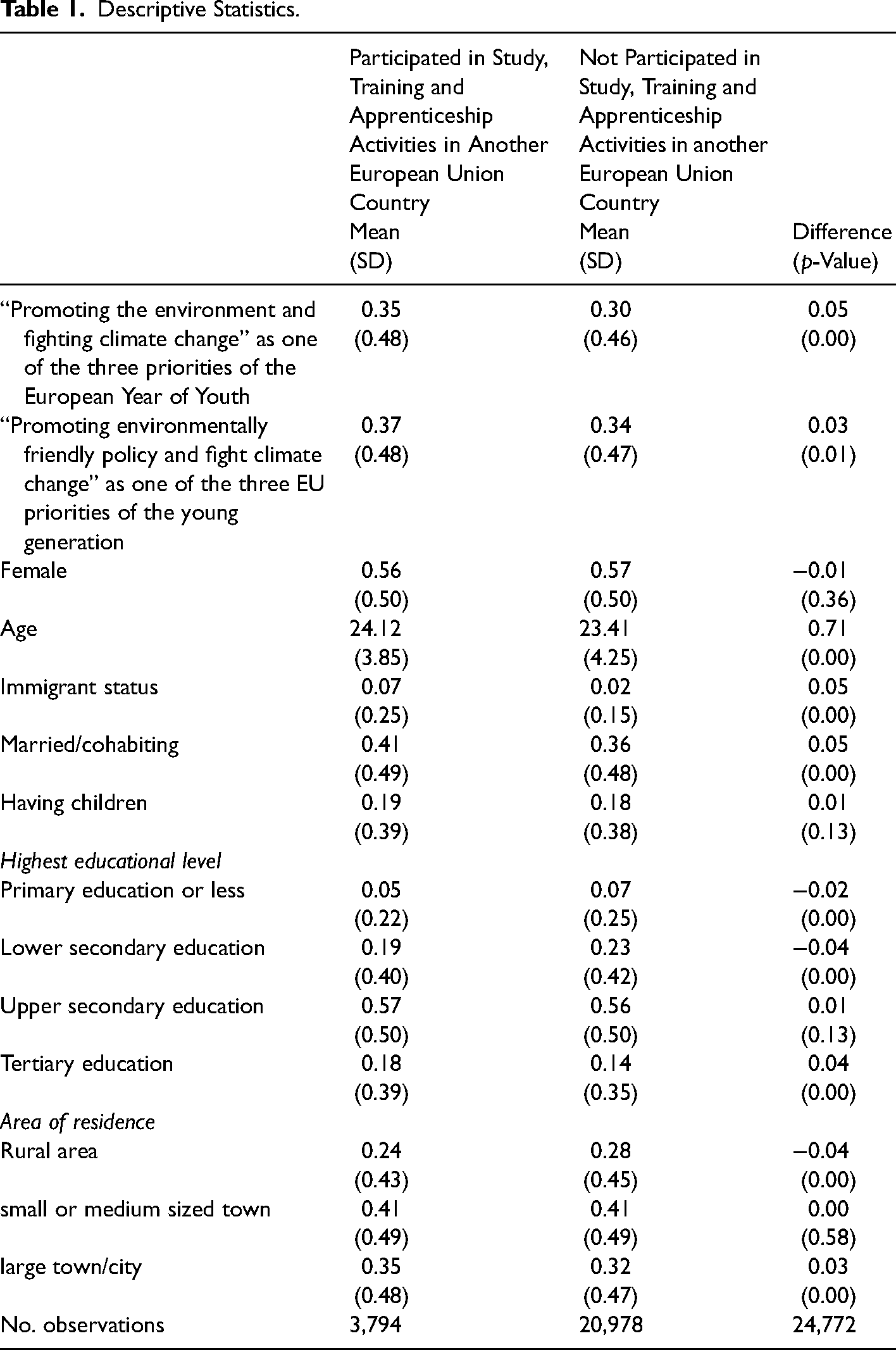
These exclusions leave a sample of 24,772 individuals. Table 1 provides summary statistics for this sample. These statistics show statistically significant differences in both our measures of environmental concerns between individuals with and without education experience in another EU country. The share of respondents considering environmental concerns to be one of the three priorities faced by the EU (both in the context of the ‘European Year of Youth’ as well as for the young generation) is higher among those who participated in an international education experience compared to those who did not (35% vs 30% as regards the first measure of environmental concerns, and 37% vs 34% as regards the second measure). However, as participants differ from non-participants along several characteristics (e.g., highest level of educational attainment) that can also affect environmental attitudes, it is important to determine whether the aforementioned positive and statistically significant differences hold even after controlling for such variables.
Descriptive Statistics.
Empirical Strategy
We use covariate-adjusted probit regression models and propensity score matching in order to address the observable selection bias associated with participation in study, training and apprenticeship activities in another EU country. We first use a probit to analyse the relationship between environmental concerns and international education mobility holding constant all the other independent variables in the model. Next, in attempt to further reduce observable selection, we employ a propensity score matching (PSM) method. This technique, which is frequently employed in observational studies aimed at identifying causal relationships, is designed to lower the bias induced by non-random treatment assignment (Rosenbaum & Rubin, 1983). When compared to regression analysis, an advantage of PSM is that, being non-parametric, it does not rely on a specific functional form of the model. The underlying idea of applying PSM here is to match individuals who studied, trained or carried out an apprenticeship in another EU country with very similar individuals who did not have this experience. Then, differences in environmental concerns can be attributed to the effect of participation in international education mobility activities.
PSM is implemented in two stages. In the first stage, the probability of taking part in international education mobility activities is estimated conditional on observable characteristics. Based on these probabilities, or propensity scores, in the second stage participants are matched with non-participants, thus creating a control group. The effects of international education mobility are then computed as the mean differences in the two measures of environmental concerns across these two groups.
PSM requires that individuals with similar propensity scores are found to be included both in the treatment and control groups (i.e., common support assumption). Another key assumption behind PSM is conditional independence. In our case this implies that once covariates are controlled for, participation in international education mobility activities is random and uncorrelated with environmental concerns. In other words, selection into the treatment group is only determined by observables.
Results
Multivariate Analysis
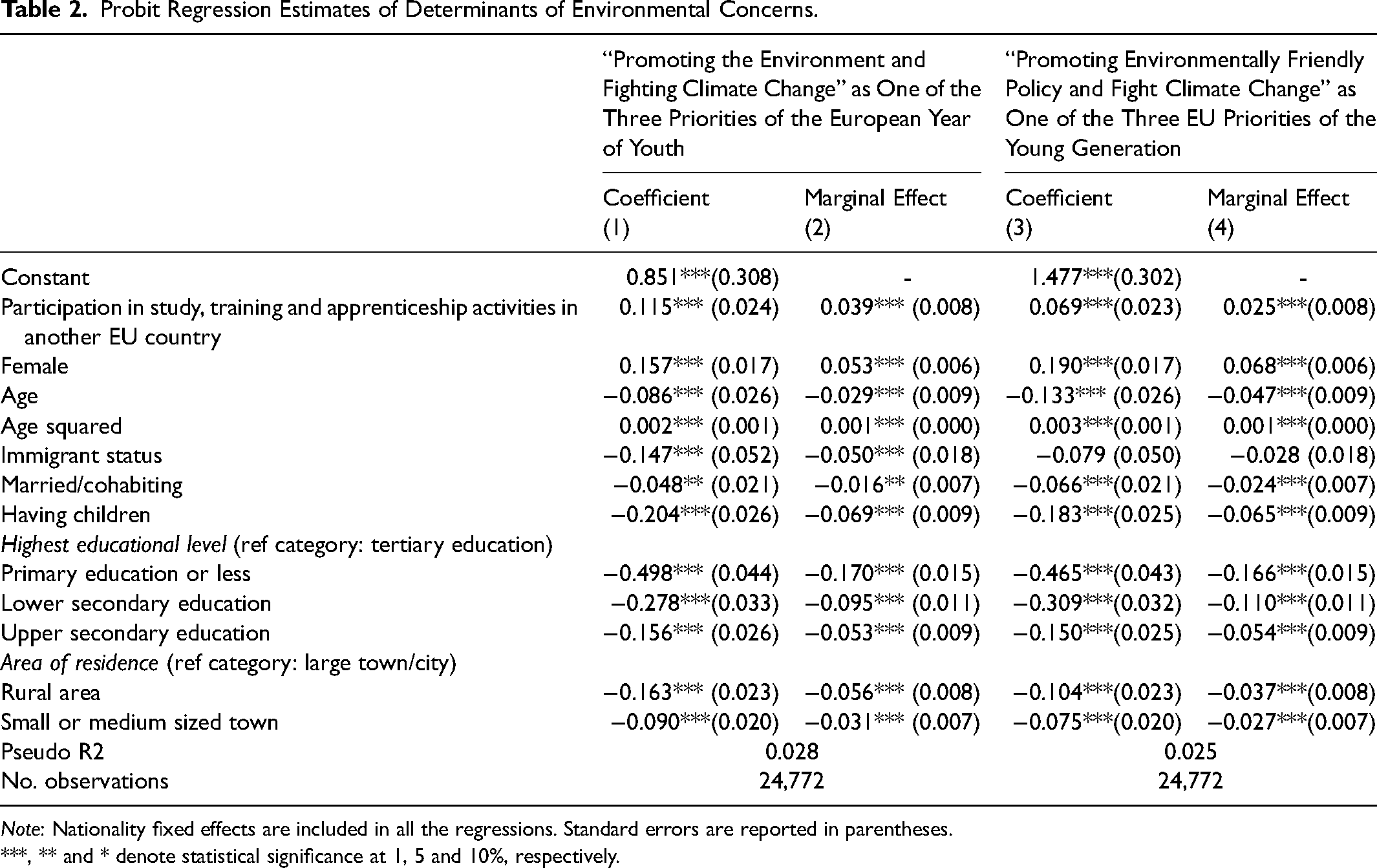
Table 2 reports the probit estimates on the relationship between international education experience and our two measures of environmental concerns.
Probit Regression Estimates of Determinants of Environmental Concerns.
Note: Nationality fixed effects are included in all the regressions. Standard errors are reported in parentheses.
***, ** and * denote statistical significance at 1, 5 and 10%, respectively.
The estimates show that differences in environmental concerns between individuals with and without education experience abroad remain statistically significant once the effects of our observable characteristics have been accounted for. More precisely, as shown in columns 2 and 4 of Table 2, individuals who have had an international education experience are found to be 3.9 and 2.5 percentage points more likely to rank the environment and climate change as one of the top three priorities of the European Year of Youth and of the young generation, respectively, compared to those without such experience.
Moving on to the other explanatory variables in the model, results on gender, education, parenthood, and area of residence are consistent with those of previous studies. Our estimates support the hypothesis of a negative relationship between age and environmental concerns. However, given that the coefficient on age squared is positive and statistically significant, this means that the negative influence of age on environmental concerns becomes weaker as age increases. While the direction of the estimated effect of married/cohabiting status on environmental concerns differs from that found in other studies (e.g., Ebreo & Vining, 2001), it is in line with the findings of Weaver (2002). Immigrant status is found to have either a negative impact or no impact on our measures of environmental concerns.
To control for omitted variables, nationality fixed effects are included in all the regressions. They account for time-invariant country-specific characteristics 4 affecting environmental concerns. Nationality fixed effects turn out to be highly statistically significant (results are available upon request), justifying their inclusion in the model.
Propensity Score Matching
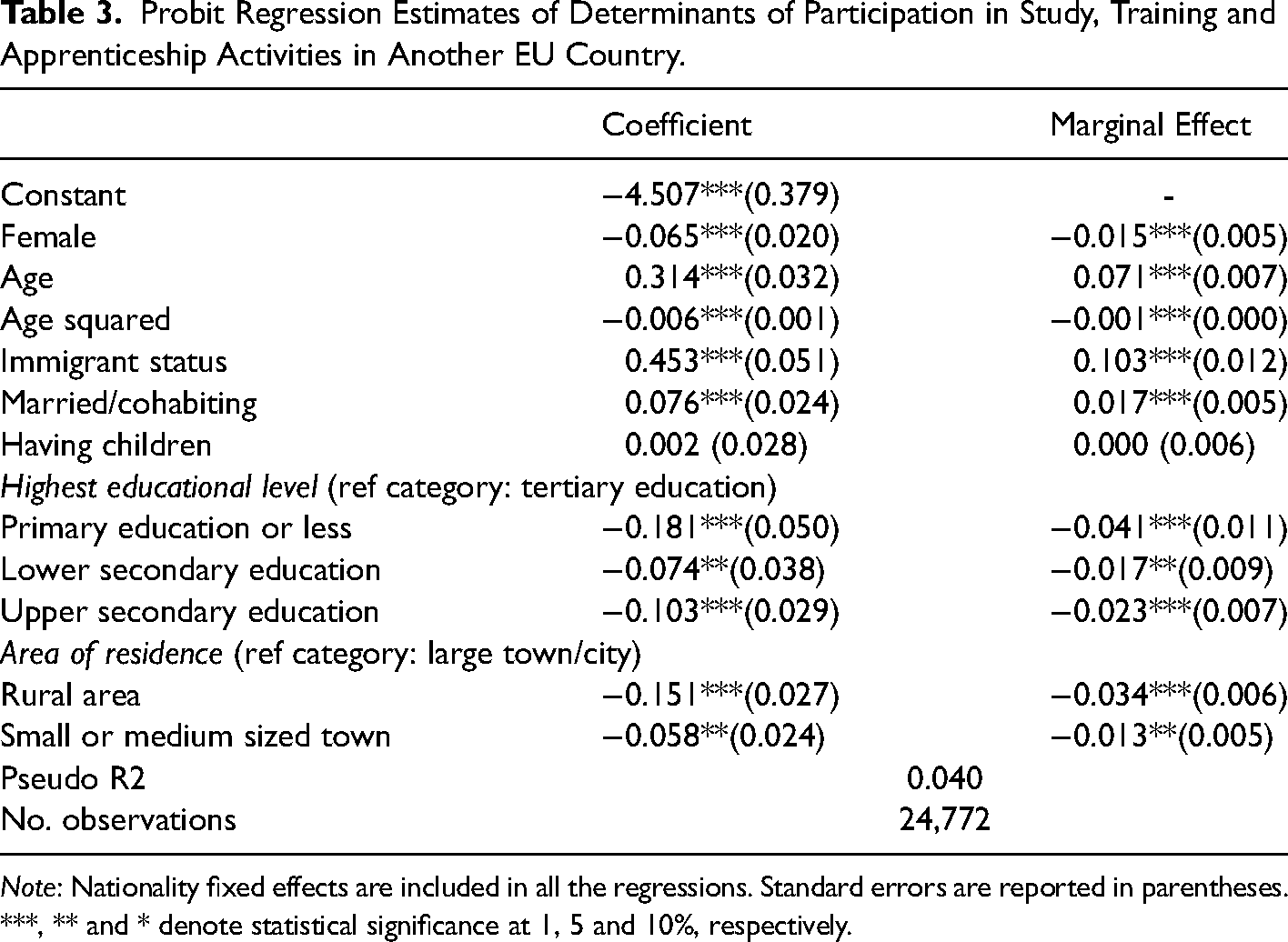
To calculate propensity scores, we estimate a probit model to investigate the factors affecting the probability of having studied, trained or carried out an apprenticeship in another EU country. As shown in Table 3, all our covariates (including nationality fixed effects), except for parenthood, are found to be associated with our treatment dummy. 5 For example, previous findings show that individuals with tertiary education are more likely to have had an international education experience than those with a lower level of education. Haldimann et al. (2021) argue that, compared to other education levels, higher education does offer more opportunities for international temporary mobility. Furthermore, participation in international education activities is higher among people from large towns/cities relative to those from rural areas or small/medium sized towns. Porter and Porter (2020) argue that the benefits of an experience abroad tend to be perceived to be more relevant in terms of future career opportunities by the former relative to the latter. Compared to students from rural areas, students from urban areas are more likely to see themselves pursuing a career that rewards those who have had an international experience. Immigrant status and being male are found to be positively related to studying, training or doing an apprenticeship abroad. While women tend to be over-represented in study abroad programmes (Di Pietro, 2022b; Van Mol, 2022), our results would seem to support the hypothesis that the gender gap is reversed when international training and apprenticeship programmes are also considered. This hypothesis is in line with the results of a recent EU survey showing that the likelihood to have taken part in a traineeship in another EU country is larger for young men than for young women (European Commission, 2023).
Probit Regression Estimates of Determinants of Participation in Study, Training and Apprenticeship Activities in Another EU Country.
Note: Nationality fixed effects are included in all the regressions. Standard errors are reported in parentheses.
***, ** and * denote statistical significance at 1, 5 and 10%, respectively.
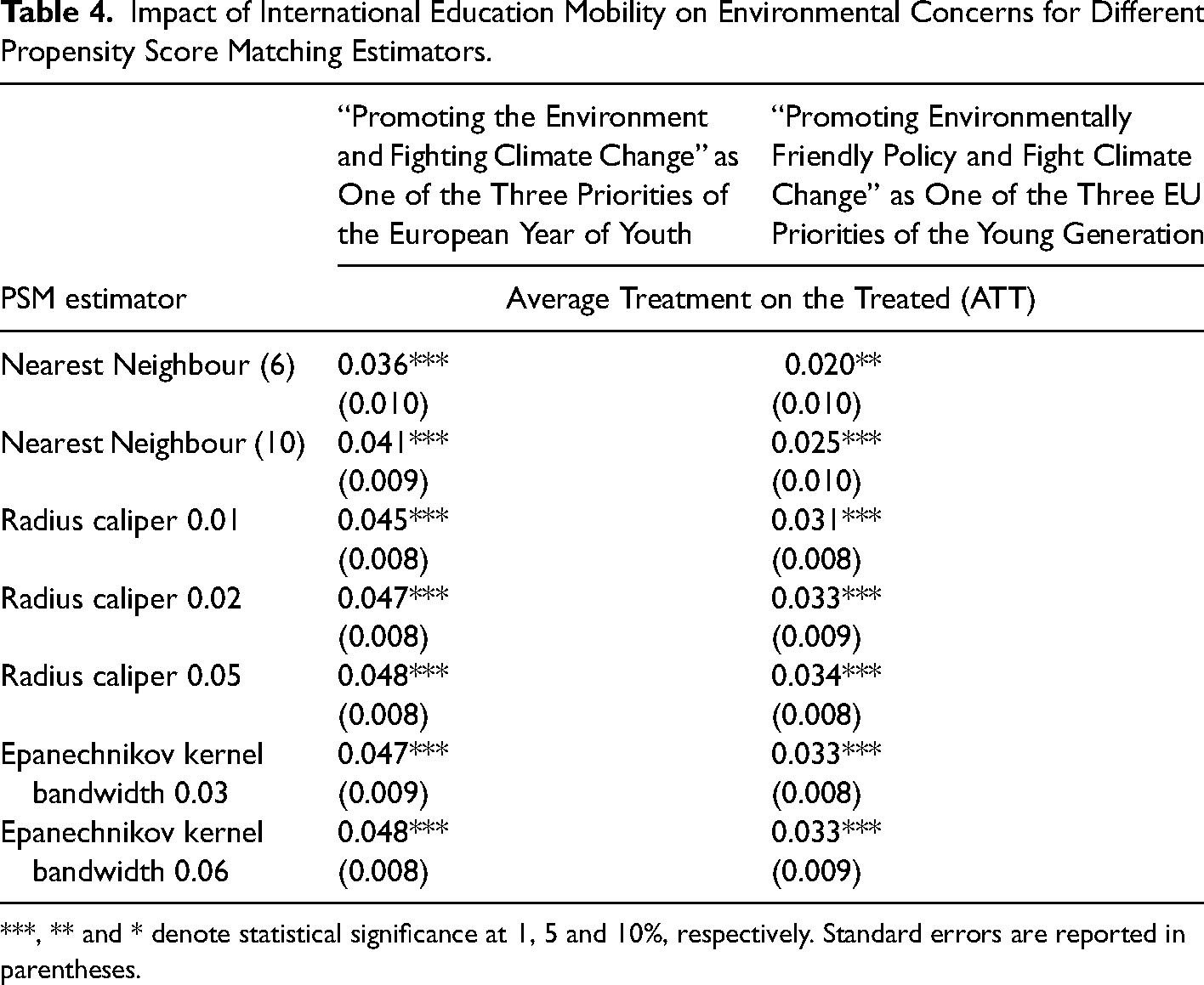
Next, using the propensity scores obtained from the probit estimates in Table 3 and following the approach of several studies (e.g., Özbuğday et al., 2020; Van Mol et al., 2021), we implement different propensity score matching estimators (i.e., Radius (with caliper 0.01, 0.02 and 0.05), Nearest Neighbour (6) and (10), Epanechnikov kernel with bandwidth 0.03 and 0.06). Estimation is conducted using the Stata command psmatch2 (Leuven & Sianesi, 2003). The average treatment effect on the treated (ATT) for the impact of international education mobility on our two environment concern measures for various propensity score matching estimators is displayed in Table 4. All estimators show statistically significant differences in environmental concerns between individuals with and without international education experience. The size of ATT is relatively similar across the different estimators used. It ranges between 0.036 and 0.048 for our first indicator of environmental concerns, and between 0.020 and 0.034 for our second indicator of environmental concerns. 6
Impact of International Education Mobility on Environmental Concerns for Different Propensity Score Matching Estimators.
***, ** and * denote statistical significance at 1, 5 and 10%, respectively. Standard errors are reported in parentheses.
In order to check whether the matching was able to balance the distribution of independent variables between the treatment and the control group, following Sianesi (2004) we re-estimate the propensity score on the matched sample and compare the pseudo-R2's before and after matching. For all our estimators, as reported in Table 5, pseudo-R2 values considerably dropped after matching and are extremely low. This result is indicative of a good matching as it suggests that there are no differences in the distribution of covariates between individuals with and without international education experience. Additionally, we also look at Rubin's B, which captures the absolute standardized difference in the mean of the propensity scores between the treatment and the control group. While Rubin (2001) suggests that B should be less than 25 for the samples to be considered sufficiently balanced, as shown in Table 5, this condition is satisfied for all our estimators.
Matching Quality Indicators.
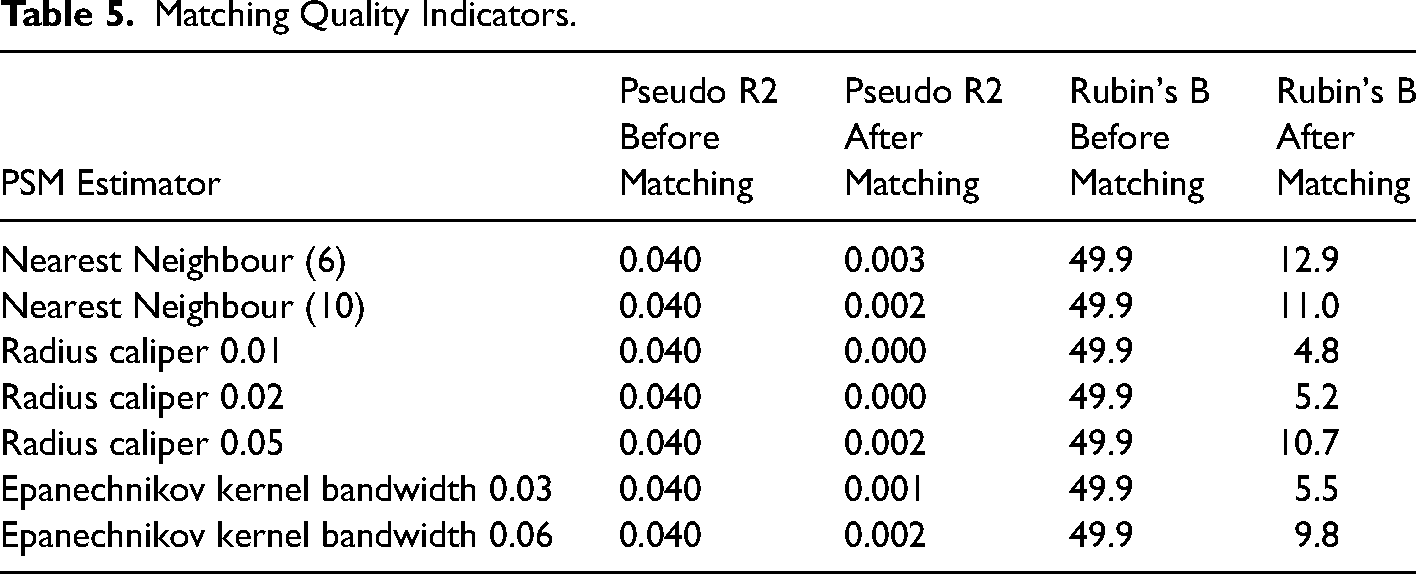
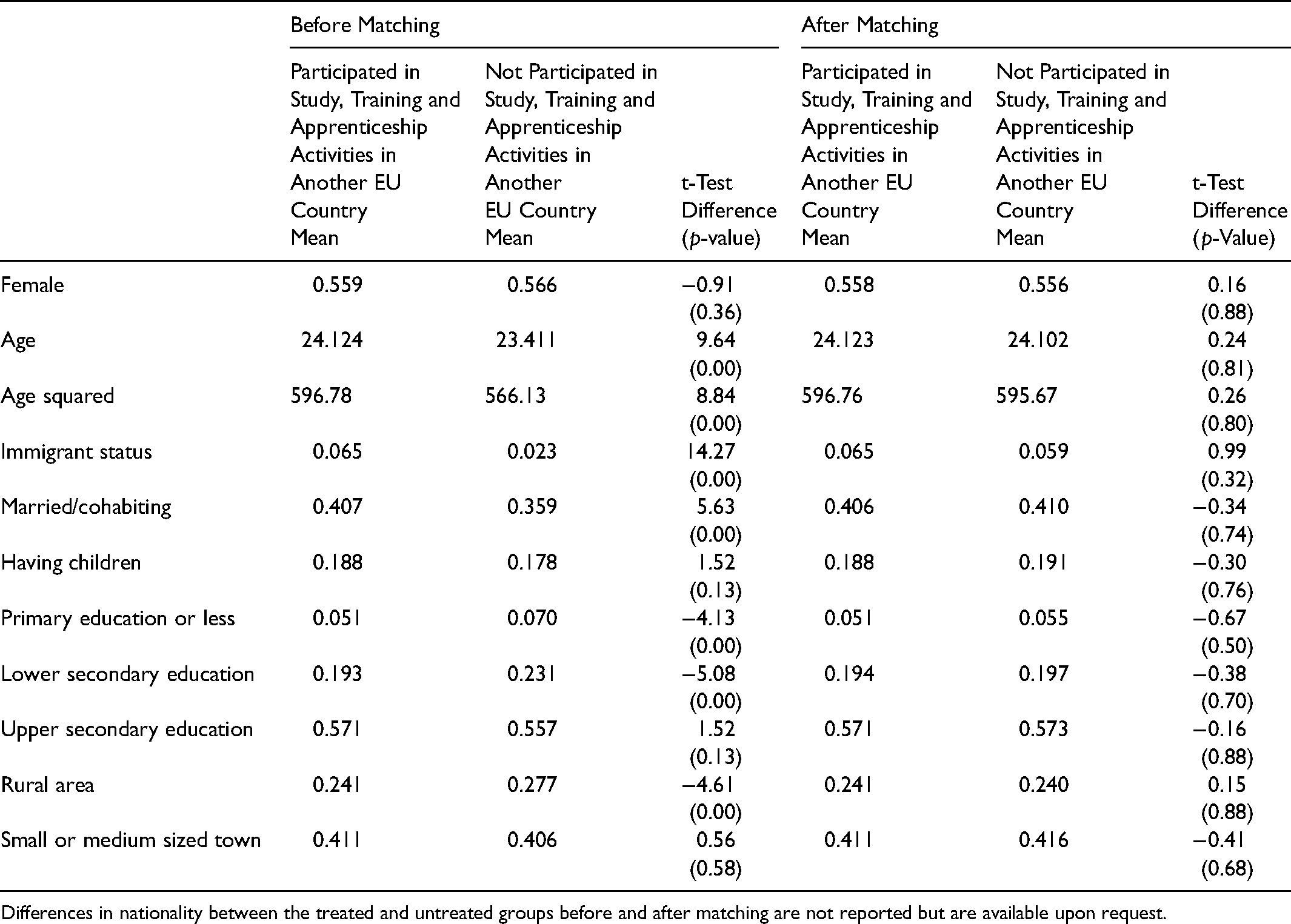
The results of the above tests would seem to suggest that PSM using Radius with caliper 0.01 is especially successful in removing the bias between individuals with and without education experience abroad. In Appendix 1, we look closer at the covariate balance resulting from this matching procedure. Specifically, we analyse t-tests for equality of means in the treated and control groups, both before and after matching. While there were statistically significant differences in several covariates between these groups before matching, they all disappear after matching.
Our work suffers from five main limitations. First, our definition of international education experience covers both degree and credit mobility. It is not possible to conduct separate analyses by type of mobility. Second, we consider study, training and apprenticeship activities in another EU country. This excludes education abroad experiences in non-EU countries. Whilst this is a problem, it is important to note that intra-EU student mobility accounts for a large share of international credit mobility in the EU. 7 Third, our model does not control for other individual-level characteristics (e.g., political belief) that may also affect environmental attitudes. Fourth, both our measures of environmental concerns may be subject to primacy bias. This occurs when respondents choose from the first answer options as they do not want to read through all the other choices. Fifth, as stated earlier, PSM cannot control for differences in unobserved characteristics between individuals with and without education experience abroad. This means that the validity of our results rests on the assumption that the treated and the control groups do not systematically differ on unobservables that may influence environmental concerns. However, the bias would be attenuated if these unobservables turn out to be correlated with observables included in our analysis (Alm et al., 2016).
Conclusions
A large body of studies investigate the benefits of participation in international education mobility programmes. While some of these benefits can be more easily quantified (e.g., foreign language proficiency, employment prospects), others are more difficult to be measured (e.g., open-mindedness, global citizenship). Appropriately estimating the effects of participation in international education mobility programmes poses a number of statistical challenges- most notably accounting for the selection bias related to studying abroad, i.e., the different composition of study abroad participants and non-participants.
Using propensity score matching to control for the selection into international mobility, we study whether an education experience abroad influences young people's environmental attitudes. The underlying idea of this hypothesis is that living and studying abroad may broaden young people's perspectives, increasing their awareness about global issues, including the environment. We employ data from a recent Flash Eurobarometer survey covering 27 EU countries.
The empirical results consistently show that international education mobility has a modest but statistically significant positive effect on environmental concerns. This mild effect appears to be consistent with the idea that an education experience abroad will not be critical to those people, possibly representing the majority of study abroad participants, who had strong environmental attitudes even before travelling to another EU country. Conversely, such experience may have a considerable impact on those people, who are likely to account for a small proportion of study abroad participants, that went abroad without having a sustainability mindset.
Our findings highlight the important role that studying abroad can play in promoting environmental awareness among the youth. This is very relevant given that public environmental awareness is a key element in stimulating and supporting pro-environment actions and behaviours. Further research on this topic is needed. In particular, future studies should attempt to shed light on the mechanisms through which an education experience abroad may promote environmental concerns. This is a challenging area that requires the availability of rich datasets containing detailed information about different study abroad outcomes.
Footnotes
Acknowledgements
The author would like to thank two anonymous referees for their valuable comments and suggestions; however, the usual disclaimer applies.
Declaration of Conflicting Interests
The author declared no potential conflicts of interest with respect to the research, authorship, and/or publication of this article.
Funding
The author received no financial support for the research, authorship, and/or publication of this article.

Notes
Author Biography
Appendix 1: Quality of the PSM: Distribution of Covariates Before and After Using Radius with Caliper 0.01.
| Before Matching | After Matching | |||||
|---|---|---|---|---|---|---|
| Participated in Study, Training and Apprenticeship Activities in Another EU Country |
Not Participated in Study, Training and Apprenticeship Activities in Another EU Country |
t-Test Difference |
Participated in Study, Training and Apprenticeship Activities in Another EU Country |
Not Participated in Study, Training and Apprenticeship Activities in Another EU Country |
t-Test Difference |
|
| Female | 0.559 | 0.566 | −0.91 (0.36) |
0.558 | 0.556 | 0.16 (0.88) |
| Age | 24.124 | 23.411 | 9.64 (0.00) |
24.123 | 24.102 | 0.24 (0.81) |
| Age squared | 596.78 | 566.13 | 8.84 (0.00) |
596.76 | 595.67 | 0.26 (0.80) |
| Immigrant status | 0.065 | 0.023 | 14.27 (0.00) |
0.065 | 0.059 | 0.99 (0.32) |
| Married/cohabiting | 0.407 | 0.359 | 5.63 (0.00) |
0.406 | 0.410 | −0.34 (0.74) |
| Having children | 0.188 | 0.178 | 1.52 (0.13) |
0.188 | 0.191 | −0.30 (0.76) |
| Primary education or less | 0.051 | 0.070 | −4.13 (0.00) |
0.051 | 0.055 | −0.67 (0.50) |
| Lower secondary education | 0.193 | 0.231 | −5.08 (0.00) |
0.194 | 0.197 | −0.38 (0.70) |
| Upper secondary education | 0.571 | 0.557 | 1.52 (0.13) |
0.571 | 0.573 | −0.16 (0.88) |
| Rural area | 0.241 | 0.277 | −4.61 (0.00) |
0.241 | 0.240 | 0.15 (0.88) |
| Small or medium sized town | 0.411 | 0.406 | 0.56 (0.58) |
0.411 | 0.416 | −0.41 (0.68) |
Differences in nationality between the treated and untreated groups before and after matching are not reported but are available upon request.