




Abstract
Transnational Education (TNE) has been a growing area of university business with a range of models developed to provide high quality educational products to partners across the world. However, given the changing geo-political environment, the continued rationale, efficacy, and legitimacy of current TNE partnership templates must be questioned. This paper therefore presents an alternative conceptualization to drive future work in this area, one which prioritizes the place of knowledge and transformational learning. I propose a new learning-based framework, the Epistemological Chain (EC), and describe how this can guide future TNE interactions and establish an alternative paradigm based upon cooperation and the co-creation of learning. Exemplars are provided that illustrate the extremes of the framework. The EC's future utility and application are then discussed with regard to TNE partnership design, operation, and evaluation. In summary the paper provides an original framework that places education firmly back at the heart of TNE.
Keywords
Introduction
Transnational Education (TNE) has been a growing area of business for UK universities for the last 20 years with a range of models developed to provide high quality educational products to partners across the world. However, given the shift from West to East in global industrial power and influence, many have questioned the continued rationale, efficacy, and legitimacy of traditional TNE partnership templates (Heffernan et al., 2010; Huang, 2003; Stein, 2016). Calls for a continued reconceptualization of the donor – receiver relationship (Hu & Willis, 2017), and the recognition of the huge increase in educational mobilities (Ha & Fry, 2021), coupled with a greater understanding of the transformative benefits of education (Mezirow, 1991), drive the development of a new learning-based framework, the Epistemological Chain (EC). It is proposed that the EC could and should guide future TNE interactions and help build upon the contemporary paradigm that is based on humanistic objectives, cooperation and the co-creation of learning,
This paper's intention therefore is to provide a new and original framework that will contribute to discussions on how best to establish a partnership model that places education firmly at the heart of TNE.
To set the framework's context, the paper first outlines TNE and its importance in respect to various globalization and internationalization agendas. A critique of the existing provision and theoretical framework is provided including an exploration of various alternative lenses by which to view TNE provision. The new learning-based framework – the ‘EC’, is then presented and discussed with regards to its future utility, application, and implementation for TNE partnership design, operation, and evaluation.
Globalisation, Internationalisation of HE and Transnational Education (TNE)
The structure, systems. and products of higher education (HE) have undergone huge change over the last few decades steered by the various internationalisation processes driven by globalisation (Kosmützky & Putty, 2019). Hou et al. (2014; quoting Spring, 2009, p. 100) propose that the process of globalisation has turned HE into “a global business engaging in marketing strategies to sell their knowledge-based products, attract foreign students, and establish international branches”. HE's international business increase parallels a similar period of unprecedented growth in the levels of world trade leading to Warwick (2014) observation that HE is at the same time both “an agent of globalisation.… and a business that must respond to the consequences of globalisation” (p.92). In practical terms universities from different countries are forging alliances to compete in the global and mass HE markets and therefore themselves are becoming the agents of globalisation (Van de Wende, 2017).
In the past decades authors note that HE's internationalisation has developed a more transnational approach reflected in a change from academic mobility i.e., traditional international mobility of students and academics across borders, to encompass full educational mobility i.e., the global flows of programs, curricula resources, providers, and institutions (Knight, 2014; Xu & Montgomery, 2018). This paper's focus is solely upon the facet of HE internationalisation and specifically that which is labeled TNE, rather than the academic mobility of staff or students through teaching exchange, research placements, or study abroad programs.
There are numerous reasons why HE institutions (HEIs) engage in TNE with Healey (2018) presenting the financial rewards on offer as the over-riding driver. Bamberger et al. (2019) also note neoliberal benefits relating to academic and reputational gains as well as raised international profile. TNE is not however without its inherent challenges. These relate to its potential elitist nature, its conflicting interests, the risk of poor-quality teaching, security issues, legislative barriers, potential for corruption, as well as concerns over the potential role that HE plays in projecting soft power (Bamberger et al., 2019; de Wit & Altbach, 2021; Healey, 2018).
Hu and Willis (2017) draw attention to the dramatic changes taking place in the scope and scale of TNE around the world. Despite historical donor / host relationships still prevalent, new models are emerging aligned to more social and cultural contexts and the needs of the local populations they serve (Bamberger et al., 2019; Jones et al., 2021). Such a reconceptualization in reflected in de Wit et al. (2015) definition of Internationalisation i.e., “the intentional process of integrating an international, intercultural or global dimension into the purpose, functions and delivery of post-secondary education, in order to enhance the quality of education and research for all students and staff, and to make a meaningful contribution to society” (p.29).
TNE has clear attractiveness for students and parents selecting and enrolling on TNE programs (e.g., Evidenced by growing worldwide enrollments see, QAA, 2021 data), as well as for the host countries whom seek improvements to their domestic education systems and the teaching and Quality Assurance processes that underpin it (E.g. Government sponsored programs such as China, see Mok & Han, 2016). Despite this I would argue that a newly conceptualized view of TNE could offer much more. Instead of promoting an operational model where knowledge is sold in what Slaughter and Rhoades describe as “academic capitalism” (Slaughter & Rhoades, 2004, p. 3), TNE needs to continue its journey away from the outdated transactional view and build upon more modern cooperative and socially just approaches. Here new relationships are developed that have mutually beneficial outcomes linked to global challenges and specifically the Sustainable Development Goals (SDGs). Ramaswamy et al. (2021) note that “HE plays an important role in the 2030 Agenda for Sustainable Development both as a stand-alone target (SDG4, Quality Education) and as a pillar central to the achievement of all 17 goals” (p.390). Indeed. there are positive examples of projects utilizing more socially just approaches (Brandenburg et al., 2020) and new alliances being developed that will guide and support future initiatives (E.g. Sustainable Development Solutions Network, HE Sustainability Initiative, International Association of Universities). The Transnational Cooperative Education model (TNCE) directly targets SD4 (Quality Education) and SD17 (Partnerships for the Goals) providing a reciprocal learning focus at the organizational level affording many positive outcomes such as the transformation of the deliverer's own curricula (de Wit & Altbach, 2021). In this way shared knowledge and understanding can be achieved, with staff and students supported to become the global citizens that both governments and HEIs desire.
The Need for a New Approach
Patterns of educational mobility are changing and are intricately linked to globalisation, increasing neoliberalism and geosocial transformations (Brooks & Waters, 2011). Educational mobilities are part of the intensifying global flows of people and knowledge that have developed alongside globalisation. The dominant hegemony is shifting as evidenced by new trends in mobilities (Ha & Fry, 2021). One's understanding, appreciation, and acceptance of this change in educational mobility therefore requires us to N TNE practice.
Many critics argue that globalisation has taken the form of academic imperialism in the HE sectors with approaches to internationalisation dominated by a narrow range of Anglo-centric and Eurocentric world views (Jones & de Wit, 2012). de Wit (2002) has termed this academic colonialism with Western higher education institutions dominating the directions of international education from the West to East Asian countries. In this regard, “Globalisation of education …. may as well be called Westernization” (Gunter & Raghuram, 2017, p. 193). Stein and colleagues develop this point and draw attention to how privileged Western perspectives in research, teaching, and learning are perpetuating global power relations, normalizing inequalities, and minimizing the potential contribution of local, and indigenous knowledge (Stein, 2016; Stein et al., 2021). Indeed, Phan and Mohamad (2020), built on this concept further when they highlighted how TNE provision can sustain and reinforce the traditional unequal East/West, local/global, and religious/secular dichotomies and binary thinking in scholarship, pedagogy, and teaching.
Global higher education's landscape however is changing fast in response to and alongside the geopolitical and geosocial global transformations (Xu & Montgomery, 2018). In support, Ha and Fry (2021) point to China, India and the Asian Tigers's (Hong Kong, South Korea, Taiwan and Singapore) tremendous economic growth, whilst Gundling and Caldwell (2015) now proclaim that the world's economic gravity has shifted to the East. Data seem to support this new world view as Asia's gross domestic product (GDP) surpassed that of the rest of the world in 2020 (THE, 2020). Reflecting this shift in economic power, the dominance of the West as international education provider and controller is also being challenged by China and East Asia. The old dichotomy of West / quality, East / incompetence (Phan & Mohamad, 2020) being most obviously reconfigured by China's growing role in contributing to global knowledge, principally via its HE sector.
Recognizing HE student numbers’ rapid growth in the global south and the limitations of traditional TNE partnerships, new South-South regional education configurations are being developed (Hanada & Horie, 2021; McLellan, 2009; Oleksiyenko et al., 2021). Authors point to South-South TNE successes and the many and varied future possibilities (Bamberger et al., 2019; Kumpoh et al., 2021). de Wit (2014) in particular was early to see the landscape changing and argued that internationalisation in HE required “an update, refreshment and fine-tuning taking into account the new world and HE order” (p. 97). Many authors agreed with this sentiment and promoted the need to reconsider how TNE is described, evaluated, and operated in practice. E.g. a need to better reflect TNE operation's different cultural arrangements (Huang, 2003), its management led drivers (Healey, 2018) or relative power relations (i.e., sender v receiver- Hu & Willis, 2017). Jones et al. (2021) recommend however that Internationalisation itself needs to be reimagined. They argue for a much greater focus on universities’ global social responsibility, whilst Brandenburg et al. (2020) promote the concept of ‘Internationalisation in Higher Education for Society’ (IHES) where Internationalisation explicitly aims to extend its benefits into its local communities
Indeed, Heffernan et al. (2010) noted that if universities are to distance themselves from the colonial approaches of the past, they should seek to identify the market needs they are attempting to serve. Such market analysis should develop student cohort understanding, particularly how they learn compared with home country students. Here exploration of students and lecturers’ presage factors, that is their specific experiences and personalities, would have value (Biggs, 1993) especially if grounded in a realist evaluation of the world in which the TNE partnership exist.
Furthermore, Heffernan and Poole (2004) state that by understanding these differences both institutions’ academics and administrators will forge stronger and more knowledgeable relationships.
Kosmützky and Putty's (2019) systematic review promotes TNE research's valuable contribution but identifies the need for greater focus upon the impact on knowledge, that is the impact of new forms of TNE on the epistemological base of university disciplines and operations. This call is supported by Brandenburg and de Wit (2011) who pointed out that internationalisation indicators need to move beyond measuring what institutions are doing to measure what students are learning, whilst Buckner and Stein (2020) identified that many institutions still downplay HE's role as a site of knowledge production, critique, or political and ethical engagement.
It is here in this final area of knowledge that I find myself most drawn. For TNE to have a wider impact than is currently the case, then how it co-creates knowledge and shares this knowledge with all those involved becomes of great importance. Here one views education as the process of facilitating learning, with its wider role to impart and develop knowledge, skills, values, morals, beliefs, and habits (Siegel, 2010). How institutions interact in establishing, developing, and monitoring this foundational need should be the crucial starting point on how we reconceptualise TNE if there is to be a more effective TNCE approach.
In the context of education, Purdie and Hattie (2002) note that learning is characterized as both a process and a product. I would contend that within existing TNE models the partnership products are clear (degree completion rates, income generated via student fees, reputational gains and improved institutional rankings) and societal benefits are starting to be explicitly linked through partnerships’ focus on SDGs. The processes associated with the learning taking place however are less clear and receive less consideration. I believe that a more specialized framework is required to uncover the intricacies of education and learning. One that explores how partners develop knowledge based on the epistemological positions taken by the institutions and those who work within them. Only then will a more transformative approach to TNE partnership be fully realized.
A New Knowledge-Based Guide to TNE – The TNCE Epistemological Chain
Epistemology is an area of philosophy concerned with the nature and scope of knowledge and learning. It aims to explore the concepts of how knowledge is acquired and subsequently how knowledge is validated, it is also a significant factor in understanding how knowledge is developed, verified, or contested (Grecic & Collins, 2013). Epistemology would therefore seem to provide a valuable alternative lens to consider how TNE programs and partnership can be conceptualized by placing education – and specifically knowledge and learning, as the central focus.
Personal Epistemology
At a personal level, epistemological beliefs are deemed to be an individual's perspective of knowledge acquisition and the process of learning, which are representative views on how knowledge is acquired and the parameters that exist for identifying and verifying knowledge (Perry, 1981). These views are centered on beliefs about the knowledge certainty, knowledge organization, and the controls an individual has over that knowledge (Schommer-Aikins, 2002). Early work around epistemological beliefs by Perry (1968) plotted epistemological development on a continuum with two extreme ends – naïve and sophisticated. This theory was later expanded to include multidimensional beliefs that matured at varying rates (Schommer, 1994).
Naïve and Sophisticated Epistemological Positions
For illustrative purposes one may consider that a person who holds a naïve epistemology generally believes knowledge is certain and unchanging. Their naïve epistemological stance is based on the premise that concepts are transferred and learned quickly or not at all, and one's ability to learn is innate and fixed rather than acquired and developed. More specifically, a naïve epistemology is reflected by the perspective that the world is governed by a set of simple, clear, specific principles that result the belief that knowledge is absolute, passed from a higher authority and is replicable in various environments and circumstances (Grecic & Collins, 2013). By comparison, a person holding a sophisticated epistemology believes that knowledge is complex, uncertain, and tentative, and that knowledge can be learned gradually through reasoning processes. A sophisticated epistemology promotes the concept that knowledge is complex and multifaceted, and something that is not always replicable but often contextually / situationally dependent. Furthermore, this knowledge can be acquired over time through experience (Schommer, 1994).
Epistemology in Action
The impact or tangible outcomes of one's Epistemology have been explored in various fields. Of particular interest for TNE, numerous studies in education confirm a strong connection (i.e., chain) across teachers’ beliefs, their classroom behaviors, the learning environment they create, and how curriculum is directly implemented (e.g., Hofer & Pintrich, 1997; Soleimani, 2020). Also, of great relevance to TNE partnership operation is the work of Tickle et al. (2005), who evidenced the powerful influence of this decision-making relationship between beliefs and behavior within the management domain. Here Tickle et al. (2005) positioned managers’ and leaders’ epistemologies as being their core principles of knowing and learning which directly linked to the individual's decision-making process and behaviours.
An Epistemological Chain
Furthering this work linking epistemology to behaviour Grecic and Collins (2013) developed the (EC) to provide an articulated framework that can help to link together the belief systems of an individual with the actions that the individual chooses (decision making) to undertake.
Whilst epistemology is an individuals’ stance on learning and knowledge, the EC is effectively the link between an individuals’ philosophy, beliefs about learning and knowledge, and the resulting behaviour (Grecic & Collins, 2013). From a TNE delivery or management perspective therefore, where an EC is present, a teacher's or manager's epistemology will directly influence the educational outputs used with learners. Put more formally, the EC has been described as: the inter-related/connected decisions made that are derived from high-level personal beliefs about knowledge and learning, and which become apparent through the planning processes adopted, the learning environment created, the operational actions taken and the review and assessment of performance.
(Grecic & Collins, 2013, p. 153)
Specifically, within this framework one's epistemology is seen to directly impact upon the learning environment is established, the inter-personal relationships developed, the goal setting process adopted, the operational and delivery methods, the evaluation metrics, and the reflections on which to plan any future action.
Organisational ECs
In Grecic and colleagues’ studies the EC's existence and impact in various environments at the micro, meso and macro level has been explored (Grecic & Collins, 2012; Grecic et al., 2013). This work has had great value in uncovering, explaining, and evaluating how epistemology, more specifically, beliefs about knowledge and learning, bear influence on various facets of the decision-making process in individuals, groups and organizations. It is here that such an EC framework could be of great benefit for those working in TNE. The framework could support meaning making of existing TNE partnerships, help individual partners evaluate their own and others’ strategic fit, and guide the formulation, monitoring or assessment of how programs are operated within said partnerships.
To elucidate this point, the EC framework is presented below to demonstrate how a TNE partnership may interpret the epistemological basis of its operational decisions and products. Reflecting Perry and Schommer's work, two extreme positions are presented in Fig 1 below. This depiction is provided that the reader can clearly compare and contrast alternative TNE behaviours. This is followed by a more overarching description of each extreme.
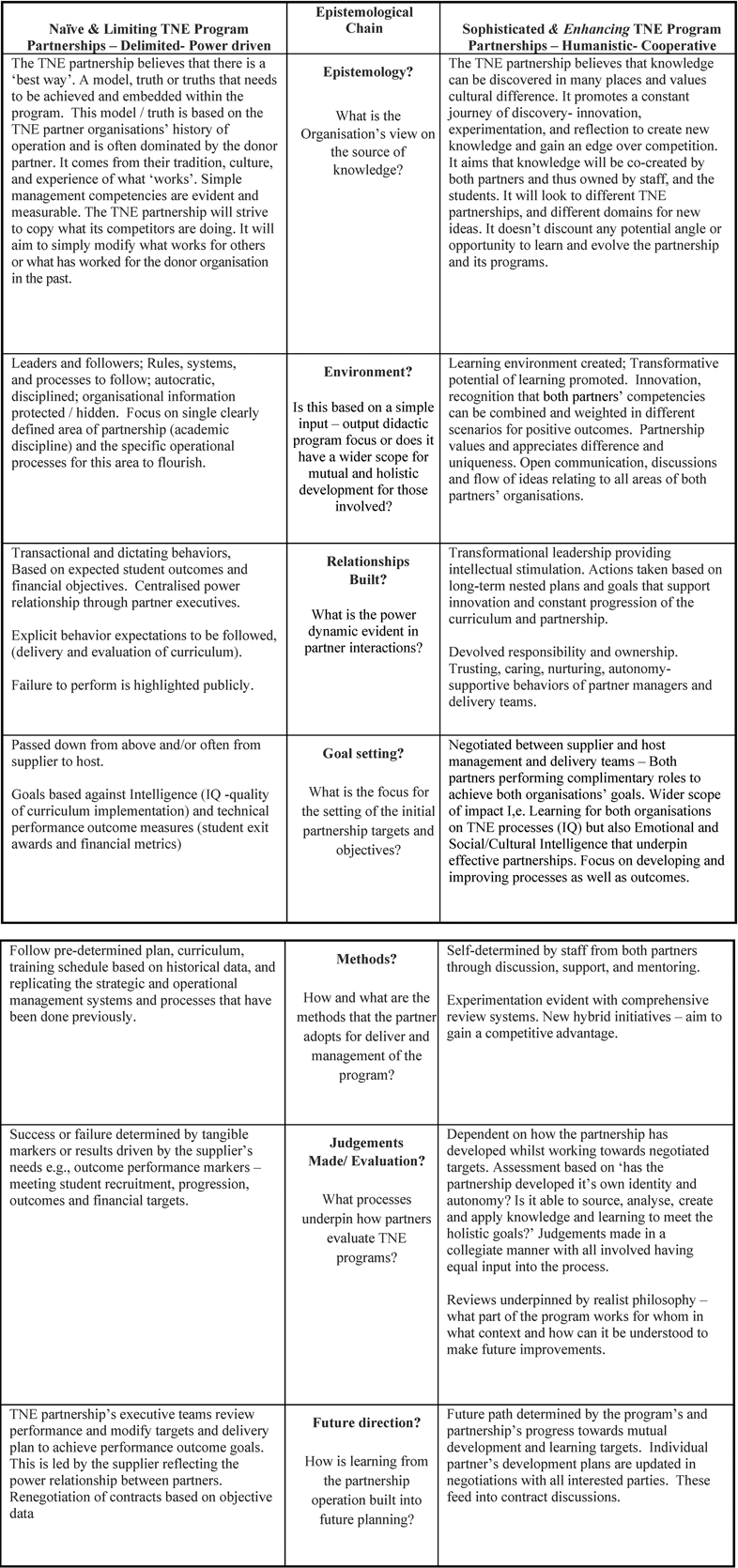
An epistemological chain of TNE partnership behaviours.
Exemplar 1. A ‘Naïve and Limiting’ TNE Organisation
Within this framework a partnership / individual partner who aligns to the extreme ‘naïve and limiting’ EC descriptor would profess and reinforce attitudes about knowledge and learning that valued existing in vogue and trusted sources that had a track record of operational success in the TNE domain. They would be resistant to new ideas and change, instead they would resort to justifying their position based on the academic colonialism of the past. The environment these partnerships would establish, or the partner promote, would emanate from their strategic direction, vision, mission, and objectives based purely upon performance outcomes. The partners in this system, their executives and managers and the partnership itself, strive to be recognized as world leaders in terms of student numbers recruited within the partnership as well as amassing various TNE awards and plaudits from international management and education associations. The relationships developed here between and within organisations would therefore be based on a transactional model with various levels of executive management telling those below them the expected performance outcomes and what needed to be done for them to be achieved. Decisions would be autocratic, based on previous experience of what works in this TNE environment. In turn, the goals passed down would be outcome based, measured solely on the students’, lecturers’, and program managers’ ability to meet the expected standards of a simple competency-based structure. Under this level of expectation the lecturers and operational managers would be pressurized to adopt short term methods and practices that would create one dimensional students and curricula that could be seen to succeed solely in terms of the goals they had been prescribed. In such an organisation's E C the judgements made about all those within the partnership and/or program would be based on how effective they had been in achieving the outcome measures laid out by the partners’ executives. Finally, all future micro, meso and macro level decisions i.e., Concerning the students, lecturers/managers, and the continuation, development or dismantling of the partnership itself would be subject to benchmarking against tangible performance measures set out by the partners’ strategic objectives.
Exemplar 2. A ‘Sophisticated and Enhancing’ TNE Organisation
A TNE partnership based on a sophisticated epistemology by comparison would look very different. Knowledge and learning here would be sought from many sources with no person, domain or communication channel discounted or not valued. Cultural differences would be celebrated and seen as positive catalysts for change. The TNE environment would be characterised by a more humanistic philosophy where its purpose would be the promotion and development of all the individuals and partners within it and the extolment of the transformational potential of learning. This message and philosophy would be explicit in the partners’ strategic objectives and particularly within holistic vision and mission statements. It would be evident from the public pronouncements from its leaders and executives celebrating new innovations, partnerships, and learning cooperatives. In turn the relationships fostered would be focused on developing all those within the partnership and related stakeholders, not just with the skills and attributes required to perform effectively within their programs, but also based on creating valuable learning and experiences to support individual progression towards whatever their final career path may be. Additionally, power within such a sophisticated and enhancing TNE organisation or partnership, would be conceptualised as ‘power with’, equally valuing all contributions. At more operational levels power would be decentralized and delegated outwards. Here each student, lecturer and manager would be clear on their own role within the TNE partnership. Indeed, goals and targets agreed between those involved in the partnership would be focused on holistic personal growth as well as the predefined objectives for the programs. In such a partnership based on a sophisticated EC, the methods and practices engaged would be creative and varied, with all members of the partnership given ownership to direct their own development and learning in order that they flourish together. The assessment of the partnership's effectiveness would therefore not simply be measured on tangible outcomes such as program grades, completion rates, student satisfaction scores, financial profit etc., but equally judged upon progress towards the self-determined goals of its participants. Finally, in such a sophisticated and enhancing EC, the decisions on the future planning and direction taken at the end of each review cycle would be directed by the students and managers to those areas that highlighted where learning and development was most required.
Further EC Applications
Extending the exemplars provided above, the EC framework can be explored further as a potential tool to aid TNE planning, decision making and reflection (Grecic & Collins, 2013) at the macro, meso and micro level of operation. At the macro level organisations need to consider how their values, purpose, strategic direction, and corporate learning culture bear influence upon the environment within which their partnership work exists. A greater understanding of their EC position would help organisations recognize how these elements have direct consequences upon how new partners are selected, contracts determined, and the direction relationships are driven during the partnership period. Here the EC could also help to explain the Executive Level leaders’ and managers’ decisions and behaviours as they take responsibility for their TNE partnership's implementation, interactions, and outcomes.
At the meso level a clear comprehension of the partnership EC could guide the recruitment and performance management of managers and lectures responsible for TNE programs’ delivery. Members of staff with epistemological beliefs more aligned to that of the organisation's EC would enhance operation and reduce the potential for conflict arising from cognitive dissonance. The organisation's partnership EC could also provide a framework by which to structure staff development and training. Here different elements of the EC could be taken in turn with the epistemological basis individual /group behaviours reflected upon in order to improve their future action's effectiveness.
Finally, at the micro level, within the TNE partnership this would be considered predominantly where groups of lecturers interact with each other and their students. Here knowledge of the organisation's EC would provide the backdrop against which colleagues could share ideas and opinions in a community of practice to support each other develop their expertise. The intention here would be to expose, reflect, and then revise / develop the lecturers’ own ECs against that desired by the partnership to best achieve the partnership objectives.
As lecturers’ interaction is crucial at the program level, not simply during but also at key handover periods at the beginning and end of a program, the group dynamics of a TNE group with respect to the alignment of their individual EC's would be another interesting avenue to explore. Such research could inform a teaching team, or department's team building activities, explore cognitive dissonance between the delivery hierarchies and ultimately help measure and improve the group's TNE performance. Extending this line of reasoning an investigation into the TNE students’ epistemology coupled with their aims and motivations of studying on the program would also provide a valuable lens in managing and delivering the partnership.
Conclusion
The paper has taken the position that the traditional model of TNE based on post-colonial West-East, Donor-Host, Provider-Receiver relationships is no longer fit for purpose given the global shifts of economic, political, and academic power in the twenty first century where dominant approaches can further reproduce power inequalities in both epistemological and material dimensions (Suspitsyna, 2015). One recognizes contemporary TNE developments that embed SDGs and provide valuable and benefits to local populations, however in order to meet the challenges of the rapidly changing world I propose a N that places education, learning and the co-creation of knowledge at the heart of TNE that sustains a TNCE model of partnership.
To facilitate this change, I have presented a TNCE EC framework that prioritises epistemology, that is individuals’ and organisations’ views about learning and knowledge, to better plan, operate, monitor and evaluate educational mobilities. It is proposed that the framework, when situated within the ecological system in which it will operate and cognisant of the situated presage factors, processes and products of staff and student interactions (Biggs, 1993), can help guide future action and establish mutually beneficial partnerships that can be judged by their truly transformative educational outcomes and impacts rather than simple financial and student completion metrics. The framework appears to be able to reflect cultural influences, management needs (QA), pedagogy drivers and student motivations, all which researchers have proposed as crucial components of future international education work. In the framework exemplar I have presented the extreme positions whilst recognizing in practice a spectrum of operation can and does exist. What is clear however is a call for action i.e., for partnerships to establish a more sophisticated approach to the development of knowledge and a re-defined partnership ethos which reflects more modern views of learning – i.e., TNCE. I do note that the model does not consciously defined a specific TNE delivery mode. I acknowledge that international branch campuses (IBCs), franchise operations, flying faculty, articulation and twinning programs, and joint/dual degree programs, with or without awarding powers, will each have their own bespoke opportunities, challenges, and geopolitical environment. This generic TNE framework will clearly need to be researched in each precise context but hopefully it provides a good starting point for those interested in such investigation.
Of course, there are already several programs (conventionally called ‘joint’) which are nearer down the continuum towards the sophisticated EC model. Nevertheless, being pragmatic one must recognise that much TNE would arguably not exist without an overseas HE institution's brand based on tradition and well-established teaching and learning practices. I argue that employing the TNCE EC framework would however add great value to all aspects of the partnership (strategic leadership, operational management, educational delivery, teaching pedagogy, student experience) and could be utilized as a positive promotional tool to engage parents, students, and potential additional partners. I am not naïve however in thinking that this is an easy task. Indeed, until governments and deliverer universities reflect upon their own education systems enough to use similar learning and value-based systems to run their own domestic programs then the move to TNCE is still a long way away. This realization does not detract from promoting my message and alternative to the status quo. In essence I accept that TNE exists as a model, much in the same way that an iPhone exists around the world – you get the standardized model and functions that you pay for. However, universities should be offering (and striving for) a second proposition – TNCE which is unique and equal in nature, an EC based model from which learning is meaningfully delivered for the betterment and transformation of both partners and is a truly global/intercultural undertaking.
Footnotes
Declaration of Conflicting Interests
The author(s) declared no potential conflicts of interest with respect to the research, authorship, and/or publication of this article.
Funding
The author(s) received no financial support for the research, authorship, and/or publication of this article.

Author Biography
David Grecic is the professor of Sport and Physical Education and the Director of the Institute for Coaching and Performance at the University of Central Lancashire, Preston, UK. He publishes extensively in the field of teaching and learning and has created, implemented and evaluated numerous international programmes around the world.