



Abstract
Despite extensive research on the push-pull factors of student motivation to study abroad, there has been little examination of university academics’ and administrators’ attitudes as program developers and providers. This research draws upon the literature of sensemaking to investigate how and why Japanese university academics and administrators develop study abroad programs in Southeast Asia. The analysis reveals that university academics and administrators balance the characteristics of their university and student demands with advantages to themselves. Involvement with study abroad allows academics to promote their research, attract students to their field, and compete with other departments. Administrators seek to increase their involvement in education through collaboration with academics. Furthermore, both academics and administrators recognize that the involvement of Southeast Asian graduates of Japanese universities can facilitate the development of study abroad programs in Southeast Asia. This social analysis highlights the historical and educational relationships between Japan and Southeast Asia and provides a new perspective for the analysis of not only motivations, but also the processes that lead from motivations to actions.
Keywords
Introduction and Background
Amid the internationalization of higher education and the growing demand for global human resources, the Japanese government has implemented several competitive projects since the 2010s (Ota, 2018). As a result, select universities actively engage in recruiting international students and sending their students overseas to achieve their goals. This trend has gradually changed the types and purposes of Japanese study abroad programs from long-term, degree-seeking study based on individual initiative to short-term, credit-earning study supported by the government and universities (Shimmi & Ota, 2018). This change illustrates the growing importance of universities in the development and implementation of study abroad programs. Nonetheless, research on the motivations and attitudes of study abroad actors has focused mainly on individual students through micro-level analysis using push-pull factor theory (Altbach, 1998, 2004; Mazzarol & Soutar, 2002; McMahon, 1992). Research seeking to understand academics’ and administrators’ motivations for international education activities is just emerging, and there have been few analyses of their attitudes as program developers and providers. Therefore, the development of a more comprehensive and dynamic model to explain study abroad motivations among the actors is needed. This study draws upon the broader literature of sensemaking (Weick, 1979, 1995) to analyze how and why Japanese university academics and administrators develop study abroad programs in Southeast Asia.
Internationalization of Higher Education in Japan and Evolution of Japanese Study Abroad Programs
According to the Ministry of Education, Culture, Sports, Science and Technology (MEXT), Japanese universities face three significant challenges (MEXT, 2017). First, domestic circumstances are changing, with growing concerns regarding the declining birthrate, access to higher education, diverse demands by and skills and attitudes of university students, educational pedagogy, and subject content. Second, international circumstances are changing in response to an information-driven global society and the need to meet the United Nations Sustainable Development Goals. Third, universities must evolve to meet the growing demands of the business sector for human resources.
To address these transitions and demands, Japanese education policies regarding internationalization have shifted over time. Based on a review of policies related to the internationalization of higher education since the 1980s (Horie, 2002; Ninomiya et al., 2009; Ota, 2018; Umakoshi, 1997; Yonezawa, 2011), government policy initiatives can be characterized as follows:
Change in policy focus from accepting international students to developing research, sending Japanese students abroad, and increasing international interaction; Change in purpose from international development and cooperation to national competitiveness; Emergence of particular countries as priorities for national policies.
Given this background, study abroad is gaining value within Japanese society. It is seen as giving students the chance to experience daily life in another culture. The adventures of adjusting to a new language and lifestyle raise participants’ comparative awareness of the world through the lens of the host country while nurturing self-discovery and developing their personal values and attitudes. Although these advantages have mostly remained unchanged, trends in study abroad practices have changed over time, as outlined in the Introduction.
In particular, government initiatives to send Japanese university students abroad have been implemented since the 2010s. Examples include the expansion of study abroad scholarship schemes, the Inter-University Exchange Project (2011–), the Go Global Japan Project (2012–17), and the Top Global University Project (2014–24). Motivated and funded by these initiatives, the number of Japanese university students studying abroad short-term, on credit-earning programs, has rapidly increased from 42,320 in 2010 to 107,346 in 2019 (Japan Student Services Organization, 2021). By contrast, the number of individuals studying abroad long-term, seeking a degree, has stagnated: 59,923 in 2009 and 58,720 in 2017 (MEXT, 2021). Notably, the number of Japanese university students studying abroad short-term, on credit-earning programs, in Southeast Asia has increased approximately tenfold from 1,879 in 2010 to 19,044 in 2017 (Hoshino et al., 2021). Nearly 90% of Japanese university students studying abroad in Southeast Asia did so for less than one month. These figures confirm that Japanese universities have established short-term credit-earning study abroad programs, making the role of universities, especially academics and administrators in international education who develop and operate these programs, critical. This is the reason why this study focuses on study abroad programs sending Japanese university students to Southeast Asia.
History of the Japanese Educational Collaboration Relationship With Southeast Asia
The Japanese educational relationship with Southeast Asia began as international cooperation in education in the post-World War II era. At the time, Japan, which had achieved postwar reconstruction, was expected to contribute to the nation-building and human resource development efforts of Asian countries. American-led educational reforms and requests for support from UNESCO were strong drives for educational cooperation with developing countries, including those in Southeast Asia. Japanese support for higher education in the region began with Official Development Assistance, which aimed to develop human resources mainly by inviting students to Japanese universities in 1954. Two main types of programs allow for inviting international students to Japan: the government-sponsored student invitation program run by MEXT, and the study abroad programs implemented by the Japan International Cooperation Agency (JICA) and other organizations. Through these schemes, Japanese universities began accepting international students from Southeast Asia, the number of whom increased rapidly from the late 1990s onward. The total number of international students coming to Japan under these invitation schemes was less than 2,000 until 1982, but by 2003, it had reached approximately 10,000. In the fiscal year 2020, 8,761 government-sponsored international students were enrolled at Japanese higher education institutions. They included Southeast Asian students from Indonesia (888), Thailand (614), Vietnam (601), the Philippines (260), Malaysia (237), and Myanmar (219), together representing more than 30% of the total (MEXT, n.d.). On the other hand, since the purpose of these programs is to provide international cooperation and assistance to developing countries, there are few students from Singapore and Brunei, which are developed countries. In addition, the Inter-University Exchange Project (2011–) has targeted international education exchanges with Southeast Asia four times since 2010 (in 2011, 2012, 2013, and 2016), and select Japanese universities have implemented short-term study abroad exchanges with Southeast Asian universities. Due in part to these projects, the number of Japanese university students studying in Southeast Asia in 2017 was 19,044, with Thailand (4,838), the Philippines (3,700), Malaysia (2,754), and Vietnam (2,413) among the destinations (Hoshino et al., 2021). Thus, while Japanese universities have a history of accepting international students from Southeast Asia as support for international cooperation, they are now sending students from Japan for short-term study abroad as well, making two-way exchange more active.
Literature Review
Push-Pull Factors: A Micro-Level Analysis
Much research has been conducted on the motivations of individual students to study abroad, mainly utilizing push-pull factor theory (Altbach, 1998, 2004; Mazzarol & Soutar, 2002; McMahon, 1992). In particular, research has focused on the factors motivating degree-seeking students from developing countries to study abroad in developed countries. In this research, factors such as “the use of English”, “quality of education and research”, “financial aid”, “living expenses”, “local employment after graduation”, “possibility of migration”, “high local competition”, and “family and relative networks and recommendations” have been identified as motivations (Chen, 2007, 2017; Li & Bray, 2007; Mazzarol & Soutar, 2002; Nghia, 2019).
For students who travel to Europe through the Erasmus program (a semester or academic year abroad), the strongest motivations for studying abroad have been noted as being to obtain “new experiences”, “time away from home”, “personal development”, “language improvement (English, German, French, etc.)”, “academic knowledge”, and “future employability” (González et al., 2011; Lesjak et al., 2015).
Similar analysis using push-pull factor theory has been applied to Mexico (Cantwell et al., 2009), Turkey (Kondacki, 2011), China (Jiani, 2017; Wen & Hu, 2019), and South Korea (Jon et al., 2014), which have recently emerged as host countries for international students. These studies have observed that international students’ motivations for studying abroad differ depending on their country or region of origin. For example, international students from areas adjacent to the host country were more likely to study abroad for an extended period (to obtain a degree). Factors such as “quality of education and research”, “facility environment”, “convenience”, “political stability”, and “availability of scholarships” were cited as motivations. By contrast, most North American and European students studied for a short period (summer school, semester, or academic year). Their motivations were “learning the local language and culture”, “career development”, “getting away from home”, “learning English (in the case of European students)”, and “low cost.” Thus, much research has broadly categorized individual students’ motivation factors for studying abroad, which are different and depend on students’ country or region of origin, into academic, cultural, economic, financial, geographical, political, and social aspects.
Motivations and Attitudes of University Academics and Administrators Towards Study Abroad Program Development
De Wit (2002) introduced a framework of rationales and motivations for institutional internationalization in which academics and administrators are engaged, and categorized these into four elements: academic, political, social-cultural, and economic. This framework is mainly used for analysis of institutions, but Friesen (2013) applies this framework to individual academics and administrators.
Other studies have examined the perceptions and motivations of university academics and administrators involved in specific international education activities (such as developing study abroad programs) in line with universities’ international strategic guidelines (Beatty, 2013; Criswell, 2014; Li & Tu, 2016; Nyangau, 2018, 2020; Turner & Robson, 2007).
For example, Turner and Robson (2007) interviewed 33 university academics and administrators from the same university regarding the UK's strategy for the internationalization of higher education and related case studies. Their results suggested that awareness of international education activities differed between academics and administrators. Administrators were likely to emphasize increases in international student enrollment, and were conscious of the operational side of the university (competitive market-based rationales). By contrast, academics were concerned that rapidly increasing international student numbers could cause educational outcomes to deteriorate as a result of universities becoming more commercial (cooperative and internationalist ideologies). This finding suggests that motivations for international education activities may differ depending on the operations for which an individual is responsible, with administrators concerned with management and academics concerned with education and research. In addition, this study implies that the divergent motivations of university academics and administrators might hinder the planning and implementation of institutions’ international strategies.
Furthermore, through interviews with five university professors in Canada, Friesen (2013), using the framework of de Wit (2002), established that “improving the quality of education” and “having experience in other countries” were personal motivational factors for university academics involved in international education activities. In this study, two out of five interviewees indicated that their personal motivations for international education activities were different from institutional rationales, while those of the other three were aligned with institutional rationales and they benefited from the activities. This result implies that there are different levels of motivation among academics for engaging in international education activities, and that the extent of academics’ engagement interweaves their personal motivations with institutional rationales.
Moreover, Beatty (2013) indicated that tenured academics from US universities were more likely to be involved in international education activities, and academics’ interests influenced whether or not they engaged in such activities. By contrast, Nyangau (2018) noted that academics from US universities were not eager to be involved in international education activities because such activities were not strongly linked to their likelihood of obtaining promotions and tenure positions. However, young, nontenured academics actively engaged in international education activities for the educational purpose of improving students’ learning and understanding global trends (Nyangau, 2018). Another piece of research by Nyangau found that academics’ strong efficacy beliefs (knowledge and competencies for international education activities) and positive perceptions about organizational context strongly influenced their behavior relative to engagement in international education activities (Nyangau, 2020).
Thus, current research in other countries has analyzed the types of university academics and administrators engaged in international education activities, their motivations and attitudes toward internationalization, and relationships between their personal motivations and institutional rationales. However, researchers have not investigated the process leading to the construction of these motivations and attitudes.
Sensemaking of Academics and Administrators: A Mezzo-Level Analysis
Merely identifying motivational factors is insufficient to identify how and why university academics and administrators develop study abroad programs. Instead, it is necessary to clarify how and why university academics and administrators accept (make sense of or interpret) these factors during study abroad program development. Unfortunately, few studies on study abroad programs have employed this perspective. However, studies in the United States have examined how principals of elementary and middle schools and classroom teachers respond to educational reforms, interpret the intention of the reforms, and apply them in an academic setting (Coburn, 2001, 2005, 2006). Coburn used the sensemaking perspective introduced by Weick (1979, 1995).
Weick (1979, 1995) constructed the process of sensemaking, and many researchers have refined it. Sensemaking describes how people try to make sense of problems and events in their daily lives. Specifically, it is the process of constructing the meaning of problems and events that contain ambiguity and uncertainty by using the knowledge, experiences, beliefs, and values that individuals have acquired in the social contexts they have experienced (Maitlis & Christianson, 2014). For example, when individuals encounter a situation, they try to understand what has occurred, organize it in their minds, and interpret it through social activities. They then take action to reflect this interpretation and try to construct an environment that suits them.
For this reason, sensemaking can be considered a cognitive and social process. It can also be used to understand how and why individuals arrive at a particular outcome. For example, researchers apply sensemaking when analyzing accidents, companies, and educational settings (Weick, 1995). In other words, the focus is on how people react to and interpret situations, thereby causing social behavior. This perspective reflects social constructionism: this theory states that people's actions construct their environment and organization.
In educational settings where reforms and changes in pedagogy are needed, Coburn (2001, 2006) indicated that classroom teachers try to make sense of the reforms and changes by integrating their previous experiences, the realities of their teaching environments, and communication with colleagues. Furthermore, in a study of principals’ responses to education reform, Coburn (2005) found that they did not inform classroom teachers of the full intentions of the reforms described by the local board of education. Instead, they deliberately shared only information that teachers could use in the actual teaching environment. This research analyzed how teachers reacted to, interpreted, and acted on various factors, including educational reforms and pedagogical change. Thus, Coburn's research raised similar questions to those in this study regarding how and why university academics and administrators develop study abroad programs.
Methodology
Semi-structured interviews were conducted with university academics (17) and administrators (12) at four Japanese universities to analyze how and why university academics and administrators develop study abroad programs and how they make sense of this process. This method was used to collect qualitative data on university academics’ and administrators’ motivations and attitudes. The four case-study universities were selected based on two criteria: the number of students actively studying abroad in Southeast Asia and the institutional characteristics listed in Table 1 (e.g., national/private, location, and missions). Since study abroad in Southeast Asia is a new and rapidly growing trend at Japanese universities, I selected different types of university that send students to the region proactively. Through this selection, I attempt to capture active university cases and programs in this study abroad. I am aware that the selection criteria thus limit the ability of the research to capture the entirety of this study abroad category.
Overview of Case-Study Universities.
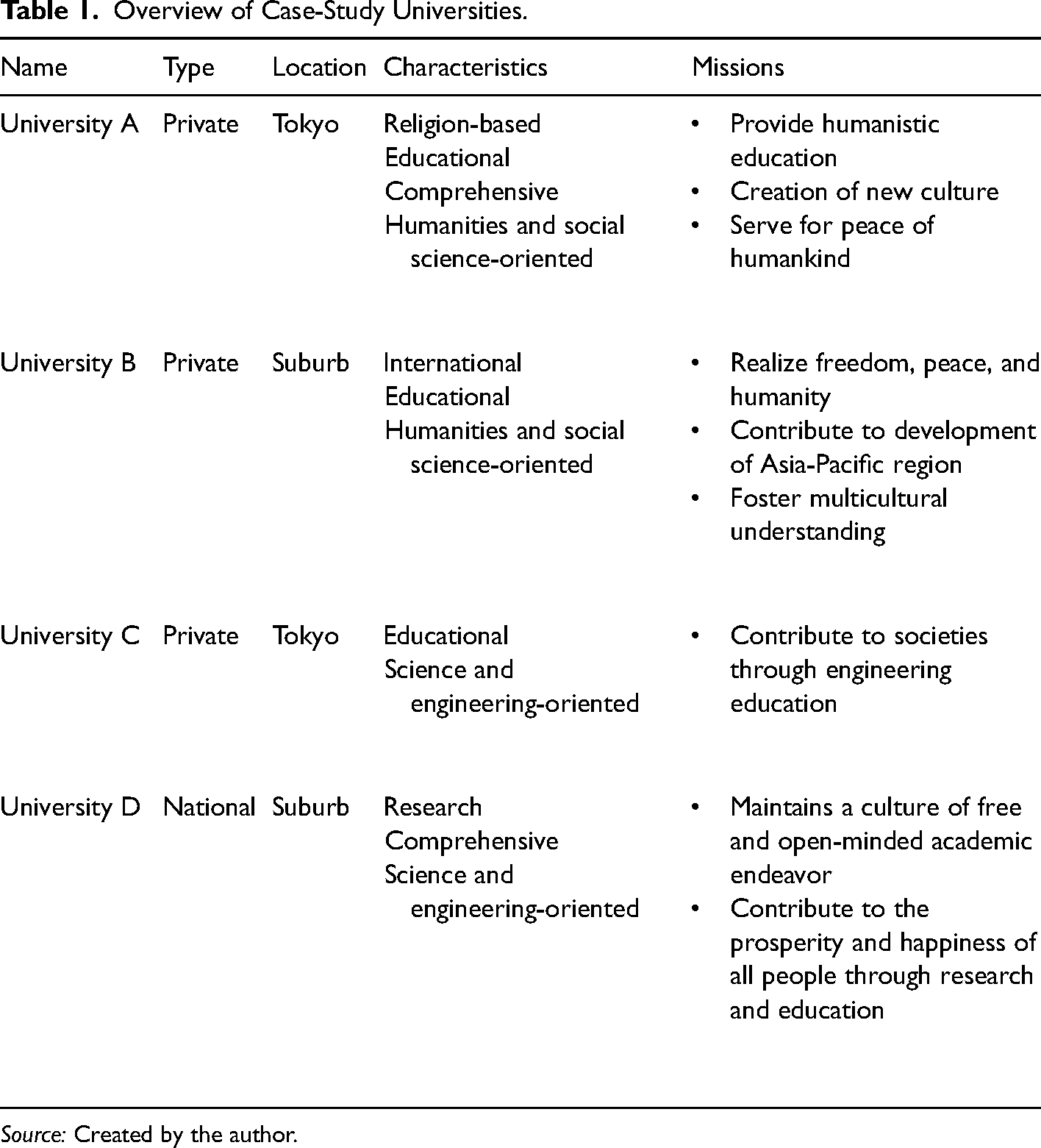
Source: Created by the author.
University academics and administrators in different roles were interviewed. All recordings were transcribed and inductively coded using descriptive and conceptual codes for analysis according to a framework of sensemaking.
Sensemaking encompasses several approaches, but all involve three processes termed by Weick as creation, interpretation, and enactment. Creation describes noticing aspects of the events one faces (ecological change) and “bracketing” them. Interpretation involves trying to interpret or explain the event through selection and retention based on the initial noticing and bracketing. Finally, enactment is defined as “trying to realize through action.” Weick et al. (2005, p. 414) further refined this conceptual foundation, and the process is presented in Figure 1, which illustrates that sensemaking is triggered by a situation in which the meaning of an event is ambiguous or uncertain (ecological change). In this situation, people are unsure about the right action to take. Therefore, they attempt to understand what is occurring through their cognitive abilities and social interactions (selection, retention). This process is a part of interpretation. Then, after determining what action to take, an environment that is favorable for the person is constructed (enactment). By repeating this process, the individual understands the meaning of the event.
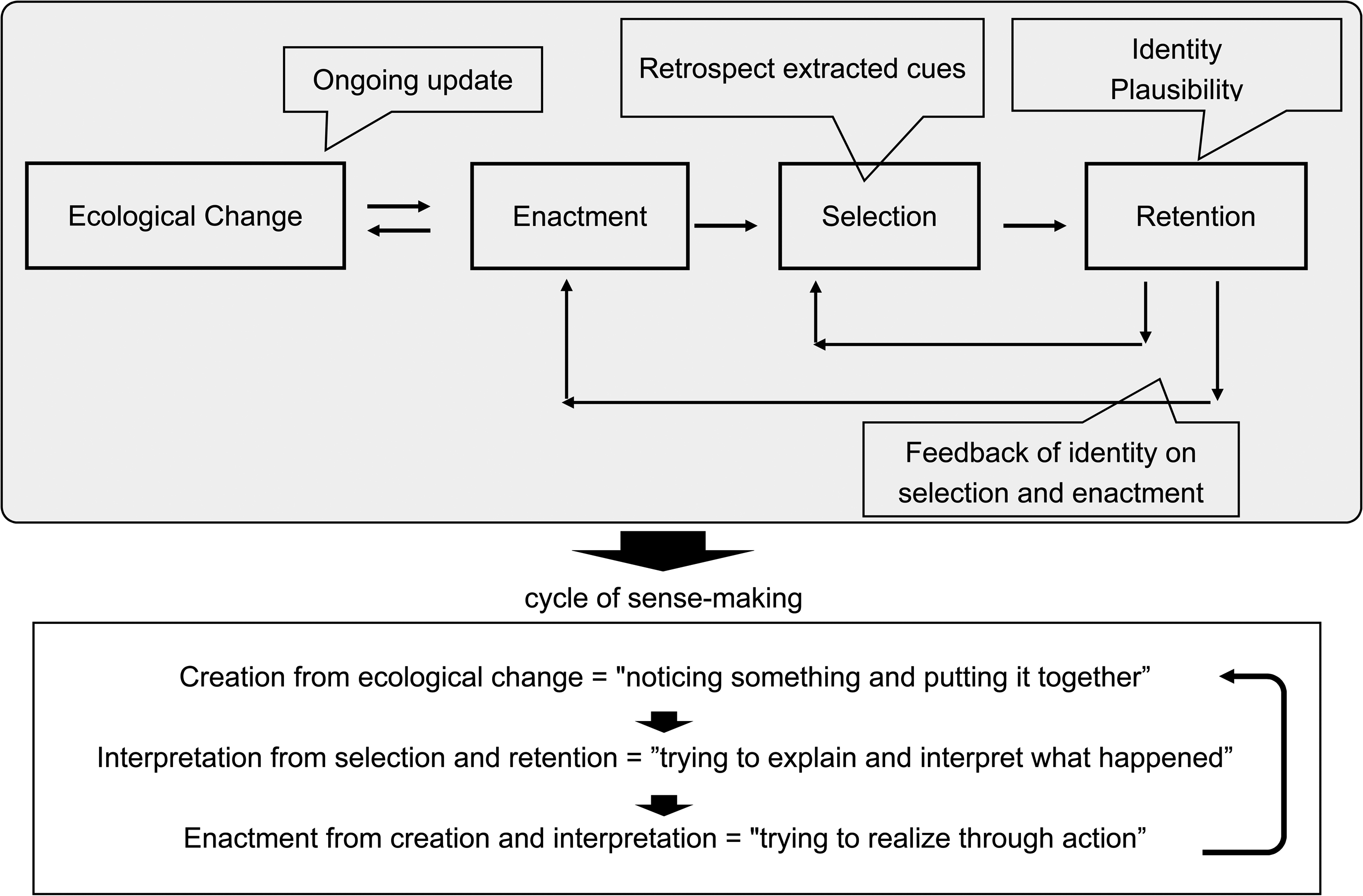
Process of sensemaking. Source: Weick et al. (2005). Modified by the author.
This study aims to explain how and why Japanese university academics and administrators develop study abroad programs. The sensemaking framework is helpful in describing this process. Academics and administrators develop study abroad programs (enactment) based on their knowledge, experiences, beliefs, and values acquired in their social contexts (interpretation [selection, retention]) while recognizing the different ecological changes (creation). This process is illustrated in Figure 2. Unlike existing research into the motivations of individual students through analyses using push-pull factor theory, the focus of this research shifts from students as participants on study abroad programs to university academics and administrators as program developers and providers. While university students, as study abroad participants, cross borders, university academics and administrators remain at home, but develop the programs. In this sense, university academics and administrators act as intermediaries between students and study abroad destinations. Therefore, push-pull factor theory, which explains only the interactions between students and destinations, is not sufficient to explain this phenomenon. Push-pull factor theory is used only to identify factors without explaining how these are formed, but this research takes on the additional challenge of adopting sensemaking to focus not only on the factors, but also on the processes of constructing these factors and linking them to actions.
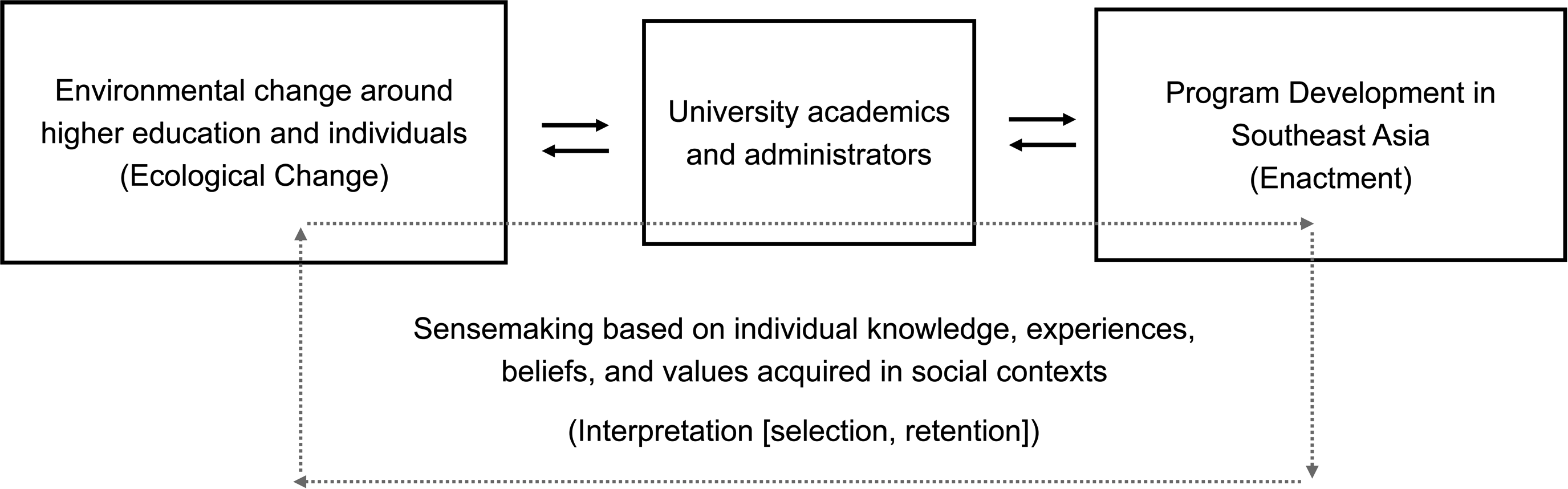
Sensemaking process of university academics and administrators. Source: Created by the author.
Based on sensemaking, this research demonstrates that Japanese academics and administrators’ motivations and sensemaking processes are determined by two main characteristics: (1) university type (science and technology university vs. arts and sciences university) and (2) occupation (academic vs. administrator).
Findings
Sensemaking at Two Types of University
Commonalities found among the academics and administrators of science and engineering-based universities (Universities C and D) were that their sensemaking was associated with “Graduates supporting the development of study abroad programs” and “pro-Japanese and pro-Southeast Asian attitudes.” The strong involvement of “development-supporting graduates” in the study abroad programs has reconfirmed the tendency to accept Southeast Asian students at Japanese universities (creation). In addition, ensuring mutual benefit for the two parties is essential: accepting Southeast Asian students (interpretation) and maintaining study abroad programs for Japanese university students (enactment). The pro-Japanese and pro-Southeast Asian attitudes reveal how Japanese academics and administrators view Southeast Asia through their academic fields.
For example, staff of University C want to help their students gain international experience (creation). Still, they find it challenging to conduct educational and research exchanges as peers with universities in developed countries such as the United States (interpretation). For this reason, staff of University C have decided that universities in Southeast Asia, where the level of education and research is equivalent and graduates of University C are employed, are the best partners for their educational activities through study abroad programs (enactment).
Meanwhile, University D is among the top universities globally in science and engineering research, and staff are eager to improve its research capability (creation). In addition, they want their students to apply and practice their knowledge and skills in science and technology (interpretation). To achieve this goal, study abroad programs are being developed in Southeast Asia, where many developing countries have less developed science and technology sectors than those in Japan (enactment).
Such sensemaking can be seen in the following testimony: A long time ago, many universities in Southeast Asia did not have doctoral programs. That is why the Japanese government started programs in which Japanese universities accept second-year master's students and first-year doctorial students from Southeast Asian universities on a full scholarship. Southeast Asian students complete their doctoral degrees and then return to their home universities to become faculty members. We have been running such a program for more than 10 years now. We now have about 50 graduates, and probably 70% of them have become faculty members in their countries. Therefore, we have a network of graduates in our partner universities in Southeast Asia who feel indebted to our university. We are developing a study abroad program in Southeast Asia utilizing this network. By producing graduates, education and research are functioning well.
(University C, Academic No. 7)
Humanities and social science-oriented universities (Universities A and B) make sense of program development in terms of competition with other universities and departments and the provision of a distinctive education. University A implements a study abroad program in the Philippines for outstanding students as an honor program. This program was developed as one way to help the university survive given the declining birth rate in Japan (creation). Besides attracting new students, the enrollment of excellent students distinguishes it from other universities (interpretation). University B has developed a four-country program to increase the impact of overseas experiences. Because part of the university's mission is “multicultural coexistence,” University B is more international than the other three universities, with international students accounting for half of its student population. Therefore, it seems that University B students have abundant cross-cultural contact throughout their campus life (creation), equipping them with the opportunity to experience a pseudo-study abroad life on campus. With a multicultural environment already on campus, University B found that students were not satisfied with a single country stay (interpretation); therefore, a four-country stay program was developed (enactment). In these ways, the interview data indicates the two universities’ intentions to distinguish themselves from other universities by creating unique programs. The program development initiatives of these two universities are rooted in the rationale of working to educate students according to their demands and in manners distinct from other universities. The following testimony is an example of this type of sensemaking: In the past, University A has had many educational programs supporting students who are not good at English, math, or who have trouble keeping up with their studies, but none that can satisfy top students. One of the characteristics of University A is that students with above-average academic ability but who share the university's philosophy are enrolled here. However, for many years, we have neglected these students. We have not implemented a program to educate these students in one place… The reason why we developed the program in the Philippines is to provide educational services that match the level of the students who have chosen University A, despite having the academic ability to enter the University of Tokyo or the University of Kyoto. Also, Japan faces a decline in the birth rate. Therefore, when high school students are thinking, “What university should I go to? I got into Waseda, but I also applied to University A. I don't know which one to choose,” we wanted to increase the number of students who would decide to go to University A because of this program.
(University A, Academic No. 5)
Sensemaking in Different Occupations
Although the same motivating factors influence academics and administrators, they make sense of their circumstances differently because of their occupations. This sensemaking is especially apparent for academics. For example, the natures and demands of students (creation) influence academics to develop study abroad programs, but during the sensemaking process, they relate the program development (enactment) to their research (interpretation). Thus, they can advance their research, develop collaboration, and simultaneously attract students to their field of study to educate them (interpretation). This behavior is related to the profession of academics and the individual's subjective view.
Similarly, in response to competition with other departments and other academics (creation), academics develop study abroad programs (enactment) to assert their presence and maintain their existing privileges (interpretation). Academics are generally evaluated based on education, research, and administration, and in most cases, the evaluation is heavily weighted toward the education and research aspects. Although study abroad programs are connected to education and research, their development requires a considerable amount of administrative work. Because such administrative work is not directly related to their evaluation, few academics willingly take charge of it. Nonetheless, academics try to distinguish themselves from their peers by engaging in study abroad program development and chaperoning. Similarly, with numerous academics involved in study abroad programs within the department or division, not being involved may put academics at a disadvantage. In addition, frequent discussions may occur within the university about abolishing or merging a small department or faculty, partly due to the declining birthrate. In response to these trends, academics differentiate their educational activities from those of other departments through study abroad opportunities, thereby asserting the significance of their department's existence. When this sensemaking occurs, academics shift their focus from the educational purpose of study abroad to the competitive purpose. For example, the following testimony reveals such an intention: When there was a movement within the university to reorganize and restructure humanities departments, my department had to show that we were contributing to something such as an international project, even if only a little. We submitted three applications for international research projects, which were to take place after the current grant program concluded, but all three applications were unsuccessful. As a result, our department was not involved in University D's internationalization activities at all, so we felt a great sense of crisis. At that time, an application for a study abroad project in Southeast Asia came up, and the executive board of the department decided that we could apply for it and make our presence known.
(University D, Academic No. 7)
On the other hand, administrators’ sensemaking is more closely related to aspects of university management, such as achieving target figures, as confirmed by the literature (Turner & Robson, 2007). In addition, when administrators are involved in program development, programs are not established based on academic disciplines. This is because university administrators in Japan are not as specialized in educational fields as academics are, and are not directly involved in education and research as part of their daily responsibilities. However, when a university is selected for a grant program and is required to achieve the numerical targets stated in the application (creation), it must expand opportunities for university students to study abroad (interpretation). In this way, the university will have to respond to the diversifying demands of students (interpretation). When these factors and motivations influence administrators’ sensemaking, their indirect involvement in education becomes obvious (enactment) as they try to develop and implement feasible programs and contribute to student education. In addition, because administrators are not directly involved in education and research, they play the role of coordinator of program development (enactment). In this case, they are collaborating with academics in the development process. In other words, although administrators play a limited role in the content of the programs they develop, these individuals try to remain involved in education as much as possible and attempt to find meaning through their involvement. For example, the following testimony elucidates this point. Because we are not education experts, we cannot evaluate students’ progress, such as what kind of growth has been seen in students as a result of the study abroad program from the perspective of faculty members. I think this is the weakest point of the administrators. However, this kind of evaluation will be required in the future, so I would like to work with faculty members to develop study abroad programs.
(University A, Administrator No. 6)
Discussion
This sensemaking analysis contributes to research on study abroad motivations by broadening its scope and making the analysis more dynamic. Previous research of study abroad motivations has mainly focused on university students, and the prevailing analytical framework has been push-pull factor theory (Altbach, 1998, 2004; Mazzarol & Soutar, 2002; McMahon, 1992). This is because such research focuses on degree-seeking study abroad, involving only the individual student and the study destination. On the other hand, in developed countries, including Japan, universities have recently started offering short-term and credit-bearing study abroad programs to students. In this case, the universities that develop and offer the programs, as well as university faculty and staff, become additional actors involved in study abroad. Specifically, when university students are considering studying abroad, if their university offers study abroad programs, this will become a push factor. This means that the choice of study abroad (destination, duration, and content of study) is already determined to some extent by the university. This research paid attention to the presence of university program provision that would work as a push factor for university students, and analyzed how and why university academics and administrators develop programs. Analyzing the situation from the standpoint of new actors, university academics and administrators, is an innovative perspective, reflecting the current situation in which study abroad involves more than just the university student and the study abroad destination. It also suggests that future research into the motivations for studying abroad should not be limited to university students alone, but should also extend to university academics and administrators who develop and offer programs, and that the analysis of motivations for studying abroad may become more dynamic.
In addition, this research provides new insights to complement the previous research on the motivations of university academics and administrators for international activities. It uncovers not only the motivations of university academics and administrators, but also a series of processes from motivations to actions in response to the questions of “how” and “why”. Most previous research has only pointed out the motivations and characteristics of university academics and administrators (Beatty, 2013; Criswell, 2014; Friesen, 2013; Li & Tu, 2016; Nyangau, 2018, 2020; Turner & Robson, 2007). By utilizing sensemaking and focusing on the cognitive and social actions of university academics and administrators, this research has been able to explain their motivations and characteristics in a more concrete way.
For example, the research by Turner and Robson (2007) showed that divergent motivations among university academics and administrators may hinder the implementation of international activities and strategies. This research has also found different motivations for international activities: in general, education for academics and management for administrators. On the other hand, it has shown the ability of both sides to compromise, despite their differing motivations, rather than hindering international activities and strategies. Specifically, it confirms that administrators collaborate with academics in education whenever possible, in an attempt to achieve numerical goals for administrators and educational goals for academics. As university academics and administrators work to develop study abroad programs, they repeatedly engage in cognitive and social actions to reconcile their respective interests and achieve their respective goals. Thus, this research suggests that a behavioral tendency for both parties to step outside their professional domains and collaborate, rather than inhibit each other, when engaging in international activities, and both achieves the goals of the university and benefits the parties involved.
In addition, Friesen’s (2013) research pointed out that academics are motivated to engage in international activity by a crossover of personal motivations and motivations in line with university policies, and that the degree of motivation varies among them. This research has been able to clarify how personal motivations differ between academics of science and engineering-based universities and humanities and social science-oriented universities in terms of the stage of formation of their motivations. For academics at both types of university, there is a presumption that they should engage in study abroad programs for student education. However, the academics at the science and engineering-based universities felt more comfortable about developing study abroad programs in Southeast Asia because of the levels of their students, relevance to students’ knowledge, and the difficulty of negotiating with counterparts in developed countries. This represents a mixture of personal motivations and motivations in line with university policies. On the other hand, academics of humanities and social science-oriented universities tried to promote their own presence by creating programs that were distinctive compared to other universities. Developing study abroad programs was interpreted as being in the interest of individual academics in an environment of competition with other universities, internal departments, and other academics, keeping in mind the declining birth rate in Japan and the survival of universities. Academics are also involved in study abroad programs due to personal motivations: in order to advance their research, develop collaboration, and simultaneously attract students to their field of study.
Furthermore, the research by Nyangau (2020) indicated that faculty members’ strong efficacy beliefs serve as motivations. This research has shown that the attitudes, as well as the competencies and skills, of Southeast Asian university academics and administrators involved in study abroad programs alongside Japanese counterparts could also be a motivation. The interviews in this research confirmed many testimonies about graduates with PhDs from Japanese universities in Southeast Asian universities who have a pro-Japanese attitude and support the development of study abroad programs. It is not simply the abilities and skills of individual academics and administrators involved in international activities, but also the history and relationship with the other side that goes beyond the domain of the individual function as a motivation.
Conclusion
Through a sensemaking analysis of university academics and administrators which highlights not only their motivations, but also the process from their motivations to actions, this research demonstrates the expanded scope of study abroad motivations and makes the analysis more dynamic. It also finds that, while developing programs that match the characteristics of their universities and the nature and demands of students, university academics and administrators are cognizant of the advantages to themselves. Moreover, their involvement in study abroad programs serves to realize these advantages.
This social analysis highlights the relationships between Japanese and Southeast Asian counterparts, the historical background of Japan and Southeast Asia, and the academic and administrative resources required for program development. In other words, this study offers a social constructionist approach that depicts how a university organization is built and how its direction is determined by the organic relationships between the individuals involved in program development. This approach has not been used in the literature on study abroad programs.
Since the trend of program development by Japanese universities is recent, few research cases have been accumulated, and little attention has been paid to this trend. In response to this research gap, this research reveals how and why university academics and administrators develop study abroad programs and offers a dynamic view of their motivations and their processes. In other words, this research highlights the relationship among universities, students, and study abroad destinations, which cannot be captured using simple push-pull factor theory between students and destinations.
This research reveals that each academic and administrator developing a program has a different sensemaking process, suggesting that study abroad program establishment incorporates the personal intentions of academics and administrators. These findings may be used as a tool for the development of study abroad programs that benefit each of the actors involved: government policymakers, university academics and administrators, and students.
Footnotes
Declaration of Conflicting Interests
The author(s) declared no potential conflicts of interest with respect to the research, authorship, and/or publication of this article.
Funding
The author(s) disclosed receipt of the following financial support for the research, authorship, and/or publication of this article: This work was supported by the Japan Society for the Promotion of Science, (grant number 19K14258).
