




Abstract
Internationalisation is transforming higher education institutions worldwide. However, the understanding of internationalisation, the rationales presented, the strategies applied and the challenges encountered differ between contexts. One challenge, especially for universities in the Global South, is how to consider internationalisation with a decolonised approach. This study explores internationalisation in two major universities in Mozambique through documentary analysis and semi-structured interviews with academics and managers. The study was guided by two questions: (1) How have Mozambican universities undertaken internationalisation in terms of understanding, rationales, strategies and challenges? (2) How are global ideas of internationalisation interpreted and translated into local practices? The results are interpreted with a theoretical lens combining neo-institutionalism and decolonisation theory, both providing arguments for translation and adaptation of ideas and practices to the local context. The findings suggest that the approaches to internationalisation emphasise the adoption of Western templates and values and can be more deliberately decolonised.
Introduction
Internationalisation includes the policies and practices undertaken by institutions and individuals to cope with the global academic environment (Altbach & Knight, 2007). It transforms higher education institutions (HEIs) and systems (Knight, 2015) and is no longer an ad hoc or marginalised part of higher education (HE). Universities’ strategic plans, national policy statements, regionalisation initiatives and international declarations show the central role of internationalisation in the world of HE (Knight & De Wit, 2018). The prevalence of such practices shows that the international dimensions have for decades been central to the agendas of HEIs around the world (Delgado-Márquez et al., 2013; Seeber et al., 2016) through partnerships, alliances and collaborations with other institutions, organisations and individuals (Yesufu, 2018).
Driven by a desire to be known as international HEIs (Knight, 2015), universities have reformed their curricula with international content; launched branch campuses, cross-border collaborative arrangements and programmes for international students; and established English-medium programmes and degrees (Altbach & Knight, 2007). However, according to various scholars, recognition should not be the only intention behind internationalisation. For instance, De Wit et al. (2015) explain that internationalisation is not a goal in itself but a means to enhance quality. This calls for a second look at the internationalisation process in many universities in developing countries. Furthermore, Knight and De Wit (2018) highlight new rationales that have characterised the internationalisation process in most countries, namely, branding, international programmes and provider mobility, global citizenship, internationalisation at home, global rankings, knowledge diplomacy, world-class universities, cultural homogenisation, franchising and joint and double degree programmes. Zapp and Ramirez (2019) posit that internationalisation and institutionalisation pave the way for an integrated global HE regime.
The rationales behind the internationalisation of higher education (IoHE) differ across countries and HEIs (Knight, 2004). In a nutshell, the contemporary rationales for IoHE can be grouped into four categories. The academic rationale encompasses a universal search for knowledge. The socio-cultural rationale relates to cross-cultural knowledge and understanding. While the political rationale contains aspects of national security, stability and peace, it also encompasses international prestige and maintenance and expansion of the influence of the HE system. Finally, the economic rationale is linked to the global economy and marketplace (Hudzik, 2011; Kreber, 2009). Unsurprisingly, the few empirical studies of HEIs’ internationalisation rationales have found different results. For instance, Delgado-Márquez et al. (2013) identified international reputation as a factor. Tamrat and Teferra (2018) saw that it was a means to promote teaching and resource mobilisation, international research projects and academic quality and standards. Other studies found international prestige to be the motive. Despite this growing body of scholarship, there is not yet a comprehensive understanding of the rationales driving internationalisation because there are variations across different contexts (Seeber et al., 2016).
In Africa, Andoh and Salmi (2019) have stressed that many universities in Eastern, Western and Southern Africa have focused on North American and European universities for collaborations, partnerships and support. Recent debates on postcolonial studies and the need to decolonise African universities place them in constant tension with the Global North (Mamdani, 2019; Mbembe, 2016), although calls for decolonisation are not new (see Fanon, 1964; Nyerere, 1966). In the context of internationalisation, some African universities have faced challenges. For instance, Andoh and Salmi (2019) have pointed out that the internationalisation agenda of some African flagship universities is not sufficiently focused on science, technology and innovation, thereby diminishing contributions to national and regional development. Kigotho (2021) has stressed that university education is under-resourced, with a low quality of graduates to boost the quality of life and postgraduate training facing a scarcity of investment.
Bedenlier et al. (2018) observed that studies on IoHE have grown considerably in recent decades but Tamrat and Teferra (2018) have noted that, except for South Africa, there is a scarcity of research on internationalisation across the African continent compared to what has been taking place in Western countries. It is on this premise that this study aims to explore IoHE within the Mozambican context, focusing on the understanding, rationales, strategies and challenges inherent in the internationalisation process. It also aims to determine the extent to which this process is implemented and translated in a decolonised way. It is a case study based on a critical analysis of policy documents and semi-structured interviews elicited from managers and academics in two public Mozambican universities, namely Eduardo Mondlane University (UEM) and the Pedagogic University of Maputo (UP-Maputo). The empirical findings from this study contribute to the ongoing debate on the internationalisation of HE in Mozambique. It also makes a theoretical contribution by combining neo-institutional and decolonial perspectives to interpret the results and conceptualise the understanding of internationalisation. In doing this, the study contributes to the field of HE in general, and will help university managers, academics and practitioners, who will benefit from understanding the main rationales, strategies and challenges of internationalisation within the Mozambican context. The significance of the study is consistent with the ideas of Altbach (2015), who posits that a conceptual understanding of internationalisation is needed to make sense of the varied and complex ways that HEIs are affected.
The current study is guided by the following research questions:
How have Mozambican universities undertaken internationalisation in terms of understanding, rationales, strategies and challenges? How are global ideas of internationalisation interpreted and translated into local practices?
Background to the Case Institutions
Mozambique HE is described as a novel and emerging field (Beverwijk et al., 2008; Uetela, 2015). Hence, two universities, UEM and UP-Maputo, were chosen as the context of the study. The purpose was not to compare them but to sample illustrations from both universities as premier HEIs in the country. Both are internationalised HEIs with a diverse international student body, international partnerships and outward and inward mobility worldwide (DPDI, 2020; GPE, 2019; UEM, 2019, 2020). Moreover, they have embarked on external collaborations with diverse academic institutions, research funding agencies, various governments (represented by embassies) and other international partners from non-government organisations (NGOs) (Zavale & Schneijderberg, 2020). Both institutions are also public. Beverwijk (2005) noted that public HEIs in Mozambique are strongly dependent on public funding from the government despite having full academic autonomy. Following Stensaker and Harvey (2011), public HEIs are in general funded to ensure quality and excellence, and in many cases have been responsible for HE policy decisions.
Conceptual Framework
An analysis of the literature suggests that previous studies on IoHE have barely engaged with conceptual frameworks; such engagement could support a better understanding of the phenomenon (Fumasoli, 2021). In exploring the internationalisation of Mozambican universities, we have chosen to combine neo-institutional and decolonial perspectives, noting that their analytical directions have rarely been brought together (see Majee & Ress, 2020; Muyaka et al., 2020; Thondhlana et al., 2021).
Neo-institutional theory has its roots in the 1970s. Its premise is that organisations are influenced by rules, norms and shared meanings in their environment, guiding their behaviour. Organisations gain legitimacy by incorporating such policies, practices and programmes that are commonly seen as rational, appropriate and meaningful. It actually matters less whether the adopted elements are effective, but it is imperative that they conform with the shared normative systems and are seen as legitimate in the eyes of their stakeholders (Meyer & Rowan, 1977). Instead of effectiveness, then, the process follows a ‘logic of appropriateness’ (March & Olsen, 2013). Since organisations in the same environment will adopt similar elements, they tend to become more alike, a phenomenon called isomorphism. One of the ways in which this happens is by imitation of the most prestigious organisations of their kind (DiMaggio & Powell, 1983). Scandinavian scholars have contended that the process of imitation should not just be seen as an act of passively copying a stable feature as it is. Practices need to be translated, shaped and transformed appropriately for the local context (Sahlin & Wedlin, 2008; Wedlin & Sahlin, 2017).
Using the neo-institutional lens, we can expect it to be important for a university that its implementation of internationalisation resemble other universities’ practices, policies and programmes. It is also likely to turn to the most prestigious institutions for models and patterns to follow. In this study of Mozambican HEIs, it is important to note the extent to which such forces are shaping the internationalisation process and whether they also offer opportunities to universities for change and innovation to consciously adapt practices to local needs and conditions.
Another impetus for recontextualising the adopted ideas and practices is decolonisation (Mbembe, 2016). IoHE in Mozambique is historically linked to the colonial past (Mário et al., 2003). Internationalisation practices of HEIs are established through connections still bearing traces of the colonial attachment, and many internationalisation activities are influenced by the Global North. For instance, organisations such as the Association of the Portuguese Speaking Universities (AULP) and the Community of Portuguese Speaking Countries (CPLP), just to mention two, are linked with the language of the coloniser in the Lusophone Higher Education Area (Langa, 2013; Mário et al., 2003). These organisations are active fora for universities and policymakers in Portuguese-speaking (Lusophone) African countries (Alemu, 2019).
The Global South has long discussed the need for ‘Africanisation’ of African HEIs, including knowledge, mind, language and literature (Mbembe, 2016; Wa Thiong’o, 1986). Beyond that, however, decolonisation is, according to Mbembe (2016), opposition to the existing and prevailing dominant academic model from the Global North described as the Eurocentric epistemic canon. Moreover, influenced by globalisation, decolonisation argues against encompassing the IoHE with the purpose of competition and marketisation, which enable HEIs to become world-class universities fostered by power relations. Failing to meet global competition, Mbembe states, universities become local only, or ‘zoned’, which is equivalent to losing. Mozambican universities cannot be oblivious to these concerns but need reconfigured understandings of their situatedness in Africa and the world.
Santos (2018) concurs that the neo-liberal internationalisation of the university and the parallel changing paradigm of HE into a commodity are creating inequality and segmentation in the university system, locally and worldwide. Therefore, there is a need to guarantee a postcapitalist, postcolonial and postpatriarchal future for the university through the ‘polyphonic university’. By polyphonic university, Santos means a committed university that is neutral but also engaged in social struggles against capitalism, colonialism and patriarchy. That is, it emerges as an alternative to the modern university, avoiding the new waves of university colonialism propagating the Western model, which encompasses market value orientation, prestige and rankings as core rationales for the internationalisation of HEIs. In this case, as argued by Fanon, ‘the problems of decolonization will conform to a spirit of solidarity, of equity, and of authentic justice’ (Fanon 1964, p. 94).
In analysing the internationalisation of Mozambican HEIs, it is important to understand from managers and academics the direction of the current practices in the universities. The purpose is to examine whether different features of the internationalisation practices that are investigated here are interpreted and translated in a manner consistent with a decolonial approach as well as the Scandinavian neo-institutionalist perspective, or if they constitute a continuation of the colonial heritage.
Methods
Research Design and Data Collection
The primary purpose of this study is to explore the understanding, rationales, strategies and challenges inherent in the internationalisation process of two public Mozambican HEIs, and as a follow-up to determine the extent to which this process is implemented and translated in a decolonised way. To this end, a qualitative research method under the interpretive paradigm was employed. An interpretive paradigm aims to understand the subjective world of human experience (Cohen et al., 2011) and the existence of multiple interpretations of a single phenomenon (Merriam & Tisdell, 2015). The case under study relies on an in-depth, multifaceted investigation and the use of several data sources (Schwandt & Gates, 2018), such as semi-structured interviews and documentary analysis, applied with the main aim of answering the research questions (Yin, 2013). For the purposes of data collection, the first author visited both universities and interviewed 12 key informants, all in Portuguese. To make the interviewees feel comfortable, a safe environment was created during the data collection, aiming to stay adaptive, avoid biases and have a firm understanding of the issues being studied (Yin, 2013).
Three main ethical issues were addressed in this study: confidentiality, anonymity and informed consent. The purpose of the study was discussed with the participants, who were assured that their participation was voluntary. For confidentiality and anonymity, the participants’ identities were protected by the use of pseudonyms throughout the study.
Sampling Procedure and Participants’ Profile
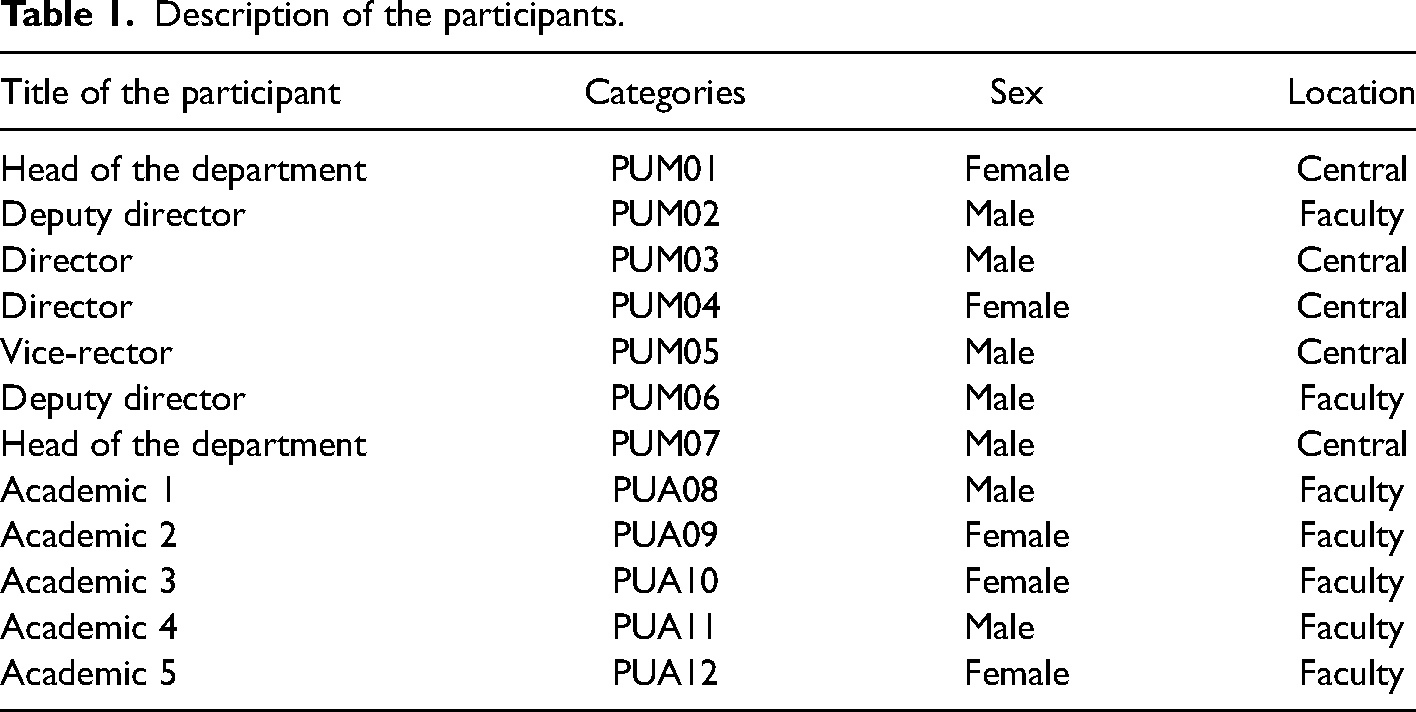
A purposive sampling strategy was adopted in this study. ‘Purposive sampling is used to access “knowledgeable people”, i.e. those who have in-depth knowledge about particular issues … of their professional role, expertise or experience’ (Cohen et al., 2011, p. 157). Therefore, in order to fulfil the main purpose of the study we targeted two groups such as managers and academics. The titles of the managers comprised vice-rector, cooperation office director, deputy academic director and head of departments. However, given that under normal circumstances internationalisation is interpreted and affects university sectors differently, we purposively selected the aforementioned groups aiming to elicit information associated with the internationalisation at their institutions. Furthermore, based on their experience, the information provided on the subject-matter could determine to what extent was internationalisation translated into local practices in a decolonised way. The profiles of the respondents (see Table 1) varied in terms of gender, qualification and institutional position. Academically, their qualifications ranged from master's degree to full professor.
Description of the participants.
Instrumentation
Two types of instruments were used to collect data to answer the research questions: semi-structured interviews and documentary analysis. In addition to eliciting background information (gender, position, qualification, department location), the interview protocol contained questions to gather information about the participants’ understanding of internationalisation in the context of Mozambican HE, their views about the strategies used to further internationalisation, the role models or best practices that serve as inspiration to their universities and the barriers and drivers of internationalisation in their universities. The documentary analysis involved the analysis of institutional documents with particular reference to internationalisation practices and related issues.
Data Analysis Procedure and Ethical Considerations
The interviews were transcribed verbatim and translated into English. Thematic analysis was conducted, in which different themes were generated from the individual interviews and then categorised to provide a holistic picture. To complement the interviews, documentary analysis was undertaken, comprising a ‘strategic plan’ and ‘internationalisation policy framework’, in an attempt to offer a valuable resource for confirming insights gained through the semi-structured interviews (Merriam & Tisdell, 2015). Following Cresswell and Cresswell (2018), the data were coded and displayed under categories and major themes, illustrated by quotations and specific evidence.
Results and Discussion
The study results are grouped into four fundamental categories: understanding, rationales, strategies and challenges for internationalisation.
Understanding of Internationalisation in Mozambican HEIs
The core understanding of internationalisation, based on the academics and managers’ experience of UEM, concerns ‘placing the university into the global context’; this is evident from the different perspectives of the participants. One of the university directors said, when asked about the nature of internationalisation: It is a process through which the university places itself in a global context, but above all, the university creates conditions so that the research it produces and the staff are acknowledged or even recognised in the global context. (PUM03)
Aligned to the view above, an academic from the same institution also reiterated the importance of an individual being able to fit him/herself within the global world as a result of internationalisation: […] someone trained in Mozambique has to have the ability to insert himself/herself without any problems into the international level […] and there is no barrier to the extent to which what he/she studies does not correspond to the requirements of the institution at the international level. (PUA10)
By contrast, one of the vice-rectors from UP-Maputo described internationalisation as homogenisation of university processes and practices: I think there are two levels of [understanding] of internationalisation: The first level is the homogenisation of university processes worldwide […], mainly of education systems, to allow the [academic] mobility of people and equivalencies [of academic degrees] internationally. […] The second level of internationalisation involves teaching practices, research and the exchange of undergraduate programmes, but mainly of postgraduate courses involving master's degrees and doctorates. This level allows the movement of teachers and students, the organisation of and participation in conferences, etc. (PUM05)
The policy framework from UP-Maputo highlights internationalisation as a process aligned with institutional goals, functions and services: Internationalisation is a process of integrating an international, intercultural and/or global dimension into the university's objectives, functions and services (GRI, 2016, pp. 4–5).
It is clear that significant variations in understanding were found, as acknowledged in the literature (see Knight, 2013; Tight, 2019). However, the interpretation of the phenomenon shows something of an imbalance. The interviewees referred to the integration of core features, such as recognition of the university in the global context and integration of university objectives, functions and services into international, intercultural and global dimensions, but these are conceived as an adaptation to a given model from the outside. Following Mbembe (2016), African HEIs should resist the prevailing dominance of the Western approach, which sees the university as an organisational field for competition and becoming world-class. The data do not suggest that active work is going on to reconfigure the understanding of the universities’ situatedness, in the first place in Mozambique and later on in the world.
The Rationales Driving Internationalisation
The rationales driving internationalisation in Mozambican universities are grouped into academic, political and economic, which are similar to those reported in the literature (see Hudzik, 2011; Kreber, 2009) but the findings do not suggest the existence of a cultural rationale.
The primary rationale stressed by the interviewees from both universities and traced on the universities’ official documents encompass ‘training’, ‘teaching’ and ‘research’ aiming to increase intellectual capital and knowledge production and enhance quality. Interestingly, the academic rationale is viewed as the main driving force for both institutions, as stated by a UEM deputy director: ‘[…] the main purpose is training because there is a lack of qualified staff internally’ (PUM06). His/her counterpart from UP-Maputo also mentioned research collaboration and teaching: […] exchange of knowledge through research group and teacher mobility […]. We send our teachers to take post-graduation programmes for master's and doctoral degrees abroad […]. Second, […] we have a strong collaboration with [foreign] universities in our postgraduate programmes […] some professors from these universities come to teach at our university, as there is also co-supervision of masters but mainly doctoral students. (PUM05)
Quality was mentioned by one of the academics at UEM, in line with De Wit et al. (2015), who see internationalisation as a vehicle to enhance the quality of the education: […] it helps us understand how the world is developing and thereby improve our higher education system. (PUA09)
The UP-Maputo internationalisation policy framework also refers to quality and specifies the following: Internationalisation […] aims to improve the quality of teaching, research, outreach, post-graduation and service provision […]. (GRI, 2016, pp. 4–5)
Another rationale is political, regarded by Hudzik (2011) as an avenue to exert worldwide influence. The respondents believed that it encompasses ‘visibility’, ‘status’ and ‘recognition through rankings’. An excerpt illustrating these views is presented here: It gives greater visibility to [our] institution [UEM] through the establishment of partnerships, institutional and academic agreements […] and mobility of students, teachers and administrative staff, not only at the level of the [African] continent but also beyond it. (PUM02)
A colleague from the same university acknowledges that it raises university status as the university transcends national borders: […] we have several partnerships [at UEM] and our experience has been much more practical; that is, we have been, for example, inspiring ourselves by what happens in the great universities of the world […] having a lot of external connections with partners from other universities leads us to become an international university. (PUM03)
Internationalisation is highlighted in the UEM Strategic Plan 2018–2028 as a strategy of global projection of the university to face global trends, namely, socio-political, economic and demographic, and HE, which influence the insertion of the university in the universal world (PEUEM, 2017). Recognition of the university through rankings was referred to by one of the academics from UP-Maputo, as it wants to be among the world's top universities: [Internationalisation] is a criterion that counts in the rankings of universities […] evaluation of programmes, courses, etc. […] having international students and teachers is an aspect that raises points for [a university]. (PUA12)
A department head from the same university linked internationalisation to the university's reputation, almost as a matter of survival, echoing Mbembe's concept of being ‘zoned’ (2016): The name of the university appears in the academic rankings […] without it, a university is isolated and ends up sinking. We are in a globalised world, so we cannot be closed and science is not just about Mozambique. (PUM07)
The economic rationale was mentioned by just one UEM respondent, referring to income generation through the enrolment of international students in Mozambican universities: […] there is not just the component of having students from other [countries] but also the financial component of [international] students contributing to the increase in university revenues […], especially those from outside the Southern African region. (PUM03)
Under the academic rationale, Mozambique is urged to expand postgraduate studies and promote high-quality research and innovation for sustainable development because HEIs are strongly centred on undergraduate studies, with few locally qualified university staff holding PhD degrees (UNESCO, 2021). Following the political rationale, the findings suggest that the sampled universities follow and want to resemble other HEIs seen as prestigious and legitimate, aiming to obtain visibility, raise status and achieve worldwide recognition. This is just as predicted by neo-institutional theory (Meyer & Rowan, 1977). However, it is not apparent from the data that the adopted elements are made to conform with the institutional reality – that is, that they are translated, shaped and transformed appropriately on the basis of the local context (Sahlin & Wedlin, 2008; Wedlin & Sahlin, 2017).
Moreover, whether political or economic rationales are cited, both universities seem highly influenced by market value orientation, prestige and rankings, which Santos (2018) calls the new waves of university colonialism. Pusser and Marginson (2016) observed that although rankings are key drivers of institutional prestige, they are dominated by powerful, internationally enacted norms and distinct interests. Hence, they fail to encompass what Fanon (1964) defends as the spirit of solidarity, equity and justice.
Strategies for Internationalisation
Various strategies are employed by both universities to achieve internationalisation, including mobility of students, academics and university staff; the building of partnerships and bilateral cooperation with foreign universities; and the strengthening of collaboration in research with international scholars. The first strategy [at UP-Maputo] is to continue collaborating in postgraduate programmes […]; for example, our students have to do an advanced scientific internship at […] universities outside [Mozambique]. Second, we are expanding this [process] of internationalisation, not only in teaching but also in the creation of research groups [including] the organisation of international scientific conferences. Third, we seek to attract students from other countries […] for training in education and curriculum teaching courses […]. (PUM05)
The internationalisation policy framework from UP-Maputo specifies six strategies:
Applying international support funding for training, research and university outreach programmes; Maximising the use of information and communication technologies and distance learning by the entire university community for the development of courses and other academic activities; Consolidation of international partnerships, as well as the search for and establishment of others to expand internationalisation activities; Implementation of joint international undergraduate and graduate programmes, research and outreach; Strengthening of ongoing initiatives and promotion of new partnerships, particularly involving the southern region of Africa; and Increase in publications in international journals. (GRI, 2016, pp. 8–9) UEM has also been striving to join major international programmes, especially ERASMUS, Intra Africa of the European Union [and others], to link to several other universities not only in Africa but also in Europe. (PUM03)
With regard to mobility, one of the UEM interviewees pointed out that it has been accomplished by adhering to international programmes supported by many foreign organisations:
Among diversified internationalisation strategies, Kot (2016) noted that international partnerships have become remarkably popular in African universities, highlighting two benefits. First, at the institutional level, international partnerships enhance capacity building and effectiveness. Second, at the individual level, administrators, academics and students encounter positive academic, cultural and economic outcomes. With reference to research collaboration with developed countries, Teferra (2009) views the strategy as extremely important for the revitalisation of the African knowledge system, which has been marginalised globally. Hence, as argued by Kovach (2009), the call for a decolonising lens suggests a solution to the internationalisation strategies of Mozambican universities to create space in research and academia for indigenous perspectives without being neglected, shunted aside, mocked or dismissed.
With respect to mobility, known as ‘internationalisation abroad’, which consists of sending students to developed and middle-income countries for academic purposes, it is still regarded by De Wit and Altbach (2021) as an elitist approach because it focuses on a small number of mobile students. Therefore, according to these scholars, the challenge for the future lies in shifting to the ‘internationalisation at home’ strategy, which encompasses the internationalisation of the curriculum, teaching and learning, and learning outcomes, as well as global knowledge.
Following neo-institutionalism, the findings seem to suggest that both organisations undertake mainly their strategies by adhering to international entities for gaining legitimacy, stability and resources across teaching/learning, research and outreach, showing that their ‘survival depends more on the ceremonial demands of highly institutionalized external environments’ (Meyer & Rowan, 1977, p. 353).
Challenges for Internationalisation
The interviewees pointed out some challenges faced by universities when performing IoHE, namely loss of autonomy, English language, brain drain and cultural alienation.
Loss of autonomy
A director from UEM referred to the loss of university autonomy when embarking on internationalisation, especially because Mozambique is a low-income country: […] there is the risk of a certain degree of interference in the autonomy of the university itself, especially for a country with economic weaknesses like ours, because whoever has the money often deals the cards; then he/she can somehow interfere with and undermine the autonomy that universities are understood to require. (PUM02)
One academic gave a practical example of how this loss of autonomy affects research: […] we lose focus […]. For example, the biggest environmental problem we face in Manica province is the contamination of rivers by mercury, but if I embark on international [research] partnerships, if [the partners] bring the money, of course, they will dictate policies […]. I will start researching seismic shocks, for example; not that they do not happen here but they are not the immediate problem in Mozambique. (PUA09)
In this regard, Teferra (2009) advises that when embarking on internationalisation, it is paramount to bear in mind that some partnerships are not fair. He describes them as donor-driven, unsustainable and inappropriate because some donor partners set and shift research while ignoring the local needs. In Mozambique specifically, Beverwijk (2005) reports that donor funding tended to be ad hoc, with each donor organisation searching for its own niche of interest and expertise. Sometimes donors themselves do not have an overall view of the support provided by their own organisation because of the numerous independent protocols between institutions in Mozambique and universities or institutions abroad. Teferra (2009) suggests that the world should embrace a new global contract that comprises equality, fairness and meaningful research and academic cooperation.
English language
The English language is the main tool when embracing internationalisation in HE. Thus, the challenges posed to various actors as non-English speakers comprised a persistent theme in both universities. The first quote comes from a head of the department from UEM and the second from a director at UP-Maputo: […] we speak Portuguese whereas universities with an international expression are from English-speaking countries, and this has been somehow limiting us with other universities [internationally] (PUM01).
[…] everyone speaks English around us [neighbouring countries] but we have a lot of difficulties among academics and administrative staff in mastering the English language. (PUM04)
Cultural alienation and the brain drain
An academic from UP-Maputo described cultural alienation for those trained Alienation means that if you are without a solid foundation, you will not return [from the diaspora]. However, if you return, you start despising your place of origin […]. There are people who, upon returning, feel a superiority complex, thinking that by the simple fact of having [studied] a few years
When asked if the brain drain may hamper university development, one academic from UP-Maputo had a different perception: There is no way to prevent the brain drain […] the movement of people around the world is not a danger. The danger lies when you suck out everything that a country produces and take away all possibility of a country having self-sufficient development. (PUA08)
Conversely, a head of department from UEM viewed it as a great concern and it has been a subject of discussion with university partners: […] the brain drain worries me a lot because we need to retain our staff […]. We have been discussing this matter with other African partners financed by the European Union and it has been the most raised issue. (PUM01)
Following our conceptual framework, the findings can be analysed from both perspectives. First, by adhering to some international entities organisations may lose their autonomy as shown in the data. This might come as a result of being strongly dependent on external support for the fulfilment of the internationalisation activities which leads to, following Meyer and Rowan, the adoption of the ‘ceremonial requirements’. In these circumstances, neo-institutionalists have stressed that organisations are expected to act under the rules and norms of the institutionalised environments from different parts guiding, therefore, their behaviour. As a consequence, they warn that such rules and norms may conflict with the local needs and demands (Meyer & Rowan, 1977). Second, from a decolonisation perspective, the findings suggest the lingering of the colonial legacy of the language and mind characterised by two elements English and culture which needs to be decolonised (Wa Thiong’o, 1986). Notwithstanding that Mozambique was not colonised by the British, and with the language of the former coloniser in the background, the English language appears to be the new necessity. The same language referred to by Wa Thiong’o, as a colonialist tool imposed to some African countries on par with Portuguese which ended up in the deliberate undervaluing of the colonised native languages. Cultural alienation, as pointed out in the findings, may come as a result of colonialism which for a long time has given primacy to the valorisation of the colonialists’ culture. With respect to the brain drain, Mbembe (2016) argues that on par with brain gain and even brain circulation, the three labels should be maximised so that the internationalisation creates a knowledge diaspora that can foster the decolonisation process in our universities. The idea is to build new diasporic intellectual networks, taking seriously these new spaces of internationalisation engagement and harnessing the floating resources freed by the process of globalised talent mobility.
Conclusion
This study aimed to explore IoHE in Mozambican universities by investigating the understanding, rationales, strategies and challenges for undertaking internationalisation (the first research question) and by considering the extent to which global ideas are interpreted and translated into local practices (the second research question).
With respect to understandings of internationalisation, the study found that placing the university in a global context was prominent, as was the homogenisation of university processes and practices. Internationalisation was thought of as a process of integrating international, intercultural and/or global dimensions into the university's objectives, functions and services. The rationales were primarily academic, encompassing training, teaching and research. This was driven by internal forces with the impetus of increasing intellectual capital and knowledge production and enhancing quality. Political rationales were also present, driven by external forces and focusing on international visibility, status and recognition through the rankings. Finally, the economic rationale aims at generating income from overseas students. In terms of strategies, the study shows that the universities have embarked on internationalisation by building partnerships with international entities; engaging in the inward and outward mobility of students, academics and administrative staff; and strengthening research collaboration with international scholars. The study also revealed some challenges that the universities encountered when undertaking internationalisation, namely, language issues, the brain drain, loss of autonomy and cultural alienation.
With regard to the second research question, the findings show that many core features are adopted into the institutions according to Western templates. It is evident that the practices are clearly shaped by wishes for visibility, status and worldwide recognition, including ranking. If adopting these values is to some extent viewed as a necessary evil to avoid parochialism in scholarship and research, their wholesale adoption can also be seen as a new wave of university colonialism.
We conclude that the global ideas of internationalisation presented in the findings can be more deliberately decolonised. In other words, global ideas can be translated, edited and transformed into practices that give the institutions more autonomy and that benefit the local context in long-term sustainable ways. In place of a university that slavishly copies the hegemonic modern Western template, a polyphonic university can emerge (Santos, 2018), fulfilling Fanon’s (1964) vision of HE in a spirit of solidarity, equity and justice.
Further empirical research across other formerly colonised African countries would be welcome to provide a more general spectrum of insights into how IoHE is being implemented and translated.
Footnotes
Acknowledgements
This work was supported by the Swedish International Development Cooperation Agency (SIDA). The authors also appreciate the reviewers for their valuable comments on the research.
Declarations
Availability of Data and Material
Data applied for the manuscript are available and they were collected at Eduardo Mondlane University and the Pedagogic University of Maputo in Mozambique.
Authors’ contribution
The three authors contributed to the conception and design of the study. Material preparation, data collection and analysis were performed by Charnaldo Jaime Ndaipa as a PhD candidate and reviewed by Professor Lars Geschwind and Associate Professor Kristina Edström as supervisor and co-supervisor, respectively. The first draft of the manuscript was written by Charnaldo Jaime Ndaipa and all authors read and approved the final manuscript.
Declaration of Conflicting Interests
The author(s) declared no potential conflicts of interest with respect to the research, authorship, and/or publication of this article.
