




Abstract
In times of globalisation of higher education, alternative theoretical and methodological approaches were introduced in the field of comparative higher education research. To stimulate the debate on this issue, this paper firstly addresses them theoretically by combining the concept of institutional isomorphism and the ‘glonacal’ analytical heuristic. On this basis, it discusses arguments in favour of convergence and diversity from the perspective of the internationalisation of higher education and also points to the limits of institutional isomorphism resulting from ‘glonacal’ influences of agencies and agency on the development of (internationalisation of) higher education. Secondly, the paper also draws attention to the influence of globalisation on the selection of methodology in comparative higher education research by exposing the limits of methodological nationalism. Along these lines, it portrays the reversed pyramid model of different horizontal and vertical levels of comparisons with which it establishes the (missing) link between the selected theoretical and methodological framework of comparative (higher education) research. In conclusion, it acknowledges the need to integrate the contextual element into the comparative framework which allows thorough analysis of complex relationships between globalisation and higher education both theoretically and methodologically.
Keywords
Introduction
Comparative studies are undoubtedly one of the most fruitful ways of exploring contemporary changes in the field of higher education. Worldwide, comparative researchers in higher education, for example, frequently focus their attention on neoliberal discourses in higher education (e.g. Kandiko, 2010). These emerged under the complex impact of globalisation on higher education and, on the one hand, reduced financial support by the state, and, on the other, increased the need for institutional accountability and efficiency in an increasingly competitive global higher education ‘market’. In Europe, the need to conduct comparative research visibly increased with the Bologna Process and the establishment of the European Higher Education Area (EHEA); as Zgaga et al. (2013: 13) underline, ‘(t)he Zeitgeist called for the creation of more “unity” in the European “diversities”’ to be able to compete as a region in the global higher education space: The policy dilemma – either a ‘united’ (‘harmonised’) ‘European system’ or ‘European systems’ as a ‘unity in diversity’ . . . was provoked by the rapidly penetrating ‘globalisation’ and . . . it was (also) an inner result of the ongoing ‘European process’ and its ‘extraordinary achievements of the last few years’. (Zgaga et al., 2013: 12)
This convergence–diversity dichotomy is raised by many (comparative) researchers in the field of higher education. But as argued by Dobbins (2011), this dichotomy is (still) frequently addressed in a rather descriptive way, without the inclusion of theoretical and methodological assumptions into the (comparative) framework of research. To overcome such research limitations adequately, this study provides the missing link between the selected theoretical and methodological framework of comparative (higher education) research and proposes a multidimensional pyramid model of different horizontal and vertical levels of comparison which may serve as one alternative for (comparatively) analysing different higher education phenomena in the era of globalisation of higher education (see also Hauptman Komotar, 2018).
In the first part, the paper addresses the convergence–diversity dichotomy theoretically through the lens of the neo-institutionalist theory. To this end, it firstly focuses attention on the convergence argument in the context of institutional isomorphism (DiMaggio and Powell, 1983), given that the development of European higher education in the context of the Bologna Process placed this theoretical perspective in the centre of interest of many (comparative) researchers of higher education (see Dobbins, 2011; Vögtle, 2014). Institutional isomorphism is a school of thought established within the sociological tradition of new institutionalism next to historical and rational choice institutionalism (Hall and Taylor, 1996). Whilst some of its proponents assume that ‘nation-states . . . are more isomorphic than most theories would predict and change more uniformly than is commonly recognised’ (Meyer et al., 1997: 173), the exclusive focus on the national dimension is no longer sufficient for the analysis of different higher education phenomena from the comparative perspective in times of globalisation of higher education (Dale and Robertson, 2009; see also Marginson and Rhoades, 2002). For this reason, institutional isomorphism is frequently viewed as being too deterministic (Vaira, 2004) and, to deal with its conceptual shortcomings adequately, the paper then employs a multidimensional analytical framework which originates from the glonacal agency heuristic (Marginson and Rhoades, 2002); on this basis, it establishes the link between the selected explanatory concept of institutional isomorphism and the ‘glonacal’ analytical framework.
The ‘glonacal’ model was used by several authors for the study of different higher education phenomena. Hou et al. (2015), for example, employed this model for the assessment of the impact of an Asian ‘glonacal’ quality assurance system on Taiwanese universities. Based on the ‘glonacal’ analysis, Liu and Metcalfe (2016) also examined local layers and conditions in the context of internationalisation of Chinese higher education, whilst Willis (2010) analysed internationalisation at a research-driven UK university with the help of this analytical tool. All three examples demonstrate the flexibility of this heuristic in higher education research and its value in the three-dimensional emphasis on the global, the national and the local dimension of higher education (Marginson and Rhoades, 2002).
To make the ‘glonacal’ analysis more convincing, this study addresses arguments in favour of convergence and diversity with the practical application example of internationalisation in higher education, which is one of the most visible trends within the international dimension (De Wit et al., 2015). As such, it is frequently discussed in relation to globalisation of higher education (see Marginson and Van der Wende, 2009; Scott, 1998), the latter being understood as ‘the expanding scale, growing magnitude, speeding up and deepening impact of interregional flows and patterns of social interaction’ (Held and McGrew, 2000: 4). Additionally, it also reflects on the impact of globalisation on the selection of comparative methodology in (higher) education research by outlining the limits of methodological nationalism (Beck and Sznaider, 2006; Dale and Robertson, 2009; Shahjahan and Kezar, 2013).
Along these lines, the paper aims to answer why theoretical and methodological (comparative) approaches that consider the nation-state as the main analytical unit have quite a limited value in times of globalisation (and internationalisation) of higher education. Answers to this question are provided with the reversed pyramid model of different horizontal and vertical levels of comparisons which may serve as one alternative for investigating commonalities and differences between and within supra- and sub-national higher education contexts. Since these are triggered by distinct interests and expectations of various organisational and human agents operating in the field of higher education, research also points to the need to integrate the human element into the theoretical and the methodological framework of (comparative) higher education research. As Teichler argues, comparative research continues to be met with caution or even suspicion . . . and seems to lack theoretical and methodological rigor. If, in contrast, projects seem to be theoretically and methodologically well prepared, they . . . do not pay sufficient attention to the complexity of the different national systems addressed. (1996: 432)
The convergence–diversity argument in comparative higher education research from the theoretical standpoint
The convergence argument in the context of institutional isomorphism
As already noted, a point of reference for addressing convergent tendencies in the field of higher education is the concept of institutional isomorphism which focuses on processes of homogenisation in institutional environments such as educational organisations (DiMaggio and Powell, 1983, 1991). This sociologist tradition of new institutionalism assumes that the legitimacy of organisations depends on their compliance with externally determined procedures, structures and rules, and presupposes that organisations respond to these external environmental pressures (from other organisations) more or less similarly (DiMaggio and Powell, 1991).
DiMaggio and Powell (1983) explain that (greater) homogeneity between different organisations is caused by coercive, mimetic and normative isomorphic sources of change. They claim that coercive isomorphism results from (formal and informal) pressures of dominant authorities on which organisations depend because they adopt their policies, regulations or rules, whilst mimetic isomorphism occurs in cases of uncertainty and ambiguity and encourages imitation of more legitimate or successful models of organisations that serve as ‘a convenient source of practices that the borrowing organisation may use’ (DiMaggio and Powell, 1983: 151). Normative isomorphism is, on the other hand, associated with professionalisation; in the words of DiMaggio and Powell, ‘various kinds of professionals within an organisation may differ from one another, (but) they exhibit much similarity to their professional counterparts in other organisations’ (1983: 152).
As the paper revealed in the introductory part, the concept of institutional isomorphism received considerable attention among researchers dealing with higher education, and in Europe they investigated the convergence argument in the context of the Bologna Process. To explain whether (or how) policy convergence occurs in EHEA member states, Vögtle (2014) linked the assumptions of sociological institutionalism with the notion of sigma and delta convergence (see also Heinze and Knill (2008) for a discussion on these two types of policy convergence) and argued that reform initiatives in the EHEA signatory countries exhibit normative isomorphism because they joined the Bologna Process voluntarily, without coercion, and also participated in the design of supranational higher education policies. Dobbins (2011) also addressed the argument of convergence by using the explanatory concept of institutional isomorphism and revealed that the Bologna Process creates good conditions for mimetic and normative isomorphism in Western European countries, whilst Central and Eastern European ones are characterised primarily by mimetic isomorphism. In similar vein, Vaira (2004) highlighted that higher education systems from developed (western) countries are influenced predominantly by normative and partially mimetic pressures, whilst coercive and mimetic influences from international organisations (such as the European Union, the World Bank, etc.) are to be found in less developed ones.
Internationalisation of higher education in the context of institutional isomorphism
Assumptions of institutional isomorphism may also provide a point of departure for discussing the convergence argument in the context of internationalisation of higher education, given that in Europe the Bologna Process has stimulated ‘a high level of comparability, compatibility and exchange among the HEIs and systems of the European Higher Education Area’ (European Commission, 2013: 2). Hence, the existence of national internationalisation strategies that promote mobility, internationalisation at home and strategic partnerships – key priority areas for the development of comprehensive internationalisation in European higher education (European Commission, 2013) – supports the trend of homogenisation of internationalisation strategies in the EHEA (De Wit et al., 2015). This trend exhibits coercive isomorphism, as it presupposes that higher education systems respond more or less homogeneously to pressures from the external environment (DiMaggio and Powell, 1983). Another argument in favour of coercive isomorphism may be found in the promotion of the ‘20/2020’ mobility objective in mobility policies of many EHEA countries which claim that by 2020, one fifth of their graduates will spend part of their studies abroad (Leuven/Louvain-la-Neuve Communiqué, 2009). Moreover, such imitation of more legitimate and successful internationalisation (mobility) models which were established at international level may also be viewed as a sign of mimetic isomorphism, whilst normative isomorphism is supported by the promotion of one specific internationalisation activity – (traditional) mobility of students and staff since the launch of the Bologna Process until the 2012 ministerial conference in Budapest when the term ‘internationalisation’ also entered into supranational policy discourses (see Bologna Declaration, 1999; Bucharest Communiqué, 2012).
The existence of coercive, mimetic and normative mechanisms of isomorphic change (DiMaggio and Powell, 1983) in the development of internationalisation in European higher education can therefore not be denied. But isomorphism is also ‘a constraining process that forces one unit in a population to resemble other units that face the same set of environmental conditions’ (Hawley, 1968 quoted in DiMaggio and Powell, 1983: 149) and, for this reason, the paper now concentrates on some of its most visible shortcomings.
Conceptual shortcomings of institutional isomorphism
The lack of focus on specific local environments is one notable limitation of institutional isomorphism (DiMaggio and Powell, 1991), as it non-problematically accepts that isomorphic patterns characterise the performance of organisations at the macro-structural level (of higher education). As such, institutional isomorphism overlooks particularities of national and institutional (micro) contexts in which organisations operate and therefore reduces the existing differences between and/or within organisations (see Vaira, 2004).
Certain assumptions of institutional isomorphism may also risk parochialism, especially if they do not take into consideration findings from other theoretical approaches. It is thus frequently suggested that different traditions of the neo-institutional theory should be combined, although substantial variation among different neo-institutionalist approaches may be found ‘both as to what extent human agency plays a role and how it interacts with the institutional context’ (Bleiklie and Kogan, 2006: 12). Dobbins (2011), for example, combined institutional isomorphism and historical institutionalism to explain the continuity of past decision-making patterns within individual nation-states in present-day situations. Vaira (2004), on the other hand, linked the three mechanisms of isomorphic change with the concept of organisational allomorphism which does not constitute part of the neo-institutionalist tradition. As Vaira emphasises, this concept allows us both to examine the dynamics and outcomes of the higher education organisational change and to address dichotomies such as convergence and divergence, homogeneity and heterogeneity, micro and macro or global and local (see also Willis, 2010).
The common denominator of these theoretical debates may be identified in their awareness that externally determined performance of actors and organisations ignores diverse modes of their operation at different levels of analysis. For this purpose, our following example also integrates the ‘glonacal’ analytical heuristic (Marginson and Rhoades, 2002) into the theoretical framework of comparative higher education research, given that this analytical tool builds on the ‘framework for conceptualising agencies and processes that extend beyond the nation state’ (Marginson and Rhoades 2002: 285). As such, it forces us to reconsider some of the fundamental issues in comparative research; for example, the key role of the human agency in theorising contemporary changes in the field of (internationalisation of) higher education (e.g. Bleiklie and Kogan, 2006).
The diversity argument in the context of the ‘glonacal’ analytical heuristic
The ‘glonacal’ approach allows us to thoroughly explore the interconnectedness between the global, national and local dimension of higher education. In the words of Marginson and Rhoades (2002), the focus of comparative studies on the national dimension as the main unit of analysis (such as the higher education system) has become rather questionable in times of globalisation of higher education: The growing and changing potency of the global and the local has implications for nation states and national policy making in higher education. It leads us to rethink the relationship between universities and national governments, to extend our analysis of their negotiations upward to the regional and global level (and downward to the local level). (294)
To adequately understand this alternative heuristic, both the term ‘glonacal’ and the term ‘agency’ need to be explained in more detail. Contrary to the concept of glocalisation which considers the relationship between the global and the local (Robertson, 1995), the term ‘glonacal’ clarifies the reciprocity of relations between the global, national and local dimension which shape the contemporary development of higher education (Marginson and Rhoades, 2002). The relationship between the three components is not linear nor hierarchical, because the global dimension does not take ‘precedence over local, national or regional orders of social life. Rather, the point is that the local becomes embedded within more expansive sets of interregional relations and networks of power’ (Held and McGrew, 2000: 3). As Marginson (2011: 12–13) explains, ‘(t)he local dimension is the day-to-day institution and its communities inside and outside the campus gate. The national dimension is about national culture and polity and policies, and the laws and regulations shaping higher education and research.’
With the term ‘agency’, authors of the ‘glonacal’ model refer to formal agencies and human actions at each of the three domains: organisational agencies are formally established organisations such as UNESCO (at global level), the ministry of education (at national level) or the individual higher education institution (at local level), whilst human agency represents individuals or groups that are globally, nationally and locally active within these organisational entities and have agency (Marginson and Rhoades, 2002: 289).
Internationalisation of higher education in the context of the ‘glonacal’ analytical framework
As shown in the introductory part of this paper, both above-discussed terms can also be explored in the context of internationalisation of higher education, which encompasses interdependent relationships that go beyond the national analytical dimension (such as the higher education system or the nation-state). In this sense, the term ‘glonacal’ may refer to responses of individual higher education systems and their higher education institutions to the development of internationalisation in the globalised higher education environment (e.g. Liu and Metcalfe, 2016).
However, contemporary discussions on this issue also frequently highlight the interplay between global and local aspects of internationalisation of higher education, given that many higher education institutions established their own local activities with the international dimension which are, as such, increasingly in conflict with the national dimension (for example, overseas recruiting, branch campuses abroad, etc.; see Liu and Metcalfe, 2016; Rumbley and Altbach, 2016; Willis, 2010). But on the other hand, higher education institutions are still quite dependent on specific national (and local) conditions; they are primarily funded from the state budget fund, their internal organisation is regulated with national legislation and they frequently deliver education for students from the local community (Marginson and Van der Wende, 2009; Scott, 1998). Therefore, ‘not all universities are (particularly) international, but all universities are subject to the same processes of globalization – partly as objects, victims even of these processes, but partly as subjects, or key agents, of globalization’ (Scott, 1998: 122). From this perspective, higher education institutions are confronted with both opportunities and challenges of the increasingly competitive global higher education environment with differing potential of the relationship between the global, national and local dimension of higher education (Liu and Metcalfe, 2016; Marginson and Rhoades, 2002; Willis, 2010). As Willis (2010: ii) underlines, ‘local factors of place, tradition and individual agency are important items in shaping internationalisation endeavours’, whereas differently embedded structures of layers and conditions, spheres of activity and variable strength lead to different ways of adaptation or resistance to the influences of the global(isation), add Marginson and Rhoades (2002: 292–294). As a result, complex and context-dependent tendencies in the development of internationalisation at national and local level of higher education arise.
The two meanings of the term ‘agency’ may also be addressed in the context of internationalisation of higher education (or, for example, quality assurance in higher education; see Hou et al., 2015). Whilst organisational agencies in the field of internationalisation operating at the global level of higher education are represented by international associations in this field (for example, the International Association of Universities – IAU) or by international university networks and consortia (for example, Universitas 21), at the national level, these formal entities are symbolised by different ministries (e.g. for education, economic development, foreign affairs) or government agencies for international cooperation in the field of (higher) education (e.g. the German Academic Exchange Service, known as DAAD) and at the local level by university or faculty services for international cooperation, international offices, etc. Human agency, the other meaning of the term ‘agency’, is, on the other hand, associated with beliefs, interests or expectations of individual members or groups involved in these global, national and local internationalisation organisations. These members or groups may either support or restrain the development of internationalisation within diverse supra- and sub-national higher education contexts, thereby manifesting that there is no universal internationalisation model that would fit all, given that regional, national and institutional differences in this field are varied and are continuously evolving (De Wit et al., 2015: 27; see also Liu and Metcalfe, 2016 for the internationalisation model in the ‘glonacal’ context at one Chinese university, or Willis, 2010 for the ‘glonacal’ example of the internationalisation development at one UK university).
Interpretations of the local analytical dimension
Understanding local layers and conditions is of key importance to recognise the capacity of universities to integrate into global-, national- and local-level flows (Liu and Metcalfe, 2016). However, one specific conceptual shortcoming of the ‘glonacal’ framework is in its vague interpretation of the term ‘local’ which may refer to any level or group below the national dimension. It is therefore appropriate to break down this analytical unit into the institutional, disciplinary and individual level of analysis (Bleiklie and Kogan, 2006; Willis, 2010). With the term ‘institutional’, Willis (2010), for example, refers to units of analysis such as individual higher education institutions, academic disciplines or study programmes, whilst with the term ‘individual’, Willis acknowledges influences of individual institutional actors such as students, academic staff, heads of departments, etc. on the local development of (internationalisation of) higher education.
Another alternative for exploring influences of individual agency and institutional characteristics on the development of (internationalisation of) higher education at different (sub-national) levels of analysis is the actor-context model of higher education change; this model was proposed by Bleiklie and Kogan (2006) who emphasise that individual agency and institutional characteristics ‘are constantly shaping and affecting the outcome of political processes, [but] their role and significance vary according to characteristics of the situation at hand as well as to the theoretical perspective applied’ (Bleiklie and Kogan, 2006: 13). In accordance with this claim, one may argue that the two examples of institutional isomorphism and the ‘glonacal’ analytical heuristic fit to theoretically explain convergent and divergent tendencies in the study of different higher education phenomena. Additionally, they may also provide a starting point for discussing methodological efforts in comparative (higher education) research from the standpoint of (the limits of) methodological nationalism and its interpretation of the national dimension as the central unit of (comparative) higher education research (see Dale and Robertson, 2009).
Methodological insights into comparative higher education research
According to Kosmützky (2016: 202), ‘comparative methodology has been reflected upon more intensively in the field of comparative education than in higher education’. In comparative higher education, an influential analysis of eight higher education systems based on the triangular model of coordination was presented in the early 1980s by Burton R Clark (1983), a renowned American scholar. His triangular model offers a useful analytical devise for cross-national comparisons of higher education systems (see Dobbins, 2011) and shares some notable similarities and differences with the glonacal agency heuristic (Marginson and Rhoades, 2002). They both define the three dimensions of the higher education system – the state, the market and the academic oligarchy (Clark, 1983) or the global, national and local dimension (Marginson and Rhoades, 2002). At the same time, they differ in their dimensionality: whilst Clark’s (1983) model portrays the two-dimensional triangular with the hierarchical pyramidal form, the ‘glonacal’ framework pictures three-dimensional space with interconnected but non-hierarchically distributed hexagons (see Marginson and Rhoades, 2002 for the figure of this heuristic).
But in the decade of the 1990s, some quite opposing views on the main purpose of comparative methodology in higher education research started to influence the prevalent debates in this field. On the one hand, Goedegebuure and Van Vught (1996) argued that the main purpose of comparative methodology is in causal explanations and hypothesis verification by means of empirical evidence; on the other hand, Kogan (1996) claimed that such empirical hypothesising has a rather limited value (see also Bleiklie and Kogan, 2006). In his view, phenomena such as the higher education system are socially constructed and can only be properly investigated within time-space correlations (Bleiklie and Kogan 2006: 8; see also Antonucci, 2014; Robertson, 1995). Instead of testing hypotheses, Kogan suggested using thematic comparisons of two or more countries (Page, 1995 quoted in Kogan, 1996: 400) and focusing on their key commonalities and variations by means of documentary sources and interviews (Bleiklie and Kogan, 2006).
Nevertheless, the interest in conducting comparative studies in the field of higher education visibly increased during the past two decades. Comparative researchers started to pose questions about the impact of supranational processes on the development of (internationalisation of) higher education (e.g. Antonucci, 2014). For this debate, it is therefore of vital importance to discuss how globalisation influences the choice of the methodological framework of comparative (higher education) research and to showcase the established link between the theoretical and the methodological framework of research on this basis.
The comparative methodology in times of globalisation of higher education
Prevalent debates on the comparative methodology (in higher education research) frequently criticise methodological nationalism (Beck and Sznaider, 2006; Dale and Robertson, 2009; Shahjahan and Kezar, 2013) which presupposes that empirical research is based on ‘the choice of statistical indicators, which are almost always exclusively national’ (Beck and Sznaider, 2006: 5). But in times of globalisation of higher education, the exclusive focus on the national dimension in higher education research has become extremely questionable and hence, methodological nationalism also became a rather problematic concept, although it should not be denied or ‘confused with the thesis that the end of the nation-state has arrived’ (Beck and Sznaider, 2006: 4). To exceed its apparent limitations, alternative methodological discourses focused on the position and relations of the nation-state in a globalised world (Dale and Robertson, 2009: 1116). By acknowledging the coexistence and the interconnectedness between different supra- and sub-national levels of analysis, they recognised the value of the ‘glonacal’ framework as one alternative for tackling the perceived limits of methodological nationalism in contemporary comparative (higher education) research (e.g. Shahjahan and Kezar, 2013).
Along these lines, the study further decomposes the original ‘glonacal’ model with the reversed pyramid model of various supra- and sub-national levels of comparisons pictured in Figure 1. Given that many existing attempts predominantly directed their attention to the vertical analytical dimension (e.g. Antonucci, 2014; Willis, 2010), the specific value of the model is in its emphasis on horizontal attributes which are also central but still often overlooked (Marginson and Van der Wende, 2009; Teichler, 2004).
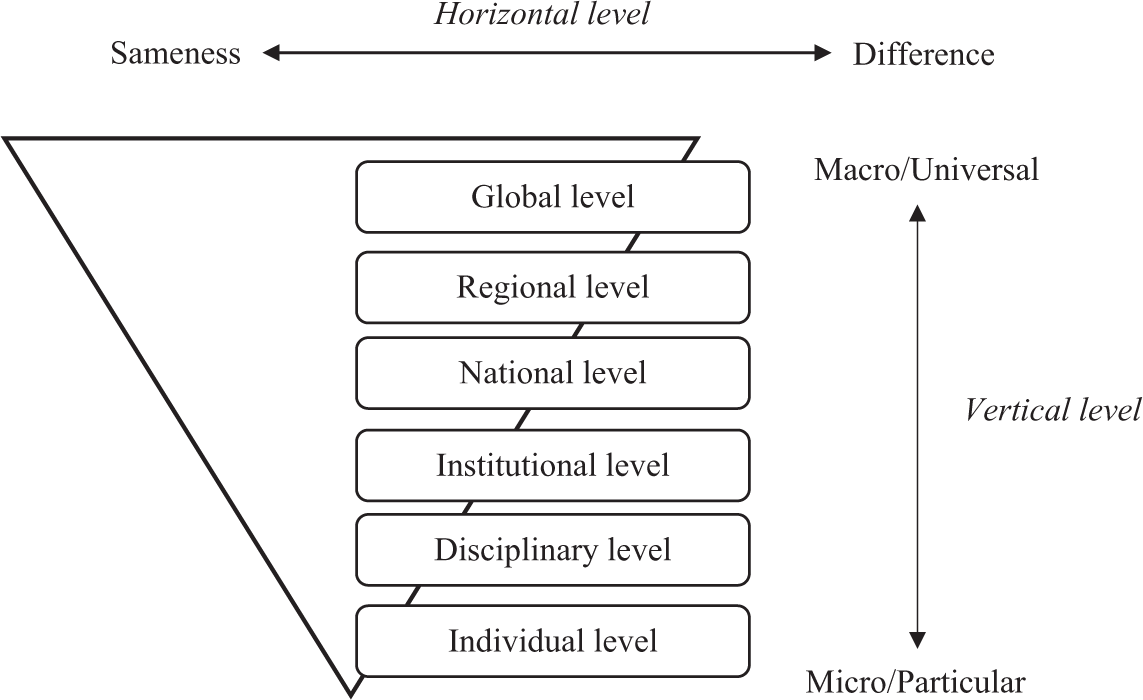
The reversed pyramid model of different levels of comparisons.
As Figure 1 illustrates, the top of the reversed pyramid displays the most general, global level of comparison which is influenced by processes of globalisation of higher education (Antonucci, 2014). But individual regions, countries and institutions respond differently to this trend because they operate within limits that restrain some of them (much) more than others (Marginson and Van der Wende, 2009). Whilst some regions (such as Europe) and countries strive to become the most competitive economies in the world, research-intensive universities do their best to enhance their position in global university rankings. But although world university rankings are often perceived as key drivers for the development and implementation of internationalisation policies and strategies at the national and institutional level of higher education (De Wit, 2017), at the same time they also increase vertical diversity of the higher education system (Bleiklie, 2011).
The reversed pyramid model shows that the next analytical level of comparison is the regional analytical level, which is shaped by influences of regionalisation of higher education or, in the case of Europe, of Europeanisation of higher education, understood by Marginson (2011: 18) as ‘a meso-level of activity between global and national dimensions, designed to position Europe as a global player while modernising its national and combined systems’; for example, in the framework of the Bologna Process.
Following the regional level of analysis is the national dimension, which is frequently associated with globalisation (and regionalisation) of higher education. But although the development of higher education systems can no longer be confined only to the limits of the nation-state, not all of them are involved in global and/or regional flows to the same extent or intensity (Marginson and Van der Wende, 2009: 20). For this reason, horizontal attributes such as their educational tradition, size or the availability of resources should also be taken into account (Bleiklie, 2011; Marginson and Van der Wende, 2009; Teichler, 2004).
In relation to the institutional and disciplinary analytical dimension, Antonucci put forward the example of individual institutions, disciplinary departments and central authorities as key analytical units with which interactions occurring between and within higher education institutions may be thoroughly clarified (Becher and Kogan, 1992 in Antonucci, 2014: 7).
Teichler, on the other hand, additionally highlighted the importance of horizontal differentiation based on institutional profiles; in his words, higher education institutions are ‘key carriers of homogeneity and diversity’ (2004: 5) and should be therefore treated as ‘equal but different’ (Bleiklie, 2011: 23). Nevertheless, such horizontal diversity may create pressures towards the hierarchy through the competition for the most talented international students or academic staff, financial resources, etc. which may, in turn, form the vertical diversity of the higher education sector (Bleiklie, 2011: 26).
Furthermore, at the reversed top of the pyramid model is the individual level of comparison which relates to micro(scopic) aspects of higher education; these may refer to particular experiences of the individual with teaching and learning (Antonucci, 2014) or subjects in higher education, such as the student or the scholar-researcher as the most relevant ones (Marginson, 2011).
By outlining the transition from more general levels of comparisons to the level of the individual, the pyramid model also displays that convergence and diversity, universal and particular, macro and micro, global and local, etc. are only seemingly opposing and exclusive positions (Antonucci, 2014; Robertson, 1995; Vaira, 2004). To paraphrase Robertson (1995: 36), the complex relationship between the global and the local is both universal and particular, because the homogenisation process goes ‘hand in hand with heterogenization’. The consideration of these issues is therefore essential for comparative researchers in higher education, as they have a natural tendency to address effects occurring at the supranational and/or the global level of comparison (Antonucci, 2014). The pyramid model may thus be viewed as an attempt to transform methodological nationalism into methodological cosmopolitanism which is ‘not mono- but multi-perspectival. . . . A single phenomenon, transnationality, for example, (or, in our case, internationalisation of higher education) can, perhaps even must, be analysed both locally and nationally and transnationally and trans-locally and globally’ (Beck and Sznaider, 2006: 18).
Conclusion
From the above, we may conclude that comparative studies are one of the most fertile ways of addressing different higher education phenomena from the comparative perspective; however, their main challenges relate to the fact that many comparative researchers still (too) frequently present their research results in relation to individual countries, without adequately explaining the context and the comparative element in their theoretical and/or methodological framework (Teichler, 1996). This may be associated with the fact that not all of them agree that separate discussion on the methodology of comparative (higher education) studies is needed. As revealed by Øyen (1990: 5), ‘purists’ are convinced that conducting comparative research across the borders of the nation-state does not differ from any other type of research, ‘ignorants’ perform research beyond national boundaries but they are not sensitive to historical, social and cultural differences, whilst the so-called ‘totalists’ are informed by methodological and theoretical challenges of comparative research but they often deliberately ignore them. ‘Comparativists’, on the other hand, are concerned with such challenges and aware of specific features of comparative research (Øyen, 1990) whose main purpose is not merely associated with the identification of commonalities and differences but also with the exploration of causes why do they actually appear.
The chief purpose of comparative approach was discussed already in the early 1930s by Isaac L Kandel, one of the best-known historical comparativists from the past century (Kazamias, 2009). In his opinion, its key purpose ‘lies in an analysis of the causes which have produced them, in a comparison of the differences between the various systems and the reasons underlying them, and, finally, in a study of the solutions attempted’ (Kandel, 1933: xix). In concurrent debates on the purpose of comparative higher education research, Kosmützky (2016) pointed to its interdisciplinary nature: (C)omparative studies within higher education, do not have a single method of comparison or unique set of comparative methods in the sense of a specific technique of data collection. Instead, they rely on concepts and theories, methodological approaches and methods as they are used in social sciences and humanities in general, and in comparative disciplinary sub-fields in particular. (203)
In this study, this interdisciplinarity was exemplified with the impact of globalisation on the selection of theoretical and methodological framework of comparative higher education research. By merging institutional isomorphism (DiMaggio and Powell, 1983) and the ‘glonacal’ analytical heuristic (Marginson and Rhoades, 2002), the study firstly drew attention to the central role of institutional and human agents who may differently respond to coercive, mimetic or normative isomorphic pressures at different levels of analysis (see also Vaira, 2004). On this basis, it then outlined the multidimensional pyramid model with six essential horizontal and vertical units of any (comparative) analysis, namely global, regional, national, institutional, disciplinary and individual analytical dimension.
Therefore, the contextual element based on the exploration of similarities and differences as well as causes why do they actually appear should have a central role in theoretical and methodological research endeavours. After all, ‘(c)omparative (higher) education is not an empirical or a positivistic “social science”. It is a “human science” in the broad meaning of the term “science” as signified by the German word Wissenschaft and the Greek equivalent Episteme’ (Kazamias, 2009: 39).
Footnotes
Declaration of conflicting interests
The author declared no potential conflicts of interest with respect to the research, authorship and/or publication of this article.
Funding
The author received no financial support for the research, authorship and/or publication of this article.
