




Abstract
The increase in higher education internationalisation has called for finding possible ways to understand and improve its related issues. Despite the financial, cultural, and social benefits that international students bring to host countries’ educational institutions, the challenges they encounter in a new environment are hard to deal with, especially acculturative stress and adjustment problems in a new environment. As international students are at the heart of education internationalisation, it is crucial to understand and address their adjustment issues for a sustainable education management. Therefore, this study develops a conceptual framework to portray international students’ adjustment issues in a host country from perspectives of field theory and cross-cultural adaptation theory. The proposed conceptual model not only considers factors influencing international students’ cross-cultural adaptation in a host country, but it also highlights the outcomes of such adaptation which can provide managerial implications for sustaining higher education mobility growth.
Keywords
Introduction: towards developing a conceptual framework
Internationalisation of higher education refers to the integration process of international/intercultural dimension into the teaching, research, and service functions of an institution (Knight, 1993). This process among higher education services emerged in the early 1990s and has dramatically increased till present (Terry, 2011). Higher education services have pushed the territorial boundaries away with the advent of globalisation, advancement in information technology, and increase in international travel (Arokiasamy, 2010). At the heart of higher education internationalisation lies cross-border student movement, which can foster global competition among educational institutions (Marginson and Van Der Wende, 2007). The number of students pursuing their education in a country outside their home country (i.e. international students) was 1.75 million in 1999 which raised to nearly 3 million in 2007, according to a report by World Trade Organization (2010). Additionally, Gürüz (2008) reported that the overall number of students enrolled in various disciplines in educational institutions outside their home country was about 3 million, which is expected to increase to almost 6 million by 2020 and 8 million by 2025.
The trend shows that a substantial factor for higher education institutions’ success in the global education competition is recruiting a growing number of foreign (or international) students (Qiang, 2003). Universities and educational institutions around the world strive to boost their reputation in order to attract more international students and increase their share of education market (Mayo, 2009). As such, higher education globalisation has become a prevalent market for both developed and developing countries especially in Asia (Arokiasamy, 2010). It is worth noting that international movement of students to other countries for the purpose of pursuing education can be a considerable source of business, and economic growth for host countries (Marginson, 2006). For instance, international students through their expenditures on food, housing, books, and tuition fees can bring additional revenue for universities and local communities.
Along with the economic growth, higher education internationalisation can result in social, and cultural benefits for host countries (Dobson and Hölttä, 2001; Terry, 2011). By sharing a wide variety of perspectives and views, international students can contribute to host countries’ social and cultural diversity (Zeszotarski, 2001). These benefits have stimulated educational institutions around the world to compete for growing their countries’ economy by focusing on producing knowledge and moving towards higher education internationalisation (Arokiasamy, 2010; Wilkins, 2014). Although this is the case, it is crucial to emphasise and consider the essential role of international students’ successful transition to a new cultural environment (or cross-cultural adaptation) (Lamprianou and Sunker, 2014). This is the prerequisite for higher education institutions in order to attract more international students, achieve prosperity, and remain reputable in the global education market.
Transition to higher education in an unfamiliar cultural environment is an unavoidable cause of anxiety and unease for international students irrespective of social class or other categorisations (Clayton et al., 2009). As highlighted by Berry (2006), cultural differences and rigorous academic work are the potential causes of pressure and frustration that international students experience. Perhaps, insufficient knowledge and lack of understanding about the values and norms of the new culture together with cultural gap between international students’ ethnic and host countries could result in stress and anxiety for international students (Yang and Clum, 1994). This can result in negative consequences for both individuals and host society (Sumer, 2009). Apart from cultural, social, and financial contributions of international students to host countries, challenges they face in a host country might lead them towards frustration and social problems (Sumer, 2009). Therefore, by overcoming their difficulties and problems, international students can experience ‘successful transition’ (i.e. adapt) to a new environment, which can prevent adversity and its negative impacts from host societies (Earley and Ang, 2003; Molinsky, 2007). Since international students’ cross-cultural adaptation to a new environment can directly influence their psychological and social well-being, it is essential to be prioritised.
To this end, the issue of cross-cultural adaptation has engaged many researchers from various contexts (Berry and Sabatier, 2010; Demes and Geeraert, 2014; Jibeen and Khalid, 2010; Masgoret, 2006; Ward and Kennedy, 1994). Accordingly, several acculturation models have been proposed in an attempt to portray individuals’ adaptation as well as the factors contributing to this process. For instance, Ward et al. (2001) proposed the ABCs of the acculturation process by emphasising stress and coping framework, cultural learning approach, and social identification theories concerning with affective, behavioural, or cognitive aspects of individuals’ adjustment. Berry (2006) first developed the stress and coping framework to explain the factors influencing cross-cultural adaptation.
Furthermore, distinction between the two facets of adaptation (i.e. psychological and sociocultural adaptations) was suggested by Ward and colleagues (Searle and Ward, 1990; Ward and Kennedy, 1992). In their framework, the aspects of stress and coping, cultural learning, and social identification from Berry’s (2006) framework were integrated along with an emphasis on social and cultural specific skills, which help individuals in adjustment process. Moreover, in line with the frameworks proposed by Berry (2006) and Ward et al. (2001), Arends-Toth and Van de Vijver (2006) and Safdar et al. (2003) developed comprehensive models where they incorporated the mentioned three theories to explain individuals’ acculturation. In the model developed by Arends-Toth and Van de Vijver (2006), and Safdar et al. (2003), the aspects of individuals’ characteristics, and host society’s characteristics, as well as hassle predictors were highlighted; however, the framework developed by Arends-Toth and Van de Vijver (2006) had an extra element of the society of origin’s characteristics. Similarly, both of the mentioned models, focused on psychological and sociocultural adaptations as the consequences of adjustment and acculturation attitude as the predictor linking the antecedents and outcomes.
Although the above-mentioned models proposed some antecedents for cross-cultural adaptation that might be relevant to international students, there is a necessity to focus specifically on international students and consider factors with aspects of cognition, behaviour and perception (Smith and Khawaja, 2011). Particularly, with the increase in international mobility in higher education, there is not a specific conceptual framework to understand and address international students’ needs in a new environment. Although the extant literature suggests several individual (personal) factors and situational (environmental) factors that assist individuals to achieve successful adaptation in a new environment, still there is a need to identify situational (environmental) factors specifically for the context of international students (Smith and Khawaja, 2011). This can enrich understanding towards international students’ cross-cultural adaptation. Since the above-mentioned models were not developed precisely for the context of international students, the proposed outcomes of cross-cultural adaptation in these models are limited. This limitation signals that further investigation is required to suggest specific outcomes in the context of international students because they play crucial roles in sustaining higher education growth.
Additionally, the extant literature mainly considers the perspectives of organisations and educational institutions in improving policies (e.g., Bartell, 2003; Knight, 2004; Qiang, 2003). The uni-dimensional assessment for policy improvement, which is based on educational institutions’ viewpoint, may not account for the needs of their main customers (international students). Overlooking international students’ perspectives and requirements in designing and improving policies may impede educational institutions from reaching their goal of becoming reputable education service providers in the global education market. Since international students are at the core of international education mobility and considered as the main customers of global education sector, it is paramount to pay attention to their needs, and take into account their perspectives in improving policies and practices. This approach could benefit both educational institutions and international students to achieve prosperity and success. It is the aim of this paper to bridge this gap in the literature by proposing an alternative conceptual model which is based on international students’ cross-cultural adaptation needs.
Furthermore, prior acculturation models in the literature are rooted in three renowned theories: (a) stress and coping theory (SCT); (b) culture learning theory (CLT); and (c) social identification theories (SIT). These theories elaborate ‘Affective’, ‘Behavioural’ and ‘Cognitive’ aspects individuals’ adaptation process to a new cultural environment respectively (Zhou et al., 2008). However, despite providing insightful support, ‘field theory’ (Lewin, 1951) and ‘cross-cultural adaptation theory’ (Kim, 2001) have not been applied to explain individuals’ adaptive behaviours and cross-cultural adaptation to a new environment. The main rationale for integrating field theory and cross-cultural adaptation theory and using them as the governing theories in this paper is that these two theories can explain the nexus of antecedents–adaptation–outcomes with the emphasis on cognition. Moreover, field theory by focusing on the equation of behaviour as the function of a person and the environment (B = P, E) makes it possible to divide the antecedents of cross-cultural adaptation into individual and situational factors. In addition, using cross-cultural adaptation theory offers support for investigation of the outcomes of cross-cultural adaptation that can provide managerial and practical contributions to education policymakers and authorities in higher education.
Thus, it is the aim of this study to present an alternative conceptual framework that considers both wide and narrow perspectives in explaining international students’ adaptation process based on field theory and cross-cultural adaptation theory. Then, a conceptual model in consensus with the prior models, but extended from them is developed to be applied in exploring international students’ adaptation and its outcomes in a new cultural environment. This can be beneficial to higher education institutions. The proposed framework focuses on international students, those who pursue higher education in a country outside their home country. The framework also examines antecedents and outcomes of international students’ cross-cultural adaptation. The proposed model can be employed by emerging countries competing towards higher education internationalisation through attracting more international students. The following sub-sections elaborate the notion of cross-cultural adaptation from the lens of field theory and cross-cultural adaptation theory.
Cross-cultural adaptation
Generally, the dynamic change process that happens to individuals upon their relocation to a new environment is defined as cross-cultural adaptation (Kim, 1988, 2001). Three main facets namely functional fitness, psychological health, and intercultural identity development are involved in cross-cultural adaptation. However, Kim (1990) only considered functional fitness and psychological health (Wang and Sun, 2009). In line with Kim’s definition, Beiser et al. (1988) defined cross-cultural adaptation as the changes that take place during acculturation. Two types of changes were outlined as ‘short-term’ and ‘long-term’ changes. Specifically, the former would be sometimes negative, whereas the latter would be mostly positive, resulting in adaptation. Berry (1997) in response to Beiser et al. (1988) claimed that the long-term changes could highly vary ranging from poorly adapted to well-adapted. In addition, Aycan and Berry (1995) proposed a similar definition for cross-cultural adaptation as Kim’s definition by focusing on the dynamic change process and the three facets of cross-cultural adaptation.
Meanwhile, Ward and colleagues proposed a definition for cross-cultural adaptation in line with Kim’s definition. They stated that when individuals move to a new environment, the dynamic process of change causes individuals to adapt both psychologically and socioculturally to the new society (Searle and Ward, 1990; Ward, 1996; Ward and Kennedy, 1993a). Therefore, they formulated the two key concepts of psychological adaptation and sociocultural adaptation into cross-cultural adaptation. In fact, the terms psychological adaptation and sociocultural adaptation concur respectively with psychological health, and functional fitness suggested by Kim (Wang and Sun, 2009).
Cross-cultural adaptation from the lens of field theory
Rooted in social psychology, field theory was developed by Lewin (1951) to overcome the limitations of traditional way of thinking through merely psychology (Atkinson, 1964). Through his broad system of topological concept, Lewin represented the idea of encompassing emotions, values, thoughts, social relationships, and behaviours through psychological situations (Chak, 2002). Therefore, he formulated his field theory to explain human’s behaviour from the perspective of social psychology by stating a person’s behaviour is related to his/her personal characteristics as well as the social situation in which he/she finds him/herself (Lewin, 1951).
In particular, field theory focuses on humans’ actions as a result of their behaviour, which occurs in a ‘force field’. Field is defined as mutually interdependent coexisting facts or forces which represent different aspects of an individual’s coexisting environment. In other words, humans are influenced by surrounding factors in the field. These factors could determine individuals’ behaviour. Thus, behaviours occur as the result of various interactions in the field and between the fields of other individuals (Neill, 2004). Every individual possesses a field and since individuals have a lot of differences, their fields are different from each other. As individuals gain more information and knowledge about the environment, their field changes to accommodate them (Cronshaw and McCulloch, 2008).
Moreover, Lewin stated that a person’s behaviours occur within a psychological field, which is called ‘life-space’ (Schultz and Schultz, 2004). The term ‘life-space’ refers to every force in the field both from inner and outer environment that shapes up an individual such as the places an individual goes, the people an individual meets and the feelings an individual has about the places or people (Lewin et al., 1944). As Lewin believed, understanding the relations of all factors in one’s life-space is crucial because those are the elements which play important roles in helping or blocking people from accommodating to a new environment (Sorrentino, 2013). The equation for life-space is ‘B = f (P, E)’, which indicates that individuals’ behaviour (B) can be explained by considering both the person (P) and their environment (E). The environment here does not refer to the physical environment, but rather the psychological environment perceived by the person (Sorrentino, 2013). Additionally, the person and environment are interdependent and that creates a dynamic and complex field of interaction which help individuals learn more about themselves and their environment (Daniels, 2003). Therefore, Lewin (1951) regarded field as a continuous state of adaptation.
Field theory explains the influence of several individual and situational factors on individuals’ behaviours; however, it lacks detailed explanations and operationalisation of individuals’ cross-cultural adaptation in a new environment. Therefore, Kim’s cross-cultural adaptation theory is needed to precisely operationalise this notion by proposing a clear explanation for cross-cultural adaptation process of individuals in a new environment and its relative outcomes.
Cross-cultural adaptation theory
Kim (2001) developed an integrative theory of communication and cross-cultural adaption, which can be considered as one of the most detailed theoretical frameworks applied in adaptation process. At the heart of this theory lies the notion of transformation process when an individual relocates to a new and culturally unfamiliar environment. As such, cross-cultural adaptation is defined as a dynamic process owing to individuals’ constant interaction with their environment in this theory (Hamad and Lee, 2013). In other words, as individuals have to face and accept the differences between their ethnic culture and that of the host culture, they might face challenges when entering a new environment. In facing challenges, dynamic human nature struggles for an internal balance through acquiring new cultural communication practices, participating actively in the interpersonal and mass communication processes of the local community and being competent in host communication system (Hamad and Lee, 2013). The struggle for internal balance or stability causes all individuals to go through a transformation process, which is called cross-cultural adaptation (Kim, 2001).
In fact, individuals are open, complex, and evolving systems that constantly search for stability through establishing, re-establishing, and maintaining relatively stable and functional relationships with their new environment (Kim, 2005). In addition, Anderson (1994) believed that the adaptation process is a continuum that can result in positive or negative outcomes. It also involves building and rebuilding of identity since sense of self and self-esteem of individuals can be shaken in a culturally unfamiliar environment. Consequently, a gradual personal identity transformation occurs as a result of successful adaptation. Although the old identity can never be completely replaced with the new one, it can be transformed into something that will always contain some of the old and the new side by side, to form a new perspective that allows more openness and acceptance of differences in people (Kim, 1988, 2001).
As mentioned earlier, the two facets of cross-cultural adaptation proposed by Kim correspond with the two notions of psychological (emotional/affective) adaptation and sociocultural (behavioural) adaptation proposed by Ward and colleagues (e.g., Searle and Ward, 1990; Ward, 1999; Ward and Kennedy, 1994). Kim’s theory can explain individuals’ adaptation phenomenon through psychological and sociocultural adaptations, and also focus on outcomes of such adaptation (Kim, 2001). Therefore, it is applied in the proposed conceptual framework in this paper. The integration of the two mentioned theories can provide a better understanding of cross-cultural adaptation from a theoretical perspective.
The proposed conceptual framework
The proposed conceptual framework in this paper is mainly formulated based on field theory and cross-cultural adaptation theory. Both of these theories provide support by emphasising the important role of several individual and situational factors in facilitating international students’ adaptive behaviours [field theory] and their constant search for achieving stability or equilibrium [field theory and cross-cultural adaptation theory] which results in cross-cultural adaptation and its outcomes [cross-cultural adaptation theory]. As antecedents and outcomes of adaptation are equally important, integration of field and cross-cultural adaptation theories complement each other in providing a platform to explore the factors contributing to international students’ cross-cultural adaptation, and its outcomes in a new environment (i.e. the nexus of antecedents–adaptation–outcomes).
In particular, field theory emphasises on life-space as a perceived psychological environment that involves both inner and outer factors influencing adaptive behaviours of individuals. Inner and outer factors are conceptualised as the psychological environment that international students perceive from their inner and outer environment in field theory. Therefore, perception and cognition are crucial to shape up international students’ adaptive behaviours in a new society (Sorrentino, 2013). Additionally, the inner and outer factors are operationalised, respectively, as individual/personal and environmental/situational factors in the field theory. Perception, cognition, and attitude play vital roles in individuals’ adaptation process (Tajfel, 1981). Besides, it is essential to find out factors that take into account aspects of cognition, behaviour, and psychology in the setting of international students (Smith and Khawaja, 2011). As such, field theory can greatly contribute in designing and developing the conceptual framework in this paper.
Since field theory incorporates the components of psychology, cognition, and behaviour, it allows for identifying both individual (inner) and situational (outer) factors contributing to international students’ adaptation from a theoretically sound perspective. Although in the above-mentioned models both personal characteristics and society characteristics (i.e. host and ethnic) have been considered as the antecedents of adaptation process, the specification of these factors considering international students is yet to be explored (Smith and Khawaja, 2011). Hence, the current conceptual framework is proposed to address the existing gap in the literature of international students by employing field theory and cross-cultural adaptation theory to open up new directions for further studies.
Summary of the field theory and cross-cultural adaptation theory.
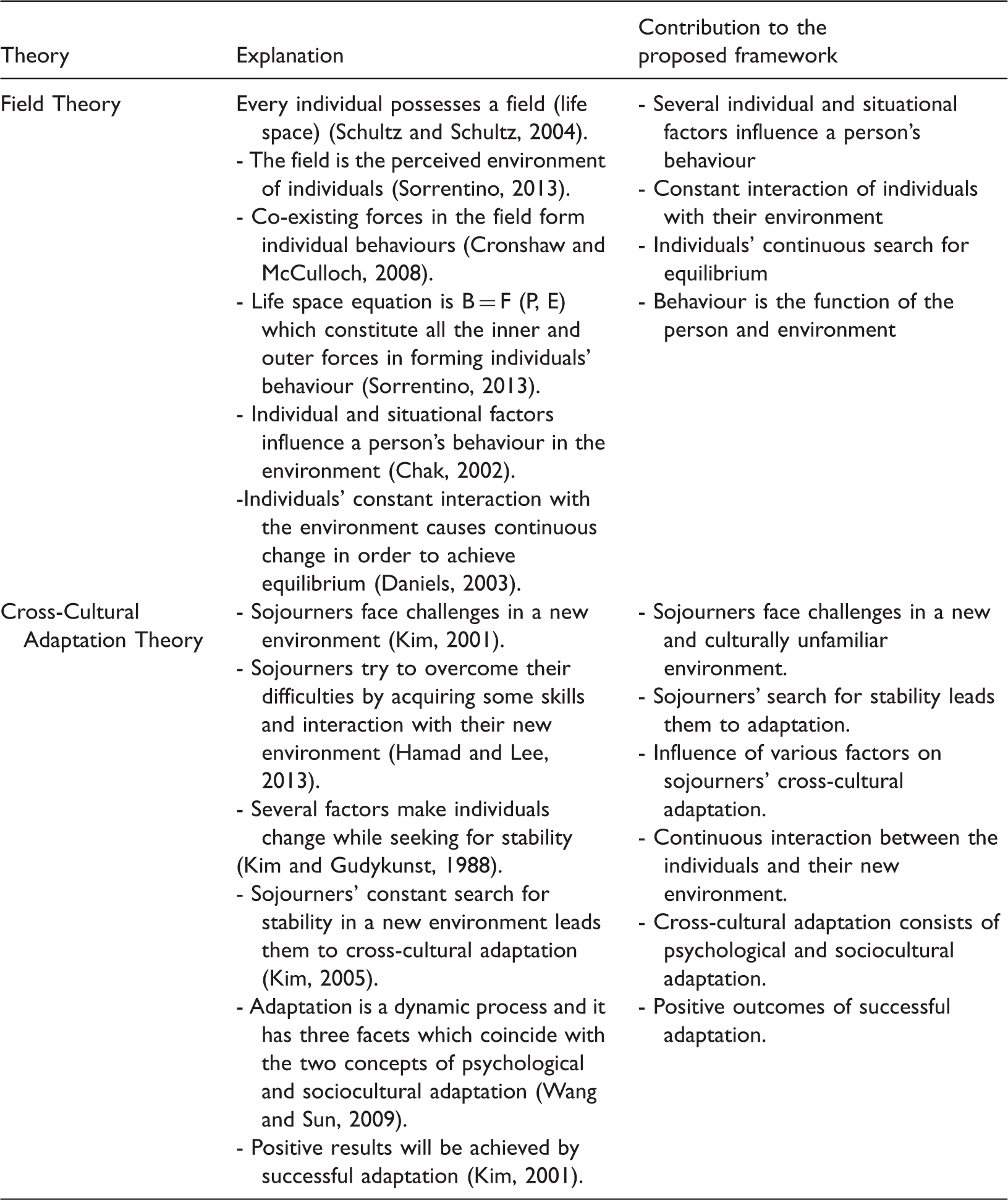
The two mentioned theories explain international students’ cross-cultural adaptation to a new environment, and the antecedents (i.e. individual and situational factors) and outcomes of such adaptation. However, field theory and cross-cultural adaptation theory do not specify individual and situational factors in adaptation process. As such, to draw potential individual and situational factors that influence psychological and sociocultural adaptations, this paper, similar to prior models in the literature, adopts stress and coping theory (SCT), culture learning theory (CLT), and social identification theories (SIT). These three theories can provide a comprehensive, broad and conceptual basis for intercultural contact and change studies (Ward et al., 2001). Nonetheless, classification and identification of the suggested factors by SCT, CLT, and SIT into individual and situational factors is carried out from the perspective of field theory in this paper. Figure 1 depicts the proposed conceptual framework.
Proposed conceptual framework.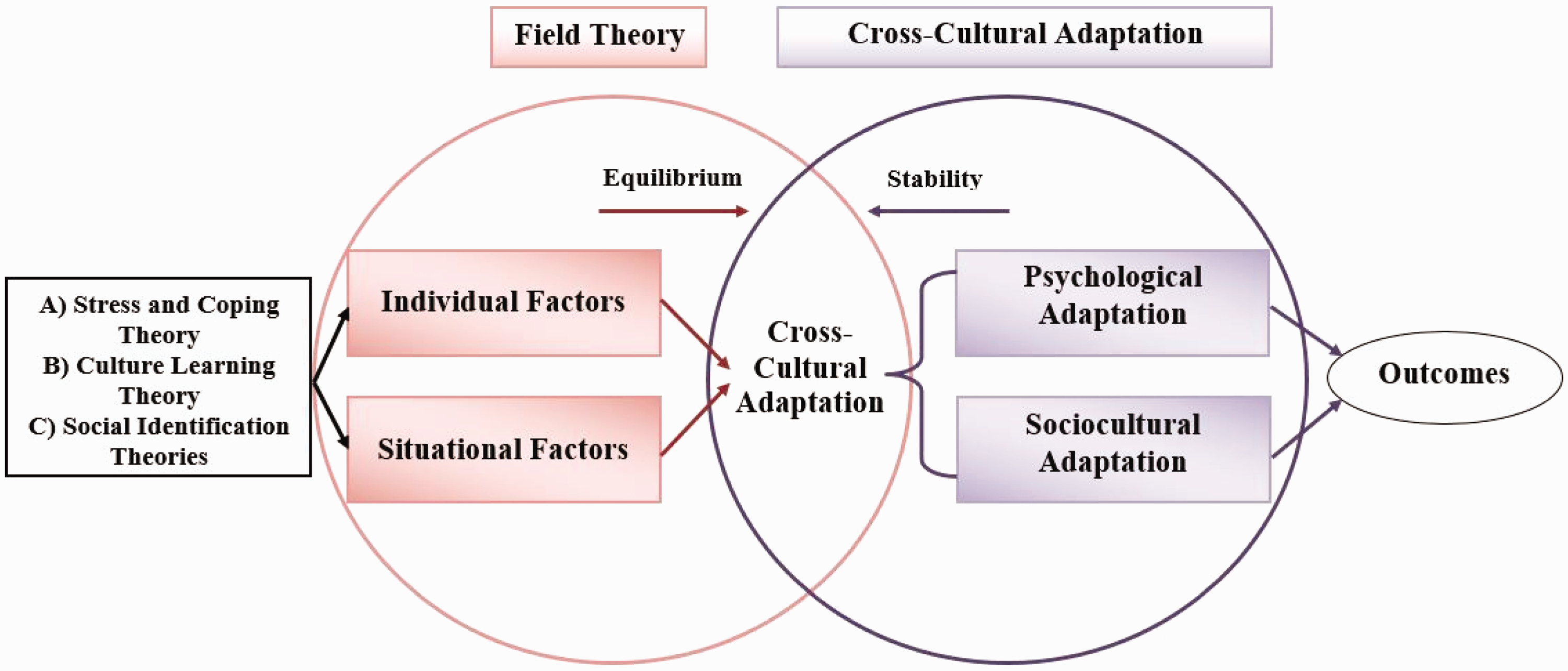
The “ABC” theories
Stress and coping theory
In stress and coping theory, Lazarus and Folkman (1984) focus on the idea that various phenomena can be understood through an organising concept of ‘stress’. Therefore, psychological stress is defined as ‘a particular relationship between a person and the environment that is appraised by the person as exceeding his or her resources and endangering his or her well-being’ (Lazarus and Folkman, 1984: 19). In fact, appraisal processes determine whether a situation is stressful or not (Schuster et al., 2003). In particular, the stress process is shaped up by the relationship between stimulus and individuals’ response where they try to evaluate and cope with it. In addition, difficulties and challenges faced by individuals in a new environment cause a lot of stress for individuals and the way they manage these challenges is defined as coping process (Decker and Borgen, 1993). Consequently, there is a need to engage people in cross-cultural encounters to make them resilient, adapt, and develop coping strategies and tactics (Aldwin, 1994; Lazarus, 1990).
Culture learning theory
Culture learning theory emphasises the behavioural aspect of intercultural contact and highlights the role of social interaction as a skilled behavioural performance (Argyle, 1969). Lack of social skills and having difficulties in dealing with daily life interactions such as norms, rules, values, as well as verbal and non-verbal communication owing to cross-cultural differences are the main causes of stress for individuals in a new environment (Masgoret and Ward, 2006). Inasmuch as cultural differences make adaptation process difficult, culture learning theory concentrates on finding ways to diminish intercultural misunderstandings. Thus, having connections with host nationals is pivotal for individuals according to this theory. This is because through interactions with host nationals, individuals can learn a series of culturally relevant skills in order to enhance their psychological and social success (Furnham, 2004).
Social identification theories
Based on theories of social cognition and social identity (Tajfel and Turner, 1986), the cognitive aspect of intercultural contact is mainly focused. In particular, individuals’ ethnical and cultural identification of themselves and the ways they interact with in and out groups is crucial. The ways individuals perceive their cultural identity and the relationships they have with co-nationals and host nationals can significantly impact their adaptation process. The notions of cognitive, mental and internal processes such as attitudes, perceptions, expectations, and values (Ward et al., 2001) are the core elements of this theory. Hence, two major concepts, namely acculturation and social identity theory, are associated with social identification theories (Phinney, 1990).
Proposed factors by SCT, CLT and SIT.
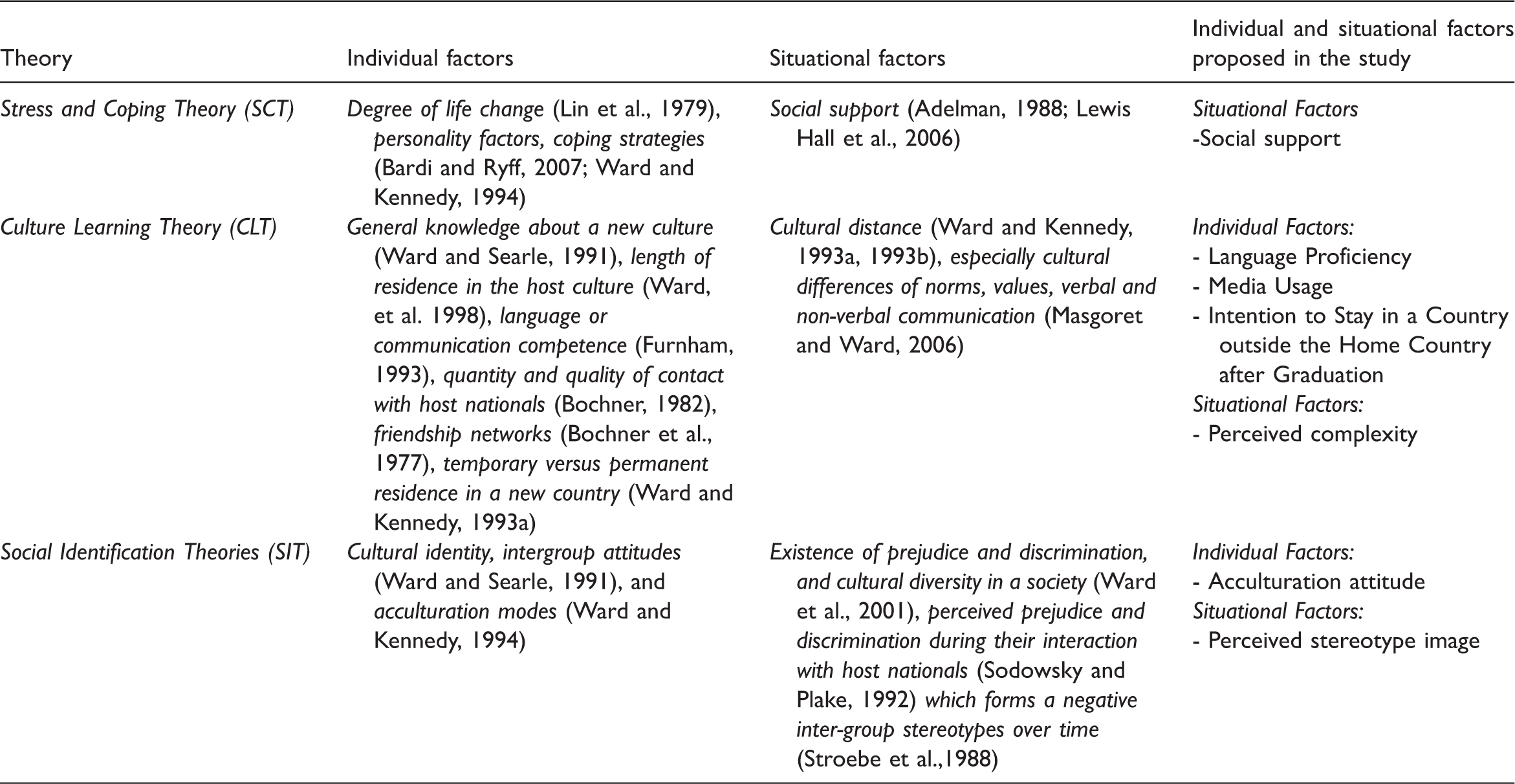
Figure 2 shows the proposed conceptual model in the context of international students which has the potential to be explored and studied to shed some light on the issue of international students’ cross-cultural adaptation and its outcomes.
Conceptual model.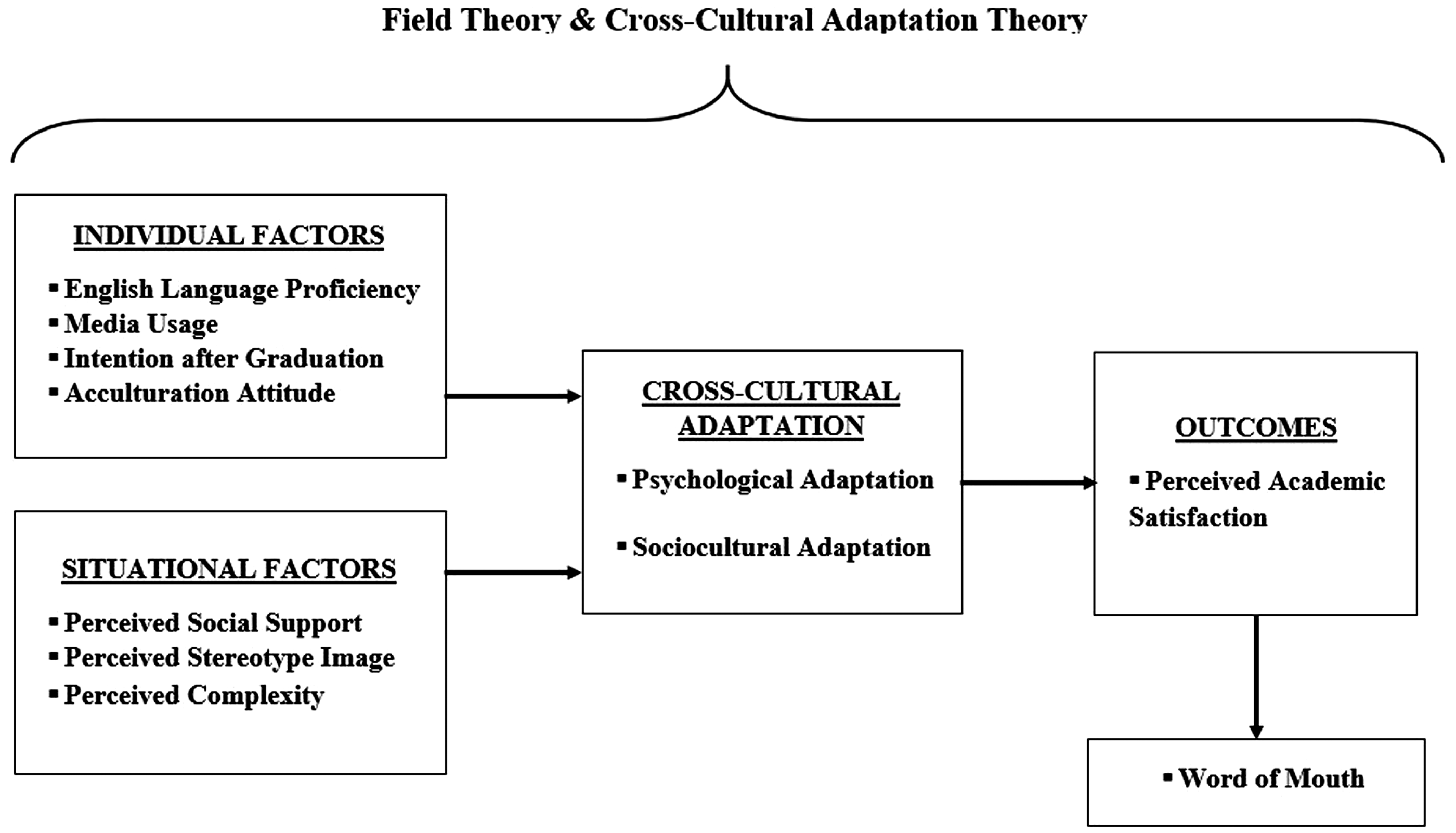
The proposed conceptual model incorporates two governing theories, namely field theory and cross-cultural adaptation theory in order to explain the nexus of antecedents–adaptation–outcomes. For the variables derivation, SCT, CLT, and SIT are employed. Specifically, the proposed framework aims to make a connection between individual and situational factors with cross-cultural adaptation of international students. It also intends to link international students’ cross-cultural adaptation to their perceived academic satisfaction. As satisfaction is an important outcome of the balance between characteristics of a person and the environment (i.e. adaptation), in the context of international students, academic satisfaction, which refers to how satisfied international students are with their overall academic performance in a host country, is pivotal to be considered (Goštautaitė and Bučiūnienė, 2010). Moreover, the evidence shows that positive word of mouth resulted from good academic experience can increase the number of international students in host countries (Cheng et al., 2013).
Concluding remarks
As international students are at the core of international mobility in higher education, it is crucial to understand the issues they encounter in a new environment. This could pave the way for higher education institutions to achieve success and attract more international students. The main reason is when international students are able to accommodate themselves in a host country, the possibility of achieving academic satisfaction would be higher (Kulik et al., 1987) that can lead to positive word of mouth in promoting higher education institutions to others. As mentioned by Rust and Oliver (2000) satisfaction is a remarkable motivator for speaking well about services. Therefore, students’ satisfaction should be at the centre of every education policy (Mark, 2013).
Despite the profound properties of field theory and cross-cultural adaptation theory, literature has provided little insights into the area of cross-cultural adaptation through these two theoretical perspectives. Therefore, the current paper built on the existing lacuna by designing a conceptual framework on the basis of field theory and cross-cultural adaptation theory that can explain international students’ cross-cultural adaptation, its antecedents, and outcomes in a new context.
The conceptual framework developed in this paper proposed a model in the area of cross-cultural adaptation of international students. The conceptual model is consistent, but extended from the prior models (Arends-Toth and Van de Vijver, 2006; Berry, 2006; Safdar et al., 2003; Ward et al., 2001) with specific focus on international students. Similar to the earlier models, SCT, CLT, and SIT are applied in the proposed conceptual framework. In contrast with the earlier models that were mainly developed to tackle the issues of migrants’ and refugees’ acculturation process, the current paper proposed a conceptual framework and model to target international students and look at their cross-cultural adaptation’ antecedents and outcomes from the lens of field theory and cross-cultural adaptation theory. Furthermore, the previous models in the literature considered psychological and sociocultural adaptations as the outcomes of acculturation. However, in the proposed conceptual model in this paper, outcomes of adaptation refer to the other factors resulting from successful achievement of psychological and sociocultural adaptations. Hence, the implications of this paper that make it distinguishable from the previous studies are outlined as the following.
Implications to theory
Building upon field theory helps to view the individual (inner) and situational (outer) factors influencing international students’ adaptive behaviours in a new environment from different viewpoints. Moreover, field theory makes it possible to identify antecedents of cross-cultural adaptation with cognitive aspects since the key role of perception is emphasised in this theory. As cognition plays a vital role in adjustment process (Tajfel, 1981), international students’ perceptions of their new psychological environment in a new culture is essential to understand their adaptation. This is a missing link in the extant literature. Field theory’s contribution to the proposed conceptual framework in this paper led to identifying some important factors to bridge the existing gap in the literature on international students’ cross-cultural adaptation. Moreover, by integrating field theory and cross-cultural adaptation theory both antecedents and outcomes of cross-cultural adaptation are taken into account. Unlike the previous models, employing cross-cultural adaptation theory in this paper helps to go beyond the existing models by suggesting several outcomes rather than merely focusing on psychological and sociocultural adaptations as the outcomes.
Thus, the conceptual framework proposed in this study takes a different approach and looks at internationalisation of higher education from a new angle by placing international students at the heart of this phenomenon and suggests a channel through which both international students and host countries’ educational institutions can prosper and benefit.
Overall, this study is distinctive owing to several reasons: first, systematic classification of the antecedents into individual and situational factors is in accordance with field theory which emphasises the role of perception and cognition. Second, since international students are the target group for developing the conceptual framework, more context-specific outcomes (i.e. perceived academic satisfaction and positive word of mouth) related to this group are suggested. Last, the conceptual framework developed in this paper has the potential to be studied and examined empirically in relation with international students’ cross-cultural adaptation and it can open up new horizons in the area of higher education mobility.
Implications to research
As mentioned by Smith and Khawaja (2011), there is a need to develop a model specifically for the context of international students because the current models primarily concentrate on refugees and migrants. Besides, there is a gap in the literature regarding the identification of individual and situational factors contributing to international students’ adaptation with cognition, psychology, and behaviour components. Therefore, the proposed conceptual model in this paper requires further empirical scrutiny concerning international students. Future research should test each identified antecedents proposed in the model in relation with psychological and sociocultural adaptations. The proposed model should be empirically tested in various contexts on international students who move to a new country for the purpose of pursuing their higher education. In particular, the relationships among the variables in the proposed conceptual framework can be tested quantitatively using questionnaires in order to get insights from a large number of international students. It is suggested that Structural Equation Modelling (SEM) technique could be applied for data analysis since SEM provides an appropriate and the most efficient estimation technique for a series of separate multiple regression equations to be estimated simultaneously. Moreover, SEM incorporates multi-item scales in the analysis and accounts for the measurement error associated with each of the scales (Hair et al., 2010). SEM as a second generation data analysis technique provides a platform to model multiple independent and dependent constructs’ relationships simultaneously and enables researchers to answer interrelated research questions through a comprehensive, systematic, and single analysis (Gefen et al., 2000). Since the proposed model in this paper is exploratory in nature (i.e. the relationships among the variables in the model have not been tested before), Partial Least Squares technique (PLS-SEM) is deemed appropriate to be employed.
The proposed conceptual model could be tested in various contexts using sample of international students from different backgrounds. Owing to social, cultural, and educational discrepancies that exist among international students, it would be insightful to empirically examine the model in different contexts. It could also be informative to separate international students based on geographical regions they come from and identify specific factors which could facilitate their cross-cultural adaptation. Additionally, length of stay in a host country, friendship network, and field of study could be assessed in the proposed conceptual model to portray a detailed picture of international students’ needs in a host country. It is also suggested to test the model for both private and public educational institutions in order to compare and contrast their effective policies and practices concerning international students. Through employing various statistical tests, more interpretation of the relationships in the proposed model could be achieved.
Furthermore, with the strong support from theories mentioned in this paper, more antecedents of psychological and sociocultural adaptations can be explored and incorporated into the proposed model with regards to international students. It is also crucial to identify and examine other outcomes of psychological and sociocultural adaptations in the context of international students, since it could contribute to the growth of higher education mobility.
Implications to higher education
This paper provides strategic managerial insights for academicians, education policymakers, and university administrators of the emerging countries that compete to attract more international students. Given the impact of internationalisation of higher education and the competition among new players in the global education market to attract more international students, positive word of mouth is essential to bring more international students to host country’s educational institutions. Mainly for the new players in the market that are competing with well-established educational institutions, it is substantial to build a good reputation which can convey a positive image to customers and stakeholders of an organisation. Positive reputation can be a basis for competitive advantage that can help an organisation attract and retain customers (Thomaz, 2010). As such, it is timely for emerging countries to boost their educational institutions’ good reputation in order to remain competitive in the global education market. Higher education institutions should prioritise international students’ adaptation issues. This not only ensures successful transition of international students, but also assists new players to attract more international students through their existing customers’ positive word of mouth.
Since most of the conceptual frameworks in the area of education internationalisation consider educational institutions and organisations’ perspectives in handling and addressing the issues involved in international students’ mobility, this study helps higher education authorities to view the phenomenon of higher education internationalisation from a different angle. This proposed approach offers new path through which international students’ psychological and sociocultural needs are taken into consideration as well as their positive outcomes which could contribute to higher education management and improvement in host countries. In particular, international students’ successful cross-cultural adaptation can lead to higher academic satisfaction which would result in positive word of mouth in promoting host countries’ educational institutions to others. In addition, by empirically implementing the proposed model, higher education institutions especially the new players in the global education market can devise suitable human capital management strategies tailored for meeting specific needs of international students. Figure 3 depicts the implications of this study to higher education.
Managerial contribution of the proposed conceptual model.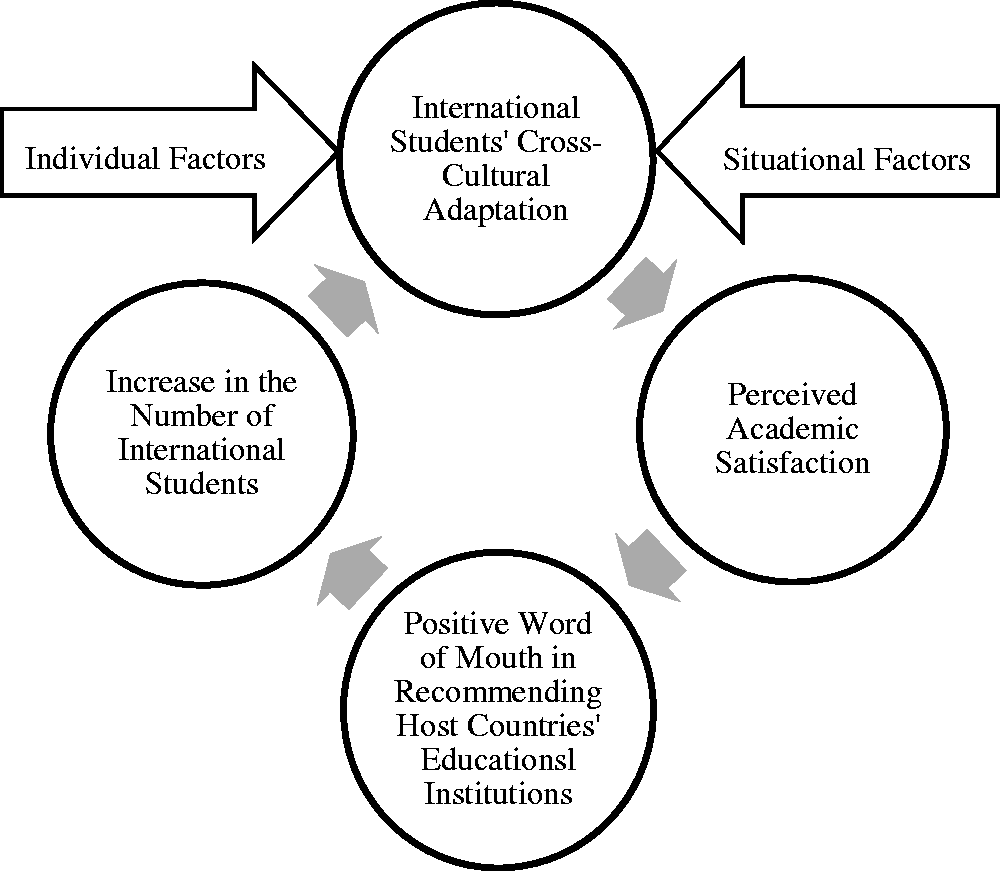
This is an alternative marketing strategy for emerging countries. By meeting and addressing international students’ needs, higher education institutions can enhance their international students’ academic satisfaction and willingness to promote host country’s educational institutions to others through positive word of mouth. In the process of marketing education services, it is essential to consider the receivers’ wants and needs (Schofield et al., 2013). Given that the process of internationalisation is cyclical (Qiang, 2003), further planning and reforming of the existing programmes and policies contribute to the refinement of higher education internationalisation cycle and ensure sustainability of higher education mobility.
In moving towards internationalisation of higher education and its growth, the issue of cross-cultural adaptation, which is the main source of stress and anxiety for the international students, should be understood and addressed well by education policymakers and academicians. As proposed in this paper, international students’ successful cross-cultural adaptation, known as ‘successful transition’, can lead to satisfaction with their academic performance which can ultimately result in positive word of mouth in promoting host country’s educational institutions to others. As such, it is suggested to higher education institutions to apply the proposed model for their existing students in order to find out the areas which require more attention and refinement. The results can then be translated into tactics and strategies for prospective students. In fact, this is a never ending process which can stimulate higher education institutions’ progressive transformation towards excellence. By developing a conceptual model, this paper offers an alternative path to propel competing countries towards education internationalisation, and transforming their higher education to a centre of excellence through attracting more international students. The alternative channel suggested in this paper not only tackles the issues of international students’ adaptation, but it also helps competing countries grow and sustain their higher education market.
This paper is not being considered concurrently for publication elsewhere nor has it been published in any language before. All the authors have contributed significantly and are in agreement with the content of the manuscript.
Footnotes
Acknowledgements
The first author is a recipient of USM Global Fellowship. The authors also acknowledge the support of Universiti Sains Malaysia (USM) through Research University Grant (Grant Number: 1001/PGURU/816267).
Declaration of conflicting interests
The author(s) declared no potential conflicts of interest with respect to the research, authorship, and/or publication of this article.
Funding
The author(s) received no financial support for the research, authorship, and/or publication of this article.