




Abstract
In this article, we argue that there is an urgent need to align internationalisation and university social responsibility agendas through the construct of Internationalisation of Higher Education for Society. The service or “third mission” of higher education institutions - to contribute to the social, economic, and cultural development of communities - has long been a core function of universities alongside teaching and research. However, the service mission is often disconnected from the internationalisation agenda. Service to society is rarely the focus of internationalisation strategies, and third mission strategies are predominantly domestically oriented. We consider how universities might, in today’s fractured and fragile world, amplify their contributions to society and the global common good by strategically enacting their global social responsibility through internationalisation. Related concepts of relevance are discussed, and we conclude with recommendations for leaders, researchers, and those involved in teaching and learning who seek to contribute to these endeavours.
Keywords
Introduction
Universities have a critical role to play in our rapidly changing, fractured, and fragile world. It is vitally important that they remain relevant and evolve to meet new challenges. Citing the example of the dissolution of English monasteries in the 16th century, Marginson (2011) reminds us that societies can learn to live without institutions that they assumed would last forever. Bortagaray (2009) notes the importance of institutions evolving with societal expectations and values, and maintaining a focus on their core roles. Society expects higher education institutions (HEIs) to be responsive to its needs, providing multiple public and private benefits, and to engage with a wide variety of external stakeholders (Wallace & Resch, 2015). The risk for HEIs is arguably greater if the public role is neglected, because the private benefits could be produced elsewhere.
In this article, we argue that there is a need for closer alignment of the internationalisation and social responsibility agendas through the construct of Internationalisation of Higher Education for Society (IHES). In our super-complex world, the local and the global are intertwined and the concepts of social responsibility and the public good are themselves both global and local in their scope. Equally, the internationalisation and third mission agendas of institutions have been criticised for emphasising capitalist, competitive, neoliberal agendas over social, human, public benefits (Bamberger et al., 2019; Naidoo, 2007). We suggest that aligning the third mission and internationalisation agendas would facilitate strategic realignment of both, and assist universities to fulfill their public role nationally and internationally.
Approaches to internationalisation have long been criticised for being dominated by a narrow range of Anglo-centric and Eurocentric worldviews (Jones & de Wit, 2012), “academic colonialism” (de Wit, 2002), and “academic ethnocentrism” (Mestenhauser, 2002). It has been argued that this is evidenced across several contexts: by international education associations (Buckner & Stein, 2020), the design of overarching graduate attributes (Bullen & Flavell, 2021), and approaches to internationalisation of curriculum (Stein, 2017), including outcomes from study abroad (Leask & Green, 2020), and in conceptualisations of student engagement with “otherness” (Andreotti, 2007; Killick & Foster, 2021). The privileging of Western (and largely White) perspectives in research, teaching, and learning is also seen as perpetuating global power relations, normalising inequalities, and minimising the potential contribution of diverse voices, as well as local, and indigenous knowledge (Stein, 2016; Stein et al., 2021; Thondhlana et al., 2021). While it is true that the internationalisation of higher education is also associated with progressive values such as cosmopolitanism, multiculturalism, diversity, and social justice, the tendency toward neoliberalism, competition, markets, and stratification largely takes precedence (Bamberger et al., 2019). Institutional strategies are often competitive rather than collaborative, focused more on commercial aspects of the global knowledge economy and a drive for entrepreneurialism and income generation than on benefits for society. In summary, academic capitalism, whereby universities sell knowledge as a commodity rather than as a public good, is increasingly evident (Slaughter & Rhoades, 2004).
Similarly, although the third mission, “the sum of all activities concerned with the generation, use, application and exploitation of university knowledge, capabilities and resources, outside of the academic environment” (Compagnucci & Spigarelli, 2020, p. 5), is associated with altruistic engagement with communities, institutions have frequently been criticised for focusing their third mission strategies on a narrow range of entrepreneurial activities and the “capitalisation of knowledge” (Etzkowitz, 1998). In the Global North, this has come at the expense of less self-interested forms of societal engagement (Cooper, 2017; Gutberlet et al., 2014; Pugh et al., 2016; Reichert, 2019).
One of the reasons for this overemphasis on academic capitalism in the Global North may be the lack of an overarching institutional strategy for third mission activities. Without this, there are likely to be few opportunities for academics who are primarily responsible for teaching and research to engage in community activities, other than through marketable outputs, which many find unpalatable. The unintended result is that third mission activities have only limited integration into institutional practice (Fonseca, 2019) and risk being regarded as desirable, but not essential (Benneworth et al., 2018).
Approaching internationalisation as a contribution to an institution’s social responsibility has the potential to strategically align multiple institutional agendas, increase opportunities, and improve impact because it encourages thinking globally and locally about social and intercultural engagement. In this article, we discuss key features of the third mission of universities and how these relate to the concept of global social responsibility; we then focus on the connections between global social responsibility and the internationalisation of higher education. Next, the construct of IHES is located within the context of universities’ global social responsibility. Examples of current and potential practice are provided, which together highlight the wide range of institutional stakeholders with a part to play in pursuing these related agendas. Finally, we conclude with recommendations for stakeholders - leaders, researchers, course designers, and teachers - who seek to contribute to this dimension of university social responsibility.
The Third Mission and Global Social Responsibility
Social responsibility and engagement are clearly part of the service or “third mission” of universities and are present in the strategies and endeavours of HEIs all over the world (Zomer & Benneworth, 2011). Outcomes are often closely scrutinised (Jongbloed et al., 2008) and are predominantly national or regional in their focus, which is surprising given the interconnectedness of the globalised world in which we now live. In addition, activities oriented toward social and cultural development, contribution to public debate, the fostering of human capital, community welfare, or the enrichment of society and social change are less visible in the literature from the Global North (Compagnucci & Spigarelli, 2020). In a context of unevenly concentrated resources and privilege, the global social responsibility of universities is important.
Several authors have explicitly extended the notion of University Social Responsibility (USR) to encompass “global social responsibility” through working with international as well as local partners (Alzyoud & Bani-Hani, 2015; Shawyun, 2011; Vasilescu et al., 2010; Wigmore-Álvarez & Ruiz-Lozano, 2012). The concept of “globality” or consciousness of the world as a single place (Robertson, 1992) is also relevant here. Conceptualising an institution in terms of worldwide inclusiveness, reach, or relevance entails a responsibility to contribute not only to national prosperity but also to creating dynamic and sustainable global communities (Escrigas et al., 2014). Framing these responsibilities locally, nationally, and/or globally should in turn determine how community engagement is pursued, the nature of stakeholder groups, and how success is defined. To make significant contributions to the global common good, knowledge must be applied to improve the lives of people all over the world (Marginson, 2016; UNESCO, 2015), and mutually advantageous activities should benefit society as a whole even though stakeholders may benefit in different ways (Benneworth et al., 2018).
Both USR and global social responsibility are connected to the concept of sustainability education and through this to the achievement of the United Nations (2015) Sustainable Development Goals (SDGs). However, sustainability is also interpreted more broadly than in purely ecological or environmental terms, as part of an agenda to develop healthy, sustainable human societies (Appe & Barragán, 2017; Clugston & Calder, 1999). Universities clearly have a crucial role to play in achieving the United Nations 2030 Agenda for Sustainable Development (Association of Commonwealth Universities, 2015; International Association of Universities, n.d.; Times Higher Education, n.d.). However, although there is no doubt that developing and maintaining healthy societies requires international and indeed global cooperation, the intersections between USR and internationalisation of higher education are rarely discussed in the literature. We see this is as a lost opportunity that could and should be addressed immediately.
Global Social Responsibility and the Internationalisation of Higher Education
In the context of the above discussion, it is not surprising that an updated and widely embraced definition of internationalisation of higher education specifically places contribution to society at its very heart, describing it as The intentional process of integrating an international, intercultural or global dimension into the purpose, functions and delivery of post-secondary education,
It has long been recognized that internationalisation is beneficial to communities at home and abroad, as well as to society in its broadest sense, by bringing the global to the local or the local to the global. Indeed, Hudzik’s (2011) appeal for a comprehensive approach to internationalisation stresses the need for international perspectives to be incorporated into all missions of higher education, as well as the importance of both global and local partnerships. Such an approach should not only impact “all of campus life but the institution’s external frames of reference, partnerships, and relations,” including its response to changes in the external environment and the impact of global forces on local life (Hudzik, 2011, p.1). Yet the extent to which institutions have achieved this part of the vision of Comprehensive Internationalisation is not entirely clear.
There is, however, evidence that in reality social responsibility is rarely the primary driver for the international activity of universities, and even where it happens, it is framed in narrow terms. Certainly, potential contributions from higher education internationalisation to local communities receive little attention. Consider, for example, that of the 2,317 HEIs responding to an EAIE (European Association for International Education) Barometer question on perceived goals for internationalisation, only 11% saw “better service to the local community” as one of its goals (Rumbley & Sandström, 2019). Also, only 18.5% of 744 universities using the Indicators for Mapping and Profiling Internationalisation (IMPI) tool selected the goal “to provide service to society and community social engagement,” and none chose it as a top priority (Brandenburg & Laeber, 2015). This comes at a time when “globalization and the application of neo-liberal models of economic development have led to social crises to which universities must respond” (Herrera, 2009, p. 40).
Marginson (2016) also notes that more attention is paid to elite international activities that create rather than correct social inequality, and it is difficult to determine the extent to which even service-learning activities that have an international focus have been designed to ensure at least equal benefit to the community being served as to the visiting student and their home university. Service-learning has been a feature of higher education since the 1990s, particularly but not exclusively in the United States. It has been “coupled with concepts of social justice, civic responsibility and ethical practice” (Carrington, 2011, p.1) as part of the third mission and also, in some disciplines such as medicine and nursing, with internationalisation of curriculum and the global responsibilities of professionals (Wu et al., 2020). There is scant evidence of the impact mobile students have on the communities which host them, although there are some examples, such as those documented by Gaul (2015), Murphy et al. (2014), Potts (2016), and Wood et al. (2012).
It is also concerning that a recent European mapping report finds that instead of considering internationalisation as one tool to support social engagement and responsibility, locally, nationally, and globally, it is actually seen as drawing resources, focus, and infrastructure away from social engagement (Benneworth et al., 2018). Given the synergies between the two agendas discussed above, and their individual and collective importance, it is timely to consider how they might be brought together. However, this will require a sharper focus on the global common good (Marginson, 2016) in both agendas, moving this consideration to the main stage rather than leaving it in the wings, along with a fundamental change from an entrepreneurial focus to an emphasis on societal transformation (Trencher et al., 2014).
Aligning Agendas
There are various ways to approach this work—obviously through enterprise and research, but also through internationalisation of the curriculum at home. The latter provides opportunities for faculty to incorporate concepts such as social justice, identity, equity, inclusivity, equality, and decolonisation into the content as well as the teaching and assessment methods of programmes, in ways that are accessible to all students and relevant to both domestic and global communities (Beelen & Jones, 2015; Leask, 2013, 2015).
Also, Hazelkorn’s (2016) three models for community engagement—social justice, economic development, and public good—as well as UNESCO’s global common goods (UNESCO, 2015) are as relevant for global as for local societies because they contribute to human capability, sociability, and solidarity within and between nations (Marginson, 2019). Hazelkorn’s (2016) models of community engagement are worthy of further discussion here. While the emphasis of each model is significantly different, they are not mutually exclusive. The social justice model focuses on addressing disadvantage, on student activities and service-learning (such as integrating classroom instruction with practice-based, interactive community service activities), and on community empowerment. The economic development model emphasises economic growth, technology transfer, and innovation through community engagement, and the public good model focuses on making the world a better place through contributing to community development and revitalisation activities. All have relevance and can be applied domestically and internationally, thereby offering valuable models for action for those seeking to internationalise their social responsibility agenda and make valuable contributions to international and domestic communities.
However, international and local issues cannot be neatly separated, nor do they overlap completely. Hence, it is critical that internationalisation strategies also specifically include a focus on university social responsibility. Similarly, third mission strategies must pivot more towards international, intercultural, and global issues. The SDGs along with social justice movements, such as anti-racism and gender equality, have raised awareness of the dichotomies of otherness which are relevant at both global and local levels. These movements are also a reminder of the importance of staff, faculty, and graduates having the capacity to interrogate their personal assumptions, biases, and stereotypes as part of an ongoing process of developing an international and intercultural mindset, along with reflexive awareness of colonial histories and global hierarchies. Institutional engagement with both global and local aspects of USR has the potential to enrich teaching, research, and service while making invaluable contributions to society and the ongoing professional development of staff and faculty.
A call for universities to demonstrate their commitment to these values was made by the International Association of Universities (IAU, 2012), following which a “Global Dialogue” was convened by the International Education Association of South Africa (IEASA). There was agreement that, rather than focusing on commercial drivers, the future agenda for internationalisation should concentrate on three integrated areas of development:
Enhancing the quality and diversity in programmes involving the mobility of students and academic and administrative staff;
Increasing focus on the internationalisation of the curriculum and of related learning outcomes;
Gaining commitment on a global basis to equal and ethical higher education partnerships. (IEASA, 2014)
Integrating these three areas into broader conceptualisations of internationalisation in institutional strategies offers another way forward. This requires approaching internationalisation not as “a marker of institutional reputation or as a proxy for quality” (Jones, 2013b, p. 210), but as a powerful tool to create a better world through the development of responsible global citizens committed to a sustainable future for all (de Wit & Leask, 2017). It also entails distributing leadership for internationalisation efforts beyond international offices, integrating it strategically into all dimensions of institutional activity (Hudzik, 2015; Jones, 2013a; Jones & de Wit, 2020). More specifically, the regular call for the curriculum to be internationalized to benefit all students (Leask, 2015) is widely acknowledged as important and yet largely underdeveloped at institutional level.
In light of this discussion on aligning agendas, we now turn our attention to how universities might, in today’s fractured and fragile world, amplify their contributions to society and the global common good, and strategically enact their globality, through internationalisation.
Internationalisation of Higher Education for Society
In an article for University World News, Brandenburg et al. (2019a) emphasised the need for HEIs to address international social concerns more directly and systematically within their internationalisation agendas. To emphasize this alignment, the following description was subsequently developed: Internationalisation of Higher Education for Society (IHES) explicitly aims to benefit the wider community, at home or abroad, through international or intercultural education, research, service and engagement. (Brandenburg et al., 2019b).
When considering the concept of IHES, it is important to recognise the diversity within both local and global communities so as not to prioritise dominant social imaginaries and reinforce patterns of Euro-supremacy (Stein, 2017, p. S25). It is crucial, therefore, that “society” and “communities” are understood in the broadest terms in discussions of IHES.
It is also important that internationalisation activities are designed and conducted specifically to contribute to resolving local and global social issues. A review of literature (Brandenburg et al., 2020) showed little evidence that institutional internationalisation strategies were addressing the global aspects of university social responsibility in a systematic way. Equally, only limited evidence of USR strategies incorporating international dimensions within the local context was found.
The same study sought to conceptualise and visualise the field, collating a large body of research conducted to that point (Brandenburg et al., 2020). A framework of practice was developed analysing IHES projects according to seven characteristics: goals, actor groups in the HEI, target groups, dimensions of internationalisation, involvement at the HEI, movement between HEI and society, and beneficiaries. The report revealed many individual examples of IHES initiatives across the world, but these were rarely integrated into strategic internationalisation plans. Furthermore, agendas for internationalisation and university social responsibility were seldom connected. Instead, other elements of strategy, such as teaching, collaborative research, student recruitment, and mobility, took precedence (Brandenburg et al., 2020). This is risky because if, in practice, IHES is primarily the responsibility of individuals rather than the institution, it is likely to be patchy in its application and therefore in impact. It is also likely to be highly vulnerable to forced and voluntary changes in personnel and minor shifts in funding priorities.
There is, however, much that can be learned from examples of IHES initiatives. Tables 1 and 2 illustrate how a range of university actors may engage with local and international communities in ways that provide mutual benefit. Each table is illustrated by a short description of a specific example.
Typology of Internationalisation of Higher Education for Society Initiatives in Local Communities.
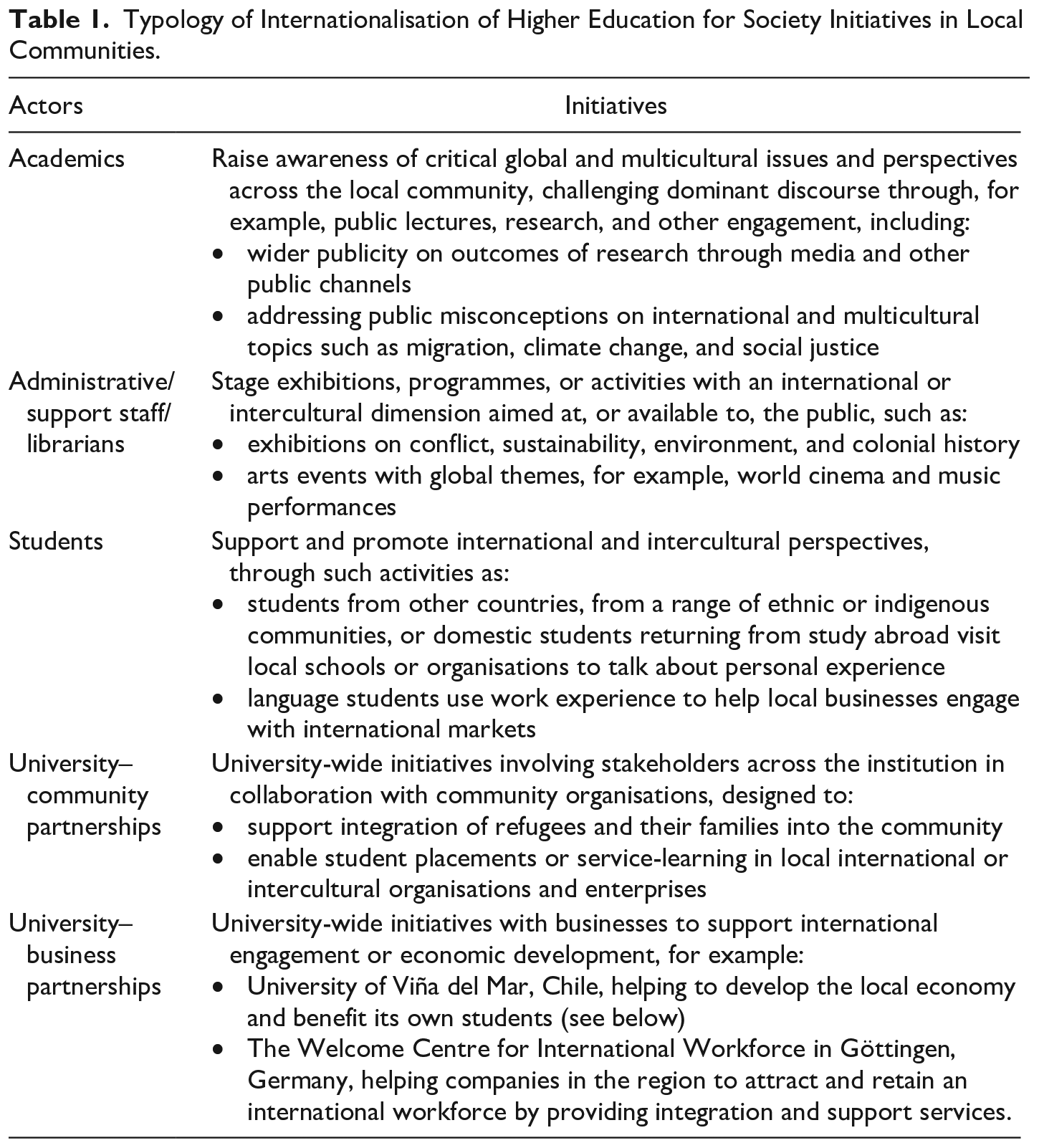
Viña del Mar University used its international partnerships to enable academics and students from different career tracks related to entrepreneurship to facilitate exchange programmes for two groups of local low-income women entrepreneurs. One group focused on marketing strategies for their products (hats, dresses, ponchos, and home décor) through a training programme with a group of women entrepreneurs in Arequipa, Peru, who already had established international sales channels, primarily for European markets. The second group undertook a 10-day training programme to develop knowledge of crop cultivation techniques, conservation, fertilisation, and marketing of flowers and medicinal plants in Gombrèn, Spain. Both initiatives contributed to the productive development of the Valparaiso Region in Chile, directly benefiting low-income women entrepreneurs while enhancing the knowledge and skills of undergraduates in a practical setting. In each case, the university used international resources to strengthen social inclusion processes locally, offering mutual benefits and learning for all stakeholders.
Typology of Internationalisation of Higher Education for Society Initiatives in International Communities.
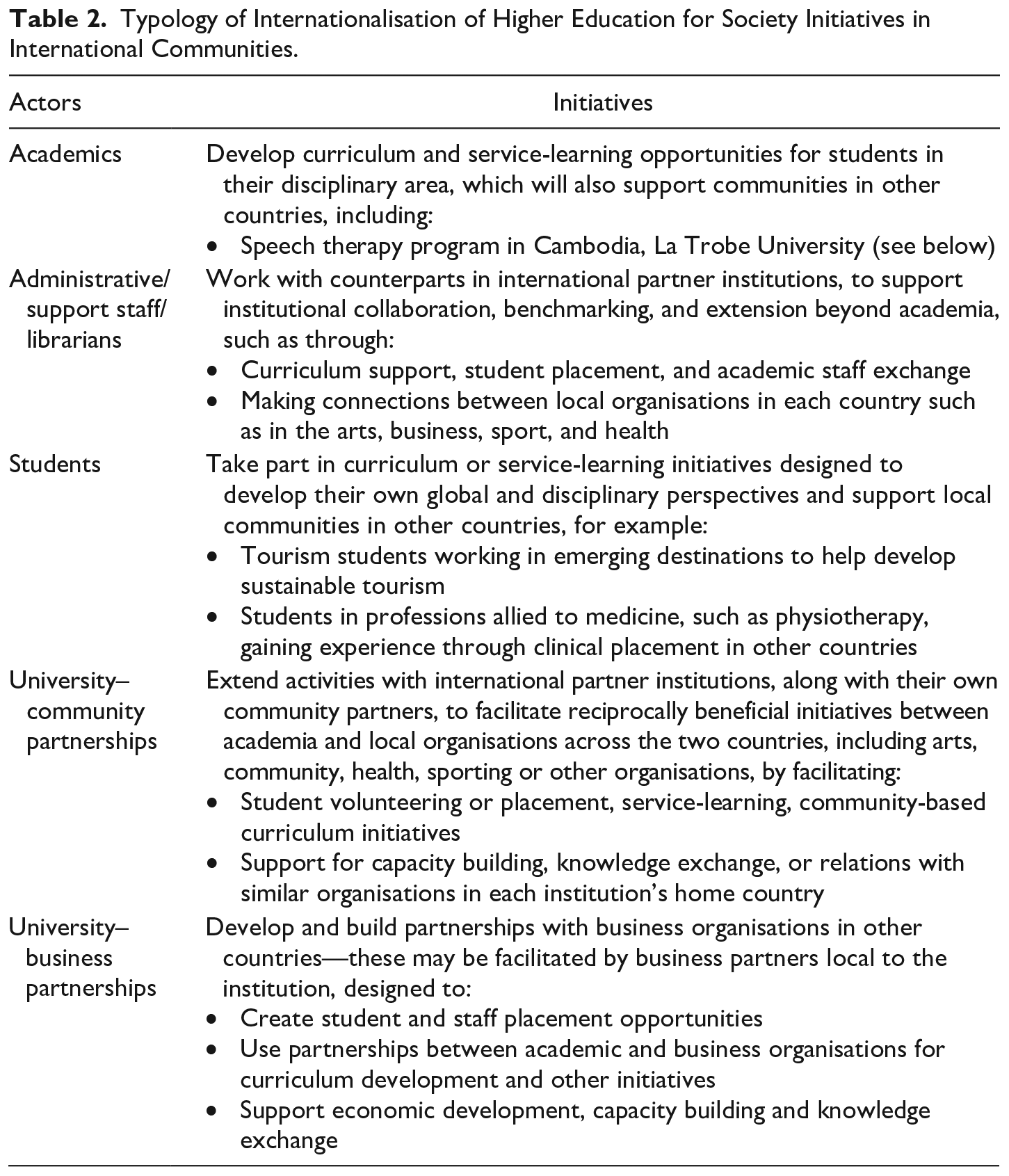
Following a successful pilot training programme in 2014 (Rogers & Heine, 2015), speech pathology students from La Trobe University have been travelling to Cambodia to participate in a service-learning programme as part of their clinical placement. They conduct assessments and therapeutic interventions to support children, and their families, with communication and swallowing disabilities in regional Cambodia, where speech pathology is relatively underdeveloped, but one in 25 Cambodians need such services (Rogers & Heine, 2015). The placement also involves visiting and working with nongovernmental organisations (NGOs) in Cambodia and learning about local education and health care systems. Students work closely with the person requiring the service, their families and carers, the wider community, other health care professionals, translators, and volunteers. Not only do benefits accrue to patients and their families, the wider community, and other professionals in Cambodia, but students gain practical experience and very different perspectives on clinical practice than those they may have previously encountered. The supporting academics are able to bring these international experiences back into the university curriculum, enabling other students to benefit also.
Examples 1 and 2 here, as well as others documented by Brandenburg et al. (2020), illustrate a variety of ways in which universities can meaningfully enact their third mission through local and international socially responsible engagement, with mutual benefit for a variety of stakeholders. Overwhelmingly, these IHES initiatives were reportedly driven by individuals or small groups of committed staff, and sometimes were not obvious to others in the institution. Despite the disjointed nature of this work, a range of key features can be identified which provide a framework for understanding and systematising IHES efforts.
Key Features of IHES
Three key features of strategic approaches to IHES emerge from the literature and the research undertaken by Brandenburg et al. (2020): the values that drive it, who is involved, and how it is delivered and evaluated.
Strategic approaches to IHES:
Are driven by values consistent with higher education for the global common good by:
intentionally and purposefully seeking to contribute to and learn from society both locally and globally;
promoting a future orientation for society, involving enhanced resilience, sustainability, and equality of opportunity;
supporting social justice, equity, development, conservation, social integration, and/or community relations within societies.
Involve a broad range of people from within and outside the institution:
led and enacted by people in different units and academic departments across the home institution;
through partnerships with international/intercultural communities at home and/or abroad;
bringing the global to the local and/or the local to the global—treating each as equally valuable.
Maximize benefit for all stakeholders and parties involved:
diverse and deep local and international partnerships are central to the planning, delivery, and evaluation of IHES activities;
activities are carefully planned and regularly evaluated, at home and abroad;
evaluation of impact includes mutually agreed measures of benefit for all parties;
evaluation data are regularly scrutinised and used to improve practice.
Keeping these key features in mind can offer guidance for a more systematic approach to IHES at departmental, school and institutional levels.
Future Considerations and Recommendations
This article has argued that there are multiple benefits for institutions and for society if the intersections between the third mission of universities, institutional social responsibility, and IHES are approached strategically. Some of the implications for key actors in universities are now provided. These actors include higher education leaders, researchers, course designers, and teachers, all of whom will need to be involved.
For Higher Education Leaders
To support a more systematic, integrated approach, institutional leaders might make IHES a core, integrated, mission-related component of teaching, research, and service plans by, for example,
ensuring that all in the institution (staff, faculty, students) understand the core characteristics of IHES and are supported to engage with that agenda. This may be through, for example, adoption of the SDGs as a cross-cutting theme in teaching, research, and service plans;
making IHES part of the institutional discourse in strategies and related documentation as well as in internal and external conversations;
respectfully engaging local and international community partners in these conversations to develop shared ownership and commitment to IHES;
identifying faculty and staff already engaged in IHES, considering how to encourage, celebrate, and reward them and to encourage others’ proactive engagement in the development of new initiatives;
supporting a range of top-down and bottom-up initiatives in IHES.
For Researchers in Institutions
Building on Brandenburg, Jones, and Leask (2019), who drew attention to a range of potential topics to advance IHES through the research agenda, researchers might usefully consider:
identifying possible rationales, goals, and motivation for IHES and how these relate to institutional research and internationalisation strategies;
identifying local and international partners with a shared interest in advancing the global common good through IHES;
connecting with existing active individuals and groups within their own HEIs (academics, students and administrative staff), who are already working on IHES-related research, to learn what has worked for them;
exploring and analysing IHES in practice in their regional and global networks;
measuring the international impact of their work on society, moving beyond simple numerical measures of output;
disseminating the results of such research through community publications and gatherings as well as in more traditional academic fora.
For Course Designers and Teachers
The goals of IHES can be achieved in a range of ways through course design and teaching. Those involved might consider, for example,
incorporating learning outcomes that focus on the development of attributes associated with the “global common good” (UNESCO, 2015) or the 2030 Agenda and SDGs (United Nations, 2015) in course documents and student materials;
inviting students and members of local community groups to partner in the development of courses and transformative, active learning experiences such as those described by Carrington (2011);
providing opportunities for students to engage in active learning in local community organisations and businesses that have an intercultural or international mission/focus;
emphasising the reciprocal relationships between intercultural/international service-learning and community engagement throughout a programme of study and encouraging/requiring students to take up the opportunities provided;
exploring ways in which online tools and approaches, such as Collaborative Online International Learning (COIL), could be utilised to engage students in international service-learning;
creating education abroad programmes founded on mutualism in all phases of the programme—pre-immersion, immersion, and post-immersion. Such reciprocity would see mutual benefit for both the community and students participating in international service-learning or education abroad (Johnson et al., 2020).
Conclusion
At the time of writing this article, the COVID-19 pandemic shows little sign of abating, demonstrating that global issues know no borders and require global cooperation and engagement for the common good. The pandemic has also demonstrated the close association between education and social outcomes and the important contributions higher education can make to society, at a time when the unevenly concentrated resources and privilege between nations have been thrown into even sharper relief.
Higher education institutions have a responsibility to contribute to the global common good and to support the development of sustainable communities at home. In this article, we have discussed the possibilities arising from the intersection between the social responsibility and internationalisation agendas of HEIs. We have argued that it is important for strategic approaches to engagement with local and international communities to be integrated into both internationalisation and third mission strategies.
We have further argued that such an approach has the potential to contribute to the global common good, and that, as yet, insufficient attention has been paid to pursuing this objective through internationalisation. We have highlighted the importance of institutions reorienting themselves and their internationalisation strategies to be more outward-looking, less focused on the traditional and most often-sought private benefits of international higher education (benefits for institutions and for individual students). We have also discussed the importance of at least a partial reorientation of third mission agendas to be more internationally focused and some possible ways in which these two agendas may be strategically aligned in projects and activities. IHES has been presented as a useful conceptual and action framework to guide institutions seeking to meet their global social responsibilities and to ensure their continuing relevance in a rapidly changing interconnected and globalised world.
However, institutions must first consider their place in the world, their globality, and how they might contribute to creating more sustainable human societies. This is important and challenging work, but it is possible to achieve if more attention is paid to ensuring that students and staff are engaged locally and globally in education, research, and service activities in ways that benefit communities as well as the institution and its students.
Footnotes
Declaration of Conflicting Interests
The author(s) declared no potential conflicts of interest with respect to the research, authorship, and/or publication of this article.
Funding
The author(s) received no financial support for the research, authorship, and/or publication of this article.
