




Abstract
This research explores the rising trend of International Branch Campuses in the Global South, particularly in Egypt, through a decolonial lens to address the potential tensions between globalization and the preservation of local culture and knowledge. While International Branch University Campuses (IBCs) offer high-quality education, they may inadvertently perpetuate colonial legacies by favoring Western educational models over local knowledge systems. This study formulates a conceptual framework based on polarity management to navigate the conflicting forces at play—granting IBCs full autonomy versus implementing local guardrails to preserve cultural and educational integrity. The framework highlights the benefits and challenges of both perspectives and provides policy recommendations for stakeholders to manage these tensions effectively. By offering a pathway for decolonizing education while leveraging IBCs, this research contributes to discussions on how developing countries can balance the pursuit of robust educational standards with the protection of local cultural values.
Keywords
Introduction
This research aims to address the trend in the rising number of International Branch University Campuses in the Global South (Clarke, 2021; Xu, 2021), specifically in Egypt (Westphal, 2018), from the critical theory lens of decolonizing education to achieve social justice. Fundamentally, the colonization of education has detrimental effects that could lead to widening inequalities between and within nations (Bhabha, 2004; Clarke, 2021; Lo, 2011; Nguyen et al., 2009). In Egypt, like in other developing countries, the government is planning for sustainable development. The Egyptian government has set a plan called Vision 2030 that aims to develop the various sectors of the country while working towards the Sustainable Development Goals (SDGs). Two of the goals the government is working towards are SDG #4 Quality Education and SDG #10 Reduced Inequalities (Ministry of Planning and Economic Development, 2023). One of the proposed methods to improve the quality of education is through the setup of International Branch University Campuses (IBCs) (Westphal, 2018). The premise of this research, however, is that an increase in IBCs may compromise the goal of reducing inequalities over the long-term.
As will be portrayed in more detail in the literature review, the International Branch Campuses (IBC) education model is viewed by decolonial scholars as an extension of colonial education. IBCs are seen to perpetuate the hegemony of Western epistemologies by giving higher value to Western education compared to the local. At the same time, students enrolled in IBCs in developing countries are often alienated from the issues in their local contexts, thus preventing them from using their education to improve the situation in their countries. According to the Cross-Border Education Research Team (C-BERT), out of the 333 operational IBCs in 2023, the largest exporters were the United States, the United Kingdom, France, Russia, and Australia. Together, these countries accounted for around 50% of the total number of IBCs. Among these top exporters, all except Russia were Western nations. Hence, the claim that IBCs risk extending the idea of Western hegemony can be justified, since the vast majority of IBCs are Western-led rather than initiated by institutions in the Global South. While a small number of IBCs do originate from Global South countries—most notably India, China, and Japan—their presence remains limited in comparison. Therefore, the critique articulated by decolonial scholars primarily applies to IBCs exported from the Global North, which dominate the landscape.
Previous literature on IBCs mainly focused on their success, challenges, and business models from an entrepreneurial and management perspective. Studies linking IBCs and decolonization are scarce and are centered on Asian countries. No studies addressing IBCs and decolonization have yet been performed on IBCs in Egypt nor Africa, most likely because the IBC model is a recent addition to this region's Higher Education offerings. Thus, it is critical that research begins to explore this topic in order to limit the negative effects of IBCs on the culture in these African nations.
The end goal of this research is to create a framework built on the notion of polarity thinking and managing tensions (Johnson, 1996; Kise, 2013). The tensions that need to be managed in this case are those of keeping IBCs operational to improve the quality of education without erasing the local culture and epistemology. In fact, if the tensions are successfully managed and polarity thinking achieved, this should result in a new formation of assimilated culture and knowledge, combining local and foreign best practices.
The research formulates a conceptual model that aims to enable host countries to benefit from high-quality education through IBCs while minimizing the influence of neo-imperialism and intellectual imperialism. The framework utilizes a polarity-thinking approach to manage tensions (Johnson, 1996). The central research question is: How can IBCs be deployed to enhance the quality of education in developing countries while preserving native culture and knowledge? In other words, this research offers a conceptual framework for the decolonization of education within the operational structure of the IBC model.
Drawing on this framework, the paper outlines policy recommendations for various stakeholders in host countries to ensure the success of the IBC model from a decolonial perspective. This research holds relevance for policymakers in the education sector, educators, decolonial scholars, and anyone interested in fostering intellectual innovation in the Global South.
The paper is structured as follows: Section II provides a review of relevant literature on coloniality, epistemic hegemony, the IBC model, and the context of Egyptian higher education. Section III outlines the methodology. Section IV presents and analyses the polarity map developed for this study. Section V proposes a set of policy recommendations informed by the concepts of epistemic plurality and creative assimilation. The final section offers concluding reflections on the implications and suggests directions for future research.
Background and Literature Review
Coloniality and Neocolonialism
Coloniality refers to the power dynamics considered to be remnants of colonialism. The underlying assumption of coloniality is that non-Western cultures, knowledge, and ways of thinking are inferior to Western ones. Thus, coloniality perpetuates a power imbalance between Western and non-Western nations (Maldonado-Torres, 2007; Quijano, 2007). Even though most Global South countries (Asia, Africa, and the Middle East) were freed from direct colonialism after World War II, they remained controlled by the colonizers’ economic and political systems (Mignolo, 2021). This phenomenon has also been referred to as “neo-colonialism”. Neocolonialism is evident in countries which are seemingly sovereign, yet in reality their economic and political systems are controlled by foreign forces. Such control is permitted under the guise of foreign capital aid and investments that come with strings attached. It has been argued that these strategies continue to exploit less developed nations (Nkrumah, 1969). Compounding this effect was the fact that national leaders who took over these newly independent nations were influenced by Western colonialist ideologies. (Alatas, 2000; Fanon, 1963). As a result of decades of colonialism followed by coloniality, “the colonized” cultures adopted the belief that they are inferior to Western cultures (Clarke, 2021).
Epistemological Hegemony and Intellectual Imperialism
One of the critical repercussions of coloniality is the continued disfiguration of the epistemologies of the Global South. This insidious process began during the era of colonialism when colonial powers assigned Western intellectuals to collect and synthesize knowledge about the colonized peoples. These intellectuals viewed their knowledge and culture as more superior and hence wrote about the native colonized people from an ethnocentric perspective. Subsequently, a whole body of disfigured knowledge known as Orientalism was created about the Global South that excluded the view of the natives themselves (Alatas, 2000). An example of this is Joseph Fourier's work which justified Napoleon's conquest of Egypt by claiming that Egyptians had become barbaric and thus the invasion was necessary to make them more civilized (Said, 1978). Such distorted epistemologies were prolifically published and distributed across the globe “through mass education” (Regmi, 2022, p. 12).
Over time, the accumulation of these Western-influenced epistemologies diminished other perspectives of history and forms of meaning created by natives in the Global South (Vázquez, 2011). To this day, the predominant colonialist systems give precedence to the epistemologies produced by the West (Mignolo, 2007; Spivak, 1994). According to Behari-Leak (2020, p. 10), such systems have created “epistemic hierarchies” by viewing Western knowledge as optimal and superior, whereas other forms of knowledge are viewed as inferior. Similarly, Quijano (2007) refers to the West's belief in its epistemic superiority as “totality in knowledge”. Totality in knowledge entails that all societies must aspire to follow Western culture and practices in order to reach the ideal state. This relates to Foucault's (1980) assertion that “epistemic power” categorizes knowledge by deciding which types of knowledge are viewed as legitimate and which are viewed as “naïve”. Knowledge classified as “naïve” is then “disqualified”. The act of disqualification of knowledge embodies what post-colonialist theorist Spivak (1994) labels as “epistemic violence” (p.83). Epistemic violence takes place when Western countries act as “the reference point” for the rest of the world (Behari-Leak, 2020, p. 11).
Along the same lines, Alatas (2000) argued that intellectual imperialism pervades developing countries and prevents its people from creating their own knowledge forms. According to Alatas, intellectual imperialism is a form of “the subjugation of one people by another for the advantage of the dominant one” through the control of knowledge (2000, p. 23). One of the characteristics of intellectual imperialism is the concept of “tutelage”. Built on the notion that “intellectual know-how” in developing countries is inferior, tutelage by the West was viewed as necessary to re-educate individuals from the Global South on the correct ways. Hence, it became common in Asian and African countries that if individuals wanted a credible education, they had to go to Europe or America (Alatas, 2000). Other postcolonial scholars contend that the perception of superiority associated with Western education is an extension of epistemological hegemony (Bori, 2018; Holborow, 2021). Labeling Western education as the “world-class” reference enforces this epistemological hegemony by relegating non-Western education to a subordinate position (Siltaoja et al., 2019). Epistemological hegemony is accused of suppressing non-Western knowledge production (Clarke, 2021) and stifling creativity in non-Western cultures (Alatas, 2000). These represent some of the ways in which colonialism has influenced education systems in formerly colonized countries (Regmi, 2022).
The Decolonization of Education
Decolonization is the term used to describe the act of challenging colonization (Fanon, 1963). This movement is meant to rebel against colonization in “its multiple domains, levels, and places” (Regmi, 2022, p. 12). Within the domain of education, decolonization involves the defiance of Western epistemological hegemony by recognizing the validity of the plurality of epistemologies (Cummins, 2020). One of the proposed methods to achieve decolonization is through “delinking” (Mignolo, 2007) from colonial ways, which emphasizes the significance of “plurality, multiplicity, and difference” (Dastile & Ndlovu-Gatsheni, 2013, p. 109).
Delinking calls for reassessing the knowledge and ways engrained by the colonizing regimes without completely tossing away all that has been learned from Western cultures (Behari-Leak, 2020). Hence, delinking has the potential to eradicate “intellectual slavery” without obliterating “genuine creative assimilation” (Alatas, 2000, p. 27). According to Alatas (2000), intellectual slavery takes hold when a society believes that its insights are inferior to foreign knowledge and hence historical local knowledge is discarded. On the other hand, genuine creative assimilation is when local cultures integrate their local historical knowledge with that from foreign sources, leading to an enhanced amalgamation. The end goal is to avoid completely abandoning local or foreign ways of being and knowing which could be beneficial.
Another trap to be avoided is that of adopting the nationalization creed heedlessly which could lead to negative consequences (Regmi, 2022). As expressed by Fanon (1963), nationalism “is nothing but a crude, empty fragile shell. The cracks in it explain how easy it is for young independent countries to switch back from nation to ethnic group and from state to tribe – a regression which is so terribly detrimental and prejudicial to the development of the nation and national unity” (p. 97). Thus, the role of education systems in postcolonial nations is twofold in that they must not only challenge neocolonial policies, but also challenge nationalist discourse that could have a pernicious effect on society (Regmi, 2022).
To reverse the accumulated effects of colonial policies on education, it has been argued that educational leaders in postcolonial cultures must take the reins into their own hands (Mignolo, 2021; Moosavi, 2020; Regmi, 2022). According to Regmi (2022), educational leaders should adopt “critical praxes” as a step to decolonizing education. While the goal of decolonization is to “restore national sovereignty” as Fanon articulated in his seminal work (1963), educational leaders need to recognize that the culture that existed prior to colonization has been lost (Regmi, 2022). Hence, it is the educational leaders’ role to work with their students and community on forming a new culture that still manages to restore national sovereignty. Moreover, it is the responsibility of higher education institutions in these countries to raise awareness about decolonial praxes among educational leaders (Regmi, 2022).
IBCs and Decolonization
The rise in the number of universities’ IBC in developing countries seems to be at odds with the decolonization movement (Clarke, 2021; Xu, 2021). The IBC has been defined as “An entity that is owned, at least in part, by a foreign education provider; operated in the name of the foreign education provider; and provides an entire academic program, substantially on site, leading to a degree awarded by the foreign education provider” (Garrett et al., 2016, p. 14). Over the past two decades the number of IBCs has exponentially increased. The most recent data from the Cross-Border Education Research Team in 2023 indicated that there were 333 operational IBCs (Cross-Border Education Research Team, 2025); this figure is up from 18 IBCS in 2002 (Xu, 2021). Clarke (2021) attributes Western universities’ growing interest in IBCs to push and pull factors.
Push factors include increasing revenue and enhancing global brand reputation (Altbach & Knight, 2007; Guimon, 2016; Wilkins, 2020). These factors appear to be the result of “academic capitalism”, which describes the treatment of education as a good on the free market (Slaughter, 2014). Academic capitalism, along with the reduced government funding for higher education institutions, led Western universities to become more entrepreneurial (Girdzijauskaite et al., 2019; Slaughter, 2014) and to seek profitable opportunities in continents such as Asia and the Middle East (Siltaoja et al., 2019). Pull factors are those instigated by the host countries and include the appeal of reduced taxes and subsidies tied to direct foreign investment (Clarke, 2021). The governments of host countries encourage IBCs for several reasons, including reducing brain drain and building a workforce that has international training and qualifications (Guimon, 2016; Hill & Thabet, 2018; Knight, 2011; Mackie, 2019).
IBCs have been criticized by numerous scholars for propagating neocolonial Western hegemony through education (Bhabha, 2004; Lo, 2011; Nguyen et al., 2009). Clarke (2021) asserts that IBCs possess traits that are analogous to the colonial education systems of the 16th to 19th centuries. These characteristics are identified by Teferra and Altbach (2004) to include:
Restricted access to the local population The use of Western languages as the primary mode of instruction The centralization of control within the Western home campus, i.e., “colonial centres” Selective curricula that do not take local knowledge or context into consideration.
Furthermore, IBCs reinforce the idea that Western education is superior to local education in the operating countries, leading to the devaluation of local knowledge and stifling its growth. These characteristics imply that IBCs can pose harmful long-term effects to the culture of the countries in which they operate (Xu, 2021).
The Context of Egyptian Higher Education
A Brief History of Globalizing Education in Egypt
The globalization of higher education in Egypt began during Napoleon's invasion (1798–1801), when French scholars introduced Western scientific inquiry through their published account of Egypt, Description de l'Égypte. This was followed by Mohamed Ali's educational reforms, which involved sending hundreds of Egyptian students to study in Europe between 1813 and 1847 as part of a broader effort to modernize Egypt's institutions. A key milestone came with the founding of the Egyptian University (now Cairo University) in 1908, where European faculty initially led instruction, while promising Egyptian students were trained abroad to help build local academic capacity (Ead, 2019).
A few years later, the American University in Cairo was established in 1919. Although it is not an International Branch Campus—since it operates as a private, independent institution within Egypt rather than a branch of a foreign university—Kosmützky (2018) notes that this model is often considered a precursor to the IBC model. More recently, universities operating on similar foundations—such as the German University in Cairo and the French University of Egypt, both established in 2002—have further expanded this landscape by delivering foreign curricula through private, locally operated institutions. Today, such universities continue to compete with IBCs by offering comparable academic experiences, while maintaining stronger local presence and institutional autonomy.
Egypt's Higher Education Expansion and Vision 2030
Over the past decade, Egypt has rapidly expanded and diversified its higher education system, nearly doubling the number of universities and significantly increasing student enrollment to meet rising demand and align with global standards. This growth includes public, private, and nonprofit institutions, as well as the launch of technology universities designed to equip students with future-oriented skills for the local, regional, and international labor markets. Supported by a substantial increase in government funding, these efforts are part of Egypt's Vision 2030 strategy, which seeks to boost the global competitiveness of Egyptian universities, increase international student enrollment, strengthen research output, and foster academic-industry partnerships. The development of foreign university branch campuses, especially in the New Administrative Capital, further reflects Egypt's ambition to become a regional hub for quality education and innovation, leveraging its strategic location between the Middle East, North Africa, and Sub-Saharan Africa (Leila, 2024).
The IBC Model in Egypt
In Egypt, this issue has become even more prominent with the government's novel plan to reform education by increasing the number of International Branch Campus universities. In 2018, the Egyptian government introduced The International Branch Campus Act into law. Article 16 of this act states that the “branch shall operate within a framework of academic and institutional autonomy and freedom” (Westphal, 2018). Some the sought-out advantages of internationalizing higher education in Egypt include reducing “brain drain” by preventing Egyptian students from traveling to study abroad, improving the skills of Egyptian students to meet the labor market's requirements, and increasing competitiveness and thus quality in the higher education sector (Sawahel, 2023). While it is valid that the Egyptian government seeks to enhance its education by “outsourcing” higher education to international institutions, a balance must be kept to avoid the loss of national Egyptian identity and thought. Moreover, local universities claim that they are deprived of many of the advantages offered to international universities by the government (Enterprise, 2019). Thus, a possible result of this act on the long term is that the quality of education in local universities will be further weakened rather than enhanced, leading to continued reliance on foreign institutions and their teachings. This cycle could prevent local institutions and thought from evolving, instead encouraging the uptake and entrenchment of Western and neocolonialist theories.
With approximately seven years since the introduction of the IBC model in Egypt, now is an ideal time to evaluate its outcomes and plan the way forward, including any necessary adjustments to the strategy. The key challenge lies in managing the tensions created by the IBC model itself. This is not about rejecting the IBC concept, as its potential benefits have already been demonstrated. Rather, the focus must be on addressing the conflicting demands that arise due to the model's structure. Specifically, these tensions manifest in two opposing approaches:
granting IBCs full autonomy over curriculum and campus culture, and implementing local guardrails to ensure alignment with the host country's needs and values.
Methodology
Polarity management is a technique designed to address seemingly unsolvable problems. It employs a polarity map to analyse a situation from multiple perspectives. This map serves as a framework that illustrates two paradoxical ideas as opposing poles, listing the upsides and downsides of each. By doing so, it reveals the tensions between the ideas and helps users arrive at a solution that adopts a holistic perspective without requiring a choice between the two. The goal is to manage these tensions effectively while embracing the paradoxical ideas simultaneously (Johnson, 1996).
In this research, the two identified polarities are granting IBCs full autonomy over curriculum and campus culture versus implementing local guardrails to ensure alignment with the host country's context. These paradoxical ideas were mapped using the polarity management framework, with their respective upsides and downsides outlined (see Figure 1). The content of the polarity map was informed through a combination of practitioner experience and conceptual reasoning, which included analytical auto-ethnographic reflection—an approach that uses the researcher's personal experiences to reflect on broader social phenomena (Kuzhabekova, 2024; Zempi, 2017). This was further strengthened by insights drawn from relevant academic literature. Together, these sources ensure that the polarity map reflects both theoretically informed perspectives and lived, context-specific understanding.
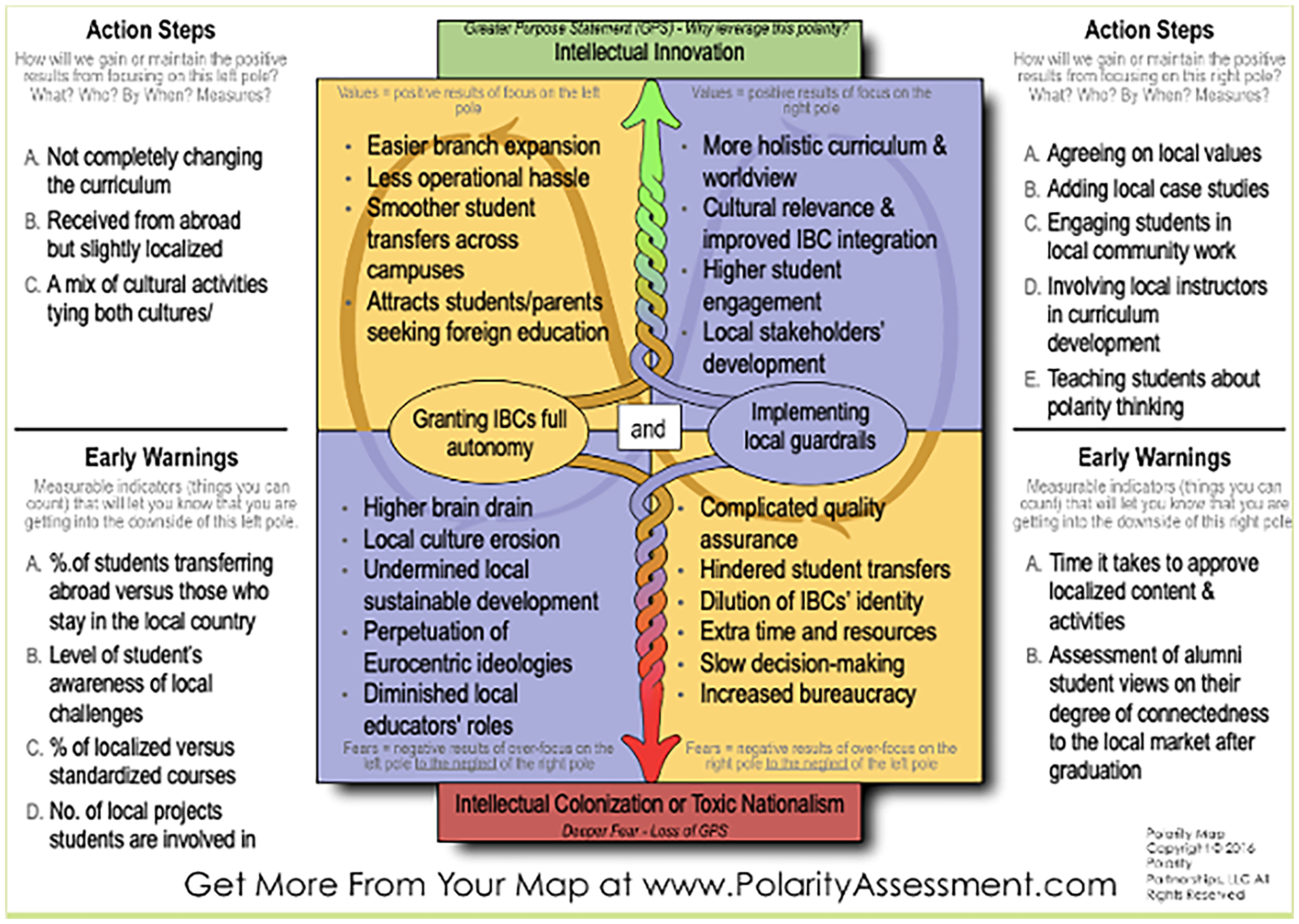
Mapping the tensions between granting IBCs full autonomy over curriculum/campus culture versus implementing local guardrails to ensure alignment with the host country's context.
The subsequent sections delve deeper into these advantages and challenges, providing a detailed analysis. This polarity map serves as a valuable tool for policymakers, offering a structured approach to fostering informed discussions and guiding decisions that balance the benefits of both poles effectively.
Polarity Mapping Framework for IBCs
Granting IBCs Full Autonomy Over the Curriculum and Campus Culture
The Upsides
Granting IBCs full autonomy simplifies the process of opening branches in host countries, making it more appealing for international universities looking to expand their presence across the globe. With reduced operational complexities, IBCs can replicate their existing model with minimal hassle. From the perspective of local hosting institutions, this approach also reduces organizational challenges and resource investments, as they are not involved in curriculum development or campus culture creation, resulting in less overall workload.
Additionally, full autonomy by the IBCs ensures a standardized experience for students across all campuses, facilitating smoother transfers for those wishing to move between locations. For local institutions in host countries, hosting an international university with its standardized curriculum and culture can serve as a key selling point to prospective students and their parents. It attracts students and parents who perceive foreign education as superior to local options, thereby boosting enrollment and enhancing the institution's appeal.
The Downsides
The full autonomy of IBCs could perpetuate a Eurocentric mindset, reinforcing the notion that Western epistemologies are superior to those of the Global South. This could lead to further intellectual colonization of future generations, undermining local knowledge systems. Decolonial scholars argue that vague and uncritical approaches to curriculum internationalization sustain Eurocentric epistemic hegemony by presenting Global North knowledge as universally valid. This framing privileges Western perspectives while marginalizing or erasing African and other Global South knowledges. Universities perpetuate this imbalance by selectively determining what counts as legitimate or international knowledge, thus reinforcing colonial structures in higher education (Heleta & Chasi, 2024; Ndlovu-Gatsheni, 2021; Zembylas, 2018).
Moreover, without local involvement in curriculum and culture development, IBCs increase the risk of eroding local culture, values, traditions, and epistemologies. Since students would primarily be taught foreign perspectives, they may become disconnected from the issues facing their home country. As a result, they may be ill-equipped to contribute to sustainable development efforts. Each country has its unique challenges, and if students are not exposed to local issues or encouraged to devise solutions tailored to their context, their education will be more aligned with addressing problems abroad. This contradicts the goals of local governments, such as Egypt's, that use IBCs to foster sustainable development. In such cases, IBCs could worsen rather than improve the situation. Similarly, Kuzhabekova (2024) highlights the case of internationally branded universities in Kazakhstan to illustrate the tension between achieving international recognition and maintaining local relevance. The curriculum, developed with top Western partners, prioritized global employability but overlooked local realities. As a result, graduates lacked familiarity with domestic work environments and cultural norms, thus prompting criticism from local employers.
The role of local educators and researchers would also be diminished, as they would be expected to deliver standardized content without integrating their own expertise or insights. This stifles the development of local research and innovation, particularly in areas rooted in local issues and traditions. For example, in some IBCs, local professors are required to teach the exact same material as their foreign counterparts, and exams are even sent from abroad. In this scenario, the role of the professor is reduced to mere delivery, with little opportunity for intellectual contribution or growth.
Furthermore, granting IBCs full autonomy could inadvertently contribute to increased brain drain, which runs counter to one of the primary motivations behind their establishment by local governments. While these governments typically set up IBCs to deliver high-quality education locally and reduce the need for students to study abroad, full autonomy may instead reinforce outward migration. For instance, research on similar institutions in Kazakhstan found that most domestic students enrolled in such universities with the intention of preparing for further study abroad (Kuzhabekova, 2024). This creates a contradiction between the reality of educating largely outward-bound graduates and the original policy goal of contributing to national and regional economic development. When IBCs emphasize the appeal of foreign education and enable easy transfer pathways abroad, students may come to view them not as opportunities to stay and contribute locally, but as stepping stones to leaving the country.
Implementing Local Guardrails on IBC's Curriculum and Campus Culture
Upsides
Ndlovu-Gatsheni (2021) contends that authentic internationalization in higher education requires the prior decolonization of knowledge and curriculum. This entails embracing epistemic plurality—the recognition and inclusion of multiple global ways of knowing, rather than privileging dominant narratives from the Global North. True curriculum internationalization critically engages with diverse epistemologies, challenging entrenched hierarchies and ensuring that perspectives from the Global South are not marginalized.
Achieving epistemic plurality requires deliberate action. Heleta and Chasi (2024) propose reflective questions that examine whose knowledges and worldviews are legitimized, which ones are excluded, and how the curriculum connects with students’ lived experiences. These questions also ask how the curriculum can foster understanding of global injustices and promote pluralistic, inclusive perspectives.
Implementing local guardrails in IBCs is one practical way to realize this shift toward epistemic plurality. Local guardrails enable the adaptation of curricula to the host country's cultural and societal context, allowing for the integration of both local and foreign perspectives. Rather than defaulting to a purely Eurocentric worldview, this approach fosters a more holistic understanding of the world. The end goal is to achieve what Alatas (2000) calls creative assimilation—the meaningful integration of historical local knowledge with insights from foreign sources. This process avoids the extremes of rejecting foreign knowledge or discarding valuable local epistemologies. Instead, it enables a dynamic amalgamation that strengthens learning and supports innovation grounded in cultural relevance.
Localization also enhances cultural alignment, ensuring that imported values are thoughtfully adapted to fit the host context, while still exposing students to local traditions, languages, and societal concerns. This fosters greater legitimacy and acceptance of IBCs within their communities. When students see their own identities, histories, and challenges reflected in the curriculum and campus culture, they are more likely to feel a sense of belonging—improving engagement, retention, and academic success. Furthermore, giving local stakeholders—educators, researchers, and policymakers—a role in curriculum development promotes capacity building and supports the cultivation of local talent. Ultimately, the goal is not to abandon either local or foreign knowledge systems, but to create a synergistic educational model that prepares students to think critically, act locally, and engage globally.
Downsides
The lack of standardized educational content might make quality assurance more difficult, as it would be harder to ensure consistent quality across different campuses. The variation in content taught across campuses could also complicate student transfers, which is a key feature of the IBC model. Furthermore, IBCs might reject the idea of granting certificates based on localized content with which they may not be familiar. Another concern for IBCs is that localization could dilute their distinct identity, making it harder to maintain the unique value and educational philosophy that the parent institution represents.
Additionally, implementing local guardrails would require more time and resources from both the IBCs and local stakeholders to ensure alignment. The process may also increase administrative complexity, as both parties would need to negotiate and align local requirements with the IBC's practices, potentially resulting in more bureaucracy and slower decision-making.
Discussion and Recommendations
In light of the advantages and disadvantages of the two poles discussed above, this section presents action steps for moving forward. These ideas aim to highlight the benefits of each pole while mitigating potential harms.
Action Steps to Leverage and Multiply the Upsides
As shown in Figure 1, the Action Steps to Leverage and Multiply the Upsides section addresses the question: “How can we gain or sustain the positive outcomes of focusing on this pole?”
Fostering Epistemic Plurality Through Core Local Values and Curriculum Integration
To safeguard local culture, values, traditions, and knowledge systems, the Ministry of Education should lead the process of defining core local values to be embedded in the education system. Achieving educator alignment through mandatory, cost-effective training—such as online modules with certification—would help standardize these values across public, private, and IBCs. This consensus-driven process, involving broad stakeholder participation, ensures shared ownership and increases the likelihood that these values will permeate teaching and campus culture.
Localization efforts must balance integration and preservation by blending local and foreign values within curricula and campus life, embracing the principle of creative assimilation. Rather than discarding local or foreign knowledge, IBCs should highlight convergences and complementary differences. Practical curriculum adjustments should maintain core content aligned with home campuses for quality assurance, while incorporating local case studies and examples that deepen contextual relevance and critical thinking.
Empowering Students and Educators to Navigate Cultural Complexities
Teaching students polarity thinking—the skill of managing opposing perspectives—prepares them to avoid intellectual colonization (which undervalues local knowledge) and toxic nationalism (which rejects beneficial foreign insights). Encouraging reflection on cultural plurality fosters their ability to integrate positive elements from diverse epistemologies, cultivating a truly international mindset.
Exposure to successful local role models and engagement in community-based projects strengthen students’ connection to their local environment and encourage contributions to sustainable development goals. Collaborations with local companies, governments, and NGOs provide experiential learning opportunities that balance global perspectives with local realities.
Local educators play a critical role in this ecosystem. Empowering them to participate actively in curriculum development, alongside their counterparts from IBC home campuses, builds their capacities and leadership while fostering innovation rooted in local contexts. Integrating indigenous knowledge—for example, Egypt's ancient sustainable farming practices—enriches learning and reinforces cultural pride, completing a cycle of epistemic plurality and creative assimilation that benefits students, educators, and society alike.
Early Warnings Detection to Mitigate Risks
To mitigate the risks linked to the two poles of IBC governance—full autonomy and local guardrails—specific, measurable key performance indicators (KPIs) should be used to identify early warning signs of potential negative outcomes, such as intellectual colonization or toxic nationalism. As shown in Figure 1, the Early Warnings section outlines indicators that flag an emerging drift toward the downside of either pole.
KPIs for Granting IBCs Full Autonomy
To monitor the risks of granting IBCs full autonomy, the following KPIs can serve as early warning signs that the downsides of this pole are emerging:
Student Retention and Brain Drain
A critical KPI is the percentage of students who transfer abroad and do not return. By comparing the proportion of students who complete their studies at the local campus with those who leave for further education abroad, it becomes possible to assess whether the IBC is merely serving as a stepping stone for students to exit the country. A higher-than-expected number of students moving abroad could signal that the IBC is failing to meet its goal of curbing brain drain, prompting a reassessment of national retention strategies.
Student Awareness of Local Challenges
A KPI to measure students’ awareness of the host country's challenges and goals can be obtained through surveys. These assessments can gauge students’ understanding of local issues, helping to detect any lack of connection with the local context. A significant gap in student knowledge may suggest that the curriculum is not adequately addressing local realities, requiring adjustments to integrate more relevant content.
Local Course Development and Localization
A KPI to track the extent to which local educators contribute to the curriculum by localizing existing courses or developing new ones is essential. By comparing the number of localized courses with the total number of courses delivered unchanged from the home campus, it's possible to gauge local educators’ involvement in curriculum development. A low number of localized courses may indicate insufficient local input, signaling that local talent is not being sufficiently empowered to shape the curriculum.
Student Engagement in Local Projects
The degree to which students are engaged in local projects is another KPI. If involvement in local projects is minimal or absent, it could signal that students are not being immersed in local culture and challenges. Low student engagement would be an early warning sign that the IBC is not effectively fostering a connection with the host country's context, which is essential for the development of students’ local awareness
KPIs for Implementing Local Guardrails
On the other end of the spectrum, to monitor the risks of implementing local guardrails, the following KPIs can act as early warning signs that the downsides of this pole are becoming evident.
Approval Time for Localized Content
A critical KPI is the time taken for the home campus to approve localized content and activities. Although initial delays may be expected as trust is built, excessive or growing approval times over time could indicate bureaucratic inefficiencies, suggesting that the IBC is becoming too rigid. If approval times do not decrease as relationships mature, it could signal a shift toward the negative consequences of local guardrails, where the IBC's adaptability to local needs is hindered.
Graduate Perception of Local Market Readiness
Surveys of IBC graduates, particularly regarding their readiness to work in the local market, serve as an important KPI. By assessing whether graduates feel prepared for the local job market or disconnected from it, it's possible to gauge how well the curriculum is aligned with local needs. A high level of perceived disconnect would indicate that the IBC's educational offerings are not sufficiently localized, requiring immediate action to realign the curriculum with the local context.
Conclusion
This research advances the literature by introducing a polarity management framework to navigate the tensions inherent in the IBC model. It provides host countries like Egypt with a strategic tool to benefit from IBCs while preserving local epistemologies and cultural values. As Egypt continues implementing higher education reforms under Vision 2030, balancing these dynamics becomes crucial to ensuring IBCs support national goals without reinforcing intellectual colonization.
The proposed framework is supported by a set of adaptable policy recommendations for higher education institutions considering or currently hosting IBCs. These policies aim to promote decolonization and strengthen local knowledge systems. By encouraging reciprocal knowledge exchange between the Global South and the West, they help shift away from mimicry models toward more equitable partnerships. As Regmi (2022) argues, such policy interventions can play a significant role in reducing inequality within and across nations.
While much of the existing literature critiques IBCs for perpetuating colonial legacies (Bhabha, 2004; Clarke, 2021; Lo, 2011), this study suggests a constructive way forward. Rather than discarding the IBC model, it shows how thoughtful governance and policy design can mitigate its downsides while maximizing its potential.
Though polarity thinking has been applied in other fields, this is its first application to the IBC context. The framework encourages education stakeholders in Egypt and other countries to use it as a foundation for dialogue, helping them address competing priorities. Grounded in decolonial theory, the study emphasizes epistemic plurality—the inclusion of diverse ways of knowing—and advocates for creative assimilation as a pathway to culturally relevant innovation and knowledge creation.
Future research should explore the framework's application in Egyptian institutions and other Global South settings to build a more inclusive and context-sensitive approach to transnational higher education.
Footnotes
Declaration of Conflicting Interests
The author declared no potential conflicts of interest with respect to the research, authorship, and/or publication of this article.
Funding
The author received no financial support for the research, authorship, and/or publication of this article.
