




Abstract
As digital technology’s economic importance increases, policymakers pivot to supporting startups—new, small, high-risk firms that produce technological innovation. Tracing the passage of startup policies in Brazil and Spain between 2014 and 2022, this article argues that startup policies do little to reduce peripheral countries’ dependence on the core. In each case, startups advocated for these policies by relying on financial and organizational resources from the giant US-based technology firms known as “Big Tech.” The article makes three contributions to the framework of dependent development. First, it reinforces existing observations that dependence on Big Tech extends beyond the Global South. Second, it revives political analysis of dependency, exploring the political conditions for economic development in the periphery. Lastly, it shows how startups’ political dependence on Big Tech implies important limits on startups’ ability to lead peripheral economies out of dependence on the core.
Introduction
In 2023, United Nations Trade and Development (UNCTAD) joined the chorus calling for startups to lead economic development in peripheral regions (UNCTAD, 2023). UNCTAD’s initiative, “The Square for Global Goals,” views startups as “agents of change” that can foster “grassroots innovation and competitiveness.” It is common to view startups—“innovative new firms with high-growth potential” often focused on digital technology (Klingler-Vidra and Pacheco Pardo, 2024, 524)—as drivers in improving peripheral economies, where production remains stuck in low value-added activities (Marini, 2022). Avlijaš et al. (2025, 486), for instance, suggest that small-and medium-sized enterprises (SMEs) “from peripheral economies have been boosting their productivity and innovation capacities,” thereby reducing peripheral economies’ dependence on the core. To support this vision, peripheral governments have passed policies over the past decade to support startups (Audretsch et al., 2020).
Despite hopes that digital technology would lower barriers to entry for entrepreneurs and thereby put capitalist development on a more egalitarian path, the opposite seems to have occurred. Analyzing the politics of startup policies, this article identifies important limits on startups’ ability to lead peripheral economies out of dependence on the core.
In digital capitalism, understood as a shift in the regime of accumulation in which digital technology reconfigures capitalism’s social, economic, and political dynamics (de Rivera, 2020, 727), peripheral regions face significant economic limits to sustainable development due to technological dependence on a handful of giant US-based firms known as Big Tech, which includes Alphabet (Google), Amazon, Apple, Meta (Facebook), and Microsoft. 1 In 2024, these firms controlled 64% of the global cloud market, with Amazon alone accounting for 31% (Statista, 2024a). Entrepreneurs are especially dependent, since they rely on platforms like Apple’s App Store or Amazon Marketplace in order to reach customers, and depend on Big Tech for cloud services (Cutolo and Kenney, 2021). Opportunities for growth exist, but “these opportunities are shaped and controlled” by Big Tech (Andreoni and Roberts, 2022, 1433). As scholars continue to debate the economic limits that peripheral regions face in digital capitalism, what has received less attention are the political limits.
This article shows that in digital capitalism, Big Tech dominates the political process of upgrading economic policy just as much as they dominate the underlying technology. I argue that Big Tech’s technological domination creates potential allies by aligning startups’ economic interests with their own. Big Tech activates those alliances by providing startups with resources for pursuing shared policy goals. Although startups’ own political influence is limited, they can draw on Big Tech’s resources to participate in the policy process. Startups are free to use those resources to pursue their own policy goals, as long as they do not threaten Big Tech’s interests. The chances of conflict, however, are slim because the alignment between Big Tech’s and startups’ interests ensures that startups comply with Big Tech’s interests even without explicit direction or coordination. Diagnosing this as a patron-client relationship highlights the unspoken reciprocity between Big Tech and startups. It also emphasizes startups’ political dependence on Big Tech, which makes it unlikely for startup policies to challenge Big Tech’s supremacy by reducing the periphery’s technological dependence on these core firms.
A comparative case study of the policy process around startup laws in Brazil and Spain illustrates startups’ political dependence on Big Tech. Brazil passed national legislation to promote startups in 2021, and Spain in 2022. In both cases, Big Tech provided financial and organizational support to startup associations leading the efforts. However, Brazil and Spain occupy different positions in global capitalism, with Brazil in the periphery and Spain in the historical core. These different positions in global capitalism correspond with variation in the political conditions for economic upgrading. A most-different systems, most-similar outcomes analysis enables identifying common patterns in Big Tech’s patronage of startups.
Evidence of a patron-client relationship between Big Tech and startups makes three contributions to research on dependent development in digital capitalism. First, it extends research on how digital capitalism reconfigures traditional notions of core and periphery rooted in geography to instead revolve around dominant firms that exercise intellectual monopoly, namely, Big Tech (Rikap, 2024). Second, this article revives political analysis in the framework of dependent development, showing that Big Tech’s power is not just technological or economic, but also political, in that Big Tech dominates the policy process around economic upgrading in digital capitalism. Third, identifying the essential features of a patron-client relationship between Big Tech and startups indicates that startups are unlikely to reduce peripheral economies’ dependence on the core.
The following section explores how the wave of startup policies in the new periphery suggests that startups may exercise greater agency in digital capitalism than expected by accounts of dependent development. The third section argues that, despite initial appearances, startups are politically dependent on Big Tech, and that their relationship resembles that of patron and client. After outlining the research design, the following sections trace the policy process leading to the passage of startup laws in Brazil and Spain, showing how startups’ technological dependence on Big Tech entails political dependence. The article concludes with questions for future research.
Dependent development in the new periphery
Colonialism left lasting legacies in Latin America and everywhere that was subjected to domination and extraction. Those legacies continue through the twenty-first century, as the global periphery remains trapped in lower value-added segments of global value chains due to dependence on core countries in the Global North (Naseemullah, 2022). Economically, peripheral countries’ dependence on technology from the Global North inhibits their capacity to upgrade their economies by “increasing value added, domestic linkages, and sustained productivity growth” (Doner and Schneider, 2016, n. 3; Evans, 1979). Politically, domestic elites’ alliances with foreign capital lead them to obstruct upgrading efforts, because shifting away from extraction would reduce the rents they receive (Bambirra, 1978). The endurance of those alliances, and corresponding elite intransigence, lead Doner and Schneider (2016, 611) to pinpoint the “main political obstacle” to upgrading as the difficulty of forming effective upgrading coalitions that can advocate for reforming institutions according to a targeted strategy for economic growth.
The rise of digital capitalism has reconfigured historical relationships between core and periphery. Traditionally, scholars have understood the core-periphery distinction as a “general principle of stratification introduced by capitalist development that can be applied not exclusively to state-to-state relations but to a variety of levels of analysis” (Palestini and Madariaga, 2021, 8). This notion of the periphery overlaps with the “Global South,” distinguished as those regions “made to serve as a source of cheap labor and raw materials” for the core of Western Europe, North America, and East Asia (Hickel et al., 2021, 1031). These relationships have evolved under digital capitalism, with the “decolonial turn in global data studies” highlighting how Big Tech’s technological supremacy underpins an “uneven power architecture” that subordinates much of the world to its domination (Hung, 2024, 2; Mejias and Couldry, 2024). In contrast to previous eras, digital capitalism entails a more expansive periphery, now including regions in the historical core, such as Western Europe (Franco et al., 2023), which is as dependent on Big Tech as Latin America is (Mayer and Lu, 2025). One reason that digital capitalism’s periphery is so expansive is that a narrower core has emerged. Rather than focused on regions, the new core revolves around firms, particularly Big Tech, due to their ability to exercise intellectual monopoly irrespective of historical geographical divisions (Rikap, 2024).
While the periphery in digital capitalism may be more expansive than in previous eras, there are hopes that its dynamics of dependence may have a shorter half-life. Over the past decade, countries have adopted policies to promote digital capitalism, many of which focus on startups and their potential to shift production to higher value-added activities. Audretsch et al. (2020) document the passage of startup policies in the historical periphery, such as Argentina, Bahrain, Brazil, Chile, Croatia, Cyprus, Estonia, India, Malaysia, Mexico, the Philippines, and Thailand, as well as countries in the historical core, such as Belgium, France, Germany, Italy, the Netherlands, and Spain. Startup policies qualify as economic upgrading because they update the core institutions that scholars identify as facilitating complex economic activities associated with digital capitalism: tax codes, labor laws, financial regulations, and corporate governance (Lei, 2023).
Existing analyses of economic policy outcomes struggle to explain this wave of startup policies because they cannot identify a relevant upgrading coalition. Startups themselves are unlikely to influence economic policy, since their miniscule contribution to gross domestic product (GDP) and employment leaves them with little structural power (Baccaro and Pontusson, 2016). Furthermore, with over 90% of startups failing, startups’ precarity affords them neither the time nor the resources for policy advocacy (Startup Genome, 2019). Historically, startups have participated in policymaking thanks to support from other actors with more resources, such as venture capital (VC). In the 1970s, startups joined VC to lobby US policymakers to lower taxes on capital gains and pass other policies they argued were favorable to technological innovation (Rothstein, 2022). In other countries, however, VC is unlikely to play much of a role, because it is mostly absent. While VC in the United States constituted 0.7% of GDP in 2013–2023, that figure averages 0.2% in the European Union and has exceeded 0.19% in Latin America just once (Arnold et al., 2024; Glisco, 2023).
Klingler-Vidra and Pacheco Pardo (2024) find that startup policy in Japan benefits incumbent firms, so we might expect incumbents to advocate for startup laws. The authors do not trace the policy process, so the question remains open, but even if there were evidence of incumbents advocating for startups in Japan, it is unclear whether we can expect similar patterns elsewhere, given that Japan’s economy is exceptional. Japan has consistently ranked as the most complex economy since 1995 (The Growth Lab at Harvard University, 2019), so Japanese incumbents are more likely to benefit from collaborations with technologically advanced startups than incumbents elsewhere, such as in Latin America, where the most economically complex country, Mexico, ranked 21st in the same period. Indeed, as Franco et al. (2024) demonstrate, even the most successful startups in Latin America develop extractive rather than collaborative relationships with local incumbent firms. Given startups’ limited political influence, and the marginality of powerful partners like VC or incumbents, what explains the implementation of startup policy in the new periphery?
Political dependence in digital capitalism
I argue that startups depend on Big Tech’s financial and organizational support in order to participate in shaping economic policy. Big Tech’s patronage is essential to building the upgrading coalitions that advocate for startup policy in the new periphery.
Big Tech has many reasons to support startups. From an economic perspective, Big Tech benefits from a bubbling startup economy because startups are Big Tech’s paying clients. Startups also bring Big Tech more end users, and their business activities enhance Big Tech’s concentration of intangible assets (Rikap, 2024). These economic factors explain why Big Tech supports startups’ business growth by sponsoring incubators and startup campuses, such as Google for Startups.
Big Tech also has political reasons to support startup associations, which, in contrast to incubators, attempt to influence economic policy. Allied for Startups (AFS) is the startup association that has received the most attention, likely because European Union transparency regulations force it to disclose its funders, which include Big Tech (Bank et al., 2021). According to most accounts, Big Tech sponsors AFS in its efforts to dodge regulatory threats, such as the EU’s Digital Markets Act. While this tactic has seen uneven success (Heermann, 2024), Big Tech’s sponsorship of startup associations carries implications for the politics of digital capitalism beyond efforts to evade regulations.
Big Tech’s support for AFS and other startup associations resembles “corporate grassroots lobbying,” in which firms build coalitions with civil society organizations to advocate for shared goals (Yates, 2023), but it has more in common with a patron-client relationship. These coalitions between Big Tech and startups embody the four characteristics of patron-client relationships that Hicken (2011) identifies. First, these coalitions are dyadic, involving Big Tech and startups. Second, they are iterative, with Big Tech supporting startups for multiple years and through multiple policy battles. Third, these relationships are contingent, based on reciprocity: one reason that Big Tech supports startups’ political activity is that startups help lobby against regulations affecting Big Tech. Lastly, these alliances are hierarchical. The power asymmetry between Big Tech and startups means that Big Tech can unilaterally withdraw its support, which helps explain why startups’ political influence varies over time and across countries, with upshots for the content of startup laws.
Startups’ relationship with Big Tech is asymmetrical because startups are technologically dependent on Big Tech. Cutolo and Kenney (2021) describe the “platform-dependent entrepreneur,” capturing the degree to which entrepreneurs cannot do business without relying on the infrastructure Big Tech provides, from cloud computing to market intermediation. Startups’ technological dependence on Big Tech entails economic dependence. Just as in other patron-client relationships, where “dependency aligns incentives” (Hicken and Nathan, 2020, 286), startups’ technological dependence aligns their economic incentives with Big Tech’s, because if Big Tech faces a threat, so do they. Startups’ dependence on Big Tech’s essential infrastructure enables Big Tech to shape startups’ business strategies, such as developing technology that serves Big Tech’s interests, as scholars observe in the artificial intelligence (AI) segment (van der Vlist et al., 2024).
While existing research has largely focused on startups’ technological dependence on Big Tech (van der Vlist et al., 2024), this article analyzes startups’ political dependence. Political analysis is distinct in three ways. First, the actors at the center of analysis are startup associations, rather than individual firms. Second, the analysis focuses on political action, such as lobbying, rather than economic action, such as business activities. Third, startup associations depend on Big Tech for political resources, so that, in addition to relying on Big Tech’s funding, these associations also receive organizational support, such as access to policy analysts and legal counsel.
Still, this political analysis builds on, and complements, existing analyses because startups’ technological dependence on Big Tech shapes their political advocacy. Aligned economic incentives position startups as Big Tech’s potential allies to advocate for shared policy preferences, and Big Tech provides financial and organizational support to actualize that alliance. Another upshot of startups’ dependence is that Big Tech need not direct or coordinate with startups to ensure that their political activity complies with Big Tech’s goals, since technological dependence already aligns their interests. Many startup associations would not exist without Big Tech sponsorship, so their dependence on Big Tech exceeds that of most patron-client relationships. Nonetheless, the patron-client framework is useful because it highlights how startups are politically dependent on Big Tech in addition to, and as a result of, their technological dependence.
Big Tech’s patronage of startups echoes other forms of business power. Similar to what Young and Pagliari (2014, 576) call “actor plurality,” Big Tech builds “lobbying campaigns [that] are often able to tie their interests to those of other private sector groups affected indirectly by the regulation in question, and forming coalitions helps them to amplify—or ‘leverage’—their influence over the regulatory policymaking process.” In contrast to actor plurality, which focuses on networks linking firms, such as overlapping leadership and formal alliances, Big Tech’s relationship with startups includes material support without explicit coordination, and it is marked by hierarchy. Big Tech’s enrolling other actors as advocates also reflects what Culpepper and Thelen (2020) call “platform power,” in which Big Tech enables and encourages end users to advocate on their behalf against regulatory threats. However, Big Tech’s patronage of startups focuses on firms instead of consumers, and its support enables startups to pursue policy goals distinct from Big Tech’s. Startups’ degree of freedom is also what sets this apart from “astroturfing,” in which corporations sponsor apparently grassroots organizations to advocate on their behalf (Walker, 2014). 2
What makes Big Tech’s patronage of startups distinct from other forms of business power is that Big Tech does not exercise direct control and startups have more leeway to use Big Tech’s support as they wish, within particular bounds. Startups can pursue their own policy goals, as long as they do not threaten Big Tech’s interests. Startup laws, for instance, may even present a net positive for Big Tech. But there are limits, as the group European Digital Rights (EDRi) found out when Google cut their funding after EDRi began advocating for stricter privacy rights (Fontanella-Khan, 2013).
While Big Tech expects reciprocity from startup groups, this expectation is rarely explicit. Patron-client relationships function on the basis of a Maussian gift, which creates an alliance and an obligation to repay, while simultaneously obfuscating that obligation (Eisenstadt and Roniger, 1980; Fourcade and Kluttz, 2020). Dependence aligns the subordinate’s preferences with the dominant’s, ensuring the subordinate’s compliance with the dominant’s preferences without the dominant needing to direct or monitor them. Big Tech does not need to direct startup associations’ activity because startups know it is in their interest to defend Big Tech’s policy preferences.
Extending existing research on how these emerging dynamics of dependence on Big Tech reach beyond the Global South, this article argues that startups are hardly a promising path to reducing the new periphery’s dependence on Big Tech, whether in Latin America or in Europe. Startups are as dependent on Big Tech’s resources for political advocacy as they are on Big Tech’s technology for conducting business. As long as startups’ political advocacy remains within the bounds of those interests they share with Big Tech, startups are unlikely to challenge Big Tech’s supremacy.
Research design and case selection
Startup laws provide a window onto startups’ political dependence on Big Tech. While reflecting policymakers’ belief that startups are crucial for economic upgrading, the recent proliferation of startup laws cannot be explained by startups’ economic footprint or alliances with VC or incumbent firms. Tracing the policy process around startup laws in two countries with different political conditions for upgrading allows testing and refining the argument that upgrading coalitions in digital transformation depend on Big Tech’s patronage of startups.
In 2021, Brazil passed a law to support startups, and Spain followed in 2022. Each country’s law reflected elements common to contemporaneous startup laws (see Audretsch et al., 2020). First, each explicitly defined startups, while previous legislation only addressed startups indirectly through other policy areas, such as science, technology, and innovation or SMEs. Second, these were national laws. Rather than treating startups through peripheral agencies (Breznitz and Ornston, 2013), policymakers treated startups as a topic of national importance. Lastly, each proposed significant changes to the country’s economy. In contrast to existing programs that offered limited funding for startups on a one-time basis, these laws adjusted core institutions.
The similarities between Brazil’s and Spain’s startup laws are striking because their economies are so dissimilar. While each country has adopted a growth model based on debt-driven consumption (Nölke et al., 2022; Vukov, 2023), Brazil is in the periphery, while Spain is in the historical core. The difference between their positions in the global economy is evident in their wealth gap, with Spain’s 2022 GDP per capita at $29,675 against Brazil’s $8,917 (World Bank, 2024). Spain’s economy is also more complex than Brazil’s, representing the 24th most complex economy between 1995 and 2021, versus Brazil’s position as 41st in the same period (The Growth Lab at Harvard University, 2019).
The most important difference between Brazil and Spain, however, concerns distinct political conditions for economic upgrading. Brazil represents a paradigmatically difficult case for upgrading, where production remains trapped in low value-added activities due largely to the difficulty of forming upgrading coalitions. In Brazil, entrenched elites concentrated in commodity sectors and, increasingly, finance, oppose shifting away from the established growth model (de Gaspi, 2024; Reis and de Oliveira, 2023). Brazil is also one of the most unequal countries in the world, and its inequality reproduces social fractures that further obstruct upgrading coalitions (Doner and Schneider, 2016). These two factors, together with negative institutional complementarities (Schedelik, 2023), reinforce social, political, and economic divisions, suggesting that any upgrading coalition may need to rely on intervention by external actors.
In contrast to Brazil, Spain’s political conditions for economic upgrading are more promising. Relatively low inequality supports social consensus around policy goals, and elites are concentrated in complex sectors, making them willing and able to ally with high value-added sectors to support upgrading policy. Garcia Calvo (2021) illustrates how the Spanish state coordinated with Telefónica and other firms to move the powerful incumbent into higher value-added markets in the 1990s and 2000s. The politics of Spain’s economic upgrading echo Finland’s, where the state worked closely with Nokia, who then helped anchor Finland’s startup ecosystem (Lunden, 2012; Ornston, 2012). Given these conditions, we would expect domestic actors to pass Spain’s startup law without any intervention by external actors like Big Tech.
What follows is a most-different systems, most-similar outcomes comparative analysis that explores the conditions under which startups ally with Big Tech to advocate for economic upgrading. Each case study engages process-tracing to analyze the causal processes through which upgrading coalitions form to pass startup laws. Adopting a systems-understanding of causal mechanisms (Falleti and Lynch, 2009, 1152), each case study traces how startups’ technological dependence on Big Tech leads to their political dependence. Each case study is structured in four parts. First, each establishes the outcome to be explained (startup law), and, second, illustrates that a startup association was the central advocate for the law. Third, each case study presents evidence that Big Tech’s financial and organizational support for the startup association enabled their political activity, and, lastly, demonstrates that startups’ technological dependence on Big Tech forms the basis of this patron-client relationship by aligning their policy preferences. The case of Brazil highlights startups’ political dependence by illustrating how startups’ political advocacy falls short without Big Tech’s patronage, and the case of Spain illustrates how the patron-client relationship exists in the historical core. The claim advanced here is neither that Big Tech’s patronage is sufficient nor that it is necessary for startups to pass national legislation. Instead, the sections that follow document the patron-client relationship between Big Tech and startups to illustrate how startups’ political dependence on Big Tech follows from and reinforces their technological dependence.
The case studies draw on extensive documentary evidence, including secondary sources like journalistic accounts, and primary sources like government archives and startup associations’ documents, corroborated with interviews and documents shared by interview partners. I constructed a sample frame to interview leaders of the startup associations in each case, as well as government officials involved in passing each startup law. Interviews were semi-structured around a protocol focused on eliciting a comprehensive account of the policy process and testing hypotheses about startup associations’ political dependence on Big Tech. Interviews lasted between 30 and 90 minutes, and were recorded and transcribed for analysis. 3
Brazilian startups’ political dependence on Big Tech
Since the early 2000s, Brazilian policymakers’ support for economic upgrading has been uneven. 2004 saw the passage of the “Innovation Law” and industrial policy targeting innovative firms (Arbix, 2019). In 2013, the Ministry of Science and Technology introduced the program Startup Brasil to support startups. Despite these efforts, much of Brazil’s industrial policy over the past two decades has served non-innovative sectors, largely due to the power of incumbents to direct public support (de Gaspi, 2024). The 2021 Marco Legal das Startups (“Regulatory Mark for Startups” or “Startup Law”) represents a break from this trajectory, raising questions about how startups were able to construct an upgrading coalition and successfully reform national institutions according to a targeted strategy for economic growth.
The Marco Legal defines startups as a specific target for public support, improves conditions for startups in public procurement, offers regulatory flexibility, and limits investors’ liability. However, the law does not simplify the tax regime for startups, nor does it provide a framework for employee stock option plans (ESOP), and it does not reduce capital gains taxes or offer other significant incentives for investors. Speaking to a journalist, Rodrigo Afonso, president of the startup association Dínamo, described the law: “Advances exist, but not enough to change the Brazilian market and put us on a competitive level with the rest of the world” (Oliveira, 2021). These mixed results help illustrate startups’ political dependence on Big Tech, because the Marco Legal’s origins coincide with Big Tech’s patronage of the startup association Dínamo, just as the final stages of the policy process coincide with Big Tech’s withdrawal of support.
The Marco Legal has dual origins. Around 2014, the government was considering new ways to support innovation by promoting startups. At the same time, private sector actors were discussing novel proposals for startup policy, and organized themselves in an association that came to be called Dínamo. According to a Former Director of Innovation in the Ministry of Industry, Foreign Trade and Services, “You had a lot of institutions that were involved [in the Marco Legal]. But Dínamo was in my opinion leading from the beginning to the end.” 4 Dínamo was formed in São Paulo in 2015 by startup leaders who decided it was time to stop complaining about Brazil’s startup policies and start taking action. Their first step was to send two representatives around the world to gather lessons about how public policy could support startups. 5 They compiled their findings in a report titled Inovação no Brasil: Como aprender com as experiências globais, and created a handful of “playbooks,” designed to educate policymakers on different policies to support Brazilian startups (Afonso and Freitas, 2015; Ramos and Matos, 2018). These playbooks contain the seeds of the Marco Legal: when policymakers first came together for a briefing on initial ideas at the Ministry of Science and Technology, they arrived with Dínamo’s playbooks under their arms. 6
From the Marco Legal’s early days to its passage in 2021, Dínamo was the primary advocate. The group brought together actors from Brazil’s startup ecosystem, represented by the overlapping affiliations of its leaders. For instance, founding member of Dínamo, Humberto Matsuda, sat on the board of the Associação Brasileira de Private Equity e Venture Capital, which was founded in 2000 and had more than 200 members by the late 2010s (ABVCAP, 2024). Matsuda also sat on the board of Anjos do Brasil, an association of business angels founded in 2011, with a membership of more than 300 investors (Matsuda, 2024). Felipe Matos, another Dínamo founder, was a board member from 2014 to 2020 of the Associação Brasileira de Startups (ABStartups), which was founded in 2011 as the central organization for Brazilian startups, and had more than 5000 members in 2021 (Matos, 2021).
Dínamo was the leader who brought together different actors across Brazil’s startup ecosystem and led efforts to advocate for the Marco Legal. According to a founding board member and former executive director of Dínamo, “We created this WhatsApp group with all the entities, preparing letters of support, getting help from the lawyers of these entities with the text we wanted.” 7 Throughout the policy process, Dínamo remained central, whether on the public stage or in more private channels. For instance, in a series of five congressional hearings on the Marco Legal in 2020, Dínamo contributed at least three different representatives, a significant number considering that only 23 speakers were invited, many of them representing various ministries rather than the private sector, so Dínamo was the main business representative (Poit, 2020).
Dínamo’s public lobbying illustrates its role in leading the coalition in support of the Marco Legal. For instance, Dínamo brought together 43 associations and actors representing Brazil’s startup ecosystem to submit a letter in February 2021 encouraging legislators to support specific measures of the Marco Legal (AB2L et al., 2021). Dínamo was seemingly involved in every organization advocating for the bill, with its endorsement appearing on communications with legislators, such as the letter that Anjos do Brasil submitted in October 2020 (Anjos do Brasil, 2020). Given the overlapping leadership of these organizations, it is unsurprising that Dínamo was so involved in these efforts to pass the Marco Legal.
Behind the scenes, Dínamo also provided technical support to policymakers and their staff working out the details of the Marco Legal. Some of this support took the form of detailed letters sent directly to legislators, such as the 12-page letter that Dínamo sent in February 2021 to Senator Carlos Portinho, who led the Marco Legal through the Senate (Afonso, 2021). Dínamo also provided the technical basis for other associations’ communications, such as the letter that ABStartups submitted in support of the Marco Legal (Matos, 2021), or the letter submitted to legislators by a group of startup actors, including the Brazilian Fintech Association and the National Confederation of Young Entrepreneurs (Startup Advocacy et al., 2021). Afonso and Matos traveled regularly to Brasilia to meet with legislators, and they “had an amazing relationship with the technical guys,” whom Dínamo provided information and research about Brazil’s startup ecosystem. 8 The former official in the Ministry of Industry confirmed that “we get information from the private sector, from Dínamo, from angel investors. We did get the studies that they had.” 9 Reflecting on Dínamo’s effectiveness, they recalled that “Dínamo is interesting because they have the VC association, from the angel investor association and all that and they are part of Dínamo. So that company, you have Google, you have other companies, — And that’s why I think Dínamo, overall, it was for me, the institution that was leading the work.” 10 Such broad inclusion of the startup ecosystem certainly strengthened Dínamo’s role in the policy process, but support from Big Tech firms like Google was also important.
Big Tech was a central, if silent, partner in the upgrading coalition that pushed for the Marco Legal. Dínamo is a member of AFS (European Commission, 2024), and Facebook and Google both have representatives on Dínamo’s board (Dínamo, 2024b), indicating a formal alliance between the association and Big Tech.
Even more striking than the networks linking them is the financial support that Big Tech provided for Dínamo’s political activities. Dínamo’s website lists Facebook and Google as “institutional supporters” (Dínamo, 2024a). In contrast to other startup associations in Brazil, such as ABStartups, Dínamo is not funded by membership dues or Brazilian corporations. 11 Instead, since its founding, “the only funders” have been Amazon, Facebook, and Google. 12 The fact-finding mission on startup policy led by Afonso in 2015 was “all paid by Google,” with the resulting report listing Google as “institutional support” (Afonso and Freitas, 2015). The playbooks that Dínamo prepared in the early days of advocating for the Marco Legal also note Google’s “institutional support” (Ramos and Matos, 2018). Big Tech provided the funding for Dínamo’s day-to-day lobbying operations, which included holding events, preparing and publishing materials, traveling to Brasilia, and hosting around 25 meetings with legislators per year. 13 According to one of Dínamo’s leaders, Big Tech “were the ones who made it [Dínamo] happen… that’s how we got successful, through their financial support.” 14 Another leader estimated this support at approximately $500,000 annually, which constituted Dínamo's entire annual budget, with Amazon, Facebook, and Google each contributing roughly $150,000. 15 Facebook’s contribution to Dínamo represents approximately 20% of what it spent on lobbying in the EU in 2015 (LobbyFacts.eu, 2024). This is a negligible sum for the tech giants, but differences in purchasing power suggest that Dínamo had a significant war chest for lobbying.
Brazilian unicorns’ dependence on Big Tech.
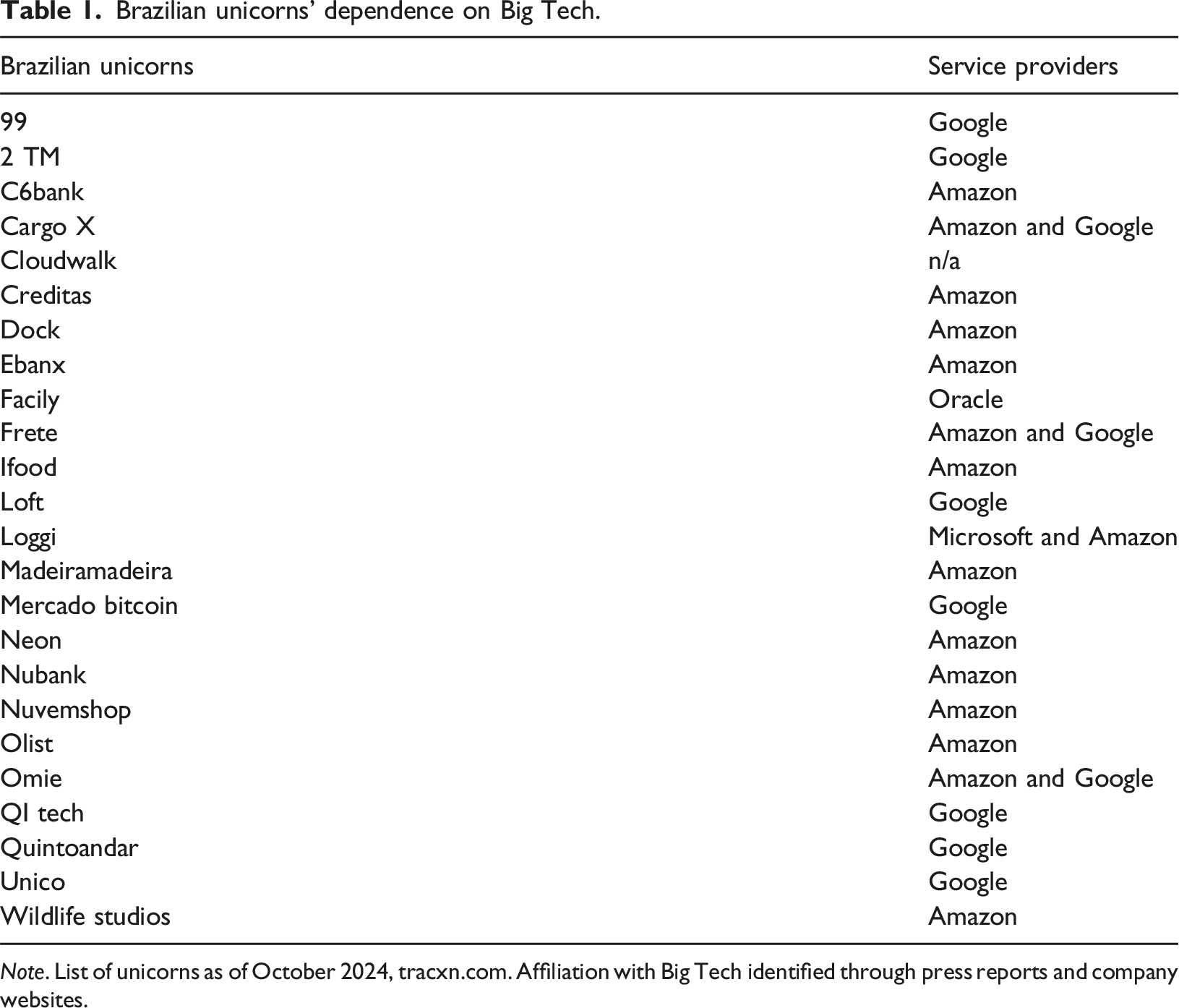
Note. List of unicorns as of October 2024, tracxn.com. Affiliation with Big Tech identified through press reports and company websites.
The dependence of Brazil’s tech sector on Big Tech corresponds with policy preferences aligned with Big Tech’s. Nearly a decade before the Marco Legal, policymakers began discussing internet regulations, which were passed in 2014 as the Marco Civil da Internet. The Marco Civil was Brazil’s first comprehensive internet regulation, and Big Tech was understandably concerned, given that Brazil had previously shut down WhatsApp due to legal violations and that Big Tech executives faced the risk of arrest when their firms violated Brazilian law (Veronese and da Fonseca, 2021). Google, Facebook, and the Argentinian platform MercadoLibre wrote an open letter to legislators in which they expressed their concerns about the pending Marco Civil, focusing much of their attention on the threat of being held liable for content posted by users. Big Tech deployed political, social, and economic arguments against intermediary liability, including the threat posed to startups: “The absence of safeguards tremendously increases costs for entrepreneurs, small companies, and Brazilian startups, creating disparities that make national innovation unfeasible and scare away foreign investments” (Migalhas, 2012). Startups agreed, with Guilherme Junqueira, the executive director of ABStartups, telling a journalist that intermediary liability would “make startups disappear overnight” (Caputo, 2014).
While Brazilian startups’ policy preferences may align with Big Tech’s, this alignment is due to dependence, rather than equality. That dependence became evident in the case of the Marco Legal when Facebook and Google withdrew their support for Dínamo around 2019. According to Dínamo’s leaders, this significantly hampered their effectiveness, with one underlining that “we can’t do what we were doing without the funding from Facebook and Google.” 16 One leader confirmed that they would have been able to push more if they had had more funding, because we “would have had full-time people in Brasilia, lobbying in Brasilia.” 17 Of course, other factors played a role in limiting Dínamo’s effectiveness, such as the Covid crisis. Nonetheless, Big Tech’s withdrawal of support during the final push for the Marco Legal weakened Dínamo’s ability to secure some of the policy elements they cared about most, such as ESOP.
In Brazil, startups are dependent on Big Tech not just for essential technology but also for financial and organizational resources necessary for policy advocacy. Big Tech’s patronage is what enabled Dínamo to assemble an upgrading coalition to lobby for the Marco Legal. Their political activity, however, was just as dependent on Big Tech as startups’ economic activity, illustrated by the withering of their advocacy when Big Tech withdrew its support.
Spanish startups’ political dependence on Big Tech
Spain’s passage of the Ley 28/2022, de 21 de Diciembre, de Fomento del Ecosistema de las Empresas Emergentes, known as the Startup Law, built on a mixed legacy of policy support for entrepreneurship. Despite some existing policies, such as government loans through a dedicated agency for SMEs in 2005 and the 2013 “Entrepreneur’s Law,” a 2016 study by the European Commission placed Spain in the bottom half of EU countries in its support for startups (Van Roy and Nepelski, 2016, 3–4). Against this backdrop, the 2022 Startup Law marked a new direction for policy because it explicitly targeted startups.
Spain’s startup law provides extensive support for startups. It has three main elements. First, it defines startups, focusing on firms that are less than 5 years old, independent, unlisted, innovative, have revenues under €5 million, and do not distribute profits. Second, the law provides benefits for startups, such as reducing corporate taxes, lessening bureaucracy, and introducing “digital nomad” visas for employees. Third, it provides benefits for investors by offering funds for co-investment and tax deductions for investments in startups (DealRoom, 2023). Other sections of the law dictate the process for certifying startups as “innovative,” as well as other forms of support. The 2022 Startup Law marks a sea change in Spain’s support for startups and one of its most significant economic upgrading efforts in decades.
A wide swath of Spanish business associations supported the Startup Law, thanks to advocacy by the Asociación Española de Startups (AES). Founded in 2015, AES grew out of the “startup manifesto movement,” in which Europe’s startup ecosystem banded together to demand policy changes to support startups (Asociación Española de Startups, 2024b). By 2022, AES boasted more than 700 members, comprised mostly of startups, along with other members of Spain’s startup ecosystem, such as investors and large technology companies (Asociación Española de Startups, 2022b). AES organized widespread enthusiasm for the startup law, from local startup associations, such as Startup Valencia, to investors’ associations like Spaincap, as well as Cotec, a transnational foundation that supports innovation (Asociación Española de Startups, 2022c).
AES’s centrality in advocating for the Startup Law is illustrated by its extensive public support and its involvement in the policy process. AES released many public statements supporting the Startup Law, in attempts to drum up excitement among the public (Asociación Española de Startups, 2022a). In December 2015, AES held an electoral debate for parliamentary candidates and another in June 2016, where “the main topics discussed [were] the strategic importance and potential of the startup sector, the regulatory and fiscal framework necessary for them to be an economic engine, and the role of innovation and investment” (Asociación Española de Startups, 2016a, 7). In 2016, AES’s leadership met with Pedro Sanchez during his successful campaign for prime minister, pressing him on what he would do to support startups (Asociación Española de Startups 2016b). These efforts to build support for upgrading policy targeting startups continued from 2015 until the Startup Law was passed in 2022, with AES acting as startups’ main voice.
In addition to its high-profile public events to support the passage of the Startup Law, AES was also deeply involved in drafting the policy. AES met with administrative agencies, such as the National Innovation Company (ENISA), and with political parties, to lobby for a robust startup law (Asociación Española de Startups 2016a, 8). AES’s members followed its advice to participate in the public consultation process (Asociación Española de Startups, 2018). The Ministry of Economics and Digital Transformation reported that a plurality of the public comments it received on the bill came from entrepreneurs and startup workers (42%), with the second highest proportion of comments coming from business associations (22%). Similarly, of the 80 statements made during public hearings on the Startup Law, 35% were from business associations and 33% from entrepreneurs and startup workers (Ministerio de Asuntos, 2021, 3).
As policymakers readied to approve the Startup Law, they highlighted their close collaboration with startups. Member of Parliament Víctor Píriz Maya announced in parliament: This is the meaning of our role here: legislate, talk to the sectors involved—in this case, the innovative startup sector—sit down with them, analyze the viability of what they propose and propose improvements to the different laws. That is our job here and that is what we have done in this law. … with a spirit of collaboration, negotiation and consensus (Congreso de los Diputados, 2022a, 15).
AES was the primary advocate who counseled policymakers on designing the Startup Law and shepherded it through the policy process. A former Public Affairs Director at AES recalls coordinating weekly meetings among different stakeholders while the bill made its way through parliament, to “put in common the different conversations we had, different approaches, problems we faced during these conversations, trying all the time [to ensure] that the advances we were trying to do were in a similar direction.” 18
AES’s efforts led every corner of the political spectrum to support the Startup Law. This is a remarkable feat, considering the character of Spanish politics in this period, whose tumultuousness is evident in the constitutional crisis of 2017 and 2018. Member of Parliament Maria Muñoz Vidal described the startup law as “the only haven of peace and understanding in this Congress” (Congreso de los Diputados, 2022b, 20). Consistent with the pattern of an effective upgrading coalition, AES managed to build broad consensus for complex institutional reforms, with all the major parties in Congress approving the Startup Law on December 1, 2022. How was AES able to construct and lead this successful upgrading coalition?
One member of AES’s upgrading coalition who played a central, if publicly invisible, role was Big Tech. AES is closely connected to Facebook and Google through informal and formal networks. All of AES’s leadership had or has close ties to Google. One of AES’s co-founders ran the startup accelerator Tetuan Valley, where they developed a close relationship with Google’s Spanish leadership when Tetuan Valley was chosen as the anchor for Google for Startups in Spain, where it remains today. 19 Carmen Bermejo, president of AES from 2017 to 2018, also led Tetuan Valley from 2013 to 2018, which overlapped with co-founding AES (Bermejo, 2024). Carlos Mateo, president of AES since 2018, served on the board of AFS from 2018 to 2020, the startup association funded by Amazon, Apple, Google, Meta, and Microsoft (Mateo, 2024).
Big Tech provided the initial funding for AES’s founding. Although AES formed in order to represent startups, they struggled to attract members. According to an AES co-founder, “We tried the membership stuff but nobody believed in this crap. They would literally tell us, ‘What are we going to get for our money?’” 20 One AES leader recalls a startup founder telling them, “If you are going to do this, regardless if I give you money or not, why should I do it [pay for membership]?” 21 This lack of support from startups meant that AES faced “a problem of income, sustainable income. We got some sponsorship from some technology companies, and that helped.” 22 Another leader was more specific: “So Facebook and Google actually invested there [in AES] from the beginning.” 23 Evidence of this financial support endures today. AES’s website lists its partners as AWS, Google, and Meta (Asociación Española de Startups, 2024a).
Big Tech’s funding is what enabled AES to advocate for the Startup Law. One AES leader reports that “it was more than enough money to get a little off the ground,” certainly enough to hire a skilled lobbyist who was “the one that made the law happen.” 24 In addition to financial support, Google offered organizational assistance: “they would help us run the events, they would come to the event. So whenever we would say, ‘you know, we’re going to run this debate’, and then we would bring someone from Google, like legal counsel from Google.” 25 Google offered its “emblematic” Madrid campus for the first electoral debate that AES hosted in 2015, 26 and the second debate took place at Facebook’s Madrid offices (Asociación Española de Startups, 2016a). One AES leader recalled how Big Tech firms offered access to extensive resources, including large teams working on policy development. Describing regular meetings with Google’s legal counsel, another leader emphasized that Big Tech firms “were involved in this thing also. Don’t get me wrong. It’s not like they didn’t have a seat at the table. They clearly had a seat at the table.” 27
Spanish unicorns’ dependence on Big Tech.
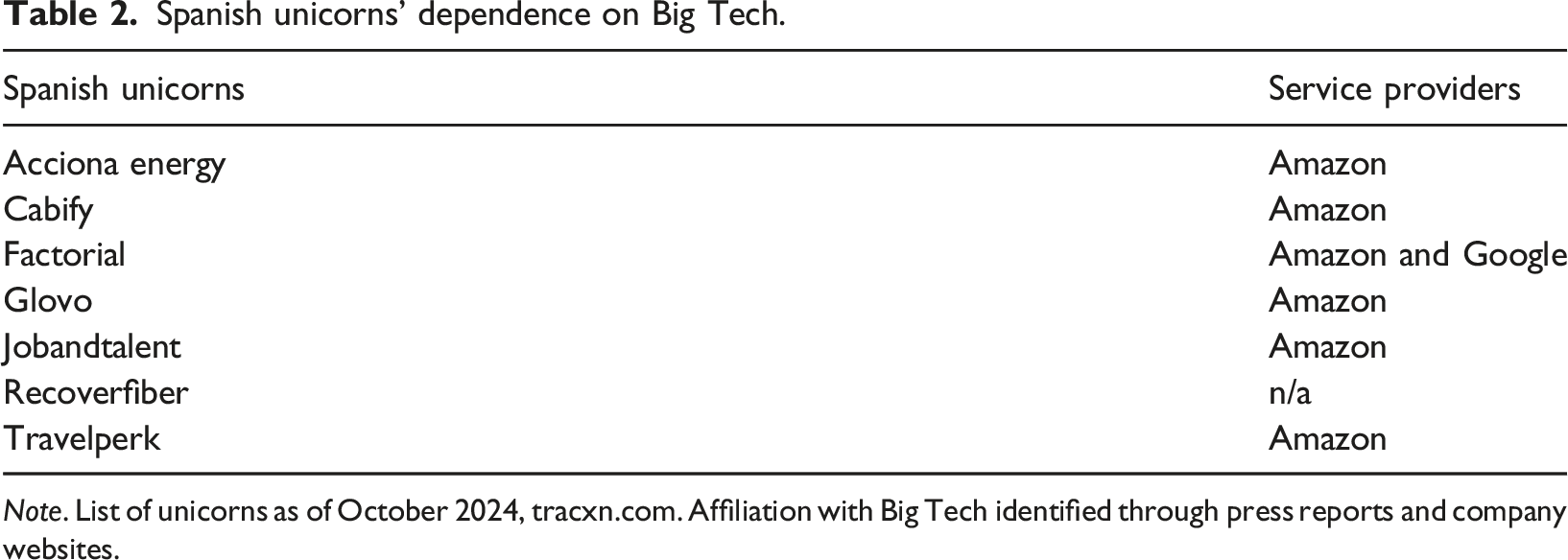
Note. List of unicorns as of October 2024, tracxn.com. Affiliation with Big Tech identified through press reports and company websites.
The Spanish tech sector’s technological dependence on Big Tech is reflected in their policy preferences. In the 2010s, Spanish legislators began discussing a copyright law that required news aggregators to pay media producers for links they posted to those producers’ websites. The law became known as the “Google tax” because it directly targeted Google News. Google publicly opposed the law and built a civil society coalition, Coalición Pro Internet, to lobby legislators. Spanish tech firms joined the Coalición Pro Internet and were perhaps its most vocal members because while large foreign firms like Google may have been legislators’ target, the “Google tax” also threatened Spanish tech firms who had built platforms similar to Google News. Spanish startup founders posted studies that the law would cause €1.1 billion of damage to the Spanish tech sector (Alonso, 2014). The founder of the Spanish startup Menéame wrote that “the reality is that proportionally it affects Menéame much more than Google” (Galli, 2014).
Similar to Brazil, Spanish tech firms’ economic interests overlap with Big Tech’s, and they allied with Big Tech to advocate for shared policy goals. Like their Brazilian counterparts, Spanish firms are technologically dependent on Big Tech, so the alliance between Spanish firms and Big Tech was marked by asymmetry. While Spanish startups’ policy advocacy was no less dependent on Big Tech, Big Tech did not withdraw its support for AES before the startup law was passed, which may help explain why Spain’s startup law is more robust than Brazil’s.
Discussion and conclusion
Despite hopes that startups can lead peripheral economies out of dependence, this article identifies significant limitations. By reviving political analysis of dependency, the article highlights how startups’ ability to lead upgrading coalitions depends on Big Tech’s support. In both Brazil and Spain, Big Tech acted as a patron to startups because startups’ technological dependence aligned their policy preferences. This enabled Big Tech to rely on startups’ advocacy for shared policy goals without explicit coordination. Big Tech’s support for AES in Spain enabled startups to pass a robust startup law. In Brazil, Big Tech enabled Dínamo to take shape and begin lobbying for a startup law, but Big Tech’s withdrawal of support left startups without the resources to push for their desired policies, leading to a startup law that fell short of their expectations. This comparison illustrates the importance of Big Tech’s support to startups’ political influence. Startups depend on Big Tech’s resources in order to overcome the limits that otherwise prevent them from participating in the policy process. Analyzing startups’ political dependence on Big Tech illustrates that in digital capitalism, just as in previous eras, the limits on peripheral regions’ ability to escape dependence on the core are more than economic.
Highlighting these dynamics of dependence in digital capitalism raises questions to take up in future research. First, to what extent are geographical notions of core and periphery still useful? Building on evidence of core-periphery dynamics among firms, rather than countries (Rikap, 2024), the analysis presented above illustrated startups’ dependence on Big Tech in the historical core, namely, Spain. But even in the contemporary core of digital capitalism, similar dynamics appear, such as US startup associations’ political dependence on Big Tech. Engine is a startup association founded in the United States in 2011 that lobbies extensively around policies affecting startups. From its founding through the present day, Engine has depended on Google’s funding, and lists other Big Tech funders in its 2023 Annual Report, including Amazon and Meta (Engine, 2023; Google Transparency Project, 2018). Future research could compare the relationships between startup associations and Big Tech in core and peripheral regions to investigate whether and how geography remains relevant to dynamics of dependence in digital capitalism.
Second, future research could extend these findings in order to probe for evidence of Big Tech directly influencing startup policy. The evidence presented above mirrors analyses of economic dependence, in which multinational firms based in the core operate in a structural situation that automatically empowers them. For instance, multinational firms do not need to exercise direct influence in order to benefit from unequal exchange (Naseemullah, 2022). Applying Palestini and Madariaga’s (2021, 5) distinction between “situations” and “mechanisms” of dependency, startups’ technological dependence appears as a “situation” of dependence, which aligns startups’ interests with Big Tech’s, while Big Tech’s sponsorship of startups’ political advocacy appears as a “mechanism” of dependence, in that it is one of the “concrete ways through which dependency works.” Big Tech has explicitly designed strategies to transform users’ technological dependence into political influence. For instance, Airbnb lobbied against a regulatory threat in San Francisco in 2015 by mobilizing hosts “whose economic well-being was highly dependent on the platform and needed Airbnb to help make ends meet” (Burfield and Harrison, 2018, 248). In many cases, Big Tech’s technological domination enables it to avoid exercising direct political influence, but future research could examine a wider range of cases for potential exceptions.
Lastly, future research could explore additional factors that limit startups’ ability to reduce peripheral economies’ dependence on the core. As this article has illustrated, those limits are political in important ways, because if the impetus for economic upgrading comes from Big Tech’s allies and is consistent with Big Tech’s interests, there is little chance of reducing technological dependence. These political limits can also be placed in a broader framework, such as international relations, where US foreign policy may play a role in shaping the conditions for Big Tech’s domination (Farrell and Newman, 2023). Big Tech’s alliance with the Trump regime suggests that understanding Big Tech’s power has become more pressing since January 2025.
Footnotes
Acknowledgments
I am grateful to Darius Ornston and Kevin Young for initial conversations about startups’ political power, to Renato de Gaspi, Erez Maggor, Jimena Valdez, and participants in the research colloquium at Williams College’s Oakley Center, for thoughtful feedback on an early draft, as well as Galen Jackson, who helped me think through the relationship between Big Tech and startups.

Ethics considerations
The Williams College Institutional Review Board approved interviews on December 18, 2023. Respondents provided written informed consent.
Funding
The author disclosed receipt of the following financial support for the research, authorship, and/or publication of this article: Department of Political Science, Williams College; Oakley Center for the Humanities and Social Sciences, Williams College.
Declaration of conflicting interests
The authors declared no potential conflicts of interest with respect to the research, authorship, and/or publication of this article.
Notes
Interview list
Brazil
Number
Title
Interview date
1
Founding Board Member, Dínamo
December 20, 2023
2
Founding Board Member and Former Executive Director, Dínamo (2015-2019)
January 16, 2024
3
Executive Director, Dínamo (2015 – )
March 24, 2024
4
Subsecretary of Innovation, Ministry of the Economy (2019 – 2021)
Director of Industrial Competitiveness (2018 – 2019), Special Assessor (2018), Director of Innovation and Intellectual Property (2015 – 2018), Ministry of Industry, Foreign Trade and ServicesApril 1, 2024
Spain
Number
Title
Interview date
5
Cofounder and Former Board Member, Asociación Española de Startups (2015 –)
March 27, 2024
6
Co-founder and former President, Asociación Española de Startups
April 8, 2024
7
Public Affairs Director, Asociación Española de Startups
(2017 – 2023)April 9, 2024
8
Member of Congress (PP), Deputy Spokesperson for Economic Affairs and Digital Transformation (2016 – 2023)
April 16, 2024