




Abstract
Political economy scholarship on Eastern European countries identifies their export-led growth models as dependent on foreign direct investors (FDI). This paper argues that small and medium enterprises (SMEs) are another important cohort of exporters for at least some of these countries. We attribute the success of exporting SMEs to the rise of new technologies and production processes, which have allowed economic agents from peripheral countries to engage with global value chains and international business-to-business trade directly, rather than via FDI. We empirically draw on an in-depth case study of Serbia, combining macroeconomic analysis and 145 interviews with exporting SMEs. The country made a notable switch from consumption- to export-led growth in the aftermath of the 2008 crisis, despite lagging in FDI attraction. To address this puzzle, we show that internationalization of SMEs became an additional driver of the country’s exports. Then examining how these exporters have internationalized, we find that firm co-location is not a main source of knowledge exchange for them. Instead, they emphasize the importance of drawing upon translocal sources of knowledge exchange for international competitiveness. Using SME owners’ networks abroad, immigration experiences, clients from online platforms, and contacts from outsourcing opportunities has provided them with the knowledge needed to become innovative, and to repurpose the old socialist industrial resources they had at their disposal. Since exporting SMEs and their multi-level agency is an empirically under-researched phenomenon in the region, future studies on peripheral export-led growth models should explore economic and political implications of this growth coalition further.
Keywords
With the rise of information and communication technologies (ICT) in the 21st century, global value chains (GVCs) and international business to business (B2B) trade have become primary modes of engagement with the world economy for many countries which previously had to wait for entire industries to develop within their borders (Whittaker et al., 2010). A growing number of small and medium enterprises (SMEs) from peripheral economies have been boosting their productivity and innovation capacities through direct interaction with the global economy (Harvie and Charoenrat, 2015). This indicates that foreign direct investment (FDI) is no longer the only channel through which smaller domestic firms in peripheral countries can acquire the know-how they need to internationalize and become competitive in the global economy.
Matching these insights, this paper argues that a distinct cohort of exporting-oriented SMEs can be found in some countries of Central Eastern and South-Eastern Europe (CESEE), a region whose export-led growth models are homogenously described as FDI dependent (Avlijaš et al., 2021; Ban and Adascalitei, 2022). We thus offer a more heterogeneous understanding of these advanced peripheral growth models by identifying export-led growth coalitions that go beyond FDI dependency and that are not well documented.
Identifying exporting-oriented SMEs as a distinct cohort of economic actors, the paper also adds nuance to the recent comparative political economy (CPE) discussions on Central and Eastern Europe (CEE) which portray domestic firms as politicized and reactionary against transnational capital, and oriented towards rent-seeking in collaboration with the growingly authoritarian regimes (Magyar and Madlovics, 2020; Naczyk, 2022). We thus challenge the commonly held view that promotion of domestic capital is necessarily a form of defence against transnational dependency by suggesting that it can also be a different form of engagement with the global economy.
We empirically draw on an in-depth case study of Serbia which consists of a detailed analysis of the country’s macroeconomic exporting trends and 145 interviews with exporting SMEs. Until 2015, Serbia was a laggard in CESEE in the attraction of FDI, especially of the exporting-oriented type. Nonetheless, the country made a notable switch from consumption- to export-led growth in the aftermath of the 2008 crisis (Ban and Adascalitei, 2022). To address this puzzle, we show how after 2008 internationalization of SMEs which didn’t have direct linkages to localized FDI became an additional driver of the country’s exports, and that it compensated for the country’s slower attraction of FDI. To increase the generalizability of our findings, we indicate that some other economies in the wider region, such as Estonia and Slovenia, also have a substantial share of SMEs in the structure of their exports. Since exporting SMEs are an empirically under-researched phenomenon, we suggest that future CPE studies should explore this driver of export-led growth in other countries where FDI is assumed to be the only driver of exports, but where empirical data indicates otherwise.
Besides accounting for non-FDI based drivers of exports in peripheral growth models, the paper examines the mechanisms through which these exporting-oriented SMEs have tapped into international markets. Although the Serbian government has focused on FDI-oriented industrial strategies, we show that a new type of productive and innovation strategy has become available to export-oriented SMEs with the rise of ICT and the knowledge economy, and the associated changes in global business practices. This is a distinct strategy from Piore and Sabel’s industrial districts’ based flexible specialization model which emerged in advanced capitalist economies during the 1970s (Piore and Sabel, 1984), as it relies less strongly on physical proximity among firms. While we show that exporting SMEs tend to cluster geographically in areas where related industries had flourished in the socialist era because of the availability of workers who have useful skills for a particular industry, as well as the proximity of production inputs and sources of capital, we also show, in contrast to much of the mainstream literature on industrial districts and clusters, that these SME exporters do not find firm co-location an important source of knowledge exchange. Instead, they argue that firm owners’ networks abroad, immigration experiences, clients from online platforms, and contacts originally created in the context of outsourcing, have provided them with the knowledge they need to become innovative, bypassing the need for a physically proximate ecosystem of firms where tacit knowledge circulates. Thus, the resources that are available to these SMEs locally such as skills developed during socialist times got repurposed by drawing on translocal, rather than localized sources of knowledge exchange.
The article is organized as follows. The next section offers an overview of CPE literature on peripheral growth models, followed by insights from GVC, development studies and economic geography scholarship that we use to underpin our argument. We then discuss our case selection and methodology, and present empirical evidence on the rise of the exporting SMEs in Serbia. The last section offers concluding remarks and suggests avenues for further research.
Literature review
Beyond FDI in dependent export-led growth: Enter exporting SMEs
Analyses of growth regimes in Europe’s eastern periphery have focused on FDI dependency as their key feature. Early CPE research argued that FDI was an essential source of capital and know-how and characterized these countries as dependent market economies – DMEs (Nölke and Vliegenthart, 2009). Avlijaš et al., 2021 then identified Visegrad and Baltic countries as FDI-led exports-oriented growth regimes. Expanding their empirical focus to also include SEE, Ban and Adascalitei (2022) show that export-led models in CESEE are distinct due to their dependence on FDI, which is why they refer to these economies as dependent export-led growth models. They also argue that policy reactions to the 2008 crisis led to a consolidation of dependent export-led growth models in the region (Ban and Adascalitei 2022: 191).
CPE scholarship has also emphasized how the state underpins FDI-dependent growth. Bohle and Greskovits (2012) showed how FDI dependency shaped these countries’ politics and policy since the onset of post-socialist transition. Bohle and Greskovits (2018) then showed that FDI-oriented growth continued in Hungary after 2008, with quiet government support for exporting-oriented FDI in particular, despite its populist anti-FDI rhetoric towards sectors focused on domestic consumption, such as banking. The supranational dimension has also been explored, including its unequal core-periphery dynamics, leading to new theoretical and empirical insights on the pros and cons of managed market integration by reliance on transnational capital (Bruszt and Langbein, 2020; Bruszt and Vukov, 2018; Rhodes et al., 2019). Introducing the developmental state into the EU periphery, Bruszt and Langbein (2020) showed how the EU as a transnational integration regime can facilitate or constrain peripheral countries, contingent on their domestic institutional capabilities. All this research, however, sees multinational companies (MNCs) as key economic actors driving export-led growth.
For a long time, domestic firms were perceived as too small and inefficient to innovate and also as primarily operating in the nontraded sectors (Appel and Orenstein, 2018; Bohle and Greskovits, 2012; Nölke and Vliegenthart, 2009). In the more recent debates on the rise of economic nationalism in Eastern Europe, which have mostly focused on Hungary and Poland, domestic firms have started to draw some scholarly interest. Emphasis, however, has been placed on their politicization and entanglement with the state in their attempts to push out transnational capital (Naczyk, 2022) or on how they benefit from corrupt deals with growingly authoritarian regimes (Magyar and Madlovics, 2020). CPE literature has also increasingly turned towards accounting for greater domestic political efforts in Hungary and Poland to control the economy and reduce their levels of transnational dependency by supporting domestic, politically connected firms (Naczyk, 2022; Sebők and Simons, 2021). None of this research has looked at domestic exporters and how they interact with international markets and supranational institutions independently of the state. Moreover, in line with the state-institutionalist framework, and with the exception of Naczyk (2022) who looks at the interactions of domestic entrepreneurs and ‘compradors’ with the Polish state, most CPE research on the region assumes that local economic development has to be started by the state and that local actors cannot do anything from the bottom up. Instead, they have to wait for the state to change the institutional framework which then incentivizes them towards entrepreneurial activity and away from rent-seeking (following Baumol, 1990). These perspectives reinforce the view that peripheral economic actors lack the ability to change conditions that structure their lives while the only economic actors with agency are MNCs, for better or for worse. The CPE literature on the region also reinforces the idea that any success of domestic economic agents in the global economy should be attributed to the developmental state and that no other institutions or domestic stakeholders can play a role in domestically-driven development.
On the other hand, surveying development studies scholarship, Puente and Schneider (2020) show that firm diversity by ownership, size and organization plays an important role in economic development across the world because it increases the potential pool of development-enhancing firms. They also urge policy makers to inventory the types of firms and their capabilities and needs before designing any industrial and innovation policies. Reflecting on the role between entrepreneurship and politics, Yadav and Mukherjee (2016) show that in corrupt autocracies, SMEs are the drivers of coalitions that demand anti-corruption measures because SMEs are outsiders to the established business elite, as well as the biggest employers of the economy. They can therefore have a positive effect on institutional development and growth. These perspectives giving agency to smaller economic agents vis-à-vis the state also echo Schumpeter who argued that entrepreneurs and smaller firms represent the political foundation of democratic capitalism (Henrekson and Jakobsson, 2001), as well as the earlier transition economics literature which emphasized the positive relationship between entrepreneurship and democratization (Roland, 2000).
Following identification of these literature gaps, we argue that state-of-the-art in CPE obscures alternative developmental pathways which have more recently taken root in some advanced peripheral economies, in CESEE and likely beyond. We also argue that accounting for non-state stakeholders and their agency in economic growth should be a particularly important research agenda for the CESEE context, since there are increasing concerns that the developmental state in the region has been prone to capture either by special interests of autocratic regimes or by the FDI. Yet, CPE literature keeps offering us the paradoxical solution of needing even more of the developmental state to manage the economy, amid concurrent fears that the state is politically captured by autocratic leaders. While we do not argue against state involvement in managing the economy, our logic follows the bottom-up approach to economic governance. We argue that by mapping the needs of various economic agents that contribute to export-led growth, and the strategies they currently use to overcome the constraints of state capture and weak institutional support, we can also improve our ideas about what kind of developmental and industrial policy may be needed and how more heterogeneous policy support can be supplied to the different coalitions that underpin export-led growth. These questions are also pertinent for other emerging markets which lack developmental state capacity, and they are in line with efforts by Aiginger and Rodrik (2020) to design a multi-stakeholder industrial policy for the 21st century.
How exporting SMEs innovate and internationalize
But how do peripheral SMEs innovate and internationalize in contexts where industrial policy favours FDI interests? What insights can we gather from literatures focussing on SME-level perspectives on economic development?
In line with CPE and IPE (international political economy) literature, GVC informed perspectives describe that the inclusion of the periphery into economic globalization processes has been driven by efforts to improve the competitiveness of western companies following the crisis of Fordism. By relocating some parts of the lead firms’ production process to countries with cheaper manufacturing labour, advanced capitalist economies found a cost-effective adaptation to the demise of Fordism, while also offering a developmental opportunity to the periphery. Like political economists, GVC scholars have critiqued this model because local subsidiaries in the periphery typically have little room to contribute to the lead firm’s innovation processes or capture more of its value added. We have thus seen low spillover effects from FDI to the rest of the economy, in CEE in particular (Zoltán and Gábor, 2022).
More recently, GVC and the broader policy literature have identified another economic phenomenon, that of growing internationalization of geographically dispersed specialized and niche SMEs from peripheral economies (Harvie and Charoenrat, 2015; Whittaker et al., 2010). Apart from their better price competitiveness due to the lower cost of labour and more frugal and cost-effective forms of innovation that characterize the developing world (Pisoni et al., 2018), factors such as the decreasing costs of remote communication and coordination brought upon by ICT have generated new opportunities for peripheral SMEs to find clients in the global economy and form production networks with them without that specific sector of specialization having to be present in their home country in the form of FDI. Moreover, ‘new digital information flows, services, and networks may be altering the economic value distribution within production networks’ (Foster and Graham, 2017: 73), which indicates that these SMEs have been able to capture more value from them. The semantic shift in the literature from global production chains to global production networks indicates that agency is being increasingly diffused from lead firms in the global core which order tasks from their subsidiaries and/or subcontractors in the periphery, towards a more dynamic, innovative and value capturing process for peripheral SMEs. In other words, there is growing evidence that the more recent waves of globalization, underpinned by the rising application of ICT in manufacturing, have been strengthening the agency of smaller economic actors from peripheral economies by allowing them to make better use of the global networked economy to upgrade their production and innovation capabilities. Moreover, the economics literature on CEE is also seeing this increasingly important role of smaller, dispersed economies from around the world in the global economy as an important post-2008 developmental opportunity for the region (Gerőcs and Ricz, 2021). Since CESEE countries are already some of the most globally integrated economies, it seems pivotal to enquire whether and how these global production trends have already affected the composition of their exports and heterogeneity of their economic actors.
The development of alternative production capabilities of peripheral SMEs can also be associated with what Piore and Sabel (1984) referred to as flexible specialization which emerged during the 1970s in response to the growing consumer demand for custom-made and niche products. Such a system does not follow the Fordist principle of mass production. While mass production requires a narrow skillset of the workforce which only needs to know about the narrow task it is set to carry out, specialized production requires workers who have a wide range of skills, as well as tools and approaches that are more similar to preindustrial artisans than to semiskilled assemblers. Output comes in small batches of customized products, while those involved in it need to be highly adaptable to fast-changing market conditions and customers dissatisfied with standardized products. Thus, flexible specialization requires just-in-time production, a workforce with more knowledge and broader skills, and more flexible machinery and organizational design.
The exporting SMEs from core European economies which were at their peak from the 1970s to the 1990s, such as those of Italy’s Emilia Romagna and Germany’s Mittelstand, were typically organized into industrial regions and clusters so they strongly relied on firm co-location to innovate and access new markets. However, new types of productive and innovation strategies have become available to peripheral exporting-oriented SMEs with the rise of ICT-driven global business practices and the knowledge economy. Economic geography thus offers a novel understanding of fragmented and non-spatial models of firm innovation and internationalization. Starting with Iammarino and McCann (2006) who challenged the conventional wisdom that firm co-location improves the likelihood of local innovation, and that even clusters can benefit from external forms of knowledge exchange, a growing body of literature has shown that firms can benefit from translocal and virtual types of knowledge exchange. For example, for firms in peripheral areas, translocal innovations in networking can be more important than innovative product lines (Fitjar and Rodríguez-Pose, 2011; Rodríguez-Pose and Fitjar, 2013). Shearmu and Doloreux (2016) show how remote innovators innovate by relying on technological or science-based information that is less time sensitive than market-related information which is more accessible in urban agglomerations. Reflecting on the urban bias to innovation studies, where ‘innovation is understood as intimately connected with cities and clusters of economic activity’ (p. 53), Doloreux et al. (2023) show that rural and small-town firms rely on procuring knowledge-intensive business services which are not necessarily provided locally. Emerging political economy research is also increasingly interested in the relationship between peripherality and innovation. There is an interest in analyzing the role of institutional regimes at different levels of governance (especially sub-national and supranational) which facilitate upgrading and innovation capacities of smaller local firms that are captured by their peripheral contexts (Avlijaš, 2022; Bruszt and McDermott, 2012; Gartzou-Katsouyanni, 2020). Much of this research on innovation in the (advanced) periphery that has emerged over the past decade indicates that we need to pay more attention to new cases and remove our biases and assumptions that the periphery cannot innovate, or that co-location is a key driver of innovation and firm competitiveness. Since the principle of knowledge exchange and transfer of know-how via physical proximity between MNCs and local SMEs did not work as expected in CESEE, highlighting the limitations of inter-firm proximity as a source of innovation and upgrading, it seems pertinent that mechanisms of translocal knowledge exchange should be explored further, by also focussing on emerging markets.
At the same time, we acknowledge the limitation of peripheral innovation. We do not go against Rodriguez-Pose and Crescenzi (2008) who argue that peripheral regions can never maximize the benefits of globalization or have a level playing field with the richer and more urbanized areas of the core. The world is clearly not flat, and some regions and localities continue to have more resources than others. Yet, research on peripheral innovation shows that there is more agency in the periphery than is typically recognized and argue that peripheral economic agents can use translocal strategies to capture more value added from the global economy. We argue that these insights should be recognized even in the context of FDI-dependent CESEE, researched in greater detail, and supported by policy so that they can be scaled further.
To that end, our paper brings micro-level insights on firm level innovation into theoretical debates on growth models in peripheral capitalism, indicating that there should be a greater dialogue between political economy and economic geography. Findings from economic geography can support political economists in their efforts to understand how SMEs compete in today’s globalized economy. They also challenge the commonly held CPE position that SMEs in the periphery do not innovate and that the state is always ‘the first mover’ when it comes to the economy. Economic geographers can also benefit from exchanging with political economists since that would improve their understanding how SME innovation and exporting strategies can, apart from generating profits, allow firms to also navigate political constraints associated with absence of the developmental state and FDI capture of industrial policy. Such insights can make their findings more relevant for emerging market economies.
Case selection and methodology
Case selection
The paper empirically draws on an in-depth case study of Serbia’s exporting SMEs. Serbia rapidly switched from a consumption led to an export led growth model in the aftermath of the 2008 crisis. Figure 1 shows that exports have taken over consumption in terms of their contribution to growth of the Serbian economy. Moreover, according to World Bank indicators, exports reached 54% of GDP in 2021, from 32% in 2010, indicating that exports have become a key driver of growth over the past decade. Moreover, the data presented by Ban and Adascalitei (2022: 203-4) indicate that this switch in the growth model in the aftermath of the Great Recession was more pronounced than in most other CESEE economies, although they do not provide any explanation for it. Contributions of final consumption and exports to Serbia’s GDP growth. Source: Own calculations from National Accounts and BoP data, Statistical Office of the Republic of Serbia (SORS).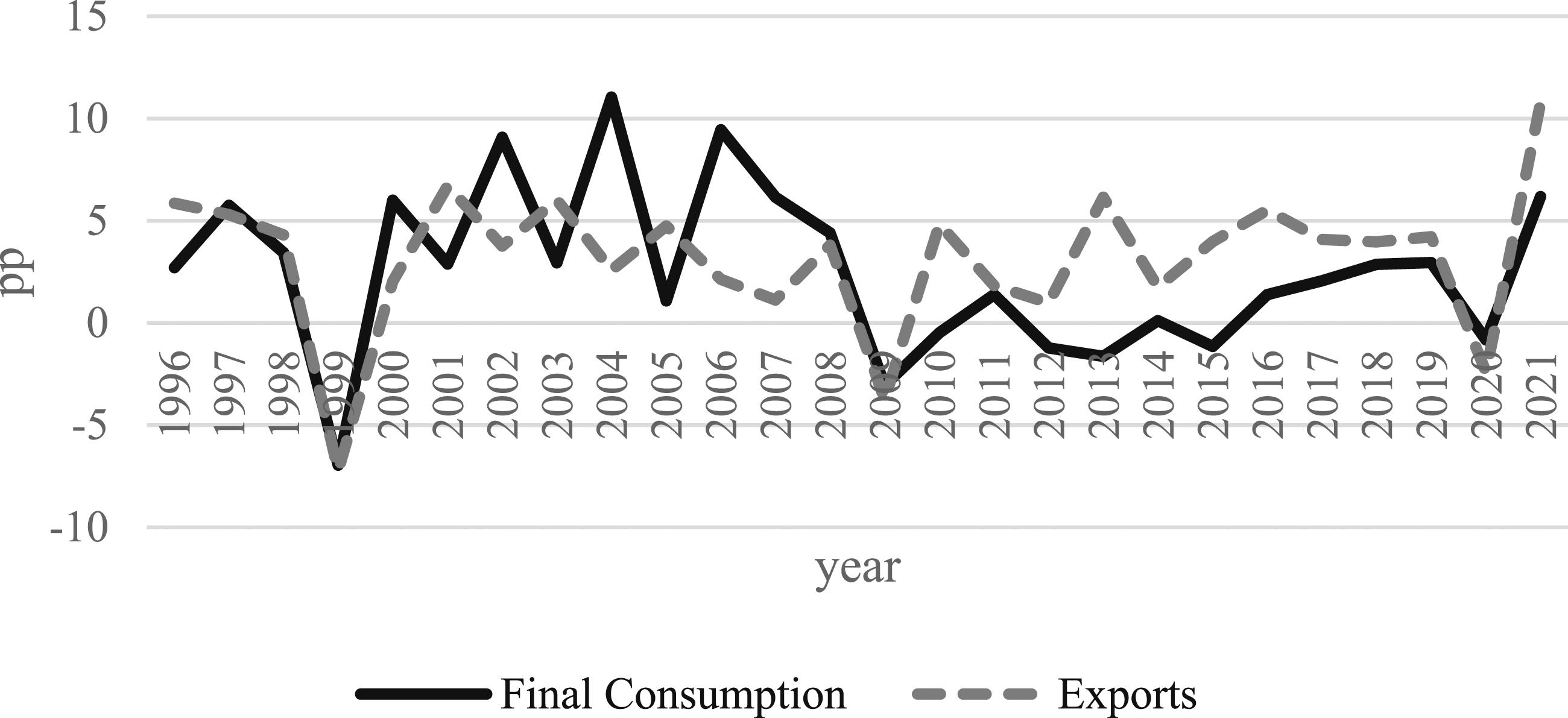
At the same time, although government policy has continually focused on FDI attraction, the country has been a regional laggard until at least 2015 (see Figure 2), due to its multiple political challenges and crises of the 1990s and 2000s rather than absence of industrial capabilities. This makes the switch from consumption- to export-led growth puzzling from the perspective of the analytical framework of FDI-dependent export-led growth. Inward FDI, stock per capita. Source: Own calculations from UNCTAD Statistics and World Bank Indicators.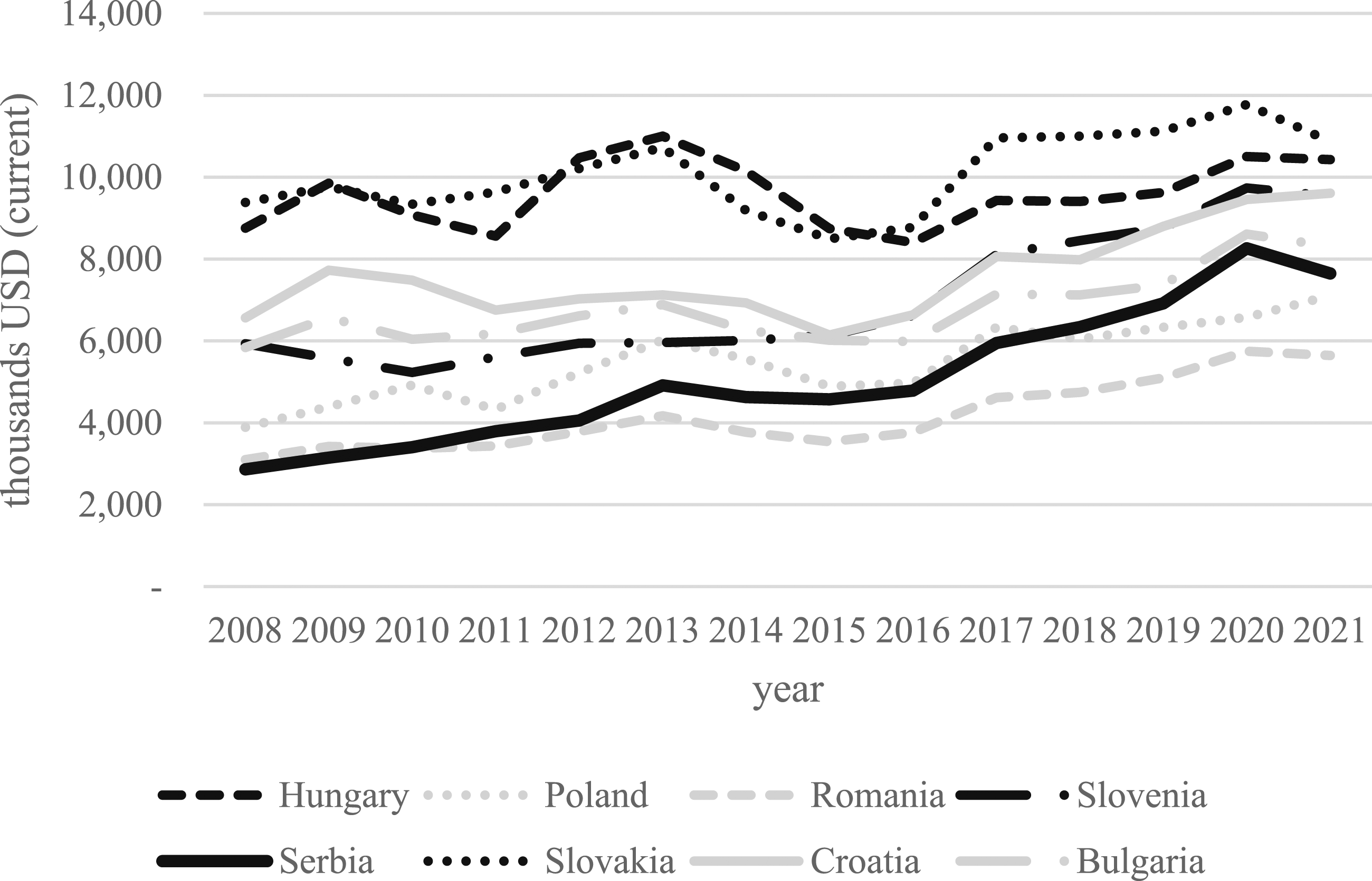
The puzzle, however, becomes explainable when we look at Figure 3 which places our case study in the wider context of European economies. The figure shows the percentage of total firms that are classified as goods exporters, as well as the percentage of manufacturing firms that are classified as goods exporters. Given that Eurostat does not provide data on service exporters, zooming into the manufacturing sector allows for a more balanced cross-national comparison, since the share of exporters among all firms underestimates the size of the exporting firm cohort in countries which predominantly export services. Since most EU economies are dominated by SMEs in terms of the total number of firms, we interpret this indicator in the following manner: the higher the share of exporting firms in an economy, the more SME populated its exporting sector is. For example, the Czech Republic is at the bottom of Figure 3, since below 5% of all its firms are exporters, which is consistent with the fact that the country’s export-led growth model is driven by a few large MNCs while most other firms either supply the domestic economy or participate in the export-led growth model by providing components to large MNCs who then act as exporters. Serbia is at the other end of the spectrum, on top of Figure 3, as it has the highest share of all, as well as manufacturing, firms as exporters.
1
Therefore, our country case is characterized by a highly fragmented exporting sector populated by many smaller firms. This makes it highly relevant for testing our hypotheses. Share of exporters in manufacturing and in all firms by country, 2020. Source: Own calculations from Eurostat data [EXT_TEC01__custom_6948997]; last accessed on 19 July 2023. Note: The data on manufacturing firms is not available for North Macedonia.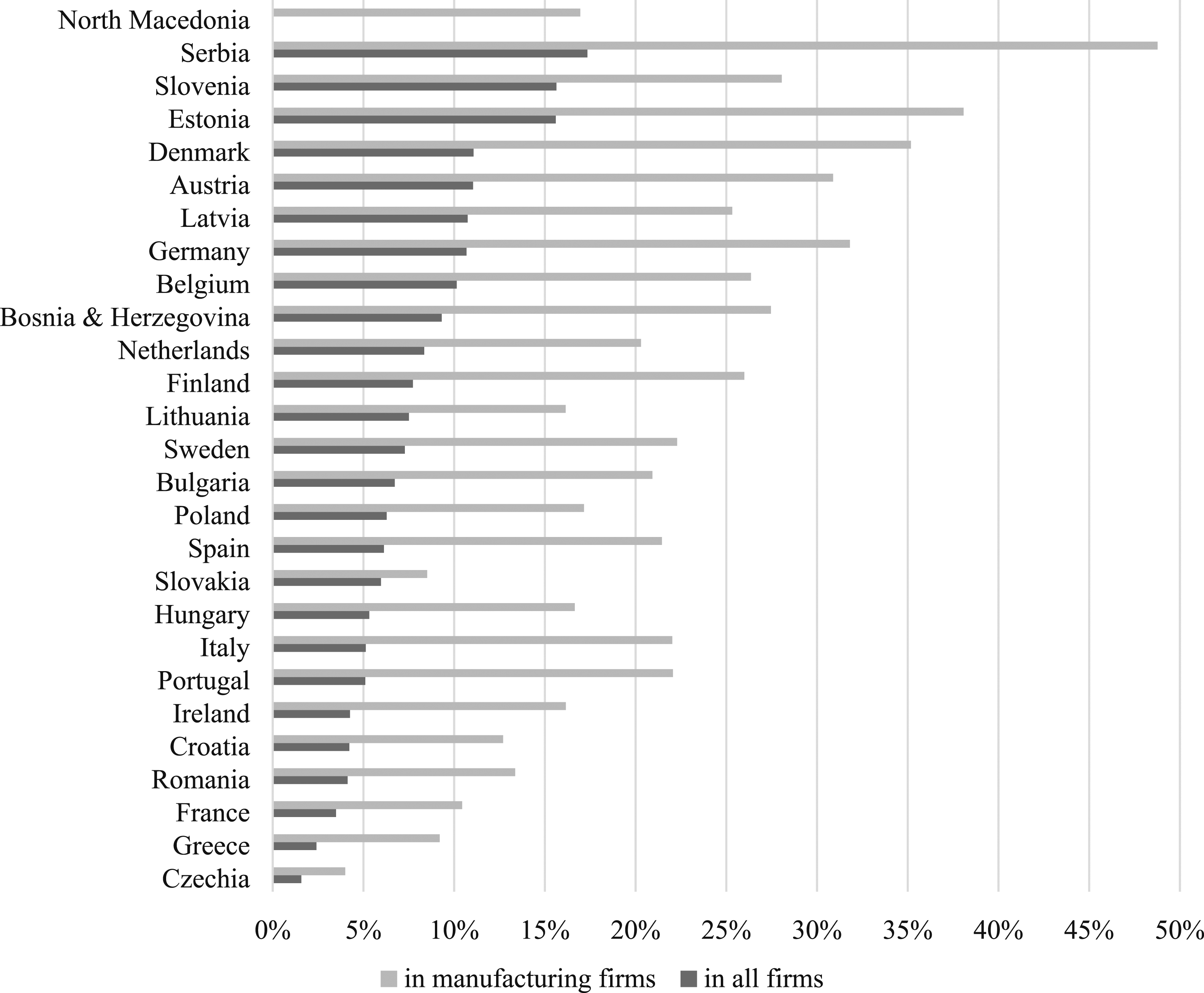
Figure 3 also shows that Serbia is closely followed by Estonia and Slovenia, as well as Denmark and Germany, all of which are known for a high share of exporting SMEs. Therefore, we should distinguish between countries where a larger share of SMEs are exports-oriented and thus more competitive versus countries where they are either oriented towards the domestic market or where they make part of supply chains for exporters but are not direct exporters themselves. We also see a large dispersion with regards to this indicator among CESEE economies. Estonia, Slovenia, Latvia, Bosnia and Herzegovina and Lithuania appear to have a more SME driven export-led growth model than a MNC driven one which seems to be more prevalent in the Czech Republic, Romania, Hungary and Slovakia. Since this is an empirically under-researched phenomenon, future studies should explore this alternative driver of export-led growth in other countries where MNCs are typically considered to be the only driver of exports, but where empirical data indicates the presence of additional actors.
Offering an explanation for how Serbia so convincingly switched from consumption to export-led growth in the aftermath of the financial crisis, we also contribute to overcoming the current bias in the political economy literature on the region which argues, based on a few macroeconomic indicators rather than in-depth country cases, that every economy in the region has been following the same trajectory. For example, although Ban and Adascalite (2022) include data on Serbia and other SEE countries such as Bulgaria and Romania, they do not comment on these countries but indirectly assume them to be part of a broader regional trend of FDI-dependent export-led growth. Furthermore, understanding in greater detail how a country switches from a consumption- to export-led growth model following a severe crisis – The Great Recession, has implications for many economies around the world.
Hypotheses
We empirically test the following three hypotheses which summarize our key arguments:
Internationalization of SMEs has contributed to the entrenchment of Serbia’s export-led growth model after 2008.
Exporting SMEs in Serbia are fragmented, engaged in innovative flexible specialization, and their international clients are mostly businesses.
Exporting SME have relied on two mechanisms to innovate and achieve international competitiveness: a) proximity to decaying socialist industries for access to skills and workers, production inputs and sources of capital; and b) translocal networks for knowledge exchange.
Data sources
Our empirical analysis is based on a combination of data sources. We use descriptive statistics on trade, firm size and industrial profiles of the SMEs to estimate the size of the exporting SMEs cohort in Serbia and to map the variety of product and service lines that they offer. Since international trade statistics are not detailed enough to offer a complete picture of international production/distribution networks, while country level statistics on production profiles do not get into the technological and innovation related characteristics of the exported products, we also complement the available statistical insights with qualitative observations that are collected from interviews with owners and/or general managers of 145 exporting-oriented domestically owned SMEs. The interviews were exploratory and open-ended, generally focussing on the factors which the SMEs attributed to the success of their business models.
The interviews with SMEs were conducted between 2017 and 2021. Of the total sample, 110 SMEs belong to 18 different manufacturing industries,
2
some of the most significant of which are Food products, Machinery and equipment and Fabricated metal products. Moreover, we included 25 exporting SMEs from the ICT sector, although exports of traded services are not visible in the publicly available database focussing on goods exports and which we use to estimate the value of SME exports by product line (see Figures 4 and 5). We account for ICT, however, since MIT’s Atlas of Economic Complexity estimates that ICT made up 17.4% of Serbia’s total exports in 2020. While some of these ICT exporters are certainly FDI (e.g. Microsoft opened a large data centre in Belgrade), our interviews indicate that SME based ICT exports remain a relevant share of the overall exports. Moreover, the ICT business model is such that once a small start-up grows to a certain point and achieves certain results, it is often acquired by a large MNC. This happened to the previously domestically owned firms such as the gaming company Nordeus which was acquired in 2021 by a US hedge fund. In other words, many of the current SMEs in the ICT sector may become part of the FDI sector in the future, which is why it is important to understand their innovation dynamics and potential from their earlier stages of development. Finally, ICT is an important sector also because a lot of the ICT services are performed for industrial GVCs (typically the design of software used in production processes). We also interviewed 10 exporting-oriented small firms in sectors such as design, film production, publishing and consulting services, which together with ICT make up 30% of Serbia’s total exports.
3
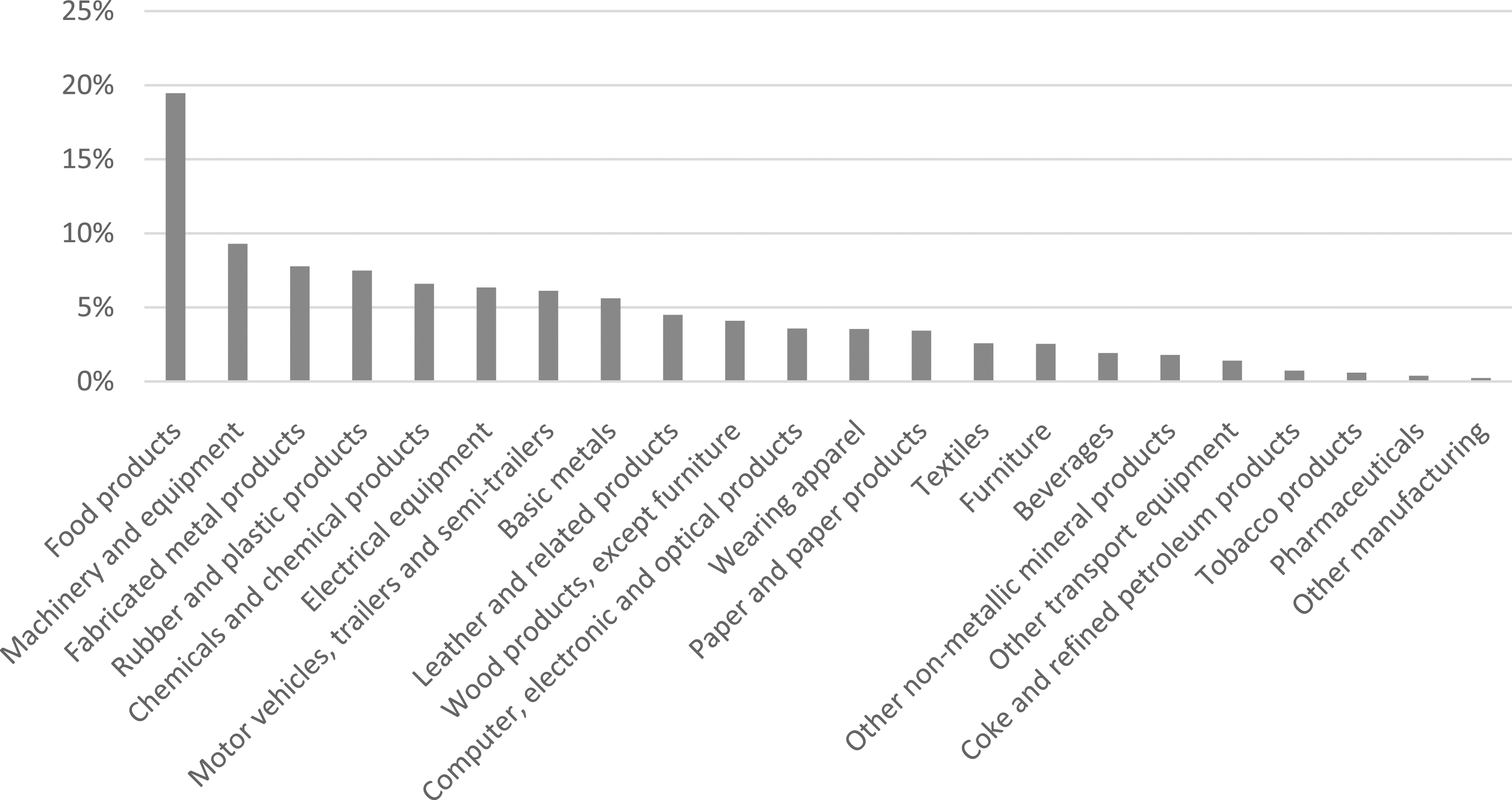
Our sample of manufacturing firms comes from various geographical locations, including the less developed parts of southern Serbia, while most of the ICT and dynamic services exporting SMEs are located in the two biggest cities, Belgrade and Novi Sad. Share of total export of goods (horizontal axis) and SME share of exports (vertical axis) by product group, 2019, Serbia. Source: Authors’ calculations on Serbia customs data of exports by company size for 2019, provided by SORS in June 2020. Note: 1) The original customs data of exports by company size and product in 10-digit HS classification were mapped to their respective NACE 2-digit industries by connecting a specific product (or group of products) to their respective NACE 4-digit industry. For example, all food products, except the primary agricultural products, were mapped to Manufacture of food products, primary textile products to Textiles, finished wearing apparel products to wearing apparel, etc. Distribution of SME exports by industry, 2019, Serbia. Source: Authors’ calculations on Serbia customs data of exports by company size for 2019, provided by SORS in June 2020.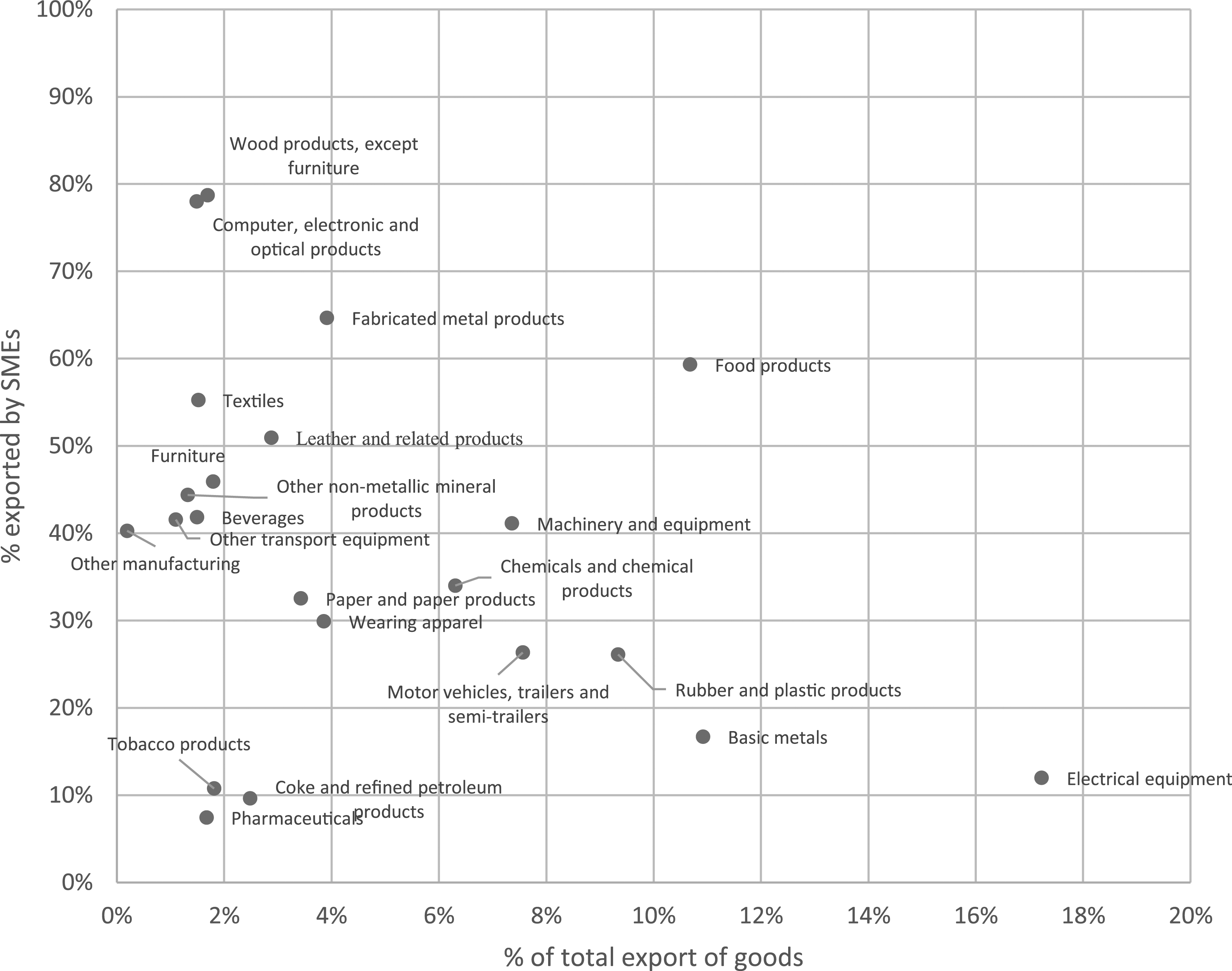
To select the firms, we initially relied on the Serbian Business Registry Agency data, which provides financial statements and exporting activity information on all registered firms. Such a selection procedure was biased towards the better performing exporters that are producing medium and high-tech goods and services, since we were interested in mapping the so-called hidden success stories of domestic exporters. However, we then expanded our sample by snowballing, where the firms we interviewed recommended other firms that they knew of or had contact with. Therefore, over time, our sample started to also include exporting firms which were technologically less sophisticated, but which were still exporting-oriented.
While we cannot claim that our sample of exporters is fully representative of a ‘typical’ Serbian exporter, our aim was to identify solid SME exporters who were using innovation and technology to participate in the global economy, mostly by creating products or services for business clients abroad. Such evidence challenges the argument that is typically found in the literature – that exporting SMEs in peripheral economies tend to be characterized by low levels of innovation and that their international competitiveness exclusively comes from cheap labour.
Empirical findings
H1: Internationalization of SMEs has contributed to the entrenchment of Serbia’s export-led growth model after 2008
Around 50% of medium-sized enterprises and around 32% of small-sized enterprises are exporting oriented in Serbia (Burzanović, 2022). Figure 6 shows that Serbia’s SMEs have in the context of the rapidly rising exports over the past decade maintained their share in total exports at around 40%, and their share in total corporate gross value added at around 60%. SME internationalization has thus gone hand in hand with the overall dynamic of exports growth. SMEs have remained internationally competitive even when the FDI influx stepped up since 2015.
4
Some of the SMEs have also over time grown into large enterprises (or acquired by larger firms), so these numbers underestimate the total contribution of the ‘homegrown’ economy to overall exports. SME share in exports and in corporate GVA, Serbia. Source: SBRA - Serbian Business Registry Agency (SBRA); National Accounts and BoP data, SORS.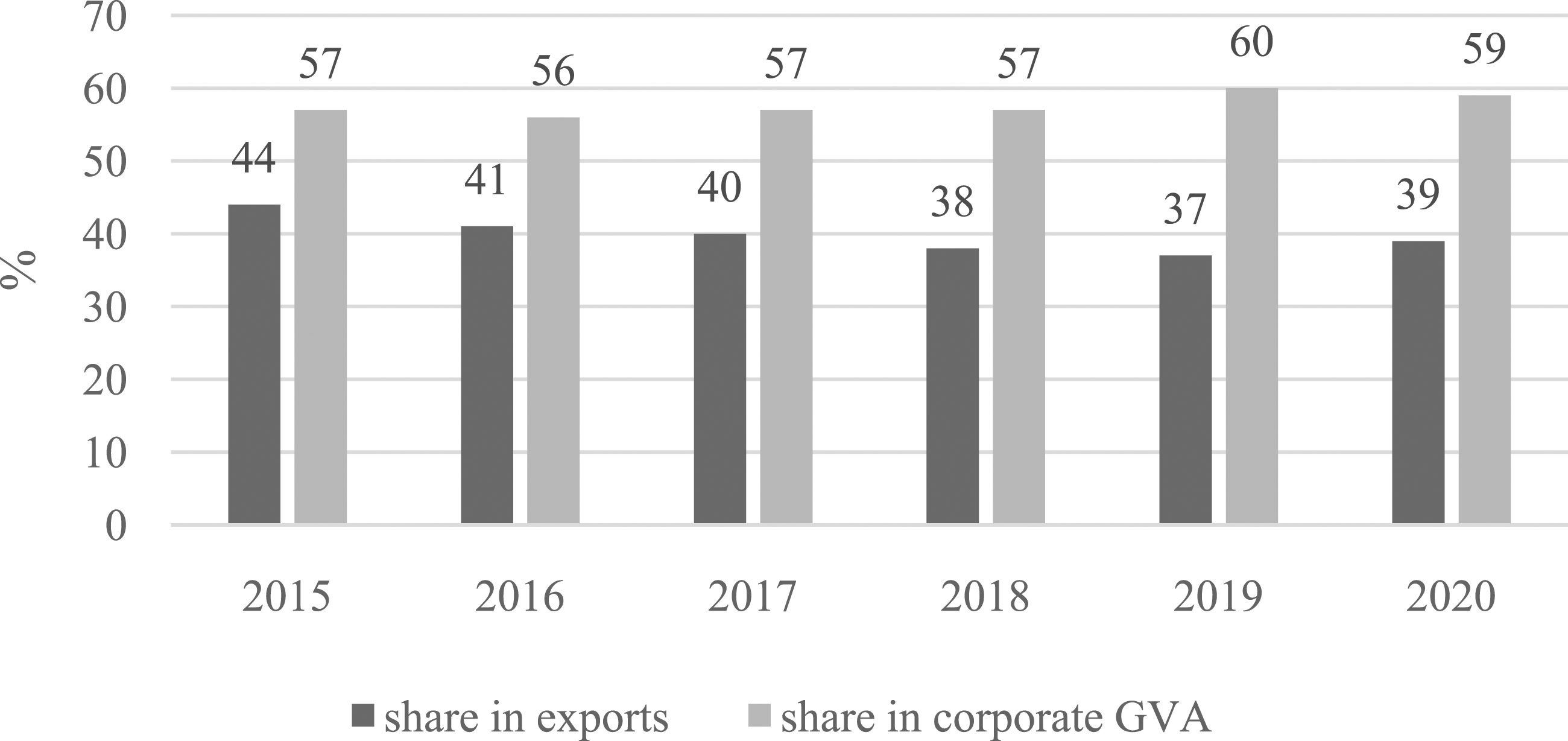
H2: Exporting SMEs in Serbia are fragmented, engaged in innovative flexible specialization, and their international clients are mostly businesses
Figure 4 shows the industrial profiles of goods that are exported from Serbia (horizontal axis), as well as the share of exports by SMEs in each of these industries. It indicates that exports of SMEs are particularly heterogeneous in terms of their production profiles, indicating an SME population of fragmented, niche and custom-made producers.
While the overall share of SMEs exports in Serbia’s total exports is around 40%, in some industries this share is a lot higher, while it is lower in others. Some of the larger exporting industries such as Electrical equipment and Basic metals are predominantly exported by large firms, while sectors such as Food products and Fabricated metal products are dominated by SMEs. For example, Food products account for 11% of Serbia’s manufacturing exports, and SMEs account for 60% of those exports. When it comes to Computer, electronic and optical products, more than 80% of all exports are conducted by SMEs. Food products and Fabricated metal products, which are particularly significant industries for SME exports, respectively, make up 57% and 65% of total exports within these industries.
Findings from our interviews indicate that SMEs are distinct in terms of their production profile in comparison to FDI that is present in the country. Within each industry in Figure 4, the interviewed SMEs are typically focussed on custom-made niche products and have relatively low numbers of employees, while FDI typically consists of much larger firms (measured in thousands of employees) which export highly standardized products for which all research and development (R&D) effort takes place outside of Serbia, and where there is no flexibility in product customization and development at the level of local subsidiaries. Moreover, given their completely different product lines, the interviewed SMEs generally did not collaborate or have contact with FDI that is present in the country. 5 In fact, a large portion of Serbia’s FDI is related to the automotive international supply chain, while local SMEs cannot source parts as suppliers to such chains because they do not make large series. This is consistent with findings from previous studies which have shown that the SME sector has very weak linkages to the FDI that is present in Serbia (Zildzovic et al., 2016) and with the broader assessment of FDI-led growth models in CEE as being characterized by low spillovers from FDI to the rest of the economy (Zoltán and Gábor, 2022).
Figure 5 illustrates the distribution of SME exports by these various industries, most of which are sold B2B, often as part of international value chains. Food products dominate in this distribution, making up almost 20% of all SME exports. A majority (approximately 60%) of these food exports are frozen raspberries which are sold wholesale to large international distribution networks. While such production is considered low tech, we also find some more technologically sophisticated firms in food production, such as a firm which develops original ice cream toppings for global companies such as Nestle and McDonald’s (interview #14). The second most significant industry is Machinery and equipment, which produces intermediary products or capital goods that are sold to other businesses. A firm we interviewed in this sector is a global leader (outside of the US) in the production of top-of-the-line premium machines for printing sausage cases (interview #16). Fabricated metal products are the third largest industry, and most of the products are also sold B2B. Rubber and plastics are split between FDI and SMEs, so that FDI firms mostly produce rubber products (e.g. tyres), while SMEs focus on plastics which are sold B2B. We found more innovation in the plastics manufacturing sector than we initially expected. For example, a firm which began with low technology production of plastic food containers over time developed into a high-tech, R&D rich production of not only plastic products and industrial tools for the worlds’ largest automotive and technology companies (like Siemens) but also robots and turn-key solutions for high-precision injection moulding (interview #36). They are known for developing world’s lightest 1 L bucket (24.5 g vs the standard 34 g), which required not only very high production precision but also innovating in polymer materials. They sell their products to large German specialist companies for sustainable plastic injection moulding.
Chemical and electrical products are also predominantly sold B2B. For example, we interviewed a medium-sized professional LED electronics producer which specializes in custom-made B2B products, such as traffic signalization boards, sport scoreboards and electronic information boards such as stock market and running text displays (interview #17). In contrast to generic Chinese producers of electronic signalization boards, they have a small series niche and ‘smart’ product which can be easily adjusted to buyers’ sign and design changing requirements. Motor vehicles consist of firms that export bicycles and boats which are often sold to end consumers, but also wagons which are sold to railway businesses. Some of the wearing apparel and furniture producers sell B2C, but more commonly they work as outsources for renown international brands, or they also conduct interior design for business offices and larger projects such as theatres and cinemas, which are also B2B (e.g. interview #24). Many of these products are therefore a part of value chains which require innovative and cost-effective niche and custom-made suppliers.
Among world class innovators, we also interviewed a firm that makes fully portable EEG devices (devices that record electrical activity of the brain) which are applicable in all kinds of neuroscience related research (interview #110). Another leading innovator in the ICT sector makes workers’ safety related software for global oil rigs and platforms (interview #125). Exporters of services also typically work B2B, for example, by providing sub-contracting production services to international film and advertising firms (interviews #131, #132, #134), or by offering digital advertising services to international fashion brands (interview #133).
H3a: Exporting SME have relied on proximity to decaying socialist industries for access to skills and workers, production inputs and sources of capital
About a half of the interviewed SMEs 6 (73 of the 145) identified the country’s legacy of engineering and technical skills from the period of socialist industrialization as having had a direct impact on the development of their business. This is especially the case for the older firms which were established during the 1990s and the early 2000s and which work in manufacturing, rather than the digital economy. During the early years of transition, and the delayed and difficult process of privatization of large socialist manufacturing firms (see Uvalic, 2019), these newly established private firms benefited from these firms’ resources which were not absorbed by the FDI.
As candidly stated by the owner of a highly innovative manufacturer: ‘I began my career as an engineer in armaments factory, where I became a department director in late 1990s. At a point in 2000s I decided to create my own company and successfully poached many great engineers, both from company for which I worked, and from other declining socialist companies in the area’. (interview #36).
In some instances, the emerging private holdings benefited from subsidized access to capital and contacts, due to their physical proximity to the declining socialist firms. As the owner of a Metal products firm explained: ‘I started my company as a direct spinoff of the socialist company that I worked for. My company even has almost the same name, which I only slightly tweaked. I have bought the equipment through bankruptcy proceedings, brought the best men we had with me and continued doing business with the customers the old company had… I think we are not the only ones who began this way, many took the equipment, sometimes even for free or without anyone’s approval, as well as employees and contacts, to create something of their own. That equipment was kind of old at the time, but it still made the beginning much easier’. (interview #13).
The owner of a Machinery and equipment firm also told us that he was able to learn how to make similar sophisticated machines in a socialist-owned company where he worked as a machine engineer, following which he put together funding for his start up through the already strong business connections that were willing to lend to him or offer guarantees on bank loans (interview #16).
This correlation between the decay of old socialist enterprises that were not successfully privatized and the emergence of private manufacturing SMEs can also be teased out by noticing the clustering of sectors of specialization in our sample of interviewed firms which corresponds to the geographic location of the old socialist industries. For example, the interviewed SMEs located in the southern city of Niš typically specialize in Electronics, while the SMEs in the central city of Čačak specialize in Machinery and equipment.
Moreover, since the government was not able to privatize or shut down many of its enterprises due to the social and economic cost that would impose on the population, this allowed some of the emerging SMEs to initially act as suppliers to these socialist firms and rely on government subsidized domestic demand for their products and services in the initial stages of their business development. All these forms of indirect and unintentional state support to the SME sector, however, abruptly ended in 2008 as the crisis affected the government’s liquidity and pushed it to end their fiscal exposure to the public resource-sapping publicly owned firms. Such circumstances generated illiquidity chains, forcing these SMEs to increasingly turn towards foreign markets, which in turn explains at least part of the switch of the Serbian growth model from domestic consumption- to export-led growth. Since then, Serbian SMEs have benefited from certain macroeconomic policies which favoured exporters more generally, as well as various free trade agreements which the country has signed over the past 10 years, including the preferential customs regime with the EU. At the same time, most of the country’s industrial policy and direct state aid continues to be directed towards MNCs, while SMEs receive very little direct support that would underpin their internationalization and innovation efforts.
H3b: Exporting SME have relied on translocal networks for knowledge exchange
The interviewed firms did not see co-location with other SMEs in their sectors of operations as being key to their business models, nor did they reflect on the benefits of local cooperation. On the other hand, about 70% of them 7 (104 of the 145) emphasized the importance of translocal networks for the expansion of their businesses abroad. Of these, 40 found both the proximity to decaying socialist industries and translocal networks as also important for their business models. These were commonly firms in the manufacturing industries, as well as the older family firms established already during the 1990s and 2000s, and which started off by relying on the infrastructure and resources built during the socialist era. Many of them, however, also sent the next generation of firm owners (their children) to study abroad, learn modern management practices and make international contacts. Some business owners even reflected on how important similar experiences were for them in their formative years: ‘As a young engineer employed in a socialist company, I got a specialization scholarship and completed it in Germany. Besides learning German, I made a lot of contacts and started my own company as soon as I returned to Serbia in the early 1990s’. (interview #17). Another owner stated: ‘As a director of Yugoslav international trade relations and exports company, I made a lot of contacts with foreign businesspeople. Exactly those were my first contacts and first international sales channels, and from there we started our expansion’. (interview #67). This indicates that translocal knowledge exchange was always an important strategy for firms in peripheral countries. While these experiences were financed from the public purse during the socialist Yugoslav era, many of the SMEs have been investing their private resources to access foreign education, contacts and business practices, perceiving them as key to success of their business operations.
Experiences with immigration have also been identified by several respondents as another important source of knowledge exchange. As amusingly explained by a tyre producer: ‘I went to Germany at a very young age, when I completed secondary school and had limited working experience. I got employment at large rubber products German company and began as a manual labour worker. Over time I got some promotions, but I realized that most of the products we produced there could be produced in Serbia much cheaper. So, I talked to my boss, sold my Mercedes, and went back to Serbia and founded my own company. At the beginning he was my sole customer, and the company was basically a small workshop, but we developed over time, and expanded our network… the knowledge of German helped me a lot too. Direct communication with customers in their native language helps us build trust quicker, and simply makes everything much easier’. (interview #1)
As expected, the newer firms, especially in the ICT sector and dynamic services, mostly identified translocal networks as key to their business development, rather than proximity to old socialist industries. Some of them returned to Serbia and started their businesses following completion of education abroad. Founders of a hi-tech electronics company both have biomedical PhDs from Western Europe so their business model is very much entrenched in their international professional networks. They explained that their university professors from Belgium were promoting and purchasing their product at the initial stages, allowing them to stay afloat until they established themselves in the international market (interview #110).
For those who did not study abroad, translocal contacts originally created in the context of outsourcing were identified as an important source of knowledge exchange. An ICT firm who started off as an outsourcer for a German software developer for the car industry explained that visiting German car makers’ production facilities, which was regularly organized by their German partners allowed them to subsequently develop their own business products (interview #122). Another manufacturing firm owner explained that he initially worked at a privately owned socialist company spinoff for almost 10 years as an engineer, mostly in the R&D department, until one of their foreign buyers noticed him and helped him to start his own company. While he initially worked as a distributor of this buyer’s products in Serbia, over time he switched to manufacturing and developed a special type of plastic that was much better at keeping cold and heat than their competitors (interview #121). A film production firm explained that collaboration with foreign film crews which had the latest filming equipment upgraded the skills of the local technical crew, while exposure to their modern and cost-effective budgeting and management practices was an extremely valuable learning opportunity for local producers, boosting the overall skill levels of the film and advertising industry in Serbia which is now increasingly working on independent projects instead of outsourcing (interview #131).
Besides translocal knowledge exchange through direct physical contact, digitalization of business practices has also played an important role for the interviewed SMEs, and especially opportunities offered by the platform economy. The owner of a now well-established international publishing firm based in Belgrade started by making a website with fashion content in English since he wanted to target an international audience from the onset. Digitalization, including the increasing importance of social media content, allowed them to reach out to fashion brands with advertising offers and to build influence over time (interview #133). YouTube and Instagram helped a media firm build a strong following, particularly relying on diaspora communities who wanted quality content in their mother tongue (interview #144). A leading (female) innovator in artificial intelligence (AI) based software started by doing gigs on Upwork (a global platform which connects independent professionals to international clients), following which she launched a company to serve clients in the Middle East and the Gulf states. In her words: ‘I had an aim from the onset to make my own product, but I had no clue what that could be. I had no experience, so I allowed client requests from Upwork to guide me initially. This is how I acquired experience with different industries, as each project was different. Then I found an industry niche which matched my interests and previous knowledge, so I decided to develop a product targeting them… All my collaborations were online and I was in situations where I was managing a project team across three different time zones’. (interview #125). She now sources experts from around the world who work remotely, so her business is not constrained by the local absence of skilled workers.
Conclusions
This paper opens a new research agenda by arguing that exporting SMEs are important actors in some of the FDI dependent export-led growth models in CESEE. Focussing on FDI as the only driver of exports narrows our understanding of these advanced peripheral countries’ growth models and makes them seem more homogeneous than they are. Our argument also challenges the more recent tendencies in CPE to characterize all domestic capital as vested in state capture and rent seeking with increasingly corrupt and authoritarian governments. We then explain the phenomenon of exporting SMEs by accounting for the effects of digitalization and the increasing use of ICT in global business practices, and by showing how translocal networks of knowledge exchange have allowed them to innovate even without state support. Therefore, the article also adds to the under-researched topic of how the globalized knowledge economy and ICT-led growth have been shaping peripheral growth models.
While we cannot explain conditions under which SMEs are more likely to drive internationalization and export-led growth in advanced peripheral economies based on one country case, our evidence from Serbia suggests that this scenario takes place in contexts with prior industrialization, but where FDI attraction has lagged for political reasons. To add a comparative dimension, future research could compare former Yugoslav non-EU countries to the Baltic states which have discouraged FDI investment into manufacturing for political reasons (Avlijaš, 2022; Bohle and Greskovits, 2012) but also have a large share of SMEs in their manufacturing exports nowadays (see Figure 3). Slovenia could be another interesting case to examine the role of EU structural funds and state support for SME exports. We will also continue to explore exporting SMEs’ translocal strategies of knowledge exchange for innovation in our future work.
The article also offers insights for another neglected topic in CPE – industrial policy in the post-neoliberal era. Focussing on the diversity of export-led growth coalitions, we respond to calls by Bulfone (2023) that industrial policy needs to evolve from an inward-looking tool for the protection of domestic demand and employment to one that can improve firms’ competitiveness in the contexts of countries’ greater global and regional market integration. Since politics of redirecting resources away from FDI and towards other growth coalitions is challenging for advanced peripheral economies (see Doner and Schneider, 2016), and since distributive conflict is inherent in the management of industrial policy (Aiginger and Rodrik, 2020; Klebaner and Voy-Gillis, 2022), introducing exporting SMEs as an additional non-state stakeholder, we offer a novel framework that can improve our understanding of distributional conflicts in export-led growth models. The variation of actors vested in Serbia’s export-led growth model implies that political contestation does not only take place between exposed and sheltered sectors of the economy, but that distribution of state resources can also be a source of conflict between various groups of exporters, as the growth model evolves and becomes more heterogeneous in terms of firm size and ownership structure. Emphasizing non-state actors also seems particularly important for peripheral growth models because we cannot transpose the logic of a well-functioning bureaucracy or state onto peripheral economies where the state may be suffering from captured or weak institutions, and where we see a rise of authoritarian tendencies (see Castaldo, 2020 for the case of Serbia).
Taking this research agenda further, one should also reflect on the longer run economic benefits of redirecting state resources away from FDI and towards smaller exporting firms. It is much harder to design an industrial policy which meets the needs of diversified SMEs than a handful of large MNCs. Moreover, while the middle income trap is described as a country’s inability of upgrade its growth model towards domestic investment and innovation (Kharas and Kohli, 2011), literature is moot on whether peripheral and fragmented innovation can provide an adequate foundation for a national growth model in the ICT-based contemporary global economy where wealth is generated through radical innovation and market concentration. Yet, two advantages can be linked to having more SMEs in a country’s export-led growth model. First, while the position of the exporting SMEs in CESEE is still that of transnational dependency, it is one which offers less constraints on domestic agency than a purely FDI-dependent growth model. Also, nurturing competitive entrepreneurship as a counterbalancing force to market concentration is, according to the Schumpeterian perspective, beneficial for the longer run survival of both capitalism and democracy (Henrekson and Jakobsson, 2001). For all its promises and successes, FDI dependent growth models have not managed to close the EU’s core-periphery rift, so new experimental approaches to development and growth in the periphery should be welcomed. Without funnelling some state resources towards exporting SMEs, it would be difficult to see a further scaling of such firms and their overtaking of FDI as the dominant growth coalition.
Supplemental Material
Supplemental Material - Reconfiguring FDI dependency: SMEs as emerging stakeholders in an advanced peripheral export-led growth model
Supplemental Material for Reconfiguring FDI dependency: SMEs as emerging stakeholders in an advanced peripheral export-led growth model by Sonja Avlijaš, Pavle Medić and Kori Udovički
Footnotes
Declaration of conflicting interests
The author(s) declared no potential conflicts of interest with respect to the research, authorship, and/or publication of this article.
Funding
The author(s) disclosed receipt of the following financial support for the research, authorship, and/or publication of this article: This work was supported by the HORIZON EUROPE Marie Sklodowska-Curie Actions with grant number 895519.
Notes

Supplemental Material
Supplemental material for this article is available online.
References
Supplementary Material
Please find the following supplemental material available below.
For Open Access articles published under a Creative Commons License, all supplemental material carries the same license as the article it is associated with.
For non-Open Access articles published, all supplemental material carries a non-exclusive license, and permission requests for re-use of supplemental material or any part of supplemental material shall be sent directly to the copyright owner as specified in the copyright notice associated with the article.
