




Abstract
This article looks at the evolution of industrial relations in Central and Eastern Europe after the so-called ‘eastern enlargement’ between 2004 and 2013. The main claim is that 20 years after EU accession the ‘European dream’ (embodied in the European Social Model) has not been fulfilled in the area of industrial relations. Furthermore, the main frame of reference (thus the goal to be reached) has become increasingly distorted over the years. The article investigates the dynamics of industrial relations in the ‘new’ Member States of Central and Eastern Europe in order to show that what had been expected to become a transition – that is, a move from one defined point to another – eventually turned into a transformation without convergence on a clear model and characterised by widespread weakness and fragmentation of industrial relations.
Introduction
This article looks at the evolution of industrial relations in the Member States of Central and Eastern Europe (CEE) that joined the EU since 2004. The main research question concerns how industrial relations in the region have been shaped by enlargement, for example, in relation to union density, collective bargaining, the role and incidence of non-union forms of worker representation (such as works councils and European works councils) and the status of tripartism. It is hypothesised that developments have not met key expectations formulated before enlargement and expressed in the debates on Europeanisation. In other words, while the expected process was conceived as a ‘transition’ (convergence), what actually took place could better be described as a ‘transformation’, leading to the emergence of institutional hybrids.
The article opens with a literature review. I then analyse industrial relations and social dialogue in the run-up to accession within the CEE cluster of candidate states. The emphasis here is on intra-regional variety in national industrial relations systems and the pursuit of different paths of institutional reconfiguration in an effort to meet the preconditions for EU accession. Post-2004 (post-2007 in the case of Bulgaria and Romania, and post-2013 in the case of Croatia) developments are analysed next, focusing on such phenomena as massive outward migration to the EU-15 and (relatedly) the posted workers/social dumping debate, as well as the impact of the 2008 financial crisis. These developments strongly affected countries with relatively viable corporatist institutional arrangements (such as Romania and Slovenia), but also led to a closing of the gap between labour standards and quality of industrial relations in the East and the South, driven, ironically, not by improvements in the former, but by deterioration in the latter (for example, Meardi, 2014). The article also discusses developments in key areas of industrial relations, such as (de)unionisation, collective bargaining, tripartism and non-union forms of employee representation, juxtaposed with processes in the old EU.
The timeline is as follows. The point of departure is the year of the first eastern enlargement (2004), but it is adjusted accordingly (in particular with regard to statistical data on industrial relations) in the case of the ‘new’ Member States that joined later (Bulgaria and Romania in 2007, Croatia in 2013). The close, as far as statistical data and analysis are concerned, is 2020, with some reference to the impact of COVID-19. For pragmatic reasons the latest other crises (the war in Ukraine and interrelated shocks, such as the energy crisis) are omitted as a credible empirical basis is still not available.
The article contributes to the debate on European comparative industrial relations first by systematising existing accounts, notably shifting perspectives in the literature, and including those only indirectly related to industrial relations. Of particular interest is the comparative analysis of industrial relations developments in Central and Eastern Europe in the broader context of changes in the EU itself during the post-accession period as manifest in the concurrent crises of Europeanisation and continuous attempts to counteract them.
Literature review
Discussion of the new Member States of Central and Eastern Europe (CEE) in the context of European integration has long been done by referencing the ‘old’ Europe in general (for example, Berend and Bugaric, 2015), or specific countries, using the rhetoric of ‘transition’ (for example, Åslund, 2012). This is in line with the paradigm of ‘imitative modernisation’ pursued by the post-Socialist countries in the 1990s. ‘Imitative modernisation’ denotes copying institutional and cultural patterns originating elsewhere, in different social, historical and economic contexts. The key challenge for post-Socialist countries was that they attempted to implement all at once patterns and arrangements built in the ‘reference societies’ of the West over long periods and often sequentially (Krastev and Holmes, 2018; Ziółkowski, 1999).
In the late 1990s Eyal et al. (1998) presented their ideas on building ‘capitalism from without’ (or ‘capitalism without capitalists’) in the post-Socialist world. Their main argument was that in the absence of a domestic bourgeoisie and capital reserves, foreign direct investment (FDI) would become the main driver of economic development. In other words, the region was a vacuum to be filled from the outside, not only in terms of capital but also institutionally. This was reflected in and reinforced by Nölke and Vliegenthart’s (2009) concept of a ‘dependent market economy’, and developed by Upchurch et al. (2015: 9), who observed that a ‘distinctive type of capitalism ha[d] emerged, based perhaps on dependence and labour exploitation through cheap labour within a new international division of labour’. While sidelined – at first glance – the state was not neglected, even in these strong versions of the ‘capitalism from the outside’ thesis. The state was still recognised as retaining agency (Jasiecki, 2013).
Comparative analysis of industrial relations in the region vis-à-vis western Europe has been problematic, first, because of historical factors – such as delayed industrialisation and feudal legacies – and second, because of the CEE countries’ experiences during four decades of authoritarian state socialism, coinciding with the Fordist ‘Golden Age of capitalism’ on the other side of the Iron Curtain (Hobsbawm, 1994). In general, a monocratic industrial relations system was established in the region, albeit with some intra-regional variations (for example, in Yugoslavia and Poland), which proved resilient, in terms of path dependency, also after 1989. In the late 1980s industrial relations in the then-Socialist CEE were undermined not only by the lack of legitimate actors, but also viable processes (for example, Naishul, 1991).
Studies of industrial relations in Central and Eastern Europe often overlap with or form part of broader research on capitalism (Bohle and Greskovits, 2012; Myant and Drahokoupil, 2011; Rapacki, 2019). It is noteworthy that in such discussions the institutional foundations of economic order (including industrial relations) or industrial relations as a specific subject of interest are usually left out of major analytical models with universalistic ambitions (for example, Amable, 2003; Becker, 2009; Hall and Soskice, 2001; Whitley, 1999). It is tempting to label national or regional variations as ‘institutional hybrids’. But this is risky because of its inherent ambiguity. A closer look at the findings of comparative research on CEE capitalism and industrial relations shows there is a broad palette of hybrids. Bohle and Greskovits (2012) label the V4 variation of capitalism ‘embedded neoliberal’, in contrast with neoliberal (Baltic states) and neo-corporatist (Slovenia), while the new Member States of south-eastern Europe are said to lean either towards the neoliberal type of political economy (Bulgaria and Romania) or towards an embedded neoliberal model (Croatia). The position of labour in industrial relations is described as ranging from very weak (in the neoliberal economy) through moderately weak (under embedded neoliberalism) to relatively strong (neo-corporatism).
In the early 1990s national industrial relations in the CEE countries differed significantly from industrial relations in the West. The case of the former German Democratic Republic served as a warning that attempts to engineer a simple transfer of institutions developed elsewhere may produce problematic outcomes (Hyman, 1996). Furthermore, the frame of reference and destination of any supposed transition process were not static by any means. The ‘return to the West’ coincided with a post-Fordist shift and accelerating globalisation propelled by the Washington Consensus, and all these factors contributed strongly to a deterioration of industrial relations in the West, epitomised by ongoing deunionisation and changes in collective bargaining, including shrinking coverage and decentralisation (Hoffmann and Waddington, 2000; Müller et al., 2019; Tros, 2023). Given that collective bargaining is supposed to provide effective wage coordination, in particular by tying it to labour productivity (McKersie and Hunter, 1973), these processes contributed to falling wage shares of GDP across the developed world and a widening gap between real productivity and real wage growth (e.g. ILO, 2022). This undermined Western industrial relations and put their viability as a benchmark in doubt.
As a result, the contours of the Western ‘promised land’ became increasingly blurred. Experiences of latecomers such as Bulgaria and Romania (accession in 2007) and Croatia (2013) were more painful. Soon after the EU accession of the first two the 2008 financial crisis struck, paving the way for ‘austerity’ policies and Troika-led interventions (Romania was deeply affected), further undermining the European Social Model (Myant et al., 2016). What is more, socio-economic transformation in the EU-13 states followed different paths, resulting in the emergence of different models of capitalism (Bohle and Greskovits, 2012). The heterogeneity of national industrial relations systems seems to be a logical consequence of the nature of CEE capitalism, which Rapacki (2019) called a ‘patchwork’, in which a variety of institutional arrangements often with divergent backgrounds are more or less loosely knitted together without an overarching institutional logic and coordination. In addition, it is sometimes argued that more than one model of industrial relations may exist within one national economy, which tend to be split along the line separating the public and private sectors (Bechter et al., 2012).
Finally, the process was hardly one-way. The West was also affected by enlargement in terms of industrial relations (Meardi, 2012) as a result of migration or debates on such vital issues as the European Social Model, posting of workers, and inclusion of CEE delegates in EWCs, among many other things. Moreover, subsidiaries of multinational companies (MNCs) in the new CEE Member States were sometimes described as a laboratory for testing modern HR practices aimed at dismantling industrial relations, which, if proven efficient, could be transferred to the West (Geppert et al., 2014). Delocalisation of economic activities to the new Member States, clearly motivated by the desire of multinational corporations to reduce labour costs, also put a strain on relations between ‘East and West’ within the European trade union movement (for example, Pernicka et al., 2017).
The 2004 EU enlargement generated hopes regarding the future of the EU in general, and industrial relations in particular. Parallel to the predominantly neoliberal ‘catching up’ rhetoric, which had been very influential since the 1990s (for example, Åslund, 2012), albeit from the opposite ideological pole, there was a view that industrial relations in the EU newcomers would more or less mimic the patterns of the ‘old EU’ by embracing ‘transformative corporatism’ (for example, Iankova, 2002) in their quest to transplant the principles of the European Social Model into their respective domestic ground. This view ignored several troubling phenomena, such as the fact that nothing like European industrial relations (not to be confused with EU-level industrial relations and social dialogue) had ever existed, given the sheer variety of traditions and national/regional models (for example, Crouch, 1993; Hyman, 2004). Furthermore, industrial relations in the post-Socialist states were not monolithic, so their points of departure differed (Bohle and Greskovits, 2007; Glassner, 2013). Transposition of tripartism, one of the preconditions of EU accession (Vaughan-Whitehead, 2000) only produced ‘illusory corporatism’ in the region (Ost, 2000, 2011). The establishment of works councils succeeded formally, but the presence and impact of this new vehicle for expressing workers’ voice has varied across the region (Skorupińska-Cieślak, 2023). European works councils (EWCs), once considered crucial agents for the Europeanisation of industrial relations and a channel for disseminating home-country patterns of industrial relations and social dialogue practices, seem not to have met expectations (Myant, 2023).
Debates on the ‘Europeanisation’ of industrial relations in the context of enlargement produced extremely divergent, often contradictory views. Radaelli (2004: 3) states that ‘Europeanisation consists of processes of a) construction, b) diffusion and c) institutionalisation of formal and informal rules, procedures, policy paradigms, styles, “ways of doing things” and shared beliefs and norms which are first defined and consolidated in the EU policy process and then incorporated in the logic of domestic (national and subnational) discourse, political structures and public policies.’ The spectrum of voices in the debate ranged from optimistic expectations of spillover effects from western European FDI (for example, Galgóczi, 2003; Tholen, 2017), to claims that admission of the new Member States would only result in a clash of trade union agendas (for example, Meardi, 2002) and undermine the foundations of the European Social Model.
What Lendvai (2004) calls the ‘mirror effect’ – that is, the EU newcomers’ convergence with the Western standards embodied in the European Social Model – proved unattainable. What actually happened was the reproduction of hybrid industrial relations in the region in parallel with the hybrid nature of CEE capitalism (Rapacki, 2019 coined the term ‘patchwork’ to capture the institutional discontinuities and contradictions observable in the region) and the reproduction of intra-regional varieties, exemplified, among others, by ‘neoliberal’, ‘embedded neoliberal’ or ‘neocorporatist’ varieties (Bohle and Greskovits, 2012). In the rest of the article, I investigate how institutional hybrids (which had not been the same across Central and Eastern Europe prior to enlargement) have evolved over the past 20 years.
On the road to the EU
As already noted, industrial relations in the candidate countries were expected to undergo ‘Europeanisation’. But Europeanisation overall and Europeanisation of industrial relations specifically remain ambiguous. After the collapse of authoritarian rule in the CEE countries between 1989 and 1991, it did not become instantly clear whether all former Socialist states would straightaway set course for ‘European’ integration. The legacies of the communist past proved to be very diverse across the region and had a significant impact on the shape and dynamics of institutional and political change. As a result the CEE countries followed different paths, leading to dissimilar results, still visible in their various economic models (Bohle and Greskovits, 2012; Rapacki, 2019). The scenarios that unfolded across Central and Eastern Europe also differed considerably in political terms. In some cases the turn towards liberal democracy seemed to proceed relatively smoothly (for example, Poland, Hungary, the Baltic states), while other countries gravitated either towards oligarchy, as in Bulgaria and Romania, or to some kind of authoritarianism (or illiberalism, to apply the modern label retroactively) as in Slovakia (under Meciar) or Croatia (in the Tudjman era).
In terms of industrial relations, the CEE countries that joined the EU in 2004 emerged from the period of authoritarian socialism with very diverse sets of institutional baggage. To mention particularly distinctive cases, Slovenia had a tradition of post-Yugoslavian worker self-government on which the foundations of neo-corporatist industrial relations were built, which remained strongly viable until the 2008 crisis and its aftermath. In the Baltic states, industrial relations stemmed from the archetypically monocratic Soviet system of labour relations, while in Hungary tripartism dated back to 1988. Finally in Poland there was the unique experience of independent trade unionism under ‘Solidarity’ in 1980–1981.
Second, the early years of CEE transformation coincided with major reforms of the then European Economic Community (EEC), which led to the Maastricht Treaty and the European Economic Community’s transformation into the EU. It may sound oversimplified but the West’s initial approach to the CEE countries could be described as one of ‘wait-and-see’. The CEE countries seemed to be stuck in the middle of the road to accession, with no clear aim and pathway, even though free trade entered into force as early as 1992 in the cases of Hungary and Poland (a topic that will be revisited below). The situation changed in 1993, with the introduction of the Copenhagen criteria and association agreements signed between the EU and the majority of the future CEE new Member States (EU-10) between 1994 and 1999. The first official accession negotiations commenced in 1998. In parallel, the decision on the eastward enlargement of NATO was taken (the first stage effective as of 1999), marking, in both symbolic and institutional terms, the geopolitical return to the West of the CEE post-Socialist states.
Throughout the 1990s, subsequent waves of recommendations and guidelines regarding the shape of industrial relations in the post-Socialist countries were being formulated according to the desires of the EU and major stakeholders. They all stemmed from evidence of structural mismatches between the actual and prospective Member States, particular in the area of industrial relations. They included the ‘weakness of the social partners, low coverage of collective agreements, serious decline in membership of trade unions and the evident reluctance of governments (more often political elites) to “share sovereignty” of decision making in the relevant areas’ (Gradev, 2003: 136). They were also characterised as potential risks for the European Social Model (Kohl, 2009; Meardi, 2002). The key preconditions deemed necessary with regard to industrial relations included: basic guarantees of adequate information, consultation, participation and negotiating rights, particularly in labour law; the existence and development of social partners; the creation of social dialogue institutions at all levels; cooperation and exchange between the then-EU Member States and the candidate countries (including inter-regional union councils or transnational wage coordination); increased cooperation within EWCs in multinational firms; and social dialogue capacity building in the candidate countries with EU support (Hoffmann et al., 2003: 117).
From the outset, the 2004-2013 enlargement differed from previous EEC/EU accessions (1973, 1981, 1986 and 1992). First, it involved the largest increase in the number of Member States to date (by 13 in total, nearly doubling the number of Member States). Second, it brought into the Community eight (later 11) countries with experience of authoritarian socialism and a central command economy, and therefore characterised by path dependencies very different from those of the ‘old’ Member States. Third (but in many respects related to the two previous points), it was the first enlargement in which the candidates faced a long list of very specific requirements (embodied in the various chapters of the accession negotiations) in the form of the acquis communitaire. Industrial relations had two important aspects: (i) the need to meet general legal and political requirements related to labour and industrial relations (for example, freedom of association and the right to strike); (ii) promotion of social dialogue. The former was an obvious prerequisite, but it is the latter that proved to be a major factor in shaping industrial relations in the new CEE Member States as it led to the top-down establishment of tripartite bodies (Vaughan-Whitehead, 2000). In some cases such bodies were established even before the fall of Socialism (for example, in Hungary in 1988), but the wave of central tripartite bodies emerged primarily in the early 1990s, and under more or less direct pressure from the ILO and the European Commission. Promotion of tripartism was seen as necessary because of the weakness of collective bargaining. As Vaughan-Whitehead (2000: 396) put it: ‘The very small number of collective agreements at sectoral level in almost all applicant countries continues to shed light on the weaknesses of the social partners at intermediary levels of collective bargaining.’ It was expected that at some point the European social dialogue (once seen as a platform for building a European system of collective bargaining) (Biagi, 1999) would promote a levelling up of standards in the new Member States.
CEE experiences with neo-corporatist arrangements could arguably be best described in terms of the ‘failures and half-successes’ of social dialogue (Gardawski and Meardi, 2010). Although in its original context the description applies only to Poland, it could be projected onto other countries of the region, with the notable exception of Slovenia (prior to 2009) and, to some extent, Romania (before 2011). On the bright side, social pacts were concluded on a regular basis in Slovenia from 1993 onwards and one in Croatia in 2001. Speaking of the social partners, it is something of an exaggeration to say that trade unions failed to make an impact on the accession process. CEE trade unions were gradually admitted to the ETUC, starting with Poland’s NSZZ Solidarność in 1991, followed by a major wave in 1995, and subsequent additions between 1998 and 2012 (Ciampani and Tilly, 2017; Mrozowicki, 2017). Furthermore, in some countries trade unions had some input into the negotiation process, for example in Poland, where the chief negotiator originated from the union movement, or in Czechia and Hungary, where special bodies were established by trade unions to look after labour interests in the course of integration (Avdagic, 2001).
At the domestic level, however, the unions were rarely able to leave a visible mark on public policies affecting labour, above all in Slovenia and Romania, although even there their influence faded after 2008. Kirov (2005) notes that trade unions were struggling with the dual challenge of internal reforms and institutional change, as well as accession. This observation about Bulgaria can be extended to the whole region. In institutional terms, organisations representing labour (also employers) would be embraced at the EU level. Capacity-building programmes were also launched under the auspices of the EU (Kall, 2024). Still, the process was not managed on equal terms. A patronising tone was often detectable among the EU-level social partners, exemplified by the ‘Architecture of trade unions in Europe’ (1993), which initially included a reference to the need to ‘subject [Central and Eastern European] trade unions to a political education process for their Europeanisation’ (Wolańska, 2008: 81). As Henning (2015: 8) observes, the ‘ETUC was not willing to give Central Eastern European trade unions full membership until the congress of 1995’.
Accession and its aftermath
The accession of 11 CEE countries between 2004 and 2013 did not fundamentally change the nature of relations between trade unions from the region and their counterparts in the ‘old EU’. One of the key issues in the industrial relations discourse at the time was certainly the opening up of labour markets to citizens of the new Member States. The ‘old’ EU countries took different approaches in that regard. Only the United Kingdom, Ireland and Sweden opened up their labour markets right away. The remaining countries used their right to impose transitional periods, lasting from two to seven years. Interestingly, in Germany it was the trade unions that put pressure on the government to impose the longest allowed transitional period before opening up the national labour market to CEE citizens. As Bieler and Erne (2015) observe, however, these measures not only did not block the influx of migrant workers from the so-called EU-8 but, by forcing the new entrants to an absorbent German labour market to circumvent the law, pushed them into atypical employment, thus putting them out of reach of the trade unions. The restrictions on labour market entry were related to the phenomenon of posting of workers, which became evident following the Laval case, and especially during the debate on recasting the Posting of Workers Directive in 2014–2015 (for example, Arnholtz and Lillie, 2019).
It would be naïve to expect that formal finalisation of the 2004/2007 enlargement would put an end to debates on the future of industrial relations in an expanded EU. On the contrary, some old problems only grew, such as eastward relocation of production (for example, Pernicka et al., 2017) and disparities in economic development, amplifying fears of ‘social dumping’ by ‘dependent market economies’ (Nölke and Vliegenthart, 2009) using cheap, yet relatively high-skilled labour as their key comparative advantage. In addition, divisive new issues emerged, such as allegations, often from trade unions, of de facto ‘neocolonial’ expansion to the east on the part of ‘old’ EU countries (for example, Trappmann, 2013).
But have the CEE new Member States managed to ‘catch up’ with the West since EU accession? Significant progress has been made in terms of closing the development gap. This is related, however, not only to the advancements that all CEE new Member States have made, but also to the economic stagnation and chronic crises that have hit the Mediterranean Member States, especially Greece, since 2008. The dependent nature of CEE capitalism has not been overcome (criticism of which certainly became one of the cornerstones of the populist political agenda of the 2010s and early 2020s, with vows to enhance domestic capital) (Becker, 2024). Given the scope of this article, however, our focus must remain on basic measures/indicators related to industrial relations, such as collective bargaining coverage, trade union density and the rate of association among employers. In order to capture the link between industrial relations and the broader labour market context, however, the picture must be expanded using indicators on labour productivity and wages.
Looking at the core industrial relations indicators and beginning with collective bargaining coverage, a severe, albeit uneven slump is observable (Table 1). It is worth discussing the travails of two countries – Romania and Slovenia – that once had viable multi-employer collective bargaining, with substantial coverage rates. Their motives for dismantling collective bargaining differed. In Romania, the 2011 labour law reform introduced in the aftermath of post-2008 crisis austerity policies was allegedly drafted under pressure from foreign investors and their proxies (see Trif, 2016). In Slovenia, the lifting of compulsory membership of employer organisations meant that the last general agreement for the private sector was signed in 2008. Slovakia had abandoned cross-industry bargaining as early as 2000.
Key industrial relations statistics.
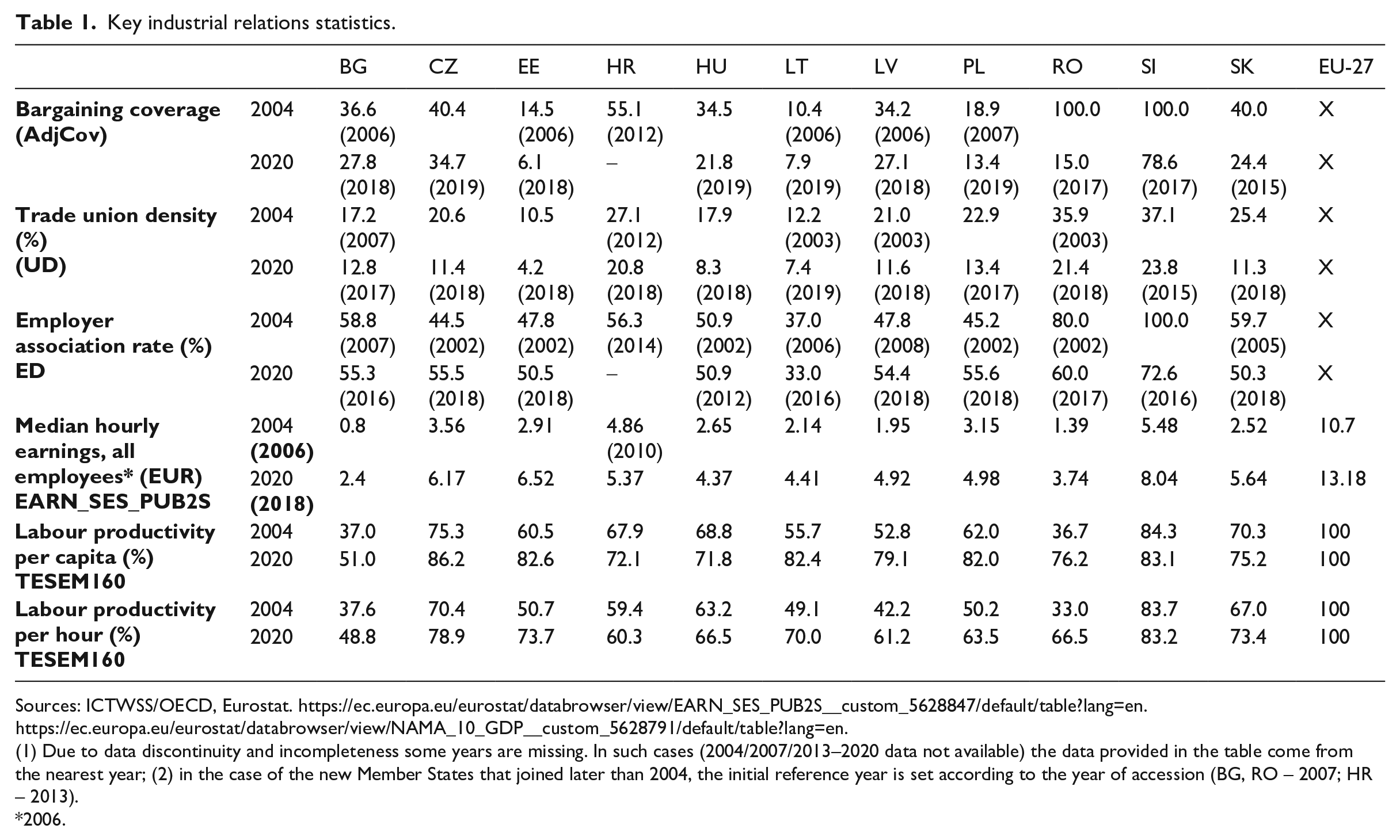
Sources: ICTWSS/OECD, Eurostat. https://ec.europa.eu/eurostat/databrowser/view/EARN_SES_PUB2S__custom_5628847/default/table?lang=en.
(1) Due to data discontinuity and incompleteness some years are missing. In such cases (2004/2007/2013–2020 data not available) the data provided in the table come from the nearest year; (2) in the case of the new Member States that joined later than 2004, the initial reference year is set according to the year of accession (BG, RO – 2007; HR – 2013).
2006.
Elsewhere among the countries we are examining the reductions in collective bargaining coverage were smaller, and in any case the fall started from a lower level. Unsurprisingly, there is a clear correlation between level of bargaining and coverage: the more decentralised the collective bargaining, with single-employer agreements playing a dominant role, the smaller the share of employees covered. This is well illustrated by the cases of Estonia, Lithuania, Poland and post-2011 Romania. One of the key reasons for low bargaining coverage in many Central and Eastern European countries, according to Müller et al. (2019: 646), was ‘the weakness and fragmentation of employers’ associations and their hostility towards negotiating industrial agreements’.
Deunionisation is a major problem in modern industrial relations (Colfer, 2022). In the CEE context, however, it has advanced so far that in some countries it has started to put the very viability of trade unions into question. In Estonia, Hungary and Lithuania union density is in single figures, and only in Croatia, Romania and Slovenia does it exceed 20 per cent. While in a number of ‘old’ EU countries unionisation rates are comparably low (for example, France, Germany and Spain), this is arguably compensated by power resources other than associational, namely structural and institutional. As for the dynamics of unionisation, they have fallen substantially in all the countries under examination, most severely in the Baltic states. The erosion of union membership has continued, despite extensive organising campaigns and other attempts at trade union revitalisation in the region (see Mrozowicki, 2014; Mrozowicki et al., 2018).
Turning to the other side of industrial relations, employer organisations, generally speaking, have not moved beyond the form of ‘business association’, mainly pursuing a ‘logic of influence’ rather than a ‘logic of membership’ (Schmitter and Streeck, 1981), and acting more like industrial lobbying groups than genuine employer representatives (Danaj and Meszmann, 2024). As already mentioned, employer organisations tend to refrain from collective bargaining. Employer organisations’ relatively high coverage rates may be misleading, as in some countries, such as Estonia, Poland and Bulgaria (until 2012), the law allows multiple memberships (employers may belong to more than one association). Furthermore, the continuing ability of employer associations to avoid sectoral collective bargaining is an incentive to maintain de facto ‘bargaining-free’ membership while providing access to political representation and service provision.
The role of foreign capital in the emergence and evolution of employer organisations deserves special attention, particularly in the context of the dependent nature of CEE capitalism. A fairly broad palette of strategies has been employed. In some countries, such as Slovakia and Hungary (especially in the case of MGYOSZ), multinationals have driven the development of employer associations, motivated by, among other things, a desire to keep sectoral standards under control or by the presence of relatively strong sectoral trade unions, seen as viable partners in reducing uncertainty in labour relations. In the post-2008 polycrisis years, however, there has been a tendency among employer organisations to opt out of collective bargaining in some countries. In Slovakia, for example, they changed their legal form to ensure that bargaining is not obligatory (Kahancová et al., 2019). In other countries, such as Poland, multinationals have not driven the development of employer organisations and have joined them only selectively and with little enthusiasm for promoting collective bargaining. Given advanced pluralism and decentralisation of collective bargaining, employers often choose to remain uninvolved, with industrial relations confined to the enterprise level (see Myant, 2023). The lack of collective bargaining would be less detrimental if market pressures alone – for example, the labour shortages that have emerged across the region – were enough to push wages higher. This has only become the case recently, however, as labour shortages have become particularly severe (partially compensated for by immigration, also from outside Europe) and government policies have driven up minimum wages.
It might be useful to bring economic variables into the picture in order to verify whether effective wage coordination, by tying wage development to labour productivity growth, is observable in the CEE new Member States. A glance at median wages shows that, although wage dynamics have been much stronger in the new Member States than for the EU-27 as a whole (for example, median hourly earnings in Bulgaria, the poorest Member State, tripled between 2006 and 2018), there is still a significant gap. Even in Slovenia median hourly pay represents barely 61 per cent of the figure for the whole EU-27, while in Bulgaria it is only 18 per cent.
On the other hand, the gap between the EU-27 as a whole and the CEE new Member States with regard to labour productivity indicators – both per capita and per hour – is smaller than in the case of wages. In Bulgaria – which scores lowest among the countries in focus – it is roughly half what it is for the entire EU-27. In Slovenia and Czechia, the most advanced countries from the region in that regard, labour productivity levels (both per capita and per hour) oscillate around 80 per cent of the EU-27 level. To sum up, wage gaps remain wider than productivity gaps.
There is also the issue of collective labour institutions, such as European works councils (EWCs) and works councils. While their origin, structural positioning and effects in the architecture of national industrial relations differ, they are both ‘European’ institutions ‘from without’. On the one hand, there are only seven EWCs in the companies falling under the scope of the Directive and with headquarters in the CEE new Member States (EWC Database, 2023), another fact highlighting the dependency of CEE capitalism. On the other hand, EWCs have played their part in integrating CEE unions into the ‘European trade union family’ (Adamczyk, 2018). EWCs, along with ETUFs, have been the main EU-based industrial relations institutions in Central and Eastern Europe. There are numerous widely publicised cases of EWCs admitting delegates from subsidiaries in the candidate countries as early as the late 1990s (for example, Heineken in 1998; Gardawski, 2007).
There is evidence that CEE union delegates, especially from subsidiaries with adversarial workplace industrial relations, managed to use EWCs effectively as sources of information denied to them locally, and occasionally even as a way of alerting central management to questionable practices in the host countries (Geppert et al., 2014; Myant, 2023). However, non-union EWCs are also on the rise, in which at the end of table reserved for employee representatives one may find, instead of union delegates, council members appointed through various vague procedures, often on the spurious ground that the company is non-unionised (see Czarzasty et al., 2020; De Spiegelaere et al., 2022).
Works councils had existed in some of the CEE new Member States prior to their accession, for example, in Croatia and Slovenia. In both cases they were part of the post-Yugoslavian workers’ self-government inheritance. In most cases, however, works councils were established in the course of transposing Directive 2002/14/EC, sometimes reluctantly (for example, Poland). A number of countries opted to allocate information and consultation rights to existing bodies (Bulgaria, Estonia, Romania) or limited the establishment of works councils to non-unionised employers (Czechia, Slovakia). Experiences with works councils have been mixed. Early on there were expectations that the Directive might have a stronger impact in the CEE new Member States than in the EU-15, because in the former no general regime for information and consultation had existed (for example, Donaghey et al., 2013). At the initial stage of implementation of the Directive, it appeared that trade unions (at least in Czechia, Poland and Slovakia) were sceptical towards works councils, seeing them more as competition than allies (Tholen, 2017). In general, wherever introduction of works councils into the national institutional framework was triggered directly by implementation of the Directive, they struggled to become embedded (for example, Blanpain and Lyutov, 2014; Skorupińska-Cieślak, 2023), as indicated by their limited incidence and coverage. It would be unfair, however, to ignore the fact that the structure of the enterprise sector has played a significant part in hampering the progress of works councils. In most of the countries under examination here, micro, small and medium-sized companies constitute the bulk of enterprises (for example, in Croatia nearly 90 per cent of all firms have fewer than 10 employees). Given the regional norm of a threshold of 50 employees required for works council elections there is little chance of getting this institution off the ground.
Finally, the erosion of the European Social Model and its implications for industrial relations in the CEE new Member States should be addressed. The post-2008 polycrises and their aftermath were a major blow to the European Social Model, which fell apart on impact of the tide of Troika-driven austerity policies and a real, even if implicit, shift in the dominant logic of EU integration towards financial and fiscal stability at the expense of social standards. The process that followed could be concisely described as the ‘South going East’. Specifically, the impact of the policy reforms implemented in the Mediterranean Member States in the period of austerity – such as ‘internal devaluation’ to drive down labour costs, hence wages (Myant, 2016 et al.) – amplified those features of both their economies and industrial relations that even before 2008 had made them look relatively similar to those of the CEE new Member States. They include a relatively low union density, fragmentation and politicisation of trade unions, advanced labour market dualisation (wide gaps between large and small companies constituting core and periphery, respectively), a high level of informality in social and economic relations, and a limited welfare state (Meardi, 2014).
Discussion and conclusion
As we analyse the impact of eastern enlargement on the CEE new Member States it becomes quite obvious that industrial relations were affected as seriously as other institutional areas in the sense that the aims envisaged by the Copenhagen criteria (or assumed to be determined by them, even if not explicitly, as in the case of tripartism) were more or less met, at least formally. The regulatory framework has been implemented with visible effects. Nevertheless, the transposition of institutions has not necessarily led to their viability once established. Works councils have failed to become embedded in the industrial relations landscape, while EWCs have generally remained a ‘foreign’ body with very few examples in Central and Eastern Europe. Traditional industrial relations institutions, such as trade unions and collective bargaining, which were supposed to regain or at least sustain their strength following EU accession, in fact did not develop. Given the dependent nature of CEE capitalism, multinationals were looked upon as possible agents of change. In fact, they proved to be skillful opportunists, adjusting to the local institutional environment (for example, Šćepanović, 2013). As a result, whenever collective bargaining remained viable in a particular country, it seemed fine to use this channel and even animate the institutional actors (such as employer organisations in Slovakia) needed to coordinate industrial relations. By contrast, when it was nearly dead (as in Poland or Estonia), it was more rational to ignore it. Significantly, once collective bargaining became so weak that it no longer offered employers any sort of control over industrial relations, it became less attractive to maintain employer organisations as bargaining units and their role was switched mainly to lobbying.
The Europeanisation of industrial relations that was once so broadly expected, although hardly inevitable, is now, arguably, as vague a prospect as the future of the EU in its present shape. What was portrayed as a ‘transition’, an ‘all-encompassing catching up’ with the West (or becoming part of the EU’s core) through the transposition of institutions turned out rather to be a ‘transformation’ of what had been centralised command economies under politically authoritarian regimes into a rather ambiguous model. This model not only rather poorly fits most of the leading academic concepts of capitalism in general, and of employment relations in particular, but also displays a number of intra-regional variations. Besides these differences, however, there are also persistent commonalities, including the fact that the CEE new Member States, despite improving their positions in the global division of labour since EU accession, still lag behind the ‘old’ Member States (especially the countries of the north-western cluster) in terms of labour productivity and real wages. The weak collective bargaining that underlies the dysfunctional wage coordination significantly distorts the link between labour productivity and wages, and discourages employers from seeking productivity improvements, as their competitive edge may be maintained simply by keeping pay levels low.
Even though extensive discussion of the impact of the ongoing polycrises is beyond the scope of this article, it is worth asking whether the CEE new Member States will be able to break out of the vicious circle of low wages, low incomes and low productivity in the foreseeable future. After all, even prior to the current series of interlocking crises, ‘improvements in labour market conditions in these (EU-CEE 8) countries – with the exception of the relatively advanced Czech Republic and Slovenia – [had] not led to higher wage settlements’ (Astrov et al., 2019: 34). The recent (since the COVID-19 pandemic) rise in nominal wages has not compensated for inflation, which in this region was the highest in Europe in 2022 and early 2023, which means that real wages have been stagnating or even falling. In that sense, the wage gaps between the CEE new Member States and the old Member States are likely to be sustained or even further extended.
The influx of labour migrants not only from neighbouring non-EU countries (such as from Ukraine to Poland or from Serbia to Hungary), but also from more distant locations (Central Asia, India and Bangladesh) has largely compensated for huge demographic losses experienced in the CEE new Member States as a result of post-accession outward migration and low fertility (Okólski, 2012). This might lead to a petrification of the ‘cheap labour’ model of economic development (Danaj and Meszmann, 2024). Given that one of the key lessons of the COVID-19 pandemic is an increased awareness of risks stemming from overstretched supply chains, the incentives for seeking even larger labour cost reductions outside the EU (for example, the Central Asian post-Soviet states) could be offset by the benefits of political and economic stability and predictability still to be found within the borders of the EU. Amidst all these interlocking processes, industrial relations and their institutional actors are struggling to cope with the relevant challenges.
The journey that the CEE new Member States set out on in the 1990s led to their admission to the EU in the 2000s (with the exception of latecomer Croatia, in 2013). But the EU that the 10 CEE countries entered in 2004/2007 was already unlike the EU that had invited the first candidate countries to the negotiation table in the late 1990s. Furthermore, the first in a series of polycrises (spanning 15 years with periods of remission) arrived soon afterwards.
The disintegration of a coherent frame of reference – the Social Europe engineered by the EU and founded on rules set by the old Member States (EU-15) to be embraced by the new Member States of Central and Eastern Europe – as a result of the austerity policies imposed after 2008, followed by the wave of populism throughout Europe (both ‘old’ and ‘new’) and beyond since the mid-2010s, not to mention the so-called illiberal shift in CEE (Hungary, Poland and Slovenia, but also Bulgaria and Czechia, albeit more moderately) have renewed the debate on industrial relations in the EU.
On the other hand, in recent years (under the Juncker and von der Leyen presidencies) there seems to have been a political shift at the EU level, indicated by such ambitious initiatives as the European Pillar of Social Rights (of 2017), the Directive on Transparent and Predictable Working Conditions (of 2019), the Directive on Adequate Minimum Wages (of 2022), and the draft Platform Work Directive (proposed in 2021 and endorsed by the European Council in 2023). All this is arguably contributing to a reinvigoration of the European Social Model (for example, Copeland, 2022; Vesan and Pansardi, 2021). Amending the Directive on Posting of Workers (2018) also contributed to that process and the debate preceding the revision provided an unprecedented case of cross-border trade union solidarity, as some CEE unions (for example, from Poland and Slovakia) joined forces with western European unions to back the proposal despite government and employer opposition.
The impact of the COVID-19 pandemic on industrial relations in the CEE new Member States has received fairly wide coverage so far, although the long-term effects remain to be seen. The pandemic’s directly observable impact was manifest in the disruption of tripartite talks, and illiberal governments and employers seizing the chance to restrict employee rights, but also in quite unexpected opportunities for micro-bargaining and increasing mobilisation of peripheral workers (including platform workers) (Bohle et al., 2022; Czarzasty and Mrozowicki, 2023).
What is now certain is that the heralded transition in Central and Eastern Europe has not been completed. This is because the destination, as envisaged at the time of accession for most of the CEE new Member States, no longer exists. Industrial relations in the region can therefore only be described as having undergone not a transition, but a transformation.
Footnotes
Funding
This research received no specific grant from any funding agency in the public, commercial, or not-for-profit sectors.