




Abstract
This article assesses perceptions among national and EU-level social partners of developments in social dialogue since the EU accession of Central and Eastern European (CEE) countries 20 years ago. The analysis evaluates the processes, structures and outcomes of interactions between social partners from CEE countries and the EU level. Social partners from CEE countries see the benefits of interaction with and exposure to EU-level social dialogue. On the other hand, their underdeveloped national structures for tripartite dialogue and sectoral bargaining pose a substantial barrier to capacity building and to voicing their interests at the EU level, undermining their legitimacy in EU-level structures. Even 20 years after enlargement, there is a perceived duality and internal competition between ‘Western’ and ‘Eastern’ social partners at the EU level, criticisms of the ability of EU-level social dialogue structures to deliver effective outcomes, and a diversity of actors’ preferences concerning binding and non-binding provisions.
Introduction
As one of the essential building blocks of the European Social Model, social dialogue in the EU has undergone considerable development, with a number of ups and downs, over recent decades. The fall of the Iron Curtain, EU expansion to southern and eastern Europe, the financial crisis of 2008 and the COVID-19 pandemic have all left their marks on the EU’s unique social market economy and its democratic mechanisms, including social dialogue. The eastward EU enlargements in 2004 and 2007 were accompanied by significant efforts to develop the capacities of national social partners in the ‘new’ Member States to enable them to become real partners in EU-level interest representative organisations and social dialogue structures. On the one hand, this was important to signal equal treatment of national representatives in EU-level social dialogue structures and, on the other hand, to reinforce the role of EU-level social dialogue as an important democratic process to address EU-wide issues and contribute to EU-level policies. At that time, national trade unions and employers’ associations in CEE countries were still acquiring experience in democratic governance while having an opportunity to voice their interests in the larger community of the EU. It was expected that efforts to strengthen the organisational capacities of CEE unions and employers’ associations would help not only to stabilise EU-level social dialogue but also to strengthen national collective bargaining and secure better policy-making access for the often weak unions and employers’ associations in CEE Member States. Thus, from the EU-level perspective, capacity-building initiatives were justified as an attempt to keep control of the growing diversity of social dialogue and collective bargaining traditions across the Member States. More positively, the goal was to facilitate convergence towards stronger social dialogue to achieve the goals of the European Social Model (Vaughan-Whitehead and Vazquez-Alvarez, 2019).
Many CEE social partners received capacity-building support from EU-level social dialogue actors and were able to increase their visibility in EU-level social dialogue structures. For example, trade unions from the Visegrád countries (Czechia, Hungary, Poland and Slovakia) played their part in the debate on a European minimum wage at the European Trade Union Confederation (ETUC) and thus in EU-level social dialogue. Nevertheless, some (such as Adamczyk, 2018) refer to the persistence of multiple ‘worlds’ within EU-level social partner structures, in which representatives from some regions, including the CEE countries, feel they have less influence on EU-level matters than unionists from other regions.
In the context of 20 years of participation in EU-level social dialogue, this article will address two questions: (i) whether CEE unions and employers have been able to raise their concerns effectively in EU-level social dialogue, thereby helping to shape EU-level policies, and (ii) whether they have been able to introduce topics raised in EU-level social dialogue to national discourses at home. The latter refers to using EU-level social dialogue as a resource to strengthen domestic social dialogue and collective bargaining. In both processes, social partners require sufficient capacities, including adequate leadership, resources and human and procedural infrastructure (see Lévesque and Murray, 2010). In a broader context, this article thus sheds light on the success or failure of integration efforts in social dialogue directly through the perspectives of the actors concerned.
The article’s analytical framework builds on a multi-level governance approach (Keune and Marginson, 2013). This allows us to capture the processes, structures and type of engagement of actors at different levels of the decision-making process while assessing the legitimacy of outcomes from their interaction (Curry, 2016; Kahancová et al., 2019; Piattoni, 2009). The framework accounts for the growing involvement of non-state actors in policy-making as an EU goal, the emergence of supranational governance structures, and dynamically changing preferences of national and sectoral social partners, their power relations and the substantial diversity in industrial relations across the EU Member States (Keune and Marginson, 2013). Together, these factors imply strong interdependencies between different actors and levels of social dialogue.
This framework is the context for an empirical study based on an analysis of a survey of national unions and employers across the EU about their preferences and experiences concerning their involvement in EU-level social dialogue. The survey was implemented in 2018–2019 within the European Commission-funded research project EESDA. 1 Supplementary qualitative evidence concerning initiatives of CEE trade unions to take their priorities to EU-level social dialogue originates from the European Commission-funded ARTUS-CEE project 2 implemented in 2019–2021.
The article argues that the lower organisational capacity of CEE social partners compared with those in most EU Member States, especially on the trade union side, limits their active participation in EU-level social dialogue. At the same time, the CEE social partners have found some of the issues raised at the EU level even more relevant for shaping policy than social partners elsewhere. The interaction of national and EU-level social dialogue is thus referred to as a one-way street in which CEE social partners are able to draw resources from the EU level while their capacity to shape social dialogue priorities and debates at the EU level remains limited. More cooperation with social partners from non-CEE Member States might be needed to enable CEE countries to obtain the full benefit of EU-level social dialogue at the domestic level and to influence EU-level social dialogue in turn.
The article is structured in four sections. Section 1 introduces EU-level social dialogue and develops an analytical framework for studying the transfer of social dialogue topics and procedures between the national and EU levels. Section 2 describes the data and methodology. Section 3 presents an analysis of empirical results. Section 4 concludes by assessing the state of social dialogue and interaction between EU-level and national-level social dialogue in CEE countries after 20 years of eastward EU enlargement.
A multi-level governance perspective on European social dialogue
Social dialogue refers to several forms of interaction, such as negotiation, consultation or exchange of information between or among social partners and public authorities (European Commission, 2015a, 2015b). The current article focuses on the interaction between national and EU-level social dialogue actors (Kahancová et al., 2019). It embraces the expectations of national social partners vis-à-vis EU-level social dialogue, modes of interaction between actors at the national and EU level, and their assessment of the ability to transfer social dialogue outcomes achieved at one level of social dialogue (for example, the EU level) to another (for example, the national level).
Social dialogue occurs at many different levels in Europe, including at the EU and the national levels, within and across sectors, involving both public and private actors. Thus, social dialogue is diverse, with various intertwined levels. However, there is no vertically integrated EU industrial relations and social dialogue system. Instead, processes within EU-level social dialogue (known simply as European social dialogue) and European sectoral social dialogue interact with national dialogue in the Member States. The fundamental aim of this complex structure is to facilitate access to EU-level policy-making for non-state actors and to build an effective interaction channel across Member States, economic sectors and levels of social dialogue to this end.
The start of structured European social dialogue goes back to the mid-1980s when Commission president Jacques Delors launched the Val Duchesse 3 social dialogue during the internal market development process. European social partners, including the ETUC representing workers, BusinessEurope (then known as the Union of Industries of the European Community or UNICE) and SGI Europe (Services of General Interest Europe, formerly known as the European Centre of Public Enterprises or CEEP), reached several agreements on issues such as employment, education and training (Akgüç et al., 2019). Following these initial phases of EU social dialogue, the year 1991 (Maastricht Treaty) marks a turning point. From that point onwards, agreements among EU-level social partners could be made legally binding by Council decision (Akgüç et al., 2019). While the social partners are recognised as the main actors in social dialogue, their autonomy and diversity were emphasised in the 2009 Lisbon Treaty.
The development of European social dialogue (and national social dialogue, for that matter) was severely disrupted during the financial crisis of 2008–2009 and the immediate post-crisis years, particularly in Member States hit hardest and facing austerity policies and budget cuts to varying degrees of extremity. This exerted severe pressure on spending in social domains and diminished the capacities of the social partners (Vaughan-Whitehead, 2011). Since 2015, with the launch of the flagship initiative ‘A New Start for Social Dialogue’, one of the objectives of the European institutions has been to give new impetus to social dialogue in the aftermath of this crisis and to pay attention to Member States that required further capacity building in order to foster social dialogue (Akgüç et al., 2019).
In 2017, the European Parliament, the Commission and the Council jointly proclaimed the European Pillar of Social Rights as the EU’s social compass. The Pillar includes 20 principles structured in three chapters: (i) equal opportunities and access to the labour market, (ii) fair working conditions, and (iii) social protection and inclusion. The second chapter contains a specific principle regarding social dialogue and workers’ participation. It endorses social partner consultation on the design and implementation of economic, employment and social policies in accordance with national practice. Where appropriate, agreements concluded between the social partners should be implemented at the level of the Union and its Member States. 4 The final element of this principle also emphasises support for the social partners to further promote social dialogue through capacity building. The latter is particularly important for the social partners in CEE countries.
As stated repeatedly in various policy documents, European social dialogue is often seen as complementing national-level social dialogue (European Commission, 2016). To evaluate how CEE unions and employers’ associations perceive their involvement in European social dialogue, we need to understand the interconnectedness of social dialogue at various levels and analyse the activities of national and EU-level social partners, their power relations and degree of autonomy (Keune and Marginson, 2013; Smismans, 2008; Weber, 2010). A multi-level governance approach is an appropriate conceptual framework for such interaction because it allows for contestation and diverse interests in social partner interactions (Bechter et al., 2018). It also allows us to capture processes, structures and actors’ interactions to assess the legitimacy of outcomes achieved in the broad and diverse political structures that characterise European social dialogue (Curry, 2016; Keune and Marginson, 2013; Marks, 1992; Piattoni, 2009). The differences between actors’ resources, priorities and ability to integrate into the EU-level social dialogue structures may originate in particular national contexts in CEE countries, but also sectoral differences. Social partners in certain industries are more interested in raising industrial policy issues in the European social dialogue than social partners in sectors less exposed to globalised markets. Additionally, the multi-level governance approach helps to maintain flexibility when tackling the diverse interests of actors in the national and the EU-level contexts, with implications for the effectiveness of social dialogue and implementation outcomes (Akgüç et al., 2019).
Figure 1 shows the relations between EU-level and national-level social dialogue structures from a multi-level governance standpoint. At the EU level, social dialogue occurs at the cross-sectoral level (European social dialogue) and the sectoral level (European sectoral social dialogue), with horizontal interaction vis-à-vis the European Commission and the European Council. From a vertical perspective, interactions with national-level social partners occur in both the European social dialogue and the European sectoral social dialogue. National cross-sectoral, or peak-level, social partners interact with EU-level cross-sectoral trade unions and employer representatives, respectively. In addition, sectoral social partners in the EU Member States interact with their sectoral counterparts at the EU level, thus influencing the topics and priorities in EU-level sectoral social dialogue committees.
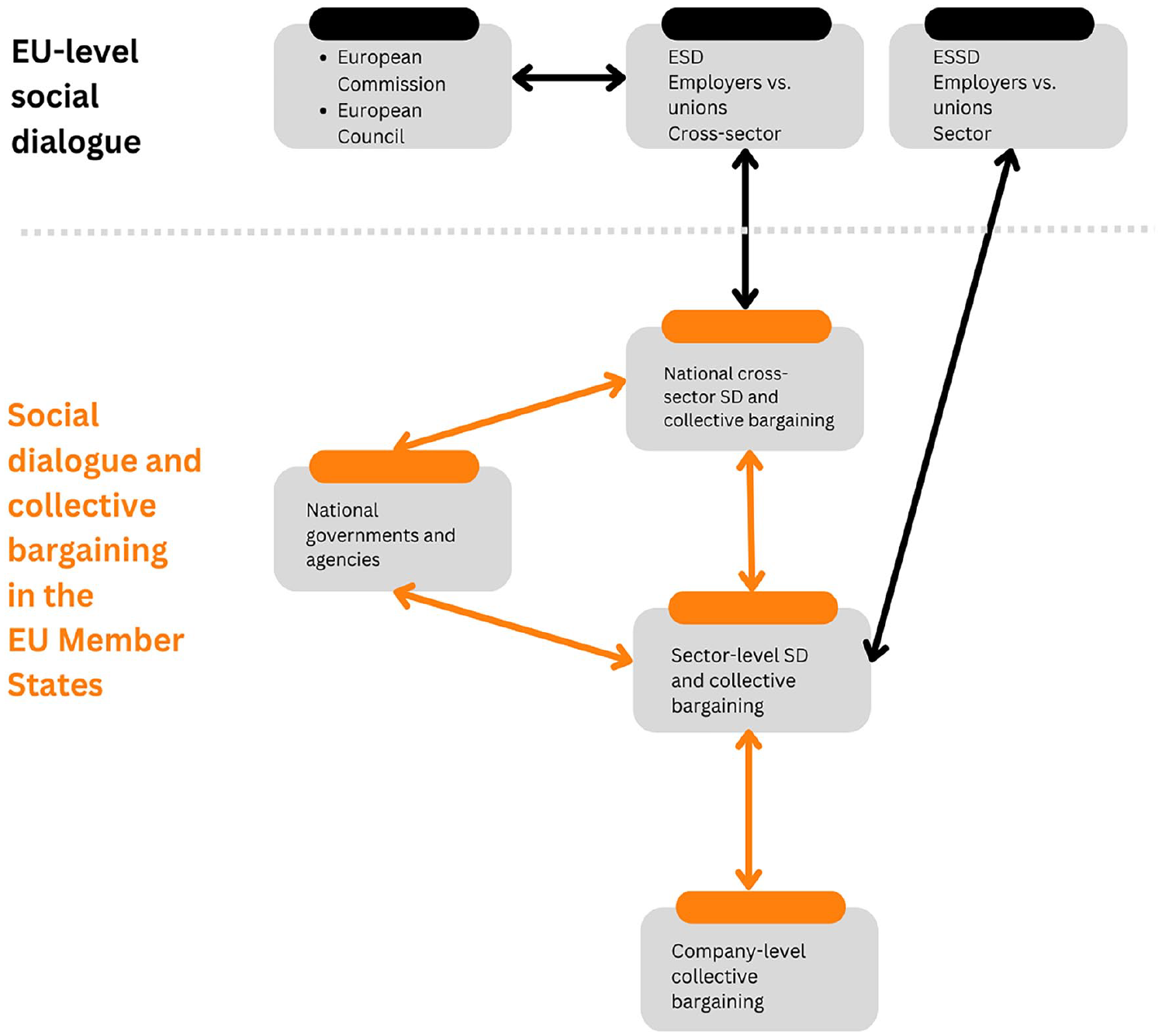
European social dialogue and European sectoral social dialogue in a multi-level governance perspective.
This helps us understand how national unions and employers are able to influence decisions, outcomes, and positions at the EU-level social dialogue structures and vice versa. The latter refers to whether and how the EU-level social dialogue outcomes are transferred to national social dialogue priorities and agendas in CEE Member States and implemented under their respective national institutional and legislative conditions.
Within this interactive framework encompassing the sectoral, national and EU levels, social dialogue can also evolve at the company level. EU-level social dialogue is structured cross-sectorally and sectorally (see Figure 1), so this is the focus of this article. It refrains from analysing interactions at the company level, such as representation via works councils, co-determination or information and consultation. Sectoral social dialogue is underdeveloped in some CEE countries while functioning in others. Based on the multi-level governance framework, our empirical analysis is based on the following elements:
– Themes/topics relevant at the EU level (for example, interactions between EU-level social partners and the European Commission and Council), and how they align with themes/topics prioritised and/or successfully transferred to national social dialogue.
– Actors, namely national and EU-level social partners, among both unions and employers, who are regularly involved in interactions and play a role in transferring social dialogue topics between the national and the EU level. We also examine actors’ organisational, structural, political and societal power resources (Lévesque and Murray, 2010).
– Social dialogue processes and outcomes, including the assessment of national social partners’ engagement in EU-level social dialogue and the analysis of interactions between the national and EU levels, influenced by prevailing power relations between the actors (see Table 1). We also assess the social partners in (selected) CEE countries regarding their integration into these EU-level social dialogue structures and whether they can actively voice their interests to the EU-level social dialogue. In turn, the analysis provides insights into CEE social partners’ preferred social dialogue outcomes and the forms such outcomes have taken, such as binding or non-binding recommendations, statements, collective agreements, social pacts, and similar.
– Effectiveness: an overall evaluation of whether social dialogue can deliver the expected outcomes after the integration of CEE social partners. The focus is on assessing whether the Central and Eastern European social partners’ capacity-building initiatives and exposure to European social dialogue over the past 20 years have facilitated the development of national social dialogue structures that are now able to transfer EU-level priorities to the national level and to channel social partners’ national interests and priorities to the EU-level social dialogue.
EU-level interviews.
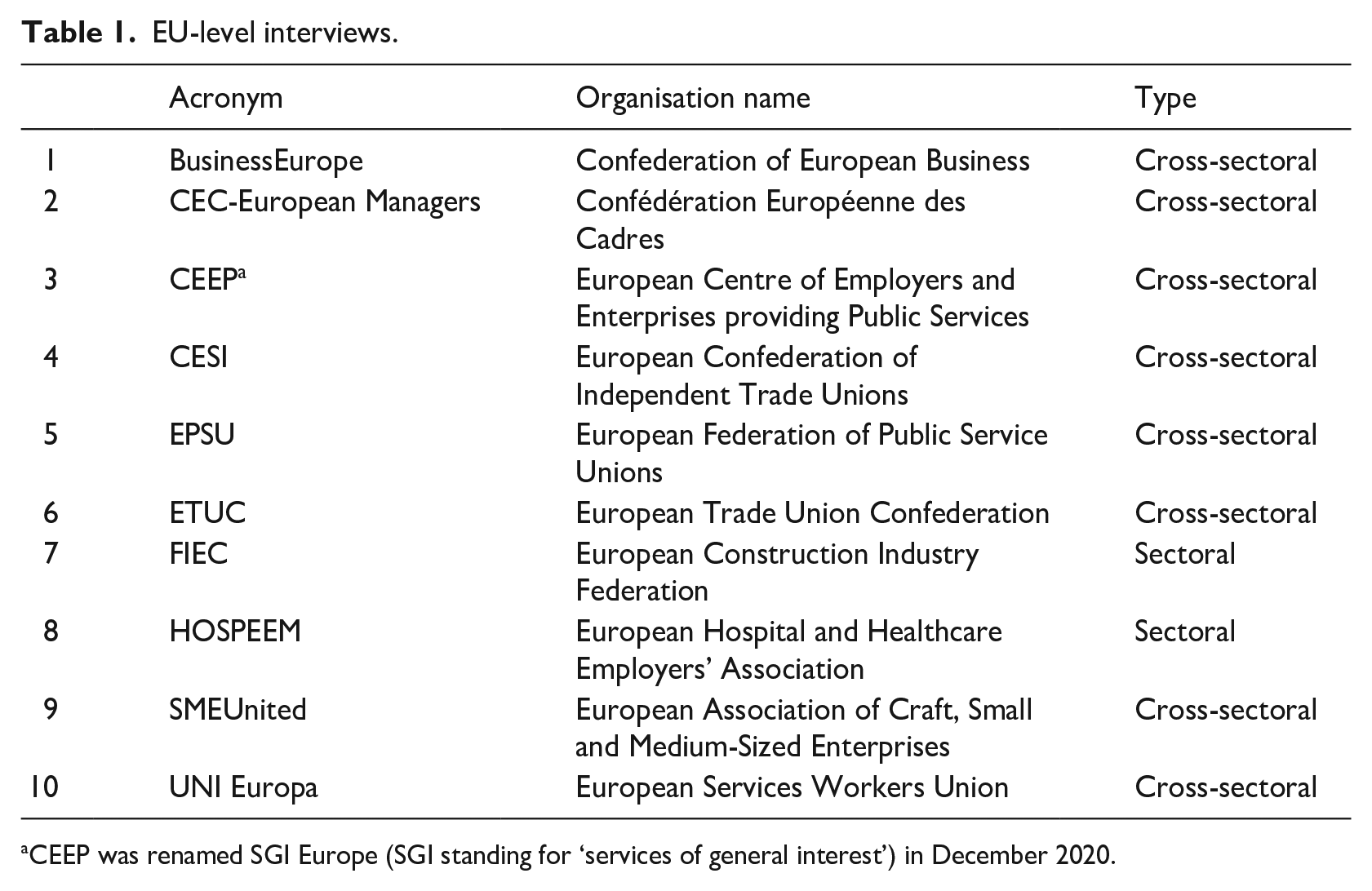
CEEP was renamed SGI Europe (SGI standing for ‘services of general interest’) in December 2020.
The remainder of this article provides a systematic account of the interaction between national social dialogue in Central and Eastern Europe and EU-level social dialogue actors and processes. This will enable us to assess ongoing social dialogue interactions after 20 years of EU membership and capacity building. Social dialogue interactions can take various forms between the national/sectoral level and the EU level and yield different outcomes regarding CEE social partners’ degree of integration in EU-level social dialogue structures and how EU-level agendas help them influence social dialogue in their respective Member States. For example, some CEE national social partners feel they have little say in their respective EU-level confederation. The CEE social partners may thus feel weakly represented or even under strong influence from the agenda dictated by EU-level social partners or social partners in other Member States. This would imply that, despite formal integration, the voice of CEE social partners is weak at the EU level, and the EU-level social dialogue structures are not providing equality in democratic decision-making and social partner access to EU-level policy-making.
Data and methodology
The article uses a mixed methodology for data collection and analysis of how national social partners in the CEE Member States voice their interests at EU-level social dialogue structures and how they can use EU-level social dialogue as a resource for their domestic social dialogue priorities. The evidence comes from an EU-wide survey among national social partners and is supplemented by qualitative evidence from 10 semi-structured interviews with EU-level social partners. The complete list of organisations interviewed for that purpose is presented in Table 1.
Interviews with EU-level social partners help us assess their own perspectives on the functioning of EU-level social dialogue and the interaction of EU-level social partners with national social partners across the Member States. To focus the analysis, we analysed interactions related to the most prominent topics in EU-level social dialogue. These were identified from a word-frequency analysis of the minutes of all EU-level cross-sectoral and sectoral social dialogue committees between 2015 and 2017 within the research project EESDA and the authors’ follow-up analysis of minutes to identify topics discussed frequently in EU-level social dialogue structures from 2017. These multiple kinds of data from various sources help us to put the interactions of CEE social partners with their EU-level counterparts in a comparative perspective.
The EU-wide survey was conducted in the 27 EU Member States between November 2018 and May 2019 (Akgüç et al., 2019). The survey was sent to at least 10 social partners in each country. From the 250 social partners targeted, 147 responses were received, and after excluding responses lacking some essential information, 130 were included in the final sample. The latter number included 68 responses from trade unions, 50 from employers’ associations and 12 from other associations (although six of the latter can be recategorised as employer associations and two as trade unions). The number of responses per country varied from two to ten; generally, CEE countries were more strongly represented in the sample.
It is important to note that at first sight, the overall number of respondents and the number of respondents per country appears to be relatively small in terms of a statistically consistent quantitative analysis. However, the survey was meant to collect data at the meso – i.e., organisational – level, which can represent millions of workers or hundreds of employers in Europe overall. Therefore, from the interest representation perspective and the population of social partners, the statistical relevance of the survey and its inferential capacity for empirical analysis are justified. Information on the statistical significance of differences at the commonly used levels using Fisher’s exact test has been added to the respective tables and figures. 5
Results
EU-level social dialogue: relevant themes and perspectives on capacity building
The empirical analysis is informed by the above conceptualisation of multi-level governance in social dialogue, particularly its building blocks (themes, actors, processes and outcomes, and assessment of the effectiveness of interactions between social partners).
The analysis of topics most frequently discussed in EU-level social dialogue structures (based on the minutes of meetings) in both European cross-industry and sectoral social dialogue committees included:
– skills, training and employability;
– health, safety, and well-being at work;
– working conditions (working time regulations, type of contracts and similar).
In addition, two new topics sparked the interest of EU-level social partners, and the frequency with which these topics have been taken up in discussions has been increasing since 2017. Analysis of European social dialogue and the minutes of European sectoral social dialogue committees after 2017 shows that the social partners paid increased attention to the social and employment consequences of digitalisation, automation and the impact of the COVID-19 pandemic on business, work and incomes. Since 2019, decent minimum wages and the related bargaining coverage to be achieved across the Member States have received extensive attention (Schulten and Müller, 2021). This topic is particularly relevant for CEE social partners, especially unions because they have successfully developed coordinated action to raise awareness of the European minimum wage theme at the EU level (Brandl et al., 2021).
One of the main findings from EU-level interviews as regards the challenges in vertical social dialogue interaction related to the social partners’ (particularly from the CEE region) lack of personal and analytical capacities to provide sufficient representation when agenda items or social dialogue work programmes are being planned. Although several issues discussed at the EU level are also commonly raised by the majority of social partners from various EU Member States, less CEE representation often means that there is less chance that topics from CEE countries will be brought up at the EU level (Akgüç et al., 2019).
Unlike the above-mentioned topics featured in meetings of EU-level social dialogue committees, the topics featured in national social dialogue structures across the EU largely evolved around national pension reforms, labour market participation of different groups, job creation, unemployment reduction, and skills, training and employability (Eurofound, 2018). Topics taken up in national social dialogue reflect individual country differences. Still, those that connect the Member States include responses to the pandemic, state support for employers and employees to mitigate the effects of the pandemic and the recent energy crisis, and discussion of the implementation of the EU Minimum Wage Directive. The upshot is that there is a partial overlap between topics addressed in EU-level social dialogue structures and partially unique national social dialogue. Identifying relevant social dialogue topics at the EU and national levels helps us contextualise the survey findings and respond to the article’s second research question, namely, how CEE social partners could align topics discussed at the EU level with topics prioritised at the national level. This allows us to shed light on the extent to which EU-level social dialogue serves as a resource for domestic social dialogue and collective bargaining, and EU-driven capacity-building initiatives helped strengthen social dialogue in Central and Eastern Europe.
It was confirmed in the interviews with EU-level social partners that, over the past decade, the European Commission has been more open to consultations with trade unions than in the past (for example, before the financial crisis of 2008–2009). This has also led to more targeted activities by the Commission concerning capacity building and enhancing the representativeness and involvement of social partners in CEE Member States. Here, capacity building is to be understood in a broader sense, ranging from having enough staff to attend various social dialogue meetings to overcoming language barriers, having the financial capacity to be able to travel, or possessing the analytical capability to evaluate the aims of EU-level policies and to contribute to them.
In June 2022, EU-level social partners – the ETUC representing workers and BusinessEurope, SMEUnited and SGI Europe representing employers – agreed on the Social Dialogue Work Programme 2022–2024. 6 Capacity building is one of the six priorities in this work programme, which includes telework and right to disconnect, green transition, youth employment, work-related privacy and surveillance, and improving the skills match in Europe. Capacity building has thus remained a common priority between previous and current social dialogue work programmes. More recently, emphasis has also been put on the current programme to support capacity building regarding recovery from the COVID-19 pandemic. Social partner consultation was encouraged during both the preparation and implementation phases of the National Recovery and Resilience Plans, even in the guidelines provided by the Commission (Theodoropoulou et al., 2022). However, emerging evidence based on analysing the National Recovery and Resilience Plans in a selected number of Member States suggests that social partner involvement or improvements in their capacity have remained limited during the recovery process (Sabato and Theodoropoulou, 2022).
Although the pandemic has disrupted capacity building, it may have led to more virtual or hybrid opportunities to engage with social partners in Member States experiencing capacity constraints. Nevertheless, some EU-level sectoral social partners (particularly those representing workers) have stressed that the increased social partner involvement in the labour market and social affairs – for example, in the context of the European Semester and the National Recovery and Resilience Action Plans – is not always matched by an increased social partner capacity. Some still confront representation issues (Akgüç et al., 2019; Theodoropoulou et al., 2022).
Interviews with the EU-level social partners also revealed that, in their view, social dialogue would be more effective if funding dedicated to Member State capacity building were increased. This would allow social partners to invest in training (for example, language, negotiation, analytical and presentation skills), as well as boost their financial resources, enabling them to hire more staff or to travel and participate in more meetings both within the country or abroad (Akgüç et al., 2019; Waddington et al., 2023). For example, the European Semester process is often coordinated from the capital city of the Member State, which might be a financial and capacity issue (for example, lack of staff) for other national social partners (or stakeholders) from remote regions who might want to participate in coordination meetings. Increased funds to enhance the capacity of local social partners would allow them to raise their voices to a higher level and raise their awareness of various issues through interacting with different social partners (Akgüç et al., 2019; Waddington et al., 2023). The latter is indispensable to bottom-up interaction between national and EU-level social partners. This is a key concern for most EU Member States but is especially acute in the CEE region.
Survey of the social partners across EU Member States
After presenting the most critical issues in EU-level social dialogue structures and EU-level social partners’ perceptions of the importance of EU-level social dialogue in the wake of EU enlargement, this section focuses on national social partners’ views, particularly on their involvement in EU-level social dialogue structures. The analysis presented here is based on a survey of national social partners. National respondents from across the EU consider the EU-level social dialogue important. Of the 118 responding trade unions and employers’ associations, 96 participate in at least one committee within this framework. The most frequently reported reasons for organisations that do not participate in the EU-level social dialogue include a lack of financial resources and capacity constraints.
Table 2 shows that most of the surveyed social partners generally participate in the EU-level social dialogue. Still, the proportion is somewhat lower in CEE countries than in other EU countries, at 72 and 85 per cent, respectively (statistically significant at the 10 per cent level in contrast to several other differences highlighted below). The lower capacity of the CEE social partners certainly has some role in this. For example, looking at the reasons for not participating in the EU-level social dialogue, social partners from both groups of countries, CEE and non-CEE, attached relatively lower importance to procedural transparency and entry barriers (15–30 per cent of respondents), while a much higher percentage of CEE social partners highlighted financial resources (70 and 42 per cent, respectively), and capacity constraints (65 and 42 per cent). 7 There is little difference between the groups regarding participation in EU sectoral organisations (75 and 80 per cent, respectively). In both groups, a roughly equal percentage of organisations (ca. 36 per cent) have changed the participating delegation since 2015. There also do not seem to be major differences in their perception of their ability to initiate topics at the EU-level social dialogue; in both cases, about one-third of organisations answered positively. The CEE unions are marginally more active in EU-level social dialogue than CEE employers (77 and 68 per cent). But the unions more frequently mention capacity constraints (83 and 29 per cent) and financial resources (83 and 57 per cent) as inhibiting factors. That may also reflect the unions’ greater desire to participate in the European social dialogue. Note that most of these differences are statistically insignificant because of the low number of observations – in some cases, the number of observations is too small for meaningful statistical tests.
Participation in European social dialogue by national social partners: CEE and non-CEE Member States.
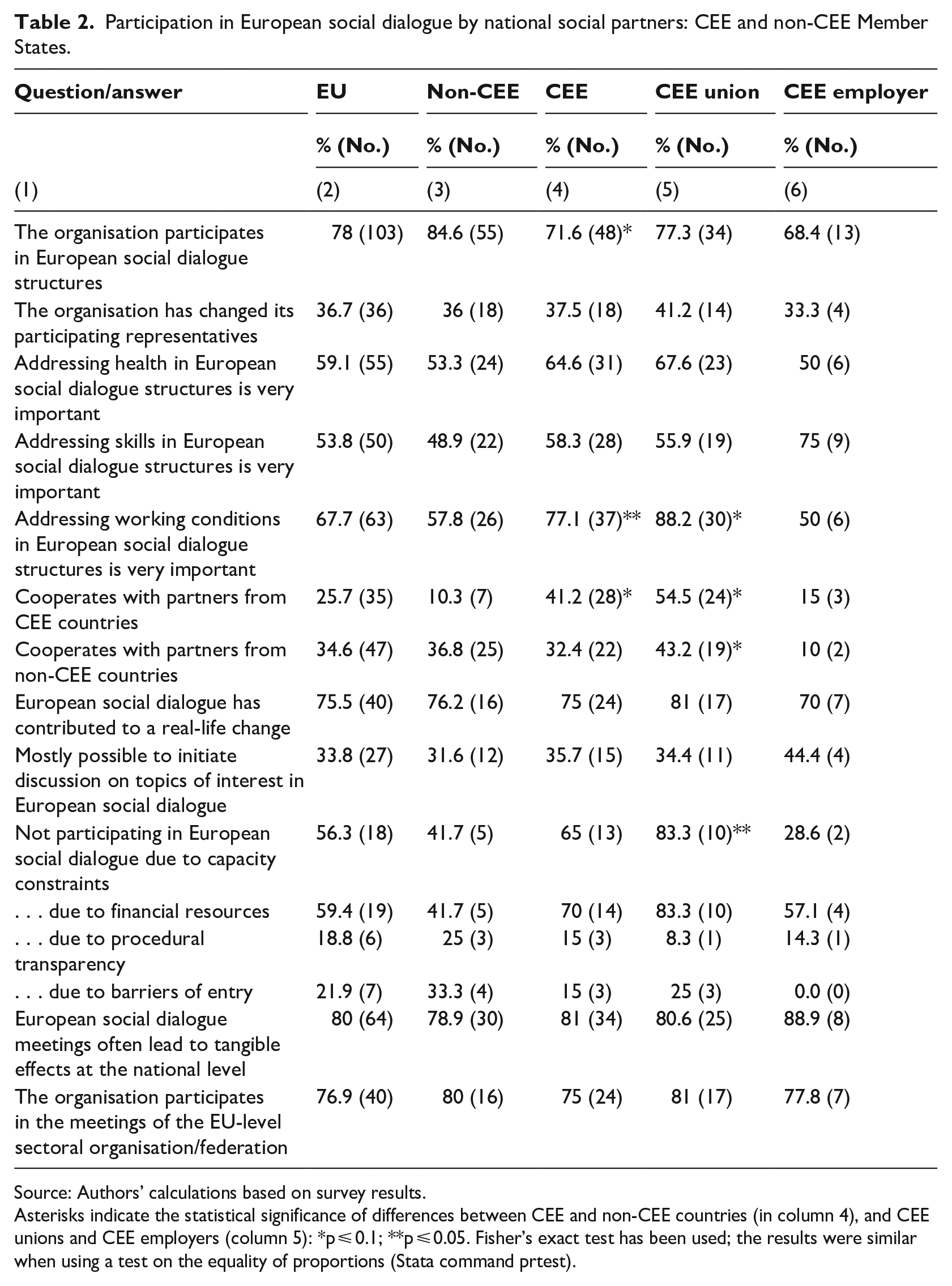
Source: Authors’ calculations based on survey results.
Asterisks indicate the statistical significance of differences between CEE and non-CEE countries (in column 4), and CEE unions and CEE employers (column 5): *p ⩽ 0.1; **p ⩽ 0.05. Fisher’s exact test has been used; the results were similar when using a test on the equality of proportions (Stata command prtest).
Concerning which countries are strategic partners in the EU-level social dialogue, a clear and robust clustering effect is observed regarding belonging to the CEE region. While among the CEE social partners, 41.2 per cent mentioned social partners from the other CEE countries, only 10.3 per cent of social partners from the non-CEE Member States said the same. This finding seems almost entirely driven by international cooperation by trade unions. However, the propensity for collaboration with social partners from non-CEE countries is broadly similar, at 32 per cent in CEE and 37 per cent in non-CEE countries. This finding deserves further attention to understand why CEE social partners are only somewhat less important as cooperation partners for non-CEE social partners (that issue may also go beyond the EU-level social dialogue). 8 We did not check for other ‘groupings’ (southern, Nordic and so on), which would be challenging given the low number of observations in the analysed survey data. Thus, it is hard to say whether it is a regionalisation pattern or a definite ‘CEE vs the rest’ situation.
Given the importance of broad topics at the EU-level social dialogue (skills, health care, working conditions), generally, very few organisations considered these to be either of low or no importance. Thus, we focus on the share of those labelling some topics ‘very important’. While generally, the majority of social partners rate these topics as very important, and all three are considered very important more frequently by the CEE social partners, the difference is most striking regarding working conditions: 77 per cent and 58 per cent among CEE and non-CEE social partners, respectively, rate working conditions a very important issue to be discussed at the EU level. That probably reflects more problems with working conditions in the CEE countries (although some recent issues, such as platform work, should be topical for all countries). The finding that working conditions are a much more critical issue for CEE unions than for CEE employers (88 per cent and 50 per cent, respectively, with statistical significance) is only to be expected.
Finally, besides participation in the European social dialogue, its effectiveness depends on whether EU-level social dialogue leads to any tangible effects at the national level. Very few respondents in any group indicated that such a linkage never or always exists; thus, we instead report the share of respondents answering ‘Sometimes’ or ‘Often’, which is fairly similar in both country groups (77 and 79 per cent, respectively). It is positive that there is no evidence of the EU-level social dialogue being perceived to be less effective in leading to outcomes at the national level in the CEE countries (although the fact that social dialogue is considered effective does not need to indicate that the social partners do not expect improvements).
Another interesting question concerns how the social partners in CEE and non-CEE EU countries see the future of EU-level social dialogue. Generally, more than 80 per cent expected that there would be some changes, although responses vary (see Table 3). At the same time, relatively few social partners expected that EU-level social dialogue would become more or less important for national-level policy-making. CEE social partners seemed more sure that such developments would occur (30 per cent). In comparison, among the non-CEE social partners, 49 per cent responded that while EU-level social dialogue should become more important, it lacks the capacity to do so. The latter finding could result from their longer participation in the EU-level social dialogue. Thus, the social partners from the ‘old’ EU Member States may be more realistic, even sceptical, about future developments. At the same time, less developed social dialogue in the CEE countries may give the CEE social partners higher expectations of rapid developments in EU-level social dialogue.
Expectations regarding the future of European social dialogue.
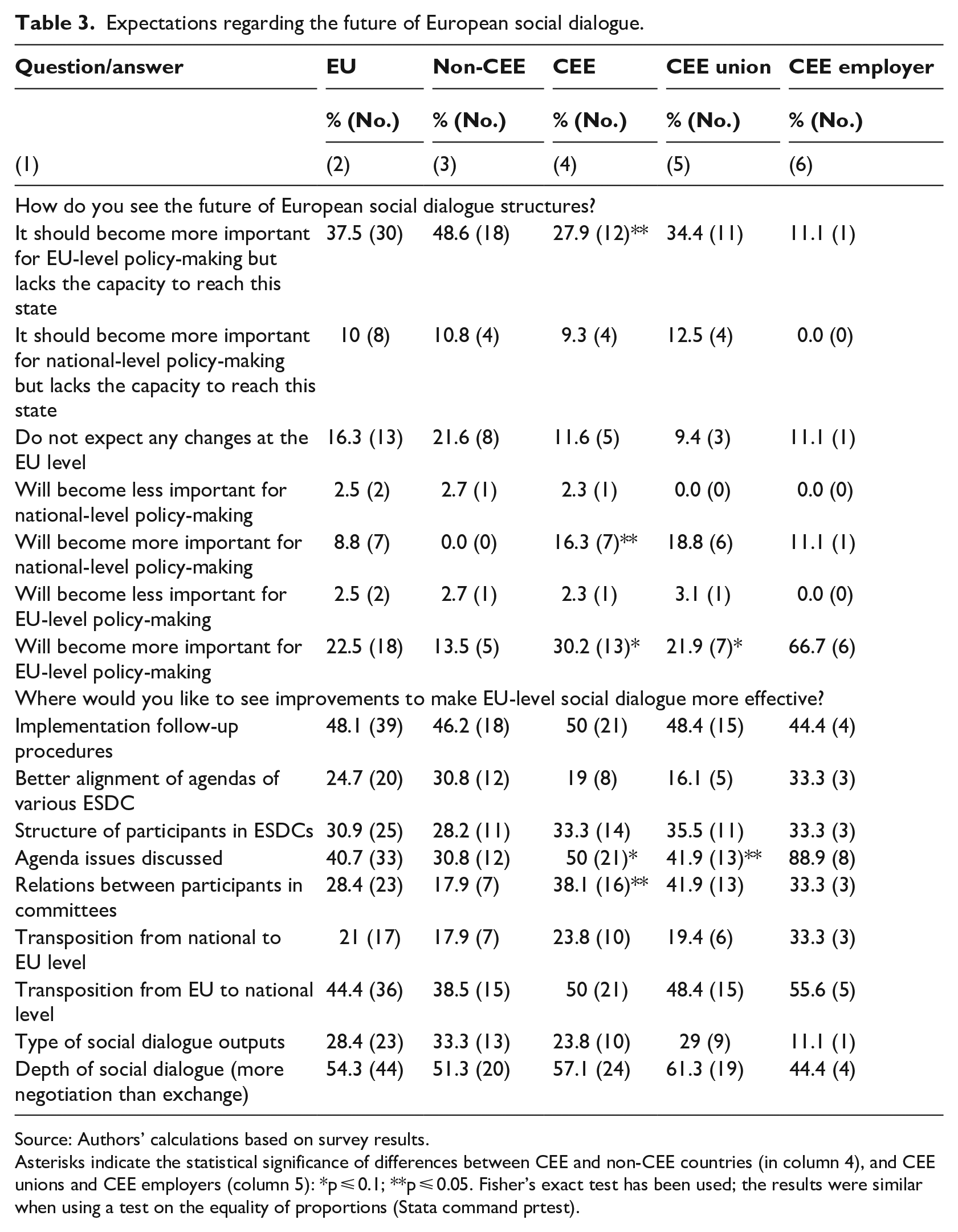
Source: Authors’ calculations based on survey results.
Asterisks indicate the statistical significance of differences between CEE and non-CEE countries (in column 4), and CEE unions and CEE employers (column 5): *p ⩽ 0.1; **p ⩽ 0.05. Fisher’s exact test has been used; the results were similar when using a test on the equality of proportions (Stata command prtest).
Concerning areas where improvements are expected in European social dialogue, respondents from both non-CEE and CEE countries want deeper social dialogue (more negotiation than information exchange: 57 per cent in CEE and 51 per cent in non-CEE). Social partners would also like to see changes in the issues discussed in the committees (50 per cent in CEE, 30 per cent in non-CEE). Compared with social partners from non-CEE countries, CEE social partners more often see the need for improvements in relations (38 vs 18 per cent), in the issues discussed (50 and 31 per cent), and in the transposition of topics from the EU level to the national level (50 and 38 per cent), and from the national to the EU level (24 and 18 per cent).
Concerning the social partners’ expectations towards the EU-level social dialogue, the vital question is whether they expect changes in the character and type of social dialogue outputs. A higher percentage of organisations were satisfied with current outcomes in non-CEE countries (38 versus 31 per cent of respondents). CEE representatives indicated somewhat more often that they would prefer fewer non-binding and more binding agreements (33 and 20 per cent). On the other hand, representatives of non-CEE countries would instead like to see a move towards more non-binding agreements (21 and 32 per cent). But that can be explained by a higher share of CEE respondents being trade unions (65 per cent and 39 per cent, respectively).
Discussion and conclusions
From an industrial relations perspective, one of the essential dimensions of joining the EU is the integration of social partners in EU-level representation structures via trade unions, employers’ associations and social dialogue. Also important are opportunities to voice national demands at the EU level and to draw on power resources from the EU-level social dialogue in domestic social dialogue, bargaining and policy-making. The multi-level governance perspective provides tools to address this complex and dynamic network of interactions between the EU and national levels from the perspective of actors, processes, outcomes and their effectiveness.
This article assesses actors’ perceptions of how social dialogue interactions between the national and EU levels have taken shape since the CEE Member States joined the EU 20 years ago. After highlighting the structure of EU-level social dialogue from the multi-level governance perspective and setting out its history and priorities, the analysis evaluated interactions, structures and outcomes between national and EU-level social partners.
The analysis results in three key arguments. First, the perceived lower capacity of the CEE social partners, especially unions, clearly limits their participation in the EU-level social dialogue and, more generally, their expectations of its development. Second, economic realities in the CEE countries, such as the labour market situation, affect what topics interest the national social partners (although that issue requires further investigation). While wages and financial regulation (including pensions) dominate national social dialogue, social partners from CEE countries also find the priority issues raised at the EU level relevant. In some cases, CEE social partners found the topics raised at the EU level even more important than the non-CEE Member States’ social partners. Finally, CEE social partners are clearly a separate group in EU-wide cooperation, especially on the trade union side. Thus, some development of their networks and more integration with social partners from non-CEE Member States might be needed to enable them to participate fully in the EU-level social dialogue and to obtain the full benefit of it for their domestic agendas.
While integrating national actors in EU-level organisations and social dialogue structures has yielded benefits in capacity building and strengthening the legitimacy of domestic bargaining, some challenges remain even after 20 years of the enlargement. These include a perceived duality (by the national social partners) and internal competition between ‘Western’ and ‘Eastern’ members of the EU-level social partners (Adamczyk, 2018); criticisms of EU-level social dialogue’s ability to deliver effective outcomes (even though respondents seemed to indicate that the EU-level social dialogue is important); and diversity of actors’ preferences, for example, concerning binding and non-binding stipulations. Social partners from CEE certainly see the benefits of their interaction and exposure to EU-level social dialogue, but they also identify weaknesses. Although they have been able to use EU-level outcomes as leverage in domestic bargaining, CEE social partners admit that their underdeveloped structures (for example, tripartism and sectoral bargaining) pose a substantial barrier to their capacity building and ability to voice their interests at the EU level. This contrast between what CEE social partners can pull from EU-level social dialogue and what they can raise at the EU level leads us to refer to this interaction as a one-way street, in which the ‘pull’ factor is demonstrable, but the ‘push’ factor remains limited even after 20 years.
These findings are supported by insights obtained from interviews with EU-level social partners. Despite similar EU-level preferences, the diversity of national social dialogue practices and industrial relations systems became more pronounced with EU enlargement. The relaunch of the European social dialogue in 2016 to boost its level of activity and raise awareness was one attempt to overcome such challenges and increase the active participation of social partners. Despite these efforts, some sectoral EU-level social partners admit that some Member States are not sufficiently consulted or informed to be able to participate in discussions and make meaningful contributions to the EU-level social dialogue. This article thus confirms the findings of other studies (Akgüç et al., 2019, among others) that a lot of progress still needs to be made to tackle significant differences across the Member States.
Footnotes
Funding
The research presented in the article received funding from the European Commission within two projects: ‘Enhancing the Effectiveness of Social Dialogue Articulation in Europe’ [EESDA, Project No. VS/2017/0434], implemented in 2018–2019; and ‘Articulation of the trade unions’ strategies on upward convergence of social standards in the enlarged European Union – voice of CEE countries’ [ARTUS-CEE, Project No. VS/2019/0070], implemented in 2019–2021.
1
Enhancing the Effectiveness of Social Dialogue Articulation in Europe (EESDA, Project No. VS/2017/0434), implemented in 2018–2019.
2
Articulation of the trade unions’ strategies on upward convergence of social standards in the enlarged European Union – voice of CEE countries (ARTUS-CEE, Project No. VS/2019/0070), implemented in 2019–2021.
3
The term comes from the Château Val Duchesse in Brussels where the European social partners met in 1985. It has come to be used to describe the emergence of European social dialogue.
4
For a complete list of the principles of the Pillar, see the relevant European Commission webpage (European Commission, Secretariat-General, 2017).
5
Test results did not differ much when using the test of the equality of proportions, Stata command prtest. Fisher’s exact test is preferred given the small size of the sample.

7
Capacity broadly refers to social partners’ resources, including leadership, internal solidarity, network embeddedness, adequate policies and material, human and procedural infrastructure to frame certain actions, activate networks, have an impact on certain topics and be able to learn from these experiences (Lévesque and Murray, 2010).