




Abstract
App-based food delivery relies on business models centred on the use of self-employed persons, combined with algorithmic management. In Norway, however, delivery platforms initially adapted the more traditional model: couriers were given employment contracts, joined an established trade union and negotiated a collective agreement. Nevertheless, the market entry of companies reliant on the self-employed, which expanded during the pandemic, prompted strategic changes that reduced worker power. This article explores agency in app-based food delivery in Norway. The research questions are: How do different actors’ (platform companies, workers and unions) strategies affect working conditions and pay? How do these actors use power and power resources strategically? This article makes a dual contribution. First, it provides empirical insights by examining a notable case of collective organising and negotiation involving a traditional union in Norway. Second, it contributes to our theoretical understanding of how workers and companies change their strategies to navigate the power dynamics in this emerging field.
Introduction
App-based food delivery has become widespread and now dominates political debate on platform work and the future of work in Europe (Vandaele, 2020). Although the road to collective agreements for delivery workers – who are often classified as self-employed – seems a long one, various forms of worker action have developed across Europe (Cant, 2019; Tassinari and Maccarrone, 2020; Woodcock and Cant 2022). Often, protests have taken the form of spontaneous strikes, with or without the aid of grass-roots unions (Cini et al., 2022), and in some cases with the aid of more established unions (Jesnes et al., 2021; Vandaele, 2020). Woodcock and Cant (2022) nevertheless point out the lack of victories, despite widespread worker action.
In Norway, which has a well-unionised labour market, employed couriers at Foodora decided to organise and join an established union. The organised couriers obtained a collective agreement in 2019 after a five-week-long strike, compensated by the union’s strike fund. The agreement included a pay increase, a supplement for equipment and winter months, and a collectively agreed pension scheme. It has been renegotiated twice, in 2020 and 2022. The collective agreement was a significant victory for the workers. However, during the pandemic, Wolt, which relies solely on the self-employed and freelancers – not covered by the Working Environment Act – gained ground. Foodora has thus changed strategies and increasingly uses self-employed couriers, too. 1 Hence, even in this ‘best-case’ scenario of collective action, there is an ongoing power struggle between delivery companies and workers, with considerable consequences for couriers’ working conditions and pay.
In this article, I identify app-based food delivery as an emerging field (Fligstein and McAdam, 2012) and combine it with the power resource approach (Korpi, 1985) in order to explore the strategies and power dynamics of companies, couriers and unions. The research questions are as follows: How do different actors’ (platform companies, workers and unions) strategies affect working conditions and pay in app-based food delivery? How do these actors use power and power resources strategically? While the power resource approach is a well-established analytical framework, I expect that the specific circumstances of app-based delivery, such as the lack of established regulations, variation in contracts and the prevalence of algorithmic management, will significantly shape the way workers are able to access and use power resources. I also expect that the institutional mechanisms in the Norwegian labour market model will play a significant role in this case.
This article’s contribution is twofold. First, it offers an empirical example of a best case with regard to collective action in Norway, highlighting not only workers’ struggles, but also how workers and companies use different strategies when cooperating and confronting each other on working conditions and pay. Second, the article deepens our theoretical understanding of how platform companies change strategies to maintain the upper hand in the power dynamics in this emerging field.
The article is structured as follows. In Section 1, I provide an overview of previous research on platform companies and the Norwegian context. Then (Section 2), I present the analytical framework, building on field theory and the power resource approach. Third (Section 3), I outline the data and methodology. Section 4 describes the case study and Section 5 its findings. In the Conclusion, I argue that Foodora initially appeared to adapt to the Norwegian institutional environment, but later changed strategy in order to maintain market power. In response, workers find themselves compelled to navigate between different power resources and strategies, depending on their availability and applicability at different points in time. However, expected changes in Norwegian regulations are likely to prompt companies to readapt to the institutional environment, shifting the power dynamics between the actors once again.
Previous research: platform companies and the Norwegian context
App-based food-delivery companies may serve as prominent examples of platform companies, which have been extensively researched during the past decade. Vallas and Schor (2020) present four aspects of platform companies, based on the literature, providing insights into how these companies behave. First, platform companies are perceived as entrepreneurial incubators, offering flexible and occasional income opportunities. This flexibility is often constrained by algorithmic management, however, defined as the use of technological tools and digitalised supervision to govern and discipline the workforce, with minimal human intervention (De Stefano and Taes, 2023). This leads us to the second aspect: platform companies as digital cages, in which workers are subject to automated decision-making, raising concerns about misclassification of legal status and exploitation. Kougiannou and Mendonça (2021) and Mendonça and Kougiannou (2023) highlight how platform companies frequently modify algorithmic management systems over time, termed ‘intraplatform algorithmic changes’, worsening working conditions and pay, and limiting worker action. Third, platform companies are identified as accelerants of precarious employment, characterised by uncertainty and insecurity. These companies’ heavy reliance on self-employment and atypical employment shifts risks and costs onto workers. Couriers lack job security, safety nets and adequate worker representation because of their self-employed status, high turnover, geographical dispersion, and lack of a fixed workplace (Heiland, 2022). Migrant couriers, in particular, face added vulnerabilities as a result of poverty, debt and obligations to support family (Mendonça et al., 2023). Van Doorn and Vijay (2021) emphasise the dual nature of platform work for migrant workers: it provides a job but is often a dead end. This reinforces the image of platform companies as intensifying precarious work.
Nevertheless, platform companies are undeniably influenced by their context, exhibiting variations in their business models across countries (Thelen, 2018). This leads to the fourth aspect of platform companies as chameleons, adapting to the institutional context. Moreover, Vallas and Schor (2020) outline their own perspective on platform companies as permissive potentates – ‘a new type of governance mechanism with which employers can conduct economic transactions’ (p. 282). This involves platform companies maintaining control over vital functions such as data, task allocation and pricing (‘potentates’, rulers), while ceding control over aspects such as schedules and performance evaluations (hence permissive). While these aspects are not mutually exclusive, some take precedence in the Norwegian context. In particular, I will discuss whether platform companies behave as chameleons or permissive potentates.
Norway’s institutional context challenges the platform model, and thus represents a crucial case for understanding whether platform companies behave as chameleons or not, or only partly. The Nordic countries’ institutional framework is unique in Europe. It is characterised by strong social partners, organised wage setting, a centralised collective bargaining system and a generous welfare state (Dølvik, 2013). Huzzard and Nilsson (2004) describe the Nordic labour market model as providing tools for both confrontation, described as ‘boxing’ (for example, strikes), and collaboration, described as ‘dancing’ (for example, regular meetings between management and trade union representatives). This shifting between ‘boxing’ and ‘dancing’ illustrates the dynamics of cooperation and confrontation in the region’s industrial relations. In 2020, around 51 per cent of Norway’s workforce was unionised, with roughly half of private sector employees covered by collective agreements (Kjellberg and Nergaard, 2022: 52). This also makes Norway a crucial case for studying worker action in food delivery, a sector in which successes have otherwise been limited. As Patton (2014) says about critical cases, ‘if it doesn’t work here, it won’t work anywhere’ (p. 266).
In Norway, Foodora started out by offering employment contracts, and some of its employees joined an established union, the Transport Workers Union, which in 2019 merged into the largest private sector union in Norway, the United Federation of Trade Unions (Fellesforbundet). The latter organises workers in – among others – manufacturing, construction, hotels and restaurants, and transport. Fellesforbundet is a member of the Norwegian Confederation of Trade Unions (LO), with strong historical ties to the Labour Party, and also (currently) to other political parties on the left.
The union and the company signed a collective agreement in 2019. This represents a noteworthy success in organising couriers. The Basic Agreement between LO and the Federation of Norwegian Enterprise (Virke, of which Foodora is a member) accompanies the collective agreement. This agreement binds management and trade union representatives, as well as safety representatives, 2 at company level to assume joint responsibility for transposing the Working Environment Act and collective bargaining outcomes into actions at company level through regular meetings. The latter also facilitate collaboration on productivity improvements, restructuring and organisational development (Løken et al., 2013). While wages are negotiated annually, the local parties – trade union representatives and management – conduct negotiations on agreements every second year at company level, with central parties stepping in only when they fail. These negotiations operate under a peace clause prohibiting strikes. If the negotiations fail, the National Mediator must be informed of strikes and lockouts in advance, and has the authority to halt such actions until mediation is completed (Løken et al., 2013). Regulations and collective agreements are underpinned by enforcement mechanisms, such as the Labour Inspectorate.
Ilsøe and Söderqvist (2022) argue that platform companies in the Nordic countries engage in collective bargaining and comply with regulations because they perceive it to be a competitive advantage. In line with this, Jesnes (2019) outlines two Nordic platform models: the typical one, using self-employed workers with algorithmic management; and the hybrid variant, employing workers on atypical contracts, combined with algorithmic management. The hybrid model offers enhanced worker rights, benefits and easier access to collective rights. With this model, the platform companies exhibit chameleon-like behaviour. While platform work is limited in the Nordic context, the typical platform model is more widespread in private services, such as cleaning, hospitality, transport and logistics, in which unions are weaker and precarious work more common (Rasmussen et al., 2019). Many workers with migrant backgrounds work in these industries, with lower unionisation rates than the overall workforce, posing challenges for union integration (Hagen and Jensen, 2019; Nergaard and Ødegård, 2022). Thus, the typical platform model may also gain traction in these industries. Indeed, despite the success of the Foodora–Fellesforbundet agreement, the increased use of self-employed workers by companies during the pandemic has reshaped the landscape (Jesnes and Oppegaard, 2023). This again raises the question of whether these companies only partly behave as chameleons, and increasingly more as ‘permissive potentates’ in the Nordic context.
Analytical framework – combining field theory with the power resource approach
Field theory is useful in delineating our case, which concerns the power dynamics and strategies in play between companies, unions and workers in app-based food delivery and the institutional framework of the Norwegian labour market model. Field theory examines how power resources empower certain actors in the field and the dynamics between these actors (see Fligstein and McAdam, 2012). Consumers and restaurants are not part of this analysis, as these actors’ strategies are less explicit in the Norwegian context. In this field, there is consensus on challenges such as worker misclassification and algorithmic management (Donini et al., 2017). App-based food delivery is an emerging field in the sense that the rules are not yet institutionalised, and power dynamics come into play among actors seeking to shape the landscape in alignment with their interests. The lack of established rules is illustrated by the upcoming amendments to the Norwegian Working Environment Act in 2024, and the proposed EU Directive to enhance working conditions for platform workers, under negotiations (European Commission, 2021). These regulations aim at a more inclusive definition of employee, with the presumption of employee status, similar to the Riders’ Law in Spain, in accordance with which companies, rather than workers, must prove legal status. The EU Directive also includes regulations on algorithmic management. The Directive, if adopted, might influence working conditions for couriers in Norway as part of the European Economic Area (EEA). But concerns have been raised that, if adopted in its earlier versions, platform companies will be able to circumvent the Directive (Buendia Esteban, 2023).
The power resource approach explores different sources of power and/or strategies that help workers improve their situation. Pioneered by Korpi (1985), and later by Wright (2000) and Silver (2003), the power resource approach suggests that labour can protect its interests by using power resources collectively. Here, power means the ability to do something (power to), not necessarily to control the rules (power over) (Lévesque and Murray, 2010). The power resources in focus here include associational, structural and institutional power (Schmalz et al., 2018; Silver, 2003; Wright, 2000). 3
First, associational power refers to workers’ ability to organise and take action collectively. Companies’ organisation of work through algorithmic management, the large share of migrant workers and the high turnover pose challenges to couriers’ associational power (Heiland, 2022). Second, structural power refers to workers’ position in the economic system and is twofold (Silver, 2003; Wright, 2000): while ‘workplace bargaining power’ comprises workers’ capacity to disrupt production or service delivery, for example, through strikes and work stoppages, ‘market bargaining power’ relates to companies’ ability to replace workers. Couriers are easily replaceable because the job does not require formal skills, training or even a specific language (Joyce et al., 2023). Third, workers’ institutional power relies on labour laws and collective bargaining frameworks established through past worker movements, which couriers can leverage (Schmalz et al., 2018). As a result of platform companies’ classification of workers as self-employed, labour laws and collective bargaining frameworks are not readily accessible to couriers (Heiland, 2022). Recognising that power is a relational concept, however, companies have options when it comes to legal status, choosing between negotiation, cooperation or labour destabilisation (Schmalz et al., 2018). Foodora has chosen the hybrid platform model in Norway (Jesnes, 2019), which has also spread in Europe lately (Lamannis, 2023). Workers’ institutional power is thus more readily available.
Data and methods
According to Flyvbjerg (2006), a critical case is of strategic importance in relation to the general problem under study. In this instance, if couriers cannot organise and acquire power in the Norwegian context – known for its strong social partners and worker-friendly regulations – victories among such workers are unlikely elsewhere (Flyvbjerg, 2006: 230). While the focus is on the strategies adopted by actors in the emerging field of app-based food delivery, particular attention is given to how Foodora adapts strategies in response to emerging competition and the challenges posed by the pandemic, alongside an examination of the ways in which the workers have navigated this evolving landscape.
The primary data sources for the analysis include interviews with 24 couriers, five trade union officials, four representatives from the relevant two companies and two employer organisations, ensuring the inclusion of multiple voices within the field (Tracy, 2010). The interviews with different actors give a better overview of the actors’ dynamic interaction and strategies.
Achieving saturation – meaning data collection until no new information emerges (O’Reilly and Parker, 2013) – is challenging in this rapidly evolving field, in which actors continue to change strategies. The interviews were conducted between 2018 and 2022, and the timing – before, in the midst of and after the height of the pandemic – is more important for understanding developments than the number of interviews.
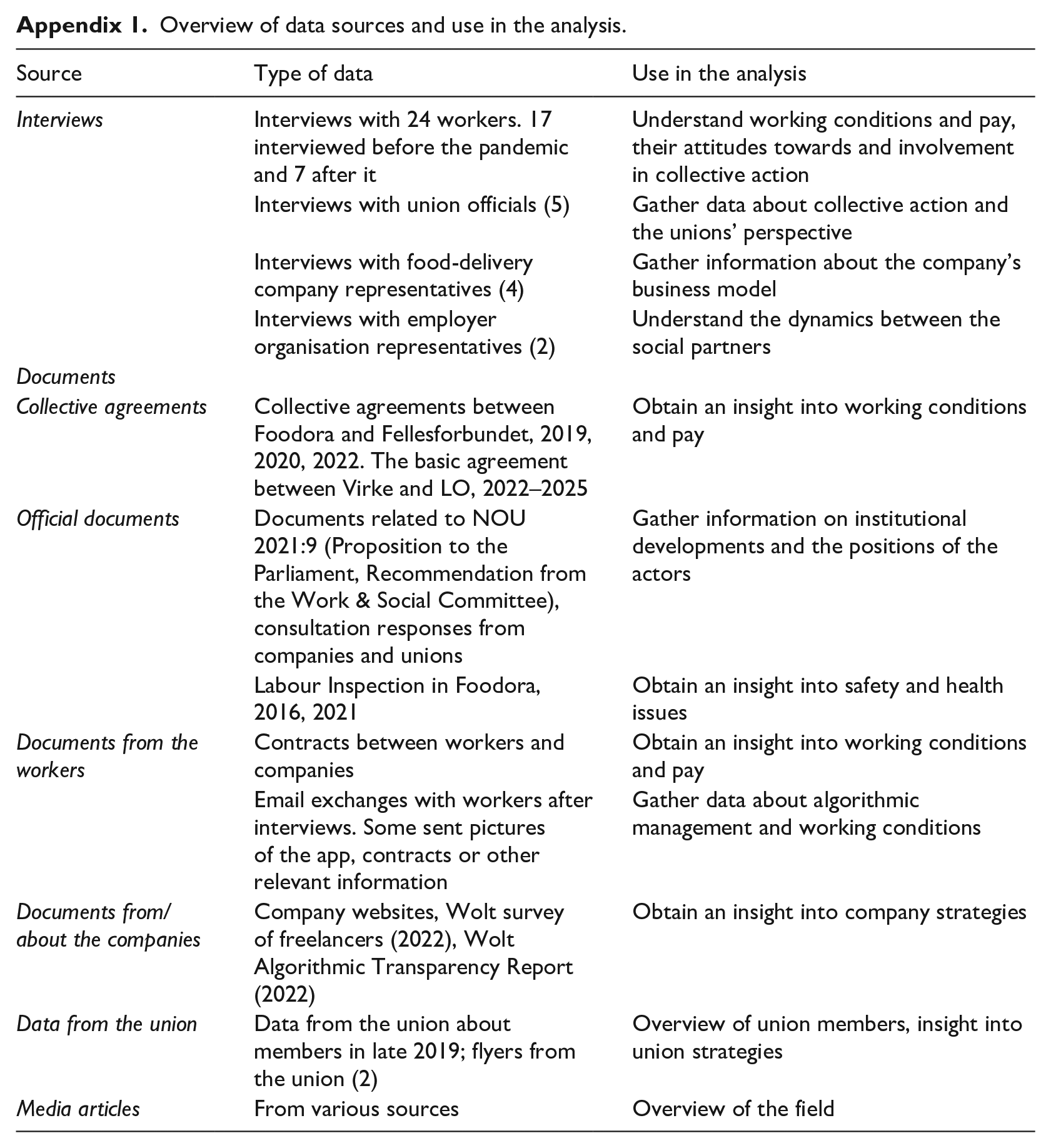
Additionally, relevant documents such as collective agreements and consultation responses by the social partners in relation to legislative changes were used as supportive data to the interviews, allowing data triangulation (Tracy, 2010). Appendix 1 gives an overview of how the interviews and documents were used in the analysis.
Recruiting and interviewing couriers was most time-consuming, so I will first outline my approach to these workers, before I describe my dealings with other informants. Finally, I will comment on my strategy for analysis.
Interviews with couriers
Purposeful sampling was used to capture the insights of key informants, including couriers who were members of and active in the union, non-members of the union and typical couriers, such as migrants and the self-employed (Patton, 2014). A combination of recruitment techniques was used. Initially, the union helped me to recruit workers for mini focus-group discussions of two to five participants. Focus-group dynamics reveal insights not readily accessible in individual interviews (Ringdal, 2018). In order to hear the perspectives of migrants from outside Europe and the self-employed, I obtained the union’s support in disseminating information about the research project on the workers’ dedicated Slack channel. In addition, direct approaches were made to couriers in restaurants with high delivery volumes. Although this approach required significant time, it proved vital in engaging participants with diverse perspectives on strategies. During recruitment, efforts were made to accommodate the language preferences of non-Norwegian-speaking workers by providing project information sheets in both Norwegian and English. Resource limitations prevented interviews with workers who did not speak English or Norwegian, however, potentially limiting insights from the most vulnerable workers.
Interviews were conducted primarily face-to-face, but occasionally via telephone – or in one case email – to align with workers’ preferences and save time. A semi-structured interview guide covered various topics, including background, work experiences, motivations and worker representation/union engagement, ensuring consistent coverage of essential themes while allowing for in-depth exploration (Patton, 2014). Initially, union-arranged interviews were in focus-group format, but subsequent interviews were individual, enabling discussions on sensitive topics such as health and safety, which might not have arisen in focus groups (Ringdal, 2018). Each interview lasted one or two hours, providing ample time for thorough discussions.
Throughout the research process, key participants were interviewed multiple times in an effort to understand developments and to verify the researchers’ interpretations (Tracy, 2010). Follow-up exchanges occurred through various channels, including conversations, emails and picture sharing. Most interviews were recorded and transcribed.
Out of the 24 interviewed couriers, 19 were male and five female, with ages ranging from 20 to 60. I asked the union to ask women to participate in the first round of interviews, to make sure that I heard the voices of both genders. Union membership varied among the couriers: some were members, some trade union representatives at company level, and others not affiliated. Over half of the couriers had migrant backgrounds, including students, EU migrants and non-EU migrants. Although not asked directly, there was no indication of undocumented migrant workers among the couriers interviewed.
Interviews with other participants
In addition to couriers, interviews were conducted with representatives of the unions organising them, namely the Transport Workers Union (TWU), which merged with Fellesforbundet in 2019. These interviews provided insights into union strategies, their perspectives on the platform economy, and the challenges and opportunities of organising within this context.
I also conducted interviews with four representatives of the two companies operating in the food-delivery industry in Norway, Foodora and Wolt. I have relied heavily on supportive documents to understand these companies’ strategies.
Additionally, interviews were conducted with the employer association Virke, of which both Foodora and Wolt eventually became members, and the Confederation of Norwegian Enterprise (NHO). These interviews shed light on their views concerning platform work and their engagement strategies with platform companies and involvement in negotiations.
Analysis
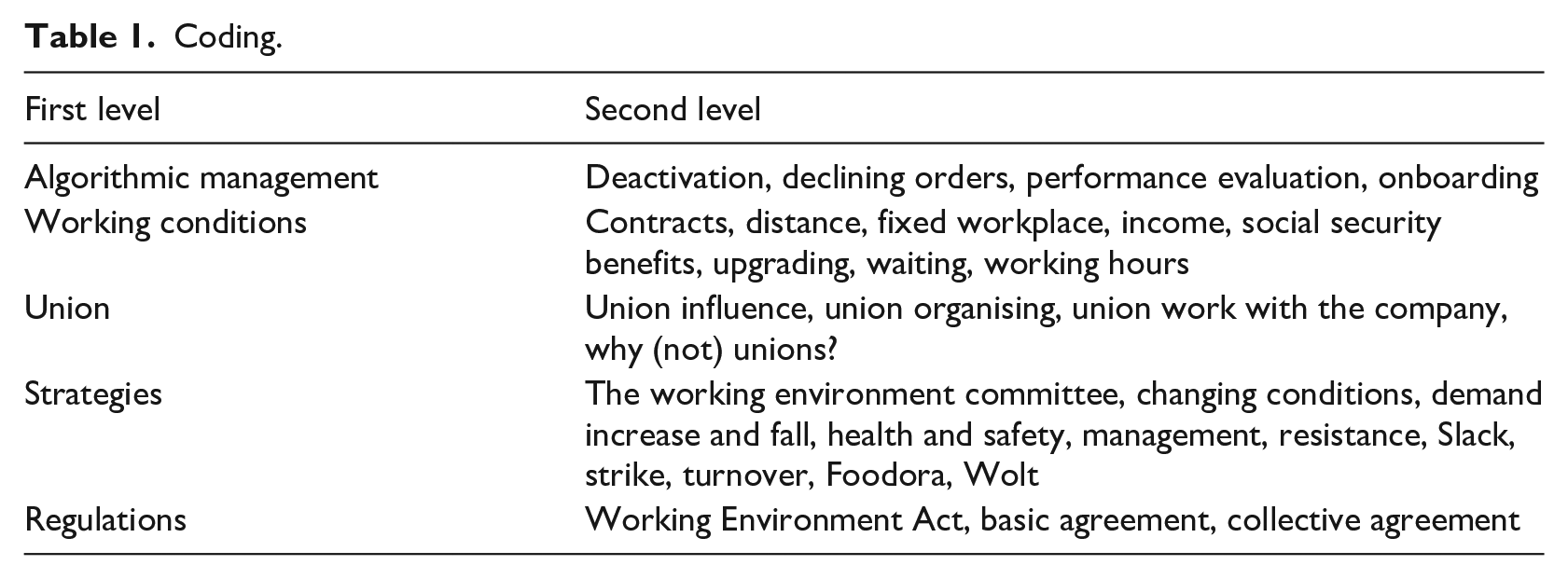
The interviews and documents were analysed using thematic analysis, which is a ‘method for identifying, analysing, and interpreting patterns of meaning (“themes”) within qualitative data’ (Braun and Clarke, 2006: 297). The thematic analysis was guided by the research questions. I have used an abductive approach to the analysis, going back and forth between the material and theory. The interview material was coded in two levels to understand both the material conditions of the workers, the actors’ strategies and regulations, as shown in Table 1.
Coding.
Case study: the emerging field of app-based food delivery in Norway
Foodora and Wolt, operational in Norway since 2015 and 2018 respectively, dominate app-based delivery in Norway. Initially, Foodora employed part-time bike couriers with guaranteed weekly hours, provisions per delivery, and the opportunity to organise collectively. The couriers joined the TWU, which merged with Fellesforbundet in 2019. In August 2019, the organised workers conducted a five-week strike, leading to a collective agreement for all employed bike couriers, including a wage increase, equipment allowances, winter bonus and early retirement pensions (Eurofound, 2021). Renegotiations of the agreement occurred in 2020 and 2022, with support from the employers’ organisation Virke, with improvements in pay rates and other supplements. Inspections by the Labour Inspectorate in 2016 and 2021 also pushed Foodora to adhere to health and safety regulations. The Labour Inspectorate lacks the authority to intervene in companies such as Wolt, however, which exclusively employ self-employed workers and freelancers.
In 2019, Wolt expanded operations in Norway. Foodora then also increased their use of self-employed workers, allowing couriers to choose their employment status. The pandemic led to increased demand for food deliveries, prompting both companies to expand to include delivery of groceries and other products, and to move training online, reducing workers’ meeting points. By 2022, approximately 40 per cent of Foodora’s 2900 workers were employed and benefited from collective agreement coverage, according to the company, compared with 100 per cent of the bike couriers when the collective agreement was signed. Wolt relies on roughly 2000 freelance or self-employed couriers, according to the company. According to Norway Statistics, about 2000 couriers earn money from delivery services through platforms every month (SSB, 2023). This suggests the possibility that couriers are affiliated with both companies, which is supported by my research. Alternatively, it could indicate a high turnover rate or the prevalence of undocumented workers. Another plausible interpretation is that companies may inflate their workforce numbers to enhance their appeal.
Findings
I will first examine the strategies of the various actors and their impact on working conditions and pay. Then, I will delve into the dynamics among these actors, exploring cooperation and confrontation within the context of two specific issues: employment models and algorithmic management.
Company strategies
Both Foodora and Wolt use employment strategies that differ from the Norwegian norm. Wolt relies solely on freelance and self-employed workers, which limits the workers’ ability to negotiate collectively and their associational power. In their response to the upcoming amendments in the Working Environmental Act, Wolt stresses the need for enhanced safety nets and opportunities for collective organising among the self-employed. This strategy essentially transfers risk to workers by relying on freelancers/self-employed while advocating for improved statutory rights financed by the state, ostensibly benefiting this worker group. In doing so, the company also reveals itself to be an accelerator of precarity by leaving it to the state to ensure a safety net for these workers.
Foodora’s choice of employment model – part-time employees – in 2015 was the basis for the workers’ associational power and shows evidence of chameleon-like behaviour. In 2019, during the negotiations on an agreement, Foodora’s CEO posted an op-ed titled ‘We support the Norwegian working life model’, arguing that the company was adhering to its values by using part-time contracts (Tengberg, 2019). The use of the hybrid model might be a strategy to gain legitimacy, while also ensuring workforce flexibility. In their consultation response to the proposed amendments to the Working Environmental Act, Foodora again gives credit to the Norwegian labour market model, noting that ‘active shop stewards and a close dialogue with the trade union have been central to Foodora’s productivity in recent years’ (Foodora, 2021).
When Foodora adjusted their strategy by combining part-time contracts with self-employment, the workers lost considerable power as the self-employed are not covered by the collective agreement. This makes it more difficult for the local trade union representatives to argue for better wages in negotiations because the company can always claim that other workers are willing to do the job for less money. The company’s use of both employment models therefore is a step away from chameleon-like behaviour and challenges the workers’ structural power.
During the pandemic, the company also introduced a performance-based evaluation system (algorithmic management system), evaluating couriers on the basis of absences, breaks, late log-ins, acceptance rate, work during peak hours, and volume of work, as explained by this courier:
There is a performance section in the app, which says how well you are doing; if you have clocked in late, if you haven’t done all the hours you were meant to, if you don’t show up, if you take a break, it all affects your performance score. The worse the performance score is, the later you get the new release of shifts the following week.
The algorithm combines elements to rank couriers and assign them to one of ten batches. Batch one gets priority in selecting shifts. Poor performance affects shift choices in following weeks, influencing income. This is a form of sanctioning. Human involvement is minimal, leaving couriers feeling unfairly treated with limited chance to rectify their scores, as explained by this courier:
Sometimes I get an order that is too big to fit the box and then I have to say that I can’t take that order and I fall down the ranking. It’s not my fault. I’m supposed to send an email to Foodora and say that I got too big an order. They should receive the email and adjust so that it is not treated as a decline. But it doesn’t work as it should. (Researcher’s translation)
Employees and freelancers are in the same algorithmic management system, although employees are guaranteed the hours in their contracts before freelancers get to pick their hours. Through the algorithmic management system, the company, to a certain extent, controls the behaviour of both employees and self-employed. Also, the algorithm does not take into account all the differences in employment models or rights. If you are on sick leave as an employee, this also affects your score:
When you are sick or take time off, then you end up in batch 4 or 5. The app does not understand who is on sick leave. It thinks you just didn’t show up. It takes a month before you get back up. Now I’m in batch 3. (Courier – researcher’s translation)
This suggests that the implementation of an algorithmic management system has led to a deterioration in both working conditions and pay for Foodora workers. While I initially compared the company’s adaptability to that of a chameleon, what is described in the quote above also reinforces the image of a ‘permissive potentate’, ceding control when necessary, and taking it back whenever the power balance allows it. Nevertheless, the company remains constrained by the terms of the collective agreement and is obliged to adhere to the regulations outlined in both the collective agreement and the Working Environment Act, and does not have complete authority to set standards, as could be the case in more liberal labour markets.
Workers and union strategies
The Foodora couriers made a significant move to enhance their power by opting to join an established union, which is not common practice among couriers in Europe. Approximately 20 couriers from Norway and western Europe engaged in discussions regarding their options (Jesnes et al., 2021). According to informants, it was more difficult to reach out to couriers with a migrant background from other parts of the world.
There was a debate about whether we should do it internally in the union or whether we should create our own organisation [. . .] There was some disagreement, but then we concluded that if we want to achieve anything, we must do it within the trade union system. (Jesnes et al., 2021: 265)
This choice, as reflected in the quote, was rooted in the belief that the union system offered the best way to achieve their goals of improved working conditions and pay.
Importantly, the TWU chose to welcome app-based delivery workers as members, and the strategy of mobilising couriers played a crucial role in shaping this field in Norway. The TWU, organising in logistics and transportation, viewed Foodora more as a logistics company than a ‘platform company’, not recognising its claim to be an entrepreneurial innovator, and therefore the union decided to organise the couriers.
We are concerned with not making it what Foodora and others want it to be. Foodora is a way to place an order. In Foodora’s case, the couriers have contact with management. (Union official, researcher’s translation)
When Foodora couriers joined the union, the TWU’s commitment of time and resources fostered trust, as shown by the following quote:
They showed up and said that they took it very seriously. They listened to us. And they wanted us to describe the working conditions, the problems, what we envisioned [by joining the union], what work we are interested in taking on, and explained that it is going to be a long process. [. . .] They also acted in a serious and credible manner. The fact that they lined up with so many people and that there were people from the top level. It meant a lot to me (Courier and local trade union representative – researcher’s translation).
This was the start of a recruiting process in which the workers built associational power. They gained new members partly through face-to-face meetings with couriers in the streets and partly through their social media channel for couriers on Slack. Important for recruitment was the use of an institutional arrangement, namely §14-4 a (1) Working Environment Act, which states that workers can demand extra hours in their contract if they work more than the set number of hours over a certain period. Drawing on this institutional power, couriers were able to add more hours to their contract corresponding to actual working hours, implying more guaranteed income. This attracted new members and the union built associational power by way of institutional power.
At the same time, the union put pressure on the company to accept these demands while offering reassurances: ‘We tell Foodora not to be so afraid of people getting more hours in their contracts because of the high turnover’ (courier, local trade union representative – researcher’s translation). Here, the union managed to frame the ‘problem’ as a small one for the company with reference to turnover, indicating social skills.
Having built up considerable associational power, the union worked on suggestions for a collective agreement. When negotiations with the company at the National Mediator’s Office failed, the 102 organised workers went on strike. The union merger with Fellesforbundet gave the couriers access to additional resources of great importance during the strike, including a strike fund, communication officers and other human resources, demonstrating institutional power:
The success of the strike had a lot to do with the fact that we were in a larger union – we had our own media people. They followed up closely on all points. [. . .] The networks were bigger. We were part of a large apparatus. [. . .] We received a lot of help. (Union official – researcher’s translation)
During the strike, the union more than doubled its membership among couriers, also among workers with a migrant background, strengthening associational power. The resulting collective agreement improved working conditions and pay, and opened the door to further negotiations on these issues.
Cooperation and confrontation on the issue of freelancers
During the regular meetings mandated by the Basic Agreement between management and local trade union representatives, the latter have put particular emphasis on the company’s increasing use of freelancers. The company has agreed to offer employee contracts to those who want them after pressure from the union and offer this possibility through a form in the application. According to Foodora, offering employment contracts to those who want them is another version of the presumption rule. ‘In our view, the presumption rule will be safeguarded in practice in that the business has a “standing offer” of permanent employment to the individual at all times’ (Foodora, 2021 – researcher’s translation). This suggests that while the company honours the union and their agreement, they simultaneously employ an alternative strategy to achieve greater flexibility in their workforce, which only partly aligns with the image of a chameleon.
The competition between Foodora and Wolt complicates the union’s task of pushing for better conditions and pay at Foodora, while ensuring the company remains competitive against Wolt. This requires strategic timing for exerting pressure and easing off, as one courier and trade union representative explains: ‘We cannot apply too much pressure on the company [Foodora] unless Wolt does the same [hires employees], so it should be an industry agreement. And everyone should be an employee’ (Courier and local trade union representative). This clearly shows the shifting balance of power in this emerging field to the advantage of the companies. The workers are more easily replaced and their ability to confront the company through a potential work stoppage has decreased with the increasing use of freelancers and self-employed.
The union also faces challenges in recruiting new members among freelancers and the self-employed. While the union is willing to accommodate these workers, they must transition to employee contracts. This might lack appeal to freelancers and self-employed as the Working Environment Act restricts the hours couriers can work on weekends, when demand is highest, and caps their daily hours at 7.5. Despite the collective agreement allowing employees to work extra hours at an increased rate, Foodora tends to assign these hours to self-employed individuals at a lower rate. This thus appears to be a company strategy to make freelance contracts seem more attractive, but it hampers the union’s ability to attract new members. As a compromise, the union prioritises political work on the issue of misclassification, in addition to organising efforts:
We are not attacking Foodora because we understand the situation of distorting competition. We have a loyalty to the companies we have an agreement with. We are working politically with this issue [masked self-employment]. (Union official – researcher’s translation)
The quote shows the union’s loyalty to the company they are in partnership with, and how they must weigh their options, which is central in the Norwegian working life model (‘boxing’ and ‘dancing’), and rather contest the use of freelancers by other means. Wolt, by only engaging self-employed and freelancers, weakens the couriers’ structural power in the field overall.
To summarise, boxing and dancing are fitting metaphors to describe the dynamics between the parties to the collective agreement, which are at times confrontational and at times more of a fruitful partnership (Huzzard and Nilsson, 2004). By choosing to work as partners with Foodora through the union, couriers built associational power, and they have access to regular meetings with the company at which they can discuss different issues related to the business. All aspects of the collective agreement are renegotiated every second year, and wages are renegotiated yearly. Foodora’s couriers enjoyed no wage increase from 2015 until 2019 when the first collective agreement was negotiated. This opportunity to negotiate and co-determine the conditions of employment has had a positive impact on working conditions and pay, and has considerably improved their power base. The company has shown chameleon-like behaviour in its interaction with the organised couriers.
The arrival of Wolt disrupted the competitive landscape, however, and it has put employment contracts at risk. Freelance and self-employed couriers at Foodora and Wolt lack the ability to negotiate delivery pay rates, and both companies have unilaterally adjusted prices without worker input. This change in the landscape and in strategies has diminished couriers’ bargaining power, transforming Foodora to resemble Wolt, which aligns the company more with the image of platform companies as permissive potentates rather than chameleons. The union faces a number of dilemmas in putting pressure on Foodora and often demonstrates loyalty to the company. In response to this decline in structural power, the union has opted to address misclassification issues politically, in addition to organising efforts.
Cooperation and confrontation on the issue of algorithmic management
Wolt and Foodora employ different algorithmic management systems: Wolt uses variegated pricing on orders, while Foodora uses a performance-based evaluation system. In the interviews with Foodora couriers conducted after the pandemic, the topic of the performance-based evaluation system, introduced at the time, is highly present. Local trade union representatives have obtained information about how the system works, but it is not always easy to understand the exact consequences for working conditions and pay:
I’m not sure what the formula behind it is exactly. They were not against showing it to us, they showed us how much each of the factors contributed, but it was in percentages. One factor could contribute 20 per cent, but the variability in that factor could be more or less depending on your performance, which would affect the total score. (Courier, local trade union representative)
This statement suggests that transparency is not enough without training in how algorithmic management systems might affect working conditions and pay. Safety representatives, as well as unions have nevertheless played an important role in determining the parameters of the algorithmic management system, as indicated below.
In spring, we brought up the use of the UTR system as a basis for the batch again. UTR is about how well the couriers are used [deliveries per hour]. They have sneaked this [UTR] into the cities where we don’t have a safety representative or trade union representative. [. . .] We received documentation from a courier on how UTR affects risk; and now we have convinced the management to remove this as a basis for the batch system. (Courier, worker representative – researcher’s translation)
By putting pressure on the company, the workers and their representatives succeeded in removing deliveries per hour as part of the evaluation, which has the potential to reduce accidents in Foodora. This shows how institutional power has been important in the Norwegian case. This is also an important example of how workers and unions can ‘negotiate the algorithm’ and make material changes to working conditions, highlighting how collective bargaining and trade unions might mitigate negative risks associated with algorithmic management (Collins and Atkinson, 2023; Todolí-Signes, 2021).
Wolt aims for transparency through an Algorithmic Management Report (Wolt Algorithmic Management Report, 2022). However, Wolt (2023) ‘reserve[s] the right to change the pricing structure of [its] delivery fees without notice’. The current system, changed several times, prices deliveries based on demand and the perceived difficulty of the delivery in terms of length or weight. This intraplatform algorithmic change increases behavioural control while reducing transparency on pay and limits worker input on pricing, making the company appear to be a permissive potentate.
Discussion and conclusions
This article combines field theory and the power resource approach to explore agency, power and strategies within the emerging field of app-based food delivery in Norway. It asks: how do different actors’ (platform companies, workers and unions) strategies affect working conditions and pay in app-based food delivery? How do these actors use power and power resources strategically?
In Norway, in contrast to more liberal (deregulated) labour markets, such as the United States and the United Kingdom, institutional frameworks set boundaries for platform companies’ operations. The Norwegian case therefore underlines the important role of institutional power in combination with associational power. The workers have made strategic use of the Basic Agreement, collective agreements and the Working Environment Act in combination to enhance working conditions and pay. Together, these regulations have empowered health and safety and union representatives, who have influenced the company effectively through regular meetings, resulting in improvements in working conditions and pay, as well as the algorithmic management system.
Companies’ changing strategies have also challenged workers’ associational power, however, which in turn may weaken their structural and institutional power. The platform companies behave as strategic actors, transitioning between roles that are not mutually exclusive, from chameleons – adapting to the context – to permissive potentates, taking and ceding control where they see fit, depending on strategic considerations and the surrounding institutional framework. Actors’ strategic manoeuvres in this emerging field are increasingly evident, especially in the case of Norway, underscoring the importance of studying power resources. Foodora, for instance, leverages power to cultivate an image of playing along with the norms and rules of the Norwegian labour market model, engaging in collective agreements and fostering a collaborative approach. This was a rational move in 2015 when they entered the market, and in 2019 in response to a five-week strike. The entrance of new actors and the pandemic, however, reshaped the landscape in such a way that Foodora decided to employ different strategies. They increased the use of self-employed workers and introduced more stringent use of algorithmic management systems for all, only partly behaving as a chameleon. For Foodora’s employees, this changing environment poses challenges to their associational, structural and institutional power, particularly in light of competition from self-employed couriers. Their power base has been significantly narrowed by Wolt’s expansion and the increasing use of self-employed persons. This underlines how these companies change strategies according to context and effectively maintain the upper hand in the power dynamics between themselves and the workforce.
Operating solely as permissive potentates seems unfeasible in a Norwegian context, however, given the presence of numerous mechanisms that prevent a race to the bottom. For example, it is likely that these companies will adapt to changes in Norwegian regulations in 2024. In addition, despite weakened power resources, the analysis highlights the agency of workers and unions, and their ability to ‘negotiate the algorithm’, leading to material improvements in working conditions and pay. This case therefore underscores the potential impact of effective collective bargaining and trade unions in mitigating the negative implications associated with algorithmic management.
Footnotes
Appendix
Overview of data sources and use in the analysis.
| Source | Type of data | Use in the analysis |
|---|---|---|
| Interviews | Interviews with 24 workers. 17 interviewed before the pandemic and 7 after it | Understand working conditions and pay, their attitudes towards and involvement in collective action |
| Interviews with union officials (5) | Gather data about collective action and the unions’ perspective | |
| Interviews with food-delivery company representatives (4) | Gather information about the company’s business model | |
| Interviews with employer organisation representatives (2) | Understand the dynamics between the social partners | |
| Documents | ||
| Collective agreements | Collective agreements between Foodora and Fellesforbundet, 2019, 2020, 2022. The basic agreement between Virke and LO, 2022–2025 | Obtain an insight into working conditions and pay |
| Official documents | Documents related to NOU 2021:9 (Proposition to the Parliament, Recommendation from the Work & Social Committee), consultation responses from companies and unions | Gather information on institutional developments and the positions of the actors |
| Labour Inspection in Foodora, 2016, 2021 | Obtain an insight into safety and health issues | |
| Documents from the workers | Contracts between workers and companies | Obtain an insight into working conditions and pay |
| Email exchanges with workers after interviews. Some sent pictures of the app, contracts or other relevant information | Gather data about algorithmic management and working conditions | |
| Documents from/about the companies | Company websites, Wolt survey of freelancers (2022), Wolt Algorithmic Transparency Report (2022) | Obtain an insight into company strategies |
| Data from the union | Data from the union about members in late 2019; flyers from the union (2) | Overview of union members, insight into union strategies |
| Media articles | From various sources | Overview of the field |
Acknowledgements
I extend my gratitude to the reviewers and editors of Transfer for their valuable contributions to enhancing this article. I am also grateful to my supervisors, Sissel Trygstad and Bertil Rolandsson, as well as colleagues within and outside of Fafo, for their insightful comments and unwavering support throughout the writing process.
Funding
This article constitutes a component of a PhD project conducted at the University of Gothenburg and funded by the Trade Union Research Program (Fagbevegelsesprogrammet) at Fafo Institute for Labour and Social Research.
1
The differences in rights and benefits between employees, freelancers and the self-employed in Norway are outlined in  . Within the context of this article, the most significant distinction lies in the comparison between employee status, on the one hand (covered by the Working Environment Act), and freelancers/self-employed status on the other, which are not covered by the Act nor by collective agreements.
2
3
Other scholars have identified supplementary power resources not in focus here (for instance, Kjellberg, 2021; Refslund and Arnholtz, 2022).