




Abstract
There have been numerous legal battles in Western countries concerning employment relations between platform-based food delivery firms and their riders; however, no such legal battles have occurred in Taiwan. This qualitative case study applies the theory of institutional logics to examine the reason such legal action is absent in Taiwan, focusing on how different stakeholders apply different logics to employment relations in Taiwan’s platform-based food-delivery sector. Through this investigation, this article shows that most stakeholders in this sector quickly came to a consensus that the ‘quasi-employee’ hybrid logic should be applied to riders, and that this was due to a convergence of worker and capitalist theories of profit, motivation to maintain the profitability of these platform firms (who are regulatory entrepreneurs performing symbolic compliance) and the techno-developmentalism of the Taiwanese government.
Introduction
The employment relationship between riders (i.e., couriers who use bicycles, motorbikes, etc., to make deliveries) and platform firms has been intensively debated in academia and broader society, with several legal battles occurring in Western economies in relation to this issue (Forde et al., 2017; Joyce et al., 2020; Tassinari and Maccarrone, 2020). This contrasts with Taiwan, where there is a marked absence of such legal action. How can we explain this absence? This article comprises a qualitative case study, in which the theory of institutional logics is applied to: 1) represent employees and contractors as two competing institutional logics (both of these have long been defined as such in Taiwan’s Civil Code); 2) consider stakeholders’ (including riders, platform-based food-delivery firms, labour activists, scholars, the media, government officials and legislators) adoption and even manipulation of these logics in order to gain resources, obtain social status and rewards and even avoid punishment; and 3) critically examine how competing perspectives of rider–platform firm employment relations are applied by multiple stakeholders within the developmental state, which is distinct from most Western liberal and coordinated market economies, but has received relatively little attention in current literature.
This article argues that, in Taiwan, the abovementioned stakeholders share a hybrid logic of the rider–platform firm employment relations: the ‘quasi-employee’, which means that riders are neither employees nor contractors of platform firms. As the data show, most of the stakeholders in this sector contend that platform firms should provide some form of insurance for riders, something that is not legally required if the riders are contractors. However, these stakeholders also argue that platform firms are not obliged to provide labour and health insurance for riders, the provision of which is legally required if riders are employees. This consensus in perspectives was reached soon after the occurrence, in October 2019, of two fatal accidents involving riders.
Why did most of the stakeholders regarding the employment relationship between riders and platform-based food-delivery firms in Taiwan quickly agree on a hybrid logic (quasi-employee) for this relationship? This article suggests that, first, as riders in Taiwan ‘regard their future livelihood as contingent on the survival and expansion of their capitalist employer’ (Burawoy, 1979: 29) and are not poorly paid by platform firms, they implicitly identify themselves as quasi-employees. Second, in order to maintain their operation and profitability, the platform firms in question are regulatory entrepreneurs that not only tactfully fulfil employer responsibilities, which can be considered ‘symbolic compliance’ (Edelman, 2016), but also actively mobilise public discourses to shape the construction of their employment relations with their riders. Lastly, as Taiwan is a developmental state, the Taiwanese government prioritises attracting foreign capital in order to secure investment and foster the development of the country’s economy, including its digital sector. Consequently, the government has installed a governance regime that focuses on maintaining state-capital relations, implementing an industrial policy designed to develop the digital sector and continuing the subordination of labour (Haggard, 2018; Lei, 2021).
This article is structured as follows: in Section Two, the current literature on employment relations in the platform economy and the theory of institutional logics is reviewed. In Section Three, the research context is introduced; namely, the Taiwanese platform-based food-delivery sector. In Section Four, I justify why and how I conducted our document analysis. Section Five presents the findings and Section Six presents further analysis of these findings. Finally, Section Seven presents implications of the findings, limitations to the approach and future research directions.
Literature review
Employment relations in the platform economy
Platform-based food-delivery firms often claim that they provide neutral technology infrastructures that mediate transactions between buyers and sellers. Nevertheless, platform-based food-delivery firms are active intermediaries that have control of riders/couriers since these firms develop and implement algorithms to: 1) determine who can participate in their platform, 2) allocate tasks, 3) monitor quality, 4) evaluate workers and 5) manage performance (Cherry, 2016; De Stefano, 2016; Gandini, 2019; Gregory, 2021; Griesbach et al., 2019; Rosenblat, 2018; Veen et al., 2020; Wood et al., 2019). These firms also cultivate workers’ self-entrepreneurial mindsets by guaranteeing flexibility in work schedules and methods (Vallas and Schor, 2020; Veen et al., 2020). Although some riders have identified themselves as their own bosses (Dubal, 2017; Veen et al., 2020), their employment status has been fiercely debated. Some researchers argue that, as a result of the algorithmic control exercised by these platforms, the binary distinction between employees and contractors should be applied to the platform economy (De Stefano, 2016; De Stefano and Aloisi, 2018; Rogers, 2016). However, others, such as Atmore (2017), contend that current employment laws hamper economic growth because of their lack of consideration of the platform economy and its workers. As a means of addressing this issue, Lobel (2017) and Stewart and Stanford (2017) have provided a set of reform options, including introducing a new category for platform workers; such a category has already been implemented in some Western countries (Cherry and Aloisi, 2017).
Normative claims concerning platform workers’ classification have not only been made by researchers. In the Western world, social mobilisation regarding the employment status of platform workers (i.e., workers’ engagement in legal battles to force governments and platforms to recognise their status as employees) has been occurring for years (Forde et al., 2017; Joyce et al., 2020; Tassinari and Maccarrone, 2020). Similar to platform workers in the USA and Europe, platform workers in Taiwan can take legal actions to secure benefits associated with legally recognised employment status; however, no such actions have been taken. This raises the question of why this is so. To answer this, an institutional analysis that focuses on the stakeholders involved and the embedded economic and political context (including, for example, the fact that Taiwan is a developmental state that relies on Weberian bureaucracies, controlled relations between the state and capital and subordination of labour (Haggard, 2018; Lei, 2021), and that Taiwan has a business system that is distinct from most of the developed Western economies characterised as either liberal or coordinated market economies by Witt et al. (2018)) would be helpful.
Theoretical framework: Institutional logics
In terms of institutional analysis, this article applies the theory of institutional logics to examine why there have been no legal battles in Taiwan regarding riders’ employment status. Institutional logics are ‘the socially constructed, historical pattern of material practices, assumptions, values, beliefs and rules’ of action, interaction and interpretation that influence which issues attract social actors’ attention and the solutions that should be considered (Friedland and Alford, 1991: 243; Thornton et al., 2012). This theoretical perspective facilitates examination of stakeholders, the structures within which they are embedded and the ‘hidden competition’ for their respective legitimacies within their field (Gog et al., 2018: 1033). In particular, this theory is suitable for analysing the target context because employment systems are culturally and socially constructed symbols and practices that govern the relations between workers and employers, and these systems provide sets of meanings that workers and employers can apply to define their situations and actions (Fligstein and Byrkjeflot, 1996).
Multiple logics can exist within a specific institution; such different logics can have discrepant identities, goals and schemas, which can, in turn, create cognitive conflicts that social actors may seek to reconcile (Pache and Santos, 2013a; Thornton et al., 2012). One method of such reconciliation is the creation of a hybrid logic; for example, work integration social enterprises are simultaneously influenced by commercial and social logics, and such enterprises create hybrid logics to resolve the internal conflicts between members of the social and commercial areas (Pache and Santos, 2013b; Ramus et al., 2017).
Few studies have applied this theoretical perspective to examine the platform economy. One exception is Frenken et al. (2020), who demonstrated that platform firms comprise market, corporation and state logics, and that platform workers are trapped in an institutional anomaly. That is, workers are classified as independent contractors (corporation logic) but cannot grow their businesses in the same manner as platform firms. Thus, platform workers are forced to use a market logic but, as platform firms tightly manage their work, they have minimal entrepreneurial freedom. This weakened state logic fails to provide sufficient protections for platform workers. However, Frenken et al.’s study views each stakeholder in the platform economy as a passive recipient who only applies specific institutional logics that accord with their respective social groups; this overlooks the possibility that each stakeholder can have unique interpretations of their embedded environments and can take diverse actions.
This study aims to adopt an institutional perspective to identify the actors in the target policy field, examine the discourses they adopt and analyse the broader structural factors that shape not only their actions, interactions and interpretations, but also their attitudes towards the contested issue of whether to classify riders as employees or contractors of platform firms. I also consider why most platform-economy stakeholders in this East Asian developmental state quickly came to the joint conclusion that riders should not be categorised as employees or contractors but should be regarded through the hybridised logic of ‘quasi-employee’.
Research context: Platform-based food-delivery firms in Taiwan
According to labour statistics released by Taiwan’s Ministry of Labor, the labour-participation rate in Taiwan has slightly increased since the global financial crisis of 2008 (from 57.90% in 2009 to 59.02% in 2021), while the unemployment rate has fallen (from 5.85% in 2009 to 3.95% in 2021). However, there has been a marked rise in nonstandard (or contingent) forms of work, including part-time, temporary and dispatched work: in 2009, there were approximately 687,000 contingent workers in Taiwan; by 2019 this number had risen to nearly 819,000. Meanwhile, union membership has shown a long-term decline: the union (corporate and industrial unions) density rate fell from 15.4% in 2009 to 7.6% in 2020. Further, although some previous strikes in Taiwan have received media attention, only 14 strikes have been organised since 2010. Low union density rate and rare strike action are examples of the subordination of labour, a characteristic of a developmental state (Haggard, 2018; Lei, 2021).
In Taiwan’s platform-based food-delivery sector, 45,129 riders work for nine platform-based food-delivery firms (Ministry of Labor, 2019a). Of these nine platforms, Foodpanda and Uber Eats, which launched their services in Taiwan in 2012 and 2016, respectively, are the most widely used by Taiwanese customers (Institute for Information Industry, 2020). Along with the firms, riders and customers involved, the completion of orders is embedded within a broader social context in which additional stakeholders are involved. Different government agencies at both the central and local levels oversee associated regulatory issues, including labour rights. Further, although the first trade union organised by riders was established in October 2019, several other trade unions and labour-activist groups have advocated labour rights for riders, including the Taipei Confederation of Trade Unions, the Taiwan Labour Front and the Taiwan Association for Victims of Occupational Injuries. Moreover, scholars from a wide variety of disciplines have been consulted by government and media agencies regarding employment relations between platforms and riders. Additionally, some platform firms are members of the Digital Economy Association Taiwan, which was founded in 2017 and comprises several firms that identify themselves as part of the sharing economy.
Employment relations in this sector attracted little attention prior to October 2019, when two fatal accidents occurred. On 10 October 2019, a rider registered with Foodpanda was killed in a traffic collision in Taoyuan City (a city in Taiwan with approximately 2.3 million residents). Three days later, a rider registered with Uber Eats was killed in a traffic incident in Taipei (the capital city of Taiwan; approximately 2.6 million residents). After these incidents, whether to classify riders as employees or contractors became a contested issue among the public.
According to Taiwan’s Labor Standards Act, individuals classified as employees must be paid above the minimum wage, and there is also a clear limit on their working time. Their employers must also contribute to their labour and health insurance fees and pension schemes. In contrast, individuals classified as contractors do not have legal rights to demand the minimum wage, working-time limits, sick pay, or holidays. If contractors choose not to join an occupational union, they must insure themselves ‒ if they join a union, they must pay 60% of these insurance fees, much more than those who are classified as employees (who only pay 20% of their labour insurance fees and 30% of their health insurance fees). There is no other stakeholder responsible for contractors’ pensions.
Methodology
A case study is a suitable approach for addressing a ‘why’ question regarding ‘a contemporary phenomenon within its real-life context’ (Yin, 2009: 2); the case study presented in this article was conducted through robust document analysis. This was the most viable method for this research because the documents examined covered an extended period, and exact names, references and details of events were included. This approach enabled me to identify changes and track the development of specific issues or events (Bowen, 2009; Yin, 2009).
To ensure that I analysed a wide array of documents with a preponderance of evidence, data were collected from various sources, including 1) press releases from Taiwan branches of platform-based food-delivery firms, 2) press releases and reports published by the Taiwanese central and local governments, 3) minutes of discussions on this issue by legislators and city councillors in Taiwan, 4) press releases and reports published by non-governmental organisations (NGOs; i.e., labour activist groups) and unions in Taiwan and 5) media reports (including commentaries) on this topic. Keywords used in our search included ‘platform economy’, ‘platform work’, ‘platform workers’, ‘gig economy’, ‘gig work’, ‘gig workers’, ‘food delivery’, ‘food-delivery riders’, ‘Uber Eats’, ‘Deliveroo’ and ‘Foodpanda’. Except for English-language brand names, all keywords were searched in Mandarin. Searches were conducted on the official websites of the Taiwan branches of platform-based food-delivery firms, Taiwanese government websites (including those of the Taiwanese parliament and city councils), the websites of some Taiwanese unions and NGOs that advocate workers’ rights as well as major databases where past media reports are stored. The search results yielded seven press releases from the Taiwan branches of platform-based food-delivery firms, 35 press releases and reports published by Taiwanese central and local governments, 31 sets of discussion minutes involving legislators and city councillors in Taiwan, 204 media reports and 14 commentaries written by individuals, labour activist groups or media companies. This rich dataset enabled triangulation of the data.
The next step was document analysis: the process of ‘reviewing, summarising, cross-checking, looking for patterns, and drawing conclusions’ (DeWalt and DeWalt, 2011: 179) to ‘uncover meaning, develop understanding, and discover insights relevant to the research problem’ (Merriam, 1988: 118). A three-phase coding process was conducted to identify the discourses each stakeholder used, how they used these discourses and, finally, narratives of employment relations in platform work. First, open coding was used to create codes to summarise the data. Second, axial coding was used to group similar codes into themes in a coherent and meaningful fashion and then identify their interrelationships. In the final phase, I immersed myself in the data and codes again in a more focused manner in order to examine the data through the lens of the theory of institutional logics, group the codes and identify different logics of employment relations.
Findings
Before the incidents: Co-existing conflicting logics
Although differing logics co-existed among the stakeholders, whether riders are employees or contractors of platform firms or represent an entirely new employment category was not a contested issue before the two fatal incidents. On one hand, riders and platform firms claimed that riders are contractors. One rider said, ‘when you applied for this job, the terms and conditions were there, and you agreed. [. . .]. From the beginning, it was not an employment contract.’ Meanwhile, Uber Eats’ director of public relations in Taiwan said: ‘[W]e encourage [riders] to have their insurance [. . .]; as they are not our employees, we [. . .] cannot force them to insure themselves’ (Xie, 2019).
On the other hand, government officials and legislators either claimed that riders are employees or suggested that there is a specific relationship between employment and contracting. In April 2019, Ms Sabrina Lim, a city councillor in Taipei City, argued that riders should be classified as employees of platform firms because the former must follow the rules set by the latter; the commissioner of the city government’s Department of Labour (hereafter ‘the commissioner’) agreed (Taipei City Council, 2019). In fact, the Taipei City Government suggested that platform firms should bear some employer responsibilities for riders, such as paying for cargo insurance and formulating procedures to address workplace bullying and sexual harassment (Taipei City Government, 2018). Later, the commissioner proposed the category ‘quasi-employee’ for riders, and one government official clearly stated that platform firms should formulate standard food-delivery operating processes, inform platform workers of safety and health regulations, establish safety and health organisations and associated personnel and provide adequate accident insurance for riders. However, a manager from Foodpanda who was involved in this forum refrained from commenting on the new ‘quasi-employee’ category, instead stressing that platform firms create flexible job opportunities and positive economic and social impacts (Taipei City Government, 2019b).
Meanwhile, the central government and scholars did not have a clear stance on worker classification; one high-ranking official of the Ministry of Labor commented that: ‘[I]f there is no clear employment relationship between a platform and a rider, we aim to ensure that riders can easily insure themselves so that they can have more protections’; meanwhile, Professor Ping-Lung Hsin merely reminded the government to ‘clarify the relations between the platforms and their riders’ before making amendments to existing laws (Xie, 2019). In sum, several different logics concerning the relationship between riders and platform firms co-existed at this time; however, it was not a contested issue.
After the incidents: A hybrid logic combining employees and contractors
From mid-October 2019, the relationship between riders and platform firms became a hotly debated issue in Taiwan, perhaps triggered by the extensive media coverage of Taiwan’s platform-based food-delivery sector. 1 This research found that most of the stakeholders in this sector quickly agreed that the hybridised ‘quasi-employee’ logic was a means of solving the dilemma of classifying riders as employees or contractors, although they did not use this term explicitly. For instance, although, soon after the fatal accidents, Foodpanda and Uber Eats told the media that the victims had been contractors rather than employees (Newsroom, 2019) and some riders also identified themselves as contractors (Lin, 2019; Zhang, 2019), their relationship did not accord with the legal definition of contracting. ‘Quasi-employee’ represented a more suitable description of their relationship, as most of the stakeholders in this sector felt that platform firms should insure riders to a certain degree. According to Taiwanese law, platform firms are not obliged to provide riders with any insurance if riders are contractors; thus, the fact that most of the stakeholders in this sector agreed with an insurance approach demonstrates that riders were neither employees nor contractors of platform firms. Instead, the hybridised logic of ‘quasi-employee’ was applied to define their relationship.
In the central government, the Minister of the National Development Council stated that the dichotomous classification of employee vs. contractor was no longer suitable for contemporary work and employment (Legislative Yuan, 2019a), and she agreed with the Digital Economy Association Taiwan that emphasis should be placed on reducing the risks of food-delivery work; for example, by providing insurance (Yang, 2019). Many legislators from both the ruling and opposition parties (including Mr Wan-An Chiang, Ms Tzu-Yung Hung, Mr Yu-Jen Hsu, Ms Yu-Min Wang and Mr Yao Yang) also suggested that the Ministry of Labor consider introducing a new category to help platform workers fit into the new digital economy (Legislative Yuan, 2019b, 2019c, 2019d), although they did not specify the details of this new category.
Regarding local governments, the Taipei City Government formally proposed a regulation introducing the ‘quasi-employee’, which was intended to provide platform workers, including riders, with some legal protections (Taipei City Government, 2019a). This regulation required platform firms to provide riders with safety training and to notify a labour-inspection agency within eight hours of any occurrence of an occupational accident (a legal requirement for employers, as stipulated in Taiwan’s Labour Standards Act). Taipei’s regulation also stated that platform firms must provide riders with personal injury insurance (if platform firms were employers of riders, they would need to provide labour and health insurance for riders, but this was not required in this regulation). Later, in December 2019, the Ministry of Labor expanded this provision of insurance, announcing that platform firms must provide several additional types of insurance for riders, including group injury insurance, locomotive third-party liability insurance and compulsory automobile liability insurance; however, labour and health insurance were again excluded (Ministry of Labor, 2019b). 2 The provision of these particular types of insurance indicates that riders were classified neither as employees (otherwise they would have been provided with labour and health insurance) nor contractors (otherwise they would not have been insured at all); instead, riders were considered quasi-employees, a hybridised logic of employment relations in Taiwan.
This ‘quasi-employee’ perspective was, for riders, the most acceptable classification as well. Although some riders argued that they should be considered contractors, they also said that platform firms should be required to provide them with some form of insurance – specifically, they argued that platforms should offer third-party liability insurance for all riders, and further provide labour and health insurance when riders had completed a certain number of delivery orders (Chen, 2020). This demand for specific types of insurance is revealing: riders understood that labour and health insurance would only be provided for those who were legally categorised as employees rather than contractors – as one rider said: ‘because you are not an employee, you have to protect yourself; the company does not have to [provide labour and health insurance]’ (Xie, 2019). The contention of some riders that platform firms should provide such insurance reflects that riders did not simply view themselves as contractors of platform firms, but rather as a hybrid of employees and contractors.
There is another piece of evidence indicating that the ‘quasi-employee’ classification was acceptable to riders. In April 2020, an industrial union organised by some food-delivery riders in Taipei demanded that the Taiwan Centers for Disease Control require platform firms to provide face masks for riders during the Coronavirus Disease 2019 Pandemic. 3 During the demonstration, the lawyer employed by this union argued: ‘the food delivery sector is an emerging industry, and it does not fit with the current laws and regulations. We need new [laws] to regulate it [in a manner] that reflects its nature’ (Huang and Guo, 2020).
This hybridised logic was also supported by platform firms; although they had long argued that riders are contractors, they also agreed to protect riders by providing insurance (Sharing Economy Association Taiwan, 2019). Additionally, some scholars (Professor Chuei-Lin Shin) and NGO workers (Mr Feng-Yi Zhang) stated that there was a need for a third way of classifying riders’ employment status with platform firms (Shin, 2019; Zhang, 2019). Specifically, the general consensus was that platform firms should have some of the responsibilities of employers – for example, the provision of certain protections – but do not need to follow all of the legal requirements of employers; this latter point was indicated by the fact that various stakeholders did not demand that platforms provide labour and health insurance.
Although most of the stakeholders in this sector adopted conflicting logics (employee vs. contractor) to classify riders, this article contends that, based on their arguments, they consider riders quasi-employees of platform firms; specifically, they feel that platform firms should protect riders to some degree (i.e., by providing particular types of insurance), something that is not legally required if riders are contractors. Table 1 summarises the perspectives of various stakeholders in this sector concerning the relationship between riders and platform firms.
Comparison of the perspectives of each stakeholder regarding the relationship between riders and platform firms before and after the fatal incidents.
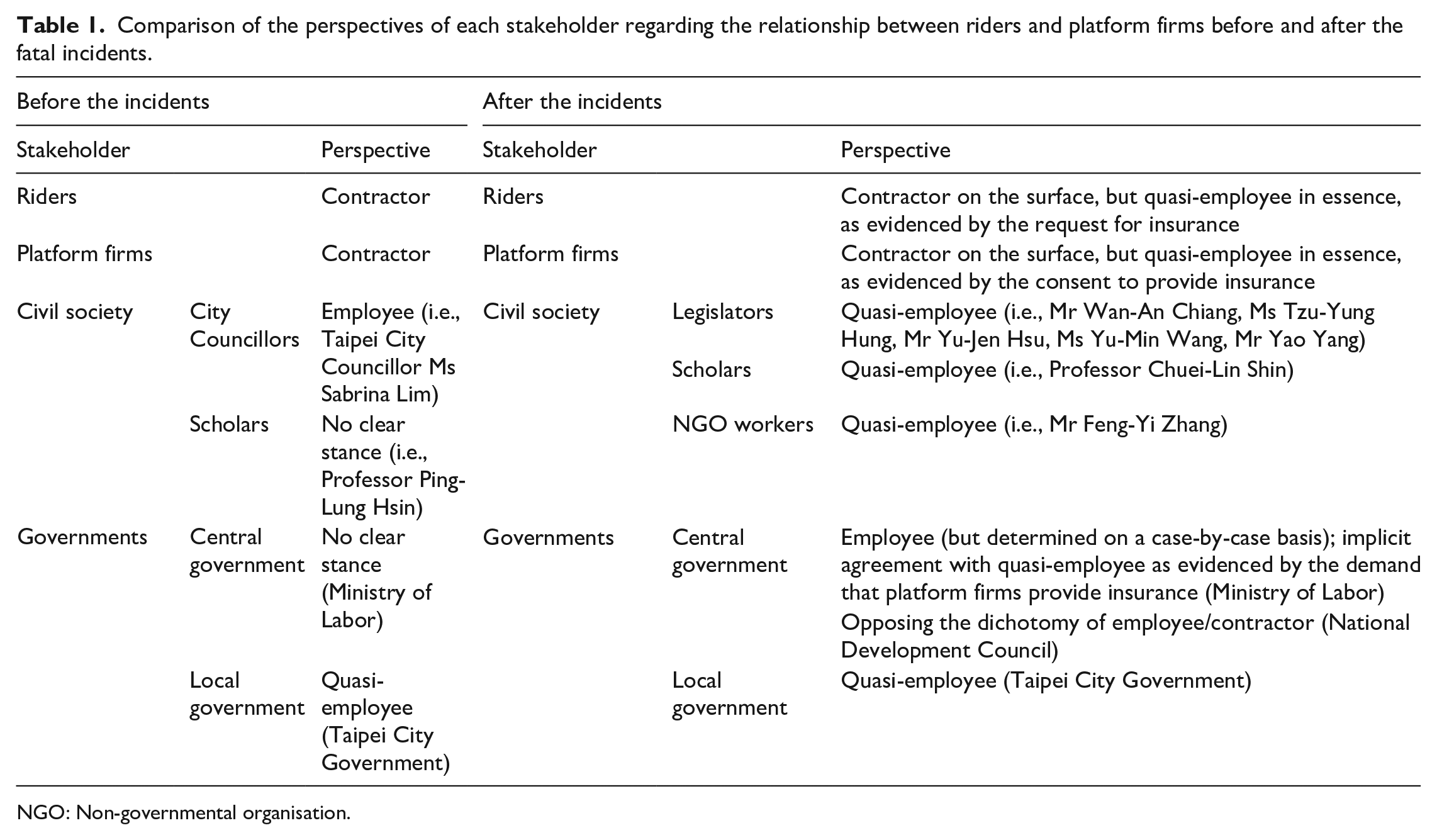
NGO: Non-governmental organisation.
Discussion: Why did an agreement on ‘quasi-employee’ logic arise in such a short time?
Based on the findings, I argue that a joint perception of a ‘quasi-employee’ logic quickly arose among the various stakeholders because riders, platform firms and governments in Taiwan were incentivised to implicitly hybridise the conflicting logics of employment relations (employee and contractor). The motivations of each stakeholder are explained below.
First, the ‘convergence of worker and capitalist theories of profit’ (specifically, the fact that ‘workers come to regard their future livelihood as contingent on the survival and expansion of their capitalist employer’; Burawoy, 1979: 29), can be observed among the riders’ own interpretations of their roles in this sector. Several riders mentioned the risk of lower pay and bonuses in exchange for recognition as employees; for example: ‘if you wanted [to be an employee], the company would have to spend money on [labour and health] insurance, and you would earn less’ (Xie, 2019; see also J Liu, 2019). Additionally, the fact that riders in this sector are not as poorly compensated as their counterparts in the West should be considered (Fabo et al., 2017). One of the most popular online job banks in Taiwan, 104 Corporation, reported that members who were or are riders for platform firms have an average monthly income of NTD 42,000 – higher than the average monthly income of recent college graduates in the workforce (NTD 30,000; P Liu, 2019). Examining the structural factors that have led to such low income among college graduates in Taiwan is beyond the scope of this article, but this nevertheless shows that riders’ unwillingness to lose their relatively high incomes may encourage them to identify themselves as quasi-employees.
Second, the platform-based food-delivery firms in Taiwan are regulatory entrepreneurs – not just capitalist firms, but also political actors that are ‘actively looking for legal grey areas’, ‘openly challenging established laws’ and shaping the development of employment relations between themselves and riders in a manner that protects their profitability (Chan and Kwok, 2021: 782; Pollman and Barry, 2017). Uber Eats and Foodpanda have been strategically highlighting the flexibility of delivery work and claiming that riders are contractors, as riders have the freedom to choose when and how they work. However, platform firms have masked their controlled labour processes and interpreted their employment relations in a manner that allows them to argue that they should not be required to bear any employer responsibilities, such as provision of labour and health insurance. Although these platform firms later accepted some employer responsibilities after the government intervened, they chose to only pay riders’ commercial insurance rather than provide labour and health insurance, much less follow the Labor Standards Act to pay minimum wages and follow working time limits. This could be regarded as symbolic compliance (Edelman, 2016); that is, the organisations are giving an outward impression of interest in worker protection, but their policies, procedures and/or programmes do not substantively improve employment conditions. 4 The platform firms’ efforts to protect riders from unhealthy and risky work conditions amount to merely providing riders with commercial insurance, rather than improving their overall job quality and reducing their risks at work. Moreover, when others challenged these firms, they framed the laws and regulations in Taiwan as being restrictive of growth, innovation and the Taiwanese people in general, particularly young people who want to make extra income (Sharing Economy Association Taiwan, 2019). This defence strategy is similar to that recently employed by Uber when the Taiwanese government tried to place stricter regulations on ride-sharing activities (Chan and Kwok, 2021). Overall, to maintain operation and profitability the platform firms in Taiwan have been tactfully adopting some employer responsibilities and actively engaging in regime governance through public discourse and mobilisation.
Third, since the mid-20th century Taiwan has been a developmental state, with a reliance on government intervention to boost its economic growth (Witt et al., 2018). Although it has advanced in some technological and economic areas (e.g. semiconductor production), the Taiwanese government still formulates and implements industrial policies. In 2016, the Taiwanese government announced ‘the Asia Silicon Valley Development Plan’, which was an attempt to make the regulatory regime for the digital sector friendlier to capital (National Development Council, 2016). This plan was coordinated by ministers from the National Development Council, the Ministry of Economic Affairs and the Ministry of Science and Technology; this composition of ministries implies that economic growth and technological advancement, instead of labour protections, are focal points in the national development plan. Government officials have also had formal meetings with a private-sector consultation committee to discuss issues concerning the platform economy but, according to records of these meetings that were published online, they did not discuss employment relations and labour rights. Notably, some members of this committee are core members of the Digital Economy Association Taiwan, a strong supporter of the platform economy. In 2018, the Executive Yuan (which directs the National Development Council, Ministry of Economic Affairs, Ministry of Science and Technology, etc.) announced ‘the Principles on Regulatory Adjustments to the Development of the Platform Economy’, in which it demanded that its subsidiaries deregulate to facilitate the development of the platform economy. The deputy minister of the Ministry of Labor, one of the subsidiaries of the Executive Yuan, once commented that ‘no matter what the employment relationship between riders and platform-based food-delivery firms is, the rights of riders should be prioritised, but [the protections] should not hinder economic growth and innovation’ (Legislative Yuan, 2019e: 309). Therefore, the Taiwanese platform-based food-delivery sector is under techno-developmentalism, with a focus on technological advances and economic competitiveness rather than labour protections (Lei, 2021).
In such an environment, the emergence of a hybrid logic of employment relations can be expected: riders want jobs with relatively good pay, platform firms want a favourable regulatory regime and the Taiwanese government needs Western digital firms to enhance its digital sector. All have incentives to keep the platform-based food-delivery business thriving; thus, such rapid creation of a hybrid logic of employment relations to solve the dilemma of whether to classify riders as employees or contractors should be unsurprising.
Conclusion
This article, to the best of the author’s knowledge, is one of few studies to explicitly apply an institutional perspective to theoretically examine, in an East Asian context (which has been relatively overlooked in the existing literature), employment relations in the platform-based food-delivery sector, what and how specific discourses (institutional logics; i.e., employee and contractor) concerning this issue have been used and how the contested issue has evolved (i.e., the creation of a hybrid logic). Applying the theory of institutional logics allowed me to theoretically examine how multiple stakeholders used competing institutional logics to interact and co-create a hybrid logic, and how broader, structural factors shaped these stakeholders’ actions, interactions and interpretations.
Although this case study focuses on a single country, this analysis has broad implications. First, regardless of context, riders’ preferences and identities should be examined. Notably, this article demonstrates that there are differences between riders in Eastern and Western countries. Specifically, Taiwanese riders’ support of the quasi-employee status shows that the entrepreneurial framing identified by Veen et al. (2020) has only been partially adopted by such riders, as they do not regard themselves as entrepreneurs independent from platform firms. Moreover, neither do Taiwanese riders identify themselves as independent contractors as Dubal (2017) observed in other contexts.
Second, multinational platform firms have localised strategies to actively shape regime governance; this is similar to Chan and Kwok’s (2021) findings in an examination of East Asia. This fact should be given more attention to better determine how these capitalists mobilise resources and construct narratives to realise profits. The article shows that platform firms in Taiwan adopt an ‘act first, revise later’ approach – this is not an attempt to disregard regulators and laws, but rather to ‘play’ with them; this contrasts with their counterparts in the USA, who utilise an ‘act first, apologise later’ approach (Collier et al., 2018). The case of Taiwan shows that a case study of one country enriches our understanding of how and why stakeholders engaging in the platform economy act differently in various local contexts, even though the business model for these platform firms seems to be the same across borders.
From the perspective of institutional studies, this article shows that stakeholders do not necessarily rely on certain logics associated with their social groups; this contrasts with Frenken et al.’s (2020) suggestion. Frenken et al. (2020) argue that riders, platform firms and government agencies adopt market, corporation and state logics based on their individual goals. However, the article shows that stakeholders can exercise agency in this regard, interpreting their situations and strategically using logics of employment relations to defend their interests and, eventually, agree upon a hybridised logic. This finding reminds researchers to carefully examine each stakeholder regardless of context, given that any of them could diverge from their theoretically expected logic.
In the future, this hybrid logic could be more deeply investigated through qualitative interviews with stakeholders; in particular, such stakeholders should be asked what they feel is the ideal employment relationship between riders and platform firms, and how they evaluate the quasi-employee logic. Although multiple sources of data were used to demonstrate each stakeholder’s perspective, more first-hand data, such as subjective perceptions and interpretations of employment relations between riders and platform firms, could reduce the risk of selectivity bias (i.e., ideologies or considerations presented in media that are influenced by the media’s relationships with the government or platform firms). That is, interview data could overcome the limitations of document analysis – ‘the available documents are likely to be aligned with corporate policies and procedures and with the agenda of the organisation’s principals’ (Bowen, 2009: 32) – and further enrich our understanding of this issue in the platform economy.
Quantitative studies are also needed, as this article has not thoroughly examined the job quality of platform-based food-delivery workers in Taiwan. A cross-national comparison could also be conducted; for example, by drawing parallels with how ‘self-employed plus’ was agreed by Hermes’ self-employed couriers, the company and Britain’s General Union (GMB Union), or by examining different governments’ policies regarding employment relations in the platform economy. How different are they? Why do differences exist (from an institutional perspective, such as between varieties of capitalism)? How do these differences evolve? Only by investigating these questions is it possible to comprehensively understand the workings of the platform-based food-delivery sector, especially in an East Asian context, which has not received much attention in the current literature.
Footnotes
Acknowledgements
I would like to thank the participants of the 19th ILERA World Congress, the BUIRA Conference 2021 and the BSA Annual Conference 2021 for their feedback on my early work. I would also like to express my gratitude to the editor and reviewers for their helpful feedback. Nevertheless, any errors are those of the author.
Funding
The author received no financial support for the research, authorship, and/or publication of this article.
