




Abstract
This study focused on mitigating wetland flood disasters in Bangladesh through community-led strategies, particularly in land-based minority communities. Wetland ecosystems, integral to the country’s landscape, are increasingly vulnerable to floods exacerbated by climate change. Recognising the intersectionality of environmental challenges and community well-being led to proactively addressing the impacts of wetland floods. This study uses participatory methods to engage minority communities, particularly those in the wetland regions. Focusing on local community-engaged approaches, the research aims to develop community-led adaptive strategies. The study emphasises the active participation of community members in decision-making processes through a community-led approach, enhancing resilience and sustainability. The study also explores the role of women in these community-led initiatives, acknowledging their unique perspectives and contributions to adaptive strategies. Ultimately, the findings aspire to inform policy frameworks and global discourse on disaster resilience, offering insights into how community-led strategies can serve as effective models in mitigating the impact of wetland flood disasters and foster a sense of hope and optimism for the future.
Introduction
Bangladesh, situated in a geographically vulnerable position, faces significant challenges from climate change, particularly in its wetland areas (Rahman et al., 2016). Among the various natural disasters, floods are exceptionally impactful, disrupting ecosystems, damaging agricultural output, increasing water pollution, and causing economic and communication network disruptions (DeClerck et al., 2006; Islam et al., 2014). There has been much research on flood impacts in Bangladesh and their multifaceted nature (Haque et al., 2016; Rawlani & Sovacool, 2011; Smith et al., 2021). Similarly, Abedin and Khatun’s 2019 study focused on the effects of the 2017 flash flood and assessed the efficacy of adaptation strategies employed by inhabitants in pre-, during, and post-flood situations. In another study, Azad et al. (2021) contributed by examining the mechanisms employed by wetland communities to recover from disasters, explicitly focusing on their ability to withstand flash floods. Notably, vulnerable populations, such as children, the elderly, and pregnant women in wetland areas, have been identified as severely affected by unexpected flooding (Abedin & Khatun, 2019). Furthermore, studies emphasise the social vulnerability and resilience of communities, particularly the economically disadvantaged in floodplains and coastal regions, who may or may not receive government support during disasters (Abedin & Khatun, 2019; Khan, 2015; Parvin et al., 2016).
Studies suggested that many extreme climate events are exacerbated mainly by human activities (Ahmed, 2022; Haque & Jahan, 2021; Khan, 2015). For example, rapid urbanisation, tourist industries, industrial expansion, deforestation, and the overexploitation of natural resources have contributed significantly to environmental degradation and climate change in many areas of Bangladesh (Haque & Jahan, 2021). Industrial emissions and unsustainable agricultural practices have increased greenhouse gas emissions, a major driver of global warming resulting in extreme weather patterns such as more intense floods, cyclones, and droughts (Rahman et al., 2018). The construction of large-scale infrastructure, including embankments and dams, has disrupted natural river systems, exacerbating flood risks and altering sedimentation patterns along Bangladesh’s coasts (Islam & Mustafiz, 2019). Human-induced climate change has also heightened the intensity of monsoons and led to more frequent heatwaves, contributing to severe food and water insecurity (Karim & Thiel, 2017). The failure of international actors to curb emissions and the continuous reliance on fossil fuels have disproportionately affected Bangladesh. This country contributes minimally to global emissions yet suffers extreme consequences (Ahmed, 2022).
Bangladesh’s disaster management policies and practices have historically overlooked local land-based knowledge due to several structural and systemic factors (Datta & Kairy, 2024). The dominance of top-down, centralised governance frameworks has marginalised Indigenous and local communities in decision-making processes. Many Indigenous and land-based local communities, such as the Munda people in coastal areas, possess extensive ecological and cultural knowledge about their environment, but their expertise is often viewed as inferior to scientific and technological interventions promoted by international development agencies and national authorities (Datta, & Kairy, 2024; Rahman & Marinova, 2022). The rush to implement rapid, scalable solutions to mitigate climate impacts, like building embankments and cyclone shelters, has sidelined slower, more contextualised approaches rooted in traditional land-based knowledge (Ahmed & Chowdhury, 2020). The lack of institutional mechanisms to incorporate local voices into policy design further perpetuates this exclusion, reducing the potential for truly inclusive disaster management strategies (Hasan & Shah, 2023). Moreover, policymakers often emphasise technological solutions over the long-standing, adaptive knowledge systems held by local communities (Alam et al., 2020), exacerbating the marginalisation of Indigenous knowledge in decision-making (Islam & Walkerden, 2017).
Despite these challenges, emerging possibilities exist for integrating local land-based knowledge into disaster management frameworks. Global shifts toward participatory and community-driven development models present opportunities for local communities to assert their role in policy formation (Roy et al., 2021). International organisations like the United Nations and development partners increasingly recognise the value of Indigenous and local knowledge in resilience-building efforts (Saha & Adnan, 2021). In Bangladesh, initiatives such as community-based disaster preparedness and co-management approaches are gaining traction (Rahman & Khan, 2022). However, significant challenges remain, including entrenched power dynamics, lack of formal recognition of Indigenous land rights, and the need for capacity building within local communities to advocate for their knowledge systems in national and international arenas (Rahman & Marinova, 2022). Successful integration will require structural reform in governance and a deliberate shift in how development agencies engage with local communities (Ahmed & Chowdhury, 2020).
Thus, addressing wetland flood disasters in Bangladesh requires a holistic approach, emphasising community-led climate change strategies (Chowdhury & Moore, 2017; Smith et al., 2011). Given the country’s vulnerability to climate-induced events, particularly in low-lying regions, communities must play a central role in developing adaptive measures (Ali et al., 2016). It is crucial to empower local communities to identify and implement sustainable solutions, as they possess invaluable traditional knowledge and a deep understanding of their ecosystems (Nandy et al., 2013). Integrating communities’ land-based practices with modern technologies can enhance resilience against wetland floods, promoting sustainable coexistence with the environment (Kamal et al., 2018). Collaborative efforts between government bodies, NGOs, and communities are essential to establish early warning systems, build climate-resilient infrastructure, and implement community-based adaptation programmes (Rabbani et al., 2013). Through these initiatives, Bangladesh can foster a sense of ownership and unity among its people, creating a more resilient and adaptive society in the face of ongoing climate challenges.
This article investigates how wetland communities address flood disasters, shedding light on their adaptation and resilience strategies. The article’s primary objectives involve exploring community-led climate change strategies implemented in wetland communities during sudden floods. It begins by outlining the authors’ positionality and theoretical framework before focusing on the methodology and approach employed. The data analysis outcomes are presented and organised into themes and sub-themes. The article concludes by addressing issues raised by male and female storytellers and providing recommendations based on the findings. Reflecting on lessons learned, the study also discusses potential areas for improvement.
The specific objectives of the article include (a) exploring the mechanisms employed to address floods in Bangladesh’s wetlands and (b) summarising the solutions proposed by the wetland community. To achieve these goals, the article details its positionality and theoretical framework, outlines the methodology and approach, presents data analysis outcomes in thematic structures, addresses issues raised by women storytellers, and concludes with recommendations and reflections on lessons learned and potential improvements.
Researcher Positionality
The role of researcher positionality is of utmost importance in Indigenous research, as it significantly impacts the research process and raises ethical considerations (Datta, 2018; Wilson, 2008). It is essential to recognise that Indigenous research frequently delves into sensitive subjects and engages with marginalised communities. Researcher positionality encompasses their cultural background, personal experiences, and social identity, which can profoundly influence their interactions with Indigenous participants and their comprehension of the issues. Acknowledging and understanding one’s positionality is crucial for approaching research with humility and respect, reducing the risk of inadvertently perpetuating harmful stereotypes or colonial attitudes. It empowers researchers to establish trust within Indigenous communities, nurture meaningful collaborations, and formulate research questions that are culturally sensitive and aligned with Indigenous worldviews.
Author 1: As a decolonial and anti-racist community-based disaster researcher, I see research as a critical responsibility for advocating community-led climate change adaptation and governance. My commitment centres on dismantling colonial legacies and combating systemic racism in disaster management. My research lies in building the adaptive capacity of marginalised populations, with a particular focus on empowering women. By prioritising community-driven approaches, I aim to foster resilience that transcends traditional frameworks, addressing climate change impacts comprehensively. Through my work, I seek to confront environmental challenges and advance climate justice, ensuring equitable outcomes and amplifying the voices of those historically marginalised in the face of global climate shifts.
Author 2: Focusing on the Indigenous community-based research in Bangladesh, I am dedicated to strengthening the voices of the unheard, motivating my active participation in this study. My research interest lies in listening to the stories of my community, and my goal is to narrate these narratives to the global audience, serving as a representative for Indigenous people. My deep connection with my community propels my enthusiasm to collaborate with other communities, fostering understanding and unity in the broader context.
Author 3: She is a climate change adaptation and governance researcher in Canada with experience working with Indigenous peoples and communities in Canada, South America, and South Asia. Her goal is to build the adaptive capacity of people, especially women, and their communities, address climate change, and advance climate justice.
As authors, our positionality is critical in addressing historical power imbalances in Indigenous research, where Indigenous communities have often been treated as research subjects rather than active participants or collaborators. We have redefined our research agenda by critically examining our positionality to ensure that it aligns with the community’s needs and benefits. Our positionality is fundamental for nurturing ethical, respectful, and empowering research relationships with Indigenous communities and advancing knowledge that genuinely serves their interests and well-being.
Conceptual Framework and Methodology
The choice of a decolonial community-based approach in exploring flood disasters stems from a commitment to fostering an inclusive and culturally sensitive research paradigm. Recognising the historical context of uneven approaches and shifting away from traditional top-down methodologies that often perpetuate power imbalances is critical. Using a decolonial lens, this research aims to deconstruct colonial narratives and prioritise the voices of local communities residing in wetlands. This approach centres on community voices and needs as active agents in the research process, acknowledging their unique perspectives, knowledge, and adaptive strategies for addressing flood disasters. By valuing diverse ways of knowing and incorporating Indigenous knowledge systems, the study seeks to create a more equitable and respectful research environment that transcends Eurocentric frameworks. Our decolonial community-based approach aligns with the principle of reciprocity and mutual respect, emphasising collaboration rather than extraction of information. Following the decolonial community-based approach, we acknowledge that communities are not just passive subjects but active participants with agency and expertise. We tried to ensure that the research process is co-created, allowing for a more nuanced understanding of the complex dynamics surrounding flood disasters in wetlands. The study aims to decolonise knowledge production, promoting a more inclusive, context-specific, and community-driven perspective on addressing disaster challenges.
Following the decolonial community-based approach, we used deep listening as our research method. Alcoff (1991) argues that deep listening is a fruitful way to resist the prevalent academic proclivity for mastery and immunity from criticism and to conceptualise an ethic of openness and intellectual humility in geographic research. In August 2023, we engaged in conversations with the men and women from the wetlands, valuing their narratives. Deep listening played a fundamental role in respecting and honouring the women’s perspectives from the wetlands. Given that community-led and community-based narratives are intimately linked to the land, steeped in the language, and deeply rooted in the Nation of the people, storytelling served as a means to reestablish a profound connection with land-based wisdom (Datta, 2017). Indigenous peoples use stories to realise, recognise, and resist colonial violence (Sium & Ritskes, 2013). Our commitment extended to following traditional Indigenous rituals and ceremonies alongside conventional research methodologies. In addition to deep listening and community storytelling, we integrated reflective writing to engage with and analyse our research findings and experiences deeply. The storytelling process was anchored in 10 individual narratives and five traditional focus group discussions (FGDs) conducted in August 2023. Each individual or collective session lasted between 60 and 90 minutes, allowing for rich, nuanced dialogue. Instead of relying on structured interview questions, we encouraged the community members to share their experiences of past and recent disaster challenges and their adaptive strategies. We also invited them to express their visions for building greater self-determination in managing future disasters, fostering a space for open and authentic dialogue about their aspirations and resilience.
This practice allowed us the autonomy and freedom to engage in thoughtful reflection. It enabled us to distil and value our discoveries more effectively, enhancing the depth and quality of our research. We upheld strict adherence to ethical protocols, prioritising the privacy and confidentiality of the respondents while demonstrating our respect and gratitude. Given the participants’ vulnerable status as members of a minority community, preserving their privacy was paramount. Moreover, we ensured that their participation was informed and entirely voluntary, underscoring our commitment to ethical research practices.
Research Findings
Bangladesh is home to several wetland regions, and for this research, we conducted our study in the Kolkolia union of Jagannathpur upazila, situated in the Sunamganj district within the Sylhet division of Bangladesh. In 2022, a sudden flood occurred in the region, resulting in devastating results. According to the area’s people, they have never seen such a big flood. Usually, there is nothing but a shelter system in the wetlands, as other disaster-prone areas have. So, the temporary shelter was set up for immediate support in a college building. This article will discuss the unique shelter system and community-led climate change strategies.
We participated in multiple listening sessions to uncover central themes and related topics from recorded stories. Reflecting on these insights helped deepen our understanding of the subject matter. The stories featured emotional and challenging accounts of the area’s inhabitants, offering a unique perspective. Direct quotes and anecdotes were chosen based on personal reflection and those that resonated with the researchers. The research process involved continuous listening and reflective learning, developing main themes and sub-themes (Table 1).
Main Themes and Sub-themes of the Results.
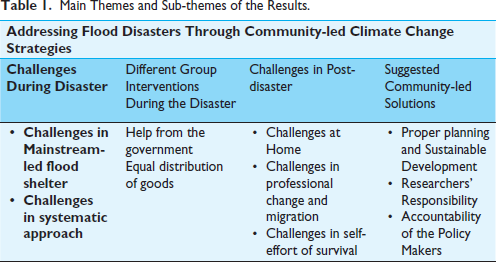
Our findings are organised based on thematic categories, reflecting an examination of the community’s efforts at different stages: the initial response at the onset of the flood, actions taken during the flood, and the community’s survival strategies in the aftermath of the disaster. This division aims to provide a comprehensive depiction of the strategies employed by the community throughout the entire timeline of the disaster, offering insights into their proactive measures, adaptive responses, and post-disaster resilience.
Challenges During Disaster
Upon discovering the absence of a shelter system comparable to that found in other disaster-prone regions, it became evident that the survival of local communities in the wetlands relied entirely on their initiatives. In this section, we delve into the community-driven process of establishing shelters, elucidating the mechanisms behind their development, operations, and how individuals sought refuge within these structures.
In the wetlands, annual floods are a common occurrence; however, the sudden and unforeseen nature of the 2022 flood caught the residents off guard, preventing any preparation. Compared to other regions with designated shelters, the wetlands lacked such facilities. The organiser of the makeshift shelter explained, ‘There was no pre-existing shelter. We repurposed educational institutions as shelters, as we do not have dedicated facilities like coastal areas. People sought refuge in schools and colleges, while mosques remained inaccessible’. The abrupt floodwaters submerged the area, leaving roads impassable and stranding the population. A health worker recounted the challenges: ‘Transportation came to a standstill during the flood. With water everywhere, we could not leave our homes. It took three or four days for the water to recede, allowing us to reach the affected individuals’. The transportation shutdown and a non-functional mobile network severed communication channels, complicating the rescue efforts.
Once the water levels receded and telecommunication services were restored, the convener of the shelter, who also serves as the college principal, initiated the shelter and assisted in relocating people. Overcoming challenges, the convener highlighted, ‘Initially, people hesitated to leave their homes, but as the water levels rose, they eventually made their way to the shelter. Regrettably, some could not reach the shelter in time and succumbed to the flood at their residences’. This harrowing experience underscored the critical importance of having designated shelters during disasters and revealed the newfound awareness among the community regarding the imperative of shelter in surviving such calamities.
The flood brought immense hardship to the people, causing the loss of homes, livestock, and possessions. However, the makeshift shelter played a crucial role in ensuring their safety. The principal highlighted the shelter’s unique and systematic operation: ‘People were better off in my shelter. We had individuals for cleaning the shelter and a generator for electricity to ensure women’s safety’. The shelter functioned efficiently, providing everyone with food, medicine, and necessary services. The health worker emphasised the equitable distribution during the flood, saying, ‘When people from all communities stayed together, the distribution of food, goods, and medicine was equal’. Despite the devastating losses, the resilient community adapted to the situation, utilising classroom benches for nighttime rest. A woman in the shelter praised the residents, stating, ‘People in this area are hardworking and can cope with any situation. They fought well in the flood and adapted to it, discovering what benefited them’. The temporary shelter’s success offers a potential model for other disaster-prone areas.
In this part, we discuss the help and assistance the affected people received during the disaster. To some extent, the success of recovery after a disaster depends on this. The woman-1 said, ‘The first day when people’s suffering peaked, nobody came from the Upazilla office or the administration. The next day, they appeared. It is not that they did not want to; the force of water makes it difficult to get in here’. Therefore, immediately after the flood, the affected people were unreachable due to the impact of the disaster; roads were broken, and the telecommunication system was disrupted. In the shelter, people were provided food, drinking water, treatment, and other service. The convener of the shelter said, ‘I tried to supply them with food. Moreover, the administration, especially the upazila executive officer, provided some food to me so that I could equally distribute them. Moreover, I tried to distribute equally’. The honesty and integrity of the convener were renowned, and he got additional support from the government instead of the local chairman and his acquaintances for the flood-affected people.
The local government personnel are well-known for their corruption. He added, ‘That’s why instead of the local chairman, he provided me with all food, all assistance. And the Bangladesh army also came to me. Moreover, they also supply me with food, water, and materials like that’. During the flood, people got quickly sick, so the health system in the shelter was very important. The adult male said, ‘All the medicines were brought from the Upazila Health Complex. We did not get any help from other organizations regarding our medicine’. This was the scenario there. He also added, ‘Rich people sent relief, cooked food, medicines, etc. to the shelter’. At the time of an emergency, people need help to pass the time and also to start a new life after a disaster. The success of their survival also depends on this.
Post-disaster Challenges
The post-disaster time and support system are also very important parts of any big disaster. Post-disaster is the moment when people think about what they are going to do next to start over again. In this section, we discuss the challenges during this period. Post-disaster survival is crucial for affected people. Usually, people go to the shelter during the disaster. But when they return from the shelter, they see the devastation of the flood in their area. As the government or any other parties did not help after returning from the shelter, they tried to find a way to survive independently. ‘After returning to our house, the government did not help us. We tried to find a way by ourselves to survive. We try to produce food’, said the male adult-2. That means some people started cultivation to produce food for themselves. If they can grow extra crops, they can sell them in the local market to make a livelihood.
The sudden flood of 2022 in the wetland made people change their profession. The flood most likely attacked the marginalised people. The convener of the shelter said, ‘It impacted people of all occupations, especially the most vulnerable marginalised people. Many people migrated to other areas in search of an earning source’. This made the women of those families more vulnerable as they were living at home alone. They could eat if their male counterpart could save money and bring it home. ‘Most male members went out for work and got involved in various occupations. The people who had only a little bit of money lost everything. However, they tried to revive again’, said the adult male. The people who did not leave the area for work were financially destitute. Although these people had some money, they lost their houses, cattle, and all other valuable things. They lost everything. It was tough for this group to achieve what they lost again.
Right after the flood, people returned to their homes in the wetlands; they had already lost everything. There were fewer options for post-disaster help. So, they tried to survive on their own. The woman said, ‘The loss we have faced due to the flood – we tried to adapt on our own. We have rebuilt our home’. So, they built their houses and managed to stay on their land. The convener of the shelter said, ‘When they returned to their home after the flood, their house was broken. Somehow, they managed to stay inside of their home for the last six months or one year’.
The adult male said, ‘If one family were affected, his rich neighbors and relatives would help him. They have provided tin to the affected people to make their house’. This means that the people who did not have rich neighbours or relatives could not get this kind of help. This creates a situation where some people are privileged. It was an example of self and community-driven survival.
Suggested Community-led Solutions
After every flood, the people of the wetland get practical experience about adaptation and survival. Some people, especially the women, were heartbroken. While discussing the disaster, woman 3 said, ‘What can we do? We become vulnerable’. They indeed become helpless when a flood strikes them so severely. However, in the future, they know more about the disaster, the reasons behind it, and how they can better adapt. Therefore, they provided some solutions. They emphasised proper planning of the government, the researchers’ role, and the accountability of the policymakers.
People of the wetland have some Indigenous knowledge about how to adapt to the disaster. They know what to do and what can make their life better during and after a disaster. However, they always have the challenge of scarcity of resources to cope with during and after the disaster. The woman said, ‘If people build their houses to maintain a safer height, it would be better. Canal digging will help to hold extra water’. If the people know the reason for the flood, they know what can be done in the future. The male adult-4 said, ‘Unplanned roads are responsible for creating the flood’. So, they have talked about changing the housing structure and making water flow easy by proper canal digging. They have strongly suggested that proper measurements be taken. The woman said, ‘If there were individual shelters for flood and digging, and people stopped making unplanned roads here and there, it would improve the situation’. The people of the wetland think that unplanned development is responsible for the disasters. The community’s male members think that government planning should be proper and sustainable. The male adult-1 said, ‘The government has a planning division, but they do not have any plan’. The people do not have trust in the planning department. They are worried about the capriciousness of the planning division. They hope that future planning will be based on the real needs of the people of the wetlands and that any development projects should not harm the general people.
The people of the wetlands think that researchers have a vital role in helping them address the disaster. The women-1 said in this perspective,
If researchers work on the adaptation and awareness building program, including practical knowledge in the curriculum instead of theories, provide practical knowledge to people of what can be done before, during and after the flood, make the house appropriate for flood, that would be better.
Researchers can assist by conducting research, creating appropriate documentation, and submitting it to the appropriate authorities. Researchers can study the reality of flood vulnerability and adaptation and disseminate their findings to draw the attention of civil society and other related bodies to make the changes.
The way the people of the wetland give suggestions to the researcher is the same way they have provided suggestions to the policymakers. They have raised their voice regarding climate change and excessive carbon in nature. The male adult-5 said, ‘People should minimize their use of carbon dioxide. They should minimize their use of coil and fuel’. This way, nature will be balanced, and they will be able to cope better in the future with disasters. The wetland inhabitants think policymakers are less concerned about disasters and climate change. In this regard, the male adult-6 said, ‘Policymakers think climate change is not so important but they don’t know how they will be able to face a situation if climate change is not under control’. The people of the wetlands also expect policymakers to discover policies that will be utilised for the well-being of the disaster-prone areas and will be helpful collectively.
The wetland inhabitants know and experience the flood disaster well and have suggested solutions for further research and policy implications. They have emphasised the need for proper government planning. They expect that any development should be sustainable and not harm anyone. Researchers can work on the challenges, find solutions for disasters, and apprise them to the respective authorities so that their suffering can be acknowledged and hopefully reduced. Moreover, the findings also can be used to further policy.
Discussion and Conclusion
Our study found that, unlike other disaster-prone areas, wetlands do not have any government-led adaptions. Wetland communities, particularly minority communities such as Hindu land-based spiritual communities, do not have any established shelter for protection from sudden disasters, no disaster tracking system, and no proper relief distribution system provided by the government. Also, communities have found that their resilience was insufficient for the flood-affected people. Although people stayed in the temporary shelter for a long time, it was not a permanent solution as wetlands have a common trait to face sudden disaster.
Our study identifies multiple challenges that wetlands face in the context of climate change and its adaptation effects, necessitating targeted interventions. The loss of occupation, damage to resources, and income instability experienced by wetland inhabitants contribute to a cycle of debt and poverty, highlighting the need for sustainable disaster management. The insights from our research can serve as a valuable guide for scholars, policymakers, planners, and researchers in developing strategies for sustainable disaster management, particularly in areas prone to potential dangers.
Our study reveals a significant shift in the professions of wetland residents, mirroring findings in other studies highlighting the highest rural-urban migration in the study area as a response strategy (Alam, 2016; Alam et al., 2016). This migration trend, as observed in our study, also reflects households with limited agricultural land seeking alternative sources of income. As Alam et al. (2017) indicated, such transitions leave women behind with minimal financial stability and underscore the gendered dimensions of these adaptive strategies. While temporary community shelters have proven essential for enabling people to survive during floods, our findings underscore several overlooked implementation aspects. There was a significant lack of support from various authorities, exasperating peoples’ vulnerability and emphasising the pivotal role of the government in this context. Since wetlands often receive less attention than other disaster-prone areas, it becomes imperative for governmental and respective authorities to enhance the support systems. To achieve this, as the community suggested, governments should integrate socio-economic capacity-building strategies into resilience policies, necessitating ethical commitments from disaster management leaders and a relational leadership framework (Abedin & Khatun, 2019; Khan, 2015; Parvin et al., 2016). A community-led approach ensures inclusive and enduring benefits in climate and disaster risk reduction efforts (Crosweller & Tschakert, 2020).
Our research underscores the resilience of wetland communities through self-reliant efforts in establishing and managing the entire shelter system. Emphasising the importance of community collaboration, disaster response, and recovery, our study aligns with the notion that community-based adaptation is critical for reducing vulnerability in these areas (Azad et al., 2021; Huq & Reid, 2007). Recognising the government’s vital role in empowering communities in Bangladesh, it becomes imperative for authorities to focus on wetland areas, leveraging local knowledge for effective adaptation and fostering knowledge sharing among stakeholders to promote long-term climate change adaptation and enhance societal awareness (Ahmad & Abu Talib, 2014; Ayers et al., 2013; Ensor & Harvey, 2015; Næss, 2012; Wahid et al., 2017).
Our study suggested that local land-based knowledge is crucial in fostering self-determination for dealing with disasters in Bangladesh. The findings from community-led strategies in wetland flood management, particularly in the Kolkolia union of the Jagannathpur upazila, underscore how Indigenous and local knowledge systems are vital for disaster preparedness and recovery. For instance, during the 2022 flood, the community demonstrated resilience by repurposing educational institutions as temporary shelters, showcasing their ability to adapt and survive without external intervention. Their understanding of their environment, including recognising the limitations of mainstream-led flood shelters, helped them develop their solutions. Such actions illustrate how local knowledge empowers communities to take ownership of disaster response, enhancing self-determination (Ahmed & Chowdhury, 2020).
The community’s emphasis on adaptive measures, such as maintaining housing at safer heights and advocating for canal digging to manage water flow, reflects a deeper understanding of the land and its challenges. Their ability to integrate traditional practices with modern needs allows for sustainable development tailored to local conditions (Sultana et al., 2022). By prioritising their lived experiences, these communities manage disasters more effectively and assert their autonomy in decision-making processes (Islam & Walkerden, 2021). These findings highlight the potential for local knowledge to drive self-determination in disaster management (Rumpa et al., 2023).
Therefore, through this article, we suggest that engaging in a decolonial learning experience while examining community-led responses to flood disasters in Bangladesh’s wetland areas must illuminate the imperative of dismantling traditional power structures. This approach has allowed us to challenge Eurocentric perspectives that often overshadow Indigenous knowledge and local resilience strategies. By prioritising the narratives and practices of the affected communities, we acknowledge the historical context of colonisation and work towards breaking free from imposed frameworks that may perpetuate inequities. Embracing a decolonial lens has enabled a more inclusive understanding of the complex dynamics surrounding flood disasters, recognising the agency of residents and emphasising their cultural wisdom in developing sustainable solutions.
The importance of community-led initiatives in wetland areas is magnified through a decolonial learning perspective, as it emphasises collaboration and reciprocal relationships. This approach underscores the significance of acknowledging and valuing the unique knowledge systems embedded in the community’s cultural fabric. Learning from the local inhabitants about their adaptive strategies and resilience measures becomes a shared process rather than an extractive one, fostering mutual respect and understanding. By embracing a decolonial learning approach, we not only gain insights into effective disaster response within the context of wetlands but also contribute to a paradigm shift in academia that recognises the richness of diverse voices and perspectives in shaping our understanding of environmental challenges.
Footnotes
Declaration of Conflicting Interests
The authors declared no potential conflicts of interest with respect to the research, authorship and/or publication of this article.
Funding
The authors received no financial support for the research, authorship and/or publication of this article.