




Abstract
Osteosarcoma is the most common primary bone cancer in young adults and adolescents. Drug resistance is the main cause leading to therapeutical failure. The mechanisms of drug resistance of osteosarcoma have not been fully understood. Notably, recent researches associate microRNA with drug resistance in osteosarcoma cells, raising the awareness that targeting microRNAs may help in chemotherapy success. In this review, we summarize the mechanisms linking microRNAs to drug resistance and ongoing researches on microRNAs in drug response to osteosarcoma. In addition, the therapeutic potential of microRNAs in chemotherapy will also be discussed.
Introduction
Osteosarcoma is the most common primary malignant tumor of bone in young adults and adolescents. 1 Thanks to the great development in chemotherapy drugs, the 5-year survival rate of osteosarcoma patients achieves significant improvement and local osteosarcoma recurrence descends over the past several decades. 2 However, osteosarcoma patients still have a poor prognosis with long-term cure about 65% and patients with pulmonary metastasis will fare a lower survival rate.3,4 Moreover, clinical outcomes of ongoing chemotherapy and drug resistance management for osteosarcoma are still rigorous. Thus, we should gain a better knowledge of the mechanism by which osteosarcoma exerts resistance to chemotherapy drugs.
MicroRNAs (miRNAs) are a group of small, noncoding RNAs containing 18–25 nucleotides which play regulative roles in various biological processes.5–8 Recently, many researches show aberrant levels of miRNAs in various cancer cells.9–11 In addition, plenty of reports demonstrate that miRNAs are involved in modulation cancer cell proliferation, metastasis, apoptosis, and autophagy.12–19 Moreover, latest documents associate miRNAs with resistance to chemotherapy drugs in cancer including ostesoarcoma.20–24 Thus, targeting miRNAs to reverse drug resistance may be a promising therapeutic strategy against osteosarcoma.
We will summarize the pathways involved in drug resistance and the alternative levels of miRNAs in osteosarcoma. In addition, we will discuss the notion of reversing resistance to chemotherapeutics in osteosarcoma.
Overview of miRNAs
MiRNAs are defined as small noncoding RNAs with length ranging between 18 and 25 nucleotides which modulate genes post-transcriptionally by recognizing and binding to specific messenger RNA (mRNA) nucleotide sequence via base pairing at the 3′ untranslated region (UTR) by the seed sequence region at the 5′-end of miRNAs, which impairs the translation of mRNAs, leading to the silencing of mRNAs expression.25–27 However, the mechanism of mRNAs in gene silencing is not fully understood. It is estimated that miRNAs could affect possibly 30% human gene. 6 Alternations in the miRNA profiles play central roles in the physiological and pathological processes of tumorigenesis.14,28–30 In addition, many researches show the relationship between miRNAs with osteosarcoma and abnormal levels in osteosarcoma. Defect of miR-498-3p induces metastasis via stimulating PAX3-MET in osteosarcoma. 31 Overexpression of miR-491-5p and miR-192 inhibits osteosarcoma cell proliferation.32,33 Moreover, miRNAs not only demonstrate direct regulatory effects on osteosarcoma but also can implicit its response to chemotherapy. 33
Potential mechanisms that miRNAs implicate in drug resistance in osteosarcoma
Autophagy and its modulatory pathways
Autophagy, a conserved catabolic intracellular process, also occurs to cancer cells including osteosarcoma by which cells achieve self-renewal and removal of excessive organelles and proteins to assure cellular homeostasis.34,35 Notably, many reporters find that autophagy may be an emergent pathway by reusing energy and resource to help cell survival in special condition such as chemotherapy.36–41 Thus, autophagy is regarded as one of the mechanisms by which osteosarcoma cells demonstrate resistance to anti-tumor drugs. MiR-101 enhances chemosensitivity of osteosarcoma cells by inhibiting autophagy. 42 Another research shows that miRNA regulates autophagy by targeting high-mobility group box 1 (HMGB1). 43 In addition, some researchers think that miRNAs can also modulate autophagy through PI3K2 and beclin-1.44,45 Therefore, autophagy may be a vital downstream effector of miRNAs to regulate chemosensitivity in osteosarcoma.
Modulating apoptosis pathways
Induction of osteosarcoma cell apoptosis is the predominant causation that chemotherapeutic drugs exert anti-tumor effect. MiRNA will aggravate resistance to chemotherapeutic drugs when it has anti-apoptotic effect on cancer cells. Conversely, miRNA will show opposite outcome if it processes pro-apoptosis effect on cancer cells. Interestingly, some documents find that miRNAs influence the expression of apoptosis-related proteins to regulate chemosensitivity in osteosarcoma. B-cell lymphoma-2 (Bcl-2), an anti-apoptotic protein, is promoted by miR-21, contributing to the development in chemical response to osteosarcoma. 46 Moreover, some miRNAs regulate osteosarcoma cell apoptosis by targeting TAp73β (a p53-family protein), EZH2, BCL2L1, PI3K, and KLF4, contributing to alternations in the expression of caspase-3 and bcl-2 and chemosensitivity.47 –50 Thus, regulating apoptosis process may be another key mechanism that miRNAs are involved in chemotherapy response to osteosarcoma.
Regulating proliferation, invasion, and metastasis
Promoting osteosarcoma cell proliferation, invasion, and metastasis may protect the tumor cells from the damage of anti-tumor drugs, resulting in the downregulation of chemosensitivity. Interestingly, miRNAs can also complicate the proliferation, invasion, and metastasis ability of osteosarcoma cells to influence their resistance to drugs. MiR-21 and miR-33b are capable to function on osteosarcoma cell proliferation markers such as CCND1, CCND2, E2F1, and E2F2 causing the changes in the chemosensitivity.51,52 In addition, miRNAs serve as regulators in osteosarcoma cell proliferation by targeting KLF12 and HIPK3, HMGB and WASF3.46,48,53,54 Moreover, miRNA may have the capability to influence chemotherapy response by affecting osteosarcoma cell invasion and metastasis. MiR-146b-5p overexpression induces osteosarcoma cell upregulation of matrix metalloproteinase 16 (MMP-16) and decreases zinc and ring finger 3 via activating Wnt/β-catenin pathway, contributing to chemoresistance in osteosarcoma. 55 In addition, miR-34c targets Notch1 and lymphoid enhancer–binding factor 1 (LEF1) to inhibit osteosarcoma cell invasion and metastasis, leading to the development in resistance to anti-tumor drugs. 56 Briefly, miRNAs regulating osteosarcoma cell proliferation, invasion, and metastasis exert vital roles in chemoresistance.
MiRNAs in chemotherapy response in osteosarcoma
MiRNAs promoting chemosensitivity
The levels of miRNAs are either increased or decreased after chemotherapy when compared with osteoblast cells. Lower levels of miR-29b-1, miR-33b, miR-143, miR-199a-3p, miR-497, miR-15a, and miR-138 can be found in osteosarcoma cell line compared with normal bone cells or tissues.47,50,51,57 –60 Osteosarcoma cells will demonstrate high sensitivity to anti-tumor drugs via inhibiting proliferation and autophagy and promoting apoptosis while overexpressing these miRNAs, promoting their anti-tumor effect. In addition, decreased levels of miR-34c, miR-22, and miR-30a could be detected in post-chemotherapy osteosarcoma cell, and their overexpression will increase sensitivity to anti-tumor drugs.44,53,54 This may be due to the fact that anti-tumor drug triggers osteosarcoma cells to suppress the expression of miRNAs processing anti-tumor, leading to resistance to it, which could be reversed by overexpression of these miRNAs. Moreover, after anti-tumor drug treatment, miR-217 is upregulated in osteosarcoma cells, 61 which enhances sensitivity to the therapy. Besides, miR-15a, miR-16-1, miR-101, miR-34b, and miR-21 are shown to have the ability to increase chemosensitivity to anti-tumor drugs.42,60,62,63 Table 1 and Figure 1 summarize the ongoing basic researches of miRNAs relating to chemosensitivity in osteosarcoma.
MiRNAs increase chemosensitivity to anti-tumor drugs.

MiRNA: microRNA.

MiRNAs target respective effectors, regulating apoptosis, proliferation, autophagy, invasion, and metastasis of osteosarcoma.
MiRNAs inducing chemoresistance
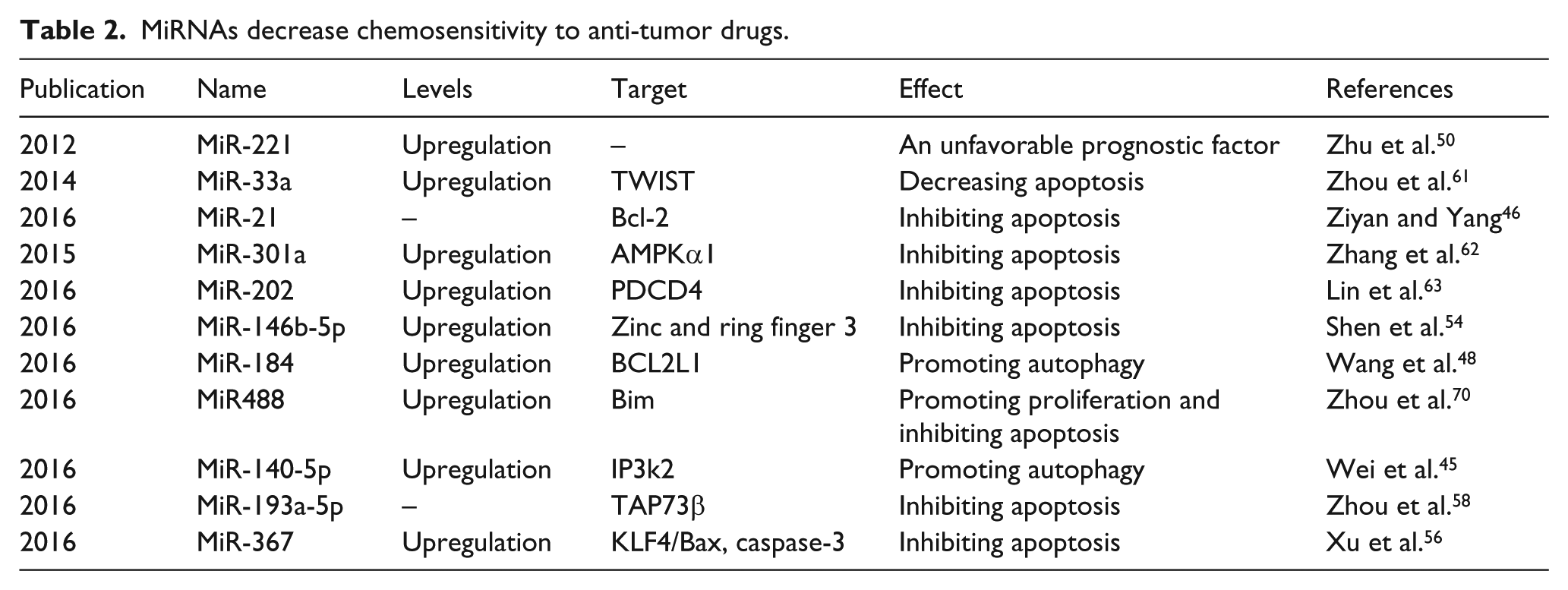
The levels of miRNA linking to chemoresistance in osteosarcoma are mutative compared with normal bone cells or post-chemotherapy osteosarcoma cells. Osteosarcoma cells have an elevated levels of miR-221, miR-33a, miR-301, miR-202, miR-488, miR-367, and miR-146b-5p compared with normal bone cells or tissues,48,66,55 which suggests that these miRNAs may process the effect of tumor promotion. Transfecting these miRNAs into osteosarcoma cells will protect the cells from anti-tumor drugs by promoting proliferation, invasion, and metastasis and inhibiting apoptosis, contributing to resistance to chemotherapy. Moreover, there are elevated miR-146b-5p and miR-184 in chemoresistant osteosarcoma cells.49,55 The pro-cancer effect and compensatory raise in levels after chemotherapy may explain that miR-146b-5p and miR-184 could suppress apoptosis to exert chemoresistance. Besides, upregulation of miR-2146 and miR-193a-5p 47 in osteosarcoma cells also shows resistance to anti-tumor drugs. Investigations suggesting that miRNAs promote chemoresistance in osteosarcoma are summarized in Table 2 and Figure 2.
MiRNAs decrease chemosensitivity to anti-tumor drugs.

MiRNAs regulate corresponding target, impacting autophagy, proliferation, and apoptosis of osteosarcoma.
Anyhow, miRNAs related to anti-tumor and pro-tumor effect are notable in different in osteosarcoma cells compared with adjacent tissues. These miRNAs may implicate chemotherapy response to osteosarcoma by regulating autophagy, proliferation, and apoptosis process. In addition, the expression of miRNAs in osteosarcoma cells varies from the chemotherapy procedure, mediating sensitivity to anti-tumor drugs. Thus, increasing miRNAs that promote chemosensitivity and decreasing miRNAs that induce chemoresistance may be a good therapeutic strategy to enhance chemotherapy efficiency. Moreover, miR-21 shows dual role in osteosarcoma chemotherapy response.46,63 Different downstream targets and levels of miR-21 and difference in anti-tumor drugs may explain this discrepancy. In a word, the roles of miRNAs in chemotherapy response to osteosarcoma are complicated, and further researches are needed to help us fully understand the mechanism.
Conclusion
MiRNAs regulate chemotherapy response to osteosarcoma via mediating autophagy, apoptosis, proliferation, invasion, and metastasis processes. Some miRNAs exert chemosensitivity promotion while others demonstrate chemoresistance induction. Thus, targeting the expression of miRNAs may develop a promising therapeutics against osteosarcoma. However, the detail mechanism of the roles in osteosarcoma is not completely known. Further investigations will help to gain a better knowledge.
Footnotes
Declaration of conflicting interests
The author(s) declared no potential conflicts of interest with respect to the research, authorship, and/or publication of this article.
Funding
The author(s) disclosed receipt of the following financial support for the research, authorship, and/or publication of this article: This work has been funded and supported by Education Department of Hunan Province (Grant number: 13B105).