




Abstract
The aim of this work was to evaluate the prevalence of TP53Arg72Pro mutations and their possible relationship with oral carcinoma and oral potentially malignant disorders in Argentine patients. A cross-sectional study was performed on 111 exfoliated cytologies from patients with oral cancer (OC), oral potentially malignant disorders (OPMD) and controls. The TP53Arg72Pro mutations were determined using conventional PCR. We evaluated univariate and multivariate study variables, setting p < 0.05. We found: (a) a low frequency of Pro72 variant in control group and a high frequency in OC and OPMD, as well in OC and oral leukoplakia (OL) diagnosis; (b) multivariate association among the TP53CC genotype and females over 45 years with no tobacco nor alcohol habits with oral lichen planus pathology; (c) multivariate association between the TP53GC genotype and males with alcohol and tobacco habits and OC and OL pathologies. Our results showed that the wild-type Arg72variant was related to control patients and Pro72variant was related to OC and OPMD, in Argentine patients.
Introduction
Head and neck cancers are the sixth most common group of human cancers, representing 3% of all cancers; 48% of cases are located in the oral cavity, and 90% of these are oral squamous cell carcinoma (OSCC). Oral cancer (OC) is a highly complex multifocal process that takes place when squamous epithelium is affected by genetic alterations. Many OSCCs are preceded by clinically evident oral potentially malignant disorders (OPMD) as oral leukoplakia (OL) and oral lichen planus (OLP). 1 The OL is presented as a white plaque of the oral mucosa that cannot be characterized as any other oral lesion clinically or histologically. 2 The follow-up studies of OL have shown a rate of malignant transformation between 1% and 18% into OC, existing an influence of the geographical area, mainly related to sociocultural habits and genetic components of the population. 3
The OLP is a chronic inflammatory oral condition but is characterized by a chronic immune response mediated by T cells with abnormal epithelial keratinization. This condition may coexist with skin and genital lesions or stand alone. The OLP is a persistent injury and has been described as risk of malignant transformation of cancer in a range of 0% to 12.5%. 4
OC incidence rates have been increasing recently. 5 Environmental factors may play an important role in the process of OC development; for example, differences have been reported in the clinical pathology and molecular pathology of tobacco- (smoking) and alcohol-associated OCs. 6 However, although tobacco use plays a major role in the etiology of OC, only a fraction of tobacco users develop this disease, suggesting that genetic susceptibility may contribute to carcinogenic mechanisms in the population. 7 Many studies have reported that oral carcinoma susceptibility is associated with gene polymorphism.
In recent years, much attention has been focused on the p53 codon 72 Arg/Pro polymorphism (TP53Arg72Pro mutation). The tumor protein p53 gene (TP53), located on chromosome 17p13, is one of the most frequently mutated genes in human cancers, and it has been reported as a significant determining factor in carcinogenesis. 7 As mutations do not lead to elevated non-familial cancer risk in the population, the role of single-nucleotide polymorphisms (SNPs) in p53 and their association with the risk of several kinds of cancers has been widely studied. 8 They have been extensively evaluated as a risk modifier for different cancers and other diseases. 9 TP53Arg72Pro mutation, which could result in either arginine (G) or proline (C), creates three different genotypes: G/G, G/C, and C/C. These forms of p53 differ in their ability to induce growth arrest and apoptosis. The CC variant possesses an increased ability to transactivate p21 and induce growth arrest, while the GG variant demonstrates superior mitochondrial localization in tumor cell lines. 10 TP53Arg72Pro mutation is located in a polyproline region between the transactivation and the DNA-binding domains, and may affect the structure of the binding domain. 11
Complex interactions between TP53Arg72Pro mutation and environmental factors may play a major role in oral carcinogenesis. 6 The impact of TP53Arg72Pro mutation appears to depend on geographic distribution and race. 12 Although OC and OPMD are common in Argentina, there are no studies related to TP53Arg72Pro mutation and OC or OPMD in recognizing which of the allelic variables of this polymorphism are related to malignancy. Studying this polymorphism could provide useful information about the early detection of OC, so the aim of this work was to evaluate the prevalence of TP53Arg72Pro mutation and its possible relationship with the characteristics of malignancy in oral carcinoma and OPMD in a population of Argentine patients.
Materials and methods
Demographics
A cross-sectional study was designed; 111 individuals, 18 controls and 93 patients, of both genders, aged 36 to 80 years, were recruited at the Clinical Office of the Stomatology Clinic “A” (Facultad de Odontología, Universidad Nacional de Córdoba, Argentina) between April 2010 and April 2015. The sample size was in relation to the number of patients attended in this service per year, with an average of six and 10 patients per year with OC and OPMD, respectively.13–15 The controls and the cases belonged to the same ethnicity and were from the same geographical region.
This study was approved by the Research and Ethics Committee of the Ministry of Health of the province of Córdoba (No. 1378), and informed consent forms were signed by all patients.
Study groups
Three study groups were established: (a) OC group: patients with a diagnosis of OSCC (ICD-10 C00-C06), (b) OPMD group: patients with a diagnosis of OPMD according to criteria described by Warnakulasuriya et al., 16 and (c) control group: patients with oral lesions excluding OC or OPMD. The OC and OPMD groups were diagnosed by routine histopathological analysis; the control group diagnosis was performed by other diagnostic methods.
Examination of the oral cavity
The examination was performed by previously calibrated dentists (Kappa = 0.68) through visual inspection and palpation of oral mucosa, teeth, and prosthetic devices (removable/fixed). Tongue, lip, and cheek parafunction habits were also registered. Patients were asked about lifestyle, age, gender, ethnicity, smoking and alcohol habits, and other information.
Exfoliative cytology
Two smears from the healthy mucosa of each patient were collected using a cytobrush (Medibrush Plus®; Medical Engineering, Argentina). They were stored in sterile H2O at −80°C for DNA extraction.
P53 genotyping
DNA from the patient’s exfoliative cytology was extracted according to the amended protocol described in Zarate et al. 14 Genomic DNA (150 ng) was amplified by polymerase chain reaction (PCR) using primers that detect TP53 codon 72 (rs1042522) in Pro72 variant (5′-GCCAGAGGCTGCTCCCCC-3′; 5′-CGTGCAAGTCACAGACTT-3) and Arg72 variant (5′-TCCCCCTTGCCGTCCCAA-3′; 5′-CTGGTGCAGGGGCCACGC-3′). 17 The PCR was obtained in a 50-µL final volume. PCR amplification was carried out on Bio-Rad’s iCycler thermal cycler using the following protocol: 5 min at 95°C, 30 s at 95°C, 30 s at 60°C for Pro72 variant and 58°C for Arg72 variant, and 45 s at 72°C for 35 cycles, with an additional 5 min at 72°C after the last cycle. The PCR products were separated on a 2% TBE (Tris/borate/EDTA (ethylenediaminetetraacetic acid)) agarose gel and stained with ethidium bromide. A DNA ladder marker (Promega, USA) was used to determine the size of DNA fragment.
Statistical analysis
The critical level for establishing statistical significance was set at p < 0.05, and data analysis was as follows:
The categorical data were described by absolute and relative % frequencies.
The Kappa coefficient was calculated to evaluate the match between dentists, setting a value equal to or higher than 0.6 for good match.
The Fisher test was used to evaluate univariate association of variables (table 2 × 2), odds ratios (ORs), and 95% confidence intervals (95% CIs).
The evaluation of multiple associations between diagnosis, gender, risk habits (alcohol and tobacco), and allele frequency was performed by the logistic model.
Results
In the OPMD group, individuals showed histopathological confirmation of OL and OLP. The OC group individuals showed histopathological confirmation of OSCC.
Demographic and clinical aspects of the patient population, in terms of absolute and relative frequencies, are shown in Table 1. Significant differences were observed between genders in the different studied pathologies. It was found that males had a higher frequency of cancers than females; on the contrary, it was observed in the OPMD group. Considering age and injury place, no significant differences between patients and controls were observed. In general, more than 80% of the patients had higher age to 45 years.
Demographic and clinical characteristics of the Argentine population under study.

OC: oral cancer; OPMD: oral potentially malignant disorders; AF: absolute frequency; RF%: relative frequency expressed as percentage.
Total number of subjects was 111 at the beginning of the study. p values <0.05 represent significant association among variables.
Of 111 patients enrolled, TP53Arg72Pro mutation was studied in 106 patients. It was not possible to determine the polymorphism in five subjects.
As shown in Figure 1, we detected three genotypes: G/G, G/C, and C/C. The samples with the C/C genotype presented a band of 178 bp; for the G/G genotype, a band of 142 bp was observed; and samples with a heterozygous genotype contained both Arg and Pro bands.

PCR genotypes amplified by conventional PCR and run on agarose gel. Lane M: molecular weight. CG (heterozygous); CC and GG (homozygous). Arg72 variant: 142 bp; Pro72 variant: 178 bp.
The frequency of TP53ArgPro mutation was associated among cases (OC and different OPMDs) and controls (p < 0.05). The frequency of the Pro72 variant was low in controls and high in OC and OPMD (Table 2).
Frequency of TP53Arg72Pro in the Argentine population studied.
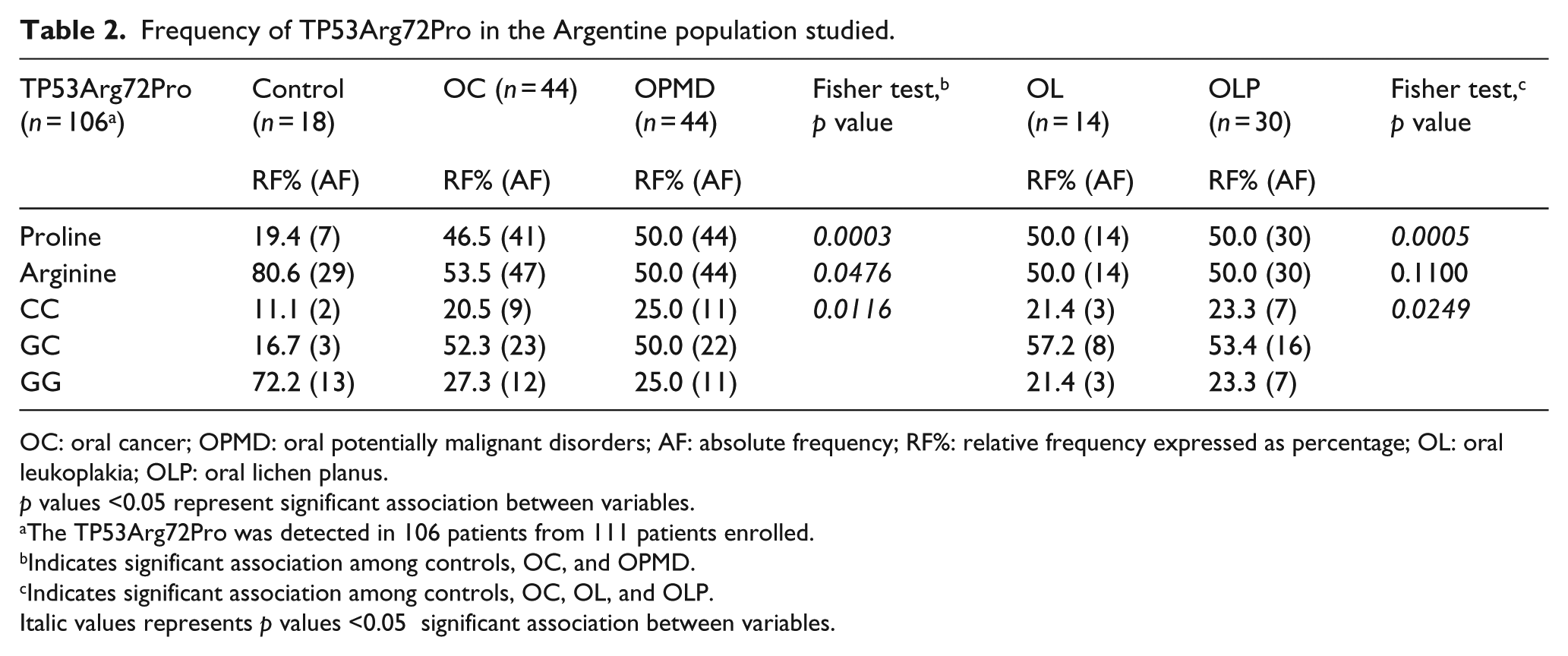
OC: oral cancer; OPMD: oral potentially malignant disorders; AF: absolute frequency; RF%: relative frequency expressed as percentage; OL: oral leukoplakia; OLP: oral lichen planus.
p values <0.05 represent significant association between variables.
The TP53Arg72Pro was detected in 106 patients from 111 patients enrolled.
Indicates significant association among controls, OC, and OPMD.
Indicates significant association among controls, OC, OL, and OLP.
Italic values represents p values <0.05 significant association between variables.
Considering OPMD separately, we found a significant association between the Pro72 variant and OC and OL diagnosis. Referring to the different genotypes present in patients, a significant association was found between controls and the TP53GG genotype and between the TP53CG and TP53CC genotypes and OC and OL (Table 2).
Patients with OC (OR = 9.27; 95% CI: 1.14–75.18)) and OL (OR = 12.38; 95% CI: 2.0–76.61)) had a nine to 12 times greater chance of carrying the Pro72 variant than subjects without these pathologies; meanwhile, OLP had inverse association with Arg72 variant (β coefficient = −1.71; p = 0.0458; Table 3).
Logit model to evaluate multiple associations among the outcome variable (presence/absence of Arg72 variant or Pro72 variant) and explanation variables as diagnosis, gender, and risk habits (alcohol and tobacco).

OC: oral cancer; OL: oral leukoplakia; OLP: oral lichen planus; SE: standard error; OR: odds ratio; LB: low bound; UB: upper bound; ref.: meaning reference category for each variable.
p values <0.05 represent significant association among variables (bold values).
Considering diagnosis, gender and risk habits (tobacco and alcohol) related to Arg72 variant and Pro72 variant frequencies; we found (a) an association between the TP53CC genotype and females over 45 years with no tobacco or alcohol habits with OLP pathology and (b) an association between the TP53GC genotype and males with alcohol and tobacco habits and OC and OL pathologies (Figure 2).

Correspondence analysis shows relation among gender, diagnosis, risk habits (alcohol/tobacco intake), age, and genotype of TP53Arg72Pro mutation. Variables included into circles are related (inertia: two first axes of correspondence analysis in each country = 35.05%; inertia axis 1: 18.44%; inertia axis 2: 16.60%).
Discussion
There is now sufficient understanding of the causes to prevent a third of all cancers in the world and sufficient information to enable early detection and timely treatment of another third of cases. 18 Identification of biomarkers for screening the high-risk population for increased predisposition to cancer is of utmost importance for primary prevention and early anticancer intervention. 19 Complex human diseases, such as OC, and differential biological responses have been linked to multiple genetic polymorphisms through association studies and candidate genes. 20
In this work, frequencies of the TP53Arg72Pro mutation in OC, OPMD, and control patients were studied in a population of Córdoba, Argentina. This is, to our knowledge, the first attempt to identify the association of this polymorphism with clinical features and prognosis in this part of the country.
We observed a higher frequency of the GG genotype in our population. All the patients studied were from the city of Córdoba, situated in the middle of Argentina. There is a clear trend in the distribution of codon 72 polymorphic alleles, and a correlation between the presence of the GG genotype and distance from the Equator. Thus, populations such as those in Africa who live closer to the Equator tend to have a larger proportion of GG genotype than Northern Europeans, who are predominantly GG genotype carriers. 8 Argentina is located in the south of the American continent between parallels 21° and 55°. The current Argentinean population has a genetically heterogeneous ethnic background, mainly conferred by waves of European immigrants and their integration into a sparse native population. 21 It is estimated that about 90% of the population is descended from Europeans, mainly Italian and then Spanish, with an indigenous legacy inherited by more than 50% of the population. Genetic components of African origin have also been established in at least 5% of the population.
We found three genotypes in the patients studied: G/G, C/C, and G/C, and significant association was found between controls and the GG genotype and between CG and CC genotypes and OC and OL. In p53 codon72 polymorphism, the wild-type genotype is (G/G) and the variants are (G/C) and (C/C). 5 This indicates that the homozygous genotype GG may be related to a lower risk of developing OC within the study population, while the heterozygous genotype and the homozygous genotype C/C would be related to a higher risk of cancer or OPMD. This could be because the Pro72 variant is less efficient in suppressing cell transformation, slower to induce apoptosis, and less efficient at binding and inactivating p73, which is a tumor suppressor protein responsible for apoptosis. 22 Nevertheless, numerous studies linking TP53Arg72Pro mutation with cancer have been conducted with differing results. Bau et al., 19 in a study carried out in Taiwan, reported that the G/G genotype seems to increase the risk of oral carcinoma 2.7-fold. Sina et al., 23 in a study in northern Iran, found no significant association between TP53Arg72Pro mutation genotypes and OSCC, which is similar to observations made by Shen et al. 24 and Katiyar et al. 25 of head and neck squamous cell carcinoma (SCC), in studies in a non-Hispanic white and an Indian population, respectively. On the contrary, Twu et al., 26 in Taiwan, reported that the heterozygous G/C genotype is associated with an increased risk of hypopharyngeal SCC. Likewise, Adduri et al. 11 reported an association of the Pro72 variant with SCC of the tongue, suggesting the effect of TP53Arg72Pro mutation on this type of cancer risk. Ethnicity has been suggested to be a critical factor in determining the effects of different TP53Arg72Pro mutation on predisposition to cancer. 8 The same SNP may play different roles in the development of cancer in different ethnic populations, 5 so the variations in these studies may be due to racial and geographic differences, as well as to a variety of other factors such as alcohol consumption, tobacco use, lifestyle, and risk of HPV viruses. 23
However, we found an association between the CC genotype and females over 45 years with no tobacco nor alcohol habits, with OLP. This matches other studies reporting OLP as a mucocutaneous disease characterized by nonspecific inflammation that leads to the severe destruction of the epithelial basal layer. The prevalence of OLP ranges from 0.5% to 2.2% of the population, and it is considered the most common skin disease involving the oral mucosa. The typical age of onset ranges from 30 to 60 years, and it is more common in women (a ratio of 2:1). Most cases of OLP occur between the fourth and sixth decades of life. Several studies report the malignant potential of OLP. 27
We also observed a significant association between the GC genotype and males with alcohol and tobacco habits and OC and OL pathologies. OL was the most common lesion in tobacco users, and OSCC is usually preceded by OL after repeated insults of carcinogens and tobacco. 28 Tobacco smoking is the most important etiological factor in the development of this lesion, and OC and gender distribution show a strong male predominance (2:1). Various studies have shown a 0.6% to 20% rate of malignant transformation of OL. The importance of OL lies in its propensity for malignant transformation. 29
The use of molecular biology techniques to diagnose oral precancerous lesions and cancer may markedly improve the early detection of alterations that are invisible under the microscope. 30 The presence and the accumulation of genetic changes have been shown to be associated with the risk of malignant transformation. We think that these changes may be measured with exfoliative cytology, as we used in this work to take samples from the patients. Because the genomic changes are at the DNA level and the input can be collected from any cells, we prefer to use this simple, non-invasive, inexpensive technique for identifying biomarkers; it is feasible to implement this in a common laboratory, and it is well-accepted by patients. We used this technique in other genetic studies to take DNA samples, obtaining a good-quality DNA sample that permitted reliable results. 14
This work shows our preliminary results on the association between TP53Arg72Pro mutation and OC and OPMD. The results need to be confirmed by a future study including a larger number of patients from different regions of Argentina.
Footnotes
Acknowledgements
The authors received financial support from the Secretaria de Ciencia y Técnica of the Universidad Nacional de Córdoba (SECYT-UNC 203/2014 y RR 1565/14. Code 05/J140 and RR. Code 05/J154).
Declaration of conflicting interests
The author(s) declared no potential conflicts of interest with respect to the research, authorship, and/or publication of this article.
Funding
The author(s) received no financial support for the research, authorship, and/or publication of this article.