




Abstract
Introduction:
Eco-directed sustainable prescribing (EDSP) is an effective upstream way to reduce the environmental footprints of active pharmaceutical ingredients (APIs), a kind of emerging contaminants, from the patients’ excretion. EDSP is one of the key steps in the programme of ecopharmacovigilance (EPV), a drug administration route for API pollution.
Objective:
To assess the attitude of physicians prescribing medicines regarding EDSP from the perspective of EPV.
Design:
Descriptive and cross-sectional study.
Study Population:
Doctors from a tertiary care teaching hospital and private physicians.
Study Period:
January 2023-June 2023.
Sample Size:
300.
Outcome Measures:
A questionnaire (reference: doi:
Results:
Most physicians agreed on the existence of APIs in the environment, worried about the potential environmental and ecological risks of API residues, supported the effectiveness and necessity of EDSP under an EPV perspective in decreasing environmental exposure of excreted APIs and showed their willingness to participate in the EDSP practices. The most important barrier to the effective implementation of EDSP was identified as ‘poor awareness of EDSP and EPV’. Most responding physicians (63%) reported that they held the wait-and-see or conservative attitudes towards EDSP practice. The biggest concerns in low-dose prescribing were the possible negative impact on therapeutic outcomes and a long time will be taken to popularise it in clinical practice and prescribing of drugs possessing environment-friendly excretion profiles was too complicated and professional for the drug evaluation process.
Conclusions:
Physicians had positive attitudes towards EDSP from the perspective of EPV. However, their environmental consciousness during prescribing and the related education were insufficient.
Introduction
‘Every rose has its thorn,’ and so have the drugs, too. Drug use in both the human and veterinary populations is increasing day by day. Consumed drug passes out from the system either as metabolites or unchanged through excretion. A few drugs are not entirely removed by the treatment process, leaving their traces to go into the water in the environment.[1] Such pollution of the environment by the drugs or their metabolites is creating an alarming situation.[1] This situation can be tackled by two approaches, such as ecopharmacovigilance (EPV) and eco-directed sustainable prescribing (EDSP). EPV is the science and activities associated with the detection, evaluation, understanding and prevention of adverse effects of pharmaceuticals in the environment.[1] EDSP prevents the adverse effects of active pharmaceutical ingredients (APIs) in the environment resulting from medical prescriptions. EDSP has been well-accepted as an indispensable part of EPV implementation.[2] It is necessary to explore the attitudes of prescribers toward EDSP.[2]
The environmental discharge of APIs in a continuous and unsupervised have led to their detection in various environmental matrices at levels of concern.[3] Based on the fact that API pollution could be ultimately traced back to the use of medications in healthcare practices, EPV focuses on the clinical application of active pharmaceutical management strategies to decrease the API emission at the sources.[3] The sources of APIs in the environment include excretion from drug-consuming patients and animals, inappropriate deposition of expired or unwanted pharmaceutical products, manufacturing plant wastes, hospital wastes and so on.[4]
The term EDSP is used to describe the combination of two prescription optimisation methods, low-dose prescribing and prescribing of drugs possessing environmentally friendly excretion profiles. The dose of drugs prescribed plays a paramount role in the quantities of APIs entering the environment.[3] EDSP places an additional emphasis on the metabolism and excretion profiles of drugs rather than only the dose initially used by the patient. Within the same therapeutic class and with similar therapeutic efficacies, more environment-friendly excretion profiles resulting in less excretion of bioactive API residues could be favoured for EDSP.[5]
The present study is an effort to determine the opinion on the acceptability of EDSP and its future application
Methods
Study Design
A descriptive, cross-sectional survey convenience sampling involving 300 physicians presently working at government and private hospitals in Gujarat was undertaken to assess their perceptions towards EDSP and EPV using a questionnaire developed by Wang et al. with a few changes from our side. The questionnaire is validated by the institutional ethics committee and all authors. The study was conducted over a period of six months from January 2023 to June 2023.
Data Collection
Physicians who were willing to participate were given copies of the electronic questionnaire. The respondents were informed about the basic concepts of EPV and EDSP on the first page of the questionnaire. A total of 24 structured questions, divided into three sections, were included in the survey questionnaire, which required approximately 10–15 minutes to complete. The first section included four questions about the respondent physicians’ socio-demographic characteristics. The second section comprises a total of seven question items framed to know the perceptions of participants toward API pollution in the environment and EPV. Data was analysed using a five-point Likert scale format (1: Strongly disagree, 2: Disagree, 3: Undecided, 4: Agree and 5: Strongly agree). The third part of the survey questionnaire contains a total of 13 questions designed to capture the physicians’ perceptions and attitudes toward EDSP from the perspective of EPV.
Statistical Analysis
The results were shown in the form of numbers (percentages) for categorical variables.
Results
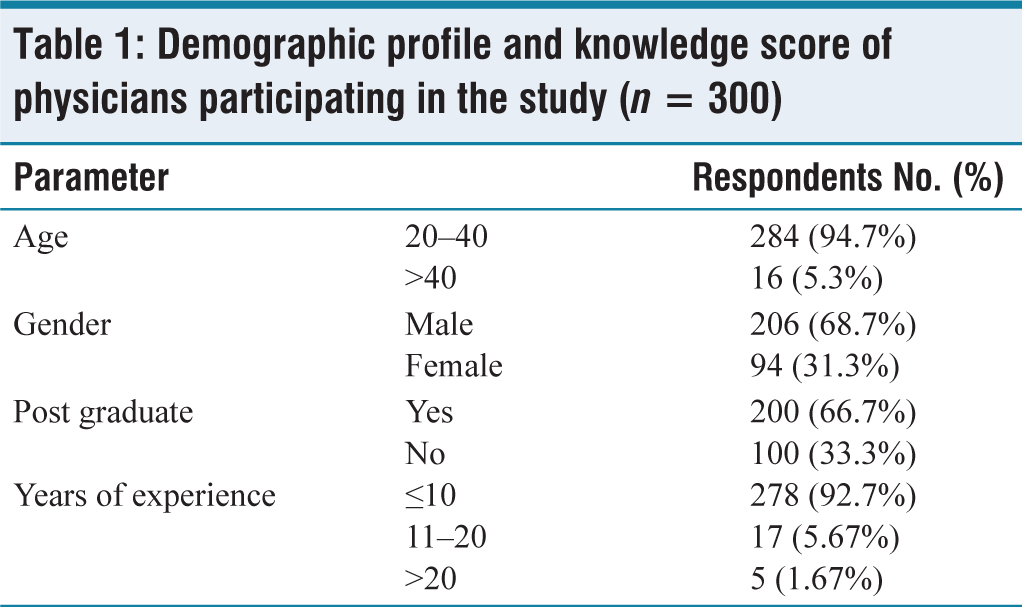
Demographic profile and knowledge score of physicians participating in the study (n = 300)
Respondents’ Characteristics
In Table 1, the majority of respondents were between 20 and 40 years. Most of the respondents held postgraduate qualifications and 92.7% of respondents had ≤10 years of experience.
Perceptions Toward API Pollution in the Environment and EPV
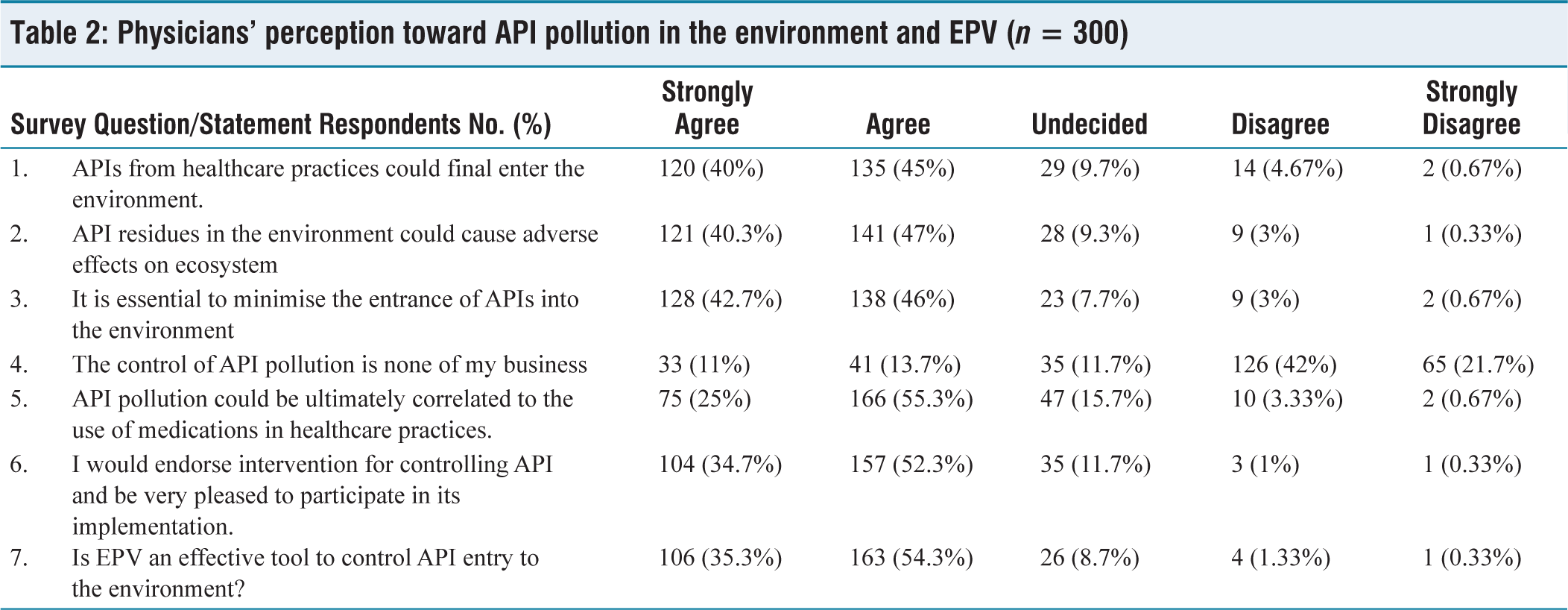
The perceptions toward API pollution and EPV from 300 physicians were analysed using five-point Likert scales. As seen in Table 2, 85% respondents accepted that API residues pave the way into the environment and the majority of them also agreed on their environmental and ecological adverse effects. Additionally, 88.7% respondents accepted that it is required to reduce the entry of APIs into the environment and the majority of them agreed with the ultimate correlation to the medication usage in healthcare practices. The majority of physicians felt that control of API pollution is their responsibility. Additionally, 87% of respondents were pleased to participate in an intervention for controlling API pollution. The majority of physicians stated that EPV is an effective tool to control API pollution.
Physicians’ perception toward API pollution in the environment and EPV (n = 300)
Attitudes Toward EDSP from the Perspective of EPV
Factors Affecting the Physicians’ Decision Process for Drug Prescription
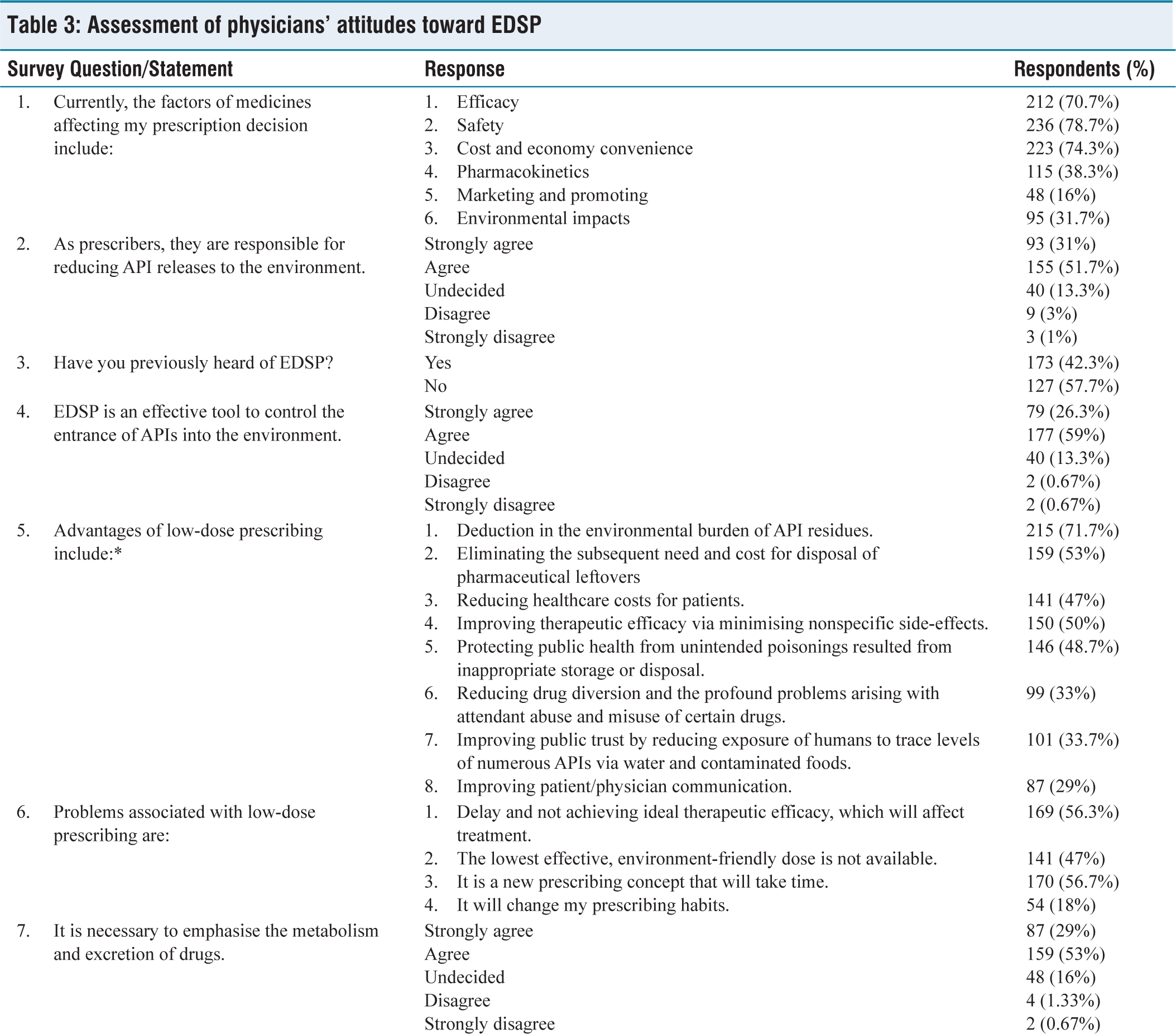
As shown in Table 3, the majority of physicians considered factors such as efficacy, safety and cost of medicines were currently affecting their prescribing patterns. On the contrary, only 31.7% respondents currently consider the environmental impact of prescribed drugs before prescribing. About 82.7% of physicians felt that they are responsible for reducing API pollution. However, only some of them had previously heard of EDSP. The majority of them felt EDSP is an effective tool to control API pollution.
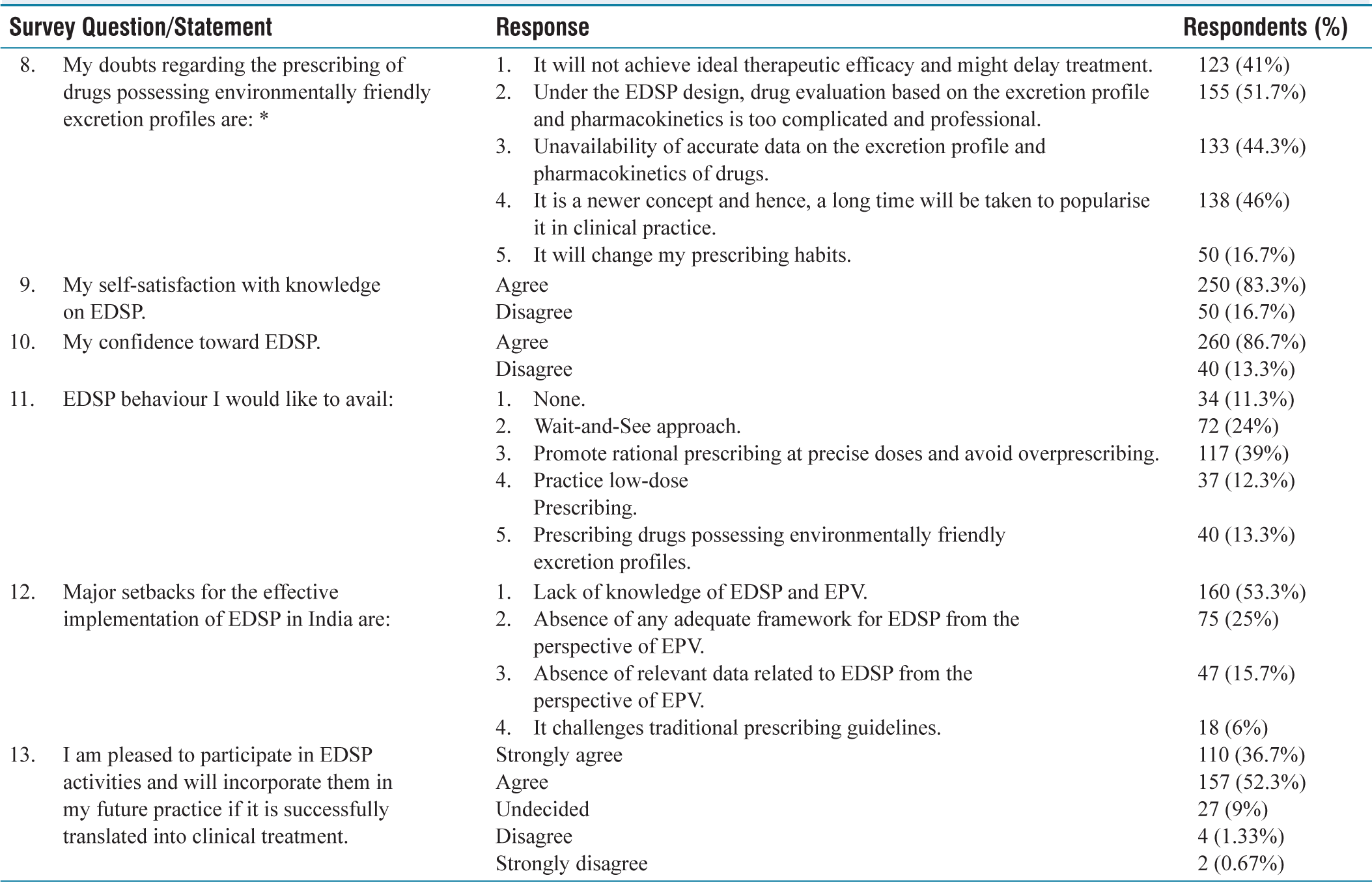
Assessment of physicians’ attitudes toward EDSP
Physicians’ Attitudes Toward Low-dose Prescribing and Prescribing Based on Drugs’ Excretion Profiles, Two EDSP Approaches
Low-dose prescribing will ultimately reduce the environmental burden of API residue release, as felt by 71% of physicians. But this will delay the treatment efficacy and a newer concept was realised by respondents. The majority of respondents believed the pharmacokinetic profile should be considered while prescribing drugs. Whereas (51.7%) of them felt this to be complicated.
The majority of participants agreed that the study has increased their confidence towards EDSP and they will practice a precise dose of drugs, avoid overprescribing and misprescribing.
Physicians’ Attitudes Toward EDSP
Eighty-nine percent of physicians agreed to participate in EDSP actively in future and they regard poor awareness as a major barrier to the effective implementation of EDSP.
Discussion
API means any substance which can be used in a pharmaceutical formulation with the intention to provide pharmacological activity.[6] The concept of EDSP was proposed by Daughton.[2] A previous study confirmed that EDSP plays a key role in controlling API pollution.[7] However, despite it establish effectiveness, the practical application of EDSP is rarely applied in health care practice. To keep the environment safe, we need to educate the individuals (physicians and patients) regarding EDSP and EPV. The acceptance of these concepts by the physicians is necessary for subsequent behavioural changes and final implementation.
EDSP is an essential component for controlling API pollution in the environment.[3,7] The results from Table 2 showed the overall positive perception of physicians towards API pollution control. This is encouraging because it suggests that physicians are ready to improve their practice in future. Our study showed that 85% of the physicians were aware of the fact that API enter the environment, which was in consonance with the study done by Kookana et al.[8] API mainly enters the environment in three ways: Through drug manufacturers, unused medicine and medicine used by patients. Out of these three, the majority of API residues enter the environment through medicines used by patients.[9] The majority of them agreed that an increase in the environmental pollution by API can ultimately have an adverse effect on the ecosystem similar result was shown by Kookana et al.[8] Kaur et al.[10] and Esseku et. al.[11] A majority of physicians accepted that APIs are harmful to the environment and the effectiveness of EDSP in decreasing them was shown in previous literature.[12] The majority of respondents showed eco-responsible attitudes and believed that they are responsible for the control of API pollution. They also showed their willingness to participate in EDSP and EPV practice, similar to the study done by Echaburu et al. on pharmacy students.[13]
Only 37% physicians selected the environmental impacts as a factor influencing their prescription decision, which depicts the insufficient environmental consciousness during prescribing. In our study, only 16.7% respondents were not satisfied with the knowledge of EDSP, contrary to the study done by Wang et al.[3] where 100% respondents were not satisfied. Only 13.3% respondents were not confident towards EDSP, whereas Wang et al.[3] reported 100% were not confident. This would be attributed to more awareness of physicians regarding EDSP in our study, as compared to Wang et al.[3]
Furthermore, 39% physicians choose rational prescribing at precise doses as the preferred EDSP behaviour. Rational prescribing is a concept of drug selection in the field of personalised treatment or the healthcare system.[3] The Royal Pharmaceutical Society highlights consultation to include non-pharmacological intervention, the importance of prescribing drugs and a patient-centred approach.[14] Considering EPV while formulating standard treatment guidelines will improve rational prescribing practice in the health care system.[14] By adopting rational prescribing, we ultimately reduce the API pollution in the environment.
Most of the physicians choose ‘poor awareness of EDSP and EPV’ as a major hindrance to the effective implementation of EDSP. Therefore, EPV and EDSP should be included in the undergraduate medical curriculum, which will affect the future prescribers’ habit of P-drug selection to be more eco-friendly. To reduce environmental exposure, we need to critically select the medicine and practice evidence-based prescribing.[2]
Most physicians accepted the necessity and benefits of two EDSP approaches, low-dose prescribing and eco-friendly prescribing. However, their biggest concerns were the possible negative impact on therapeutic outcomes and the complexity of evaluating eco-friendly drugs. Eco-directed pharmaceutical prescribing includes organising a well-represented nationwide expert group on eco-directed prescribing, integrating the environmental risk assessment into new formulary development and improving healthcare workers’ knowledge about eco-directed prescribing.[14] However, many physicians are concerned about the lack of information required in EDSP design. In India, there is no medical prescribing guidance for the selection of drugs based on environmental risks and hazards. This can be overcome by having a simple classification system for prescribing environmentally safe drugs.[2]
The majority of participants agree to change their prescribing habits for future intervention of EDSP. Eco-prescription should be motivated and green pharmacy should be introduced into the health care system, which will ultimately reduce the environmental impact of API.[15]
Limitation
The limitation of this study is that we only enrolled physicians from Gujarat, which might affect the generalisability of the results. But if all physicians from India are included and willing to participate, then the generalisability of the results will increase. Physicians who were willing to participate filled out the questionnaire and were enrolled in the study. This implies a lack of awareness of the importance of EPV among health practitioners.
Conclusion
As depicted from the above findings, we elaborated some recommendations for EDSP implementation: Develop and implement comprehensive medical training programmes to educate physicians and students about environmental impact, pharmaceutical return programme, rational prescribing and environmentally friendly drug options, while also integrating environmental considerations into prescribing principles and building databases for eco-friendly medication choices.
Footnotes
Acknowledgements
Participating physicians.
Declaration of conflicting interests
The authors declared no potential conflicts of interest with respect to the research, authorship and/or publication of this article.
Funding
The authors received no financial support for the research, authorship and/or publication of this article.
Informed consent
Consent was taken from the participants.
Institutional ethical committee approval number
Approval was taken, Regno: ECR/635/INST/GJ 2014/RR-20 dated 12 October 2022.
Credit author statement
Bhoomi B Patel: Conceptualisation, definition of intellectual content, literature search, data acquisition, data analysis, statistical analysis, manuscript preparation, guarantor.
Ajita Pillai: Conceptualisation, study design, definition of intellectual content, data analysis, statistical analysis, manuscript editing, manuscript review.
Sneha Agravat: Conceptualisation, study design, literature search, data analysis, manuscript preparation, manuscript editing, guarantor.
Anil P Singh: Study design, literature search, manuscript editing, manuscript review.
Presentation at a conference
Annual Therapeutics Congress 2024 (a national conference)
Organisation: Department Of Pharmacology and Medicine, GMC Surat;
TNMC and Nair Hospital, Mumbai; and Saveetha Medical College, Chennai
Place: Surat
Date: 18 January 2024
Data availability
A self-developed questionnaire was used in this study, since there is no standardised material available for testing attitudes about EDSP. The initial draft of the survey questionnaire was developed using information from the relevant published studies regarding API pollution in the environment, EPV and EDSP after performing a thorough literature review.
Use of artificial intelligence
NA.