




Abstract
Background
During pregnancy, the maternal immune system plays a central role in maintaining health and preventing disease. Attaining a healthy daily diet contributes to adequate immune fitness, maintaining health, and preventing disease. This pilot study evaluated the relatively underexplored relationships between the stage of pregnancy, immune fitness and the dietary patterns of pregnant women.
Methods
An online survey was conducted among n = 20 pregnant Turkish women. They reported the number of weeks that they were pregnant and completed the single-item Healthy Diet Scale (HDS) to determine to what extent they considered their daily diet to be healthy. Immune fitness was assessed with a single-item scale ranging from 0 (very poor) to 10 (excellent). Spearman’s correlations (including bootstrapping to account for the small sample size) were computed between weeks pregnant, daily diet scores, and immune fitness.
Results
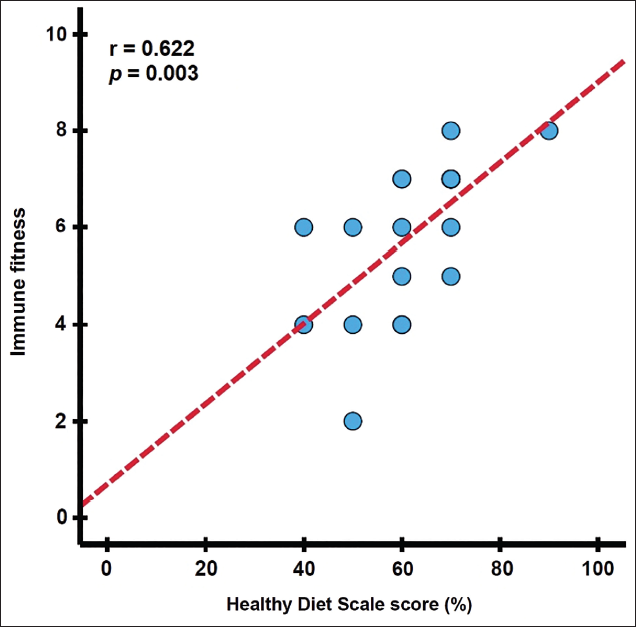
A significant negative correlation was found between weeks pregnant and immune fitness (r = −0.449, p = .047), and a significant negative correlation was also found between weeks pregnant and the percentage of daily diet considered healthy (r = −0.642, p = .002). A significant positive correlation was found between immune fitness and the percentage of the daily diet considered healthy (r = 0.622, p = .003).
Discussion
With progressing pregnancy, poorer immune fitness and a shift towards a less healthy diet were reported. The data suggest that attaining a healthy diet significantly contributes to maintaining adequate immune fitness, which is of particular importance to pregnant women. Future studies in larger cohorts should confirm these findings.
Introduction
During pregnancy, the maternal immune system plays a central role in maintaining health and preventing disease. For example, adequate immune fitness is vital to protect against external health threats (e.g., infections) and to support the normal development of the unborn child.1–3
There are several maternal lifestyle factors that contribute to an effective immune system, including regular physical activity, adequate sleep, and attaining a healthy diet.4–6 In line, research has demonstrated the importance of maternal diet for fetal development and the baby’s health after being born.7, 8 However, parallel to possible changes in immune fitness during pregnancy, dietary behaviors may also shift throughout the pregnancy. In this context, it has been reported that pregnant women often report changes in appetite and may experience cravings or aversions for certain food items. These changes may lead to an altered daily dietary nutrient intake, which may influence maternal immune fitness and ultimately fetal development.5, 6
Objective
This exploratory pilot study evaluated the possible relationships between the stage of pregnancy, immune fitness, and dietary patterns of pregnant women.
Methodology
An exploratory pilot study was conducted among n = 20 Turkish pregnant women who visited community pharmacies in Istanbul, Turkey. There were no inclusion or exclusion criteria, except for being at least 18 years old. The Health Sciences Scientific Research Ethics Committee of Altinbas University (protocol code: 2024/31, date of approval: 18 October 2024) approved the study, and electronic informed consent was obtained from all participants. An anonymous survey was administered via Google Forms in the Turkish language, and it took about 15 min to complete.
Women reported the number of weeks that they were pregnant. The single-item Healthy Diet Scale (HDS) was completed to assess to what extent participants attain a healthy daily diet.5, 6 On a scale from 0 (unhealthy) to 100% (healthy), they indicated the percentage of their daily diet they consider healthy. In addition, the single-item immune fitness scale, ranging from 0 (absent) to 10 (extreme), was completed. 4 The single-item immune fitness scale is a validated and reliable scale with outcomes that correlate well with those of the Immune Status Questionnaire 9 and salivary immune biomarker concentrations. 10
Pearson’s correlations were computed between the number of weeks of being pregnant and the scores on the immune fitness scale and HDS. To account for the relatively small sample size, bootstrapping was applied (B = 10,000 samples), and bias-corrected and accelerated 95% confidence intervals (BCa 95% CIB) were calculated. 11 Correlations are statistically significant if the BCa 95% CIB does not contain zero.
Results
N = 20 pregnant women were included in the analyses. They had a mean standard deviation (SD) age of 31.8 (4.9) years. On average, they were 22.9 (7.6) weeks pregnant (range 6–35 weeks). Their mean (SD) immune fitness rating was 5.9 (1.6), and on average, they reported that they considered 62.0% (12.0) of their daily diet being healthy.
The relationship between immune fitness and daily diet over the course of pregnancy is shown in Figure 1. A significant negative correlation was found between weeks pregnant and immune fitness (r = −0.449, p = .047, BCa 95% CIB: lower limit = −0.725, upper limit = −0.031), suggesting poorer immune fitness when pregnancy progresses (see Figure 1A). A significant negative correlation was also found between weeks pregnant and the percentage of daily diet considered healthy (r = −0.642, p = .002, BCa 95% CIB: lower limit = −0.898, upper limit = −0.089), suggesting that daily diet becomes more unhealthy as pregnancy progresses (see Figure 1B).
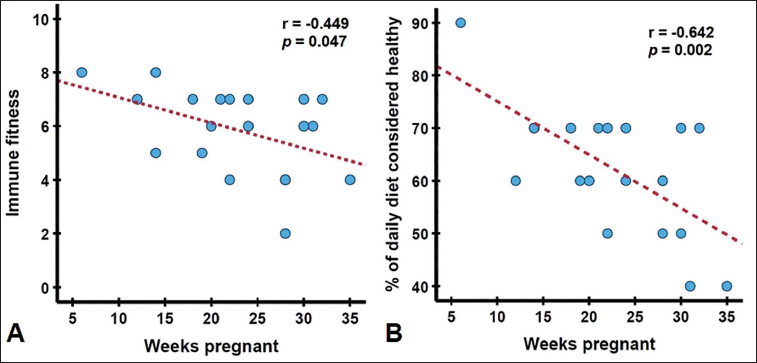
Finally, there was a significant positive correlation was found between immune fitness and the percentage of daily diet considered healthy (r = 0.622, p = .003, BCa 95% CIB: lower limit = 0.294, upper limit = 0.832) (see Figure 2).
Discussion
Attaining a healthy diet is important to maintain adequate immune fitness. While this is relevant in the general population, it is particularly important in pregnant women, as poor immune fitness increases the susceptibility of obtaining immune-related diseases by both the mother and the unborn child.1–3 The current study revealed a strong positive relationship between attaining a healthy diet and immune fitness. This finding is in line with other research using the same assessment scales in young healthy adults. 5 Of concern, the data revealed that when pregnancy progresses, a steady and significant reduction in immune fitness was observed, corresponding to attaining an increasing unhealthy diet.
A strength of the current findings is that the magnitude of the observed correlations is high, and their statistical significance was confirmed via bootstrapping. However, it is important to realize that the data were gathered from individuals at varying stages of pregnancy, rather than from a longitudinal study with repeated measurements. Furthermore, the sample size was small. Therefore, it is essential to verify, replicate, and extend these findings in a larger cohort of pregnant women. Another limitation of the current cross-sectional study is that no baseline assessment was made for immune fitness and diet prior to pregnancy. Therefore, it remains unknown to what extent these measures have changed compared to prior pregnancy. Future studies should include such a baseline measure, preferably accompanied by a measure to aid the interpretation of such a change, such as the Patient Global Impressions of Change (PGIC) scale. To aid the development of effective prevention strategies, it is important to identify why pregnant women tend to eat less healthy as pregnancy progresses, and to explore their preferred methods for maintaining adequate dietary nutrient intake during pregnancy (e.g., via dietary advise or the use of dietary supplements). The outcomes of such studies may contribute to improved prenatal counseling or nutritional interventions that support immune health in expecting mothers. Such studies could also explore alternative explanations for poorer immune fitness in later pregnancy (e.g., fatigue, nausea, or psychological stress).
Conclusion
A decline in immune fitness and a shift towards a less healthy diet were reported as pregnancy progresses. The data suggest that attaining a healthy diet significantly contributes to maintaining adequate immune fitness, which is of particular importance to pregnant women.
Footnotes
Authors Contribution
EO: Conceptualization, writing—original draft preparation, writing—review & editing. EI: Conceptualization, writing—review & editing. LMM: Conceptualization, writing—review & editing. NN: Conceptualization, investigation, writing—review & editing. GC: Conceptualization, investigation, writing—review & editing. NA: Conceptualization, writing—review & editing. JG: Conceptualization, writing—review & editing. JV: Conceptualization, data curation and formal analysis, writing—original draft preparation, writing—review & editing. All authors have read and agreed to the published version of the manuscript.
Data Availability Statement
The data are available from the corresponding author upon reasonable request.
Declaration of Conflicting Interests
The authors declared the following potential conflicts of interest with respect to the research, authorship, and/or publication of this article: Over the past 36 months, JV received research grants from Danone and Inbiose and has acted as a consultant/expert advisor to Eisai, KNMP, Med Solutions, Mozand, Red Bull, Sen-Jam Pharmaceutical, and Toast! JV, EO, and EI have received travel support from Sen-Jam Pharmaceutical. JG is a part-time employee of Nutricia Research and received research grants from the Nutricia Research Foundation, Top Institute Pharma, Top Institute Food and Nutrition, GSK, STW, NWO, Friesland Campina, CCC, Raak-Pro, and EU. The other authors have nothing to declare.
Ethical Approval
The study was conducted in accordance with the Declaration of Helsinki and approved by the Health Sciences Scientific Research Ethics Committee of Altinbaş University (protocol code: 2024/31, date of approval: October 18, 2024).
Funding
The authors disclosed receipt of the following financial support for the research, authorship, and/or publication of this article: The study was supported by TÜBITAK under the 2209-A University Students Research Projects Support Program (2024).
Informed Consent
Electronic informed consent was obtained from all participants.
