




Abstract
Senior Primary English Language Teaching is an important site for implementing Namibia’s Environmental Education and Education for Sustainable Development (EE/ESD) Policy. Language Teaching lends itself to ESD pedagogies and can be responsive to sustainability-oriented content. This article summarizes a qualitative case study of ESD implementation through the Senior Primary English Language curriculum between 1990 and 2018. Data included documents, a questionnaire with 43 Senior Primary English Language teachers in the Khomas Region of Namibia and in-depth interviews with 12 teachers. Framed by Margaret Archer’s social realist theory of Morphogenesis, the study’s findings point to a policy–practice disjuncture of relevance to policy makers, teacher educators and other ESD partners. The article recommends building English Language teachers’ agency for ESD implementation in Namibia by strengthening the EE/ESD foci in pre- and in-service teacher programmes, expanding and strengthening networks and school cluster subject groups, and prioritizing making environmental content knowledge more accessible through textbooks and other teaching resources.
Introduction
The draft Southern African Development Community (SADC)
1
Regional Strategic Framework for Education for Sustainable Development (ESD) recognizes that the implementation of ESD at regional, national and local levels is ‘a complex and evolving process that often implies the challenge of transforming existing approaches to education’ (SADC, 2022, p. iv). Based on policy dialogues with SADC member states, the framework highlights several ESD implementation challenges:
There is limited awareness of the importance of ESD, and hence limited political will to develop and disseminate ESD policies. There are limited platforms, capacities and funding streams to support ESD implementation. ESD is commonly misread by Ministries of Education as a curriculum ‘add-on’ instead of something fundamental to educational quality. Disjuncture between roleplayers (such as ministries, non-governmental organizations, youth groups, scholars and researchers) hinders widespread participation (SADC, 2022, p. 4).
This article reports on a case study of ESD implementation in the Senior Primary English Language curriculum in the Khomas region of Namibia (Malua, 2020). Many of the study’s findings resonate with the SADC-level challenges outlined above. However, the case study also highlights some successful features of the Namibian Environmental Education (EE) and ESD sector, most especially its legacy of strong partnerships between government, non-governmental organizations and higher education institutions.
Sustainable Development and ESD in Namibia
Internationally, the concept of sustainable development came to prominence in 1987 with the publication of Our Common Future (also known as the Brundtland Report) from the United Nations’ World Commission on Environment and Development. The report defines sustainable development as ‘development that meets the needs of the present without compromising the ability of future generations to meet their own needs’ (UNESCO, 2014, p. 10).
In post-independence Namibia (formerly South West Africa), development and education have always been prioritized in policy making and implementation. As a member of the United Nations since its independence in 1990, Namibia has committed and aligned itself to the United Nations’ policies and strategies towards achieving sustainable development. 2 Namibia is one of the world’s least densely populated countries with a population of approximately 2.6 million people in a total land area of 823,290 square kilometres (317,874 square miles). 3 The country is rich in mineral resources, including diamonds and uranium, but is challenged by significant socio-economic inequality, high unemployment levels and underdeveloped human capital (World Bank, 2022). Geographically, Namibia is home to two of the world’s most significant deserts: the Kalahari Desert and the Namib Desert. The driest country in Sub-Saharan Africa, Namibia’s water scarcity is exacerbated by the impacts of climate change. Despite 43% of the country being under some form of conservation management, both the terrestrial and marine ecosystems are threatened—mostly by human activities such as mining (land and off-shore), water contamination, urbanization, land degradation and wildlife crimes (Republic of Namibia, Ministry of Environment, Forestry & Tourism [MEFT], 2021).
The Namibian Constitution makes provision for the promotion and maintenance of a healthy environment, ‘for the benefit of all Namibians, both present and future’ (Republic of Namibia, 1990, Article 95 [l]). As a country emerging from a colonial history, Namibia’s post-independence education policies reflected the new government’s goals for its people: access, quality, equity and democracy. These goals were closely aligned with the United Nations’ Education for All policy and so, in 1993, an Education for All development brief was published as a guide for all stakeholders in the new education system (Republic of Namibia, Ministry of Education & Culture [MEC], 1993).
The Namibian government continues to align itself with a sustainable development agenda (Republic of Namibia, National Planning Commission, 2017). Namibia’s fifth National Development Plan (NDP5) was informed by the United Nations’ Agenda 2030 which set out 17 Sustainable Development Goals (SDGs) and 169 related targets (United Nations General Assembly, 2015). Also influential were the SADC Regional Integration Strategy Paper (African Development Bank, 2011), Vision 2030 (Republic of Namibia, Office of the President, 2004), and the national Harambee Prosperity Plan (Republic of Namibia, Office of the President, 2016).
In pursuit of these ambitious and wide-ranging goals, Namibia, like other United Nations member states, has recognized the importance of re-orientating the country’s education system to ESD (Gumede, 2008; Paulick, 2003). Decades of lobbying, formulating policies and facilitating professional development activities (many of which are described later in this article) culminated in 2020 with the launch of the long-awaited National Environmental Education and Education for Sustainable Development Policy (Republic of Namibia, MEFT, 2019). This was the first EE and ESD policy to be published by an SADC member state. The launch followed almost three decades of planning, consultations, and revisions. The process of formulating this policy started in 1994 and led to the development of a draft policy in 2010 (Republic of Namibia, 2010). The policy formulation was spearheaded by the Namibian Environmental Education Network (NEEN) with support from the Namibian Ministry of Environment and Tourism and the Namibian Ministry of Education, Arts and Culture, and in collaboration with various line ministries and non-governmental organizations. The policy is aligned to international conventions and agreements such as Resolution 57/254 of the United Nations, which launched the Decade on Education for Sustainable Development (UNESCO, 2005), the Global Action Programme (GAP; UNESCO, 2014) and the SDGs (United Nations General Assembly, 2015).
The Namibian EE and ESD Policy defines and discusses the importance of EE as follows:
…the process of developing environmentally literate citizens who are aware of and concerned about the total environment. It is crucial that societies create environmentally knowledgeable people who care about the environment as a whole. In order to ensure that everyone in society acquires the necessary knowledge, attitudes, and skills, it should involve all spheres of society, including schools, higher education institutions, technical and vocational education institutions, government institutions, the private sector, and the general public. (Republic of Namibia, MEFT, 2019, p. 3)
The policy further defines ESD as follows:
…a learning process based on the ideals and principles underlying sustainability and concerned with all levels and types of learning to provide quality education and foster sustainable development. The purpose of ESD is to inform people about international agreements and build a global lobby of collective action for sustainable development and to raise awareness about the crucial and urgent need to limit damage to the atmosphere, mitigate and adapt to climate change. It promotes learning to know, learning to do, learning to live together, and learning to transform oneself, others and society. (Republic of Namibia, MEFT, 2019, p. 4)
Namibia’s EE and ESD Policy provides guidelines and strategies for education and training at all levels to respond to urgent environmental sustainability challenges such as climate change, biodiversity loss, water scarcity, food security, and inadequate waste management. The policy aspires to mainstream environmental issues into educational processes to, ‘help Namibians to appreciate, understand and support our natural ecosystems to adapt to climate change, ensure that food production is not threatened and enable social and economic development to proceed in a sustainable manner’ (Republic of Namibia, MEFT, 2019, p. v). The policy’s first goal is, ‘to establish quality EE and ESD programmes, education and training systems across all sectors, including formal, informal education, vocational and technical education, informal and non-formal education processes’ (p. 10).
The case study reported in this article was conducted in 2018 and 2019 when momentum was building in Namibia to finalize and implement this national EE and ESD policy. The case study offers insights into factors that historically conditioned and continue to condition ESD implementation in the Senior Primary English Language curriculum in the Khomas Region of Namibia, in the hope that these may inform future ESD initiatives and teacher professional development programmes.
The following section considers the role of English language teaching in Namibia as a ‘carrier subject’ for the country’s ambitious ESD agenda. Thereafter, the article summarizes the case study’s research methodology and theoretical framework, before providing a morphogenetic account of ESD implementation in the Senior Primary English Language Curriculum.
English Language as an ESD ‘Carrier Subject’
English is known as an ESD carrier subject. A carrier subject is one that, ‘by its scope and nature is more likely to help learners develop certain knowledge, skills and attitudes that are not the domain of a single subject’ (UNESCO-International Bureau of Education [IBE], 2013, p. 10). Although the subject content of the English language syllabus does not include sustainable development explicitly, it is recognized as a carrier subject for its potential to develop competencies needed for societal transitions to sustainability, including ‘cognitive, affective, volitional and motivational elements’ (UNESCO, 2017, p. 10).
English Language teachers can work creatively with ‘ESD pedagogies’ to incorporate carefully selected themes that can turn English classrooms into sustainability-oriented learning hubs where learners are encouraged to ask questions, analyse and think critically (UNESCO, 2012). ESD pedagogies such as class discussions, issue analysis and storytelling can enrich learners’ mental capabilities (UNESCO, 2012). Critical thinking especially has also been recognized as an important competence for solving emerging problems and promoting sustainable development (Anyolo et al., 2018; Kethloilwe, 2007; Wiek et al., 2011). Jodoin and Singer (2019) propose that English language teachers can work directly with the 17 SDGs (UNESCO, 2015) through content-based or conceptual classroom activities. For example, SDG 10: ‘Reduced inequalities’ can be a starting point for exploring the concepts of inequality and social justice, and for situating learning activities in local, contextually relevant examples.
In Namibia, English is taught across the curriculum. At Junior Primary phase (Grades 0–3), English is taught as a language subject because the medium of instruction at this level is the child’s mother-tongue or pre-dominant language (Republic of Namibia, MEAC, 2015). At the Senior Primary phase (Grades 4–7), English is the medium of instruction and is scheduled seven times per week in the timetable, the highest time allocation compared to other core subjects such as Natural Science which appears five times per week (Republic of Namibia, Ministry of Education [MoE], 2008). Senior Primary English Language teachers are therefore highly likely to meet their learners every school day, and so are well-positioned to be role models and change agents towards sustainability (UNESCO, 2014).
Research Methodology
The study was designed as a qualitative case study, under-laboured by Basic Critical Realism (Bhaskar, 1979) and Margaret Archer’s theory of Morphogenesis/Morphostasis. It sought to provide an explanatory critique of the emergence of ESD based on a sample of 12 Senior Primary English Language teachers in Namibia’s Khomas Region. Khomas is one of 14 regions in Namibia. It lies in the centre of the country and is the region where the capital city, Windhoek, is located. Fieldwork was conducted between January and July 2018, and the full case study was reported in Author 1’s Master of Education dissertation (Malua, 2020).
Ethical clearance to conduct the study was granted by the Rhodes University Ethical Standards Committee, after which permission to carry out the study was given by the Namibian Ministry of Education, Arts and Culture and the Khomas Regional Education Directorate. All participants gave their informed voluntary consent to participate in the study.
The following three data generation methods were used to produce a thick description of the phenomenon of ESD’s emergence in the Senior Primary English curriculum in the Khomas region between 1990 and 2018.
Document review: At the start of the study, seven educational policy documents were reviewed to understand what ideas about curriculum and ESD were potentially conditioning English teachers’ curriculum practices. Later in the study, the participating teachers’ own working documents (English Language internal policies, lesson plans and schemes of work) were reviewed as evidence of how ESD was being actualized at classroom level.
Questionnaire: A questionnaire designed to investigate Senior Primary English Language teachers’ understandings and experiences of ESD was circulated to 55 teachers via their schools’ Language Heads of Department. Of these, 43 questionnaires were completed and included in the study. 12 teachers indicated their availability to participate further in the study.
Semi-structured interviews: Author 1 interviewed these 12 Senior Primary English Language teachers about their motivation to strengthen ESD through their English teaching practice, and what influenced, supported and hindered them in doing so. One additional key informant interview was conducted with a subject advisor to get Ministerial perspectives. Requests for interviews with other Ministerial representatives were not granted.
These data sets were coded and analysed through the lens of Margaret Archer’s theory of Morphogenesis/Morphostasis, which is outlined in the following section.
Morphogenesis as a Theoretical and Methodological Framework
Margaret Archer’s Morphogenetic Theory is a methodological complement of the philosophy of Basic Critical Realism that was developed by Roy Bhaskar from the late 1970s. It provides an exploratory and explanatory framework of why things are as they are in the social world at any given time (Archer, 1995; Archer & Morgan, 2020). The theory of Morphogenesis / Morphostasis was thus identified as an appropriate theory to guide an enquiry into ESD’s emergence in Senior Primary English Language teaching over 28 years.
The morphogenetic cycle illustrated in Figure 1 is a heuristic to explain social change (morphogenesis) or—if change does not occur—social reproduction (morphostasis). Basic Critical Realism’s interest in explanatory critique (Bhaskar, 1979) requires that any methodological framework should help us to understand how the interactions of structure, culture and human agency condition the world to be the way it is, so that when we encounter injustice, harm or unsustainability, we can apply our individual and collective agency more strategically and more transformatively (Bhaskar, 2016).
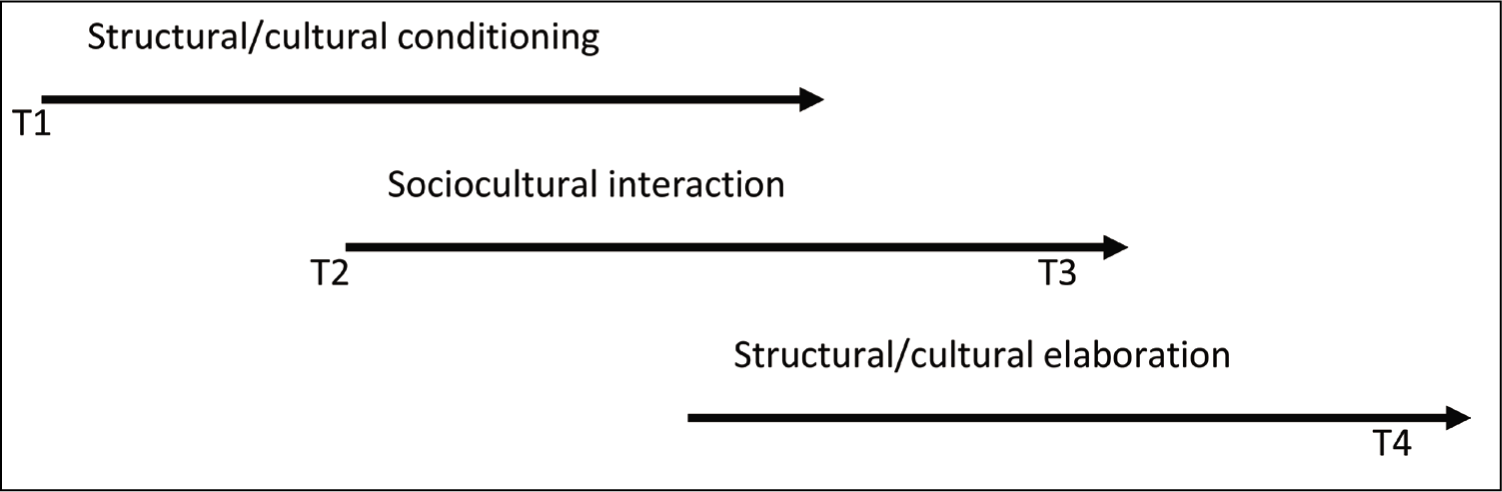
In the case study reported here, the social phenomenon under investigation was ESD in the Senior Primary English curriculum in Namibia’s Khomas region. Archer’s Morphogenetic Theory provided a framework (that is, guiding concepts and analytical tools) to understand ESD’s emergence in that setting from 1990 to 2018.
Historicity is prominent in Archer’s Morphogenetic Theory. It attends closely to the historical origins of social phenomena and proposes that structure, culture and agency operate over different time periods—and that these interactions over time need to be carefully understood. Researchers must therefore recognize that:
social and cultural structures logically predate (go before) the actions that transform them; this is what Archer calls ‘Time 1’ (T1). structural elaboration logically postdates (follows after) those actions and can be referred to as ‘Time 4’ (T4) (Archer, 1995).
In Figure 1 where the letter ‘T’ signifies time, T1 signifies the structures in society that logically must be in place prior to the human actions that transform or reproduce them. Examples of structures relevant to ESD implementation include educational institutions, policy and legal frameworks, and democratic governance structures. Similarly, at T1, there are cultural conditions for ESD implementation in the English Language curriculum. These could include established ways of doing things in Namibian schools and classrooms (such as teachers’ expectations of learner conduct), as well as people–nature relationships that have been normalized in Namibian culture. Archer (1995) refers to these starting points of analysis, respectively, as ‘structural conditioning’ and ‘cultural conditioning’, that is, they are the pre-existing structural and cultural conditions at the start of the morphogenetic cycle under investigation.
T2–T3 is the period of action between T1 and T4. It is the period in which a researcher applies analytical dualism to try and understand ‘how things have come to be as they are’ through sociocultural interaction. Archer’s morphogenetic theory relies on analytical dualism to separate (of course only artificially) ‘the people’ and ‘the parts’. Archer recognizes that structure, culture and agency are inseparable in society, but—for analytical purposes—it is necessary to examine them separately so that their interaction can be more fully understood (Archer, 1995). She explains further:
Because all structural properties found in any society are continuously activity-dependent, it is possible through analytical dualism to separate ‘structure’ [the parts] and ‘agency’ [the people] and to examine their interplay in order to account for the structuring and re-structuring of social institutions such as education. (Archer & Morgan, 2020, p. 184, parenthesis added)
Another feature of Archer’s theory that was used analytically in this study was her concept of ‘emergent properties’. Archer (1995, pp. 173–174) explains that the distinguishing features of emergent properties are that they are homogenous (that is, their constituent parts are internal and necessary, not haphazard); they are relational (that is, they are always connected to and in interaction with phenomena around them); and those relations have ‘generative capacity’ (that is, they have causal powers in the world, even if only in a limited way). Archer identifies three types of emergent properties:
Structural emergent properties (SEPs) may include the distribution of resources (ecological and manufactured), the characteristics of the Namibian education system, and the allocation of positions and functions within organizations and institutions. SEPs are fundamentally dependent on material resources and cannot be reduced to people (Archer, 1995). Cultural emergent properties (CEPs) operate in the realm of ideas. They include doctrines, beliefs, values, traditions and ideologies, for example, what teachers know, feel or believe about education, the natural environment, social justice and sustainability. Personal emergent properties (PEPs) manifest through the causal power of individuals’ consciousness, preferences and commitments, and their effect on other agents (Archer, 1995).
For this case study, analytical dualism and the generative potential of SEPs, CEPs and PEPs were used to understand selected structure-culture-agency interactions from the time of Namibia’s independence in 1990 to 2018. Such analysis enabled the morphogenetic account of ESD implementation in the Senior Primary English curriculum that is presented in the following section.
A Morphogenetic Account of ESD Implementation in the Senior Primary English Curriculum
In this section, we present the case study data through a morphogenetic lens. The presentation moves from structural and cultural conditioning at Namibia’s independence in 1990 [T1], through sociocultural interaction [T2–T3], to an account of the status quo of ESD implementation in the Senior Primary English curriculum in the Khomas region at the conclusion of the study in 2018 [T4].
Structural and Cultural Conditioning at T1 (1990)
Namibia had just gained independence in 1990, the T1 of this study’s morphogenetic analysis. Much work lay ahead for the new democratic government emerging from a colonial era characterized by racial segregation and authoritarian control of people and nature. The legacy of colonial education was vast: since the early 1800s, Christian missionaries (mostly from Britain, Germany and Finland) had sought to instil western cultural values in indigenous communities through a Eurocentric education system that promoted ‘the project of colonialism and subjugation of African knowledge systems, philosophy, arts, culture and religion’ (Josua et al., 2022, p. 1158). Missionary societies continued to run the education system even during the German colonial era (1884–1915). The purpose of education was to produce a subservient workforce that met the needs of the labour market. Little changed under South African colonial rule (1915–1990), until 1948 when the South African government imposed ‘Bantu Education’, an educational system designed to reinforce the White supremacist policy of Apartheid (Josua et al., 2022).
Namibia’s environmental history tells a similar tale of colonial conquest, domination, and exploitation. Botha (2005, p. 171) summarized decades of colonial rule in the following way: ‘Namibia’s rulers ensured that the economy was increasingly orientated towards South Africa and dependent on the export of unprocessed raw materials. Environmental stewardship took a back seat to the rulers’ economic and political priorities.’
Against this backdrop, it is significant that the Constitution of the Republic of Namibia (1990) made explicit connections between environment and the country’s development. The Constitution concerned itself with peoples’ welfare and sustainable use of resources for present and future generations and directed Namibian citizens’ perspectives on sustainable development and the practical choices they made in that regard. The new government embarked upon major reform processes across all sectors and 1990 was thus a year of major restructuring of the education system.
Social Structures at T1
The challenges of transitioning from a colonial to a post-independence education system were reflected in the structural conditions at T1. The newly established governance structures were oriented to restructuring the education system entirely and developing a new curriculum that would reflect the goals of the internationally recognized Education for All policy which foregrounded access, equity, quality and democracy (Republic of Namibia, MEC, 1993). A new Namibian Ministry of Education and Culture was formed which then established the National Institute for Educational Development (NIED) that was responsible for centralized curriculum development. NIED was mandated to develop the National Curriculum for Basic Education as well as to develop textbooks and other teaching and learning materials. The Programmes and Quality Assurance (PQA) directorate under the then Namibian Ministry of Basic Education and Culture was another structure put in place to develop teachers’ capacity for implementing the new curriculum. Each of these structures had its own SEPs which were causally implicated in realizing the national educational goals.
Another extant structure at T1 was the network of teachers’ colleges across Namibia. The inherited institutions were marred by inequities in terms of staff capacity, infrastructure and educational resources. The need to establish new colleges, transform the existing ones, and change the teacher training curricula was an immediate priority at independence as more than half of Namibia’s teachers at the time were either unqualified or underqualified (O’Sullivan, 2002).
Cultural Conditioning at T1
At independence, teaching in Namibian schools was dominated by a culture of rote learning that regarded teachers as masters of knowledge. Teaching was highly book-bound and did not incorporate learners’ perspectives (Republic of Namibia, MEC, 1993). The mechanism of the new national curriculum and its SEPs required teachers to shift the culture of their own teaching practice to learner-centred education within a more accessible, equitable schooling system. Kanyimba (2002) notes that this shift from teacher-centred education to learner-centred education was very influential in the development of EE in Namibia because it required a democratic approach aligned to international developments such as the Tbilisi Declaration of 1977.
There were other important precursors to ESD in the pre-independence schooling system. EE was an established feature of the South West African 4 school curriculum. Concepts that were later to become associated with ESD (such as ecosystem studies, water pollution, air quality and human health) were covered in carrier subjects such as General Science, Biology and Geography (Kanyimba, 2002). However, environmental sustainability was not yet recognized as a cross-cutting concern and so, outside of these subjects, learners’ experiences of environment and sustainability-oriented learning were heavily dependent on the motivation and knowledge of individual teachers and extra-curricular activities such as environmental clubs.
Sociocultural Interaction at T2–T3
T2–T3 is the period when structures, mechanisms and their emergent properties (such as those noted in the previous section) interacted with sociocultural entities to condition ESD implementation. For example, the reformed curriculum was a structure with particular emergent properties that interacted with teachers’ agency and conditioned the culture of teaching and learning in Namibian schools. In the following sections, we summarize how the implementation of ESD in Senior Primary English Language teaching was conditioned by a wide range of structural and sociocultural interactions over nearly three decades. These are summarized and presented below in the following categories: national and international developments; school curriculum reform; pre-service and in-service teacher education; support from NIED and ministerial structures; and the contributions of NGOs and development partners. Also significant was the influence of teachers’ PEPs, most especially their individual motivation and agency, which is discussed at the end of this section.
National and International Developments
In 1992, the first President of Namibia presented a document entitled ‘The Green Plan’ at the United Nations Conference on Environment and Development (UNCED) in Rio de Janeiro, just two years after the country gained independence (Republic of Namibia, Ministry of Wildlife, Conservation and Tourism, 1992). The Green Plan highlighted Namibia’s commitment to the protection of the environment and supported the inclusion of EE in the formal curriculum, stating:
If used appropriately, education can be key to ensuring that a country’s citizens follow the path of environmental responsibility and sustainable development. This can be achieved if environmental issues and the link between conservation and development are woven throughout the fabric of formal education. (Republic of Namibia, Ministry of Wildlife, Conservation & Tourism, 1992, p. 100)
The challenge was to put structures and mechanisms in place to make it possible for conservation and development to be ‘woven throughout the fabric’ of schooling, in this case with a focus on supporting ESD implementation in English Language teaching.
The Namibian government participated actively in the sequence of United Nations-led Sustainable Development and ESD frameworks and programmes through the 2000s. Notable examples include the Millennium Development Goals (MDGs) launched in 2000, the United Nations Decade on Education for Sustainable Development (UNDESD) which ran between 2005 and 2014, the SDGs from 2015, and the GAP on ESD from 2014. All these international developments directly influenced the development of the EE / ESD Strategy in 2020.
School Curriculum Reform
Following independence, the focus and aim of education in Namibia was under reconstruction and the ensuing curriculum reforms were very influential on the culture of teaching. Teachers needed to adjust to a post-colonial curriculum which embraced the educational goals inherent in Education for All and prioritized learner-centredness and an active learning methodology (Republic of Namibia, MEC, 1993). The new curriculum prescribed English as the language of teaching and learning; all subjects except the national languages were to be taught in English from Grade 4 to 12 (Republic of Namibia, MEC, 1993). Policies during the 1990s that promoted learner-centred and active learning approaches sought to instil a new educational culture that would later complement and help to advance ESD pedagogies, especially in the early 2000s. The data also revealed that teachers had to adapt to a cross-curricular approach which included the theme of Environmental Learning. For English Language teaching in particular, the cross-curricular approach meant that teachers were expected to draw on environmental themes while meeting the requirements of the English Language syllabus.
In 2015, Namibia revised its National Curriculum for Basic Education (NIED, 2015) in response to ‘rapid changes such as technological advances, globalization, HIV and AIDS, and environmental degradation’. The policy outlines seven aims for basic education in the country: a society that is caring, healthy, democratic, productive, and environmentally sustainable, that is focused on information literacy and individual development. The environmental sustainability aim envisions a future Namibia in which:
There is no atmospheric, land and water pollution from croplands and rangelands or mines, and minimal pollution from urban and industrial areas. Farms and natural ecosystems are productive and sustainable socially, economically and ecologically. There is high quality, low-impact tourism. Average family size is small, and there is food security.
Towards achieving this aim, the revised school curriculum seeks to:
…provide the scientific knowledge and skills, and attitudes and values needed to ensure that the environment is respected and sustained; and to develop the ability to make environmentally wise choices in terms of family development, as well as in economic activities. (NIED, 2015, p. 11)
Pre-service and In-service Teacher Education
The timeline of the abovementioned school curriculum reforms since 1990 had implications for teacher readiness to reorient to ESD. A new teacher professional development curriculum in the early 1990s that was enacted by teacher colleges, the University of Namibia (UNAM), and various NGOs played a key role in developing English Language teachers’ readiness to implement ESD. The data suggests that, although the opportunities were commonly short-lived and isolated, they provided important conceptual and normative foundations for novice teachers.
The teacher questionnaires and interviews indicated that teacher colleges, UNAM and teacher professional development workshops were influential in integrating EE across the curriculum during the 1990s and early 2000s. For example, both the pre-service and in-service Basic Education Teacher’s Diploma (BETD) programmes introduced teachers to the concept of Environmental Learning as a cross-curricular issue and laid conceptual and pedagogical foundations for ESD. In this study, twelve of the forty-three Senior Primary English Language teachers (28%) who responded to the questionnaire indicated that they had received some sort of formal training on how to include EE in their practice. One teacher elaborated:
I was introduced [to EE / ESD] through…my studies which is Education at the University of Namibia. We learnt a lot of topics that we were supposed to put into practice. How to, for example, teach environment…how to have a theme, a topic and a theme on how to inform learners, at the same time creating awareness and also teaching them certain skills.
Another teacher similarly reflected: ‘I was trained by the University of Namibia. The information I gained from my studies enabled me [to understand] that it’s very important, even if you are a language teacher, to integrate cross-curricular teaching in your daily lesson preparations’.
Many teacher professional development opportunities were provided by the Supporting Environmental Education in Namibia (SEEN) project that was introduced in 2001 by the Danish International Development Agency (DANIDA). SEEN (2005) recommended that English Language teachers develop a culture of choosing themes which are of importance to Namibia and take learners outside of the classroom to support learning through doing and being. SEEN later collaborated with Rhodes University in South Africa and the former Polytechnic of Namibia (now the Namibian University of Science and Technology [NUST]) to offer the Rhodes University Participatory Course in Environmental Education. NUST later ran the course independently and renamed it the Namibian Environmental Education Certificate Course. This course was influential in the development of EE in Namibia at the time (Tshiningayamwe, 2011) and provided an important professional development opportunity for some people who would later play key roles in ESD implementation in Namibia.
Support from NIED and Other Ministerial Structures
Since the 1990s, NIED has conditioned the culture of teachers’ practice by developing and distributing materials necessary to develop teacher agency as per curriculum requirements (Republic of Namibia, MEC, 1993). NIED ensured first that teachers were provided with the necessary documents to guide their practice. The curriculum and supporting documents such as the subjects’ syllabi as well as the subject policy were widely distributed, and teachers were workshopped on how they should use the documents. These actions produced an SEP that enabled teachers as groups and individuals to develop their own working documents such as internal subject policies, schemes of work and lesson plans.
The structure of schools’ subject departments and the cultures within them were also found to condition teachers’ agency regarding ESD implementation. Teachers worked as teams guided by the national curriculum documents as well as their school’s internal policy document which is collaboratively developed to guide their schemes of work and lessons. Crucial to the success of teachers’ working documents was the hierarchy within schools which put subject heads and departmental heads in positions of authority and expertise for teachers seeking subject-related assistance (Republic of Namibia, MoE, 2008). The data revealed that departmental heads were the ‘go-to-people’ within this hierarchy although in most English Language teachers’ experience, ESD-related expertise was very limited.
The participating teachers recognized school clusters as important support structures for mediating the development of teaching materials, sharing best practices and developing common working documents and activities, including examinations. A school cluster usually consists of five to seven schools in close geographical proximity, convened around one of the better-resourced schools that serves as a cluster centre (Dittmar et al., 2002). Cluster-based practice was shown to have influenced the teaching culture because teachers benefitted from using the same materials and working with common ideas and approaches. Clusters as social structures are vested with CEPs, which have an effect on the individual teachers’ practice and the knowledge that they bring into their classroom. The potential value of school clusters in support of ESD implementation was noted by one teacher who stated: ‘Yet we have an opportunity of working in cluster groups which, depending on management of that cluster, can be used to facilitate that question [of ESD]’. The clustering mechanism makes it easier for teachers to meet often and share best practices. This makes clustering an effective in-service capacity development mechanism for orientating Senior Primary English teachers to new developments and national priorities, including ESD (Republic of Namibia, MoE, 2008; Dittmar et al., 2002).
The data also indicated that the PQA directorate and various Teachers’ Resource Centres run by the Ministry of Education were also structures that continuously conditioned the culture of ESD implementation in T2–T3. This was traceable to mechanisms such as the Continuous Professional Development workshops which Resource Centres ran to equip teachers to respond to curriculum developments. Although the National Subject Policy Guide for English Grades 4–12 describes Teachers’ Resource Centres as sites where teachers can seek information to support their teaching practice, including ESD implementation, there was no evidence in this case study that Teachers’ Resource Centres were currently supporting ESD implementation in the Senior Primary English Language curriculum. This was corroborated by various teachers. One teacher explained:
In theory the support is there. Why I’m saying ‘in theory’ is because, according to the policy, that is what is supposed to happen, but maybe because of financial means and so on, that kind of support is not readily available. Workshops that I used to see many years ago…are not happening.
Another English Language teacher who was in his first year of teaching when interviewed said that he had not received direct assistance from advisory services. ‘Not directly, no. I cannot recall any time where we had a discussion actually about ESD’. Two other teachers commented on the absence of a subject advisor for the English Language Department in the region. This situation arose when the former subject advisor resigned at the beginning of 2018 and the position was vacant for nearly two years.
NGOs and Professional Networks
Alongside Ministerial interventions, NGOs and other development partners also made significant contributions to ESD’s emergence in Namibia, especially during the 1990s and early 2000s. It is noteworthy that most of them were enabled by international funding partners. They distributed educational resources and ran teacher professional development workshops and short courses that this case study showed had motivated and supported English Language teachers to integrate an environmental and sustainability focus in their teaching practice.
The Desert Research Foundation of Namibia ran a programme named ‘Enviroteach Namibia’ from 1992 to 1999. The programme was funded by the Swedish International Development and Co-operation Agency (SIDA) and its aim was to lead and strengthen a cross-curricular approach to EE in Namibia. The Enviroteach programme appeared as an important mechanism in the teacher colleges for strengthening EE across all subjects.
The NEEN was established in June 1995 hosted by the Rössing Foundation, whose EE project was funded by the United States Agency for International Development (USAID) (Gumede, 2008; Paulick, 2003). As a social structure of direct relevance to ESD implementation, NEEN is mandated to encourage and support government, NGOs, and interested parties in implementing EE in Namibia under the guidance of the EE policy.
Other established ESD partners that provided direct and indirect networking and resourcing opportunities for English Language teachers include the Environmental Education Association of Southern Africa (EEASA) that was established in 1982 and hosts an annual conference in the SADC region, and the Namibian Desert Environmental Education Trust (NaDEET) which was awarded the 2018 UNESCO-Japan Prize on ESD.
This section has outlined some of the key sociocultural interactions that influenced or had the potential to influence English Language teachers’ agency in relation to ESD implementation since 1990. The focus of the next section shifts to evidence of teachers’ individual agency in practically implementing ESD during 2018 when the case study data were generated.
Teacher Agency in Relation to ESD Implementation at T4 (2018)
The study found that a wide range of sociocultural interactions had both constrained and enabled teachers’ agency to implement ESD in English Language teaching practice between 1990 and 2018. This section briefly outlines the trends found in the case study data in terms of teachers’ conceptual and pedagogical readiness to implement ESD, and teacher motivation.
English Teachers’ Conceptual and Pedagogical Readiness to Implement ESD
At T4 in 2018, the teachers presented wide-ranging understandings of EE, ESD and their cross-curricular nature. A few showed no understanding at all, but most were of the view that the English Language subject has potential for carrying forward Namibia’s sustainable development agenda. Some of the teachers were already actively including environmental and sustainability content into their lessons, for example, one experienced teacher who explained:
English is actually very nice because you can bring in Social Studies, you can bring in History, Geography, Science, Maths and environment. I often refer back in some comprehensions, …and I say ok, fine, how does this concept or what we have just done in class influence the environment around us? And then I get a more continuous feedback, give-and-take, from the children as well to make them realise that what we do in English is not in a box…. They can also start learning to think outside the box.
She also noted that, although the concept of ESD was very new, the actual practice was not new to her: ‘… beforehand I did it [ESD] automatically whereas now it’s actually got a name. Right! But before independence I was teaching that way anyway’.
For most other teachers, ESD remained a new concept. The questionnaire data suggested that the teachers had a basic understanding of the concept of ESD. However, this was contrasted by the follow-up interview data which indicated that, generally, the teachers had weak understandings of the scope and significance of ESD as an international and national sustainability intervention. The teachers’ narratives were similarly quite superficial in terms of the practical implications and significance of ESD pedagogy.
The case study further revealed that the concept and orientation of ESD was not sufficiently explicit in the curriculum documents that guided the Senior Primary English Language teachers’ practice. Teachers similarly referred to the lack of relevant teaching materials, or the irrelevance of existing materials (particularly textbooks) which do not contain ESD content. According to Teacher Interview 2 and Teacher Interview 5, the lack of relevant ESD teaching materials forces teachers to consider other resources which may only be possible with the teachers who are willing to go an extra mile.
Teacher Motivation
The teachers were nonetheless positive and eager about the relevance and potential of ESD. This was especially evident at the end of the interviews when teachers were asked if they had anything else to say. Most indicated that they wanted more engagement, wanted to know more about the concept of ESD and how to best implement it in their practice, as evidenced in the following examples:
‘A proper training on how: to implement it, on how to use it as a subject to make the kids understand it and as well as myself so that I can better implement it’. ‘We need somewhere to start off […], because I can see that the future depends on the ESD…and people need to gain more understanding about this. So, we just need somewhere to start off’.
Overall, the data revealed a range of constraints to teachers’ agency in implementing ESD. These included: inflexibility of the English language curriculum which lacks an explicit ESD focus; a paucity of ESD-aligned teaching resources for Primary-level English language teaching; limited or superficial teacher understandings of environmental or sustainability content, the global and national significance of ESD and its practical implications for classroom practice; and inadequate guidance from subject advisors and Teacher Resource Centres.
Discussion of Findings and Recommendations
The data presentation has highlighted certain structures, mechanisms, PEPS, SEPs and CEPS in the morphogenesis of ESD implementation in the Senior Primary English curriculum in the Khomas Region. Following this analytical separation of the ‘parts’ from people’s agency, the discussion now turns to harmonizing the parts and the people to gain insight into the emergence of ESD in this context and to make recommendations for future endeavours.
In morphogenetic terms, the study found that the ‘parts’ and ‘people’ were out of synchrony. The analysis revealed that both of the ‘parts’ (the structure and culture of ESD implementation) were elaborated over time, and that the elaboration was mostly conditioned by global trends in ESD and national post-independence trajectories. The same cannot be said, however, for the ‘people’, whose elaboration as ESD agents of change (evident at T4) was more limited. This is common in morphogenetic processes since structure and agency operate at different time periods: ‘structure necessarily predates the actions which transform it and that structural elaboration necessarily post-dates those actions’ (Archer, 1995, p. 15). Additionally, the ‘parts’ and the ‘people’ have their own emergent powers, which lead to either elaboration or reproduction. That is why structures can be in place, but human agents can be unaffected by, or even resist their conditioning powers.
The morphogenetic pathways of ESD implementation in national and ministerial settings were not matched by complementary morphogenetic pathways in pre-service teacher education and continuing professional development opportunities. Nor were they reflected adequately in Senior Primary English Language textbooks or other teaching resources. English language teachers’ own agency and commitment to ESD implementation appear to have been somewhat haphazardly conditioned by factors such as their personal interest, exposure to the basic concepts and aims of EE/ESD in their pre-service qualification, access to continuing professional development opportunities, and the quality of leadership and guidance from district curriculum officials or school departmental heads. These findings are not new or unexpected in the SADC region. Gumede (2008) previously recommended that more attention be paid to how the success of policy processes is influenced by the nature of the relationship between the people and parts, and more recently the Regional Strategic Framework for ESD notes a ‘disjuncture between role-players’ (SADC, 2022, p. 4).
This case study brings contextual nuance to Priority Areas 1 and 2 of the SADC ESD Regional Strategic Framework (SADC, 2022, p. 25). Priority Area 1 calls for the need to: ‘Advocate for the integration of ESD into existing policy, regulatory and operational frameworks through multi-sector approaches, coordination and leadership’. In the very particular context of Senior Primary English Language teaching in Namibia, this should include the creation of operational frameworks that bridge policy and practice for subject advisors and English teachers. Teachers should be supported to:
understand the relationship between global–national–local sustainability priorities and Namibia’s various environmental and sustainable development policy responses including but not limited to the SDGs. understand the relationship between global–national–local educational priorities and international and national ESD policy and strategies. be prepared and adequately resourced to respond to the pedagogical implications of Namibia’s EE/ESD policy for English Language teaching practice.
This case study revealed limited synchronicity between those various dimensions, contributing to the Senior Primary English Language teachers at T4 being benignly supportive of ESD but lacking adequate depth of environmental and pedagogical knowledge to respond agentively to their aspirations.
Priority Area 2 focuses on the need to: ‘Strengthen ESD through capacity building, training and continuing professional development in formal, non-formal and informal learning settings’. In the context of Senior Primary English Language teaching in Namibia, actioning this priority area would include:
putting in place professional development mechanisms to strengthen English Language teachers’ reflexive engagement with points I–III above. giving English Language teachers easier access to reliable, contextually relevant and accessible sustainability content knowledge and, importantly, mediating that knowledge with teachers in the context of primary school language teaching. supporting English Language teachers to understand, appreciate and implement ESD pedagogies.
The Namibian EE/ESD Strategy & Action Plan for 2022–2026 presents a basic framework to guide action in these priority areas. For example, the document includes strategic foci to: ‘build capacity of teachers, trainers, lecturers in all levels of formal and informal education to integrate EE/ESD’ and incorporate EE/ESD into schools, TVET and tertiary level programmes (UNESCO & MEFT, 2022, pp. 3–4). This is in line with UNESCO’s (2020) ESD Roadmap which recommends that, ‘Leaders and staff of teacher colleges should include systematic and comprehensive ESD capacity development in pre-service and in-service training and assessment of teachers in pre-primary, primary, secondary and tertiary education’ (p. 30).
Conclusion
T4 of the case study reported here becomes the T1 of the next Morphogenic/Morphostatic cycle of ESD implementation in the Senior Primary English curriculum in the Khomas Region. At the time of writing this article in mid-2023, the new T1 is characterized by Namibia’s recently launched EE/ESD Policy (Namibia, MEFT, 2019) and the National EE/ESD Strategy & Action Plan (UNESCO & MEFT, 2022) within a democratic nation state, a national schooling system oriented to learner-centredness and active learning, and in alignment with intensified international efforts to strengthen ESD through mechanisms such as the GAP and with regional support for teacher professional development through the Sustainability Starts with Teachers (SST) programme and NaDEET’s ‘Teach for ESD’ programme, amongst others.
However, any morphogenetic analysis under-laboured by Basic Critical Realism reminds us that the interaction of the parts and the people occurs in an open social system which is open to unanticipated changes and new forms of agency. At the time of concluding this article, interactions between T2 and T3 are being conditioned by the National EE/ESD Strategy & Action Plan that is being implemented amidst the intersecting properties and powers of the socio-economic impacts of the coronavirus disease-2019 (COVID-19) pandemic, the intensifying impacts of climate change, and shifting international politico-economic dynamics. The T4 of ESD’s future implementation by Namibian English Language teachers at classroom level will be conditioned by the interactions of the ‘parts’ (tertiary teacher qualifications, professional development programmes, collaborative partnerships between NIED and non-governmental organizations, school and classroom culture and so on) and the ‘people’ (English teachers, learners, curriculum experts, policy makers and ESD facilitators and so on).
This case study has outlined how the emergence of ESD in Namibia between 1990 and 2018 was influenced by global ESD agendas interacting with post-independence national policy and institutional reforms. The study reports how, within those broad trajectories, Senior Primary English Language teachers have reoriented their classroom practice to ESD to varying degrees of success. Aligning the successes of ESD policy trajectories in Namibia with practitioner-level engagement appears to be key to strengthening ESD implementation in this sector. The case study suggests that revising pre- and in-service teacher programmes, strengthening school cluster subject groups, and making environmental content knowledge more accessible could significantly boost Senior Primary English Language teachers’ capacity and motivation to orientate their classroom practice to the Namibian ESD mandate.
Footnotes
Declaration of Conflicting Interests
The authors declared no potential conflicts of interest with respect to the research, authorship and/or publication of this article.
Funding
The authors received no financial support for the research, authorship and/or publication of this article.