




Abstract
Policy responses to the growth of the informal food sector in African cities vary from benign neglect to active destruction. The eradication of street food vending is the dominant mode of governance. Alternative approaches that recognize the inevitability of informality and the role of the sector in making food accessible to the urban poor have begun to emerge. One is an enclose-and-contain model that creates spaces for trading and seeks to confine trading to these spaces through active policing. This strategy has been pursued in Windhoek, Namibia but has been compromised by consumer demand, which is not satisfied by the city’s approved markets, and by the actions of street traders who cluster at key locations and force tacit official recognition. This paper examines the origins and development of the resulting hybrid model of informalized containment, as well as the profile of consumers who patronize both types of markets.
I. Introduction
Rapid urbanization in Africa has been accompanied by the transformation of urban food systems and dramatic growth of the informal food sector.(1) As part of this trend, street food vending has become a distinctive and ubiquitous feature of the contemporary African urban landscape. Policy responses to the growth of informal food vending vary from “benign neglect” to “active destruction”.(2) The latter has become a familiar response, involving high-profile militaristic removal “operations” directed at eradicating informal street vending. The labels for these operations are revealing: Operation Murambatsvina/Restore Order in Zimbabwe,(3) Operation Clean Sweep in South Africa,(4) and Operation Dongosolo (Clean-Up) in Malawi.(5) More commonplace are everyday eradication strategies involving low-level harassment of vendors by “predatory” city officials and police.(6) Mass forced removals and daily harassment can have “a dramatic impact on informal sector livelihoods through arrests, fines, the destruction of property, the confiscation of goods, and reduced business opportunities”.(7) Such punitive approaches to informality are all too common, but they are also largely ineffectual as food vendors return with innovative evasion strategies in the daily struggle for survival on the streets.(8) These approaches are also often undermined by forms of what Dragsted-Mutengwa terms “relational governance”, in which enforcement officials and vendors collude to the benefit of both.(9)
The ultimate futility of attempts at informal sector eradication has prompted a search for alternative governance models. One of these, advocated by international organizations such as the World Bank and the International Labour Organization, is the elimination of the informal sector through a process of formalization. Another strategy focuses more on containing the spatial extent of informal vending through the designation of legitimate and illegitimate trading zones.(10) This form of spatial engineering tries to corral the informal food sector through the control of space, referred to by some as a strategy of “enclosure”.(11) Enclosure or containment involves the creation of what Kamete terms spatial “enclaves of informality”,(12) usually in the form of renovated or new urban food market structures. Neither urban food retail markets nor their promotion as urban development planning tools are new in African cities.(13) However, their integration into the governance and policing of informality is a more recent development. An essential component of the enclose-and-contain model is the provision of infrastructural incentives for street traders to locate or relocate to designated zones such as marketplaces. The corollary of this incentivization strategy is more intensive policing of forbidden spaces to eliminate choice for vendors who cannot or do not want to pay for a fixed stand in a serviced marketplace. Pejoratively referred to as “pernicious assimilation” or “selective incorporation” by critics, governance by enclosure and containment thus rests upon a system of rewards for the included and punishment of the excluded.(14)
The existing literature on the governance of informal food vending tends to focus on laws and regulations, on state actors and actions, and on the repression of informal food vending. There is also a growing literature on informal vending as a form of entrepreneurship. Much less attention has been paid to the actual patrons of the informal food sector: who they are, where they come from, what foods they source and consume, and from whom. In general, informal vending plays a crucial role in urban food systems by making food accessible to the urban poor in African cities. An African Food Security Urban Network (AFSUN) study of food sourcing by over 6,000 poor households in 11 Southern African cities, for example, found that 70 per cent regularly purchased food from the informal food sector.(15) In some cities, including Blantyre, Harare and Maputo, the figure was over 95 per cent.(16) Even in cities with relatively small informal food sectors, such as Cape Town and Johannesburg, the proportion was 66 per cent and 85 per cent respectively. As many as one-third of households overall were found to be buying food from informal vendors on an almost daily basis. Policies that constrain or restrict the access of low-income consumers to the informal food sector therefore have major implications for those who depend on the sector in order to put daily food on the table.
The various governance models have different implications for access to affordable food by low-income individuals and households. Strategies of elimination, for example, may disrupt food accessibility altogether or at least make it more problematic for consumers who rely on the proximity and mobility of informal vendors. As Resnick notes, repressive violence “hurts a vulnerable sector of society that is already food insecure but also reduces access for others who depend on the sector for many of their fresh and nutrient-dense foods”.(17) Strategies of enclosure and containment may mean that food can only be accessed in a smaller number of fixed locations that are not equally accessible to all. Another dimension of the governance–consumer interaction concerns the ways in which consumers may shape the nature and implementation of policy through overt resistance to unpopular measures or through their food-sourcing patterns and preferences. For example, the success or otherwise of enclosure and containment depends to a large degree on whether low-income consumers are able or willing to buy food at designated markets rather than in other locations that may be more convenient.
Although attention has been given in the literature to the responses of informal vendors to repressive state policies, there is still a gap in our understanding of how their individual and collective actions interact with consumer behaviour to shape the policy environment itself. While there are few instances of informal vendors forcing change in formal legislative and regulatory frameworks governing the informal food sector, the ways in which regulations are implemented, or whether they are implemented at all, can be influenced by vendor organization and resistance of various kinds. Mass removals are often met with considerable organized opposition, including counter-violence, marches, demonstrations and petitions. In the case of Operation Clean Sweep in Johannesburg, vendors went to court and obtained a remedy that allowed the resumption of trading. The success or otherwise of policies of enclosure also depends on how informal vendors react to the incentives and blandishments to locate or relocate to designated trading spaces.
Drawing on a case study of informal food vending in Windhoek, Namibia, this paper explores how informal vendor strategies can interact with consumer needs to force substantive change to the governance of the informal policy of enclosure. The paper first examines the reliance of low-income households in informal settlements on the informal food sector, using data from a recent, city-wide household survey. It also disaggregates the various types of households to assess whether some are more reliant on the sector than others. This analysis demonstrates that any policy decisions that constrain or restrict access to the informal sector are likely to have a particularly negative impact on lower-income households in informal settlements who constitute an increasing proportion of the city population.(18) This means that informal sector eradication is not seen as a realistic policy option. Instead, the City has opted for a strategy of controlling the spread of the sector through enclosure and containment.
As in many other cities, strategies of enclose and contain have not been a great success in Windhoek. The needs of low-income consumers, and the responses of informal vendors to those needs, have therefore led to the development of an alternative model of informal food sector governance. None of the existing models of governance does full justice to this local adaptation of strategies developed in other African cities. The model eschews the eradication drive seen in many cities; nor is it completely characterized by the enclose-and-contain model. We refer to this adaptation as informalized containment and explain its background, development, and implementation in the following sections.
II. Methodology
The data for this study come from a city-wide household survey of Windhoek conducted in August 2016 by the African Food Security Urban Network (AFSUN) and the Hungry Cities Partnership (HCP). The survey instrument was developed by AFSUN and HCP and mounted on tablets through a modified computer-assisted open data toolkit for personal interviewing. The survey interviewed a total of 863 households, drawn from all 10 constituencies of the city, using a two-stage cluster sampling design. First, a total of 35 primary sampling units (PSUs) were randomly selected with probability proportional to size. The PSUs were selected from a master frame developed and demarcated for the 2011 Population and Housing Census. The second stage involved systematic sampling of 25 households in each of the selected PSUs. In each household, the head or their representative was interviewed after obtaining informed consent. For this paper, we have drawn on a sub-sample of 420 households living in the city’s informal settlements.
The survey collected data on a wide range of issues including household demography and economics, levels of food security, the types and locations of food sources, and the purchasing strategies of households. To assess the prevalence and levels of household food insecurity, the survey used three indicators developed by the Food and Nutrition Technical Assistance (FANTA) project(19):
The Household Food Insecurity Access Scale (HFIAS), a continuous measure of the degree of food insecurity in the household. An HFIAS score is calculated based on answers to nine frequency-of-occurrence questions and ranges from 0 (completely food secure) to 27 (completely food insecure).(20)
The Household Food Insecurity Access Prevalence (HFIAP) measure, which uses a scoring algorithm to categorize households into one of four categories: food secure, mildly food insecure, moderately food insecure, and severely food insecure.
The Household Dietary Diversity Score (HDDS), which captures how many food groups, from 0 to 12, were consumed within the household in the previous 24 hours.(21)
Household food purchasing patterns were identified using the Hungry Cities Food Purchases Matrix (HCFPM), which identifies where households normally purchase a range of up to 30 common food items, the frequency of purchase, and the geographical location of the source.(22) The quantitative survey data are supplemented by information from in-depth semi-structured qualitative interviews conducted by one of the authors (Nickanor) in 2011 with 50 randomly selected female food vendors and household heads in Windhoek’s informal settlements.
III. Patronage of the Informal Food Sector
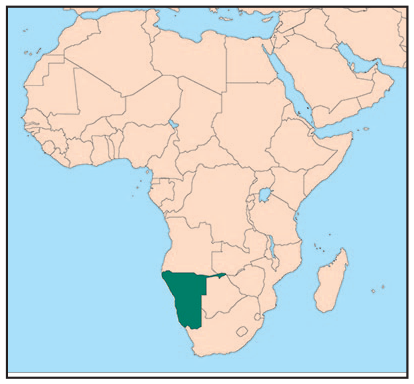
Windhoek, the capital city of Namibia, has grown rapidly since independence in 1990 and now has a population approaching 400,000.(23) The rapid pace of urbanization led to a major increase in the size of informal settlements to the north of the city. In 2011, one-third (or 27,000) of all residential units in Windhoek were shacks in informal settlements. More than 3,500 new shacks are added to the city every year.(24) Households in the informal settlements have very high levels of vulnerability to food insecurity. In the AFSUN–HCP survey, the mean HFIAS score of households in the informal settlements was an extremely high 15.4 (out of 27). Two-thirds of the households in the informal settlements had an HFIAS of 15.0 or greater, and a quarter had an HFIAS of 20.0 or greater. When these scores were converted into the HFIAP food security categories, only 6.2 per cent of households were found to be completely food secure, with 11.7 per cent mildly or moderately food insecure and 82.1 per cent severely food insecure. The quality of the diet in the informal settlements is also poor. The mean HDDS for households was only 2.6, meaning that on average households had eaten food from fewer than three food groups in the previous 24 hours. Sixty-three per cent of the households had an HDDS of 2 or less, and 97 per cent had an HDDS of 5 or less.
Interviews with informal settlement residents emphasize the challenges of securing sufficient food and the monotony of the diets:(25) “Everyday we eat the same meal, pap, pap [maize meal porridge], we do not have a choice of what we want to eat, it is what we can afford. One has to live and pap takes away your hunger.” “Every decent meal consists usually of maize meal or mahangu [millet flour] pap eaten with dried fish or meat when there is money to purchase the meat or fish. That is what we eat here every day. Even if you find chicken or vegetables on sale in the formal shops you will not buy it — where are you going to store it? There is no electricity here and no refrigerators.” “You see how full this house is. Each of my girls has two children and they are not working. We do not eat to satisfy our hunger but as long as there is something in the stomach. I use about N$600 [US$ 90] per month to buy a 50 kg bag of maize flour and other necessities but even that does not last a whole month. I have to find some supplements.” “One constantly worries about food. It is tough here, we barely get by… The food situation is relatively better for men. They can tighten their belts, but for us women it is worse. When your child looks at you and asks for food and you cannot offer it to him or her, as a mother you feel bad, you feel compelled to try anything even to engage in prostitution to give your child something to eat. I’m not educated and most casual jobs which are available are for men – to dig trenches for water pipes or cables for street lighting. Acquiring food is our daily challenge, as tough as it seems, this is our lives, but we survive.”
In order to make ends meet, a number of households derive income by participating in the informal food sector: “I was born in the rural north and because we are many I decided to move to Windhoek with the hope of finding employment, but I did not find employment to date, all I’m doing now is selling okapana [grilled/fried meat]. What I’m getting from selling is very little and is not much different from those who are not doing anything. But you cannot sit back and do nothing.” “Because jobs are hard to come by and I’m not educated, I decided to follow the example of other women. We go to Meatco to buy tripes, lungs, intestines, hooves and heads of animals; we cook them and sell on the market or from home.” “I sell meat, but there are so many of us who are selling okapana in the informal settlements. At times you don’t get customers and you store the meat overnight or we consume it in the house, but that’s not good for business. But I don’t get discouraged – tomorrow business may be good.”
In the 2016–17 AFSUN–HCP survey, 34 per cent of households were found to derive income from the informal sector, including 19 per cent from waged work in the informal sector, 8 per cent from the informal sale of goods, 4 per cent from the sale of fresh produce, and 3 per cent from another informal business.
Windhoek’s informal sector has grown rapidly in recent years. The country emerged from decades of repressive South African rule in 1990 with an extremely small informal sector.(26) A 2001 study observed that the sector was still relatively limited.(27) However, by 2007–8, an AFSUN survey of low-income areas of the city found that three-quarters of low-income households purchased food from the informal food sector.(28) Around a third did so on an almost daily basis (at least five days per week), while another 36 per cent patronized the sector at least once per week. Despite the presence of a growing number of supermarkets in the city,(29) the informal food sector has continued its expansion over the last decade.(30) There are four main types of informal food vendor in the city: (a) vendors who sell food in marketplaces (known as open markets) constructed by the City; (b) street vendors; (c) vendors who sell from tuck shops/spazas (Photo 1), which are fixed structures in informal settlements; and (d) mobile vendors who sell food house-to-house.
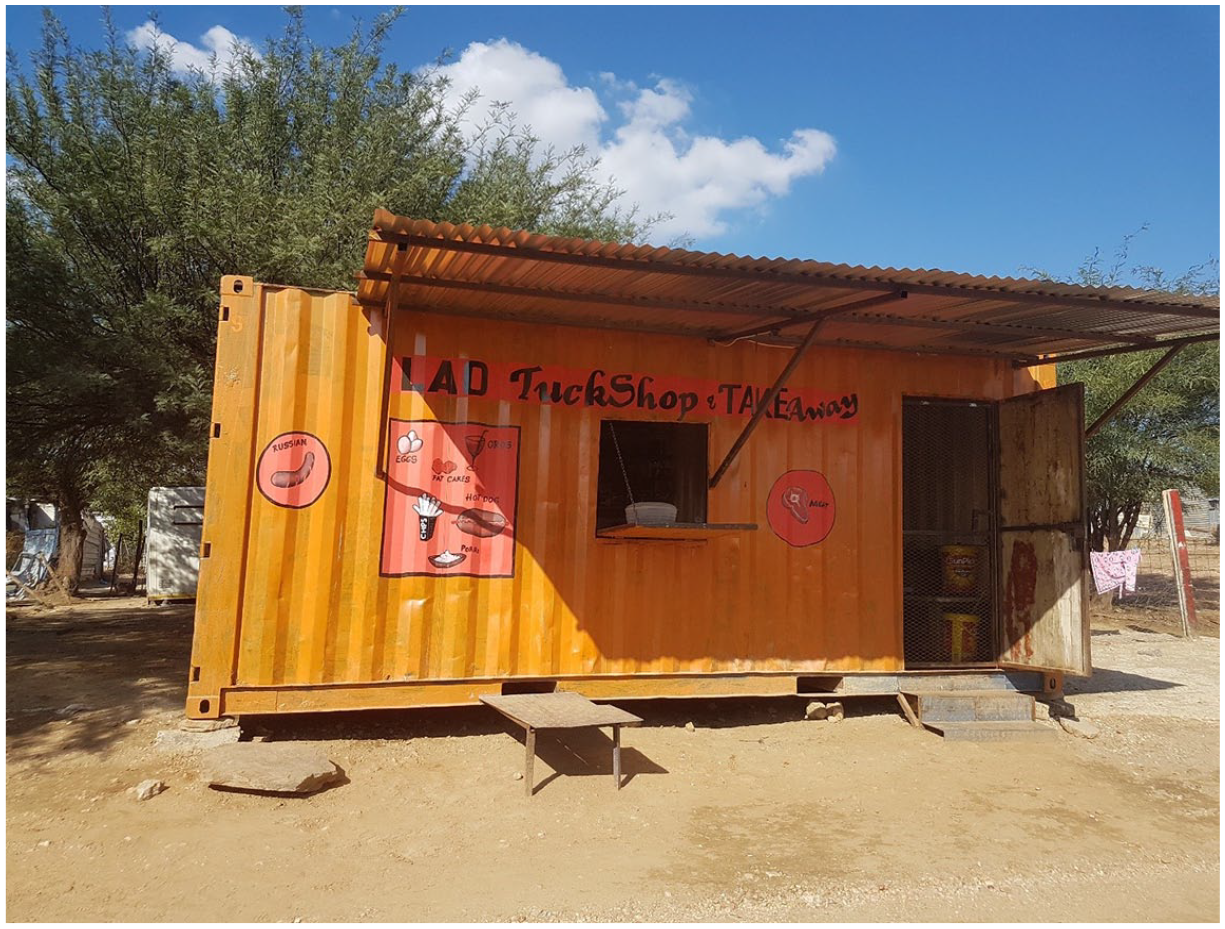
Tuck shop in the Kilimanjaro informal settlement
The survey found that the informal food sector is an important and accessible source of food for many households. Table 1 shows the sources from which households in the informal settlements said they normally purchase food, and how frequently. The market domination of supermarkets is apparent, with 97 per cent of households patronizing these outlets. However, nearly three-quarters of supermarket patrons only shop there on a monthly basis. Nearly 50 per cent source food from informal vendors in open markets, 29 per cent from street vendors, and 19 per cent from tuck shops. Over 75 per cent of households that patronize the informal food sector do so extremely frequently (at least once per week). In addition, some 50 per cent of street vendor patrons and 51 per cent of tuck shop patrons utilize these outlets on an almost daily basis. This buying pattern is typical of households more generally with low and inconsistent incomes.
Frequency of sourcing food from different outlets
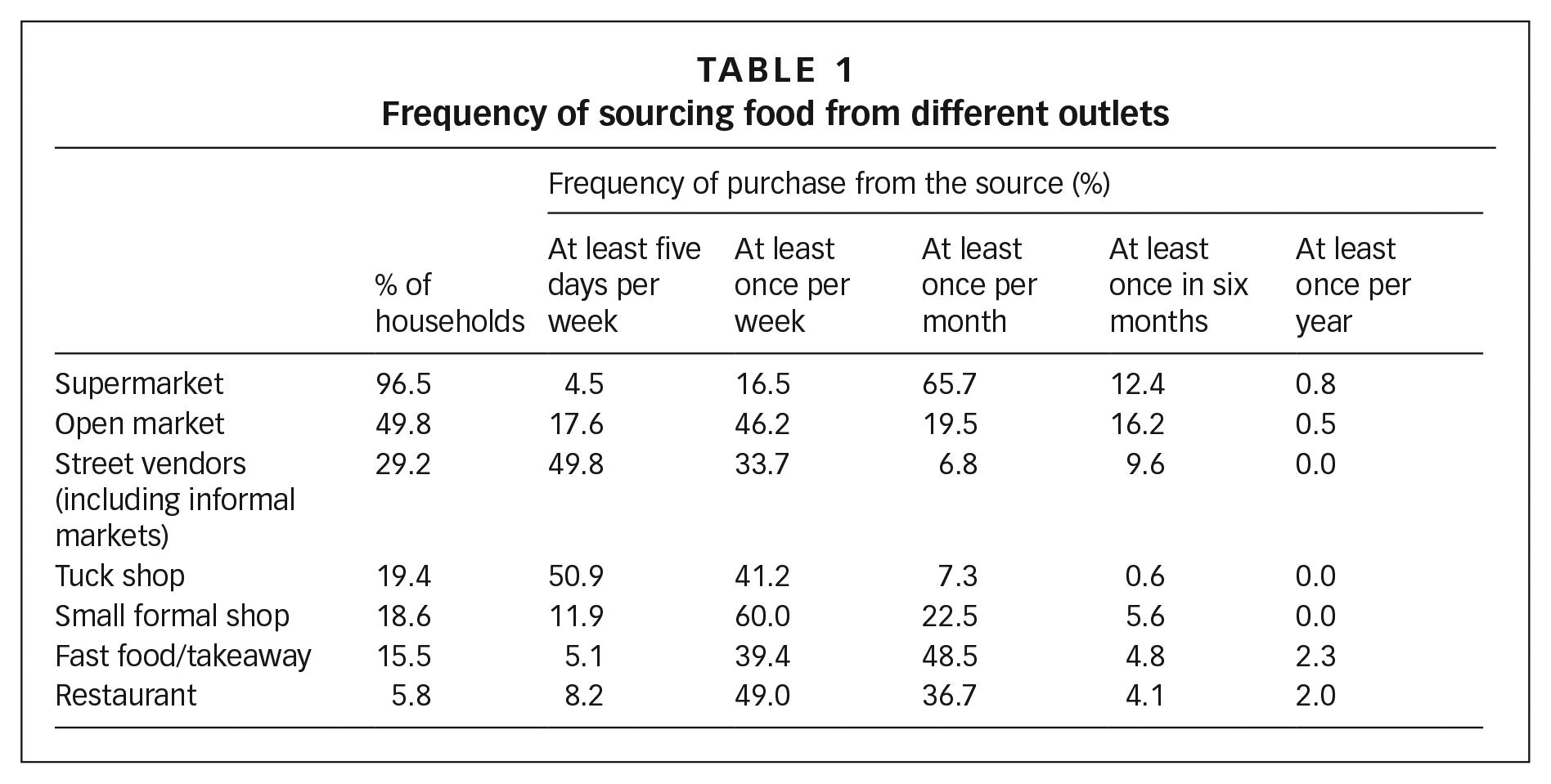
Table 2 provides an indication of the main foods purchased at different formal and informal retail outlets. The monotony of the diet mentioned by respondents and suggested by the low mean HDDS score is confirmed by the generally low proportion of households that had purchased anything other than bulk supplies of staples. Supermarkets command an unexpectedly high proportion of the market for all products and completely dominate the sale of cereal staples such as maize meal, rice, pasta and various processed products. This is a direct reflection of the fact that some supermarket chains (particularly the South African budget chain USave and the local chain Woermann Brock) have set up operations in the north of the city in reasonable physical proximity to the informal settlements. The bulk purchase of staples and processed foods such as cooking oil, sugar and tea/coffee from supermarkets still tends to occur on a monthly basis. Open markets are supplementary sources of meat, vegetables, fish and fruit. Street vendors are the most important informal source of fish but also have a reasonable share of the market for offal and meat. They also purvey vegetables and fruit. The informal food sector is thus an important source of healthier foods for households that can afford them.
Hungry Cities Food Purchases Matrix (HCFPM) of food item sources
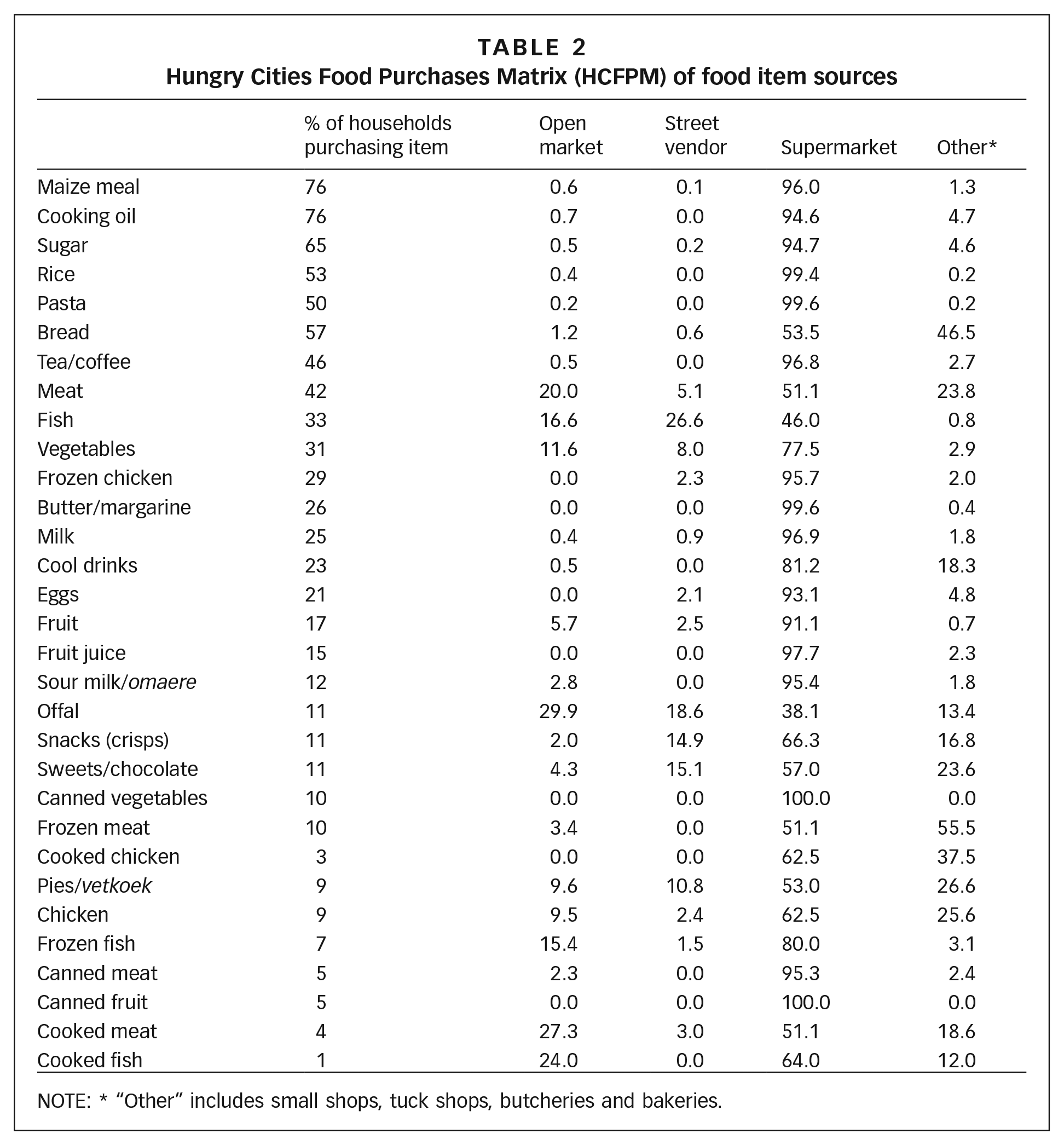
NOTE: * “Other” includes small shops, tuck shops, butcheries and bakeries.
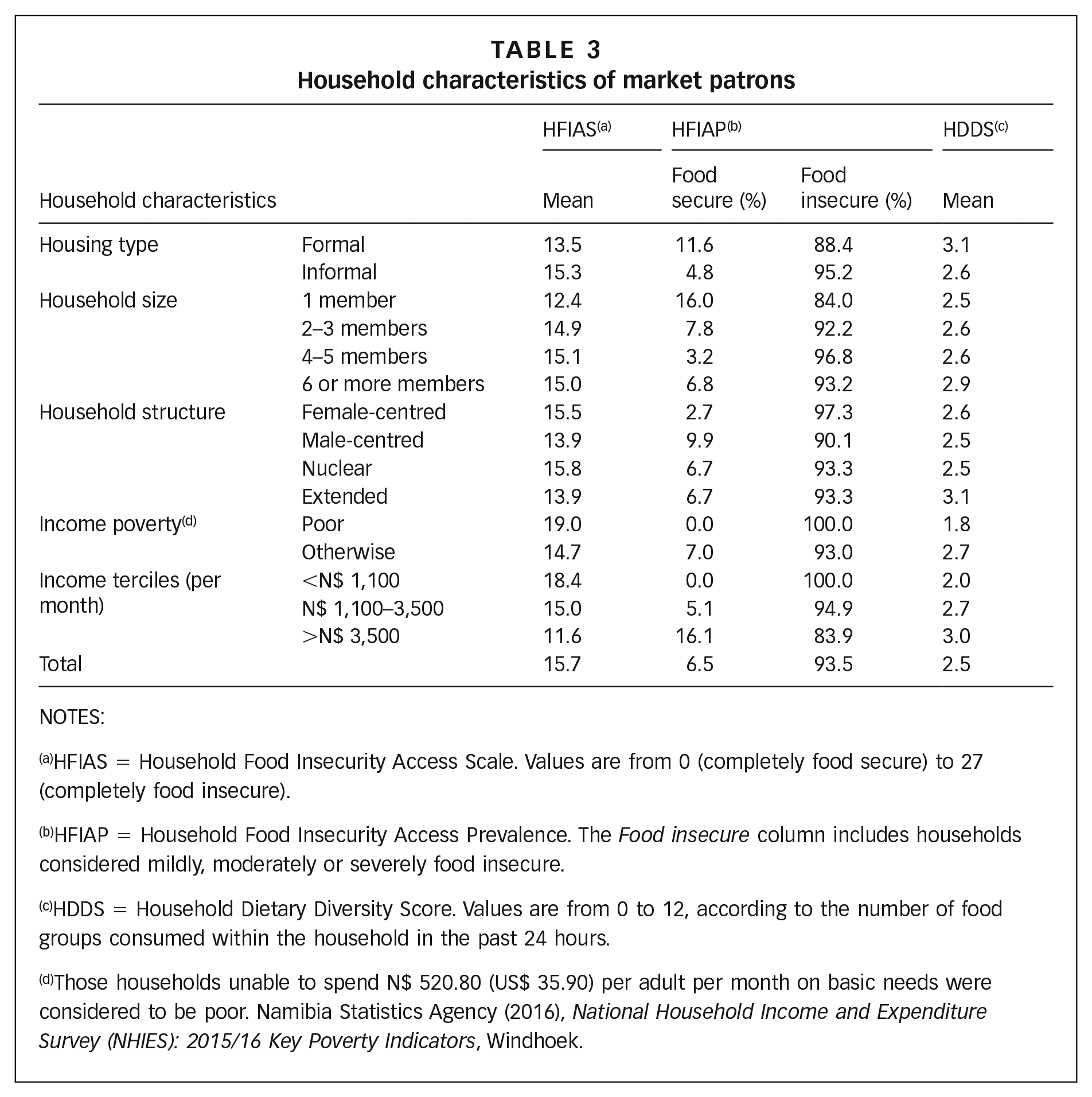
Table 3 provides a profile of low-income households that source food from the informal food sector. They certainly display high overall levels of food insecurity, as measured by the HFIAS, HFIAP and HDDS. However, patrons in informal housing are more food insecure than those in formal housing. In every category, over 80 per cent of households are food insecure, and no category has a diverse and varied diet (no HDDS is greater than 3.1). However, there are some differences in the degree of food insecurity. Bigger households are more food insecure primarily because there are more dependent children to feed. However, very large households (of six or more members) are marginally less food insecure than those with four–five members, probably because they have more adults and earning potential. Household type is an additional factor, with female-centred households (i.e. those with a female head plus dependants and no male spouse or partner) having the highest levels of food insecurity (only 3 per cent are food secure according to the HFIAP). Amongst informal-sector patrons, food procurement is also related to household income, with a clear difference between households earning less than N$ 1,100 [US$ 73] per month (all of whom are food insecure) and those earning more than N$ 3,500 [US$ 233] per month (16 per cent food secure).
Household characteristics of market patrons
NOTES:
HFIAS = Household Food Insecurity Access Scale. Values are from 0 (completely food secure) to 27 (completely food insecure).
HFIAP = Household Food Insecurity Access Prevalence. The Food insecure column includes households considered mildly, moderately or severely food insecure.
HDDS = Household Dietary Diversity Score. Values are from 0 to 12, according to the number of food groups consumed within the household in the past 24 hours.
Those households unable to spend N$ 520.80 (US$ 35.90) per adult per month on basic needs were considered to be poor. Namibia Statistics Agency (2016), National Household Income and Expenditure Survey (NHIES): 2015/16 Key Poverty Indicators, Windhoek.
The frequency with which households access food from informal sources varies with income, with poorer households accessing these sources more frequently. Figure 1 shows that the patronage of the informal food sector by households in the informal settlements varies with household income. For example, 60 per cent of the lowest-income households purchase food from street vendors at least five days a week, compared with 52 per cent in the middle tercile, and 42 per cent in the upper tercile. Similarly, households in the lowest income tercile tend to patronize open markets more frequently than those in the upper two terciles. These patronage patterns and frequencies suggest that easy access to informal vendors is critical for the poorest and most food-insecure households. This is confirmed by the itemized spatial patterns of food purchase by households in the informal settlements. As Table 2 suggests, these households would be particularly vulnerable to any policies that reduced their access to informal vendors.
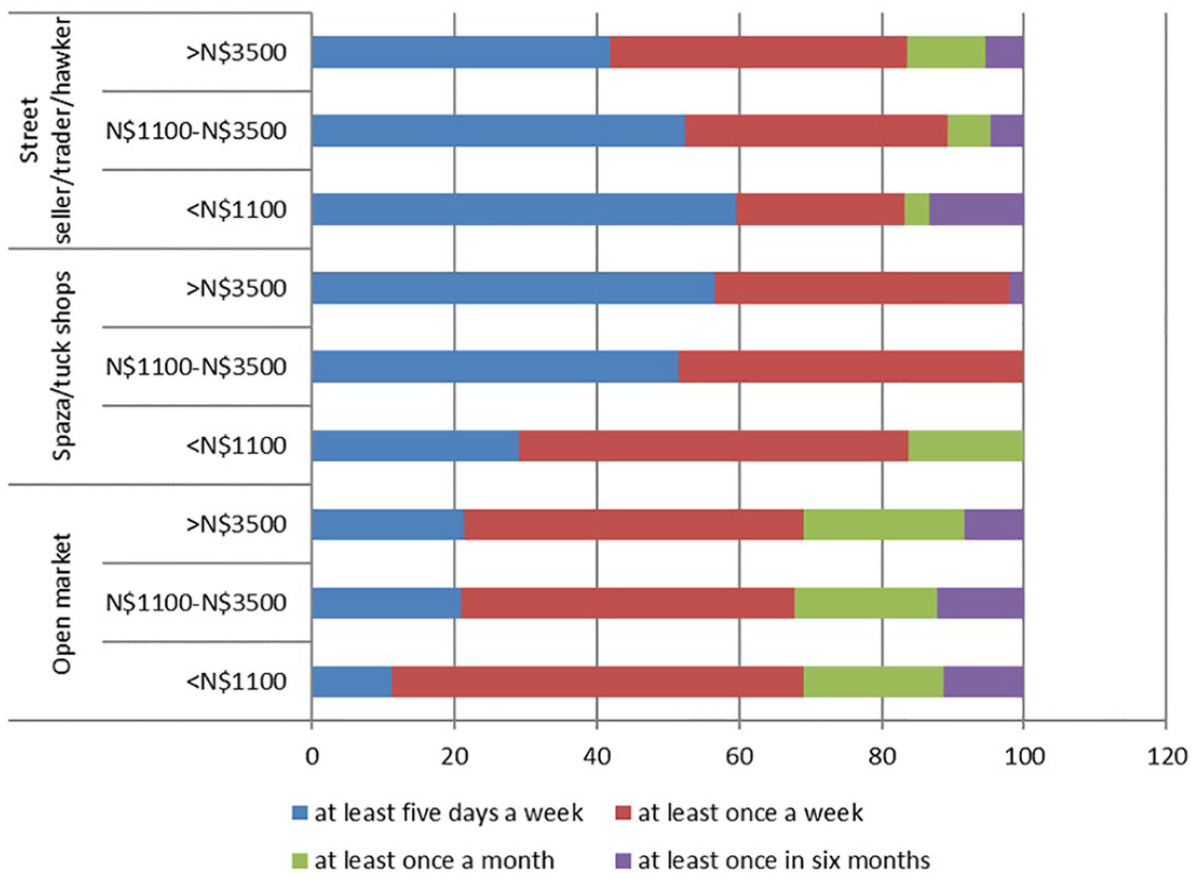
Patronage of the informal food sector by households in informal settlements
In sum, the household survey data show that the informal settlements are heavily reliant on supermarkets for the purchase of most staples, but that the informal sector is an important supplementary source of healthier foods and foods that can be bought in small quantities on a very regular basis. The eradication of informal vending, if it were possible, would create major additional hardships for households that rely on the sector for daily or weekly access to the basic components of the diet. It would also reduce the spatial and economic access to healthier foods such as vegetables, fruit, and fresh and cooked meat and fish. Another consequence of eradication would be added hardship for households that rely on informal vending for income. Politically, any attempt to eradicate informal street vending through large-scale “operations” would prompt outright opposition. This raises the question of what policies the City has actually pursued vis-à-vis informal vending, and where it is situated on the spectrum from benign neglect to active destruction.
IV. Governing Informality
The governance of the post-independence informal food sector in Windhoek was initially premised on the erasure model and embodied in the punitive 1994 Hawker and Pedlar Regulations. However, these were repealed in 1999 and replaced with new Street Trading Regulations, which legitimized street trading under certain conditions.(31) They made it illegal to trade without registering with the Town Clerk, designated various city spaces where it was illegal to trade, and established various health and sanitation provisions. Penalties for transgressing a regulation included heavy fines or up to six months in prison or both. These regulations remain in force.
The rapid growth and spatial spread of the informal food sector prompted the City to consider and then adopt an enclosure strategy by constructing a series of fixed markets (labelled “open markets” by the City) under the 1999 City of Windhoek development and upgrading strategy.(32) This strategy has subsequently been adopted in many other Namibian urban centres where informal vendors have been relocated to new open markets. The mayor of Windhoek has noted that “the open markets provide a suitable and safe trading area that can be utilized and enjoyed by the traders and the community. The City has made provision for a total of sixteen open markets and has also allocated unimproved trading sites on a temporary basis to regulate trading and maintain acceptable hygiene and safety standards.”(33) A publication by the City designed to promote their use details a number of open markets across the city (Table S1 in the online supplement).(34)
The open markets were clearly located with their target customer base in mind. As Map 1 shows, the majority of the markets are strategically located in the northern half of the city within or adjacent to the constituencies that contain informal settlements, namely Samora Machel, Tobias Hainyeko and Moses ǁGaroëb. These open markets (Photo 2) provide tenants with infrastructure such as shelter, stalls, barbecue stands, potable water, sanitation facilities and electricity, and are controlled by management boards. The boards report to the City and offer floor space to traders but without legal title. The Municipality assumes responsibility for rent collection, security, cleaning, sanitation and maintenance. Rents charged vary considerably, depending on what products are being sold (from as low as N$ 40 [US$ 2.75] to as much as N$ 400 [US$ 27.50] per month in one of the major markets).
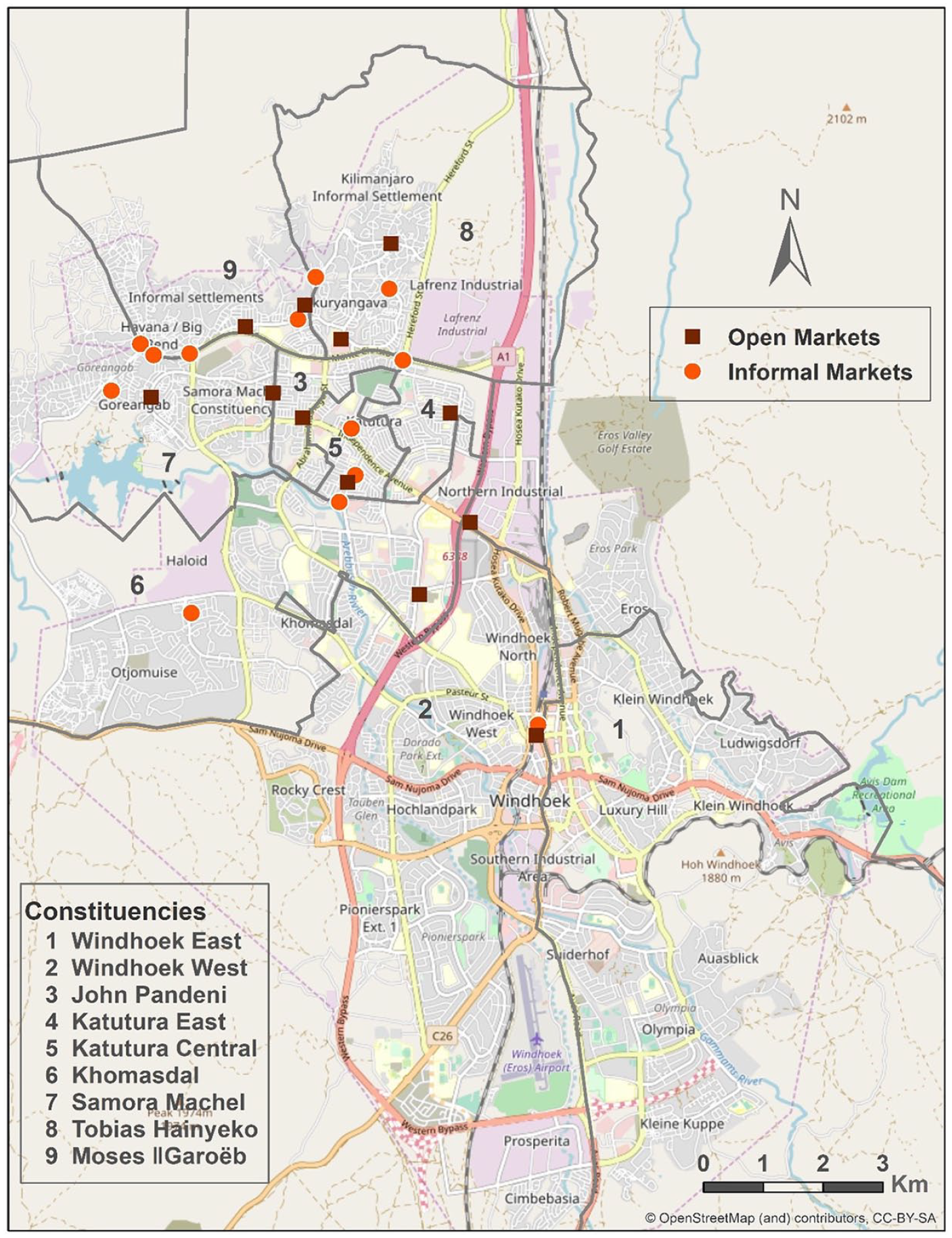
Locations of open and informal markets in Windhoek
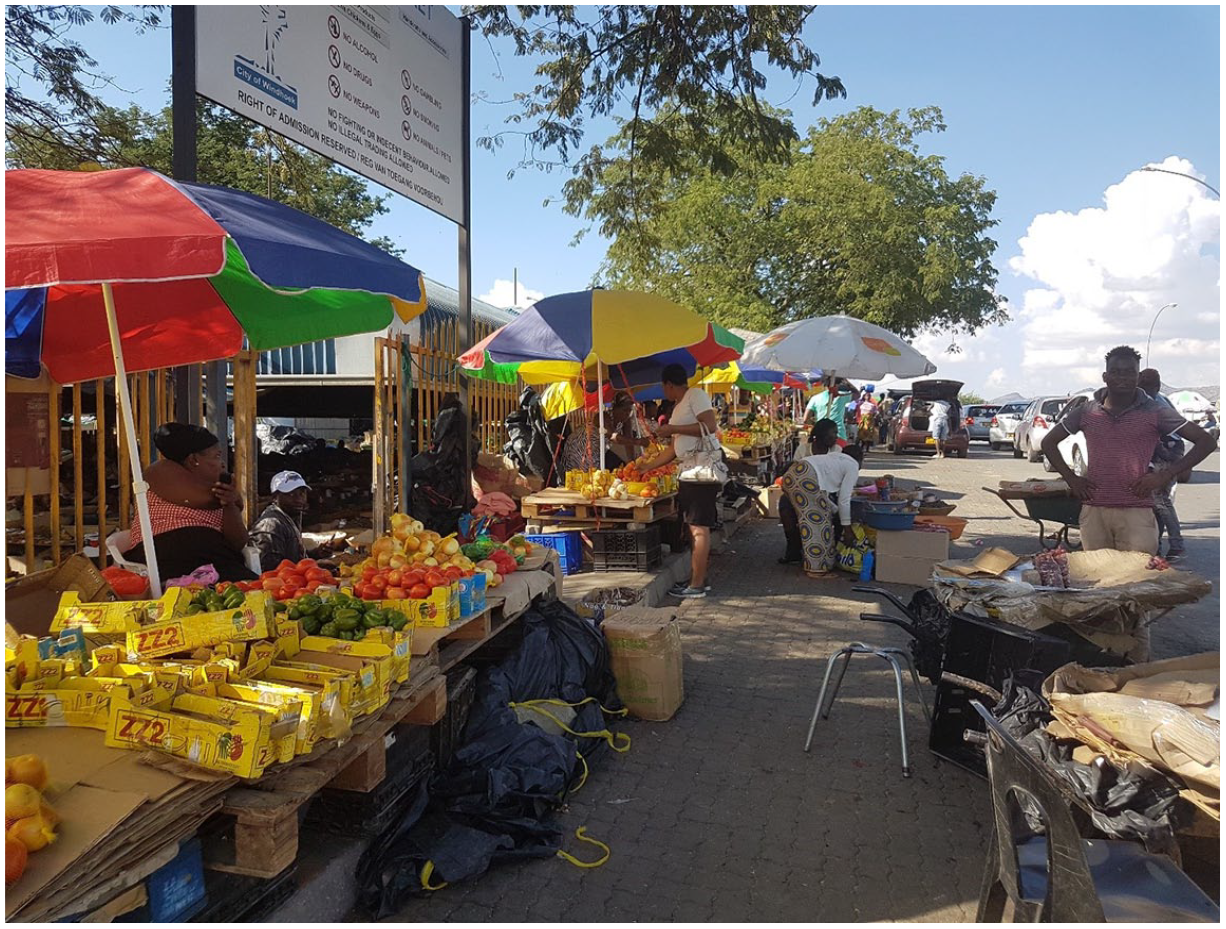
Vendors outside Tukondjeni Open Market
Table S2 in the online supplement also shows the open market preferences of survey respondents. There is considerable variation in consumer preference across the different markets and the largest markets are not necessarily the most favoured. For example, Soweto Market has a large number of stands but is only preferred by 10 per cent of open market-goers, compared to over 40 per cent for Tukondjeni Market (which is located closer to the informal settlements). However, not many stalls at Soweto Market are devoted to food sales, as it includes hair braiding, hair products, clothing, and sewing enterprises. Single Quarters Market (favoured by 25 per cent) is primarily a site for purchasing fresh and cooked meat. Although the number of informal vendors in the city far outstrips the number of spaces available, the City has had difficulty filling all of the spots. There are various reasons for this, including the high rents and the locations of some of the markets. In some parts of the city, there are customers but no markets. A recurrent challenge for market management is those vendors who locate on streets right outside the markets, where they can make use of the facilities (such as toilets and potable water) without the burden of rent. In general, despite tensions between the two groups of vendors, the City has generally adopted a laissez-faire approach to trading in the vicinity of the open markets.
The enclosure model of informal sector governance means that vendors operating outside officially sanctioned markets are vulnerable to official harassment, raids, fines, and confiscation of goods. The 1999 Street Trading Regulations provide the legal basis for sporadic police raids, arrests, and confiscation of goods from vendors and those operating in areas of the city such as the Central Business District (CBD) and outside shopping malls.(35) In 2014, for example, 18 vendors were arrested outside a mall, charged with trespass, and fined N$ 500 [US$ 47] each. Many of the vendors resisted arrest, challenging the police to shoot them, “saying they would rather die than be moved from the plot”, according to a local news account.(36) The following account of the confrontation describes the use of considerable force by the police, but also vigorous opposition: “The vendors resisted the police as the latter tried to remove them from undesignated trading spots in Ondola Street in Okuryangava. Police had to reinforce their command to disperse the charging group. No casualties were recorded but some officers were slapped by the women who numbered about 33. It is alleged that two women lost their clothing in the encounter, while the police beat them with batons. One woman was allegedly grabbed by the feet, turned upside down and given a lashing. It was a battlefield, said one of the vendors, Andreas Kangongo, adding. “We lost a lot of money that was taken from one of our members.” Kangongo said the money was a collection from the vendors and was to be used to buy sales items for the group for sharing. Eighteen of the vendors were arrested. Three of the women had their babies with them – aged three months, five months and one year and five months. The women face charges of assault and contravening municipal bylaws.”(37)
In 2017, the City police launched a “clean-up campaign” explicitly aimed at removing vendors from the streets and moving them into vacant stands in the open markets.(38) In 2018, the mayor publicly criticized street vendors not in open markets and blamed them for the city’s health problems, claiming that they were “the greatest contributors to poor hygiene as they carelessly dispose of their waste even in their trading environment”.(39) After one raid, a police spokesperson commented that “it is our job to ensure that the City looks presentable, hence we provide designated areas from where street vendors can sell from”.(40)
Efforts to vilify traders as a public health risk and enforce greater use of open markets have generally not had the desired effect. Informal vendors invariably resist removal or relocation, leading to violent clashes with police. As one vendor commented in response to the 2017 clean-up campaign: “It’s not that we do not want to go to the available open market but it’s about doing business where potential customers are. Like here at Havana Four-Way Stop, our market is those people that live at the informal settlements since they are far from the shops. So, they always buy their tomatoes and meat here and in return we make profit.”(41) Removals have also prompted organized protests from vendors, including marches and petitions to government ministers and the president. In October 2018, a group of female street vendors in the CBD held a peaceful demonstration and marched to the Ministry of Gender Equality and Child Welfare to hand over a petition addressed to President Hage Geingob.(42) The demonstrators carried signs stating “street vending is a microbusiness”, a reference to government’s official policy of support for micro, small and medium-sized enterprises. The petition requested the president to intervene in harassment and victimization by the police, and the protestors vowed that their next step would be to lobby public support and organize a mass demonstration. One protestor noted that “we are just mothers trying to earn money through non-criminal means, so that we can feed our children and send them to school”.(43)
One of the major strategies adopted by informal vendors operating outside the open markets is spatial clustering – gathering in larger groups on public land, along roadsides, at street corners, and at bus stops. This defensive strategy was partially designed to make it more difficult for the police to evict them. In turn, the City has been forced to acknowledge the presence of these clusters and to give them tacit approval, partly because removal would require considerable use of force, prompting significant resistance. The City has labelled these areas “unimproved trading sites” or “informal markets” and they are now officially recognized as legitimate sites of informality, with names based on their geographical locations. Significantly, in many of the police operations, including those detailed above, the rationale is not the elimination of trading altogether but the relocation of the vendors to municipal land designated by the City as an informal market. Additional informal markets are springing up and the City has put in place a process of legitimation, declaring that “all hawkers operating at undeveloped trading sites are advised to group themselves and to approach the City of Windhoek in obtaining permission to utilize Council’s land”.(44)
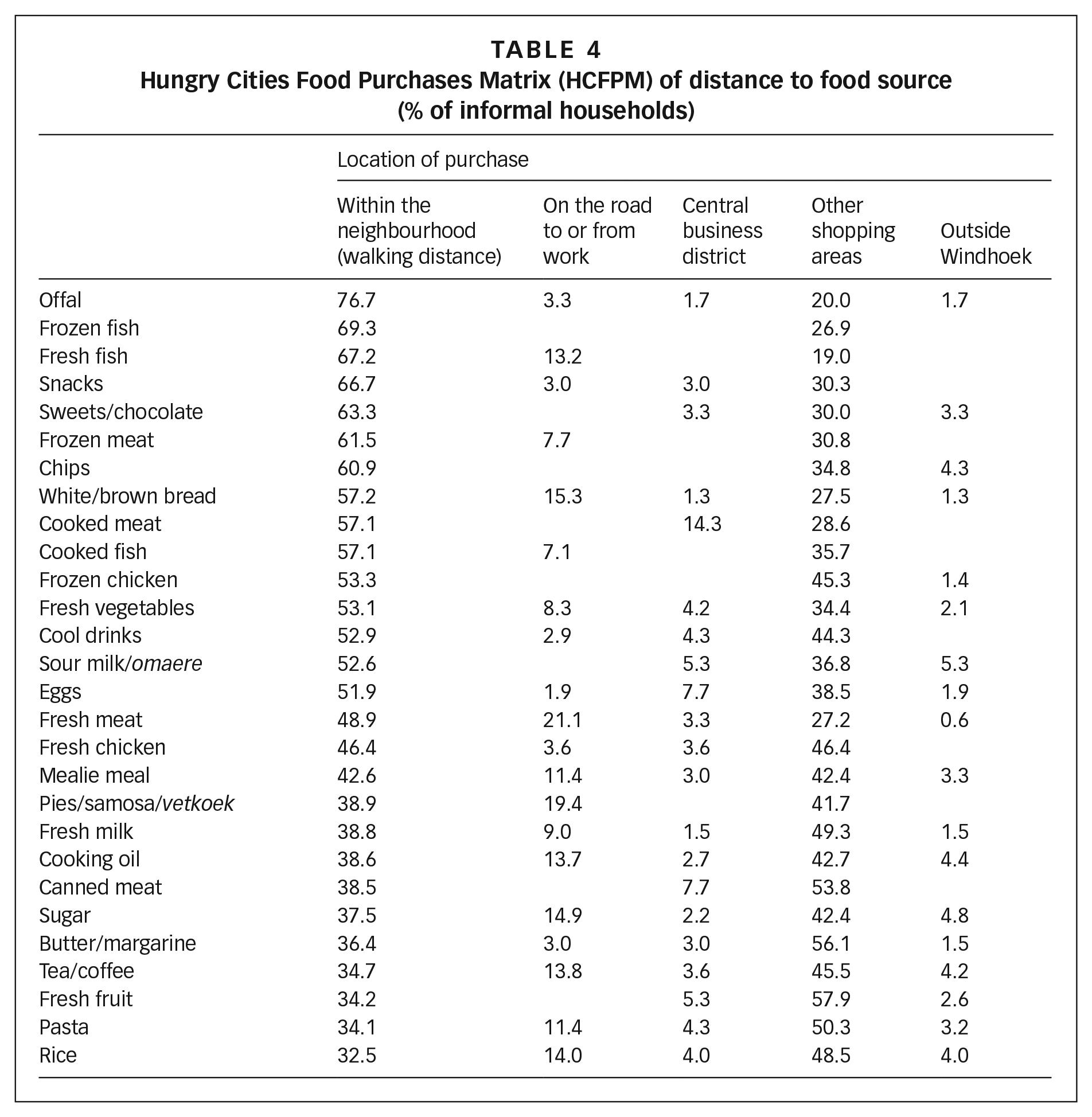
Unlike the open markets, patronage is spread amongst informal markets, with none being particularly dominant in terms of likely market share (Table S3 in the online supplement). The clustering of vendors in informal markets is not simply a strategy to avoid harassment, arrest and fines. It is also a strategic response to the needs and demands of low-income households for greater access to food. Accessibility is a key concern for food-insecure households with limited income to spend on transportation and who need to purchase small amounts of food on an almost daily basis. As Map 1 shows, informal markets are located predominantly in the north of the city within or close to informal settlements. The net result of informalized containment and the penetration of supermarkets into the area is that the bulk of regular food shopping does not require costly transportation. Table 4 shows that over a third of the households purchase almost all food items at locations within walking distance. In the case of items that are purchased with greater frequency, the preferred location for purchase is close by. In the case of foods that are purchased on a monthly basis, it is clear that more households are willing to travel greater distances to supermarkets in other parts of the city. Very little food shopping occurs in the CBD, outside the city or on the way to work. Informal markets (Photo 3) clearly play a role in making certain types of food more accessible.
Hungry Cities Food Purchases Matrix (HCFPM) of distance to food source (% of informal households)
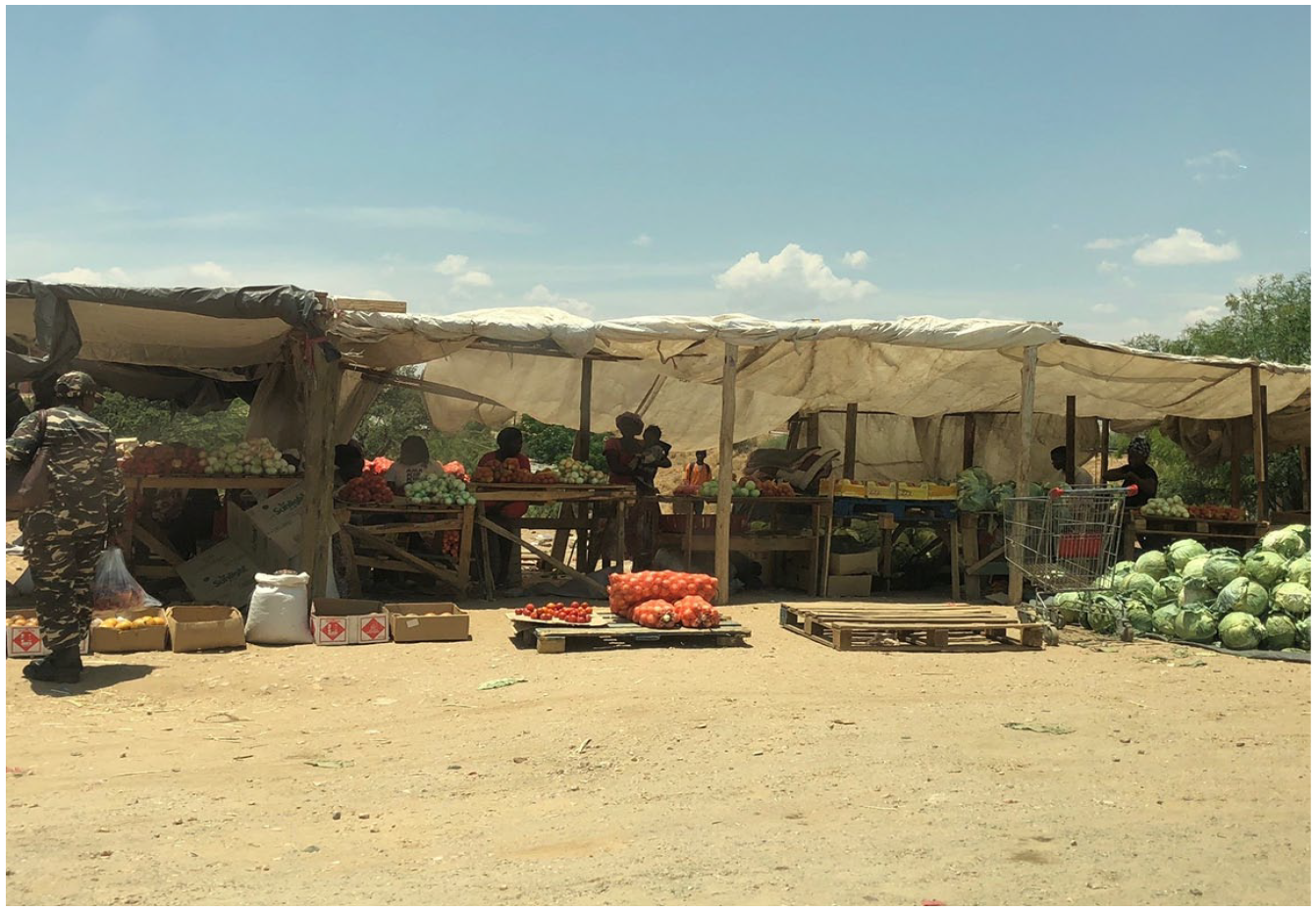
Informal market in Windhoek
V. Conclusions
Rapid urbanization, the growth of informal settlements, and high rates of unemployment have led to an increase in the size and importance of the informal food sector in Windhoek in the last 20 years. Although the city has undergone a supermarket revolution and the foodscape is dominated by South African supermarkets, the informal food sector plays an important role in making healthier food continuously available and affordable to the urban poor. As a result, the City has not pursued the kind of large-scale eradication “operations” seen in other Southern African cities in the recent past. Eradication would always have been politically untenable in a country that recently emerged from decades of oppressive South African rule. Instead, the City sought to respond to the spread of informal food vending through an alternative policy of containment and enclosure. This involved the construction of new market infrastructure at various strategic locations across the city where, in the words of the mayor quoted earlier, “suitable and safe trading” could be “enjoyed by the traders and the community”.(45) The corollary to the projected enclosure of informal traders in open markets was containment of the spread of street vending to other parts of the city.
The city’s open markets have come to play an important role in the urban food system, particularly for the marketing of fresher and cooked offerings to low-income households in the informal settlements. Their role tends to be one of mitigating food insecurity rather than eliminating it, since many households that buy from the markets remain food insecure in terms of both the amount and diversity of their food. At the same time, the construction of open markets has not led to a notable decline in street vending outside the markets. On the contrary, the number of street vendors and the places in the city where they sell has continued to climb. The initial response of the City was to enforce its 1999 trading regulations to try and contain the spread of street vending and ensure maximum usage of the open markets. Sporadic raids and arrests continue to the present, particularly in areas such as the CBD, causing disruption to the traders and prompting open defiance. The threat of random enforcement prompted street traders to adopt the strategy of clustering, documented in this paper. Clustering is an effective defensive strategy which makes it much more difficult for the authorities to remove them. However, it has led to a pragmatic policy shift in which clusters of street vendors have been recognized and given legitimacy by the City.
These “informal markets” or “unimproved trading sites” (in official parlance) lack the services and management structures of the open markets, but they clearly respond to a consumer need and are strategically located in relation to both the informal settlements and transportation hubs. As this paper shows, street vendors (including those in the informal markets) are also an accessible source of daily food for low-income households in the city’s informal settlements. In terms of the literature on the governance of the informal food sector, the Windhoek case clearly illustrates that coordination by informal vendors, in this case taking the form of clustering in informal markets, has the potential to disrupt the enclose-and-contain model of governance. These vendors have therefore helped give effect to an alternative model of governance, what we call informalized containment, by forcing an acknowledgement of their right to operate in city spaces that lie outside those formally designated as legitimate areas for trade.
Skinner argues that in many African cities informal food vendors face a hostile legislative environment, and that exclusionary practices, ranging from large-scale violent evictions to low-level harassment, are commonplace in the policy and regulatory environment for public space trading in African cities.(46) The governance model of informalized containment in the face of rapid urbanization, high unemployment, and growing food insecurity in informal settlements can be seen as a more pragmatic policy response to the realities of the contemporary African city. While the Namibian government has attempted to implement an enclosure strategy, it has also been forced to acknowledge the importance of the informal food sector to the urban food system, to livelihoods in informal settlements, and to mitigation of food insecurity. While this paper presents evidence that informal vendor agency and consumer demand have played a key role in this process, research currently in progress with street food vendors will explore the finer details of this process. This case study also suggests that there is room for more comparative research on how vendor agency and consumer demand might be reshaping the policy environment in other African cities.
Supplemental Material
867091_supp_mat – Supplemental material for Informalized containment: food markets and the governance of the informal food sector in Windhoek, Namibia
Supplemental material, 867091_supp_mat for Informalized containment: food markets and the governance of the informal food sector in Windhoek, Namibia by Lawrence N Kazembe, Ndeyapo Nickanor and Jonathan Crush in Environment & Urbanization
Footnotes
Funding
The authors wish to acknowledge the financial support of the following: Open Society Foundation South Africa; the Social Sciences and Humanities Research Council (SSHRC) and the International Development Research Centre (IDRC) under the International Partnerships for Sustainable Societies (IPaSS) programme; and the Queen Elizabeth Diamond Jubilee Advanced Scholars Program (QES-AS).
Supplemental Material
Supplemental material for this article is available online.
1.
Crush, Jonathan and Jane Battersby (editors) (2016), Rapid Urbanisation, Urban Food Deserts and Food Security in African Cities, Springer, Dordrecht, 190 pages; also Tacoli, Cecilia (2017), “Food (in)security in rapidly urbanising, low-income contexts”, International Journal of Environmental Research and Public Health Vol 14, No 12, Article 1554; and Skinner, Caroline (2019), “Contributing yet excluded? Informal food retail in African cities”, in Jane Battersby and Vanessa Watson (editors), Urban Food Systems Governance and Poverty in African Cities, Earthscan for Routledge, London, pages 104–115.
2.
Crush, Jonathan, Caroline Skinner and Manal Stalguitis (2017), “Benign neglect or active destruction? A critical analysis of refugee and informal sector policy and practice in South Africa”, African Human Mobility Review Vol 3, pages 751–782; also Young, Graeme (2017), “From protection to repression: the politics of street vending in Kampala”, Journal of Eastern African Studies Vol 11, pages 714–733.
3.
Potts, Deborah (2006), “‘Restoring order’? Operation Murambatsvina and the urban crisis in Zimbabwe”, Journal of Southern African Studies Vol 32, No 2, pages 273–291.
4.
Bénit-Gbaffou, Claire (2016), “Do street traders have a ‘right to the city’? The politics of street trader organisations in inner city Johannesburg, post-Operation Clean Sweep”, Third World Quarterly Vol 37, No 6, pages 1102–1129.
5.
Riley, Liam (2014), “Operation Dongosolo and the geographies of urban poverty in Malawi”, Journal of Southern African Studies Vol 40, No 3, pages 443–458; also Tonda, Nanase and Thembela Kepe (2016), “Spaces of contention: tension around street vendors’ struggle for livelihoods and spatial justice in Lilongwe, Malawi”, Urban Forum Vol 27, No 3, pages 297–309.
6.
Finn, Brandon (2018), “Quietly chasing Kigali: young men and the intolerance of informality in Rwanda’s capital city”, Urban Forum Vol 29, pages 205–218; also Morange, Marianne (2015), “Street trade, neoliberalisation and the control of space: Nairobi’s central business district in the era of entrepreneurial urbanism”, Journal of Eastern African Studies Vol 9, No 2, pages 247–269; Rogerson, Christian (2016), “Responding to informality in urban Africa: street trading in Harare, Zimbabwe”, Urban Forum Vol 27, No 2, pages 229–251; and Kamete, Amin (2013), “Missing the point? Urban planning and the normalisation of ‘pathological’ spaces in southern Africa“, Transactions of the Institute of British Geographers Vol 38, No 4, pages 639–651.
7.
Young, Graeme and Jonathan Crush (2019), “The governance of the informal food sector in the Global South”, Hungry Cities Partnership Series, Working Paper 30, HCP, Cape Town and Waterloo, page 15.
8.
Brown, Alison, Colman Msoka and Ibrahima Dankoco (2015), “A refugee in my own country: evictions or property rights in the urban informal economy?”, Urban Studies Vol 52, No 12, pages 2234–2249; also Moyo, Inocent (2018), “Resistance and resilience by informal traders in Bulawayo, Zimbabwe: beyond weapons of the weak”, Urban Forum Vol 29, No 3, pages 299–313; Musoni, Francis (2010), “Operation Murambatsvina and the politics of street vendors in Zimbabwe“, Journal of Southern African Studies Vol 36, No 2, pages 301–317; Steel, William, Torbi Ujoranyi and George Owusu (2014), “Why evictions do not deter street traders: case study in Accra, Ghana”, Ghana Social Science Journal Vol 11, No 2, pages 52–76; and Omogeun, Ademola, Peter Mackie and Alison Brown (2019), “The aftermath of eviction in the Nigerian informal economy”, International Development Planning Review Vol 41, No 1, pages 107–128.
9.
Dragsted-Mutengwa, Brigitte (2018), “Street traders and ‘good officers’: crackdowns as a relational form of urban governance in Nairobi”, Journal of Urban Research Vols 17–18.
10.
Resnick, Danielle (2017), “Governance: informal food markets in Africa’s cities”, in 2017 Global Food Policy Report, International Food Policy Research Institute, Washington, DC, pages 50–57.
11.
Lindell, Ilda, Christine Ampaire and Andrew Byerley (2019), “Governing urban informality: re-working spaces and subjects in Kampala, Uganda“, International Development Planning Review Vol 41, No 1, pages 63–84.
12.
Kamete, Amin (2017), “Governing enclaves of informality: unscrambling the logic of the camp in urban Zimbabwe“, Geoforum Vol 81, pages 76–86.
13.
Dewar, David and Vanessa Watson (1990), Urban Markets: Developing Informal Retailing, Routledge, London, 170 pages.
14.
Kamete, Amin (2018), “Pernicious assimilation: reframing the integration of the urban informal economy in Southern Africa“, Urban Geography Vol 39, No 2, pages 167–189; also Pezzano, Antonio (2016), “‘Integration’ or ‘selective incorporation’? The modes of governance in informal trading policy in the inner city of Johannesburg”, Journal of Development Studies Vol 52, No 4, pages 498–513.
16.
Crush, Jonathan and Bruce Frayne (2011), “Supermarket expansion and the informal food economy in Southern African cities: implications for urban food security”, Journal of Southern African Studies Vol 37, pages 781–807.
17.
See reference 10, page 53.
18.
Weber, Beat and John Mendelsohn (2017), “Informal settlements in Namibia: their nature and growth”, Occasional Paper 1, Development Workshop Namibia, Windhoek, 99 pages.
19.
Coates, Jennifer (2013), “Build it back better: deconstructing food security for improved measurement and action”, Global Food Security Vol 2, pages 188–194.
20.
Coates, Jennifer, Anne Swindale and Paula Bilinsky (2007), Household Food Insecurity Access Scale (HFIAS) for Measurement of Food Access: Indicator Guide (Version 3), Food and Nutrition Technical Assistance (FANTA) Project, Washington, DC.
21.
Swindale, Anne and Paula Bilinsky (2006), Household Dietary Diversity Score (HDDS) for Measurement of Household Food Access: Indicator Guide (Version 2), Food and Nutrition Technical Assistance (FANTA) Project, Washington, DC.
22.
Crush, Jonathan and Cameron McCordic (2017), “The Hungry Cities Food Purchases Matrix: household food sourcing and food system interaction“, Urban Forum Vol 28, pages 421–433.
23.
Nickanor, Ndeyapo (2013), “Food deserts and household food insecurity in the informal settlements of Windhoek, Namibia”, PhD thesis, University of Cape Town, Cape Town.
24.
See reference 18.
25.
See reference 23.
26.
Norval, Dixon and Rosy Namoya (1992), The Informal Sector within Greater Windhoek, First National Development Corporation, Windhoek, 145 pages.
27.
Frayne, Bruce (2001), “Survival of the poorest: food security and migration in Namibia”, PhD thesis, Queen’s University, Kingston.
28.
Pendleton, Wade, Ndeyapo Nickanor and Akiser Pomuti (2012), “The state of food insecurity in Windhoek, Namibia”, Urban Food Security Series No 14, African Food Security Urban Network (AFSUN), Cape Town, 32 pages.
29.
Nickanor, Ndeyapo, Lawrence Kazembe, Jonathan Crush and Jeremy Wagner (2017), “The supermarket revolution and food security in Namibia”, Urban Food Security Series No 26, AFSUN, Cape Town, 87 pages.
30.
Crush, Jonathan, Ndeyapo Nickanor and Lawrence Kazembe (2019), “Informal food deserts and household food insecurity in Windhoek, Namibia”, Sustainability Vol 11, No 1, Article 37.
31.
32.
See reference 28.
33.
Namibia Economist (2014), “Windhoek Council on forced removal”, 7 March, accessed 15 January 2019 at  .
.
35.
Government of Namibia (1999), General Notice No 252: Municipality of Windhoek: Street Trading Regulations, accessed 15 January 2019 at .
36.
Tjihenuna, Theresia (2014), “Vendors arrested”, The Namibian, 18 June, accessed 15 January 2019 at .
37.
Rhodes, Fifi (2014), “City Police, vendors clash in Katutura”, New Era, 18 June, accessed 10 February 2019 at .
38.
Nashuuta, Lahja (2018), “City Police declare war on illegal vendors”, New Era, 12 January, accessed 15 January 2019 at .
39.
Kapitako, Alvine (2018), “Windhoek Mayor blames street vendors for city’s health risks”, New Era, 19 February, accessed 15 January 2019 at .
40.
Nuukala, Emmency (2018), “Female CBD vendors claim victimisation by City Police”, New Era, 22 October 2018, accessed 15 January 2019 at .
41.
See reference 38.
42.
See reference 40.
43.
See reference 40.
44.
See reference 34.
45.
See reference 33.
References
Supplementary Material
Please find the following supplemental material available below.
For Open Access articles published under a Creative Commons License, all supplemental material carries the same license as the article it is associated with.
For non-Open Access articles published, all supplemental material carries a non-exclusive license, and permission requests for re-use of supplemental material or any part of supplemental material shall be sent directly to the copyright owner as specified in the copyright notice associated with the article.
