




Abstract
Background
Qijiao Shengbai Capsule is a traditional multi-herb formulation composed of natural products including Jujube (Ziziphus jujuba), Donkey-hide gelatin (Colla corii asini), Pseudostellaria heterophylla, Epimedium brevicornum, Sophora flavescens, Astragalus membranaceus, and Angelica sinensis. These botanical and animal-derived ingredients are traditionally used to tonify Qi and blood, enhance immunity, and promote hematopoiesis.
Purpose
This study aimed to evaluate the therapeutic efficacy and immunomodulatory effects of Qijiao Shengbai Capsule in combination with recombinant human granulocyte colony-stimulating factor (rhG-CSF) for the treatment of chemotherapy-induced leukopenia in patients with hematologic malignancies.
Materials and Methods
A total of 90 patients with post-chemotherapy leukopenia were randomly assigned to receive either rhG-CSF alone or rhG-CSF combined with Qijiao Shengbai Capsule for 5 days. Key outcome measures included hematologic parameters, inflammatory cytokines (tumor necrosis factor alpha (TNF-α), interleukin (IL)-6, high-sensitivity C-reactive protein (hs-CRP)), immune function markers (CD3⁺, CD4⁺, NK cells), and adverse events.
Results
The observation group demonstrated a significantly higher total effectiveness rate (93.33% vs. 75.56%, p < .001). Compared with rhG-CSF alone, the addition of Qijiao Shengbai Capsule significantly increased leukocyte, platelet, and hemoglobin levels, enhanced immune cell populations, and reduced pro-inflammatory cytokines (p < .01 for all). Adverse reaction rates were low and comparable between groups.
Conclusion
Qijiao Shengbai Capsule, composed of bioactive natural ingredients, exhibits potent hematopoietic and immunomodulatory properties when combined with rhG-CSF over a 5-day treatment course, presenting a promising adjunctive treatment option for chemotherapy-induced leukopenia. These findings support the clinical and pharmacognostic relevance of this traditional herbal formulation in oncology care.
Keywords
Introduction
Leukopenia is one of the most common adverse reactions following chemotherapy and radiotherapy. It significantly compromises treatment efficacy and poses additional health risks; severe cases can be life-threatening (Blayney & Schwartzberg, 2022). Effective management of chemotherapy-induced leukopenia is critical for improving therapeutic outcomes and extending survival in cancer patients. Current Western medical approaches primarily use recombinant human granulocyte colony-stimulating factor (rhG-CSF). However, clinical evidence shows significant variability in individual responses to monotherapy, which limits its overall efficacy (Ahn et al., 2024).
In traditional Chinese medicine (TCM), post-chemotherapy leukopenia falls under the categories of “blood deficiency” and “consumptive disease” (Yang et al., 2021). TCM theory holds that chemotherapy, as a pathogen-eliminating treatment, frequently leads to systemic deficiencies, including Qi deficiency, kidney deficiency, blood deficiency, and spleen deficiency. Accordingly, TCM treatment principles focus on tonifying Qi, nourishing blood, strengthening the spleen, and replenishing kidney essence (Wang et al., 2021; Zhang et al., 2018).
Qijiao Shengbai Capsule is a classical herbal formula composed of natural ingredients, including Donkey-hide gelatin, Pseudostellaria heterophylla, Epimedium brevicornum, Sophora flavescens, Astragalus membranaceus, Angelica sinensis, and Jujube (Ziziphus jujuba) (Cao et al., 2023; Wang et al., 2022; Supplementary Table 1). These components are widely used in TCM for their hematopoietic, immunomodulatory, and anti-inflammatory properties. For example, Astragalus and ginseng (often used interchangeably or in conjunction with Pseudostellaria) stimulate macrophage activity and lymphocyte transformation. Angelica and Donkey-hide gelatin help nourish blood and promote marrow function, while Epimedium and Sophora have demonstrated immunostimulatory and anti-inflammatory effects in modern pharmacological studies (Jiang et al., 2024; Ma et al., 2024).
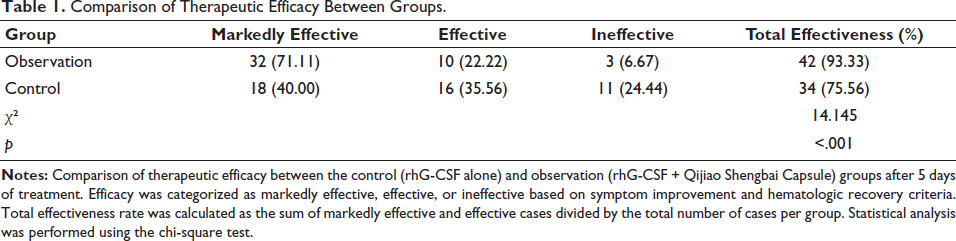
Comparison of Therapeutic Efficacy Between Groups.
Although previous studies have confirmed the hematopoietic effects of Qijiao Shengbai Capsule, its influence on immune function and inflammatory regulation, particularly in clinical settings, remains underexplored (Hu et al., 2025). There is a notable lack of robust clinical evidence regarding its immunomodulatory mechanisms and overall impact on systemic immunity in cancer patients with leukopenia. To address this gap, we conducted a randomized controlled trial (RCT) involving 90 patients with hematologic malignancies treated at our hospital between July 2021 and June 2022. This study aimed to evaluate the clinical benefits of combining Qijiao Shengbai Capsule with conventional rhG-CSF therapy, with emphasis on immune modulation, inflammatory suppression, and overall treatment outcomes in patients with chemotherapy-induced leukopenia.
Materials and Methods
Diagnostic Criteria
Western Medicine Criteria
Patients met the clinical diagnostic standards for drug-induced leukopenia, defined as a peripheral white blood cell (WBC) count below 4.0 × 10⁹/L after chemotherapy (Baradaran et al., 2022).
TCM Criteria
Diagnosis of “Qi and Blood Deficiency Syndrome” was based on TCM principles concerning leukopenia pathogenesis. Primary symptoms included shortness of breath, fatigue, and reluctance to speak. Secondary symptoms encompassed a sallow complexion, palpitations, insomnia, dizziness, blurred vision, aversion to wind, and spontaneous sweating. Tongue and pulse findings included a pale, tender tongue with thin white coating and a weak, thready pulse. Diagnosis required ≥2 primary symptoms, ≥1 secondary symptom, and relevant tongue and pulse signs.
Inclusion and Exclusion Criteria
Inclusion Criteria
Patients were eligible if they (a) had pathologically, cytologically, or radiographically confirmed hematologic malignancies; (b) had undergone at least one cycle of chemotherapy; (c) had pre-chemotherapy WBC ≥ 4.0 × 10⁹/L; (d) were mentally competent and compliant; and (e) provided informed consent and complete clinical data.
Exclusion Criteria
Patients were excluded if they (a) had known allergies to study drugs; (b) had aplastic anemia or serious infections; (c) had autoimmune or psychiatric disorders; or (d) withdrew prematurely from the study.
General Information
A total of 90 patients with hematologic malignancies and chemotherapy-induced leukopenia were enrolled at our hospital between July 2021 and June 2022. Using computer-generated randomization, participants were assigned to either the observation group (n = 45) or the control group (n = 45). Baseline demographic and clinical data, including sex, age, cancer type, and chemotherapy duration, were balanced between groups (p > .05), ensuring comparability.
Intervention Protocols
The control group received rhG-CSF (Hangzhou Jiuyuan Gene Engineering Co., Ltd.; approval no. S20013036) via subcutaneous injection at 150 µg/day, initiated within 24 h of WBC < 4.0 × 10⁹/L. For patients with WBC < 1.0 × 10⁹/L, the dosage was increased to 300 µg/day intramuscularly for 5 consecutive days, adjusted based on chemotherapy regimen intensity and neutrophil nadir. Antibiotics were administered prophylactically if necessary.
The observation group received the same rhG-CSF regimen plus Qijiao Shengbai Capsule (Guizhou Hanfang Pharmaceutical Co., Ltd.; approval no. Z20025027), administered orally at four capsules per dose, three times daily for 5 days. Each capsule contains standardized natural ingredients, including Donkey-hide gelatin (150 mg), P. heterophylla (80 mg), Epimedium (100 mg), S. flavescens (50 mg), Astragalus (200 mg), A. sinensis (100 mg), and Jujube (80 mg). The capsule composition is based on classical herbal theory and supported by recent pharmacological research.
Outcome Evaluation
Clinical Efficacy
Response to treatment was classified into three categories:
Markedly effective: Disappearance of symptoms with WBC > 3.5 × 10⁹/L and neutrophil count >1.5 × 10⁹/L.
Effective: Symptom improvement with WBC > 3.0 × 10⁹/L and neutrophils >1.5 × 10⁹/L.
Ineffective: No significant improvement or further deterioration.
Total effectiveness = (markedly effective + effective)/total cases × 100%.
Hematologic Parameters
Peripheral blood counts, including WBC, platelets, and hemoglobin, were assessed using an automatic hematology analyzer before and after treatment.
Inflammatory Markers
Levels of tumor necrosis factor alpha (TNF-α), high-sensitivity C-reactive protein (hs-CRP), and interleukin-6 (IL-6) were measured using enzyme-linked immunosorbent assay (ELISA) on fasting venous blood samples collected pre- and post-treatment.
Immune Function Indicators
Flow cytometry was used to evaluate T lymphocyte subsets (CD3⁺, CD4⁺) and natural killer (NK) cell proportions.
Adverse Events
The incidence and type of adverse reactions, including dizziness, gastrointestinal discomfort, and changes in renal function, were documented and compared between groups.
Statistical Analysis
All statistical analyses were conducted using Statistical Package for the Social Sciences (SPSS) 25.0 software (IBM, Armonk, NY, USA). Continuous variables were expressed as mean ± standard deviation (SD) and compared using independent sample t-tests. Categorical data were analyzed using chi-square tests. A two-tailed p value <.05 was considered statistically significant.
Results
Comparison of Total Therapeutic Efficacy
Following 5 days of treatment, the observation group (Qijiao Shengbai Capsule + rhG-CSF) exhibited a significantly higher overall response rate compared to the control group receiving rhG-CSF alone. Specifically, 93.33% (42/45) of patients in the observation group achieved a marked or partial response, compared to 75.56% (34/45) in the control group (χ² = 14.145, p < .001). The data are summarized in Table 1.
Comparison of Hematologic Parameters
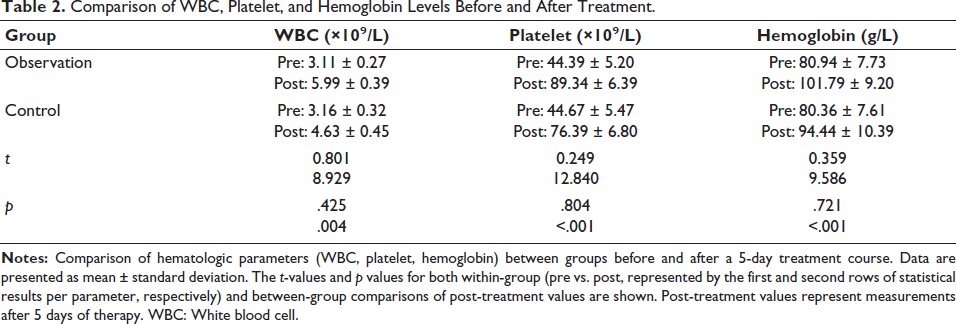
Baseline levels of WBCs, platelets, and hemoglobin were comparable between the two groups (p < .05). After treatment, all three hematologic indicators significantly improved in both groups, with the observation group showing superior recovery. In particular, the observation group had significantly higher post-treatment WBC counts (5.99 ± 0.39 vs. 4.63 ± 0.45 × 10⁹/L), platelet levels (89.34 ± 6.39 vs. 76.39 ± 6.80 × 10⁹/L), and hemoglobin concentrations (101.79 ± 9.20 vs. 94.44 ± 10.39 g/L) compared to controls (all p < .01). These findings suggest that the multi-herb formulation significantly enhanced hematopoietic recovery (Table 2).
Comparison of WBC, Platelet, and Hemoglobin Levels Before and After Treatment.
Comparison of Inflammatory Markers
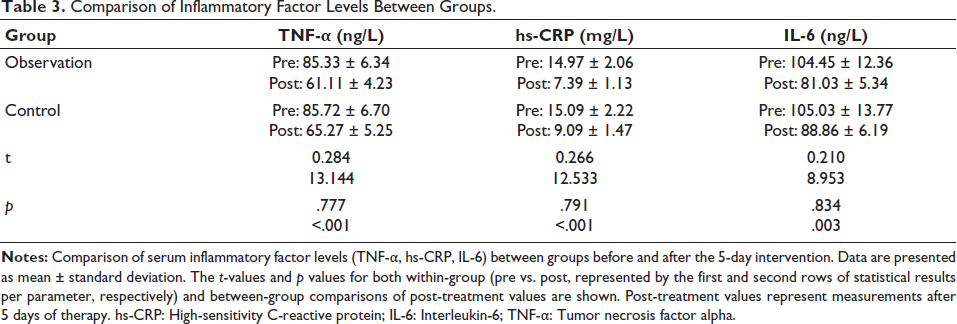
Pre-treatment serum levels of pro-inflammatory cytokines—including TNF-α, hs-CRP, and IL-6—showed no significant differences between groups (p > .05). Post-treatment, patients in the observation group exhibited markedly reduced concentrations of TNF-α (61.11 ± 4.23 vs. 65.27 ± 5.25 ng/L), hs-CRP (7.39 ± 1.13 vs. 9.09 ± 1.47 mg/L), and IL-6 (81.03 ± 5.34 vs. 88.86 ± 6.19 ng/L) compared to the control group (all p < .01). These results indicate that the botanical components in Qijiao Shengbai Capsule possess anti-inflammatory properties that may mitigate chemotherapy-induced systemic inflammation (Table 3).
Comparison of Inflammatory Factor Levels Between Groups.
Comparison of Immune Function Indicators
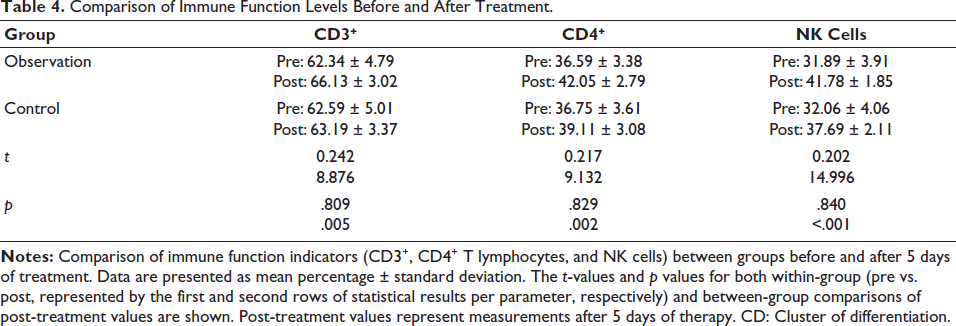
No significant differences were found in baseline immune cell levels between groups (p > .05). After treatment, the observation group demonstrated significantly greater increases in CD3⁺ T lymphocytes (66.13% ± 3.02% vs. 63.19% ± 3.37%), CD4⁺ T lymphocytes (42.05% ± 2.79% vs. 39.11% ± 3.08%), and NK cells (41.78% ± 1.85% vs. 37.69% ± 2.11%) compared to the control group (all p < .01). These findings underscore the immunomodulatory potential of the natural ingredients within the herbal formula (Table 4).
Comparison of Immune Function Levels Before and After Treatment.
Comparison of Adverse Events
Adverse reactions were mild and comparable between the two groups. In the observation group, five patients (11.11%) experienced mild side effects such as dizziness, limb weakness, or palpitations. In the control group, four patients (8.89%) reported similar symptoms, including mild gastrointestinal discomfort and transient elevation of the renal index. The difference in incidence was not statistically significant (χ² = 0.124, p = .725), confirming the good safety profile of Qijiao Shengbai Capsule when used in conjunction with rhG-CSF.
Discussion
Chemotherapy- and radiotherapy-induced leukopenia remains a significant clinical challenge, as it can severely compromise immune function, increase infection risk, and limit the intensity or continuation of anti-tumor therapy. While rhG-CSF has become a mainstay in the management of leukopenia, the therapeutic response varies considerably among individuals, and its long-term use may present tolerability issues (Cheng et al., 2021; Xiao et al., 2021). Therefore, adjunctive strategies—particularly those based on natural products with hematopoietic and immunomodulatory activity—are of growing interest in integrative oncology.
From the perspective of TCM, leukopenia is considered a manifestation of “blood deficiency” and “consumptive disease” due to the depletion of vital Qi and bone marrow essence by cytotoxic therapies. Therapeutic principles in TCM emphasize tonifying Qi, nourishing blood, and restoring organ balance to support hematopoiesis and immunity (Li et al., 2018).
Qijiao Shengbai Capsule, a compound formula of botanical and animal-derived ingredients, embodies this philosophy. Its core components include A. membranaceus, A. sinensis, Donkey-hide gelatin (Colla corii asini), E. brevicornum, S. flavescens, and Jujube, each with proven or emerging pharmacological activities. Studies have shown that Astragalus polysaccharides and flavonoids can stimulate macrophage phagocytosis, enhance lymphocyte proliferation, and promote hematopoietic recovery (Gong et al., 2023; Song et al., 2024). A. sinensis and Donkey-hide gelatin are traditionally used to enrich blood and have been shown to stimulate erythropoietin expression, thereby improving marrow microenvironments (Tran et al., 2024). Furthermore, recent multi-omics and experimental studies on this specific formulation have identified key bioactive compounds (e.g., genistein, quercetin, caffeic acid) derived from its herbal ingredients and elucidated a pivotal mechanism of action. These compounds are shown to synergistically regulate the PI3K-AKT signaling pathway and its downstream targets (mTOR, FoxO3a), which are central to promoting cell survival, proliferation, and hematopoiesis, thereby providing a mechanistic foundation for the enhanced efficacy observed when combined with rhG-CSF (Hu et al., 2025).
Epimedium, a kidney-tonifying herb, contains icariin and related flavonoids that activate hematopoietic stem cells and modulate T lymphocyte function. S. flavescens exhibits notable anti-inflammatory and immunoregulatory effects, attributed to alkaloids such as matrine (Li et al., 2021). Together, these components likely exert a synergistic effect in enhancing immune recovery and mitigating inflammatory responses following chemotherapy. Moreover, metabolomics and multi-omics studies have recently elucidated the mechanisms by which Qijiao Shengbai Capsule regulates leukocyte production and apoptosis-related pathways (Cao et al., 2023; Jiang et al., 2024; Ma et al., 2024; Wang et al., 2022).
Our clinical findings support this pharmacological rationale. The combination of Qijiao Shengbai Capsule and rhG-CSF significantly improved WBC, platelet, and hemoglobin levels compared to rhG-CSF alone. Additionally, immune parameters, including CD3⁺, CD4⁺, and NK cell percentages, were markedly elevated in the combination group. Simultaneously, inflammatory markers such as TNF-α, hs-CRP, and IL-6 were significantly reduced, suggesting that the herbal formulation not only promotes hematopoiesis but also regulates systemic immune and inflammatory responses.
Importantly, no increase in adverse events was observed in the observation group, reaffirming the safety and tolerability of Qijiao Shengbai Capsule. Its use of standardized natural ingredients minimizes the risk of accumulation toxicity and makes it suitable for integration into supportive cancer care protocols, especially in immunocompromised populations.
Nonetheless, this study has certain limitations. First, the sample size was relatively small and the study was conducted at a single center, which may affect the generalizability of the findings. Second, a long-term follow-up to assess the durability of the therapeutic effects was not performed. Furthermore, mechanistic investigations-such as in-depth cytokine profiling, metabolomics, or immune transcriptome analysis-were not conducted to elucidate the underlying pathways. Therefore, future multicenter, double-blind, large-scale studies with extended follow-up endpoints are warranted to validate these clinical findings. Further research is also needed to explore the specific bioactive constituents and molecular targets of the formulation (Xiping et al., 2017).
Conclusion
The present study demonstrates that Qijiao Shengbai Capsule, a multi-herbal formulation composed of pharmacologically active natural products, significantly enhances the therapeutic efficacy of rhG-CSF in patients with chemotherapy-induced leukopenia. The combined treatment not only improved hematologic indices (WBC, platelets, hemoglobin) but also elevated immune cell levels (CD3⁺, CD4⁺, NK cells) and reduced systemic inflammation (TNF-α, hs-CRP, IL-6). Importantly, this clinical benefit was achieved without an increase in adverse events, highlighting the formula’s safety and suitability for integration into oncology supportive care. Despite the promising results, the relatively small sample size and single-center design of this study should be taken into consideration. Nonetheless, these findings support the pharmacognostic value of Qijiao Shengbai Capsule and provide a foundation for its further investigation in larger-scale clinical trials and mechanism-based studies.
Footnotes
Abbreviations
CD: Cluster of differentiation; ELISA: Enzyme-linked immunosorbent assay; HGB: Hemoglobin; hs-CRP: High-sensitivity C-reactive protein; IL-6: Interleukin-6; NK: Natural killer; PLT: Platelet; Qi: Vital energy (in TCM); RCT: Randomized controlled trial; rhG-CSF: Recombinant human granulocyte colony-stimulating factor; SD: Standard deviation; TCM: Traditional Chinese medicine; TNF-α: Tumor necrosis factor alpha; WBC: White blood cell.
Declaration of Conflicting Interests
The authors declared no potential conflicts of interest with respect to the research, authorship, and/or publication of this article.
Ethical Approval and Informed Consent
This study was approved by the ethics committee of Lishui People’s Hospital (Approval no. 21-54-LS-PH-017: Lishui People’s Hospital; No. 15 Dazhong Street, Liandu District, Lishui 323000, China). Written informed consent was obtained from the patients and/or their guardians. This study was conducted in accordance with the Declaration of Helsinki.
Funding
The authors received no financial support for the research, authorship, and/or publication of this article.
Supplementary Material

References
Supplementary Material
Please find the following supplemental material available below.
For Open Access articles published under a Creative Commons License, all supplemental material carries the same license as the article it is associated with.
For non-Open Access articles published, all supplemental material carries a non-exclusive license, and permission requests for re-use of supplemental material or any part of supplemental material shall be sent directly to the copyright owner as specified in the copyright notice associated with the article.
