




Abstract
Osteoporosis, a chronic metabolic bone disease, has a serious impact on the quality of life of postmenopausal women and elderly men. Its prevalence is on the rise as the population ages worldwide. There are many drawbacks to the current clinical approaches to treatment, and traditional chinese medicine (TCM) has long had a unique advantage in the prevention and treatment of osteoporosis. As research in the field of ferroptosis continues to intensify, the study of TCM has become a hot area in the treatment of the disease through multimethod interventions for ferroptosis. Based on this, this study searched the Cochrane Library, PubMed, Embase, CBM, CNKI, WanFang Data, and VIP databases using osteoporosis, TCM, and ferroptosis as keywords. Up to April 2023, research literature on the relationship between TCM, osteoporosis, and ferroptosis was collected. The results found a strong relationship between the main regulatory mechanisms of ferroptosis and osteoporosis. TCM methods with good therapeutic effects on osteoporosis, such as Zanthoxylum bungeanum, Curcumae longae, Salvia miltiorrhiza, Astragalus membranaceus, Bushen Huanjing Recipe, and external treatment of TCM, can all achieve interventions on ferroptosis under different pathways. It provides a new theoretical basis and research direction for the future treatment of osteoporosis through multiple methods of TCM to intervene in ferroptosis.
Traditional Chinese Medicine, chinese herbal medicine, osteoporosis, ferroptosis, osteoblasts, osteoclasts
Keywords
Introduction
Osteoporosis is a chronic metabolic bone disease (Rovenský & Payer, 2009). The main manifestations are bone pain, easy fatigue and fractures (Zou et al., 2020). Osteoporosis is one of the main causes of death and disability in elderly patients. Osteoporosis can occur in people of any gender and any age, and depending on the etiology, osteoporosis is mostly divided into two categories: primary osteoporosis and secondary osteoporosis. Among them, primary osteoporosis is more common in postmenopausal women and elderly men, and it also occurs in the adolescent population. Secondary osteoporosis mainly develops as a result of drugs or diseases affecting bone metabolism, with the former having a higher incidence and being a constant focus of research. With the increasing aging of the world population, primary osteoporosis has become an important health issue that should go faced hand in hand between countries around the world. China, with its large population base and the largest number of elderly people in the world, has been the country with the highest number of osteoporosis cases. Reports show that the prevalence of osteoporosis in China is 32.0% among people over 65 years of age, with 51.6% among women and 10.7% among men. The number of people with osteoporosis in China is currently about 90 million, with women accounting for 70 million (Zhang, 2023). Unfortunately, along with the increasing aging in China, the prevalence of osteoporosis is increasing rapidly, placing a heavy burden on the medical and financial systems in China (Ge et al., 2020) and seriously endangering the quality and health of life of the middle-aged and elderly population.
Osteoporosis is one of the diseases that TCM is good at treating, and for thousands of years, TCM has continuously tried to treat osteoporosis with different methods and drugs and has accumulated rich experience. Gradually, it has developed the unique advantages of good curative effects and low side effects. Its methods include TCM and acupuncture. With the deepening of modern research, the principles related to the treatment of osteoporosis by TCM methods have been discovered continuously. In particular, the rise of “Ferroptosis” has led to a new direction of research on the principles of TCM in the treatment of osteoporosis (Y. Jiang et al., 2022). The treatment of osteoporosis by TCM through the intervention of “Ferroptosis” may become a new research hotspot, but the relevant studies are limited at present. In this paper, we present a review of the research on the multimethod intervention of TCM in ferroptosis to provide new ideas for the study of the principles of TCM in the treatment of osteoporosis and to provide a more accurate method for the treatment of osteoporosis by combining the advantages of TCM with the theory of “Ferroptosis.”
Overview of Ferroptosis and Regulatory Mechanisms
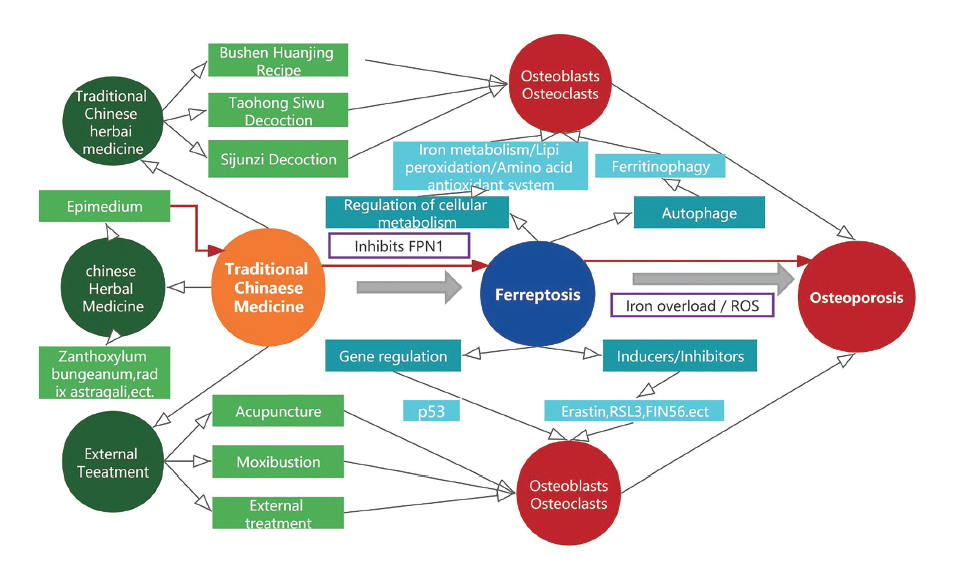
The term “Ferroptosis” was officially named by Dixon et al. (2012). Ferroptosis is a novel form of programmed cell death that is regulated by the involvement of iron ions. Ferroptosis differs from other cell death modalities in many ways and the regulatory mechanisms are complex and diverse. Studies have shown that it is mainly related to cellular metabolic regulation, gene regulation, associated autophagy, and other compounds that have both inductive and inhibitory effects on ferroptosis (Xu et al., 2022). Among them, the cellular metabolic regulatory system is mainly involved in three classical mechanisms, namely, imbalance of iron metabolism, dysregulation of the amino acid antioxidant system, and lipid peroxidation pooling (Deng et al., 2023). Iron in the human body is mainly present as ferric ions (Fe3+), stored in the liver, and transported via transferrin as a carrier and is reduced to be transported to the cytoplasm as ferrous ions (Fe2+) (Roemhild et al., 2021). Excess intracellular Fe2+ accumulation leads to reactive oxygen species (ROS) production and oxidation of cell membrane lipids, and so on, ultimately resulting in cellular ferroptosis. The main signaling pathways involved in the regulation are reduced glutathione (GSH)/glutathione peroxidase 4 (GPX4), GTP cyclo-hydrolase 1 (GCH1)/tetrahydrobiopterin (BH4) (Hu et al., 2022), ferroptosis suppressor protein 1 (FSP1)/coenzyme Q10 (CoQ10) (Doll et al., 2019), which intervene in ferroptosis by scavenging peroxides, controlling peroxyl radical generation, and protecting peroxylated lipid substrates, respectively. Among them, GPX4 is a recognized target for ferroptosis regulation (Yang et al., 2014); for gene regulation, studies have shown that a variety of genes, represented by the classical p53 oncogene, have a regulatory role in ferroptosis (Levine, 2020). Iron homeostasis in the organism depends on the iron storage proteins contained in liver, spleen and bone marrow mononuclear macrophages, which are achieved through the storage and release of iron. When the demand for iron rises or there is iron deficiency in body cells, ferritinophagy is induced, releasing Fe3+ from ferritin and reducing it to Fe2+ in a process associated with the regulation of nuclear receptor co-activator 4 (NCOA4) (Ajoolabady et al., 2021; Gryzik et al., 2021). Moderate ferritinophagy facilitates the maintenance of intracellular iron homeostasis. However, excessive ferritinophagy can induce ferroptosis by releasing large amounts of Fe3+, resulting in ROS generation (Hou et al., 2016). Ferroptosis inducers such as Erastin (Cang et al., 2022), RSL3 (Xiang et al., 2023), FIN56 (Zhang et al., 2021) and ferroptosis inhibitors such as iron chelators (Zhang et al., 2019) and free radical scavengers (ferrostatin-1, Fer-1) (Xie et al., 2023) can regulate ferroptosis by modulating the relevant pathways to regulate ferroptosis. Studies have shown that ferroptosis is not only correlated with cardiovascular, tumor, and neurological diseases but is also closely related to many bone diseases.
TCM and Osteoporosis
According to TCM, osteoporosis is mainly caused by the liver, kidney, and spleen, with the kidney being the most important. The Huangdi’s Canon of Medicine states: “When there is heat in the kidney, the seminal fluid will be exhausted, the loins and the spine will be unable to move about, and the withering of the bone and the reduction of the marrow will cause the occurrence of the flaccidity-syndrome involving the bone.” The kidney governs the bone and engenders marrow; if the kidney is deficient in its essence, the kidney is not enough to nourish the bone and marrow, and there is no source of transformation, which leads to the occurrence of osteoporosis, so whether the kidney is deficient in essence is the root of the disease. TCM has the saying “homogeny of liver and kidney.” The main physiological functions of the liver are to store blood, control, and open into the eyes. Although the kidney governs the bones and engenders the marrow, the sinew and bones are connected. If failure of the liver to store blood occurs, the sinew will lose moisture and nourishment and then affect the bones. Therefore, liver disease is also a significant factor in osteoporosis development. In addition to the liver and kidney, the development of osteoporosis is also associated with the spleen. As the kidney is the root of innate endowment and the spleen is the acquired foundation, the innate endowment and acquired foundation nourish each other, which is important for the strength of bones. The treatment of osteoporosis in TCM also mostly starts with these three Zang-Organs and focuses on nourishing their deficiencies. The fundamental treatment rules of many therapies involved, such as Chinese herbal medicine, traditional Chinese herbal compound, and external treatment of TCM, are also mostly attributed to this.
Ferroptosis and Osteoporosis
Osteoblasts and osteoclasts are closely related to ferroptosis in the pathogenesis of osteoporosis. Ferroptosis is mainly characterized by iron overload and a large accumulation of ROS. Iron overload is an important risk factor for the progression of osteoporosis. When intracellular iron overload, that is, iron overload, inhibits osteoblast activity while activating osteoclast activity, it induces the formation of ROS. Excessive ROS destabilizes the cell membrane and leads to the rupture of the cell membrane of osteoblasts due to the peroxidation reaction (De Martinis et al., 2020), which disrupts bone homeostasis and leads to the development of osteoporosis (H. Zhang et al., 2023), and the onset of the disease is positively correlated with iron overload. In addition to iron overload, ROS can also affect the balance of bone metabolism and influence the function of osteoblasts and osteoclasts, which have an important role in osteoporosis associated with ferroptosis (Gao et al., 2022). In addition, lipid peroxidation, as an important regulatory mechanism of ferroptosis, is closely related to osteoclast death. Sphingomyelin is a sphingolipid, and sphingomyelin synthase SMS2 is closely related to osteoporosis. Pathogenic SMS2 variants undermine the capacity of osteogenic cells to uphold nonrandom lipid distributions, thus leading to iron death in osteoblasts [B]. In conclusion, iron death is closely linked to the pathogenesis of osteoporosis (Sokoya et al., 2022).
Study on the Relationship Between TCM Therapy, Osteoporosis, and Ferroptosis
Osteoporosis is a well-treated condition in TCM. As research continues, several TCM approaches have been shown to intervene in ferroptosis. Therefore, it is mostly suggested that the therapeutic effect of TCM on osteoporosis may be related to its interventional effect on ferroptosis. In particular, the effects of TCM on iron overload and ROS are significant for the prevention and treatment of osteoporosis. Most TCM practitioners believe that osteoporosis is mainly due to a deficiency of internal organs, and its treatment is mostly based on syndrome differentiation to “supplement its deficiency.” Modern pharmacology has shown that some of the TCM methods, such as Zanthoxylum bungeanum (Kim et al., 2010; Zhang et al., 2020), Epimedium (Fu et al., 2022; He et al., 2022; Wu et al., 2022), Salvia miltiorrhiza (Wang et al., 2022), Curcuma longa (Chai et al., 2021), Astragalus membranaceus (Lai et al., 2021), Artemisia carvifolia (Ma et al., 2022), Taohongsiwu decoction (Deng et al., 2020; Zhang et al., 2017; Zhou et al., 2017; Zhu et al., 2020), Sijunzi decoction (Chen, 2021), and Bushen Huanjing recipe (Huang et al., 2022), in which the active ingredients of those above and external treatment of TCM can affect the function of osteoblasts and osteoclasts, promote bone formation, and inhibit bone resorption. And most of the above TCM methods have been shown to influence the prevention and treatment of many diseases by interfering with ferroptosis. The mechanisms are summarized as follows:
Chinese Herbal Medicine
The alcohol ZB-1A extracted from Z. bungeanum has a significant role in the mechanism of protecting hippocampal neuronal cells in mice with the inhibition of ferroptosis (Zhang et al., 2020). Icraiin, a derivative of flavonoid glycosides from Epimedium, can regulate ferroptosis-related pathways and promote osteoblast differentiation by inhibiting FPN1 expression (Fu et al., 2022). Tanshinone IIA, an extract of S. miltiorrhiza, can inhibit hepatic ferroptosis-related factors or reduce lipid deposition by reducing lipid peroxidation (Wu et al., 2020), which has positive implications in the treatment of related liver diseases. In addition, it has been shown that various chemical components of S. miltiorrhiza can interfere with ferroptosis to prevent and treat many tumor diseases such as gastric cancer (Ni et al., 2022) and breast cancer (L. Yan, 2021); curcumin, a Curcuma longa extract, can inhibit the hepatolenticular degeneration (HLD) model through the Nrf2/HO-1/GPX4 signaling pathway, where ferroptosis occurs and exerts a protective effect (H. Yan, 2021). In addition, curcumin induces molecular and cytological features of ferroptosis in breast cancer and has a positive role in the treatment of breast cancer (Li, 2021). Astragalus membranaceus extract Astragaloside (AS-IV) increases SLC7A11 protein expression, increases GSH and GPX4 activity, and decreases ROS, acting as a cytoprotective agent by inhibiting ferroptosis (Sheng et al., 2021). Artesunate (ART) is a derivative of artemisinin extracted from the Traditional Chinese Herbal Medicine Artemisia carvifolia. It can inhibit osteoclast differentiation and promote osteoblastogenesis (Jin et al., 2023; Zeng et al., 2020). It prevents bone loss due to iron overload. ART acts as an inhibitor of ferroptosis and has the effect of inducing intracellular lipid peroxidation and cell death. It can induce ferroptosis in various ways by modulating mitochondrial damage, STAT3, GSH, GPX4 activity and lipid peroxidation accumulation (Chen et al., 2021; Koike et al., 2022; Ye et al., 2021).
External Treatment of TCM
External treatment of TCM is a common clinical treatment for osteoporosis and includes acupuncture, moxibustion, electroacupuncture, and many other therapies. Modern research mostly suggests that it is related to modalities such as regulation of the endocrine system, related signaling pathways, or improvement of bone morphology and biomechanics. Nowadays, there have been an increasing number of studies that intervene in ferroptosis to treat diseases through external treatment of TCM, such as acupuncture, which can treat asthma by alleviating lipid peroxidation in ferroptosis (Tang et al., 2023). Moxibustion can effectively inhibit the occurrence of ferroptosis, therefore protecting neurons and improving Parkinson’s disease (Y. Li et al., 2022; Lu et al., 2019). In addition, electroacupuncture can improve gastrointestinal motility by inhibiting ferroptosis in gastric sinus tissue cells (X. Li et al., 2022) and possibly by triggering the Wnt/β-catenin signaling pathway to inhibit neuronal ferroptosis (Z. Jiang et al., 2022) or by activating the Nf2/HO-1 signaling pathway to regulate oxidative stress and related proteins to inhibit cardiac myocyte “ferroptosis,” which in turn improves the treatment of myocardial ischemia (Zhang et al., 2022). As research continues, new insights have been gained in the improvement of diseases of the cardiovascular system, nervous system, and other diseases by external treatment of TCM under the ferroptosis theory (Li et al., 2021; Liu, 2021; Sun et al., 2021).
Traditional Chinese Herbal Compound
Taohongsiwu decoction (Deng et al., 2020; Zhang et al., 2017; Zhou et al., 2017; Zhu et al., 2020) contains quercetin, lignan, kaempferol, various sterols, baicalin, and other effective components that have the ability to dissipate heat, relieve pain and anti-inflammation, regulate cell proliferation and differentiation, and improve bone metabolism. These components are mostly derived from its monarch drugs, peach kernel, and safflower, which have positive effects in the treatment of osteoporosis. The mechanism of regulating ferroptosis may be related to p53/SLC7A11-mediated oxidative damage and inhibition of ferroptosis. Modified Sijunzi decoction, which is based on Sijunzitang, is made by adding and subtracting the flavors (Astragalus mongholicus, Codonopsis pilosula, S. miltiorrhiza, Cornus officinalis, Dioscorea polystachy, Wolfiporia extensa, Coix lacryma-jobi, Angelica sinensis, seeds of Nelumbo nucifera, Rosa laevigata, Taxillus chinensis, and Atractylodes macrocephala) (Chen, 2021) has a positive effect on the treatment of osteoporosis. In terms of ferroptosis, Sijunzi decoction was able to improve liver lipid deposition in mice by interfering with proteins associated with ferroptosis in hepatocytes (Yang et al., 2022). The Bushen Huanjing recipe is derived from the empirical formula “Huanjing Recipe.” It is mainly composed of the prepared root of Rehmannia glutinosa, the prepared seeds of Cuscuta chinensis, the prepared seeds of Phyllolobium chinense, and Cynomorium songaricum and is commonly used in the treatment of myasthenia gravis due to osteoporosis. Studies have shown that the Bushen Huanjing Recipe can treat myasthenia gravis by reducing lipid peroxidation in muscle tissue and inhibiting ferroptosis-related pathways (Huang et al., 2022).
Discussion
This review was conducted to compile studies on TCM therapies useful in the prevention and treatment of osteoporosis and their ferroptosis. From the classification of the included single Chinese herbal medicine, Z. bungeanum, Epimedium, S. miltiorrhiza (Wang et al., 2022), C. longa, A. membranaceus, and A. carvifolia, it was found that their meridian entries are kidney meridian, liver meridian, and spleen meridian, all of which are commonly used in the clinical treatment of osteoporosis. Modern pharmacological studies have confirmed that the constituents or corresponding extracts of Z. bungeanum and A. membranaceus have clear therapeutic effects on osteoporosis. Also, all the single Chinese herbal medicine included can interfere with ferroptosis by regulating the relevant mechanisms for the treatment of different diseases involved. Among them, Epimedium extracts were shown to induce ferroptosis through various modalities that can interfere with mitochondrial damage, cysteinase cascade reaction, GSH, GPX4 activity and lipid peroxidation accumulation for the treatment of osteoporosis. Although there are clear pharmacological studies and reports on the regulation of ferroptosis in other single Chinese herbal medicine for the treatment of diseases, there are no reports on the studies on the prevention and treatment of osteoporosis by directly interfering with ferroptosis. This offers a novel theoretical basis and research direction for the in-depth exploration of ferroptosis intervention in Chinese herbal medicine. From the other therapies included in the study, there are many reports on modern research, clinical practice, and intervention for ferroptosis in the form of Taohongsiwu decoction, Bushen Huanjing recipe, Sijunzi decoction, and external treatment of TCM. However, the same single Chinese Herbal Medicine (except Epimedium) mentioned above has been shown to intervene in ferroptosis in multiple ways, but there are no studies involving osteoporosis. Combining the attribution, main treatment and clinical practice with modern research, it can be hypothesized that there is a close connection between osteoporosis, TCM, and ferroptosis and that the above single Chinese herbal medicine with clear therapeutic effects on osteoporosis, as well as traditional Chinese herbal compound and external treatment of TCM, can play a positive role in the treatment of osteoporosis by interfering with ferroptosis (Figure 1). This deduction will deliver an innovative strategy for the treatment of osteoporosis. As the research continues, more drugs and methods that can treat osteoporosis may be introduced into the study of ferroptosis.
Conclusion
For thousands of years, osteoporosis has been a significant disease that infringes on human health due to its extraordinary morbidity, disability, and mortality. Osteoporosis has been a common topic faced by TCM and western medicine. With the progress of modern technology research, the mechanism of action and therapeutic targets of TCM continue to be clarified, and the mechanism of action of many TCM therapies on osteoporosis has also been continuously confirmed. From the available studies, TCM can achieve the intervention of ferroptosis through multimethod and multipath modulation. From the main regulatory mechanisms of ferroptosis known so far, ferroptosis is closely related to osteoporosis, although many mechanisms of association between TCM, ferroptosis, and osteoporosis are not yet clear. As we all know, besides the above-mentioned TCM methods for osteoporosis, which are only a small part of the current directions involving ferroptosis, there are still a large number of TCM methods that are clinically effective in the treatment of osteoporosis, and the research in the field of ferroptosis is still blank. Can their therapeutic effects on osteoporosis be achieved by interfering with ferroptosis? It is still unclear, but this will provide a reference and a research guide for future TCM to overcome the challenge of osteoporosis treatment in the field of ferroptosis.
The culture of TCM has long-established and lasting charms, is eclectic and incorporates things of diverse nature. With the progress of human society, new discoveries are constantly refreshing our perceptions. Combining righteousness and innovation, combining the advantages of TCM with the new discoveries of “ferroptosis” and attaching traditional methods to new theories provides the possibility of innovative disease treatment methods in multiple ways. TCM under the ferroptosis theory needs a new theoretical nirvana, which is worthy of in-depth research and exploration.
Abbreviations
TCM: Traditional Chinese Medicine; ROS: Reactive oxygen species; GSH: Glutathione; GPX4: Glutathione peroxidase; GCH1: GTP cyclo-hydrolase 1; BH4: Tetrahydrobiopterin; FSP1: Ferroptosis suppressor protein 1; CoQ10: Coenzyme Q10.
Footnotes
Acknowledgement
The authors would like to thank Professor Dezhi Tang for his guidance, and the fellows in Huanan Li’s research group for their help with this research project.
Authors’ Contribution
Weikang Sun: Conceptualization, Methodology, Formal analysis, Investigation, Resources, Data Curation, Writing − Original Draft, Writing − Review & Editing. Zichen Shao: Methodology, Formal analysis, Investigation, Writing − Original Draft. Qipeng Yuan: Investigation, Resources.
Declaration of Conflicting Interests
The authors declared no potential conflicts of interest with respect to the research, authorship, and/or publication of this article.
Funding
This research was funded by The Fourth Batch of National Training Program for Excellent Talents in Traditional Chinese Medicine (Clinical and Basic) (National TCM Human Education and Development [2017] 24), Jiangxi University of Chinese Medicine University-level Science and Technology Innovation Team Project (CXTD22011), The Second National Medical Master Deng Yunming Famous Medical Studio of Jiangxi Province (Gan RenSheZi [2021] 201) and 2022 Jiangxi Provincial Postgraduate Provincial Innovation Special Fund Project (YC2022-s864), Key Research Laboratory of Arthromyodynia of Jiangxi Province Administration of Traditional Chinese Medicine (Gan ZhongYiKeJiaoZi [2022] No. 8).
