



Abstract
Hepatic fibrosis (HF), a global issue that develops gradually during the repeated repair process of chronic liver injury caused by various factors, can progress to irreversible cirrhosis and hepatocellular carcinoma. Currently, there are no approved chemical or biological drugs for the treatment of liver fibrosis. Modern medicine primarily focuses on addressing the underlying causes of liver fibrosis. HF is classified as an accumulative disease in the Yellow Emperor's Internal Classic, which is the earliest and most influential extant medical classic in China. Thousands of years of treatment experience have accumulated a large number of effective Chinese medicines. In recent years, studies on the anti-liver fibrosis effects of Chinese medicine have mainly focused on the curative effects of extracts and compounds. Studies have shown that the treatment and prevention of liver fibrosis through Chinese medicine demonstrate a comprehensive pharmacological effect that involves multiple pathways and targets. Therefore, further in-depth research in this field is both promising and necessary. However, it is crucial to expand clinical application studies, as the current research on the anti-liver fibrosis effects of TCM is predominantly limited to laboratory investigations. In this review, we summarized the pharmacological effects, targets and related mechanisms of 13 traditional Chinese medicines in the treatment of HF in the past five years, in order to provide comprehensive information for the development of anti-liver fibrosis drugs.
Introduction
The term hepatic fibrosis (HF) refers to the pathological alterations resulting from excessive hyperplasia and abnormal deposition of extracellular matrix (ECM) components in liver tissue, leading to aberrant liver structure or (and) impaired function. It is characterized by an excessive accumulation of ECM proteins, hepatocyte injury, deformation of hepatic lobules, and structural changes in the vasculature.1,2 Notably, liver injury and activation of hepatic stellate cells (HSCs) and Kupffer cells (KCs) play pivotal roles in initiating fibrogenesis. HF is a prevalent feature observed in the majority of chronic liver diseases, 3 and represents the sole pathway through which chronic liver disease progresses to cirrhosis and hepatocellular carcinoma. The primary etiologies include chronic hepatitis B virus (HBV) infection, hepatitis C virus (HCV) infection, alcohol-related liver disease (ALD), and non-alcoholic fatty liver disease (NAFLD).4,5 The development of diffuse hyperplasia of fibrous tissue in the liver leads to nodular regeneration of liver cells and the formation of false flocculus, which is commonly referred to as cirrhosis. 1 Currently, liver transplantation is considered the most effective treatment for cirrhosis; however, its clinical application is limited due to donor material shortages, reliance on expert technical support, and high hospitalization costs. 6 Liver cirrhosis represents a significant global health burden, with an estimated 1 million deaths attributed to this condition in 2010. 7 Notably, liver cirrhosis stands as the leading cause of liver-related mortality in the Asia-Pacific region. 8 The prevention or reversal of liver fibrosis holds great potential for averting subsequent diseases. However, it is worth noting that currently there are no FDA-approved anti-fibrosis therapies available, and treatment primarily focuses on addressing underlying causes such as antiviral therapy for hepatitis and cessation of alcohol consumption. Several studies have reported the potential of certain drugs in reversing fibrosis; however, their clinical application in subjects with HF has not demonstrated significant efficacy. Moreover, some drugs are still undergoing clinical trials and have yet to be implemented in real-world clinical practice. 9
According to the clinical features of HF, it is classified as a disease characterized by the accumulation of mass in the abdomen. 10 This classification is derived from the Yellow Emperor's Internal Classic and is defined by the National Administration of Traditional Chinese Medicine (NATCM) (accessed 23 November 2020). It generally refers to the presence of a mass or lump in the abdomen and hypochondrium, which can be attributed to factors such as emotional stagnation, qi and blood stasis, phlegm and food obstruction, deficiency in positive energy, or pathogenic factors. 11 TCM provides a variety of effective herbs for the management of HF. This article critically examines the relevant literature on traditional Chinese medicine treatment for liver fibrosis in the past 5 years. It summarizes the mechanisms of action of 13 Chinese herbal medicines, including whole substances, extracted single compounds, and derivative monomers. The traditional methods of using Chinese medicine include external application and oral administration. The medication methods mentioned in this article are all for oral administration. The clinical trials are conducted through oral administration, while the experimental studies are conducted through intragastric administration.
Chinese Medicine and Extracts
The following section presents a comprehensive overview of 13 Chinese medicines and their corresponding extracts, which have been studied for their therapeutic potential in liver fibrosis treatment. Detailed information regarding the specific effects and underlying mechanisms of action can be found in Table 1.
The Mechanisms and Functions of Chinese Herbal Medicine and Extracts in HF.
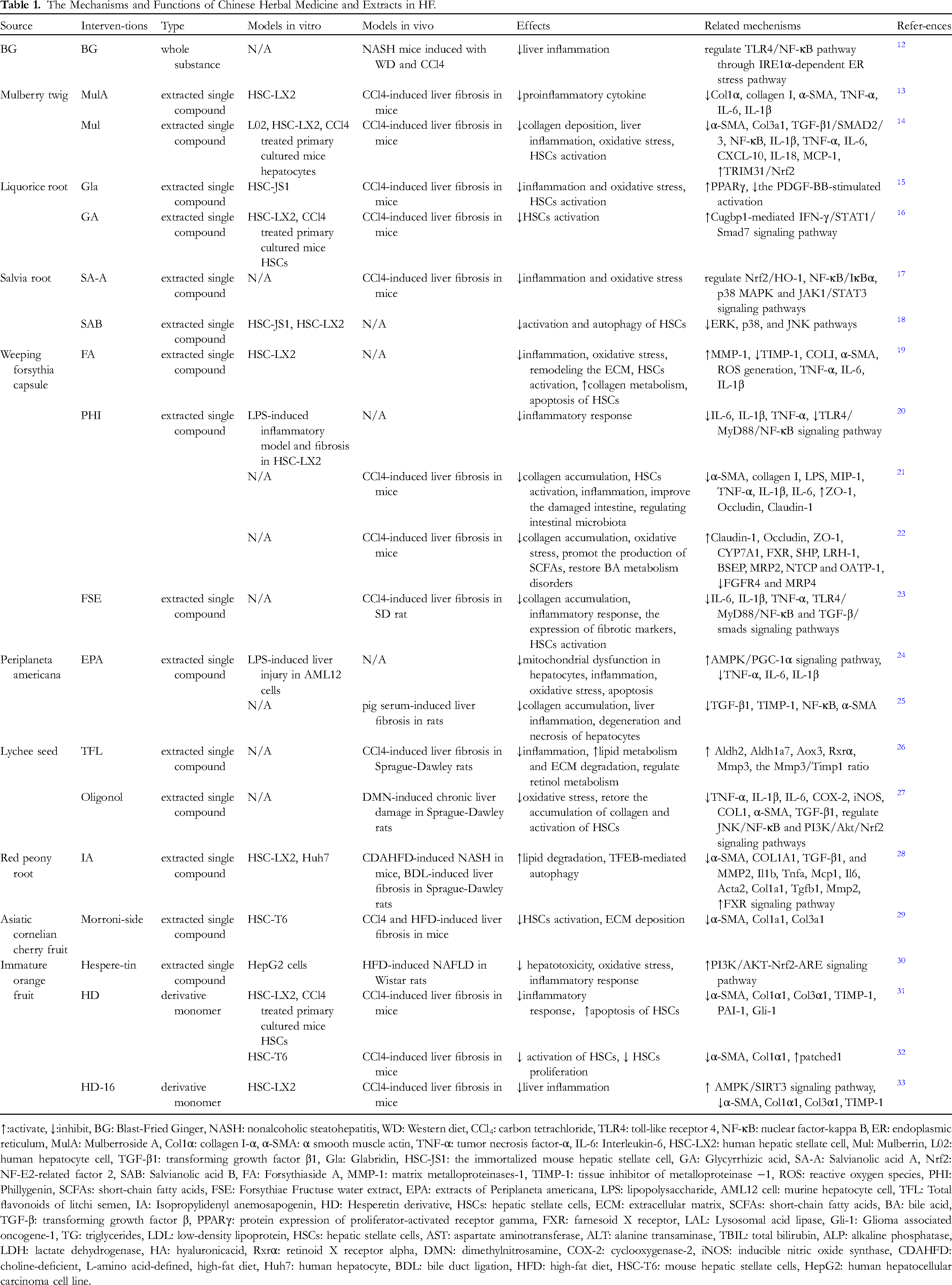
↑:activate, ↓:inhibit, BG: Blast-Fried Ginger, NASH: nonalcoholic steatohepatitis, WD: Western diet, CCl4: carbon tetrachloride, TLR4: toll-like receptor 4, NF-κB: nuclear factor-kappa B, ER: endoplasmic reticulum, MulA: Mulberroside A, Col1α: collagen I-α, α-SMA: α smooth muscle actin, TNF-α: tumor necrosis factor-α, IL-6: Interleukin-6, HSC-LX2: human hepatic stellate cell, Mul: Mulberrin, L02: human hepatocyte cell, TGF-β1: transforming growth factor β1, Gla: Glabridin, HSC-JS1: the immortalized mouse hepatic stellate cell, GA: Glycyrrhizic acid, SA-A: Salvianolic acid A, Nrf2: NF-E2-related factor 2, SAB: Salvianolic acid B, FA: Forsythiaside A, MMP-1: matrix metalloproteinases-1, TIMP-1: tissue inhibitor of metalloproteinase −1, ROS: reactive oxygen species, PHI: Phillygenin, SCFAs: short-chain fatty acids, FSE: Forsythiae Fructuse water extract, EPA: extracts of Periplaneta americana, LPS: lipopolysaccharide, AML12 cell: murine hepatocyte cell, TFL: Total flavonoids of litchi semen, IA: Isopropylidenyl anemosapogenin, HD: Hesperetin derivative, HSCs: hepatic stellate cells, ECM: extracellular matrix, SCFAs: short-chain fatty acids, BA: bile acid, TGF-β: transforming growth factor β, PPARγ: protein expression of proliferator-activated receptor gamma, FXR: farnesoid X receptor, LAL: Lysosomal acid lipase, Gli-1: Glioma associated oncogene-1, TG: triglycerides, LDL: low-density lipoprotein, HSCs: hepatic stellate cells, AST: aspartate aminotransferase, ALT: alanine transaminase, TBIL: total bilirubin, ALP: alkaline phosphatase, LDH: lactate dehydrogenase, HA: hyaluronicacid, Rxrα: retinoid X receptor alpha, DMN: dimethylnitrosamine, COX-2: cyclooxygenase-2, iNOS: inducible nitric oxide synthase, CDAHFD: choline-deficient, L-amino acid-defined, high-fat diet, Huh7: human hepatocyte, BDL: bile duct ligation, HFD: high-fat diet, HSC-T6: mouse hepatic stellate cells, HepG2: human hepatocellular carcinoma cell line.
Blast-Fried Ginger
Blast-Fried Ginger (BG, Pao-jiang) is a type of processed ginseng (Zingiber officinale Roscoe) product. 34 As a dietary supplement, it can enhance liver health by augmenting the activity levels of antioxidant enzymes in the liver and mitigating liver inflammation through the IRE1α-dependent endoplasmic reticulum (ER) stress pathway. 35 Moreover, BG exhibits potential as a therapeutic agent for preventing NAFLD. 36 Experimental evidence demonstrates that BG significantly attenuates liver fibrosis and inflammation in NASH mice models, while also inhibiting Toll-like receptor 4 (TLR4) protein expression and nuclear factor-κb p65 (NF-κB p65) phosphorylation. These findings suggest that BG exerts hepatoprotective effects by modulating the TLR4/NF-κB pathway. 12
Mulberry Twig
Mulberry twig (Sang-zhi) is a commonly used traditional Chinese medicine with potent anti-inflammatory and antioxidant activities.37,38 It is derived from the dried twigs of Morus alba L. and belongs to the liver meridian according to the Chinese Pharmacopoeia. 39 Studies have demonstrated that Mulberroside A (MulA), the primary active component of mulberry twig, effectively suppresses collagen I and α-SMA expression in mice with acute liver injury. Although it does not directly inhibit HSC proliferation and activation, it significantly reduces pro-inflammatory cytokine release from liver tissue and cultured macrophages, thereby mitigating hepatic fibrosis. 13 Furthermore, Mulberrin (Mul), a key constituent of mulberry twig, markedly attenuates collagen deposition and liver fibrosis in mice with hepatic injury by inhibiting the transforming growth factor β1 (TGF-β1)/SMAD2/3 signaling pathway. Additionally, it exerts anti-inflammatory effects through modulation of the nuclear factor-κB (NF-κB) signaling pathway. In vitro studies have revealed that Mul reduced the activation of human and mice primary HSCs upon TGF-β1 stimulation, and significantly delayed the inflammatory response and reactive oxygen species (ROS) accumulation in human and mice hepatocytes. Moreover, Mul inhibits HSC activation by enhancing TRIM31/Nrf2 axis activity, thus reducing hepatocyte injury. 14 Ramulus mori alkaloids (SZ-As) has been extracted and isolated from mulberry twig as well. Transcriptome and metabolomics data suggest that SZ-As may regulate lipid metabolic pathways such as glycerophospholipid metabolism and choline metabolism while increasing levels of phosphatidylcholines (PCs) and lysophosphatidylcholine (LPC) metabolites to exert therapeutic effects on NAFLD treatment. 40 Furthermore, SZ-As exhibits rapid and extensive distribution in target tissues along with good metabolic stability and low risk of drug interactions, 41 rendering it suitable for rational and prolonged clinical utilization.
Liquorice Root
Liquorice root (Gan-cao) is derived from the dried roots and rhizomes of Glycyrrhiza uralensis Fisch. ex DC., Glycyrrhiza inflata Batalin and Glycyrrhiza glabra L. 39 As a supplement, Liquorice root is superior to lifestyle modification alone in treating NAFLD, in addition to gradual weight loss and lifestyle modification. 42 Glabridin (Gla), an isoflavone extracted from Liquorice root, has been proven by both in vivo and in vitro studies to have a protective effect on ALD. Its mechanism is related to the p38 MAPK/Nrf2/NF-κB pathway. 43 Additionally, Gla inhibits inflammation and oxidative stress by activating protein expression of proliferator-activated receptor gamma (PPARγ) in CCl4-treated mice, thereby inhibiting liver fibrosis and HSC activation. 15 Another bioactive component found in licorice is Glycyrrhizic acid (GA). Guo et al demonstrated for the first time that GA attenuated the activation of HSCs by promoting CUGBP1-mediated IFN-γ/STAT1/Smad7 signaling pathway. 16
Milkvetch Root
Milkvetch root (Huang-qi), derived from the dried roots of Astragalus mongholicus Bunge, is a commonly used Chinese medicine known for its ability to tonify qi. 39 Network pharmacology analysis has revealed that Milkvetch root exerts a multi-target regulatory effect, reducing liver injury and inhibiting inflammation through its active ingredients. 44 Furthermore, Milkvetch root treatment for HF involves the modulation of arachidonic acid metabolism and ether lipid metabolism by regulating the expression of CYP1A2, CYP1B1, and PCYT1A. 45
Astragalus polysaccharide (APS), derived from Milkvetch root, exhibits significant preventive effects against high-fat diet (HFD)-induced NAFLD, 46 primarily attributed to its modulation of bile acid (BA) profiles. Additionally, APS has been demonstrated to mitigate NAFLD in HFD-fed mice through the regulation of taurohyodeoxycholic acid (THDCA) levels. 47 Network pharmacology and in vivo experiments have elucidated that APS may alleviate alcohol-induced HF by suppressing the activation of polymerase I and transcript release factor (PTRF), as well as the TLR4/JNK/NF-κB/MyD88 pathways. 48
Cycloastragenol, a bioactive phytochemical derived from Milkvetch root, exhibits significant hepatoprotective effects and mitigates the progression of HF in CCl4-treated mice. Furthermore, Cycloastragenol upregulates the mRNA expression of interleukin 6, a pleiotropic cytokine that plays a pivotal role in promoting hepatocyte regeneration. 49
Tortoise Carapace and Plastron
Tortoise carapace and plastron (Gui-ban), Latin pharmaceutical name as Testudinis carapax et plastrum, are commonly employed in the treatment of liver diseases, as they belong to the liver meridian. 39 They are also listed among traditional Chinese medicines approved for use in health food by the Ministry of Health P.R. China in 2002. Xia et al hydrolyzed turtle shell protein using a combination of pepsin and trypsin, resulting in a product exhibiting the highest anti-hepatic fibrosis activity in vitro. Furthermore, they developed a bioactive-guided molecular docking approach to isolate the carapa-antiliver fibrosis peptide. 50
Salvia Root
Salvia root (Dan-shen), derived from the dried root and rhizome of Salvia miltiorrhiza Bge., belongs to the liver meridian, 39 and serves as a commonly employed traditional Chinese medicine for treating liver diseases. Tanshinone IIA (TsIIA) is the most important effective molecule in the fat-soluble component of Salvia root, which can inhibit inflammatory response, oxidative stress, mediate cell apoptosis signaling molecules, improve obesity and diabetes, promote hepatocyte cycle arrest, and inhibit hepatocyte angiogenesis in vitro and in vivo. 51 However, TsIIA is also characterized by poor water solubility, polarity, and low oral bioavailability, which prevents it from maximizing its bioavailability in tissues. 52 To address this issue, two novel modified lipid nanocapsules (LNCs) were developed; results from in vivo efficacy assessments and biodistribution studies demonstrated that these modified LNCs loaded with TsIIA exhibited potential for targeted delivery to the liver. 53
Salvianolic acid A (SA-A) is a water-soluble compound extracted from Salvia root, which can inhibit inflammation and oxidative stress by regulating Nrf2/HO-1, NF-κB/IκBα, p38 MAPK, and JAK1/STAT3 signaling pathways, effectively preventing induced mouse HF. 17
Salvianolic acid B (SAB) is also a water-soluble compound from Salvia root. Studies have shown that SAB inhibits TGF-β1-induced activation and autophagy of HSCs partly by down-regulating ERK, p38, and JNK pathways, and there may be crosstalk between these pathways. 18 Li et al. first found that UDP-glucose ceramide glucosyltransferase (UGCG) is overexpressed in fibrotic liver and activated HSCs and demonstrated that SAB is a UGCG inhibitor. Then SAB was given intraperitoneally to prove that it could inhibit the activation of HSCs and collagen deposition in CCl4-induced liver fibrosis mice to alleviate HF, thus proving that UGCG may be a therapeutic target for HF. 54
Weeping Forsythia Capsule
Weeping forsythia capsule (Lian-qiao), derived from the dried fruit of Forsythia suspensa (Thunb.) Vahl, 39 is a commonly used Chinese herbal medicine with anti-inflammatory, antioxidant, antibacterial, antiviral, and anti-cancer activities. 55 Forsythiaside A (FA), phillygenin (PHI), and forsythiae fructuse water extract (FSE) were all active components isolated from Weeping forsythia capsule.
FA, a phenethyl glucoside, can inhibit the proliferation and migration of LX2 cells, regulate the expression of MMP-1, TIMP-1, COLI, α-SMA, TNF-α, IL-6, and IL-1β, and promote collagen metabolism, showing the potential of anti-HF. Moreover, it can inhibit the activation of HSCs and promote the apoptosis of HSCs partly by remodeling ECM and improving oxidative imbalance. 19 FA can also improve liver fibrosis by inhibiting inflammation and oxidative stress, regulating intestinal flora and BA metabolism, and increasing the content of short-chain fatty acids (SCFAs). 56 Suboptimal pharmacokinetic properties limit the clinical use of FA, 57 so Gong et al developed the nanocarrier of CD44-specific ligand Hyaluronic acid (HA)-modified milk-derived exosomes (mExo) encapsulated with FA (HA-mExo-FA). HA modification can deliver drug-loaded exosomes to target cells and form specific ligand-receptor interaction with CD44, thereby improving the anti-HF effect of FA. They also demonstrated that the mechanism of HA-mExo-FA against HF may be related to the inhibition of NLRP3-mediated pyroptosis. 58
PHI, a lignan component, has a good hepatoprotective effect. 59 In vitro experiments have shown that PHI can inhibit lipopolysaccharide (LPS)-induced proinflammatory response and LX88 cell activation through the TLR2/MyD4/NF-κB signaling pathway, thereby inhibiting HF. 20 The results of in vivo experiments showed that PHI ameliorated CCl4-induced liver histopathological damage, abnormal liver function, collagen deposition, inflammation, and fibrosis. In addition, PHI restores the intestinal epithelial barrier by promoting the expression of intestinal barrier markers and also has a corrective effect on the imbalance of intestinal microbiota. 21 Promoting the production of intestinal SCFAs and restoring BA metabolic disorder may be the potential mechanism by which PHI reduces CCl4-induced liver fibrosis. 22
FSE, a water-soluble component, can inhibit the expression of inflammatory factors and fibrotic cytokines through TLR4/MyD88/NF-κB and TGF-β/smads signaling pathways, reduce liver injury, and inhibit the development of HF. 23
Periplaneta Americana
Extracts of Periplaneta americana (Fei-lian), the dried body of Periplaneta americana Linnaeus, have a wide range of therapeutic and biological activities, including anti-fibrosis, anti-tumor, anti-inflammatory, antioxidant, and tissue repair activities.60,61 In vitro experiments have shown that extracts of Periplaneta americana (EPA) can inhibit LPS-induced mitochondrial dysfunction in normal mouse hepatocytes by activating AMPK/PGC-1α signaling pathway, which may be a potential mechanism by which EPA reduces liver injury. 24 In vivo experiments have shown that EPA can reduce liver inflammation, inhibit hepatocyte degeneration and necrosis, and reduce the formation of liver fibrous tissue. The mechanism may be related to inhibiting the expression of TGF-β1, TIMP-1, NF-κB, and α-SMA, and blocking the signal transduction pathway in the process of liver fibrosis. 25
Lychee Seed
Lychee seed (Li-zhi-he) is the dried and mature seed of Litchi chinensis Sonn., which is a traditional Chinese medicine. It belongs to the liver meridian and has the effect of promoting qi and dispersing accumulation. 39 Lychee seed is rich in phloridzin, 62 which has a strong but mild biological activity. In vivo experiments have proved that phloridzin can effectively treat HF, and its mechanism may involve ferroptosis, carbon metabolism, and related biomechanical changes. 63 Total flavonoids of litchi semen (TFL), the main active ingredient isolated from Lychee seed, can effectively alleviate LF induced by CCl4 in rats. The mechanism is related to the up-regulation of retinol metabolism, thereby affecting lipid metabolism and ECM degradation. 26 Oligonol, a low-molecular polyphenol derived from lychee fruit extract, can protect the liver against toxic acute liver injury in rats. 64 Further studies have shown that oligonol can effectively prevent dimethylnitrosamine (DMN)-induced chronic liver injury and has shown antioxidant, hepatoprotective, and anti-fibrotic effects through JNK/NF-κB and PI3K/Akt/Nrf2 signaling pathways. 27 It also reverses the overexpression of key apoptotic genes and has the potential to treat diseases characterized by excessive fibrosis. 65
Red Peony Root and Debark Peony Root
Red peony root (Chi-shao) and Debark peony root (Bai-shao) both come from the dried roots of Paeonia lactiflora Pall. and are made by different processing methods, and another source of red peony is Paeonia veitchii Lynch. Both of them are commonly used in the treatment of liver diseases, which belong to the liver meridian and have the effect of softening the liver. 39
Total glucosides of peony (TGP), extracted from Debark peony root, has the potential to treat diabetic liver injury by reducing liver lipid accumulation and inflammation. 66 Paeoniflorin is the main active ingredient of Debark peony root, which can protect the liver, relieve cholestasis, reduce liver fibrosis, prevent NAFLD and inhibit HCC. 67 CS-4, one of the paeoniflorin-free subfraction of Debark peony root, showed the most potential anti-fibrotic effect in vitro. Network pharmacology showed that the classical TGF-β/Smad signaling pathway and the non-classical TGF-β/PI3K-AKT signaling pathway may be the two main mechanisms of CS-4 anti-liver fibrosis. 68
Isopropylidenyl anemosapogenin (IA) is a new lead compound isolated from Red peony root. In vitro experiments have shown that IA has anti-hepatic fibrosis and anti-hepatic steatosis activities. In vivo experiments have shown that IA can promote lipid deg farnesoid X radation through farnesoid X receptor (FXR) activation and TFEB-mediated autophagy, thereby significantly reducing liver injury and fibrosis. 28
Asiatic Cornelian Cherry Fruit
Asiatic cornelian cherry fruit (Shan-zhu-yu) is the dried and mature pulp of Cornus officinalis Siebold & Zucc., which belongs to the liver meridian and has the effect of nourishing the liver, 39 and can prevent and treat liver diseases. 69 It was also included in the list of substances published by the National Health Commission as both food and traditional Chinese medicine (2023), 70 and a double-blind randomized clinical trial showed that the fruit extract of Asiatic cornelian cherry fruit could inhibit the exacerbation of liver fibrosis in patients with NAFLD. 71 Processing is a unique processing method of traditional Chinese medicine, which can achieve the purpose of eliminating toxicity or side effects, enhancing efficacy, and changing or easing properties. 72 Based on the fact that Asiatic cornelian cherry fruit inhibits liver fibrosis by inhibiting HSC-T6 cell activation, Han et al demonstrated through univariate and orthogonal experiments that the processing technology of high-pressure wine-steamed (HPWS) is the best processing technology for anti-liver fibrosis. 73
Morroniside is an iridoid glycoside isolated from Asiatic cornelian cherry fruit, and in vivo experiments showed that Morroniside can inhibit HSCs activation by targeting GATA3 and Lysosomal acid lipase (LAL), thereby exerting its anti-hepatic fibrosis effect. 29
Immature Orange Fruit
Immature orange fruit (Zhi-shi) is a kind of traditional Chinese medicine that can be used as a health food. It is the dried young fruit of Citrus × aurantium L. and its cultivated varieties or the sweet orange Citrus × aurantium f. aurantium in the rutaceae, which has the effect of eliminating aggregation and dispersing aggregation. 39 Hesperetin, a traditional Chinese medicine monomer isolated from Immature orange fruit, improves liver oxidative stress through the PI3K/AKT-Nrf2 pathway, and this antioxidant effect further inhibits NF-κB-mediated inflammation in the progression of NAFLD. 30 Hesperetin derivative (HD), derived from Hesperetin, has been shown to alleviate CCl4-induced HF in vitro and in vivo, inhibit the inflammatory response of primary liver macrophages, and promote the apoptosis of activated HSCs.31,32 HD-16 is also a monomer compound derived from hesperetin. In vitro and in vivo experiments have shown that HD-16 attenuates CCl4-induced liver inflammation and fibrosis by activating AMPK/SIRT3 pathway. 33
Discussion and Perspectives
HF is present in the pathological process of most chronic liver diseases, and its main pathological features are excessive hyperplasia and deposition of ECM, resulting in the formation of fibrous scars.74,75 HSC activation is the central link in the pathogenesis of liver fibrosis and the main cell source of ECM production. 76 Mild and temporary tissue damage leads to a temporary increase in ECM protein accumulation, which contributes to the healing of tissue damage. 77 However, liver fibrosis develops after extensive and persistent liver injury lasting for years or even decades, which is associated with an excessive immune response. 78 In chronic liver disease, inflammation is also closely related to liver fibrosis. 79 As chronic liver disease continues, inflammation will progressively drive ECM deposition.78,80
In this review, we summarized the pharmacological effects, targets, and related mechanisms of 13 traditional Chinese medicines in the treatment of HF in the past five years. In terms of mechanism, as depicted in Figure 1, Chinese medicines and extracts primarily exert their effects through the following mechanisms. Firstly, they possess the ability to inhibit the proliferation and activation of HSCs, induce apoptosis, and suppress autophagy. Secondly, they can attenuate ECM deposition, promote collagen metabolism to restore ECM homeostasis, and ameliorate oxidative imbalances. Additionally, these interventions are capable of inhibiting inflammation and oxidative stress within the liver parenchyma while promoting hepatocyte regeneration and reducing hepatocellular death. Furthermore, enhancing SCFA production in the intestine and restoring BA metabolic disorders represent effective strategies for combating liver fibrosis.

The mechanisms of Chinese herbal medicine and extracts in HF mentioned in this paper. (HSCs: hepatic stellate cells, ECM: extracellular matrix, BG: Blast-Fried Ginger, MulA: Mulberroside A, Mul: Mulberrin, Gla: Glabridin, GA: Glycyrrhizic acid, SA-A: Salvianolic acid A, SAB: Salvianolic acid B, FA: Forsythiaside A, PHI: Phillygenin, FSE: Forsythiae Fructuse water extract, EPA: extracts of Periplaneta americana, TFL: Total flavonoids of litchi semen, IA: Isopropylidenyl anemosapogenin, HD: Hesperetin derivative).
In terms of research, the investigation into the efficacy of monomers in traditional Chinese medicine primarily relies on laboratory experiments, including animal and cell studies, with limited literature available on clinical trials. Clinical treatment trials for liver fibrosis involving Chinese medicine predominantly employ prescriptions and compounds that have been substantiated for their effectiveness.81–83 However, there are certain limitations that persist, such as short treatment duration and restricted sample size. Future studies are needed to determine the long-term benefits in reducing the risk of fibrosis, cirrhosis, and HCC among these patients. Network pharmacology research emphasizes the holistic analysis of molecular associations between medicines and treatment targets at a systems level, taking into consideration biological networks. This approach aligns with the holistic principles of traditional Chinese medicine and is applicable for analyzing complex components in traditional Chinese medicine formulations.44,68,84,85 The integration of traditional Chinese medicine with modern analytical techniques can provide new insights for the treatment of liver fibrosis. Additionally, the combination therapy of traditional Chinese medicine and Western medicine shows significant potential. For example, several clinical trials have reported significant efficacy in the combined treatment of chronic hepatitis B (CHB) patients with liver fibrosis or cirrhosis using entecavir (ETV) or adefovir dipivoxil (ADV) when supplemented with Fuzheng Huayu recipe, Ruangan Granule, or Anluo Huaxian pill.86–88
With a history spanning thousands of years, TCM possesses a unique treatment system that has been refined and improved by successive generations. Its theoretical foundation is derived from the accumulation and synthesis of extensive medical experience. The use of Chinese medicine and extracts for the treatment of HF represents a promising approach, as numerous active ingredients with diverse therapeutic effects can be extracted from Chinese medicine. This characteristic also explains why ancient Chinese medicine lacked microscopic exploration yet remained effective in disease management, highlighting one of the advantages of TCM. Building upon this foundation, medicine extracts offer enhanced specificity compared to traditional boiling methods, resulting in time-efficient production processes suitable for large-scale applications. Consequently, monomers derived from Chinese medicine constitute the primary variables in studies investigating the efficacy of anti-liver fibrosis treatments.
In conclusion, traditional Chinese medicine demonstrates a comprehensive pharmacological effect on various channels, levels, and targets in the treatment of liver fibrosis, thereby working together with western medicine to enhance biological response. However, it is crucial to conduct additional high-quality clinical trials in order to gain broader recognition of traditional Chinese medicine in the management of hepatic fibrosis.
Footnotes
Abbreviations
Acknowledgements
We sincerely thank all the people who have provided helpful support.
Author Contributions
F.G. conceived of the presented idea. X.-R.T. researched references for the article, wrote the manuscript and revised the manuscript with support from L.-H.-Q.W. In addition, Y.L. and J.-J.M. contributed to the discussion of the content. All authors provided critical feedback and helped shape the manuscript.
Availability of Data and Materials
Not applicable.
Consent for Publication
All authors have read the manuscript and agree to publish.
Declaration of Conflicting Interests
The authors declared no potential conflicts of interest with respect to the research, authorship, and/or publication of this article.
Funding
The authors disclosed receipt of the following financial support for the research, authorship, and/or publication of this article: This work was supported by the State Administration of Traditional Chinese Medicine of the People's Republic of China [10010244B10038] to F. Gu; Doctoral Start-up Foundation of Liaoning Province [2023-BSBA-225] to Y. Liu. The funders had no role in study design, data collection and interpretation, or the decision to submit the work for publication.
Ethics Approval,Animal Welfare and Consent to Participate
Not applicable.
