




Abstract
Background
Extracts of Chenopodium hybridum L. leaves and stems exerted a significant anti-proliferative effect on human A2780 ovarian cancer cells, but C. hybridum active components have not been reported.
Materials and Methods
Here, a method is described for screening of C. hybridum extracts for potential bioactive components that inhibit A2780 cell proliferation. First, the spectrum–effect relationship between UPLC-Q-Exactive MS chromatograms and C. hybridum extract antiproliferative effect against A2780 cells was established to evaluate extract bioactive components using partial least squares (PLS) analysis.
Results
The results indicated that the optimal reflux extraction process for preparing C. hybridum extracts with antiproliferative activity involved a suspension of C. hybridum material in 8 volumes of 70% ethanol followed by heating and refluxing twice for 60 min/reflux step and then repeating the extraction and pooling of both the extracts. Chromatographic results revealed five compounds with potential anti-ovarian cancer activities based on inhibition of A2780 cell proliferation: isorhamnetin-3-O-β-D-furanosyl(1→2)-O-[α-L-rhamnpyranosyl(1→6)]-β-D-glucopyranoside, kaempferol-3-O-β-D-glucopyranoside-7-O-α-L-pyranoside, kaempferol-3-O-[α-L-rhamnopyranosyl(1″→2″)]-β-D-galactopyranoside, quercetin-3,7-di-rhamnose, and isorhamnetin-3-acacia disaccharide. Network pharmacological screening revealed nine core cellular targets that potentially interacted with these compounds.
Conclusion
These results were verified through molecular docking studies that supported the involvement of these compounds in observed C. hybridum A2780 cell antiproliferative effects, thus indicating C. hybridum active components may have value in ovarian cancer treatments.
Introduction
Chenopodium hybridum L. (also known as quinoa, star anise ash dish, etc.) is a commonly used Chinese herb and annual herbaceous plant with high medicinal value that is used to treat menstrual irregularity, metrorrhagia, hemoptysis, hematemesis, and hematuria. Based on its medicinal benefits, C. hybridum is distributed worldwide for use in folk medicines (Repo-Carrasco-Valencia et al., 2009; Ye et al., 2015). Notably, phytochemical studies have demonstrated that this herb is rich in numerous bioactive substances, including flavonoids and phenolics that are responsible for its diverse biological effects, which include antioxidant, anti-ovarian cancer, and anti-lung cancer activities.
Ovarian cancer is the most fatal gynecological cancer (Zhang et al., 2020), prompting researchers to intensively work to develop treatments to prevent and cure this terrible disease. Currently, platinum-based drugs are most commonly used to treat ovarian cancer, but cure rates are low despite good initial treatment responses, as most ovarian cancer patients experience tumor recurrence and eventually become resistant to salvage treatments (Battista et al., 2016; Ma et al., 2022). Therefore, screening to discover novel highly-effective, less toxic anti-ovarian cancer drugs are important for improving treatment outcomes for these patients. Toward this end, active ingredients of herbal medicines have been shown to possess unique advantages that highlight their potential uses as antitumor agents, due to their chemotherapeutic activities and their abilities to alleviate chemotherapeutic drug toxicity and prevent cancer recurrence (Carter et al., 2017).
Currently, ultra-high performance liquid chromatography-Q-Exactive mass spectrometry (UPLC-Q-Exactive MS) combines powerful chromatographic separation techniques with MS structural identification capabilities to achieve rapid analysis of chemical constituents of complex mixtures (Pavlovic et al., 2018; Wu et al., 2015; Yang et al., 2019), including traditional Chinese medicines (Cohen & Xu, 2015; Song et al., 2017). Moreover, causes of discrepancies in results obtained for different batches of samples have been difficult to diagnose, since current analytical methods cannot effectively determine which molecules are responsible for such discrepancies. To address these issues, multivariate analysis, clustering analysis, neuron network analysis, and other methods have generally been used. Multivariate analysis methods (Peng et al., 2018), including principal component analysis (PCA), orthogonal partial least squares discriminant analysis (OPLS-DA), and partial least squares discriminant analysis (PLS-DA) (Dai et al., 2020) In practice, for multidimensionally complex samples, PLS-DA and OPLS-DA are used to establish a mathematical model that maximizes the detection of biomarker differences between samples.
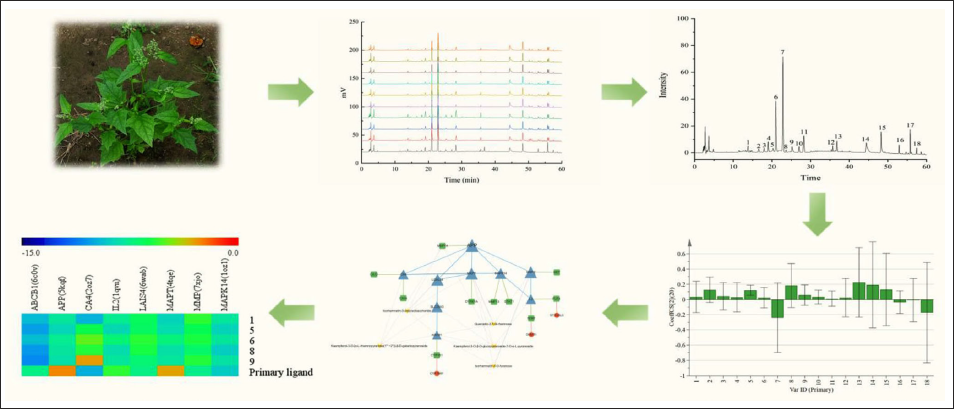
To verify results obtained using the abovementioned models, molecular docking-based “lock-and-key” molecular interaction models can be generated to simulate and predict interaction forces and binding modes between ligands and receptors to facilitate the optimization of molecular screening methods (Bolcato et al., 2019; Cuzzolin et al., 2015; Olivero-Acosta et al., 2017). Nevertheless, effective screening generally requires good chemical extraction yields. To meet this goal, here C. hybridum extraction methods incorporating different extraction solvents, extraction times, and sample-to-solvent ratios were tested and compared based on flavonoid content as the main indicator of extract quality. Next, the anti-ovarian cancer activities of C. hybridum extracts were evaluated using a method combining LC-MS and orthogonal partial least squares analysis to identify flavonoid components with potential anti-ovarian cancer activities. The method developed in this work (Figure 1) was simple, fast, accurate, and sensitive; and thus, it should be suitable for use in identifying flavonoid compounds in plants, foods, and herbal medications (Peng et al., 2019).
Schematic Showing Screening Strategy Used to Identify Bioactive Compounds Responsible for C. hybridum Anti-ovarian Cancer Activity.
Materials and Methods
C. hybridum was purchased from Beijing Tong Ren Tang Co., Ltd. (Changchun, China.). The plant specimen was deposited in the laboratory of the Jilin Ginseng Academy at Changchun University of Chinese Medicine, P.R. China. For use in experiments, 300 g of dried whole C. hybridum plants were pulverized and placed in a round-bottom flask followed by two 60-min reflux extractions in eight volumes of 70% ethanol per extraction. Next, both the extractions were pooled, and then, the suspension was mixed and filtered to remove particulates. Thereafter, the ethanol was removed by evaporation and the remaining solution was concentrated under reduced pressure to obtain a concentrated aqueous solution.
Human ovarian A2780 cells were purchased from the Cell Resource Center of the Institute of Basic Medicine, Chinese Academy of Medical Sciences. Other reagents that were purchased included fetal bovine serum (Gibco; USA), Trypsin (Amresco, USA), phosphate-buffered saline (PBS) and DMEM medium (Hyclone, USA), and dimethyl sulfoxide (Beijing Solebo Technology Co., China). Methanol and acetonitrile purchased from other suppliers were of chromatographic grade and other reagents were of analytical grade.
Equipment used in this study included an UltiMateTM 3000 series HPLC instrument and a Q-Exactive electrostatic field orbitrap high-resolution mass spectrometer (Thermo Fisher, USA), a Sartorius BP211D electronic balance (Beijing Dolis Balance Co., Ltd.), and a KQ3200BE ultrasonic cleaner (Kunshan Ultrasonic Instrument Co., Ltd.).
Determination of the Total Flavonoid Content
The total flavonoid content (TFC) was determined using a colorimetric method. Total polyphenol content (TPC) values from C. hybridum flavonoids extraction were analyzed using a colorimetric method. The various extracts were prepared as a 1 mg/mL 70% ethanol solution. Each extract (1 mL) was mixed with 0.3 mL of a 5% NaNO2 solution. The mixture was allowed to stay at room temperature for 6 min; 0.3 mL of a 10% AlCl3 × 9H2O solution was added for 6 min followed by the addition of a 4 mL 4% NaOH solution. The 60% ethanol solution (0.4 mL) was added to reach a final volume of 10 mL. The solution was mixed and kept at room temperature for 15 min. Absorbance was measured immediately against the prepared blank at 360 nm using a spectrophotometer. Comparisons were made against standards prepared Rutin. All samples were analyzed three times.
Optimization of C. hybridum Extraction Parameters
In the present study, the effects of all of the abovementioned factors on flavonoids extraction efficiency were assessed using an orthogonal L9(34) test design (Table 1), and then, the total evaluation index was determined using statistical analysis (Zhang et al., 2015; Ma’ayan et al., 2014).
Factor-level Table.

UPLC Fingerprint Analysis
Constituent compounds of C. hybridum extracts were identified via UPLC-Q-Exactive MS for samples dissolved in methanol to a concentration of 1 mg/mL, with samples applied to the column via automated injection. For chromatography, a Unitary C18 column (4.6 mm × 150 mm, 2.8 µm) was used with a mobile phase consisting of acetonitrile (A) and 1‰ formic acid (B) aqueous solution. Elution was performed using a binary linear gradient as follows: mobile phase gradient operated using settings of 0–25 min (10–20% A), 25–60 min (20–100% A), a flow rate of 0.3 mL/min, injection volume of 10 µL, column temperature of 30°C, and detection wavelength of 254 nm. For MS, an electrospray ionization source (ESI) was used and samples were scanned in positive and negative ion modes using the following settings: spray voltage of 2.5 kV, capillary temperature of 320°C, lens voltage of 50 eV, sheath gas pressure of 2.76 × 10⁵ Pa, auxiliary gas pressure of 6.89 × 10⁴ Pa, auxiliary gas temperature of 300°C, resolution of 70,000, and mass scanning range of m/z 100–1500.
Cell Lines and Cell Culture Conditions
Human ovarian A2780 cells were maintained in RPMI-1640 medium with 10% fetal bovine serum at exponential growth phase in a humidified atmosphere containing 5% CO2 at 37°C. For A2780 cell inhibition assays, the same medium was used to maintain the cells.
Tests to Determine Cell Viability
Microtiter 96-well plates were seeded with 1 × 10⁴ cells (suspended in 200 µL of medium)/well, and then, the plates were pre-incubated for 24 h at 37°C in a humidified atmosphere containing 5% CO2. A stock solution of C. hybridum extract was prepared and was serially diluted in RPMI-1640 medium. Serial dilutions were next added to wells at time zero. After incubation of plates for 24 h, 10 µL of MTS was added to each well. As assessed based on absorbance readings obtained at 490 nm using a 96-well INFINITE 200 PRO series microplate reader. Finally, the IC50 value of C. hybridum was determined for treated and untreated A2780 cells using GraphPad Prism 7 software.
Partial Least Squares Regression Analysis
Partial Least Squares (PLS) is a multivariate data analysis method, was conducted using SIMCA 11 software. For each experiment, data was acquired in triplicate and the results were expressed as the mean ± standard deviation (SD). To evaluate significant differences, IBM SPSS Statistics 19 was used, with the significance threshold set to p < 0.05.
Compound-target Network Construction
A comprehensive list of genes associated with ovariancancer was compiled from the Therapeutic Target Database (
Molecular Docking Studies
Molecular structures of extract compounds were downloaded from the PubChem database (
Next, crystal structures of targets were downloaded from the RCSB PDB database (
Results and Discussion
Effect of solvent to raw material ratio, number of extractions, extraction duration, and temperature on C. hybridum extract flavonoids content, (see Table 2).
Orthogonal Experimental Design Result.
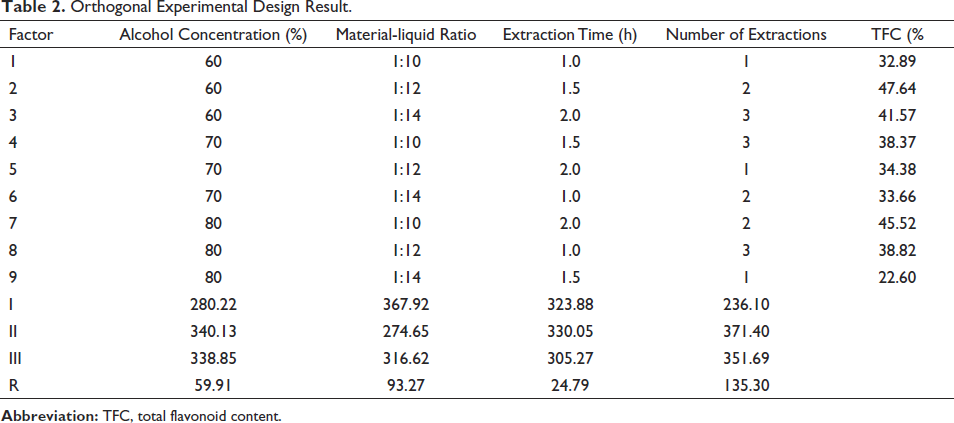
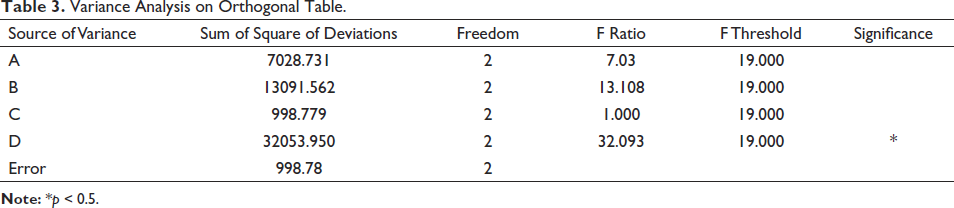
Based on quantitative analysis of dry extract weights and flavonoids content, the total flavonoids content of the crude extract was determined. While factors influencing extraction included solvent ratio, number of extractions, and duration of extraction. From the intuitive analysis results in Table 3, it can be seen that D>B>A>C, the total flavonoids content is the highest under the condition of A2B1C2D2, and the analysis of variance shows that the extraction time has the greatest influence. Combined with the results of the orthogonal test and analysis of variance, the best extraction process of total flavonoids is A2B1C2D2, with optimal values of 70%, 10:1, 2, and 1.5 h, respectively.
Variance Analysis on Orthogonal Table.
Fingerprint Establishment
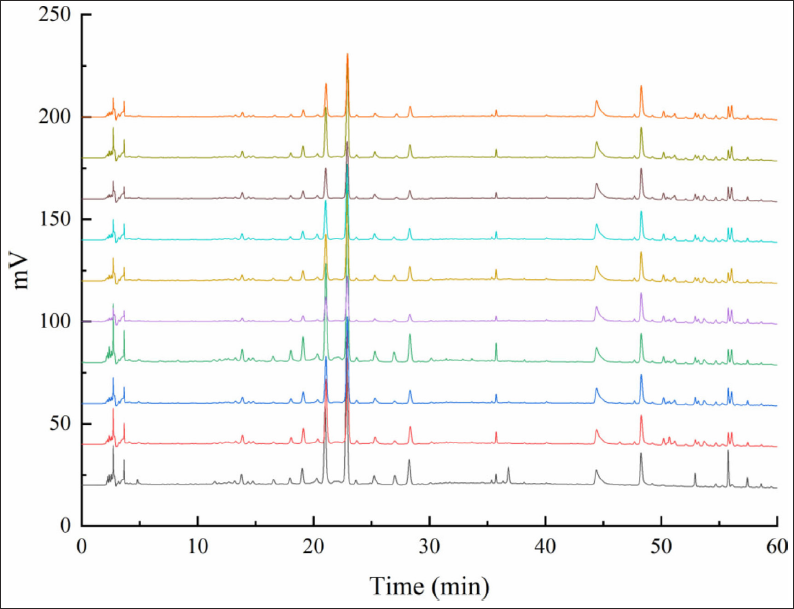
Extracts of C. hybridum obtained using different extraction methods were optimized and then used to optimize HPLC fingerprinting conditions that were used to determine HPLC fingerprints for 10 batches of samples (Figure 2). An HPLC fingerprint similarity evaluation system was used to determine common peaks and evaluate peak similarity (Chen et al., 2015; Ding et al., 2014; Wu et al., 2016).
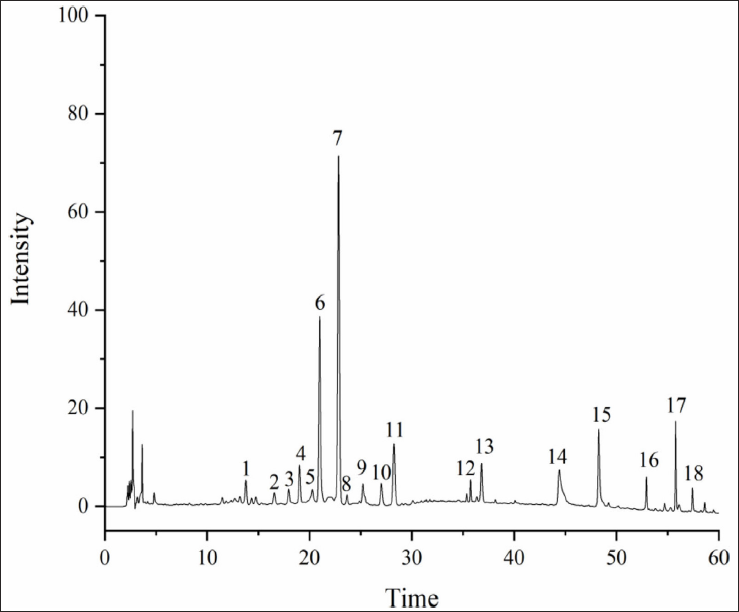
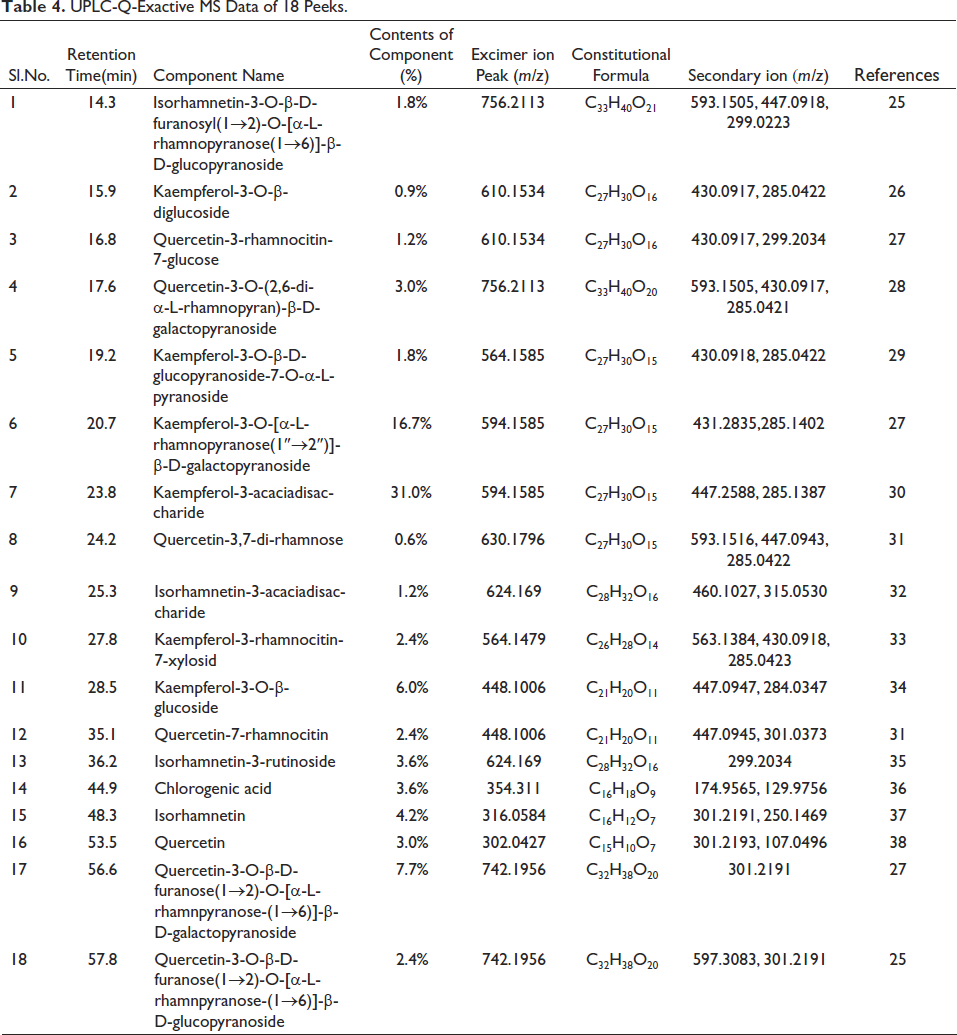
According to results of analysis of molecular ion peaks and main fragment peaks of each color spectrum were identified (Figure 3) and compared to results reported in the literature (Agnese et al., 2001; Bi et al., 2022; Cheng et al., 2002; Cui et al., 2003; El-Sayed et al., 1999; Huang et al., 2007; Ji et al., 2001; Lee et al., 2008; Rastrelli et al., 1995; Sun et al., 2020; Wang & Xu, 2015; Wei et al., 2007; Xieet al., 2002; Zhu et al., 2001). Ultimately, 17 flavonoids and one phenolic acid were identified in the crude C. hybridum extract (Table 4).
Reference Fingerprint for C. hybridum.
UPLC-Q-Exactive MS Data of 18 Peeks.
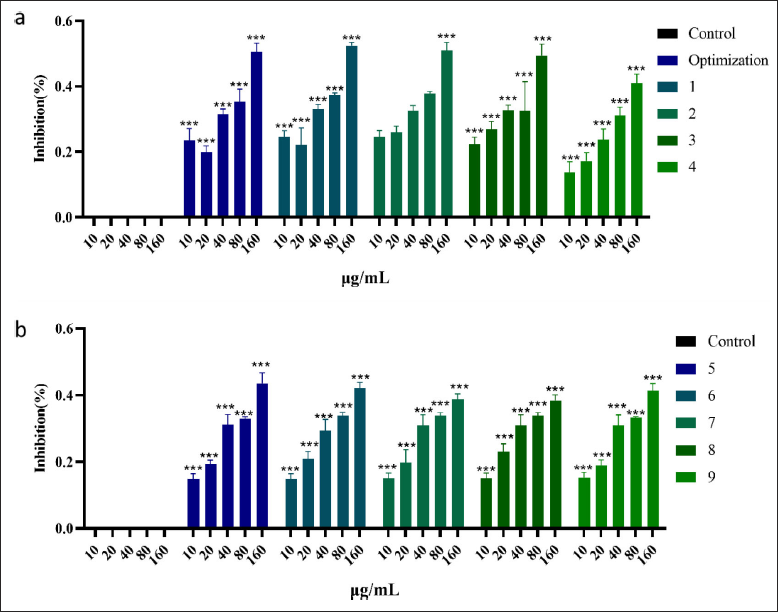
MTS Assay
C. hybridum extract is cytotoxic towards human ovarian A2780 cells. The suppression ratio of the extract on cell proliferation was determined using an MTS assay. The results revealed that the C. hybridum extract clearly exerted a significant concentration-dependent antiproliferative effect on A2780 cells (Figure 4).
Partial Least Squares Screening of Active Compounds
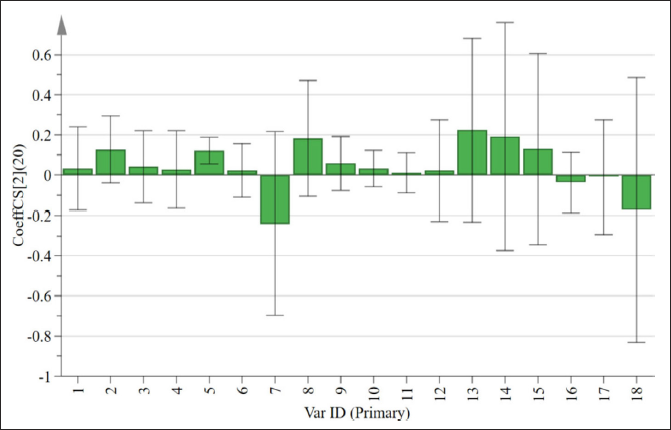
To predict potential C. hybridum active components, PLS was applied to selected initial data using parameter settings of the confidence level of 95%, R2 = (0.0, 0.954), Q2 = (0.0, –0.425) in order to establish an effective PLS model. The PLS model was then used to analyze weights of common peak areas exported from rapid resolution liquid chromatography (RRLC) spectra of 18 compounds in 10 extract samples (x-axis) that were plotted against cancer cell inhibition rate (y-axis) with a concentration of 80 µg/mL in order to screen for major compounds with anticancer cell bioactivity. The results revealed some Cr values that were greater than 0, which indicated positive correlations existed between some extract samples and cancer cell inhibition rate (Figure 5), with positive Cr values obtained for five potential C. hybridum compounds of isorhamnetin-3-O-β-D-furanosyl(1→2)-O-[α-L-rhamnopyranosyl(1→6)]-β–D-glucopyranoside (1), kaempferol-3-O-β-D-glucopyranoside-7-O-α-L-pyranoside (5), kaempferol-3-O-[α-L-rhamnopyranosyl(1″→2″)]-β-D-galactopyranoside (6), quercetin-3,7-di-rhamnose (8), and isorhamnetin-3-acacia disaccharide (9). Based on these results, additional studies were conducted to evaluate these compounds as potential anti-ovarian cancer bioactive compounds.
Network Pharmacological Analysis
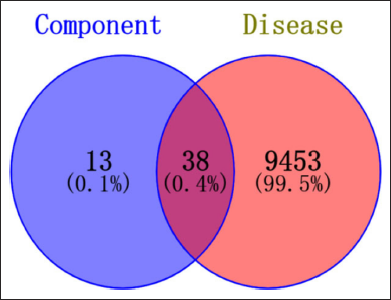
In this study, a total of five compounds with potential anti-ovarian cancer activity were identified via PLS analysis. According to the Therapeutic Target Database and DrugBank, 9491 directly-related ovarian cancer targets were screened as potential C. hybridum targets using Swiss Target Prediction, yielding 51 potential targets of the 5 C. hybridum compounds with anti-ovarian cancer activity. A Venn analysis of these targets and the 5 C. hybridum compounds with anti-ovarian cancer activity revealed 38 potential targets related to potential anti-ovarian cancer activities of the five C. hybridum compounds (Figure 6).
Venn Diagram of Components-targets.
After evaluating the topological parameters of the basic network, a compound-target network was constructed that contained five compounds and 20 targets (Figure 7). Through comprehensive evaluation of topological parameters and network stabilization, a final compound-target network containing putative major targets of C. hybridum was constructed. Analysis of the network revealed that isorhamnetin-3-O-β-D-furanosyl(1→2)-O-[α-L-rhamnpyranosyl(1→6)]-β-D-glucopyranoside (1), kaempferol-3-O-β-D-glucopyranoside-7-O-α-L-pyranoside (5), kaempferol-3-O-[α-L-rhamnopyranosyl(1″→2″)]-β-D-galactopyranoside (6), quercetin-3,7-di-rhamnose (8), and isorhamnetin-3-acacia disaccharide (9) were key bioactive compounds that were potentially responsible for C. hybridum anti-ovarian cancer activity.
Target-compound Network. Yellow Represents the Ingredient, Blue Represents the Primary Target, Green Represents the Secondary Target, and Red Represents the Tertiary Target.
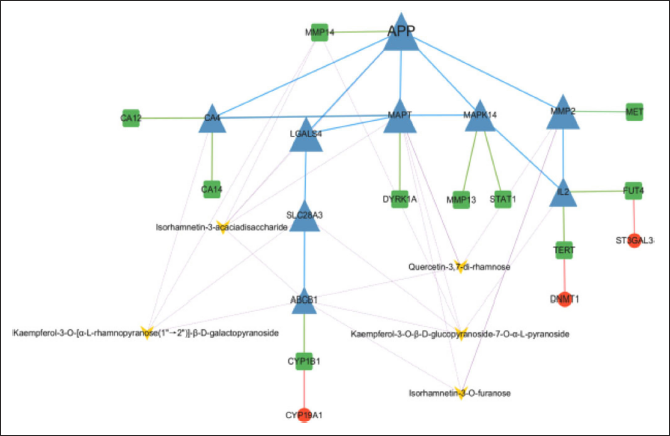
Based on component-target predictions obtained using the SWISS platform and intersecting ovarian cancer targets, here we identified 38 putative targets of the five selected C. hybridum compounds. Subsequent screening of putative targets using protein–protein interaction (PPI) analysis led to the identification of nine key potential targets, namely ABCB1, APP, CA4, IL-2, LGALS4, MAPT, MMP2, SLC28A3, and MAPK14. These nine targets were then imported into Cytoscape in order to generate a component tertiary target contact diagram (see Figure 7).
Molecular Docking Analysis
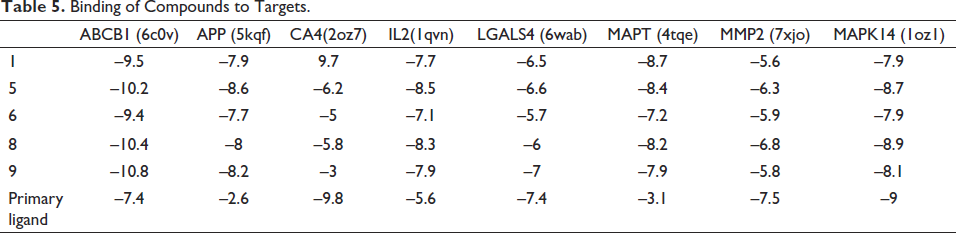
Table 5 shows molecular docking results between IL-2, ABCB1, APP, and MAPT targets and the five selected C. hybridum compounds. Notably, interactions between the five C. hybridum compounds and IL-2, ABCB1, APP, and MAPT targets were more substantial than docking interactions between these targets and their corresponding Primary ligands, warranting further study.
Binding of Compounds to Targets.
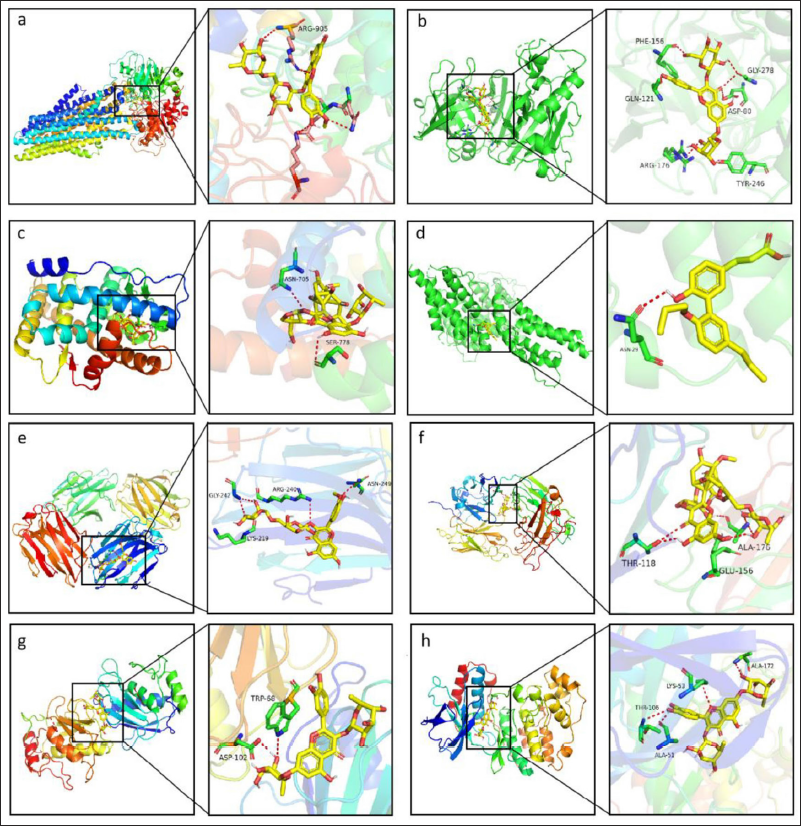
From Figure 8, it can be seen that the five C. hybridum compounds are each connected by at least one hydrogen bond to amino acid residues within the active centers of their respective targets, thus suggesting that these compounds mainly interact with their target proteins via hydrogen bonds and hydrophobic interactions, as consistent with results shown in Table 5 and Figure 8 and those reported in the literature. For example, results of a 2014 study by Gao B found that an ABCB1 blocker inhibited paclitaxel efflux from all ovarian cancer cell lines regardless of ABCB1 expression level, thus indicating that an ABCB1 transporter plays a key role in paclitaxel resistance of ovarian cancer cells. In another study (Gao et al., 2014), Duan et al. (2014) found that APP negatively regulated APP precursor protein hydrolysate. A activity during an in vitro fertilization study of plasma amyloid-β 40 regulation of ovarian cancer development (Duan et al., 2014). More recently, in 2020, Chulpanova et al. confirmed that amniotic fluid-derived mesenchymal stem cells (MSCs) expressing IL-2 could induce ovarian cancer cell apoptosis in vivo (Chulpanova et al., 2020), while the results of another study revealed that high expression of MAPT was linked to poor ovarian cancer prognosis, thus indicating that inhibition of MAPT expression could improve ovarian cancer prognosis (Schroeder et al., 2019).
Molecular Docking of the Five C. hybridum Active Compounds and Primary Ligands to Nine Potential Targets Based on the Lowest Binding Energy Configurations. The Figure was Prepared Using PyMOL, with a Panoramic View Shown at Left and Ligand Detail Map Shown at Right (a) ABCB1, 6c0v (isorhamnetin-3-acacia disaccharide), (b) APP, 5kqf (kaempferol-3-O-β-D-glucopyranoside-7-O-α-L-pyranoside), (c) CA4, 2oz7 (isorhamnetin-3-O-β-D-furanosyl(1→2)-O-[α-L-rhamnopyranose(1→6)]- β-D-glucopyranoside), (d) IL-2, 1qvn (kaempferol-3-O-β-D-glucopyranoside-7-O-α-L-pyranoside), (e) LGALS4, 6wab (isorhamnetin-3-acacia disaccharide), (f) MAPT, 4tqe (isorhamnetin-3-O-β-D-furanosyl(1→2)-O-[α-L-rhamnopyranosyl(1→6)]-β-D-glucopyranoside), (g) MMP2, 7xjo (quercetin-3,7-di-rhamnose), and (h) MAPK14, 1oz1 (quercetin-3,7-di-rhamnose).
Conclusion
In this study, the best extraction process of the total flavonoids content from C. hybridum was screened by orthogonal experiment; several C. hybridum compounds with potential anti-ovarian cancer activity were identified using UPLC-Q-Exactive MS combined with multivariate analysis (PLS analysis). Correlation analysis was studied to explore internal relationships between C. hybridum chemical constituents and pharmacological effects to discover active compounds responsible for known anti-ovarian cancer therapeutic effects of C. hybridum. It is a method for feasible, rapid, and useful screening of potential components. Molecular docking results revealed five potential bioactive C. hybridum compounds with anti-ovarian cancer activity that were predicted to competitively bind to IL-2, MAPT, LGALS4, and MMP2 cancer cell targets. And from the results of molecular docking, it can be clearly found that these components are supported by relevant literature, which proves the accuracy and feasibility of screening active components by this method. Furthermore, screening methods based on such models offer advantages of simple execution, rapid and accurate results, high-throughput capacity, and low cost that make it possible to quickly screen TCMs for potentially active compounds from a large number of chemical components. This provides a reference for the application and further development of C. hybridum in anti-ovarian cancer.
Footnotes
Acknowledgments
This work was financially supported by Jilin Science andTechnology Development Plan Project (No.20200404084YY), Development Plan Project of Education Department of JilinProvince (No.JJKH20201049KJ).
Abbreviations
UPLC: Ultra performance liquid chromatography; MS: Mass spectrometry; m/z: Mass-to-charge ratio; HPLC: High performance liquid chromatography; ECD: Electrochemical detection; DMEM: Dulbecco’s modified eagle medium; PBS: Phosphate-buffered saline; TFC: Total flavonoid content; TPC: Total polyphenol content.
Authors Contribution
Conceptualization, R.-X.L. and S.-L.Y.; Methodology, X.-Q.F.; Validation, D.-D.C.; Formal analysis, X.-Q.F. and D.-D.C.; Investigation, X.-Q.F.; Resources, R.-X.L.; Data curation, S.-L.Y. and X.-Q.F.; Writing—original draft preparation, D.-D.C.; Writing, review and editing, R.-X.L.; Visualization, D.-D.C.; Supervision, R.-X.L.; Project administration, S.-L.Y.; Funding acquisition, R.-X.L. and S.-L.Y. All authors commented on previous versions of the manuscript. All authors read and approved the final manuscript.
Declaration of Conflicting Interests
The authors declared no potential conflicts of interest with respect to the research, authorship, and/or publication of this article.
Funding
Jilin Science and Technology Development Plan Project (No.20200404084YY), Development Plan Project of Education Department of Jilin Province (No.JJKH20201049KJ).
