




Abstract
Background
Quartz album is one of the mineral drugs commonly used in Chinese medicine. Different geogenesis of Quartz album led to differences in its composition and thus affected its clinical efficacy. Mineral Chinese medicines are mainly composed of inorganic elements, including some heavy metals and harmful elements, so their quality control is crucial to their clinical safety.
Materials and Methods
In this study, the contents of 30 elements in 13 batches Quartz album of different origins were determined by inductively coupled plasma mass spectrometry (ICP-MS). Multiple elements and chemometrics were used to distinguish its different geogenesis.
Results
We found that the top elements in order of content were as follows: Al>Fe>Ca>K>Mg>Ti>Mn, all with content greater than 100 µg/g. In addition, the contents ranges of Pb, Cd, As, Hg, and Cu were 1.603–637.705, 0.011–1.387, 0.348–41.298, 0.033–10.877, and 0.808–86.482 µg/g, respectively. Quartz albums produced in Fengyang County, Anhui Province, had the lowest content of heavy metals. Correlation analysis showed that there was a strong correlation among the elements in the samples. Chemometrics were used to analyze the elemental content, and the results of the different models were found to be consistent and could be used to distinguish between Quartz albums of different geogenesis.
Conclusion
This study provided a reference for the quality control and safety of the clinical application of Quartz album.
Keywords
Introduction
Quartz album is a mineral belonging to the quartz group, containing mostly silicon dioxide (SiO2). It has a long history of clinical use in Chinese medicine, beginning in the Shen Nong Ben Cao Jing in 25–220 AD (Eastern Han dynasty of China). It has the effects of warming the lungs and kidneys, calming the mind, and facilitating urination. It is mainly used clinically for coughing and asthma with cold deficiency, impotence, thirst, restlessness of the mind, palpitation, and forgetfulness (Nanjing University of Chinese Medicine, 2006).
Mineral medicine is one of the important classifications of Chinese medicine, and the quality control of the drug is a guarantee of the safety of clinical use. There are different types of geogenesis for the same mineral, and Quartz album is no exception. The various genetic types of Quartz album reflect differences in the geological environment and physico-chemical conditions of the formation process at the time, and such differences can be evident in the elemental composition.
The traditional quality assessment considers Quartz album to be white and free of impurities, lacking an evaluation of its intrinsic composition. Several scholars have studied the identification and quality control of Quartz albums. Zhang et al. (2017) established the X-ray diffraction spectra and Raman fingerprint characteristics of white Quartz, which can be used as a rapid and accurate means to distinguish white Quartz from its counterfeit counterparts. The mineralogical characteristics and chemical elements of Quartz album in Guizhou province were determined by Dai (1990), and the results showed that white Quartz contains Si, Ca, Fe, Mg, Al, Mn, Pb, Cu, and Ti, with Si content >90%, followed by Ca, Fe, Mg, and Al, and then Mn, Pb, Cu, and Ti. The above studies contribute to the study of identification and quality control of Quartz album, but there is a lack of identification and quality control of Quartz album of different geogenesis. In order to improve the overall quality control of Quartz album, Xu et al. (2022) established its characteristic spectrum by the X-ray diffraction method, which can be used for the identification of Quartz album. In order to further clarify the elemental composition of Quartz album in different geogenesis, 30 elements were determined by inductively coupled plasma mass spectrometry (ICP-MS) in this study to provide an experimental basis for the quality control of Quartz album.
At present, we mainly use ICP-MS, inductively coupled plasma optical emission spectrometry (ICP-OES), and atomic absorption spectrometry (AAS) to determine the elements in mineral Chinese medicines. ICP-MS has gradually developed into a key technology for the quality evaluation of mineral drugs because it can achieve simultaneous determination of multiple elements with high sensitivity, low detection limits, a wide dynamic linear range, low interference, and high analytical speed (Zhuo et al., 2021). Liu et al. (2019) have applied ICP-OES and ICP-MS to determine the contents of 22 inorganic elements in calcined alumen and processed products of ammonium alum and successfully established the characteristic spectra of inorganic elements in them, which can be used for the quality control of calcined alumen. In the previous study, Liu et al. (2017) first determined the contents of six metal elements (Fe, Zn, Mn, Mg, Ca, Co, and Ni) in pyrite powders using ICP-OES and found that the contents of Fe, Zn, and Mn increased, while the contents of As decreased sharply after processing. In addition, Zhu et al. (2018) measured the concentrations of calcium, phosphorus, magnesium, iron, and zinc in healed tibial tissues of rats using ICP-OES to assess the therapeutic effect of pyritum on bone defects.
Most mineral Chinese medicines contain heavy metals and other harmful elements such as Pb, Hg, Cd, Cu, and As. Therefore, the accurate determination of these harmful elements is important for ensuring their quality control and safety during clinical application. Since Quartz album has a variety of causes, its quality is mainly controlled by trait evaluation, making it difficult to guarantee the safety of its clinical application. In this experiment, we used ICP-MS to simultaneously determine 30 elements in Quartz album from different origins and to establish a method to differentiate Quartz album species based on multiple elements and chemometrics to improve its quality control.
Materials and Methods
Samples
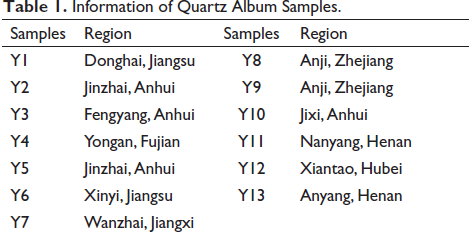
A total of 13 samples of Quartz album were collected from the main producing areas of China. The samples included two samples from Jiangsu Province, four samples from Anhui Province, one sample from Fujian Province, one sample from Jiangxi Province, two samples from Zhejiang Province, one sample from Hubei Province, and two samples from Henan Province (Table 1). The samples were authenticated by Professor Dekang Wu of the Nanjing University of Chinese Medicine. A voucher specimen was deposited in the Teaching and Research Section of Authentication of Chinese Materia Medica, School of Pharmacy, Nanjing University of Chinese Medicine, China.
Information of Quartz Album Samples.
Reagents and Instrumentation
All aqueous solutions were prepared using deionized water (18.2 MΩ cm) produced using a Milli-Q water purification system (Millipore Corp., Bedford, MA, USA) (nitric acid (HNO3, excellent grade pure, Merck, batch number: K51189956909); hydrofluoric acid (HF, pure grade, Sinopharm Chemical Reagent Co., Ltd, Batch: 20150807); argon (purity greater than 99.999%, Nanjing Tianze Gas Co., Ltd.)).
Inductively coupled plasma-mass spectrometer (NexION 350D ICP-MS, PerkinElmer, USA). Electronic analytical balance (ME104E/02, Mettler Toledo Instruments Co., Ltd.). Microwave digestion instrument (MARS 6CLASSIC, CEM). Intelligent temperature control electric heating plate (DKQ-1800, Shanghai Yi Yao Instrument Technology Development Co., Ltd.).
Calibration Standards
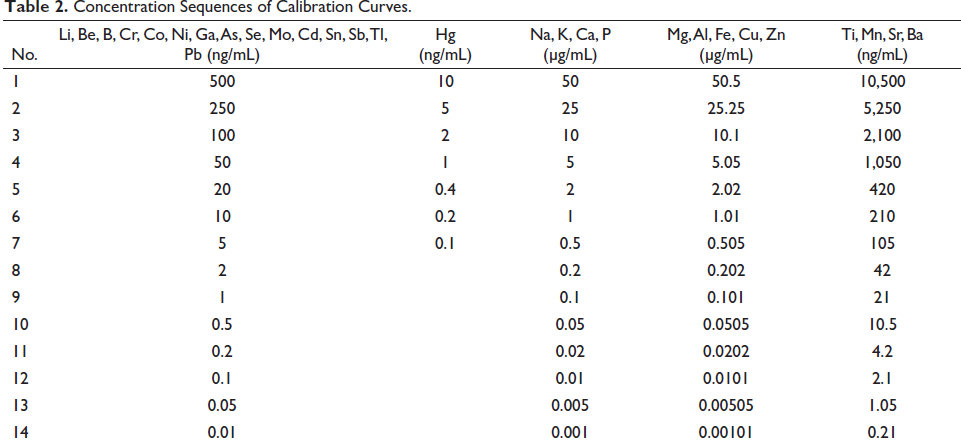
The diluent for calibration standards was composed of 1% HNO3. For simultaneous quantification of 30 elements in Quartz, the stock solution mixtures were prepared by mixing five multi-element standard solutions (Table 2). 74Ge, 103Rh, and 158Tb were used as internal standard elements and diluted to 50 ng/mL with 1% nitric acid.
Concentration Sequences of Calibration Curves.
Sample Preparation and Microwave Digestion
Samples (0.2 g) were accurately weighed in a polytetrafluoroethylene digestion vessel, and then 4 mL of hydrofluoric acid and 1 mL of nitric acid were added. After tightening the lid of the digestion vessel, digestion was performed according to the following procedure (Table 3). After cooling to room temperature, 5 mL of nitric acid (25%) was added to dissolve the residue, and then the samples were transferred into apolyethylene volumetric flasks and filled with ultrapure water to a final volume of 50 mL. Blank samples were prepared as described above. Among them, Y2, Y9, and Y10 samples were diluted 10 times to measure the Hg element, and the Y5 sample was diluted 10 times to measure the Pb element.
Microwave Digestion Parameters.

ICP-MS Analysis and Method Validation
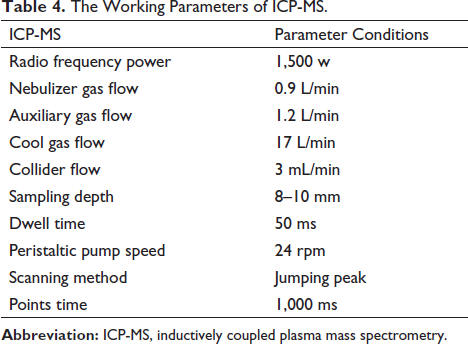
The parameter conditions used in ICP-MS are summarized in Table 4. Method validation was performed, including calibration curve linearity, precision, stability, repeatability, and recovery. The ranges for calibration curves were tested to ensure sufficient coverage for the concentration of concerned elements in these tested samples. Correlation coefficient (R2) values were determined to assess the linearities. For each element, the limits of detection (LOD) were calculated by measuring three times the standard deviation of the blank samples. A sample (Y7) was used to assess the stability, repeatability, and recovery of the method.
The Working Parameters of ICP-MS.
Statistical Analysis
Data were expressed as mean ± SD, and SPSS 25.0 was used for correlation analysis of experimental data. The correlations of all elements in the Quartz album samples were evaluated using a Pearson’s correlation test. The principal component analysis (PCA) and orthogonal-partial least squares discrimination analysis were used with SIMCA-P 14.1. P < 0.05 indicates a significant correlation, and p < 0.01 indicates a highly significant correlation.
Results
Method Validation
The validation parameters of the analytical method are shown in Table S1 (in a supplemental document). Good linearity was observed in each concentration range, with R2 > 0.9976. The RSDs of precision, stability, and repeatability were no more than 13.94%. The recovery ranged from 62.63%–115.03%. This indicated that our established method meets the requirements for the determination of 30 elements.
Elements Concentration in Quartz Album
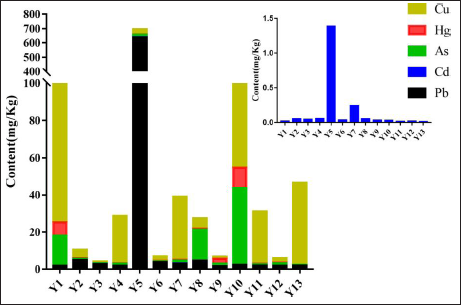
The results of the content determination of 30 elements in 13 batches of samples are shown in Table S2 (in a supplementary document). There was a greater amount of Al, Fe, Ca, K, Mg, Ti, and Mn, with 3,399.6, 1,762.9, 1,649.4, 1,175.5, 319.5, 223.8, and 130.8 µg/g, respectively. Second, Na, Pb, Ba, Cu, P, and Zn elements exceeded 20 µg/g. All remaining elements had content below 20 µg/g. The contents of Pb, Cd, As, Hg, and Cu are shown in Figure 1.
The Contents of Pb, Cd, As, Hg, and Cu in Quartz Album Samples.
Correlation Analysis
A correlation analysis was performed to determine possible relationships between 31 elements, combined with our previous studies on elemental silicon content (Xu et al., 2022). A correlation coefficient close to 0 indicates little or no correlation between two elements, whereas a value close to +1 or −1 indicates a high positive or negative correlation. The results of the correlation matrix of elements are shown in Table S3 (in a supplemental document). Based on correlation matrix analysis, 46 pairs of elements in the Quartz album showed significant positive correlations (p < 0.01): Li-Be, Be-Al, Be-Ti, Be-Tl, Mg-Al, Mg-Ca, Mg-Ti, Mg-V, Mg-Fe, Mg-Ga, Mg-Sr, Mg-Ba, Al-K, Al-Ti, Al-V, Al-Ga, Al-Tl, Si-Ni, P-Se, K-Ti, K-V, K-Ga, K-Mo, K-Ba, K-Tl, Ti-V, Ti-Ga, Ti-Ba, Ti-Tl, V-Mn, V-Fe, V-Ga, V-Se, V-Mo, V-Ba, V-Tl, Mn-Fe, Zn-Cd, Ga-Mo, Ga-Ba, Ga-Tl, As-Hg, Mo-Ba, Mo-Tl, Cd-Sn, Ba-Tl. Positive correlations were found between 45 pairs of elements (p < 0.05): Li-Co, Li-Mo, Li-Tl, Be-K, Be-V, Be-Mo, B-Ti, B-Sr, B-Sn, Mg-K, Mg-Mn, Mg-Se, Mg-Sn, Mg-Tl, Mg-Pb, Al-Fe, Al-Mo, Al-Sn, Al-Tl, P-Ti, P-v, P-Ba, K-Sn, Ca-Mn, Ca-Zn, Ca-Mo, Ca-Cd, Ti-Fe, Ti-Se, Ti-Sr, Ti-Mo, V-Sr, Mn-Ga, Mn-Ba, Fe-Ga, Fe-Sb, Fe-Ba, Fe-Tl, Ga-Sb, Se-Sr, Se-Ba, Se-Tl, Se-Pb, Sr-Sn, Sr-Ba. There was a significant negative correlation between three pairs of elements (p < 0.01): Si-Se, Si-Sr, Si-Sn. There were six pairs of elements that were negatively correlated (P < 0.05): Li-Co, Be-Co, Mg-Si, Si-Pb, NI-Sn, NI-Pb. Positive correlations indicated that the above 91 pairs of elements could enrich each other during Quartz album mineral formation. The negative correlation indicated that the above nine pairs of elements could antagonize each other’s enrichment during Quartz album formation.
Hierarchical Clustering Heat Map Analysis
Paisano’s cloud analysis platform (
Hierarchical Clustering Heat Map of 31 Elements.
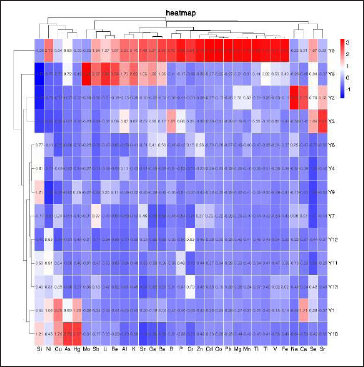
In addition, 31 elements were clustered into four groups: Si, Ni, Cu, As, and Hg were clustered into one group; Mo, Sb, Li, and Be were clustered into one group; Al, K, Sn, Ga, Ba, B, P, Cr, Zn, Cd, Co, Pb, Mg, Mn, Ti, Tl, V, and Fe were clustered into one group; Na, Ca, Se, and Sr were clustered into one group.
PCA and Comprehensive Evaluation
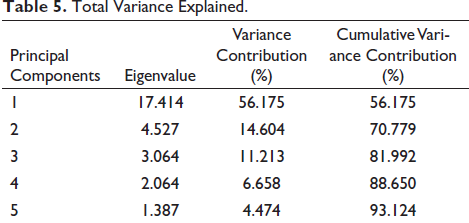
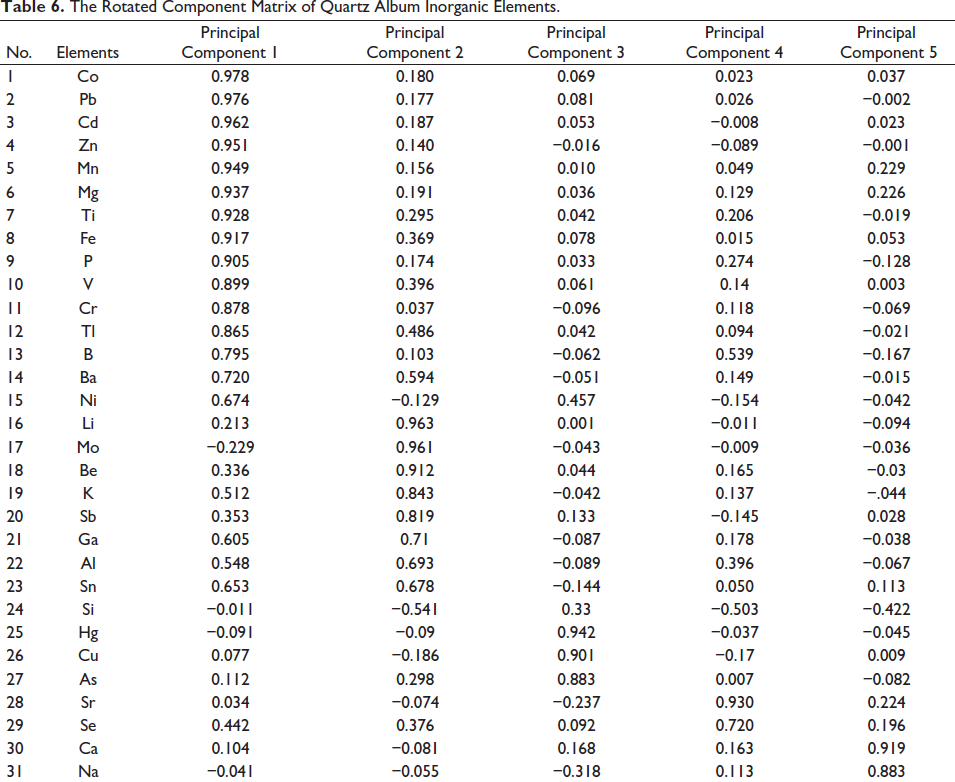
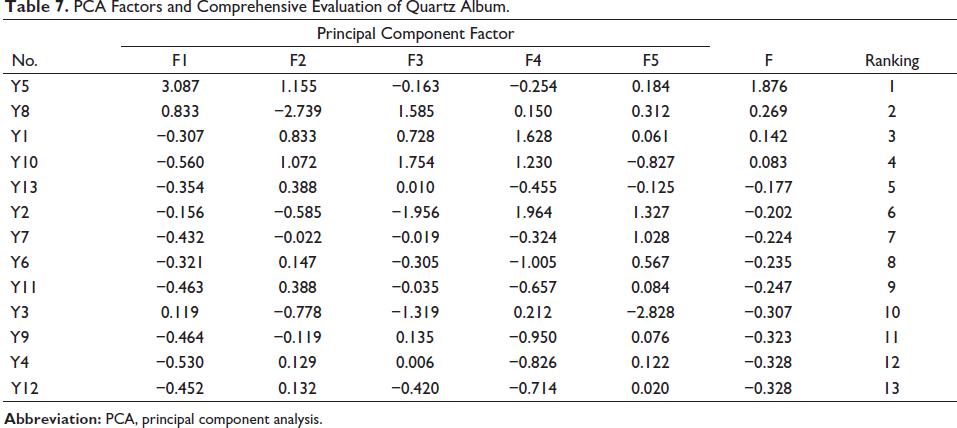
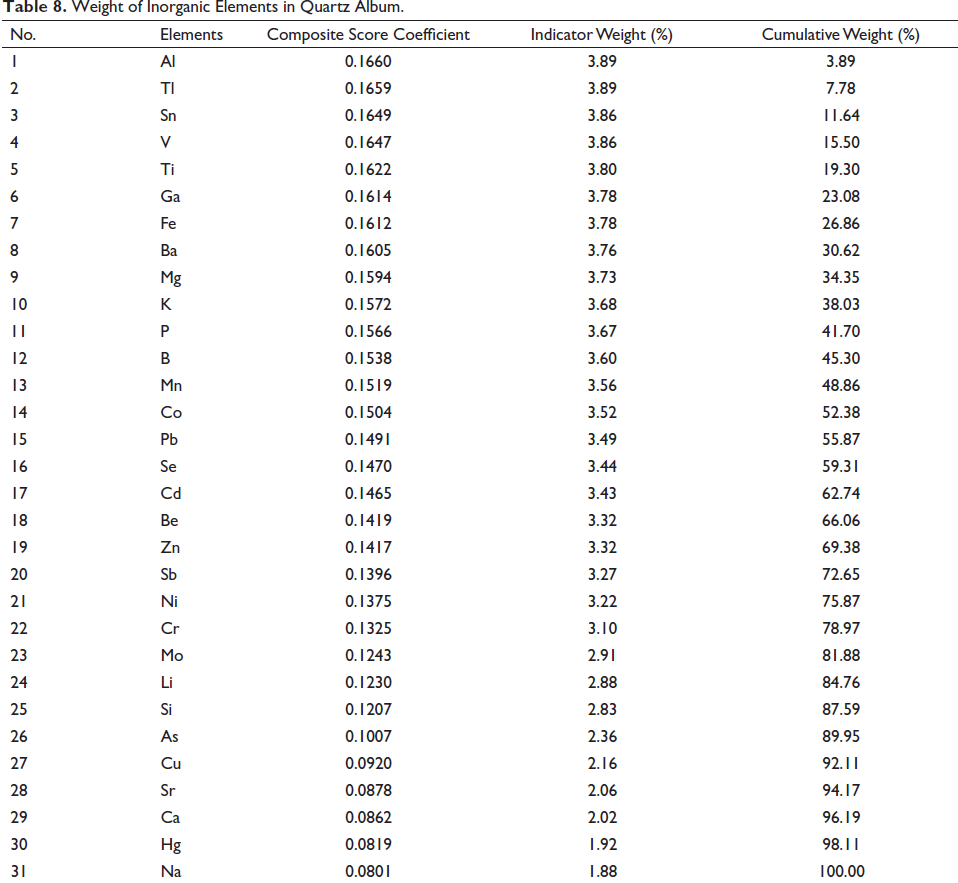
A PCA was performed on the content of 31 inorganic elements in Quartz album, and the results of eigenvalue and contribution analysis are shown in Table 5. The results showed that the first five eigenvalues were all greater than 1, and the cumulative contribution rate reached 93.124%, indicating that the first five principal components played a dominant role in the elemental composition of Quartz album. The rotated factor loading matrices were constructed for the first five principal components, and the results are shown in Table 6. In addition, the two principal components with the highest contribution rates were selected to construct the loading maps, and the results are shown in Figure 3(A). We could see that Sr, Li, Be, K, Al, Sb, Sa, Sn, Ga, Ba, Tl, B, P, Fe, V, Ti, Mn, Cr, Co, Mn, Zn, Cd, and Pb were all located in the first quadrant, indicating that these 23 elements showed positive correlations in the first two principal components. The element Si was located in the third quadrant, indicating a negative correlation with the first two principal components. The remaining seven elements were located in the second and fourth quadrants, showing negative correlations with the first two principal components to different degrees. The total factor score value F was calculated for each sample according to the following formula: F = 0.56175F1 + 0.14604F2 + 0.11213F3 + 0.06658F4 + 0.04474F5, and the ranking is shown in Table 7. The comprehensive score model was established based on the elements with cumulative weights over 80% and the contribution of each element to the five principal components, as shown in Table 8. The results showed that the following 23 elements: Al, Tl, Sn, V, Ti, Ga, Fe, Ba, Mg, K, P, B, Mn, Co, Pb, Se, Cd, Be, Zn, Sb, Ni, Cr, and Mo, with a cumulative weight of 81.88%, could be used as constituent elements reflecting the characteristics of different types of Quartz album.
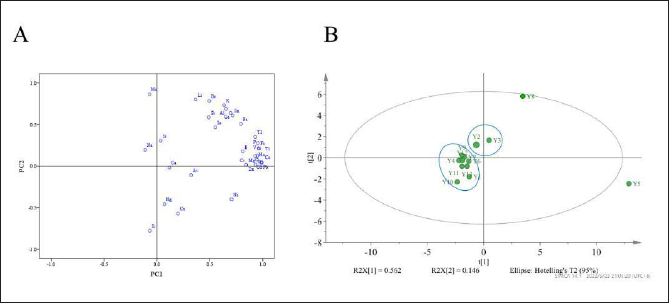
Total Variance Explained.
The Rotated Component Matrix of Quartz Album Inorganic Elements.
PCA Factors and Comprehensive Evaluation of Quartz Album.
Weight of Inorganic Elements in Quartz Album.
The plot of the PCA is shown in Figure 3(B). The results showed that samples Y5 and Y8 were in a separate category, Y2 and Y3 were grouped into one category, and Y6, Y4, Y9, Y7, Y12, Y11, Y13, Y1, and Y10 were grouped into one category. This result was consistent with the results of hierarchical cluster analysis.
OPLS-DA
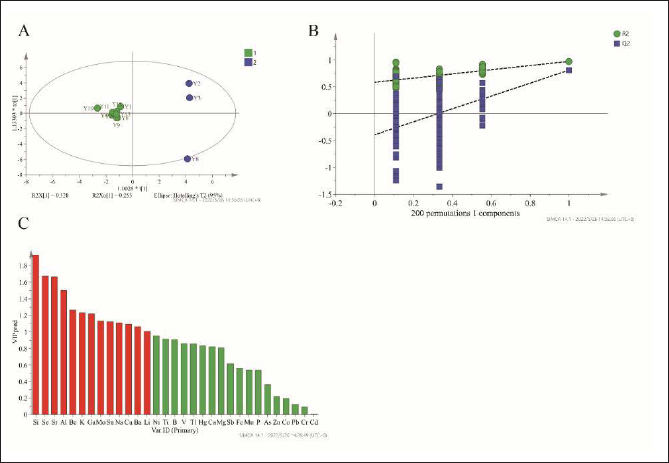
The orthogonal partial least squares method (OPLS-DA) was used to analyze the repertoire between different types of Quartz album, with green points representing vein quartz and blue ones representing quartz sandstone, and the results are shown in Figure 4(A). The convergence of Quartz albums of the same type was obvious and had a clear distinction from the other samples. In addition, there was no overlap between the samples of different types, indicating that OPLS-DA can distinguish different types of Quartz album well. The model’s explanatory rate (R2) and predictive power parameters (Q2) were 0.971 and 0.890, respectively, indicating that this model has good stability and homogeneity of predictive power. The above model was validated using a permutation test (n = 200), and the test parameters R2 = (0.0, 0.584) and Q2 = (0.0, −0.393) were obtained; the results are shown in Figure 4(B). We could see that the R2 and Q2 values generated by the random permutation were smaller than the original values, indicating that the proposed OPLS-DA model was not overfitted and could effectively identify different types of Quartz album. Figure 4(C) shows the VIP ranking of the 31 elements, where the elements with VIP > 1 were Si, Se, Sr, Al, Be, K, Ga, Mo, Sn, Na, Cu, Ba, and Li, which could be used as specific elements to distinguish different types of Quartz albums.
Discussion
Mineral Chinese medicines are mainly composed of inorganic elements, and the inorganic elements contained in them are closely related to their effects. In this study, we established a method for the simultaneous determination of 30 elements in Quartz album using the ICP-MS. Our study found that Al, Fe, Ca, K, Mg, Ti, and Mn were most abundant in Quartz album, all of which were greater than 1,000 µg/g, followed by Na, Pb, Ba, Cu, P, and Zn elements. Iron homeostasis has an important role in the body’s normal function, and iron is involved in the physiological functions of immunity as well as hematopoiesis and in pathological processes such as inflammation, infectious diseases, and iron death (Fernández-García et al., 2022; Fuhrmann & Brüne, 2022). Iron is essential for proper sperm development and function and can affect all aspects of male reproductive health; too much or too little can cause abnormalities in reproductive function (Gabrielsen et al., 2018). Calcium is the most important nutrient, essential not only for bone health but also for neuromuscular activity, heart rate regulation, immune function, and other key physiological processes (Martiniakova et al., 2022). Phosphorus is an essential micronutrient that plays an important role in energy metabolism, intracellular signaling, and acid-base homeostasis (Ciosek et al., 2021). Magnesium is the basis of ATP; is involved in regulating the activity of about 300 enzymes for synthesizing proteins, carbohydrates, and nucleic acids; and is important for maintaining normal neuromuscular function (Castiglioni et al., 2013). Magnesium enhances the immunosuppressive effect of dexamethasone on airway inflammation and has the potential to reduce asthma symptoms in patients with reduced responses to corticosteroids (Moon et al., 2021). Metallic elements are inextricably linked to sleep and cognitive performance. Studies have found a negative association between total zinc and copper intake and low cognitive performance (Li et al., 2019). In addition, a study showed that total intake of zinc, iron, and copper was negatively associated with depression (Li et al., 2018). Zinc is essential for synaptic neuronal transmission and is associated with the sleep-wake cycle and circadian rhythm (Bhatnagar & Taneja, 2001). One study found that serum zinc and the zinc/copper ratio were negatively correlated with long sleep duration, and serum copper was positively correlated with long sleep duration (Jia et al., 2022). Elemental silicon (Si) promotes osteogenic differentiation of human adipose-derived stem cells, thus contributing to bone tissue regeneration (Chen et al., 2022c). In addition, hydroxyapatite doped with both Sr and Si elements exhibited optimal osteogenesis compared to the addition of one element alone (Gao et al., 2016). Selenium (Se) is essential for the reproductive success of males and can influence sperm formation and quality by affecting mitochondrial DNA copy (Chen et al., 2023). These studies may partially explain the relationship between the metal elements in Quartz and its traditional effects, but the exact mechanism of action deserves further study.
Mineral Chinese medicines have been used in clinical practice for thousands of years; however, with the widely reported toxicity associated with heavy metals, the safety of Chinese medicines has been questioned (Chen et al., 2022b). The heavy metals and harmful elements in mineral Chinese medicines of most concern include Pb, Cd, As, Hg, and Cu, which are potentially toxic to the human brain, kidneys, and liver (Sarkar et al., 2022). However, mineral Chinese medicines are mainly derived from natural ores and contain elements such as As, Hg, and Pb, such as cinnabar, realgar, lead tetroxide, and so on (Li et al., 2022). We found that the ranges of Pb, Cd, As, Hg, and Cu contents in the 13 batches of Quartz album samples were 1.603−637.705 mg/kg, 0.011−1.387 mg/kg, 0.348−41.298 mg/kg, 0.033−10.877 mg/kg, and 0.808−86.482 mg/kg, respectively. The current Chinese Pharmacopoeia limits for heavy metals in herb drugs are as follows (National Pharmacopoeia Committee, 2020): Pb ≤ 5 mg/kg, Cd ≤ l mg/kg, As ≤ 2 mg/kg, Hg ≤ 0.2 mg/kg, and Cu ≤ 20 mg/kg. Under this standard, only the Y3 samples from Fengyang County, Anhui, met the limit. Fengyang quartz deposit has less heavy metal content due to the metamorphic remelting effect, which makes the ore composition more pure (Zhang & Chu, 2009). From this perspective, the safety of clinical application of Quartz album from Fengyang County, Anhui Province, was better than other origins. However, the content of heavy metals in the Quartz album is not limited by the current legal standards of China. We suggest that the limit of heavy metals be set according to the characteristics of mineral Chinese medicines, but this is a difficult point in the quality control of mineral Chinese medicines.
Chemometric analysis can help us better distinguish samples of different origins by analyzing the large amount of data obtained by the instrument, and this method has been extensively used in the chemical analysis of Chinese medicine. Shuai et al. successfully developed a method based on chemical composition combined with chemometrics to identify American ginseng of different origins (Shuai et al., 2022). Chen et al. provided a reliable method for identifying peanuts of different geographical origins based on inorganic elements and chemometric analysis (Chen et al., 2022a). In our study, we first performed a hierarchical clustering analysis on 13 batches of Quartz album and found that they fall into two main categories. Then the PCA was performed, and the cumulative contribution of the five selected principal components reached 93.124%, which could objectively reflect the elemental composition of Quartz album, and the analysis results were consistent with the cluster analysis. Fi Finally, we established an orthogonal partial least squares analytical model with good stability and predictive ability and found that Si, Se, Sr, Al, Be, K, Ga, Mo, Sn, Na, Cu, Ba, and Li can be used as specific elements to distinguish different types of Quartz album. The model we established can be effective in identifying different types of Quartz albums.
Conclusion
We have successfully developed an ICP-MS method to simultaneously determine 30 elements in the Quartz album. Fe, Ca, K, Mg, Ti, and Mn were most abundant in the Quartz album, followed by Na, Pb, Ba, Cu, P, and Zn. The contents of Pb, Cd, As, Hg, and Cu were the lowest in the Quartz album produced in Fengyang County, Anhui Province. The PCA and hierarchical clustering analysis have consistent results in distinguishing Quartz albums of different geogenesis. Orthogonal partial least squares analytical results showed that Si, Se, Sr, Al, Be, K, Ga, Mo, Sn, Na, Cu, Ba, and Li could be used as specific elements to distinguish different types of Quartz album. Overall, this study provided a method to distinguish the different types of Quartz album, which helps to improve its quality control and provides a reference for its rational and safe clinical use.
Footnotes
Summary
An ICP-MS method was successfully developed for the simultaneous determination of 30 elements in Quartz album.
Chemometrics analysis has shown that Si, Se, Sr, Al, Be, K, Ga, Mo, Sn, Na, Cu, Ba, and Li can be used as specific elements to distinguish different geogenesis of Quartz album.
Quartz album from Fengyang County, Anhui Province, had the lowest heavy metal content, and its clinical application was safer than that of other origins.
Abbreviations
ICP-MS: inductively coupled plasma mass spectrometry; OPLS-DA: the orthogonal partial least squares method; PCA: principal component analysis; ICP-OES: inductively coupled plasma optical emission spectrometry; AAS: atomic absorption spectrometry.
Acknowledgments
The authors thank the Analytical Testing Center of Nanjing University of Chinese Medicine for providing technical support for ICP-MS analysis.
Data Accessibility
The datasets supporting this article have been uploaded as part of the Supplementary Material.
Declaration of Conflicting Interests
The authors declared no potential conflicts of interest with respect to the research, authorship, and/or publication of this article.
Funding
The authors disclosed receipt of the following financial support for the research, authorship, and/or publication of this article: This work was supported by the 4th National Survey of Chinese Materia Medica Resources-Mineral Chinese Medicine Resources Survey Project (GZY-KJS-2018-004), the Strategic Research Project on the Modernization of Mineral Chinese Medicines of the Science and Technology Committee of the Ministry of Education of the People’s Republic of China (2021), and the Bethune Charitable Foundation (No. BCF-XD-ZL-20220118-002).
Statement of Informed Consent and Ethical Approval
This study does not include animal and human experiments and does not require informed consent or ethical approval.
