




Abstract
Background
Self-report questionnaires assessing psycho-social constructs such as values, empathy, personality, mindfulness and resting-state cognition are widely used in psychological research. Given India’s collectivistic cultural orientation—emphasising interdependence and social harmony—these instruments may function differently than in Western settings.
Purpose
This study evaluated five widely used instruments—the Revised Portrait Value Questionnaire (PVQ-RR), Interpersonal Reactivity Index (IRI), Five Facet Mindfulness Questionnaire (FFMQ), International Personality Item Pool’s Big Five Inventory (IPIP-BFI), and Amsterdam Resting-State Questionnaire (ARSQ)—to determine their construct validity, internal consistency, and construct dimensionality within an Indian university student sample.
Methods
A sample of 580 Indian university students (291 females; M = 22.5 ± 4.45 years) completed self-report questionnaires—PVQ-RR, IRI, IPIP-BFI and FFMQ—whose internal consistency, factorial validity, and structural deviations were examined employing Internal Consistency, Exploratory Factor Analysis (EFA), and Principal Component Analysis (PCA) measures. Besides, a subsample (N = 97) undergoing a one-hour meditation intervention completed the ARSQ to assess similar construct metrics in a state mindfulness context.
Results
FFMQ exhibited strong construct validity, reinforcing its five-factor structure and supporting its applicability in collectivistic Indian settings. IRI demonstrated near-optimal validity, with Empathic Concern (EC) and Perspective Taking (PT) showing expected conceptual overlap; overall, reinforcing the sole employment of EC and PT for assessing trait empathy. PVQ-RR exhibited circumplexity consistent with Schwartz’s model but revealed cultural deviations in value clustering. ARSQ showed moderate structural alignment, while the IPIP-BFI displayed poor structural validity due to cross-loadings and interpretational inconsistencies.
Conclusion
The findings provided an evaluation of the construct validity, internal consistency, and dimensionality of standardised psycho-social instruments in an Indian adult-educated cohort. FFMQ and IRI provided strong support for their theoretical foundations, whereas the PVQ-RR and ARSQ exhibited deviations related to cultural and cognitive-affective factors, respectively. In contrast, the IPIP-BFI necessitated significant future modifications for the Indian usage context.
Introduction
The assessment of psycho-social constructs such as values, empathy, personality, mindfulness, and resting-state cognition is crucial in understanding individual differences in psychological well-being and mental health. 1 Establishing the validity and reliability of these psycho-social questionnaires in an Indian context has direct implications for psychologists, psychiatrists, and counsellors. 2 Besides, the Indian socio-cultural landscape presents unique influences since, unlike Western individualistic cultures, where self-concept and psychological constructs are often framed through personal autonomy, Indian society emphasises collectivism, interdependence, and social harmony. 3 The presently studied questionnaires—Revised Portrait Value Questionnaire, 4 Interpersonal Reactivity Index, 5 International Personality Item Pool’s Big Five Inventory, 6 Five Facet Mindfulness Questionnaire, 7 and Amsterdam Resting-State Questionnaire 8 —have been widely used in psychological research. Given the cultural nuances, it is critical to assess whether they function equivalently across populations or require modifications for applicability in India. Therefore, catering to the need, this study examined within a single unified sample comprising young Indian university adult students the construct validity, internal consistency, and dimensionality of the mentioned psycho-social self-report questionnaires.
Construct Validity: Exploratory Factor Analysis (EFA)
EFA 9 identifies latent factors that are difficult to observe or measure directly,10, 11 offering a parsimonious explanation for the covariation among observed variables. 12 Beyond uncovering latent structures, EFA is crucial for ensuring factorial consistency in questionnaire adaptation across diverse sample populations.13, 14 While confirmatory factor analysis (CFA) has largely replaced EFA, it often fails to meet key measurement standards, particularly in multidimensional questionnaires, where goodness of fit, measurement invariance, and discriminant validity may be compromised. 15 The rigid CFA approach, which assigns each item to a single factor, frequently results in poor model fit and biased parameter estimates, especially for factor correlations.16–18 By contrast, EFA generally provides better model fit and more accurate parameter estimation.13, 14 Nonetheless, careful selection of rotation procedures and a sufficiently large sample (N > 300) are recommended.16, 19 Moreover, researchers are advised to avoid blind acceptance of model fit indices, prioritising theoretical plausibility instead. 13
Reliability: Internal Consistency
Internal consistency assesses how precisely a measure captures a construct by ensuring inter-item reliability.20, 21 Cronbach’s α, a common statistic, aggregates split-half reliability coefficients but relies on specific assumptions.20, 21 However, McDonald’s ω, a preferred alternative, avoids these assumptions.21, 22 These coefficients, when greater than 0.70, are generally considered ‘acceptable’, and those above 0.80 ‘good’, 23 a coefficient of 0.70 still implies that up to 30% of the variance in observed scores may be due to measurement error. 24
Dimensionality: Principal Component Analysis (PCA)
PCA is a statistical technique used for reducing dimensionality and identifying underlying structures within datasets containing multiple interrelated variables.25, 26 By transforming correlated variables into a smaller set of uncorrelated principal components, PCA helps simplify complex data while retaining essential variance. Therefore, it is a data-driven approach that maximises variance explanation without imposing a specific theoretical model.27, 28 This approach allowed us to evaluate whether the extracted components align with the expected theoretical structures of the constructs under investigation.
Examined Psycho-social Questionnaires
Interpersonal Reactivity Index (IRI)
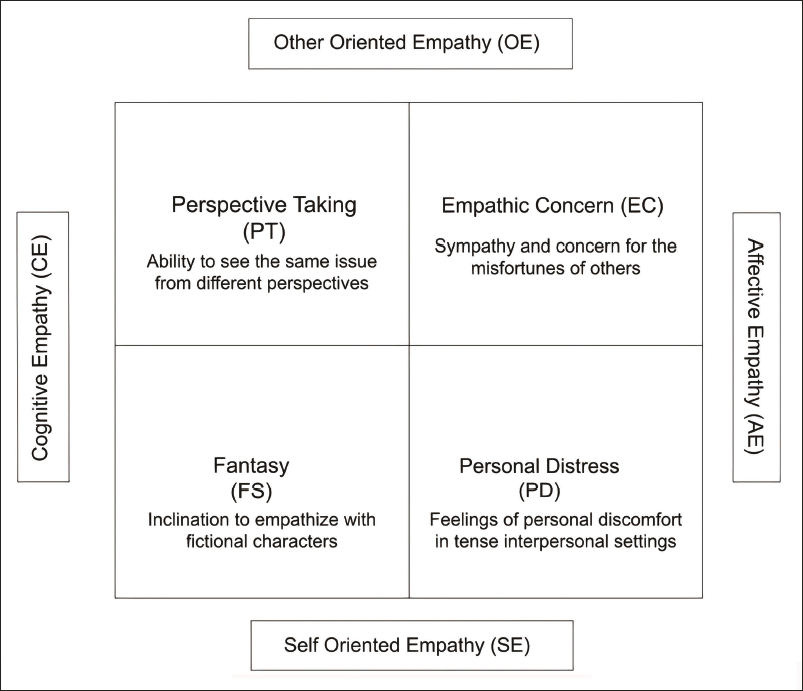
IRI 5 is a widely used tool for assessing trait empathy, comprising four distinct yet interrelated subscales 29 (Figure 1), each with seven items. 30 The Perspective Taking (PT) subscale tested individual propensity to adopt others’ psychological perspectives, while the Empathic Concern (EC) subscale measured their compassion for unfortunate others. The Fantasy (FS) subscale measured people’s tendency to imagine themselves in fictional situations, while the Personal Distress (PD) subscale measured their tendency to feel distress in response to others’ suffering. However, it’s argued that the IRI may also capture processes beyond empathy, as certain items in the FS and PD subscales may measure traits not related to empathy. 31 IRI is globally accepted and has been validated in multiple languages.5, 32 Further, it has been successfully used within collectivistic cultures, including Indian samples,30, 33, 34 with good internal consistency and test-retest reliability.35, 36
The Four Subscales of the Interpersonal Reactivity Index (IRI) and the Associated Literature Proposed Higher Dimensions.
Five Facet Mindfulness Questionnaire (FFMQ)
FFMQ is a self-report instrument designed to assess trait mindfulness. 7 It comprises five sub-dimensions: Observing (OBS) assesses the tendency to notice or attend to internal and external experiences without trying to change or criticise them; Describing (DES) evaluates the ability to label these experiences with words; Acting with Awareness (AA) measures the degree of attention and conscious engagement in present activities without relying on autopilot; Non-Judging (NJ) of Inner Experience assesses the inclination to accept thoughts and feelings without evaluation; and Non-Reactivity (NR) to Inner Experience measures the ability to let thoughts and emotions come and go without becoming entangled in them. 37 These dimensions have shown structural variation based on meditation experience, with meditators typically demonstrating greater integration.38, 39 Thus, FFMQ facilitates a scientific assessment of mindfulness practices,40, 41 particularly their effects during interventions.42, 43
Revised Portrait Value Questionnaire (PVQ-RR)
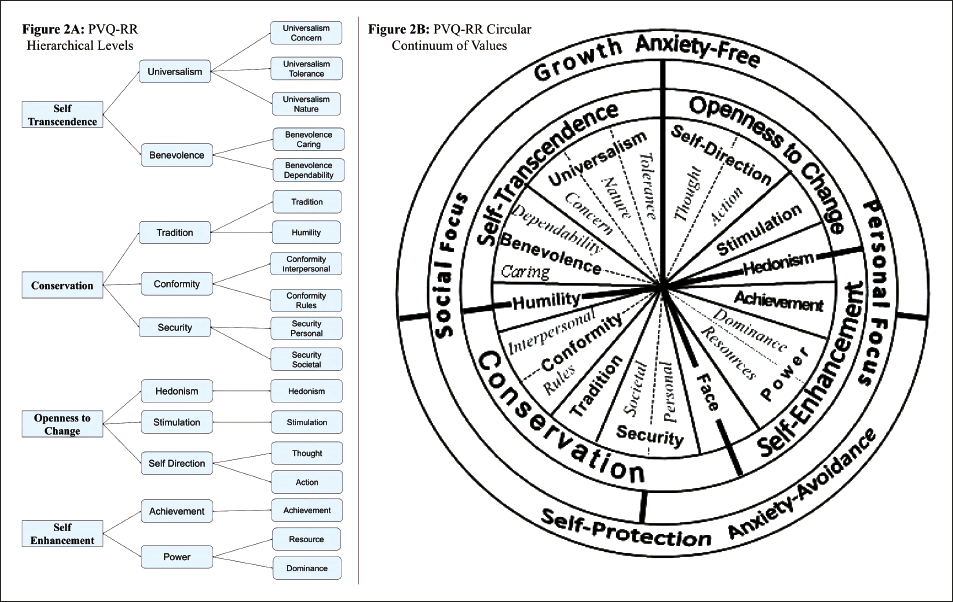
PVQ-RR is a value orientations assessment tool based on Schwartz’s Theory of Universal Human Values,4, 44 which has been studied across 80 countries, indicating its applicability across diverse cultures.45, 46 It is considered to be a reliable measurement of the complex nature of trait values across different cultures. Based upon Schwartz’s circular continuum of values (Figure 2B), it offered a hierarchical approach to examine a broader spectrum of human values (Figure 2A). The quadrant level of PVQ-RR is focused on the four broad categories of self-enhancement, openness to change, self-transcendence, and conservation. Further, these four quadrants split into ten basic and then nineteen refined values, offering increasingly nuanced categorisation.
(A) The Hierarchical Construction of Revised Portrait Values Questionnaire (PVQ-RR) Illustrating the Organisation of Schwartz’s Values Across Three Levels: Four Quadrant Value Levels, Ten Basic Value Levels, and Nineteen Narrowly Defined Value Levels. (B) PVQ-RR’s Circular Continuum of Values Depicting the Interrelations Among Values Based on Schwartz’s Theory. (From Schwartz, 2022; CC by 4.0 Licensed).
International Personality Item Pool’s Big Five Inventory (IPIP-BFI)
BFI, developed by Goldberg, describes personality based on a five-factor model. 6 Extraversion (EX) includes traits like being excitable, lively, and talkative. Agreeableness (AG) involves being affectionate, helpful, and loving. Conscientiousness (CT) involves self-discipline, responsibility, and ambition. Neuroticism refers to the tendency to experience negative emotions such as anger and fear, often associated with emotional instability. Herein, the scoring for the items on the neuroticism scale was inverted, transforming it into the emotional stability scale (N’) to facilitate our analysis. 47 Openness (OC) is characterised by artistic and adventurous traits.
Amsterdam Resting-state Questionnaire (ARSQ)
ARSQ 8 is a self-report instrument that assesses the psychological and emotional states of an individual during passive rest, allowing examination of their mental health and cognitive processes.48, 49 The facets it measures are Discontinuity of Mind (DOM), marked by rapidly switching thoughts, restlessness, etc. Theory of Mind (TOM) covers thinking about others and considering people they like. The Self dimension (SLF) involves introspection, where individuals reflect on their feelings and behaviour. Planning (PLN) includes thoughts related to work or study, solving problems, etc. Sleepiness (SLP) is characterised by feelings of tiredness and sleepiness. The Comfort dimension (CMF) includes feelings of comfort, relaxation, etc. Somatic Awareness (SOA) involves thoughts about health and consciousness of the body. ARSQ is thus structured to assess a spectrum of resting-state experiences. 8
Methods
Participants
The first sample of 580 university students (50.17% female; Mean = 22.5 ± 4.45 years), recruited through purposive snowball sampling, was utilised to investigate trait-based self-report questionnaires, namely PVQ-RR, IRI, IPIP-BFI, and FFMQ. Respondents herein had to be university-affiliated students with proficiency in English language comprehension. Further, this sample was balanced from STEM or Non-STEM academic backgrounds’ perspective (STEM = 273; Non-STEM = 307). The second sample comprised 97 adult students (90 males; Mean = 24 ± 5.18 years), employing a breath-awareness intervention pre-established in both adults50, 51 and adolescents. 52 Thus, primarily aiming to assess the psychometry-related characteristic of state mindfulness measured through ARSQ in a pragmatic mindfulness-based intervention (MBI) setting. Notably, eligibility criteria were consistent with the initial sample; however, this sample exhibited gender skewness as a potential limitation, though it comprised a balanced representation of academic backgrounds. The Indian Council of Medical Research (ICMR) ethical guidelines for human participant studies were followed, and the Institute Ethics Committee at the Indian Institute of Technology, Delhi, authorised the study (P021/P0101).
Instruments
IRI
IRI consisted of 28 items, based on a 5-point Likert scale ranging from ‘Does not describe me well’ (A) to ‘Describes me very well’ (E). It thus included four subscales, each comprising seven items. Participants described how closely each situation adhered to them by selecting A, B, C, D, or E. Items are scored from 0 to 4, with A corresponding to 0 and E to 4. However, certain items are reverse-scored, wherein A is scored as 4, B as 3, C as 2, D as 1, and E as 0. 53 Besides, higher dimensional hierarchical constructs (Figure 1), IRI evaluated sub-dimensions of trait empathy, including PT, EC, PD, and FS.
FFMQ
FFMQ’s scoring procedure involves 39 items, each aligned with a specific scale, rated on a Likert scale from ‘never or very rarely true’ (1) to ‘very often or always true’ (5). This scale also included reverse-scored items. An average score for each dimension is obtained by dividing the total score in that category by the number of items it contains. The overall FFMQ score can thus be divided by 39 to obtain an average item score, 54 yielding average trait mindfulness.
PVQ-RR
PVQ-RR presents 57 verbal portraits reflecting personal values, rated on a 6-point Likert scale (1 = Not like me at all, 6 = Very much like me). 4 It categorises values into four higher-order quadrants: Self-Transcendence (STRA), Self-Enhancement (SENH), Openness to Change (OP2C), and Conservation (CONS), 55 derived from ten basic values: Self-Direction, Stimulation, Hedonism, Achievement, Power, Security, Conformity, Tradition, Benevolence, and Universalism. The nineteen narrowly defined values specify these further: Self-Direction Thought and Action; Stimulation, Hedonism, and Achievement; Power Dominance and Resources; Face; Security Societal (SES) and Personal; Tradition; Conformity Interpersonal and Rules (CIR); Humility; Universalism Concern, Tolerance, and Nature; and Benevolence Care and Dependability.45, 55
IPIP-BFI
In the BFI scale, items are listed together and grouped into ‘positively scored’ and ‘negatively scored’ items. For positively scored items, responses are valued from 1 (‘Very Inaccurate’) to 5 (‘Very Accurate’), whereas for negatively scored items, the scoring is reversed. Summing the cumulative values assigned to all items within a scale yielded the total score for that scale based on the five-factor model, 47 namely EX, AG, CT, OC, and N’. Herein, the scoring for the items on the neuroticism scale was inverted, transforming it into the emotional stability scale (N’) to facilitate our analysis. 47
ARSQ
The ARSQ comprises 34 Likert-type statements with response options ranging from ‘completely disagree’ to ‘completely agree’. 56 Further, an average score for each dimension is calculated by dividing the total score in that category by the number of items it includes. Notably, the analyses of Tinnitus Awareness (6 items) were not included in the present study, as our focus lay on university students who were novice meditators and not experienced ones. 56
Analytical Procedures
Reliability
The inter-item reliability statistics, McDonald’s ω and Cronbach’s α, were computed using R-Jamovi 57 under the Factor module. 58
Exploratory Factor Analysis
Following the reliability analysis, construct validity using EFA was performed for all the selected psycho-social questionnaires, employing R-Jamovi’s Factor package. 58
Sample Size Considerations & Assumptions
The sample one size of 580 was deemed adequate for conducting EFA towards IRI, FFMQ, PVQ-RR, and BFI, as it satisfied the criterion of a 10:1 participant-to-item ratio and the recommended range of 100–200 participants.59, 60 Sample two of 97 participants failed to satisfy these requisite assumptions towards ARSQ; however, it is to be noted that ARSQ was administered in an MBI context posteriori, an intervention spanning one hour. Thus, given the high arousal intervention context, 61 we proceeded with the ARSQ analysis despite these limitations. The required assumptions to ensure the factorability of the correlation matrix were gauged using Bartlett’s test of sphericity.59, 60 Bartlett’s test was significant for all the psycho-social questionnaires, namely, IRI (χ²(378) = 3885, p < .001), FFMQ (χ²(741) = 7247, p < .001), PVQ-RR (χ²(1596) = 13945, p < .001), BFI (χ²(1225) = 9644, p < .001), and ARSQ (χ²(378) = 1141, p < .001). Further, the Kaiser–Meyer–Olkin measure of sampling adequacy exceeded the recommended 0.5 threshold, 62 confirming the suitability of the data for factor extraction: IRI (0.822), PVQ-RR (0.921), FFMQ (0.881), BFI (0.852), and ARSQ (0.653).
Subsequent to the establishment of EFA assumptions, the data were assessed for their suitability regarding parallel analysis and corresponding factor solutions. 63 Factor extraction was performed using Principal Axis Factoring due to its robustness in handling non-normal data. 64 The rotation procedures were selected based on inter-factor correlations: orthogonal (varimax) rotation was applied to IRI and ARSQ, given the relative independence of their factors, whereas oblique (oblimin) rotation was used for PVQ-RR, FFMQ, and BFI, where inter-factor correlations exceeded 0.3. 65
The Number of Factors Retained in the Model
Several studies advise basing the choice of the number of factors to retain in the model adhering to several criteria and theoretical considerations.63, 64 This study used three methods to determine factor retention: (a) Eigenvalue Method, retaining factors with eigenvalues above one as they explain more variance than a single observed variable66, 67; (b) Visual Scree Plot, identifying the ‘point of inflexion’ where the slope shifts, with factors above this point considered significant64, 68; and (c) Parallel Analysis, comparing real data eigenvalues with those from a randomly generated dataset, retaining factors where real eigenvalues exceed random ones. 69 Furthermore, alongside these methods, the underlying foundational theory of the examined questionnaires was considered. Consequently, the decision regarding the number of factors to retain was made based on theoretical considerations, eigenvalues exceeding one, visual scree plot, and parallel analysis (Figure 3).
Exploratory Factor Analysis (EFA) Visual Scree Plots for the Five Psycho-social Questionnaires {Each scree plot visualises eigenvalues against factor numbers, illustrating the optimal factor retention based on the eigenvalue drop-off}. (A) Interpersonal Reactivity Index (IRI) EFA Visual Scree Plot, (B) Five Facet Mindfulness Questionnaire (FFMQ) EFA Visual Scree Plot, (C) Revised Portrait Values Questionnaire (PVQ-RR) EFA Visual Scree Plot, (D) International Personality Item Pool’s Big Five Inventory (IPIP-BFI) EFA Visual Scree Plot, (E) Amsterdam Resting-State Questionnaire (ARSQ) EFA Visual Scree Plot.
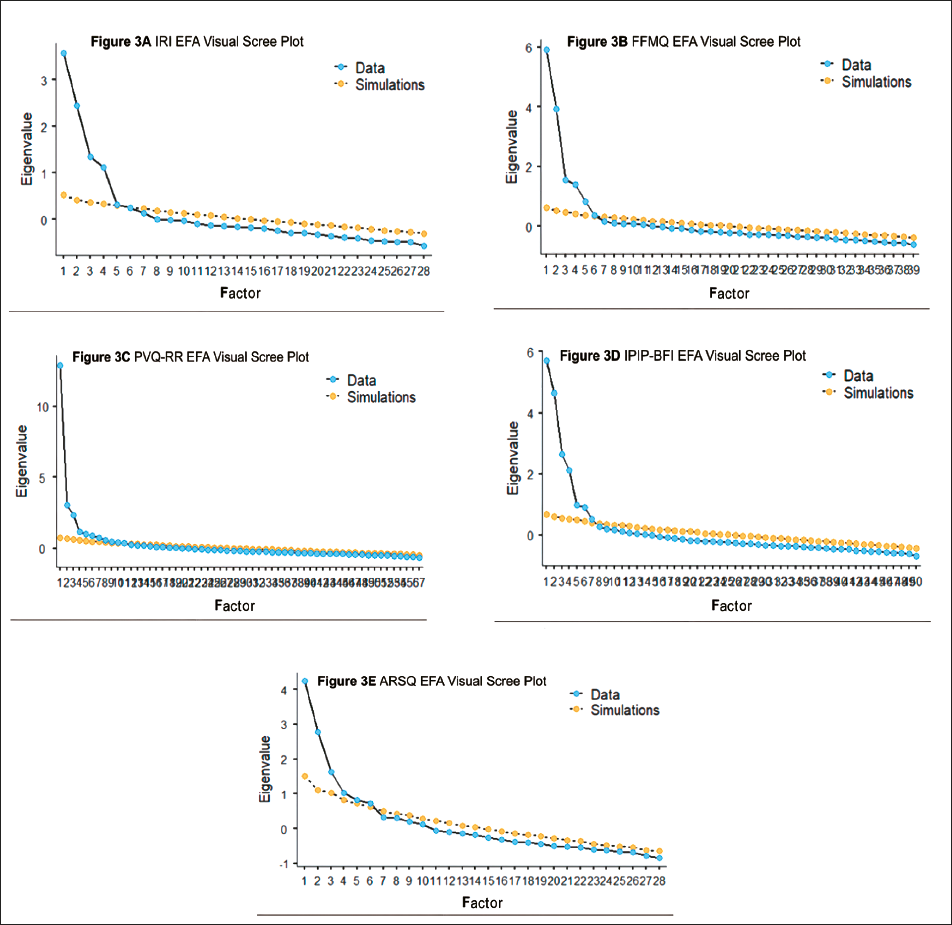
For IRI, all three methods supported a four-factor solution, aligning with its theoretical structure. 5 The FFMQ and BFI each yielded four factors with eigenvalues above one, but a fifth factor was retained based on theoretical justifications of their established five-factor structures.6, 54 PVQ-RR exhibited cross-loadings due to its circular value organisation; while five factors had eigenvalues above one, a four-factor model was retained to match the four-value quadrant-based Schwartz’s framework. 4 Pertaining to ARSQ, which was limited by a smaller sample and gender skewness, four factors had eigenvalues greater than one and six factors were proposed to be retained by the parallel analysis. However, upon a comparison of six-factor (TLI = 0.784, RMSEA = 0.0638) and seven-factor (TLI = 0.817, RMSEA = 0.0582) models, we found a better model fit with the latter. Hence, aligning with its theoretical seven-dimensional construct and given the construct validity inspection only objective, a seven-factor sub-optimal model was chosen to represent ARSQ.
Factors’ Adequacy
Factor adequacy was evaluated based on three pre-established criteria: (a) each factor required at least three significant loadings above 0.37, 59 (b) theoretical interpretability, and (c) internal consistency of at least 0.6 (McDonald’s ω). Uniqueness values, representing unexplained variance, were also examined, and to maintain a straightforward final structure, we excluded any loadings that were significant on more than one factor. 70 Notably, while the criterion of at least three significant loadings was maintained, the interpretation of adequacy did account for the total number of items per theoretically proposed dimension, as factors with relatively more or fewer items naturally influence the distribution of significant loadings.
Principal Component Analysis
The R-Jamovi’s FactoMine package71, 72 was employed to assess the alignment of the data collected from the two samples with the theoretically proposed dimensional structures of the psycho-social questionnaires’ constructs. To standardise PCA data, all the questionnaires’ dimensions were scored appropriately and mean-centred. 27
Results
Item- and dimension-level details of all the examined questionnaires are in Supplemental Materials’ Section 1, while EFA loadings and reliability statistics tables for the PVQ-RR, IPIP-BFI, and ARSQ are mentioned in Supplemental Materials’ Section 2.
Internal Consistency
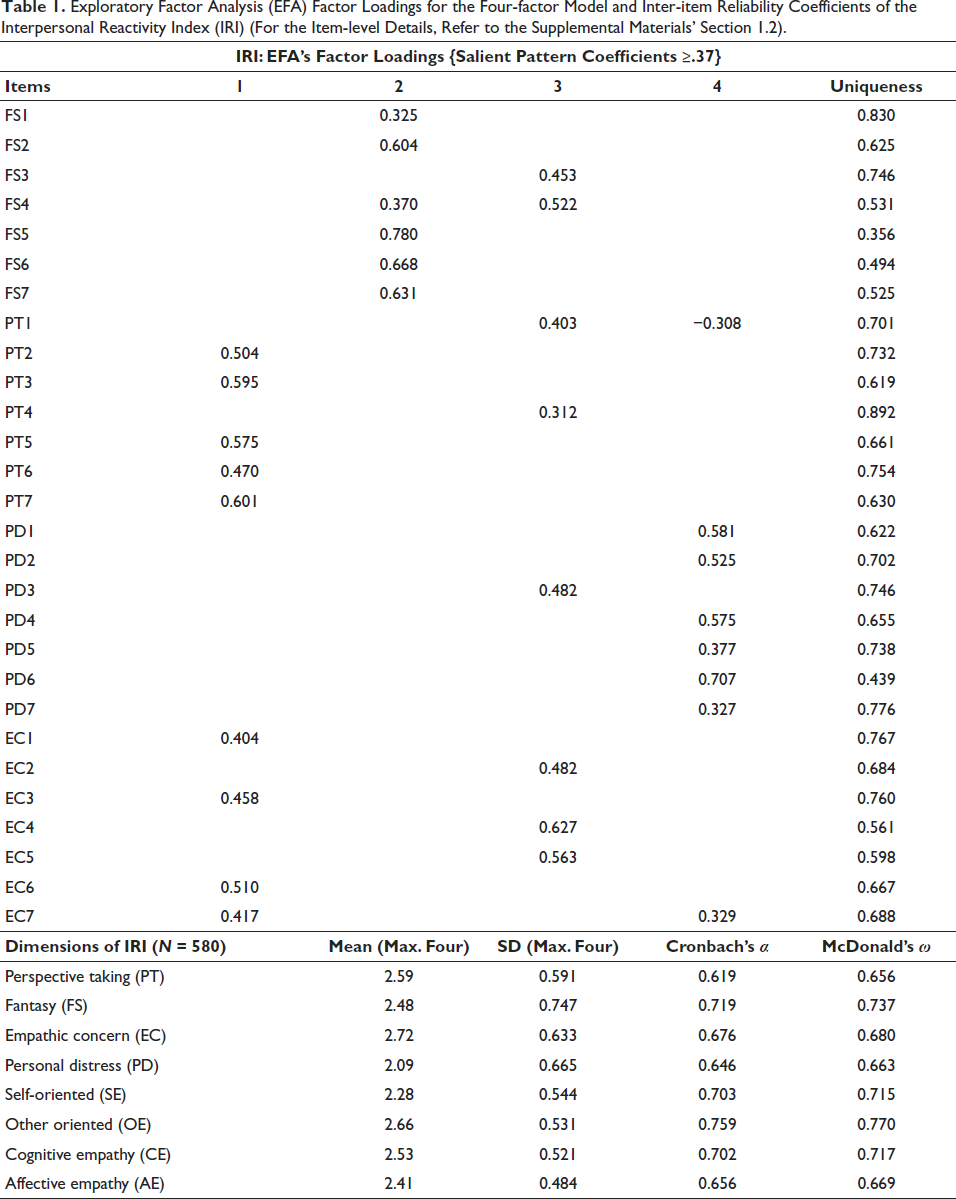
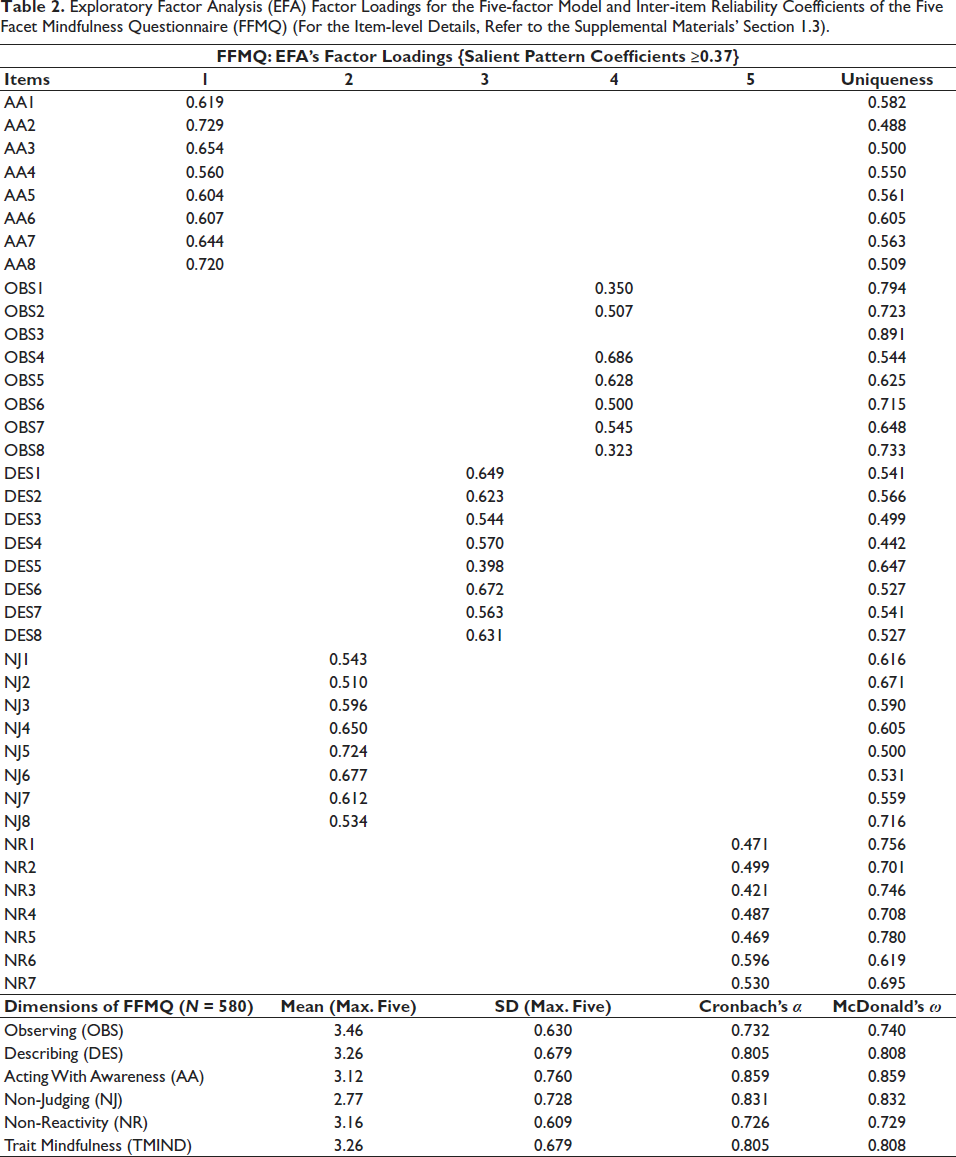
The sub-dimensions of IRI (Table 1: all ω’s > 0.65; ωmean = 0.684), FFMQ (Table 2: all ω’s > 0.7; ωmean = 0.794), IPIP-BFI (Supplemental Table 2: all ω’s > 0.7; ωmean = 0.755), and ARSQ (Supplemental Table 3: all ω’s > 0.6; ωmean = 0.724) demonstrated reasonable internal consistency. PVQ-RR showed the same across all three levels (Supplemental Table 1: all ω’s > 0.6; ωmean = 0.713), barring two narrowly defined ones: humility and universalism-tolerance (< 0.6). Lastly, the higher dimensions of IRI (all ω’s > 0.65; ωmean = 0.717) and Trait Mindfulness (TMIND; ω = 0.808) measured by FFMQ showed strong internal consistency.
Exploratory Factor Analysis (EFA) Factor Loadings for the Four-factor Model and Inter-item Reliability Coefficients of the Interpersonal Reactivity Index (IRI) (For the Item-level Details, Refer to the Supplemental Materials’ Section 1.2).
Exploratory Factor Analysis (EFA) Factor Loadings for the Five-factor Model and Inter-item Reliability Coefficients of the Five Facet Mindfulness Questionnaire (FFMQ) (For the Item-level Details, Refer to the Supplemental Materials’ Section 1.3).
Principal Component Analysis (PCA) of Psycho-social Questionnaires (For the Item-level and Dimensional-level Details of the Questionnaires, Refer to Supplemental Materials’ Section 1).
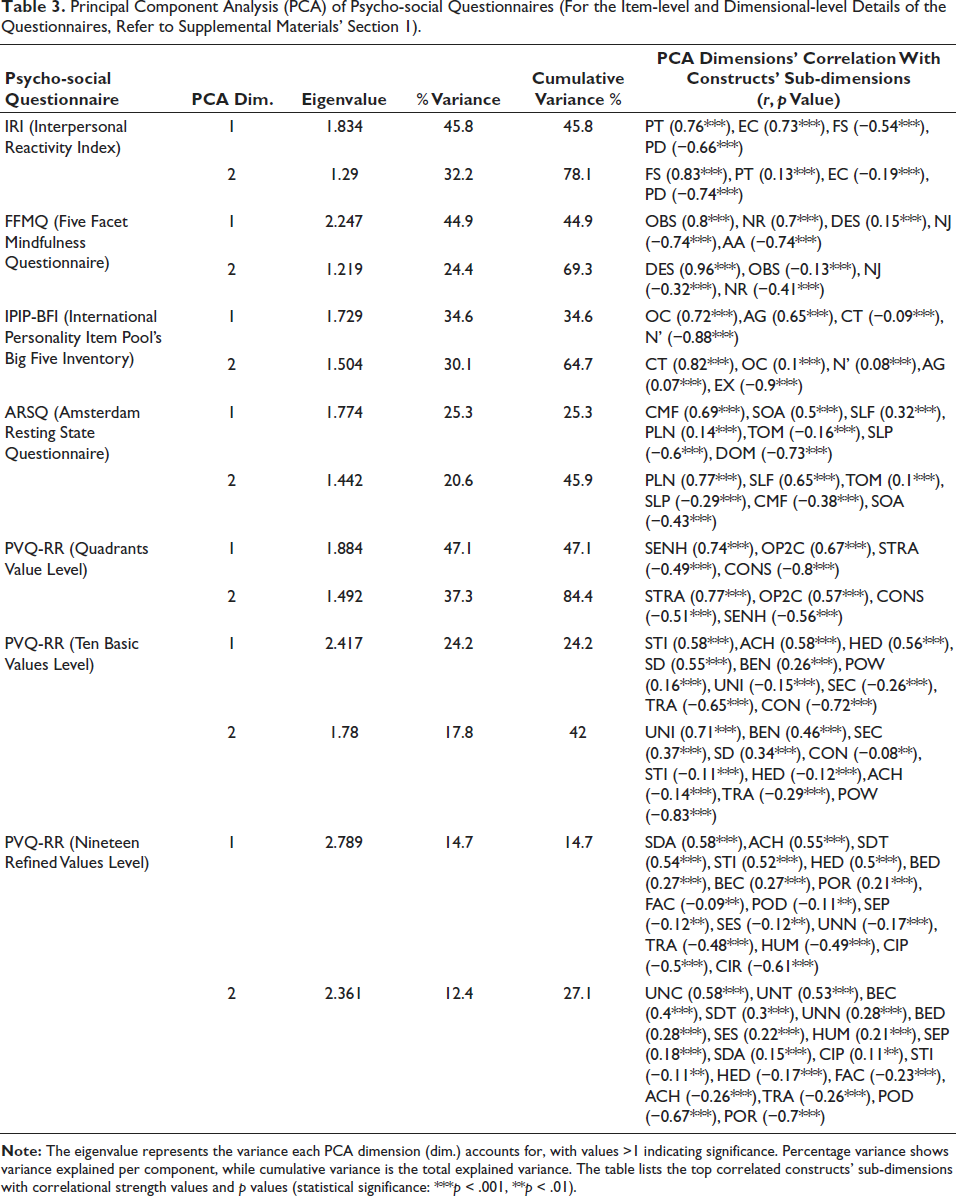
Note: The eigenvalue represents the variance each PCA dimension (dim.) accounts for, with values >1 indicating significance. Percentage variance shows variance explained per component, while cumulative variance is the total explained variance. The table lists the top correlated constructs’ sub-dimensions with correlational strength values and p values (statistical significance: ***p < .001, **p < .01).
EFA
IRI’s four-factor structure aligned with its theoretical dimensions (Table 1). PT, FS, and PD loaded distinctly onto the first, second, and fourth factors, while EC primarily loaded onto the third, with some overlap with PT—reinforcing their shared variance towards a literature expected focused definition 61 toward Trait Empathy (TE). Thus, the first factor, with the highest eigenvalue, reflected cross-loadings from EC and PT. Lastly, uniqueness values indicated acceptable explained variance and the internal consistency provided support for validity for all sub-dimensions and higher-order constructs. FFMQ’s five-factor solution matched its theoretical structure (Table 2). AA, NJ, DES, OBS, and NR loaded clearly onto the first respective five EFA factors. Further, OBS, which emerged as the fourth factor, had most items demonstrating strong loadings; however, OBS3 exhibited high uniqueness and did not load effectively. Uniqueness values overall were acceptable, and internal consistency supported the construct.
When assessing the factorial consistency of inventories like the PVQ-RR, which feature circular models with expected cross-factor loadings, a clear two-factor structure was anticipated.4, 73 Thus, a bifactorial EFA pattern emerged (Supplemental Table 1), reflecting ‘STRA vs SENH’ (16.6% variance) and ‘OP2C vs CONS’ (8.2%). Achievement, Benevolence, Self-Direction, Stimulation, and Hedonism showed strong loadings on the first factor, while Tradition and Conformity predominantly loaded on the second. Minor third and fourth factors (5.5%, 5%) captured Universalism-Nature and Power, respectively. Factor structure moderately supported the circumplex model; wherein the observed cross-loadings (e.g., CIR2, CIR3) and deviations (e.g., SES2 uniqueness) could be owing to plausible cultural variations.
In IPIP-BFI, N’, EX, and OC loaded saliently onto the first, second, and third factors, respectively, with eight, nine, and six corresponding loadings out of ten (Supplemental Table 2). Further, AG had four well-performing items and a moderately strong factor loading towards the fifth factor, though some items displayed cross-loadings with CT and EX. CT, further showed a more scattered pattern, with some components overlapping with AG, N’, and OC. Lastly, uniqueness values suggested that most items had an acceptable proportion of explained variance, though a few items indicated relatively high uniqueness, implying they captured more variance unexplained by the extracted factors. ARSQ’s dimensions of PLN, CMF, DOM, SLP, and SOA exhibited significant loadings on the first, second, third, fourth, and sixth factors, respectively (Supplemental Table 3). Further, SLF and TOM were loaded onto the fifth and seventh factor, respectively, besides some cross-loadings. Notably, TOM cross-loaded with factors aligned with SLF and DOM, and SLF with PLN and SOA. Although a few items exhibited cross-loadings or high uniqueness, the overall structure remained theoretically coherent.
PCA
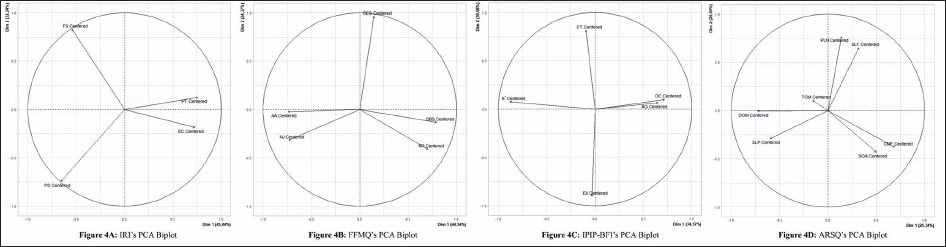
PCA of the IRI revealed two principal components (PCs) with eigenvalues >1 (Table 3), jointly explaining 78.1% of the variance (Figure 4A). PC1 (45.8%) loaded positively on PT and EC, and negatively on PD and FS, representing the contrast between Other Empathy and Self Empathy (SE). PC2 (32.2%), dominated by FS and PD, primarily captured SE. Notably, EC and PT aligned towards TE, consistent with EFA findings. For the FFMQ, PCA identified two PCs accounting for 69.3% of the variance. PC1 (44.9%) showed strong positive loadings on OBS and NR, and negative loadings on NJ and AA—suggesting a structural contrast between OBS-NR and AA-NJ (Figure 4B). PC2 (24.4%) was primarily led by DES, reflecting experiential expressiveness.
Principal Component Analysis (PCA) Biplots Illustrating the Dimensional Structure of the Four Psycho-social Questionnaires. (A) Interpersonal Reactivity Index’s (IRI) PCA Biplot. (B) Five Facet Mindfulness Questionnaire’s (FFMQ) PCA Biplot. (C) International Personality Item Pool’s Big Five Inventory’s (IPIP-BFI) PCA Biplot. (D) Amsterdam Resting-state Questionnaire’s (ARSQ) PCA Biplot.
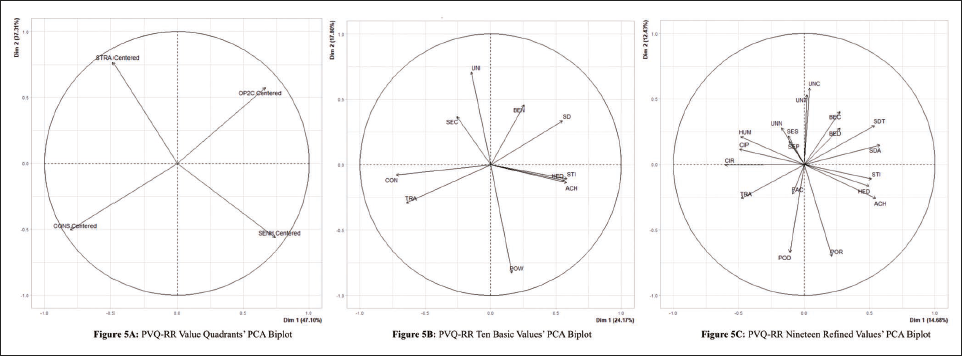
PVQ-RR upheld Schwartz’s circumplex structure across three hierarchical levels (Table 3). 4 At the quadrant level (Figure 5A), PC1 (47.1%) and PC2 (37.3%) reflected antagonistic poles—‘SENH vs. STRA’ and ‘CONS vs. OP2C’. At the ten basic values level (Figure 5B), PC1 and PC2 explained 42% of the variance, capturing circular interrelations. At the refined level, PC1 (14.7%) and PC2 (12.4%) further supported a hierarchical nested circumplex structure (Figure 5C), wherein broad quadrants split into basic values, finally onto the refined level.
Principal Component Analysis (PCA) Biplots Illustrating the Circumplex Hierarchical Dimensional Structure of the Revised Portrait Value Questionnaire (PVQ-RR). (A) PVQ-RR Value Quadrants’ PCA Biplot, (B) PVQ-RR Ten Basic Values’ PCA Biplot, (C) PVQ-RR Nineteen Refined Values’ PCA Biplot {Notably, values at all three levels were scored using mean-centring, as recommended by Schwartz et al. (2012)}.
In the IPIP-BFI, two PCs accounted for 64.7% of the variance (Table 3). PC1 (34.6%) showed strong associations with OC and AG, and a negative loading on N’, suggesting a contrast between N’ and OC-AG traits (Figure 4C). PC2 (30.1%) was related positively to CT and had a negative association with EX, indicating their possible antagonistic behavioural relationship. ARSQ’s PCA yielded two PCs explaining 45.9% of the variance (Figure 4D). PC1 (25.3%) had positive loadings from CMF and SOA, and negative from DOM and SLP. PC2 (20.6%) was shaped by PLN and SLF, with inverse loadings from SOA, SLP, and CMF. Also, a clustering of PLN-SLF, TOM-DOM-SLP, and SOA-CMF was observed.
Discussion
This study evaluated the construct validity, internal consistency, and dimensionality of five questionnaires—IRI, FFMQ, PVQ-RR, IPIP-BFI and ARSQ, in Indian young university adults.
IRI demonstrated adequate internal consistency across subscales and higher-order constructs. EFA supported its four-factor structure, though Empathic Concern (EC) and Perspective Taking (PT) showed conceptual overlap via cross-loadings, echoed further in PCA results. A few items per each subscale failed to load robustly onto their intended factors, suggesting potential ambiguity in their construct definition within the Indian cultural context. Besides, the PCA’s first principal component primarily captured EC and PT, reinforcing their shared contribution to trait empathy. Overall, the IRI remains a valid tool, especially with EC and PT together as focused trait empathy markers. 61
FFMQ showed strong internal consistency and alignment with its theoretical five-factor structure. However, the Observing (OBS) subscale revealed two weakly loading items and one with high uniqueness, suggesting possible misinterpretation. PCA revealed a bi-dimensional structure—OBS and Non-Reactivity (NR) clustering separately from Acting with Awareness (AA) and Non-Judging (NJ). Thus, possibly indicating that facets like AA-NJ, which involve observable behaviours and conscious attitudinal evaluations, align with overt mindfulness processes, whereas OBS-NR, centred on internalised awareness and restraint, represent covert mindfulness.74, 75 While prior studies have questioned OBS76, 77 and Describing 78 in collectivistic settings, EFA-PCA findings adequately supported the FFMQ’s five-factor applicability in the Indian adult-educated context, with minor refinements for OBS warranted.
PVQ-RR displayed moderate internal consistency overall, with exceptions for Humility and Universalism-Tolerance. EFA identified two main factors—‘Self-Transcendence vs. Self-Enhancement’ and ‘Openness to Change vs. Conservation’—consistent with Schwartz’s theory. 4 Also, Universalism-Nature and Power emerged as distinct third and fourth EFA factors rather than aligning neatly within their higher-order value categories, indicating their potential cultural variability. PCA confirmed this circumplex structure across hierarchical levels, though minor deviations in Benevolence and Security values further suggest culturally nuanced differences.
IPIP-BFI showed robust internal consistency. EFA weakly supported the five-factor model, 6 owing to poor loading of Conscientiousness (CT) and Agreeableness (AG), and consistent cross-loadings of the other relatively strong factors. PCA revealed structural divergence: Openness and AG clustered together, antagonistic to inverted-Neuroticism, while CT related inversely with Extraversion. These findings suggest conceptual misalignments or interpretational variations in the Indian context. ARSQ demonstrated acceptable internal consistency, though EFA displayed some cross-loadings. Theory of Mind (TOM) overlapped with Self (SLF) and Discontinuity of Mind (DOM), while SLF cross-loaded with Planning (PLN) and Somatic Awareness (SOA), suggesting a blending of cognitive-affective states in resting-state experiences. 56 PCA revealed three clusters—PLN-SLF, TOM-DOM-Sleepiness, and SOA-CMF—indicating the interconnected nature of self-referential and sensory processes.
Conclusion
The psychometric evaluation of IRI, FFMQ, PVQ-RR, IPIP-BFI and ARSQ revealed varying degrees of alignment to their respective theoretical frameworks within the Indian adult-educated cohort. FFMQ demonstrated the strongest construct validity, with minor concerns regarding the Observing subscale. IRI followed closely with EC and PT, together supporting their use as a focused measure of trait empathy. PVQ-RR and ARSQ exhibited moderate structural consistency, with potential cultural influences shaping value clustering in the former and cognitive-affective resting-states’ interrelationships in the latter. IPIP-BFI, however, exhibited conceptual inconsistencies, suggesting limited suitability without cultural adaptation.
Given the single-sample design and evolving views upon the confirmatory-exploratory continuum, confirmatory factor analyses were not conducted. Future research should thus employ exploratory structural equation modelling (ESEM) and evaluate additional psychometric properties, including test-retest reliability and content validity. Besides, ARSQ must be validated using a larger sample.
Footnotes
Acknowledgements
The authors acknowledge the UX Lab, IIT Delhi, for its invaluable support and guidance throughout the research, and extend our thanks to Ms. Riya Jain, Lab Intern, for her assistance in data interpretation.
Authors’ Contribution
MB: Overall supervision of the study, interpretation of data, study conceptualisation, study conduction, analysis of data, drafting of manuscript, approval of final manuscript.
DS: Drafting of manuscript, approval of final manuscript.
AA: Interpretation of data, drafting of manuscript.
GS: Approval of final manuscript.
JK: Overall supervision of the study.
Consent for Publication
Not Applicable.
Data Availability
The datasets generated and analysed during the study are available from the corresponding author upon reasonable request.
Statement of Ethics
This study adhered to the ethical guidelines of the Indian Council of Medical Research (ICMR) and received approval from the Institute Ethics Committee of the Indian Institute of Technology, Delhi (IEC-IITD; Proposal No. P021/P0101).
Declaration of Conflicting Interests
The authors declared no potential conflicts of interest with respect to the research, authorship and/or publication of this article.
Funding
The authors received no financial support for the research, authorship and/or publication of this article.
ICMJE Statement
This manuscript follows the uniform submission guidelines of the International Committee of Medical Journal Editors (ICMJE).
Informed Consent
All participants provided informed consent prior to their participation in the study.
Supplemental Material

References
Supplementary Material
Please find the following supplemental material available below.
For Open Access articles published under a Creative Commons License, all supplemental material carries the same license as the article it is associated with.
For non-Open Access articles published, all supplemental material carries a non-exclusive license, and permission requests for re-use of supplemental material or any part of supplemental material shall be sent directly to the copyright owner as specified in the copyright notice associated with the article.
