




Abstract
Background:
Organizations today require employees who are well at managing emotional intelligence and using their emotions in a constructive process. The present study considered the Satisfaction with Life Scale (SWLS) and Wong and Law Emotional Intelligence Scale (WLEIS) for the study. WLEIS has four factors: self-emotional appraisal (SEA), other’s emotional appraisal (OEA), regulation of emotion (ROE), and use of emotions (UOE). These scales help to manage emotions that result in satisfaction with life.
Purpose:
The purpose of the study is to validate WLEIS and SWLS because this scale has been validated across many countries but very few studies have been conducted in the Indian context. Apart from that, the current study also incorporated SWLS to validate constructs and measurement models.
Methods:
A sample of 238 participants working in the hospitality industry have been considered for the study. Exploratory factor analysis and confirmatory factor analysis were used to validate all the constructs and measurement models.
Results:
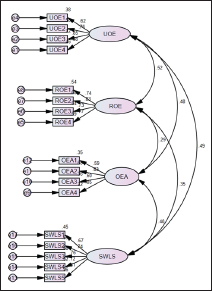
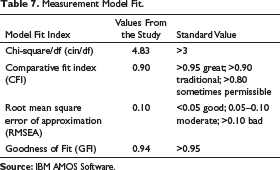
The three factors of WLEIS and SWLS showed Cronbach’s α more than 0.8 that showed excellent internal consistency except for SEA. The results of exploratory factor analysis found that eigenvalue ranged from 2.8 to 5.9, and the total variance explained by constructs was 65.9%. Confirmatory factor analysis showed average variance explained of each construct to be 0.5, and composite reliability to be more than 0.7, which shows excellent construct validity of scales in the Indian hospitality sector. The study also validates measurement research model of WLEIS and SWLS on the basis of model fit index (chi-square/df = 4.83, RMSEA = 0.10, GFI = 0.94, and CFI = 0.90).
Conclusion:
The strong validity and reliability of the WLEIS and SWLS have proved that neuroscience can apply these scales to measure emotional intelligence in order to understand others’ emotions and apply emotions in a constructive process that may lead to satisfaction with life.
Keywords
Introduction
Emotional intelligence (EI) refers to the potential to understand, use, and manage emotions positively to alleviate stress, communicate effectively, and resolve conflict and challenges. The term “Emotional Intelligence” came into existence in 1990 in research papers by two professors, John D. Mayer of UNH and Peter Salovey of Yale. In the mid-1990s and 2020s, EI has been widely studied by researchers.1, 2 There are various tools available to measure EI; the current study applied Wong and Law Emotional Intelligence Scale (WLEIS), 2 which is being rated by parents, colleagues, and supervisors.3, 4 It has been tested in different countries and cultures and for different demographic characteristics and sectors. But very few researchers have studied the reliability and construct validity of WLEIS and Satisfaction with Life Scale (SWLS) in the Indian hospitality sector. According to India Brand Equity Foundation (IBEF), the travel and tourism industry’s contributions to GDP growth are expected to have a yearly growth rate of 10.35% between 2019 and 2028. Therefore, addressing the construct validity and reliability of WLEIS and SWLS may lead to multifold benefits for employees, sectors as well as economic growth of the country. WLEIS, developed by Wong and Law in 2002, consists of four factors: self-emotion appraisal (SEA), others’ emotion appraisal (OEA), use of emotion (UEO), and regulation of emotion (REO). SEA refers to an individual’s potential to understand their emotions and naturally present those emotions; OEA is the cognitive ability to understand others’ emotions; UEO is an individual’s potential who use their emotions in their performance and constructive work; and the fourth dimension ROE refers to individual’s ability to control or regulate their emotions that help to cope with psychological distress.
WLEIS is one of the most powerful self-reported scale, which can measure four different types of emotional intelligence (EQ). But construct validity and reliability of WLEIS has been studied in different cultures and countries between 2002 and 2022, such as Chilli, 5 China,2, 6–15 Spain,13, 16 Korea,15, 17,18 Morraco, 19 Europe,20, 21 Hungary,22, 23 Pakistan, 15 USA,11, 24, 25 Nepal, 26 Canada, 13 Italy,20, 27 and Pakistan. 28 A very few Indian researchers have studied the validity and reliability of the scale. Therefore, the objective of the study is to examine the reliability and construct validity of WLEIS in the Indian hospitality industry so that this scale can be used further in different Indian sectors. Further, the SWLS has also been incorporated into WLEIS. According to Kong et al.29, individuals with high EI report higher life satisfaction. 4
Methods
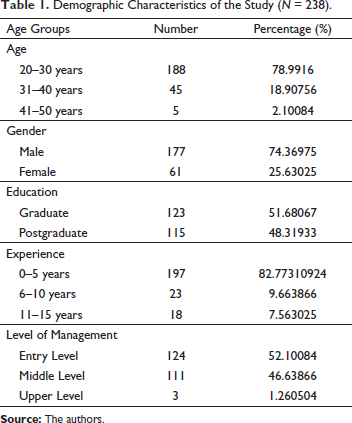
Demographic Characteristics of the Study (N = 238).
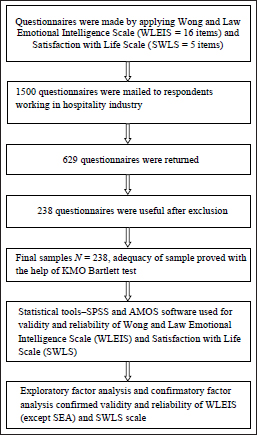
Sample Size
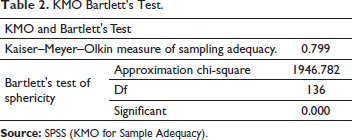
KMO Bartlett’s Test.
Measurement of Variables
Wong and Law 3 developed the WLEIS and tested it across various countries and cultures by applying a standardized process. This scale consists of 16-items of four factors, such as self-emotions appraisal (SEA), others’ emotions appraisal (OEA), use of emotion (UOE), and regulation of emotion (ROE); OEA like “He has a good understanding of the emotions of people around him/her. Pilot study showed low validity and reliability of SEA in the Indian context, which has not been considered in the present study. Responses were recorded on the 5-point Likert scale 1 = totally disagree and 5 = totally agree. Apart from that, satisfaction with life was measured from SWLS given by Diener et al. in 1985, which has five items in a scale.
Statistical Tools
For reliability and construct validity of data sets, SPSS version 21.0 AMOS 24 was applied in the current study. With the help of these tools, exploratory factor analysis (EFA) and confirmatory factor analysis (CFA) have been conducted for the data analysis.
Results
Reliability Test of WLEIS and SWLS
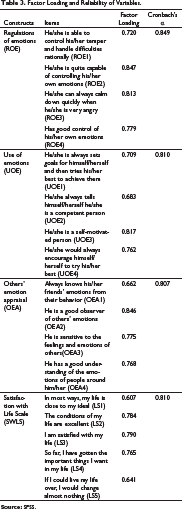
Factor Loading and Reliability of Variables.
Factor Analysis
Exploratory Factor Analysis
In order to conduct CFA, EFA has been used to investigate the number of latent variables or constructs underlying a set of items without enforcing a predetermined idea on the outcome. By conducting EFA, the underlying factor structure will be determined. But, when there will be sufficient theoretical and empirical framework to specify the model or a small subset of models, CFA will be a better approach data analysis. The present study used CFA to check the validity construct of items.
Factor Loading.
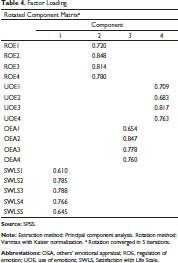
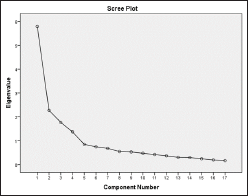
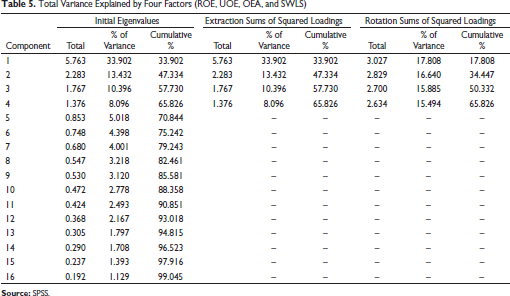
Total Variance Explained by Four Factors (ROE, UOE, OEA, and SWLS)
Confirmatory Factor Analysis (CFA)
Convergent Validity of Scales
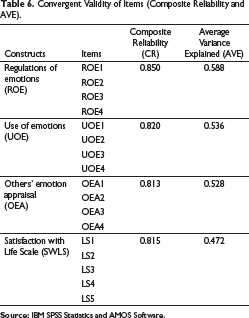
Convergent Validity of Items (Composite Reliability and AVE).
Measurement Model Fit.
Discussion
Today organizations require employees who believe in high levels of EQ that can manage individuals’ emotions diligently and collaborate to resolve conflicts at the workplace and achieve organizational goals. 33 Based on empirical analysis of data, it can be understood that WLEIS and SWLS have their importance in the Indian hospitality sector. This research provides empirical insight into the validity and reliability of both scales, which were missing in the Indian hospitality sector. These findings indicate that three factors of the WLEIS, such as ROE, UOE, and OEA, showed adequate reliability and validity except the SEA factor. The research has a number of important findings. First, it confirms that all three factors of the WLEIS are important for satisfaction with life. Thus, the result obtained showed that EI is important for life satisfaction, and it shows consistency in the previous findings where it was concluded that EI is important for life satisfaction. 4 The Cronbach’s α of all four constructs (UOE, ROE, OE, and SWLS) is more than 0.8, which indicates excellent internal consistency of these items. 34 CFA confirmed validity of WLEIS and SWLS. The average variance is explained, and composite reliability of all three constructs of WLEIS and SWLS have met their criteria for validity.2, 8, 9, 11–18 Further, the model fit of the measurement model of WLEIS and SWLS also met their criteria of model fit, which means model can be studied and applied in neuroscience. Since the past few years, satisfaction with life has become a critical issue in the hospitality industry; the findings of the current study might help this sector by applying these scales.
Conclusion
The Indian hospitality sector is gradually gearing up despite facing great challenge in managing employees’ emotions in the constructive process. Employees working in this sector continuously face work pressure because of unpredictable circumstances, and under such circumstances, managing employees’ emotions is very difficult. In conclusion, the present study provided new insights regarding the validity and reliability of the WELIS and SWLS. CFA and EFA confirmed the validity and reliability of these scales in the Indian context, which was missing earlier. These types of studies contribute greatly to neuroscience from the empirical results obtained. It initiates to apply these scales practically in the Indian context, which was missing earlier. Moreover, it acts as a guide to generate new kinds of research that permit the neuroscience department to apply such scales that support the measurement of EI in the Indian hospitality sector.
Footnotes
Acknowledgments
The authors acknowledge the assistance received from Dr Ashok Sharma regarding research on the validity and reliability of scales.
Authors’ Contribution
ST did the planning and supervision of the work, statistical evaluation of data, and writing the manuscript, and MD had done proofreading. AS was involved in manuscript editing and overall supervision.
Statement of Ethics
Not Applicable.
Declaration of Conflicting Interests
The authors declared no potential conflicts of interest with respect to the research, authorship, and/or publication of this article.
Funding
The authors received no financial support for the research, authorship, and/or publication of this article.
