




Abstract
The emergence of digital technologies has significantly transformed the workplace by enhancing productivity and improving employee wellbeing. One of the latest technological advancements in the workplace is the metaverse, which has tremendous potential to facilitate collaboration in virtual teams. In this study, we conducted a comprehensive bibliometric analysis to identify core research themes on applying metaverse in the workplace. Our findings reveal core themes, including an avatar, computer graphics, immersion, virtual world and virtual reality. We also developed a theoretical and conceptual framework to define a metaverse in the workplace, which includes individual, team and organizational factors as well as contextual moderators that influence its implementation. Finally, we propose a definition of a metaverse in the workplace as a 3D virtual immersive environment where employees interact with each other using their avatar identities, perform work tasks, and have autonomy and opportunities for creativity. Our study contributes to the growing body of research on the practical applications of a metaverse in the workplace. It highlights the importance of considering various factors for its successful implementation.
Introduction
The COVID-19 pandemic has intensified the need to incorporate digital technologies (DTs) into the workplace, leading to a significant acceleration in the transition to DT adoption in various business areas (Davison, 2020; Newman & Ford, 2020; Selimović et al., 2021). During COVID-19, organizations were forced to immediately digitize the workplace and switch to the virtual environment (Meluso et al., 2020). As a result, organizations and employees alike became accustomed to new working environments and remote collaboration forms (Bailey & Breslin, 2020; Frost & Duan, 2020). All this led to the expansion of new virtual forms of cooperation in the workplace across space or time. It is important to note that DT adoption in the workplace does not necessarily equate to a virtual environment. While DT refers to using digital tools and technologies, a virtual environment is a digital representation of a physical space or world, often created through computer simulation, that allows users to interact through a virtual interface. For the successful adoption of DT in the workplace, Trenerry et al. (2021) developed a multi-level framework that emphasizes three levels of factors that organizations must consider during DT— individual, group and organizational factors.
A classic example of the use of DTs in the workplace is telework. Nilles (1994) and Olson and Primps (1984) defined telework as using computer-based technology or telecommuting outside the typical office setting to communicate with it. In teleworking, employees are asked to perform some of their duties at an official workplace (e.g., an office). In cases where the employee works permanently from home, we talk about remote working. Remote working brings several benefits to organizations and employees. Specifically, it reduces the costs (Bjørn & Ngwenyama, 2009; Thompson, 2018) and expenses associated with travel access (Bjørn & Ngwenyama, 2009). Remote working also improves the performance of the organizations by the possibility to access talented people worldwide (Aldag & Kuzuhara, 2015; Marques et al., 2021). Remote working has its advantages, such as a high degree of flexibility in the day’s scheduling (DeRosa, 2009) and a certain autonomy in the execution of individual tasks (Ryan & Deci, 2017), but also disadvantages—necessary information and communication technologies (ICTs) and ergonomic equipment for work (Gilson et al., 2015; Kačerová et al., 2022; Mcgill et al., 2020), impact of remote working on wellbeing of the employee, or, for example, unclear legal basis for remote work in some countries, including tax rules (Tyutyuryukov & Guseva, 2021). Remote workers are often joined into virtual teams, who collaborate through ICTs and rarely meet face-to-face (Aldag & Kuzuhara, 2015).
DT also brings new elements into the work environment, such as extended reality (XR), augmented reality (AR), mixed reality (MR) and virtual reality (VR), which takes remote work further. Many authors understand XR as an umbrella term that includes AR, MR and VR (Kaplan et al., 2021; Milgram & Kishino, 1994; Morimoto et al., 2022; Mystakidis, 2022; Zhang et al., 2022). Based on these authors, AR integrates digital elements into the real environment. MR freely builds on and extends AR, thus allowing digital components to interact in the real world. VR is a cutting-edge human–computer interface replicating real-world settings and provide a feel of telepresence in VR. But the understanding of these terms is inconsistent. For example, Rauschnabel et al. (2022) argue that XR should not be an acronym for XR because X should represent all endless new formats of xReality. Wedel et al. (2020) perceive MR as integrating VR and AR. Furthermore, Hoyer et al. (2020) described MR as augmented AR, except that MR requires a unique headset (e.g., Oculus). Rauschnabel et al. (2022) understand the distinction between AR and VR based on the principle of the individual’s surroundings—in the case of AR, the user’s surroundings are part of the experience, at least visually. In contrast, users of VR are immersed in a simulated world to the point where they feel as though they are really ‘there’ (Bowman & McMahan, 2007). Regardless of the clarity of the definitions of XR, AR, MR and VR, it is clear that these technologies are changing the current world. In numerous industries, including aerospace, manufacturing, employee training, process simulation or visualization, and marketing, VR is gradually becoming a stable technology (Kumar, 2022; Kumar et al., 2022; Mortazavian et al., 2019; Stone et al., 2011). In line with three-dimensional representation, VR is essential in the workplace. For example, virtual office, which is designed to support casual interaction in an organization (Sharma et al., 2011), allows users to virtually enter the office (own or others), opening doors for informal encounters and getting acquainted with an unfamiliar environment. One of the newest types of innovation in workplaces is becoming a metaverse.
Metaverse as the Future of the Virtual Workplace
As Lee et al. (2021) stated, the word ‘metaverse’ consists of the prefix ‘meta’, which denotes transcendence, and the word ‘universe’, which describes an imaginary synthetic environment connected to the physical world. Wei and Zhang (2022) projected that the revolutionary nature of the metaverse will lead to several new technological advancements in a long line of IT technologies. This concept uses many associated technologies, such as game worlds, social networks, artificial intelligence (AI), VR, AR, MR, XR, brain–computer interface (BCI) or internet of things (IoT) (Park & Kim, 2022; Wei & Zhang, 2022; Zhu, 2022). Dwivedi et al. (2022) divide the application of metaverse into two categories—metaverse as a tool (e.g., for office, social life, education and healthcare) and metaverse as a target (can be used in games, business, role play or real estate). Metaverses are being incorporated into numerous aspects of our lives, more businesses are implementing metaverse offices for telework and remote work (Choi, 2022). Worldwide, teleworkers use immersive, interactive and collaborative metaverse systems. Specific examples are platforms created by Gather, Teamflow or Meta Inc. (Park & Kim, 2022). The metaverse office provides a user experience, an immersive service that replaces the actual physical space (Dwivedi et al., 2022). The reason for implementing metaverse into the workplace is apparent—more effective employee communication. When setting up meetings or requesting documents from coworkers, teleworkers do not need to send messages or emails, they can only do it by moving their avatars (Choi, 2022). Purdy (2022) also stated that the metaverse workplace can offer a direct line between work and leisure, by creating the impression of walking in and out of the virtual space. Thus, it can improve the wellbeing of employees. Another reason for implementing metaverse in the workplace that Purdy (2022) argue is the possibility of creating original virtual office space. There is also discussion of the involvement of the metaverse in recruitment and talent acquisition (Durana et al., 2022; Lyons, 2022), training and skill development (Hawkins, 2022) or for example, virtual human resources (Zvarikova et al., 2022).
Research into using metaverse in the workplace is in its early stages. Still, it is already of interest to big players in remote collaboration transformation, such as Meta Inc., Microsoft or Nvidia. In 2021, all of these organizations introduced their metaverse projects: Nvidia introduced Omniverse (Petrosyan & Aristova, 2022), Microsoft presented a new MR platform for enterprise use—Microsoft Mesh and Facebook transformed into Meta Inc. (Bian et al., 2022). Another exciting venture is NextMeet, creating an immersive platform that deals with interactive collaboration using virtual avatars (Purdy, 2022). Despite the growing interest in metaverse in recent years (Kaplan et al., 2021; Morimoto et al., 2022), there is still a limited body of research on the topic.
At the same time, it is not clear how to define the metaverse as a form of virtual workplace. Researchers have offered definitions of metaverse per se (Al-Ghaili et al., 2022). For example, Bourlakis et al. (2009) understand the metaverse as online virtual worlds. Hudson-Smith (2022, p. 343) understand the metaverse ‘at first sight, a mirror to the current world, a digital twin, but it is more than this: It is an inhabited mirror world where the physical dimensions and rules of time and space do not necessarily apply’. Based on Bolger (2021) and Lee et al. (2011) four elements can characterize the metaverse—AR, lifelogging, mirror worlds and VR. However, Park and Kim (2022, p. 4209) have a different suggestion and claim that the current metaverse has ‘three components (i.e., hardware, software and contents) and three approaches (i.e., user interaction, implementation, and application)’. Bolger (2021) suggests that the metaverse is a pervasive expression of technological culture and will have a global impact. Bolger (2021) further argues that AI will integrate all the elements through knowledge, social and geospatial technologies by various digital means, thereby creating a three-dimensional information and experiential layer across the globe called the metaverse. Other scholars defined the metaverse as a 3D virtual environment where users can interact with each other and objects in real-time using avatars (Duan et al., 2021; J. Kim, 2021; Ng et al., 2021). Despite numerous definitions of metaverse (Al-Ghaili et al., 2022), none have yet addressed metaverse in the workplace. Metaverse has the potential to revolutionize the way we work, collaborate and communicate in virtual environments. This indicates a need to define the metaverse in the context of the virtual workplace to fully understand its potential impact, leverage its benefits, improve the employee experience, and address the potential risks and challenges associated with its adoption.
It is also unclear what factors influence successful collaboration in the midst of a metaverse. Based on research, it is known what factors help to enhance the productivity of virtual teams—for example, knowledge (Bennet, 2022; Choi, 2022; Davis et al., 2009; Gilson et al., 2015; Schouten et al., 2016; Tunk & Kumar, 2021), autonomy (Moe et al., 2010), creativity (Anderson et al., 2014; Torres-Coronas & Gascó-Hernández, 2009), trust (Jimenez et al., 2017), communication (Jarvenpaa & Leidner, 1999; Purvanova et al., 2020) or mental health (Glazer et al., 2012; Ho et al., 2022). However, whether these factors also can be applied in a metaverse environment remains unclear.
Another problem is that the source of information is often internet blogs, newspapers and interviews rather than academic and peer-reviewed literature (Adhyaru & Kemp, 2022; Kačerová et al., 2022; Kalischko & Riedl, 2021). Moreover, metaverse in the workplace is emerging but is not well established as a proper research category yet. Dahan et al. (2022) stated that the metaverse framework is still unclear because the components are not specified yet. Davis et al. (2009) point out that studying metaverse in the workplace can contribute to a deeper understanding of virtual collaboration and teamwork in traditional contexts, showing how metaverses differ from other types of work environments and how their uniqueness can improve the functioning of virtual teams, including the design of technologies for team collaboration in the metaverse.
This study presents a comprehensive study of the application of metaverse in the workplace to enhance collaboration in virtual teams. First, our study aims to identify core research themes on metaverse in the workplace using a bibliometric analysis of current study. Second, the study aims to describe the identified core themes (clusters) and interpret their role in transforming the virtual workplace into a metaverse. And third, this research aims to propose a conceptual framework towards the definition of a metaverse in the workplace. Identifying fundamental themes and creating conceptual framework can become the groundwork for further research, practical implementation within the organizations and policymaking affecting the issue of virtual environments in the workplace.
Methodology
To highlight the main research themes and their development, we used bibliometric analysis, a systematic, transparent and reproducible measurement of science (Aria et al., 2020; Broadus, 1987; Pritchard, 1969). In the first step, we searched the Web of Science (WoS) database on 27 July 2022 with the following search query:
TS = (metaverse*) AND TS = (team* or *work* or cooperation*)
Indexes = SCI-EXPANDED, SSCI, A&HCI, CPCI-S, CPCI-SSH, ESCI, CCR-EXPANDED, IC Timespan = 1945–2022
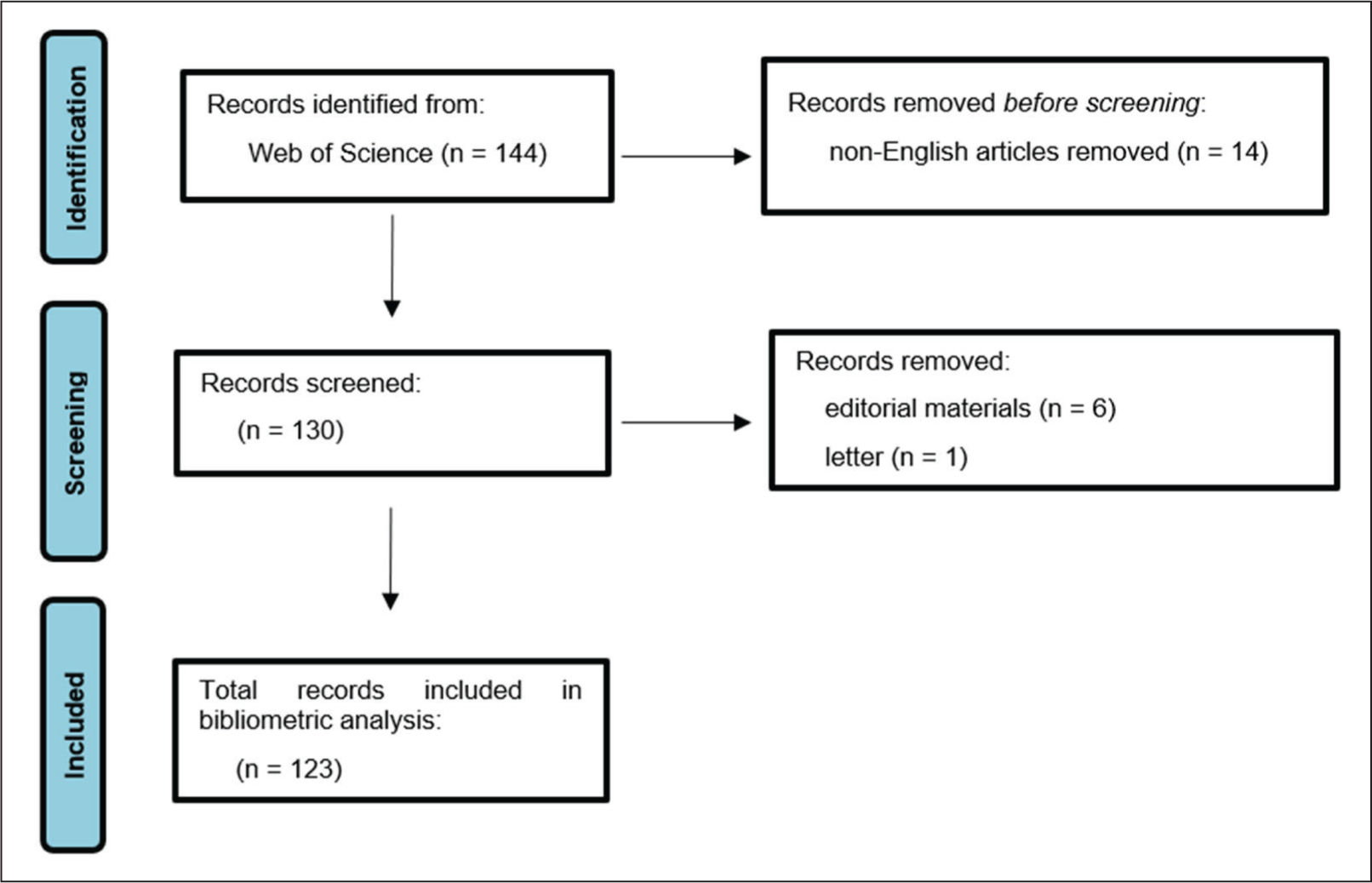
According to Singh et al. (2021), WoS contains top-level research work and is considered the most accurate. For this reason, we choose this database. During the searching process, we have adapted the PRISMA flow diagram by Page et al. (2021) to capture our decision on which references to include in the bibliometric analysis. Search query returned 144 records—130 in the English language. We excluded the editorial materials and letter (as shown in Figure 1). Overall, we used 123 records for bibliometric analysis.
PRISMA Diagram Based on Page et al. (2021).
For bibliometric analysis, we used RStudio, Biblioshiny app by Aria and Cuccurullo (2017). We used a technique from social network analysis to create co-occurrences networks. By applying a clustering algorithm and the Callon centrality method (Callon et al., 1991) on the author’s keyword co-occurrences networks, we highlighted the different themes and created a thematic map and network. To avoid bias, we merge synonyms and plurals of certain keywords (e-learning and e-learning environment; virtual world, virtual worlds and 3D virtual worlds; avatar and avatars). To avoid biased results, we did not include the keyword metaverse in the analysis. In the thematic map, the centrality shows the importance of the theme in the research field, density shows the theme’s expansion (Cobo et al., 2011). We can read the thematic map according to the quadrant in which the theme is placed: upper-right quadrant = motor themes; lower-right quadrant = basic themes; upper-left quadrant = highly developed and isolated themes (very specialized or niche themes); lower-left quadrant = emerging or declining themes (Aria & Cuccurullo, 2017; Pourkhani et al., 2019). In which quadrant a given cluster appears depends on its centrality and density—for example, clusters with high centrality and density (containing strong internal lines) are found in the motor theme quadrant. In contrast, clusters that have weak ties with other clusters, but strong internal ties appear in the upper left quadrant (Firdaniza et al., 2022). Each bubble in the thematic map represents a network cluster. The bubble size is proportional to the cluster word occurrences and the bubble name is the word with the highest occurrence value (Aria & Cuccurullo, 2017).
Results and Discussion
The search query identified 123 records in the WoS database. These records are articles, proceedings papers and reviews—in this study, we call all these formats papers. A total of 327 authors contributed to these papers. The dataset contains 34 single-authored papers, with an average of 2.93 authors per paper. The average paper receives 1.7 citations per year (overall, the average paper has 13.8 citations). Looking into the history and development, we find that the oldest paper in our dataset is a paper by Shi et al. (2004), which describes the development of technology for low-cost network immersive environments. However, the metaverse is an older concept. For the first time, this word was used in Neal Stephenson’s fiction novel Snow Crash (Stephenson, 1992). As Ning et al. (2021) mentioned, this concept has constantly been evolving since then. Thirty years later, the metaverse is ready to emerge as a new digital platform for business relationships (Wei & Zhang, 2022), or even as a tool to promote social good or healthcare (Duan et al., 2021; Wiederhold, 2022).
As shown in Figure 2, the number of papers in our dataset was constant except for 2010, 2011 and then the big boom in 2022. Till 2020, the Annual Growth Rate was 7.6%. But now, with the rapid increase in publications in 2021 and 2022, the annual growth rate for the analysed dataset is 25.73%. Focusing on the first increase of papers in our dataset (in 2010), we found that most papers were dedicated to the online multimedia platform Second Life (Ayiter, 2010; Getchell et al., 2010; Morie, 2010; Sharma et al., 2010). Another important milestone for the metaverse was the production of the prototype Oculus Rift by Palmer Luckey in 2010. We can see the second increase in publications in 2021 (13 publications) and 2022 (49 publications so far—calculated as data download date 27 June 2022). There are several reasons for the increase in the last two years. The first reason is the support of the metaverse by major organizations such as Meta Inc. (formerly named Facebook, Inc.) Microsoft or Nvidia. In March 2021, Nvidia released the key features of Omniverse—a platform for connecting 3D worlds into a shared virtual universe (Petrosyan & Aristova, 2022). In April 2021, Microsoft Mesh was introduced as a new MR platform primarily for enterprise use (Bian et al., 2022). In October 2021, Mark Zuckerberg launched Meta Inc. Zuckerberg also refers to the metaverse as the integrated environment that links all of Facebook product and services (Bian et al., 2022). A second reason for the rapid increase in publications is COVID-19. During the COVID-19, organizations were forced to immediately digitize the workplace and switch to the virtual environment (Meluso et al., 2020). As a result, organizations and employees alike became accustomed to new working environments and remote collaboration forms (Bailey & Breslin, 2020; Frost & Duan, 2020). Overall, all types of flexible forms of collaboration, such as remote working, working from home or digital nomadism, are taking on new dimensions (Meluso et al., 2020). For organizations, moving to a virtual environment can be a challenge. Organizations are therefore demanding solutions to transform the workplace into a virtual world. Researchers are responding to this unusually high demand by publishing the latest knowledge on remote collaboration, virtual teams, teleworking and working from home, as well as digital nomads and the metaverse.
Number of Publications in Time.
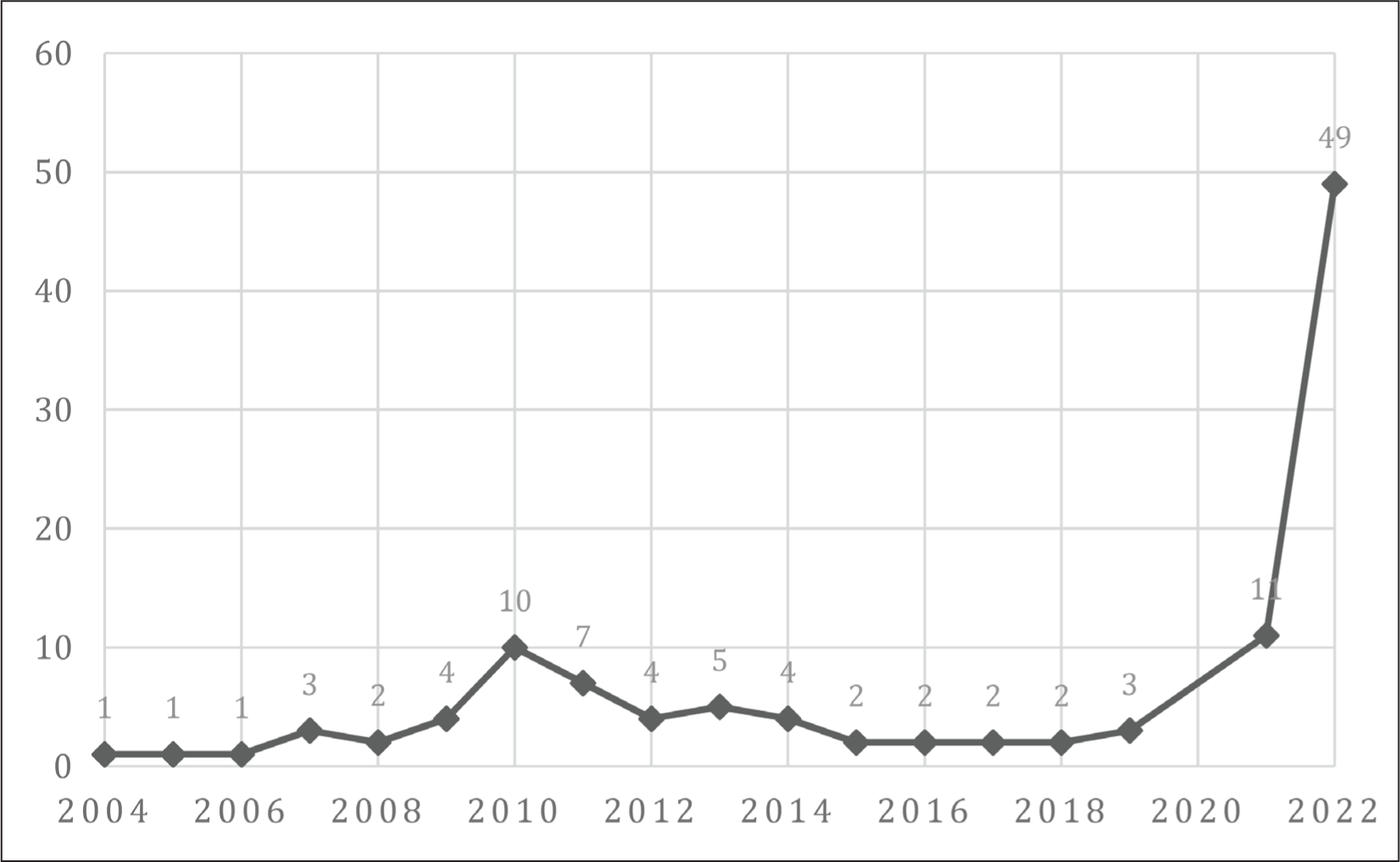
Zhang et al. (2022) conducted a bibliometric study on VR, AR and MR in surgical research, results showed a steady increase in publications. Further research also confirms the growing interest in VR, AR and MR (Kaplan et al., 2021; Morimoto et al., 2022). Those results are consistent with our results and confirm the growing interest in topics connected to the metaverse. Also, given that we downloaded the data mid-year, we can expect a further significant increase in publications dealing with the metaverse in the workplace. Future research should therefore explore the issue of the rapid increase in research on this topic in more depth.
Identification of Core Themes
The core themes of the metaverse research in the workplace are shown in Figure 3. As can be seen, the research of metaverse in the workplace is divided into six thematic clusters—avatar, computer graphics, immersion, industry 4.0, VR and virtual word. The position of each cluster (bubble) indicates its potential for future research (see Methodology).
Core Themes and its Potential: Thematic Map.
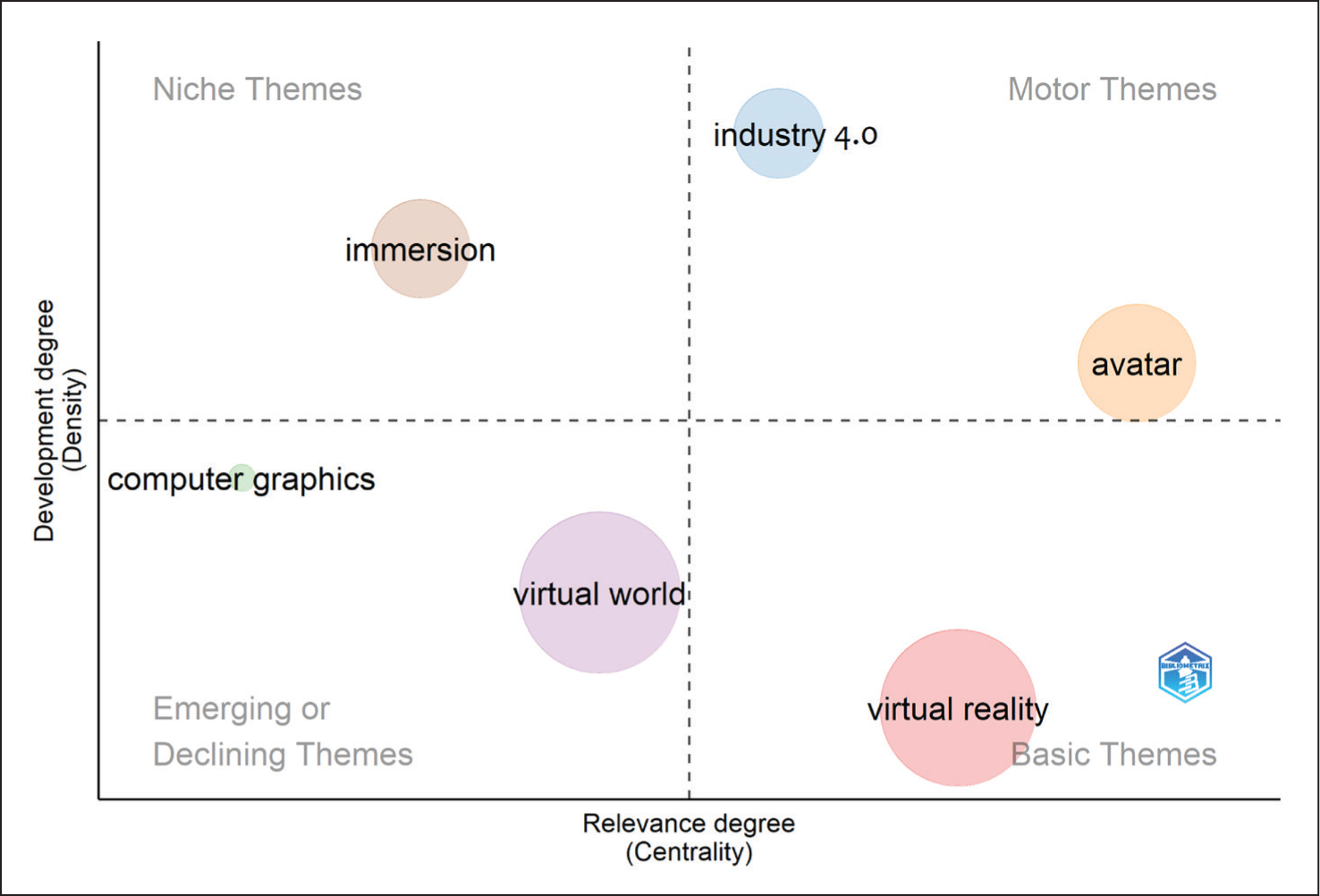
As seen in Figure 3, research connected with the keyword immersion is highly developed and isolated theme—so called niche theme, that have a great potential to become motor theme. The cluster of research related to ‘computer graphics’ is on the rise and heading towards becoming a niche theme. One of the most significant clusters is research on ‘virtual worlds’. Based on the location of the purple cluster in Figure 3, we can assume that many studies on virtual worlds have already been done and therefore this cluster is moving to declining themes. Therefore, researchers should focus on innovative ideas that they can bring to the factors addressed in this cluster. The clusters in the motor themes quadrant are research related to industry 4.0 or avatars. These are medium-sized clusters, which nevertheless generate the driving force for the entire metaverse research. Another major cluster is research related to ‘virtual reality’. The so-called basic themes form this red cluster, are the fundamental pillars of the metaverse research. Table 1 provides a statistical description of the individual clusters.
Cluster Information.

The results of our bibliometric analysis can be compared with papers published in the journal Psychosocial Issues in Human Resource Management (Volume 10 (1), 2022). The authors of these papers mainly analysed records from WoS, Scopus and ProQuest databases. The results of these analyses showed, for example, that virtual meetings, teamwork and workspaces can be improved by cognitive technologies such as motion and behavioural tracking, voice biometrics, and so on (Popescu Ljungholm, 2022). Bennet (2022) argued that workplace technology and immersive work environments can enhance the VR training experience. Zvarikova et al. (2022) analysed how immersive work environments support the productivity and performance of virtual teams. Hawkins (2022), in turn, analysed VR-based recruitment tools.
Avatar
The orange cluster connects the factors that shape the avatar. The orange cluster is between the motor and basic themes (as shown in Figure 3). The avatar is the central agent for the metaverse. As Davis et al. (2009) argue, avatars allow members of virtual teams to communicate face-to-face using 3D technologies to represent each member/s thoughts, values, objects or feelings. Park and Kim (2022) argue that the avatar in today’s metaverse represents the alter ego, the social role of the individual based on the individual’s perceptions in real life. Purdy (2022) takes the idea even further and says that in the future, in the metaverse, there will not be just lifelike employee avatars, but there will also be AI-created avatars which will make work easier for real employees. Al-Ghaili et al. (2022) state that avatars can play an important function, allowing co-workers to quickly and intuitively understand what a client or colleague needs to communicate, just like in real life.
The orange cluster also contains factors that influence virtual team members in the metaverse (and thus their avatars)—identity, play, autonomy and creativity. Team members may build trust and a sense of shared identity by working together over time, which improves their capacity to communicate and learn from each other (Kimble, 2011). For example, in virtual teams, identity plays a crucial part in communication; knowing someone’s identity is essential to building a shared understanding, which then contributes to establishing shared meanings by offering a common viewpoint (Kimble, 2011). Identity in the metaverse consists primarily of avatars through which team members communicate their opinions and thoughts (Davis et al., 2009; Park & Kim, 2022). Autonomy in virtual teams fosters higher trust and collaboration, encouraging team effectiveness and performance (Choi & Cho, 2019) and promoting individual satisfaction (Robert & You, 2018).
Another factor within the orange cluster is creativity. Various factors can influence team creativity not just on a personal level but also on team-related components such as emerging states and processes (Reiter-Palmon et al., 2021). Chavez-Aguayo (2009) argues that creating original content in the metaverse encourages creativity because it allows people to express themselves in original ways that enrich the content of virtual life. Torres-Coronas and Gascó-Hernández (2009) mention that creativity may help virtual teams work better; however, due to the lack of research in this area, there is still a challenge in reaching high levels of creative performance.
Part of the research in the orange cluster is also devoted to education and e-learning. As mentioned above (in the description of the red VR cluster), the metaverse is used in educational contexts (Abeles, 2007; Crespo et al., 2013; Cruz-Lara et al., 2011; Dahan et al., 2022; Kanematsu et al., 2014; Siyaev & Jo, 2021). Nevertheless, it is still unclear how the metaverse can be used to train employees in various areas of education.
Computer Graphics
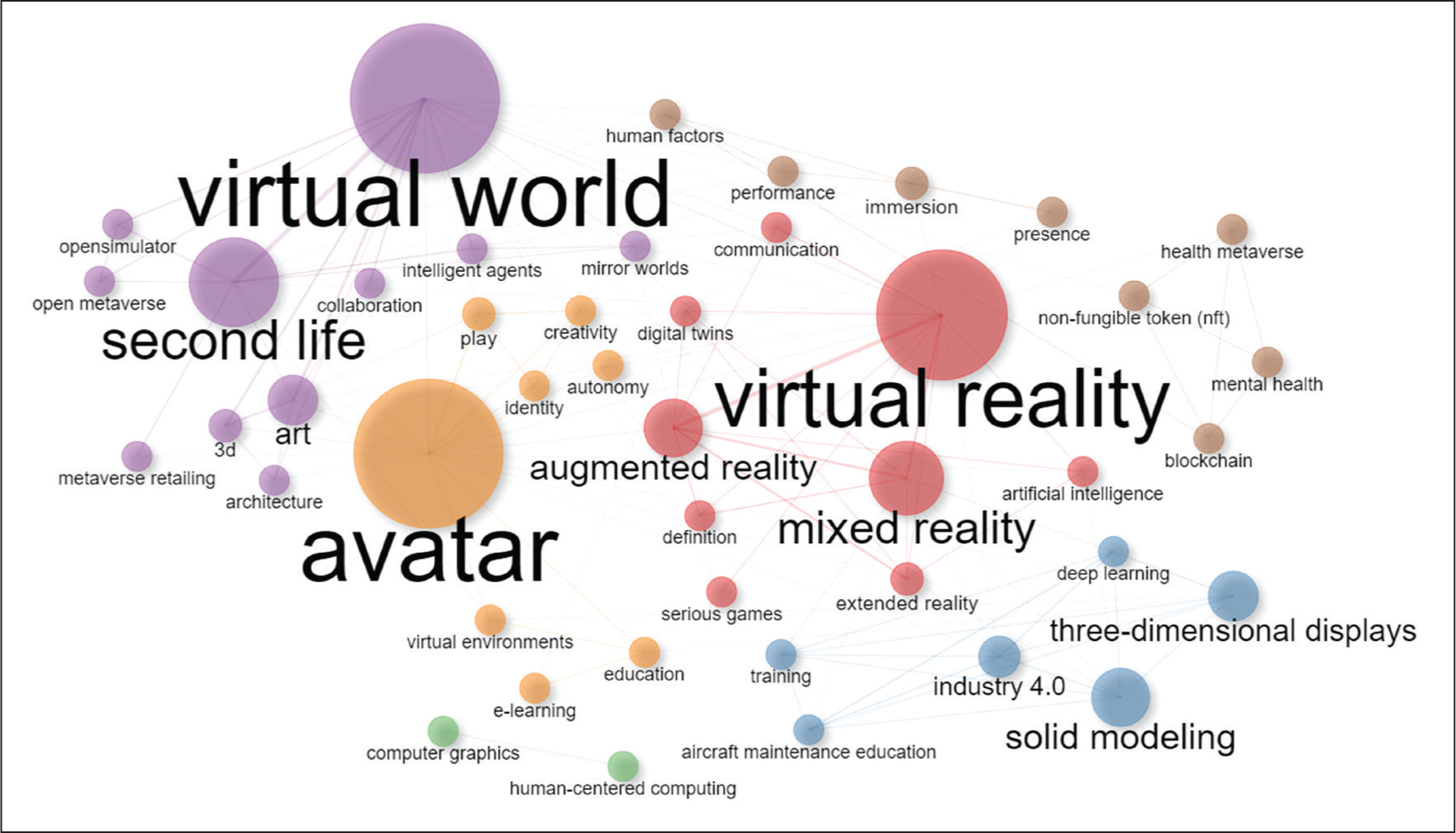
As argued by Zhao et al. (2022), computer graphics and hence the visualization of the metaverse is a very important factor that influences the visual construction of the metaverse and user-centric exploration. In addition to creating a virtual 3D world, the metaverse also includes the creation of holographs (Purdy, 2022); therefore, visualization and computer graphics are a crucial part of the metaverse. As seen in Figure 4, there is a small body of research on computer graphics and human-centred computing. The position of this cluster (Figure 3) suggests that computer graphics is an emerging theme in the metaverse.
Industry 4.0
The blue cluster comprises research that deals with industry 4.0. As can be seen from Figure 4, factors such as training, deep learning, three-dimensional display and solid modelling are associated with this theme. As we argued in the literature section, DT is a crucial driver in transforming the work environment. In today’s world, we need high levels of digital inclusion, and robust and resilient infrastructures to deliver optimized, automated and protective networks (Jacquenet, 2021), we need smart factories where automated processes will take place (Alpala et al., 2022; M. Kim et al., 2018) and we also need to incorporate elements of deep learning and AI to make employees’ jobs easier (Purdy, 2022). Industry 4.0 smart technologies are already standard in factories, and these technologies place significant demands on the knowledge of the workforce. At the same time, it is not yet clear how the elements of industry 4.0. should be integrated into the metaverse in the workplace. Another example of using a metaverse in the industry is the design and development of a serious game for a real industry partner that aims to simplify and provide complex information (Khan et al., 2022; Siyaev & Jo, 2021). As the position of the cluster in Figure 3 suggests, this is a motor theme, which has been the focus of several researchers. But as Park and Kim (2022) noticed, there is still a small body of literature focused on technology for the metaverse, thus there is still room for further research.
Immersion
Research from the brown cluster is concerned with the presence and immersion of participants in the metaverse—examines the impact of this immersion on the health and performance of metaverse participants. As mentioned in the literature review, the performance of virtual teams depends on many factors, such as autonomy (Choi & Cho, 2019), satisfaction, trust (Robert & You, 2018) and communication (Espevik et al., 2006; Kozlowski & Ilgen, 2006), team members’ perceptions of fairness and unity (Boroş et al., 2010), the social interactions between the team members (Horwitz et al., 2006) or positive atmosphere (Coppola et al., 2004). Our research suggests that there is a connection between immersion, presence and performance in the metaverse. However, the question remains how the immersive environment of the metaverse can be supported to enhance the performance of virtual teams. Health is addressed in the metaverse both in terms of physical health—for example, ergonomics of the working environment (Kačerová et al., 2022; Mcgill et al., 2020) and mental health (Ho et al., 2022). Mystakidis (2022) claims that the metaverse is facing several challenges such as the physical wellbeing of users, psychology (such as information overload). Regrettably, there is a great lack of research in the metaverse’s mental and physical health areas (as also suggested by the location of the cluster in the niche themes quadrant—see Figure 3). Therefore, future research should focus on emotional, psychological and social wellbeing as well as physical health in the metaverse workplace.
Virtual Reality
As you can see in Figure 3, the VR cluster is located in the basic themes area. We can conclude that the factors from this cluster are already explored to some extent and thus form the basis for further research. As can be seen in Figure 4, within that cluster, publications address the definitions and differences of extended, virtual, mixed and AR. The differences between these concepts is clear. As we stated in the literature review, XR can be seen as an umbrella term that includes AR, MR and VR (Kaplan et al., 2021; Milgram & Kishino, 1994; Morimoto et al., 2022; Mystakidis, 2022; Zhang et al., 2022). VR creates a fully immersive digital environment where the real world is completely blocked out (Kaplan et al., 2021). There are many examples of the use of VR—whether in the field of medicine (Moro et al., 2017), serious games (Bozanta et al., 2016), entertainment (Hartmann & Fox, 2021) or in the workplace (Bozanta et al., 2016; Hasler et al., 2009; Schouten et al., 2016; Tunk & Kumar, 2021). AR integrates digital elements into the real environment. Many researchers in various fields have studied the possibility of overlaying digital objects onto the real world—for example, in games (Rauschnabel et al., 2017), education (Lee, 2012) and healthcare (Moro et al., 2017). MR freely builds on and extends AR—MR allows digital elements to interact in the real world. Examples of the use of MR can be found in many fields—for example, to enhance museum experiences (Antlej et al., 2018), in education (Birt et al., 2018; Schaf et al., 2012; Weng et al., 2019), avatar immersion (Etienne et al., 2016) and medicine (Birt et al., 2018). Park and Kim (2022) argue there are three differences among metaverse, AR and VR. First, they highlight the social and sustainable overlap of the metaverse, second, the metaverse does not necessarily need to use AR and VR technologies, and third, the metaverse can accommodate a large number of people and thus enhance social relevance (Park & Kim, 2022). However, as can be seen in Figure 4, metaverse, AR, VR and XR are often associated and addressed with metaverse.
Network Analysis of Core Topics.
VR is also used in education—for example, using the serious game, which is in line with our results. As Mystakidis (2022) points out, the metaverse allows students to apply theoretical knowledge in a virtual environment, to experiment or learn from their mistakes, all in a safe virtual environment. The use of VR in the serious game is often seen in medicine. An example is the Virtual Emergency TeleMedicine game, which creates a safe and controlled environment with virtual patients for medical students (Nicolaidou et al., 2015). Creating a safe and controlled environment is the main advantage of connecting metaverses with serious game. These are benefits that offer teamwork improvement (Bozanta et al., 2016), enhancing collaborative learning (Vahdat et al., 2013) or even crisis management training (Loreto et al., 2013).
Another example is developing a serious game for a real industry partner that aims to simplify and provide complex information (Khan et al., 2022). Purdy (2022) stated that the metaverse can revolutionize workplace training and skill acquisition through gamification in the metaverse. Despite the fact that there are already pioneers in the application of serious games to VR and to metaverse in the workplace and in-team cooperation, this area is still very under-researched, and there is much room for future research—either in the integration of serious games or elements of gamification into the metaverse.
Within the red cluster, we can also see AI. Mozumder et al. (2022) argue that AI is one of the fundamental technologies of the metaverse. AI has been used in the metaverse, for example, to improve the teaching of football (Li et al., 2022), improve medicine (Tan et al., 2022) or study deep fake news (Neethirajan, 2021). Purdy (2022) talks about AI agents, digital colleagues, supervisors or assistants that could make the work of human workers easier in the future. However, research on the application of AI in the workplace metaverse is currently lacking. Therefore, this area opens great potential for both theoretical contributions and practical applications of AI to the working metaverse environment.
Virtual World
The research connected in the purple cluster deals with the theme of the virtual world. As can be seen in Figure 4, Second Life plays an important role in this cluster. Davis et al. (2009) claim that Second Life was the most visible platform of the metaverse. Several papers in our dataset deal with Second Life. Whether in terms of the demands that users have on it (Kumar et al., 2008), the study of communicative behaviour (Sharma et al., 2010), creativity and cultural production (Chavez-Aguayo, 2009), but also more technically based challenges such as the 3D representation of objects in the metaverse (Arroyo et al., 2009; Steurer, 2011). Salmasi and Gillam (2009) also point to the ethical dimension of Second Life and offer a framework for responsible gambling. Park and Kim (2022) argue that the metaverse and its focus on Second Life is not an appropriate platform for the current Generation Z, and therefore new platforms and ideas for the metaverse are necessary. In Second Life, researchers also investigated how individuals and organizations functioned in marketing products and services—metaverse retailing (see Figure 4). For example, Bourlakis et al. (2009) studied what challenges and opportunities the metaverse offers in retailing. Hassouneh and Brengman (2015) consider metaverse retailing as an evolution of conventional e-commerce, that offers customers benefits and a better shopping experience. Gadalla et al. (2013) offer a framework for retail in metaverse. However, there is a lack of recent studies to investigate how major organizations such as Meta Inc., Nvidia or perhaps Microsoft behave in the retail metaverse.
Another factor that the purple cluster contains is collaboration in virtual worlds, hence in the metaverse. Metaverse enables employees to communicate more effectively, primarily because the experience is more authentic, cohesive and interactive in the metaverse than in a traditional virtual environment (Purdy, 2022). As we stated in the literature, collaboration is crucial in the virtual workplace (Purvanova, 2014). Metaverse also allows to take collaboration to a higher level by encouraging networking, informal and spontaneous conversation, and overall supports the social aspect of teamwork (Purdy, 2022). However, it remains unclear how collaboration in the metaverse can be improved to achieve even higher performance of virtual teams.
Metaverse allows the creation of new worlds. This is inextricably linked to creativity, aesthetics and overall, it is a form of art. This is also why the word ‘art’ can be seen in the purple cluster. Morie (2010), for example, deals with aesthetic expression in Second Life and presents the possibilities of new forms of art in virtual worlds. Tasa and Gorgulu (2010), in turn, describe the historical development of the metaverse and the dynamic and transformative relationship between art and ICTs. They introduce a new concept of ‘meta-art’ that transforms the viewer into a participant, user, and even creator of artworks and content on the web. Chavez-Aguayo (2009) even suggests that the metaverse contributes to the democratization of culture, art and education by bringing creation closer to consumers and thus breaking down social, economic and political barriers. According to Morie (2010), the metaverse certainly brings a new dimension to art as well. However, from the perspective of this study’s focus, it is unclear how art in the metaverse affects the work environment and, consequently, employee satisfaction in the metaverse work environment. This lack of knowledge requires further research.
Towards the Definition of Metaverse as the Future of the Virtual Workplace
As we mentioned in the Introduction, there are several definitions of metaverse per se, but there is no definition for the use in the workplace. Based on the bibliometric analysis, we have identified six core themes that serve as the basis for the conceptual framework (avatar, computer graphics, industry 4.0, immersion, VR and virtual world). We applied the findings from the bibliometric analysis to the framework for Workplace Digital Transformation by Trenerry et al. (2021) and developed a theoretical conceptual framework towards the definition of a metaverse in the workplace (Figure 5). Similar to Trenerry et al. (2021), we suggest three levels of factors, that are important for practical applications of metaverse in the workplace.
Theoretical Conceptual Framework: Metaverse in the Workplace.
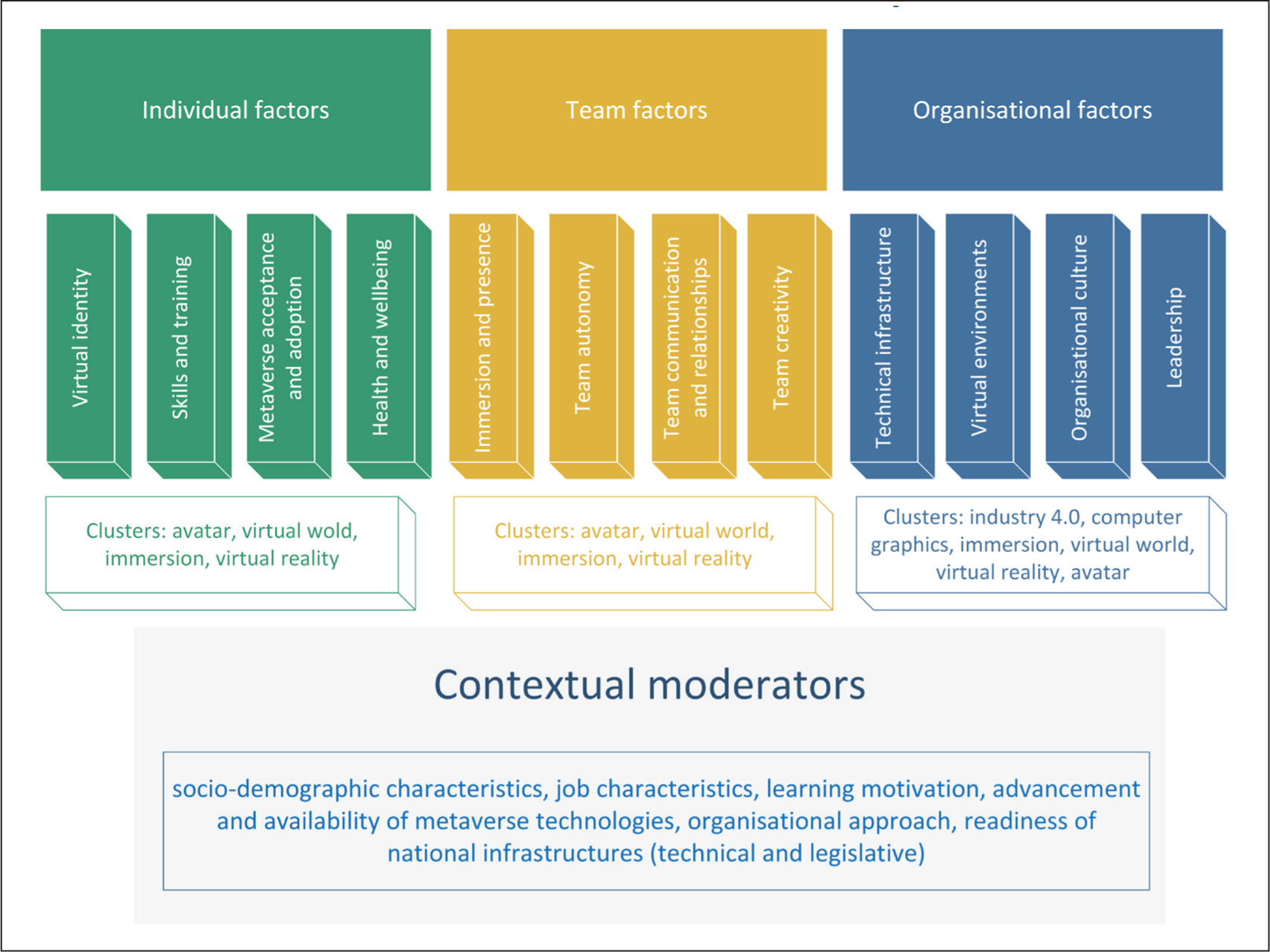
At the level of individual factors, we emphasize the importance of virtual identity in the metaverse. Furthermore, specific skills and training are necessary to empower employees to work in the metaverse. Equally important is the acceptance and adaptation to the metaverse environment. Finally, it is essential to consider employees’ health and wellbeing. At the level of team factors, we theorized that critical factors are immersion and presence in the metaverse, team autonomy, communication, creativity and relationships. At the organizational level, we suggest creating a robust technical infrastructure, a virtual environment and supporting an open corporate culture. Last but not least, a proper approach of the organization’s leadership in a metaverse environment is also essential.
As stated by Trenerry et al. (2021), it is important to note that the outcomes of any digital transformation are influenced by several personal, contextual and cultural moderators that should be considered when adopting digital transformation. Therefore, in our theoretical conceptual framework, we add contextual moderators that influence metaverse implementation in the workplace.
Based on the definitions of metaverse (see Introduction), on the results of the bibliometric analysis and the theoretical conceptual framework mentioned above, we proposed a definition of a metaverse in the workplace. The workplace metaverse can be understood as a 3D virtual immersive environment where employees interact with each other using their avatar identities, perform work tasks, and have autonomy and opportunities for creativity.
Looking Ahead: Limitation and Future Research Directions
Our study has some limitations and areas for future research that could extend the findings and contribute to a deeper understanding of metaverse application in the workplace. First of all, the study focuses on a very small area of the metaverse, which is related only to the workplace (see the search query in the Methodology section). Another limitation is based on the bibliometric method used. For example, we used only papers indexed in WoS. We based the analysis of core themes on the authors’ keywords. Our study offers a conceptual theoretical framework and a definition of metaverse in the workplace. But it does not offer a practical perspective of the impact of the metaverse on employee behaviour, attitudes and outcomes, which could be addressed in future research.
Researchers should focus on innovative ideas that they can bring to the factors identified in our study. While our study identified some factors that influence creativity in the metaverse, more research is needed to explore how these factors can be leveraged to enhance creativity and innovation in the metaverse workplace. Also, it is not clear how the metaverse can be used in staff training in different areas of education (including serious game and gamification). Such research could investigate the effectiveness of these approaches in enhancing employee learning, engagement and performance. Furthermore, a relatively small body of literature deals with technologies in the metaverse workplace (3D work environments, use of AI and retail). Further research could explore the potential of these technologies in improving collaboration and productivity in metaverse workplace. Another area for future research are immersive environments, which according to our study has a connection to performance and collaboration in the metaverse. Research in this area could examine how immersive environments can be designed and implemented to facilitate collaboration and promote positive outcomes in the metaverse workplace. The question also remains how the workplace metaverse affects emotional, psychological and physical health as well as wellbeing and what organizations can do to improve these factors. An equally interesting area for future research is how art in the metaverse affects the work environment and, consequently, employee satisfaction in the metaverse work environment.
Despite the aforementioned limitations, our study has several practical and theoretical implications for applying metaverse in the workplace. From a practical perspective, our findings suggest that organizations can use metaverse to enhance collaboration and creativity. This could lead to increased productivity and employee satisfaction in the workplace. Our study also identified areas where organizations can focus their efforts, such as employee training use of immersive environments and avatars. On a theoretical level, our study contributes by providing a comprehensive analysis of research on metaverse in the workplace. The core themes we identify can serve as a foundation for future research in this area. Moreover, our proposed conceptual framework towards defining metaverse in the workplace can guide researchers and practitioners in their efforts to understand and implement this technology. Overall, our study highlights the potential of a metaverse in the workplace and provides valuable insights for researchers and practitioners.
Conclusion
Since the early 1990s, we have seen a continuing transformation of the work environment. One of the newest workplace innovation types is becoming a metaverse. This study aims to study how metaverse can enhance collaboration in virtual teams by identifying core research themes, describing their role in transforming the virtual workplace, and proposing a conceptual framework for defining metaverse in the workplace. The results showed a dramatic increase in researchers’ interest in metaverse issues in the workplace in the last two years (2021 and 2022). On the basis of the results from the bibliometric study, we identify core research themes on metaverse in the workplace—avatar, computer graphics, immersion, virtual world and VR. Further, we developed a theoretical, conceptual framework towards the definition of a metaverse in the workplace. We suggest three levels of factors that are important for practical applications of a metaverse in the workplace—individual factors, team factors and organizational factors. Further, we suggest contextual moderators that influence the implementation of a metaverse in the workplace. Finally, we proposed a definition of a metaverse in the workplace as a 3D virtual immersive environment where employees interact with each other using their avatar identities, perform work tasks, and have autonomy and opportunities for creativity. Overall, this study provides valuable insights into the practical and theoretical implications of using a metaverse in the workplace. By identifying core themes and developing a theoretical and conceptual framework, this study offers a foundation for future research and practical applications of this technology.
Footnotes
Declaration of Conflicting Interests
The authors declared no potential conflicts of interest concerning this article’s research, authorship or publication.
Funding
This study was created with the support of the Project No. 70/2021, Meta-analysis of Factors Affecting Virtual Team Effectiveness, from the OP RDE project Improvement in Quality of the Internal Grant Scheme at CZU, reg. no. CZ.02.2.69/0.0/0.0/ 19_073/0016944.